Prepositions of Support and Opposition: for, against, in favor of

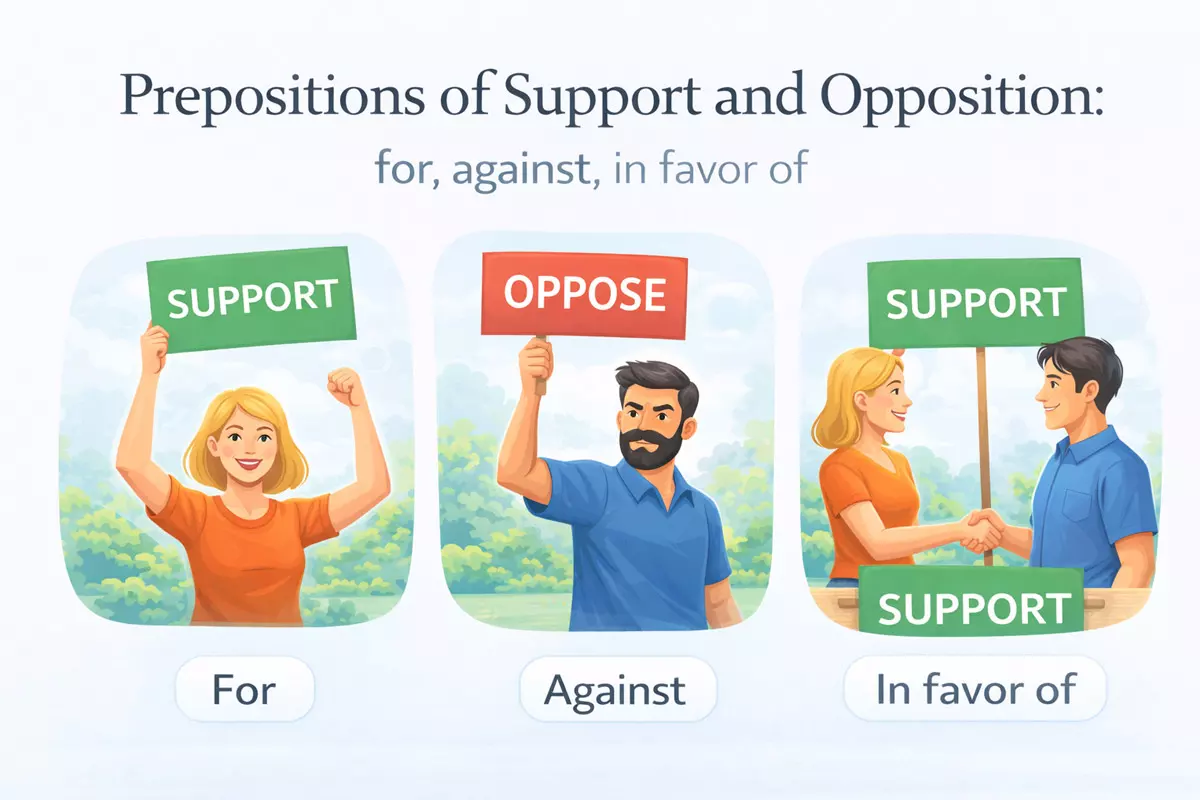 This article explains how for shows support and agreement, while against signals opposition or criticism. It covers the formal phrase in favor of, usage with people, ideas, and plans, and provides examples and practice.
Expressing support or disagreement with an idea requires careful word choice, as language provides us with nuanced ways to clarify our position. By selecting terms that clearly indicate whether we agree or challenge a viewpoint, we can communicate our perspectives more effectively and avoid misunderstandings. This skill not only enhances our ability to participate in discussions but also helps us present our opinions with greater confidence and clarity, ensuring that our intended message is accurately conveyed to others.
How for shows support and agreement
When someone uses the preposition for in a discussion or argument, they are usually signaling their approval, endorsement, or backing of an idea, proposal, or person. This little word helps us express that we are in favor of something, whether it's a decision at work, a new law, or even a favorite team. The use of for is direct and clear, making it easy to show alignment in both formal and informal situations.
Common contexts for expressing agreement
People rely on for to indicate support in a variety of scenarios. Here are some typical situations:
- Backing a suggestion: "I'm for trying the new schedule."
- Supporting a candidate: "Are you for or against her in the election?"
- Agreeing with a proposal: "Most of the group is for the new policy."
- Showing preference: "Which option are you for?"
- Expressing approval: "He spoke for the motion."
Typical expressions and patterns

Here are some common ways for appears in speech and writing to express support or agreement:
- I'm for it.
- We're for making a change.
- They voted for the proposal.
- She argued for better working conditions.
- He is for the idea.
- Who is for more discussion?
- The town is largely for the development.
- Are you for or against it?
- The committee was for approval.
- All members are for the change.
- I am for moving forward.
- She spoke for the plan.
- Most students are for the new rule.
- We stand for equality.
- He is for this approach.
- They campaigned for cleaner streets.
Nuances of meaning
Choosing for rather than another preposition like with or in support of often makes the statement more active and direct. It signals not just agreement, but sometimes advocacy or active participation. For instance, saying "I am for this plan" is more decisive than "I support this plan," and less formal than "I am in favor of this plan."
Comparing support and opposition
To better understand how for contrasts with expressions of opposition, see the structured comparison below:
| Support (for) | Opposition (against) |
|---|---|
| I am for the idea. | I am against the idea. |
| They voted for the plan. | They voted against the plan. |
| Who is for this proposal? | Who is against this proposal? |
| The group is for the changes. | The group is against the changes. |
Using for is a straightforward way to show where you stand. It’s a key part of expressing agreement, supporting arguments, and making your position clear in English conversations and writing.
How against marks opposition and criticism
The preposition against is a key marker for signaling resistance, disagreement, or negative stance in English. When someone is against something, they are not just neutral or indifferent—they actively oppose, criticize, or resist it. This word often appears in discussions, debates, and arguments to highlight differing points of view or outright objections.
Common uses of "against" to express opposition
- Disagreeing with an idea: "She spoke against the proposal."
- Objecting to a plan or action: "Many people are against raising taxes."
- Resisting a rule or authority: "He protested against the new law."
- Criticizing behavior: "They warned against careless driving."
- Taking a stand in a debate: "The committee voted against the motion."
- Expressing moral or ethical opposition: "She is against animal testing."
- Formally rejecting: "The board ruled against the appeal."
- Warning about potential dangers: "Experts caution against overuse."
- Describing competition: "It’s team A against team B."
- Highlighting contrast: "His opinion is against popular belief."
- Legal contexts: "A case against the defendant."
- Personal disagreements: "I’m not against you, just your idea."
- Social or political stances: "The group campaigned against pollution."
- Scientific skepticism: "Evidence against the hypothesis."
- Opposing with action: "They voted against the amendment."
Patterns and structures with "against"
"Against" is commonly followed by nouns, gerunds (verbs ending in -ing), or pronouns. This makes it flexible for expressing both general and specific forms of opposition.
- Against + noun: "against the plan"
- Against + gerund: "against smoking"
- Against + pronoun: "against him"
Comparison: "against" vs. other prepositions of opposition
| Preposition | Usage Example | Typical Context |
|---|---|---|
| against | They argued against the changes. | Direct opposition, criticism, resistance |
| versus (vs.) | It’s science versus superstition. | Competition, comparison, contrast |
| contrary to | Contrary to expectations, he succeeded. | Unexpected contrast, mild opposition |
| in opposition to | The party stood in opposition to the policy. | Formal, political, or group opposition |
Key points to remember
- Using "against" emphasizes an active or explicit disagreement.
- It can range from personal to formal, legal, or institutional contexts.
- In criticism, "against" often introduces arguments, warnings, or objections.
Understanding how "against" frames opposition helps in both expressing and interpreting criticism clearly in English communication.
Formal phrase in favor of in debates and writing
Choosing the right expression to show support for an idea is important, especially in structured discussions or academic writing. In formal contexts, certain phrases carry more weight and clarity than casual alternatives. Using precise language helps convey your position and strengthens your argument.
Common Formal Expressions of Support
When presenting an argument or endorsing a proposal, consider these formal phrases:
- In favor of (e.g., "I am in favor of the proposed amendment.")
- In support of (e.g., "She spoke in support of the new policy.")
- Advocate for (e.g., "They advocate for increased funding.")
- Endorse (e.g., "We endorse the candidate's platform.")
- Approve of (e.g., "The committee approves of this measure.")
- Uphold (e.g., "I uphold the principle of equality.")
- Back (e.g., "The organization backs the initiative.")
- Support (e.g., "He supports the motion.")
- Be a proponent of (e.g., "She is a proponent of renewable energy.")
- Stand behind (e.g., "They stand behind the proposed changes.")
- Express approval for (e.g., "We express approval for the plan.")
- Be in agreement with (e.g., "He is in agreement with the recommendations.")
- Favor (e.g., "Many favor the new approach.")
- Champion (e.g., "She champions the rights of workers.")
- Promote (e.g., "They promote collaboration.")
- Be inclined to support (e.g., "I am inclined to support this proposal.")
- Give one’s backing to (e.g., "The board gave its backing to the reform.")
- Side with (e.g., "He sided with the majority opinion.")
Usage Tips
In debates and formal writing, these expressions are typically followed by the policy, proposal, or idea being discussed. For clarity, avoid vague references and state explicitly what you support. Using these structures ensures your stance is both clear and professional.
Comparing "For" and More Formal Alternatives
"For" is direct but often less formal than other options. In academic or official contexts, alternatives like "in favor of" or "endorse" are preferred for their specificity and tone.
| Phrase | Example Sentence |
|---|---|
| In favor of | The committee is in favor of the new regulations. |
| Support | Many citizens support the proposed changes. |
| Advocate for | The expert advocates for sustainable policies. |
| Endorse | We endorse the recommendations of the panel. |
| Be a proponent of | She is a proponent of stricter safety laws. |
| Back | The organization backs the environmental initiative. |
| Uphold | They uphold the principle of transparency. |
| Stand behind | We stand behind this decision. |
Using such formal alternatives enhances your credibility and ensures your viewpoint is communicated respectfully and clearly in any debate or written discussion.
Using these prepositions with people, ideas and plans
When expressing support or opposition, it’s important to know how prepositions like for, against, and in favor of attach to different nouns—whether you’re discussing individuals, concepts, or proposals. These prepositions help clarify your stance and can shape the tone of your message, especially in group discussions, debates, or formal writing.
Supporting or Opposing People
Use these prepositions to show alignment or disagreement with a person or group. For example:
- Are you for the new manager?
- She spoke against the candidate.
- We are in favor of Dr. Lee for the position.
Notice that in favor of is typically followed by the person’s name or title, while for and against are more flexible.
Applying Prepositions to Ideas and Plans
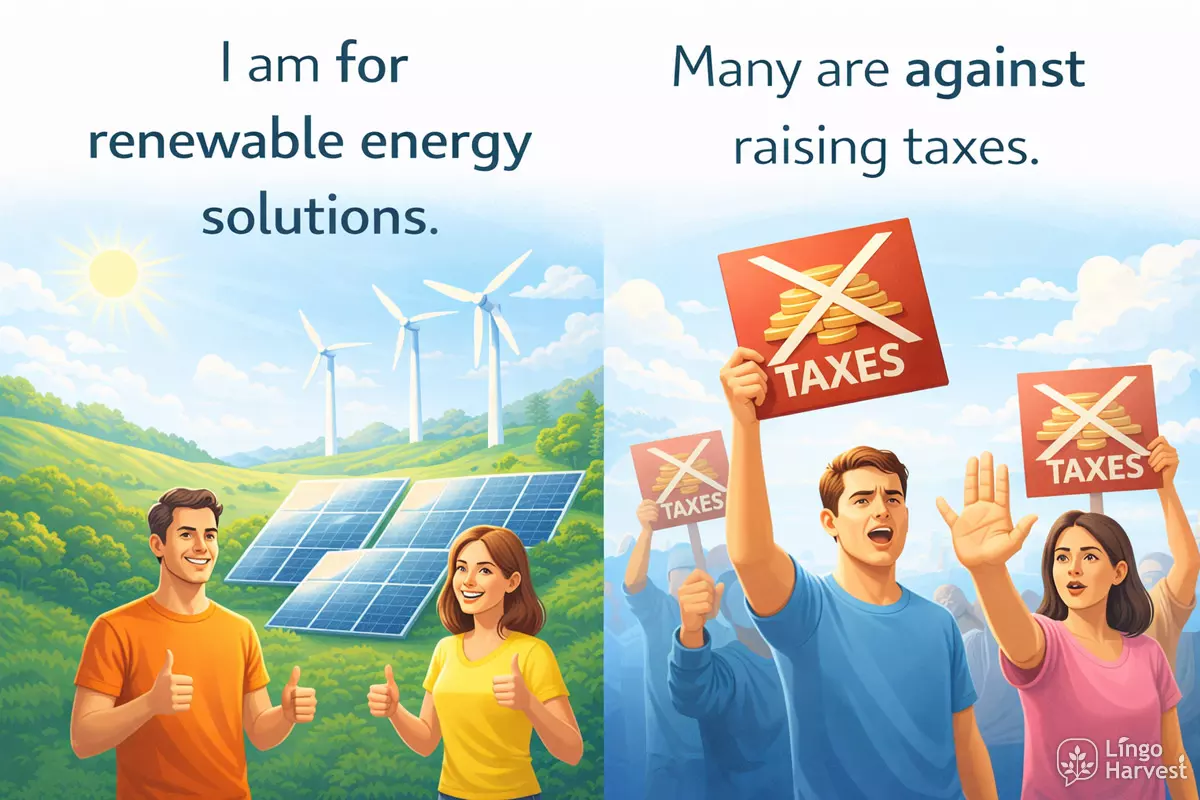
When discussing projects, beliefs, or strategies, these prepositions clarify your viewpoint:
- I am for renewable energy solutions.
- Many are against raising taxes.
- She argued in favor of a four-day workweek.
- The group voted against the proposal.
- They are in favor of stricter regulations.
Common Patterns and Examples
Here’s a broader set of usage patterns to illustrate how these prepositions work in context:
- He’s for lowering tuition fees.
- They’re against the merger.
- We’re in favor of simplifying the process.
- The committee is for more transparency.
- Local residents are against the new highway.
- She’s in favor of more flexible hours.
- The team is for adopting new technology.
- He voted against the amendments.
- They argued in favor of the alternative plan.
- Parents are for healthier school lunches.
- We’re against cutting the arts budget.
- She’s in favor of expanding the program.
Comparing Prepositions: Typical Structures
| Preposition | Common Structure |
|---|---|
| for | for + noun/pronoun/gerund (e.g., "for the team", "for reducing waste") |
| against | against + noun/pronoun/gerund (e.g., "against the plan", "against raising prices") |
| in favor of | in favor of + noun/pronoun/gerund (e.g., "in favor of the proposal", "in favor of keeping it open") |
When choosing the right preposition, consider whether you’re referring to a person, a concrete plan, or an abstract idea. This helps you communicate your position clearly and appropriately in any discussion.
Examples from discussions, articles and surveys
Real-life usage of prepositions such as for, against, and in favor of often appears in debates, opinion pieces, and survey responses. These expressions make it clear whether someone supports or opposes a particular idea, proposal, or action. Below are some typical contexts and sentence structures found in both informal conversations and formal writing.
Common Phrases Indicating Support or Opposition
- She voted for the new policy.
- Many are against raising taxes.
- He spoke in favor of renewable energy.
- The committee is for implementing stricter rules.
- Several members argued against the proposal.
- The survey showed 60% were in favor of the change.
- I’m for more flexible working hours.
- Are you against this decision?
- The article was in favor of free education.
- He is for lowering the voting age.
- Parents are divided for and against school uniforms.
- The panel voted against the motion.
- She made a case in favor of remote learning.
- A majority is for stricter environmental laws.
- Public opinion is shifting against single-use plastics.
- They rallied in favor of animal rights.
- Local residents are largely for the new park.
- Experts warn against overreliance on technology.
Patterns in Surveys and Debates
When summarizing group opinions or survey results, writers and speakers often use these prepositions to present contrasting viewpoints clearly. Below is a structured comparison of how these words function in different contexts:
| Preposition | Example in Context |
|---|---|
| for | 62% of respondents are for expanding public transport. |
| against | One-third of participants were against the new regulations. |
| in favor of | The editorial board wrote in favor of tax reform. |
| against | Debate teams presented arguments against the motion. |
| for | Public forums heard voices for and against the project. |
These examples demonstrate how prepositions of support and opposition are used not only to express personal opinions, but also to summarize group attitudes in a clear and concise way. Whether in academic articles, online forums, or opinion surveys, these patterns help signal the stance being taken and clarify the direction of the argument.
Practice: write short opinions using support and opposition words
Expressing your viewpoint clearly often means using the right prepositions to show support or disagreement. Here, we’ll focus on using for, against, and in favor of in short opinion statements. Practicing these structures will help you communicate your stance more effectively in discussions or writing.
Sample Opinion Starters
- I am for increasing the minimum wage because it helps low-income workers.
- She is against extending school hours since students need time to relax.
- We are in favor of recycling programs to reduce waste.
- They are against building a new highway due to environmental concerns.
- He is for remote work as it saves commuting time.
- Many people are in favor of stricter pollution laws.
- I am against banning smartphones in schools because they are useful learning tools.
- She is for free public transport to cut down on traffic.
- We are against increasing taxes without clear benefits.
- They are in favor of allowing pets in the workplace.
- He is against homework on weekends.
- I am for flexible working hours to improve work-life balance.
Practice: Write Your Own Short Opinions
- Write a sentence that shows you support banning plastic bags.
- Write a sentence that opposes increasing university fees.
- Write a sentence in favor of more public parks in cities.
- Write a sentence against using animals for entertainment.
- Write a sentence in favor of stricter rules on air pollution.
- Write a sentence against texting while driving.
- Write a sentence in favor of free public libraries.
- Write a sentence against wasting food.
- Write a sentence in favor of renewable energy.
- Write a sentence against bullying in schools.
Show answers
- I am for banning plastic bags because it protects the environment.
- I am against increasing university fees as it makes education less accessible.
- I am in favor of more public parks in cities to provide green spaces for everyone.
- I am against using animals for entertainment because it is often cruel.
- I am in favor of stricter rules on air pollution to improve public health.
- I am against texting while driving because it puts lives at risk.
- I am in favor of free public libraries because they make knowledge accessible to everyone.
- I am against wasting food because it harms both people and the planet.
- I am in favor of renewable energy because it reduces carbon emissions.
- I am against bullying in schools because it can seriously damage mental health.
Common Patterns for Support and Opposition
- be for + noun/gerund
- be against + noun/gerund
- be in favor of + noun/gerund
Use these patterns to build clear, concise opinions. Practicing these expressions will help you participate confidently in debates and written arguments.