Prepositions with Measures and Rates: at 50 km/h, by 10%, per Day

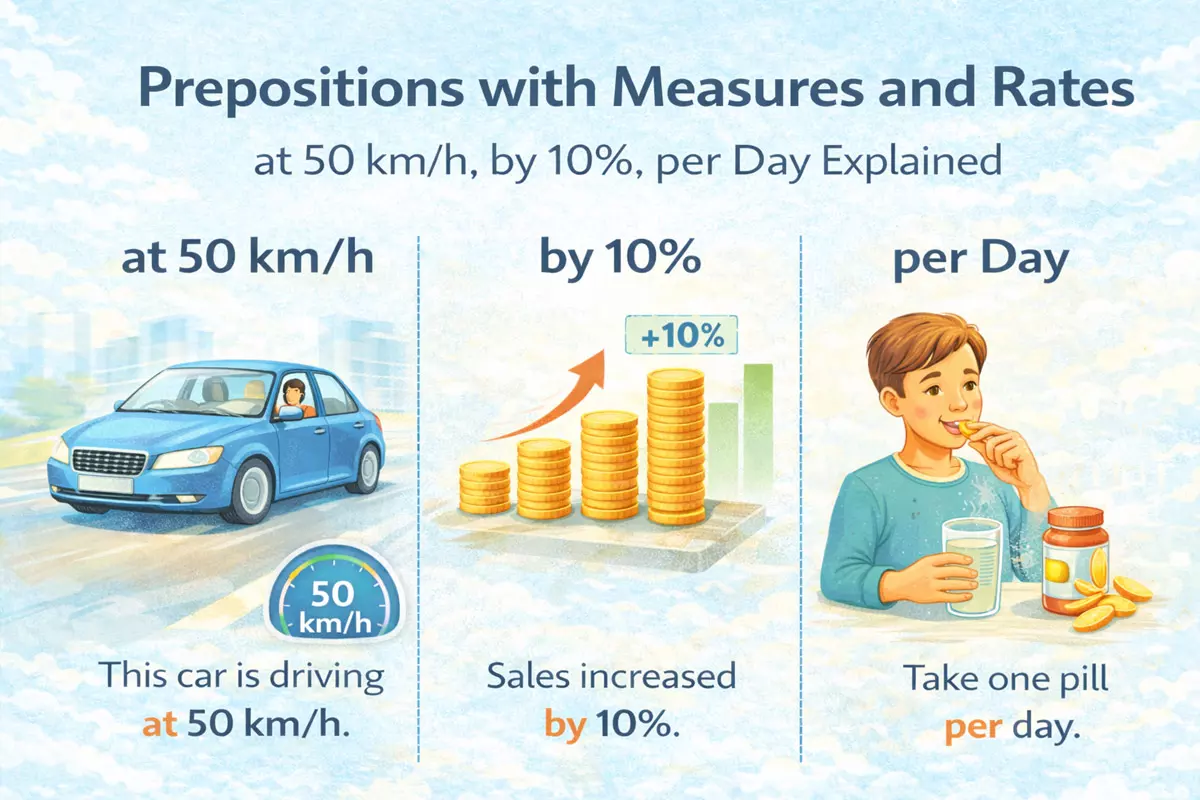 The article explains how to use at for speeds and rates, by for expressing percentage changes, and per for frequency and distribution. It covers combining these with time or quantity, gives km/h and mph examples, and includes sentence practice.
Learning to use prepositions correctly with quantities, percentages, and speeds is essential for clear and precise English communication. For example, we say at 60 miles an hour when describing speed, or an increase of ten percent when discussing changes. Using the right preposition ensures your meaning is understood and helps you express information accurately, whether you are talking about measurements, statistics, or changes in prices. Mastering these details will make your English more effective and professional.
Patterns for speed and movement rates with at
When talking about speed, rates, or movement, the preposition at is commonly used to express a specific rate or value. This construction helps clarify exactly how fast something is moving or at what rate an action occurs. It is particularly frequent in scientific, technical, and everyday contexts where precision matters.
Common phrases and structures using at for rates and speeds
- at 50 km/h – The car was traveling at 50 kilometers per hour.
- at a speed of – The train moves at a speed of 300 km/h.
- at full speed – The runner sprinted at full speed.
- at a rate of – The machine operates at a rate of 100 units per hour.
- at 70 miles per hour – The wind blew at 70 mph last night.
- at a pace of – He walks at a pace of 5 kilometers an hour.
- at a frequency of – The device vibrates at a frequency of 60 Hz.
- at maximum velocity – The rocket reached at maximum velocity during launch.
- at a temperature of – The reaction occurs at a temperature of 100°C.
- at 10 degrees per minute – The oven heats up at 10 degrees per minute.
- at 5 meters per second – The river flows at 5 m/s here.
- at a growth rate of – The company is expanding at a growth rate of 8% per year.
- at high speed – The data was transmitted at high speed.
- at a rate of knots – The ship sailed at a rate of 30 knots.
- at a rate of one per minute – The sensor triggers at a rate of one per minute.
- at a constant rate – The medication is administered at a constant rate.
How "at" differs from other prepositions for measures
At is used when you want to specify the exact speed or rate. In contrast, by indicates a change or amount of difference, and per is used to describe frequency or distribution. Here is a comparison:
| Preposition | Example & Usage |
|---|---|
| at | at 60 km/h (specific speed or rate) |
| by | by 10% (amount of change: "increased by 10%") |
| per | per day (frequency: "twice per day") |
| in | in 10 minutes (duration: "finished in 10 minutes") |
Summary of usage
Use at to indicate an exact speed, rate, or level. It helps to give precise information about how quickly or at what level something happens. These patterns are essential for clarity, especially in technical writing or when small differences in rates or speeds can be significant.
Expressing percentage change with by
When talking about how much something increases or decreases, English commonly uses the preposition by to show the amount of change, especially with percentages. This structure is used to clarify the difference between the original and new value, not the final result itself. For example, saying "Sales increased by 10%" means there was a 10% rise compared to the previous value.
How to use "by" with percentage changes
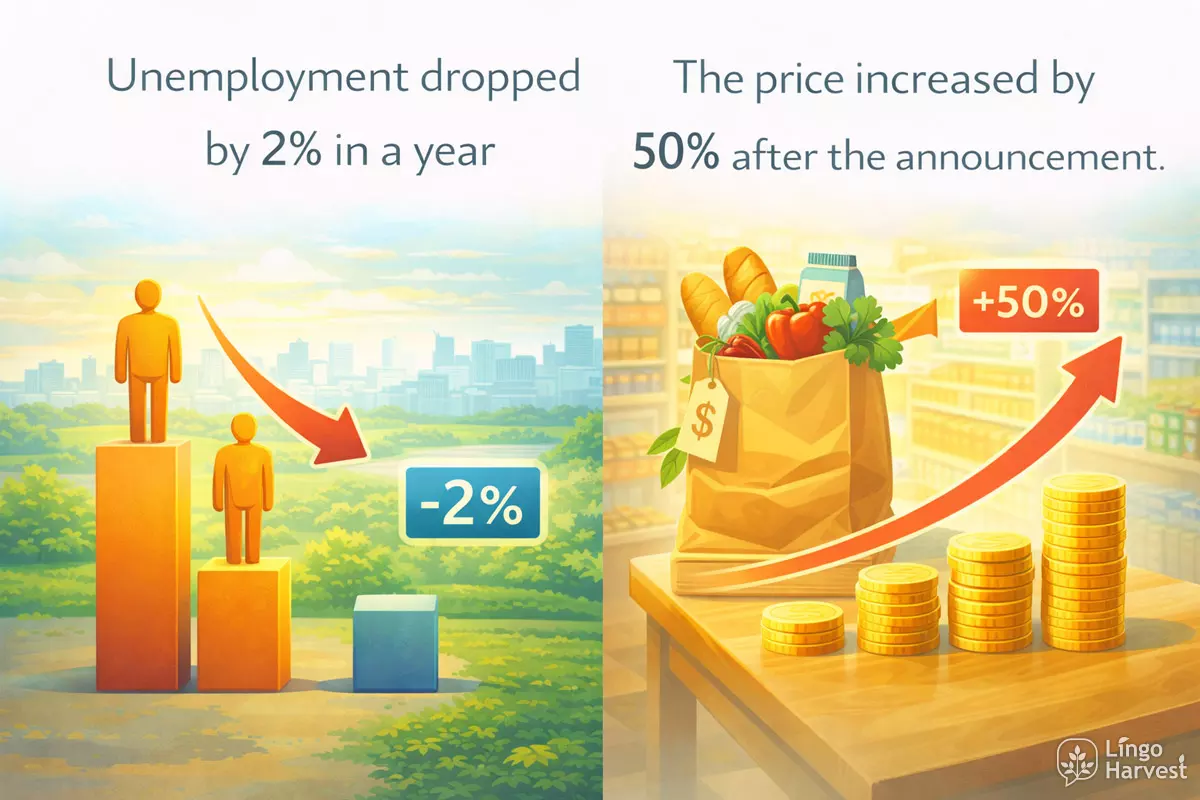
Use by when specifying the amount of growth, reduction, or difference. The pattern is typically: verb of change + by + amount/percentage. This is different from using to, which shows the end point, or from, which introduces the starting value.
- Profits rose by 15% last quarter.
- Unemployment dropped by 2% in a year.
- The price increased by 50% after the announcement.
- Attendance fell by 30% during the winter.
- Costs were reduced by 5% through efficiency.
- Our energy use decreased by 12% this month.
- Membership grew by 20% over the summer.
- The error rate improved by 8% after training.
- Revenue shrank by 25% during the crisis.
- She increased her speed by 10% in the last lap.
- Water consumption was cut by 18% last year.
- Production dropped by 40% due to supply issues.
- Demand rose by 7% in April.
- Staffing was reduced by 13% after automation.
- Exports grew by 11% in the first quarter.
Comparison with other prepositions
It’s easy to confuse by with other prepositions like to or from when talking about figures. The table below summarizes the differences:
| Preposition | Usage Example | Function |
|---|---|---|
| by | Sales rose by 10% | Shows the amount of change |
| to | Sales rose to 110% of last year | Shows the new total or end value |
| from | Sales rose from 100 units | Shows the starting value |
Remember, by answers "how much did it change?", not "what is the new amount?" This distinction is important for clarity in reports, presentations, and everyday conversation about data.
Using per for frequency and distribution
The preposition per is commonly used to express how often something happens or how items, costs, or quantities are distributed. It connects a unit of measurement (such as time, distance, or item) to a rate or frequency, allowing clear communication of statistics, rules, or schedules.
Expressing rates and regularity
When you want to indicate how frequently an event occurs, or how something is allocated, per is a flexible choice. It appears in contexts ranging from travel speeds to pricing, and even in scientific or technical writing.
- 60 kilometers per hour (speed)
- Twice per week (frequency)
- One ticket per person (allocation)
- $2 per kilogram (cost)
- 100 calories per serving (nutrition)
- Three meetings per month (regularity)
- Per capita income (per person)
- 500 units per batch (manufacturing)
- Per page rate (publishing, translation)
- 15 minutes per session (timing)
- Emails per day (workload)
- Points per game (sports stats)
- Per household usage (utility bills)
- Per square meter (area-based calculation)
- Liters per minute (flow rate)
- Per shift allowance (work scheduling)
- Students per class (education)
- Per annum (per year)
Distribution and allocation patterns
Per is also useful for outlining how something is divided among individuals or groups. It clarifies rules and limits, such as in tickets, servings, or quotas.
- One vote per member
- Two bags per passenger
- One entry per household
- Per child allowance
Comparison: per vs. other prepositions
While per is the go-to for frequency and distribution, sometimes by or for are used for rates or amounts, especially in more conversational or idiomatic English. Here's a quick comparison:
| Expression | Typical Context |
|---|---|
| per hour | Standard for rates (salary, speed) |
| by the hour | Less formal, sometimes for services |
| for each hour | Emphasizes individuality, clarity in instructions |
| per person | Distribution or allocation |
| for every person | Alternative, more explicit phrasing |
Choosing per helps keep statements concise and precise, especially in formal writing, technical descriptions, or when space is limited (like charts or labels).
Combining measures with time and quantity phrases
When expressing measurements alongside time or quantity, English relies on prepositions to clarify the relationship between numbers and what they describe. This is especially important when talking about rates, proportions, or changes. The choice of preposition depends on whether you’re showing speed, frequency, change, or distribution.
Common patterns with measures and time/quantity
- at + speed or rate: at 90 km/h, at a rate of 5 per second
- by + amount of change: by 10%, by 3 degrees, by twofold
- per + period or unit: per hour, per person, per liter
- in + time period for completion: in 5 minutes, in a week
- every + interval: every day, every 100 meters
- for + duration: for three hours, for five days
- within + time limit: within a month, within 24 hours
- to + target value: to 50 km/h, to 100%
- from ... to ... + range: from 10°C to 20°C
- over + period for change: over two years, over the weekend
- on average + rate: on average 5 times a day
- up to + maximum: up to 60 liters per minute
- between + two values: between 5% and 10%
Comparing prepositions in typical measure & time expressions
| Preposition | Example Usage |
|---|---|
| at | at 50 km/h (speed) |
| by | by 20% (amount of change) |
| per | per day (frequency) |
| every | every hour (recurrence) |
| in | in 30 minutes (duration to complete) |
| over | over six months (period of change) |
| within | within a year (time limit) |
Tips for clear combinations
- Pick at for fixed rates or speeds: at 100 km/h
- Use per for “each” unit or period: per student, per month
- Choose by to show change or difference: increased by 5%
- Rely on in, for, or over to set time frames
- For regular intervals, every is standard: every 2 hours
Mixing quantities with time or frequency is common in reporting data, instructions, or scientific results. Paying careful attention to preposition choice ensures your meaning is precise and natural.
Examples with both km/h and mph where relevant
When talking about speed or rates in English, both kilometers per hour (km/h) and miles per hour (mph) appear frequently, especially when comparing international and US/UK contexts. Prepositions like "at," "by," and "per" are commonly used with these units to describe movement, limits, or changes. Here are practical examples showing how these prepositions pair with speed and rate expressions in both metric and imperial units.
Speed: at [number] km/h / mph
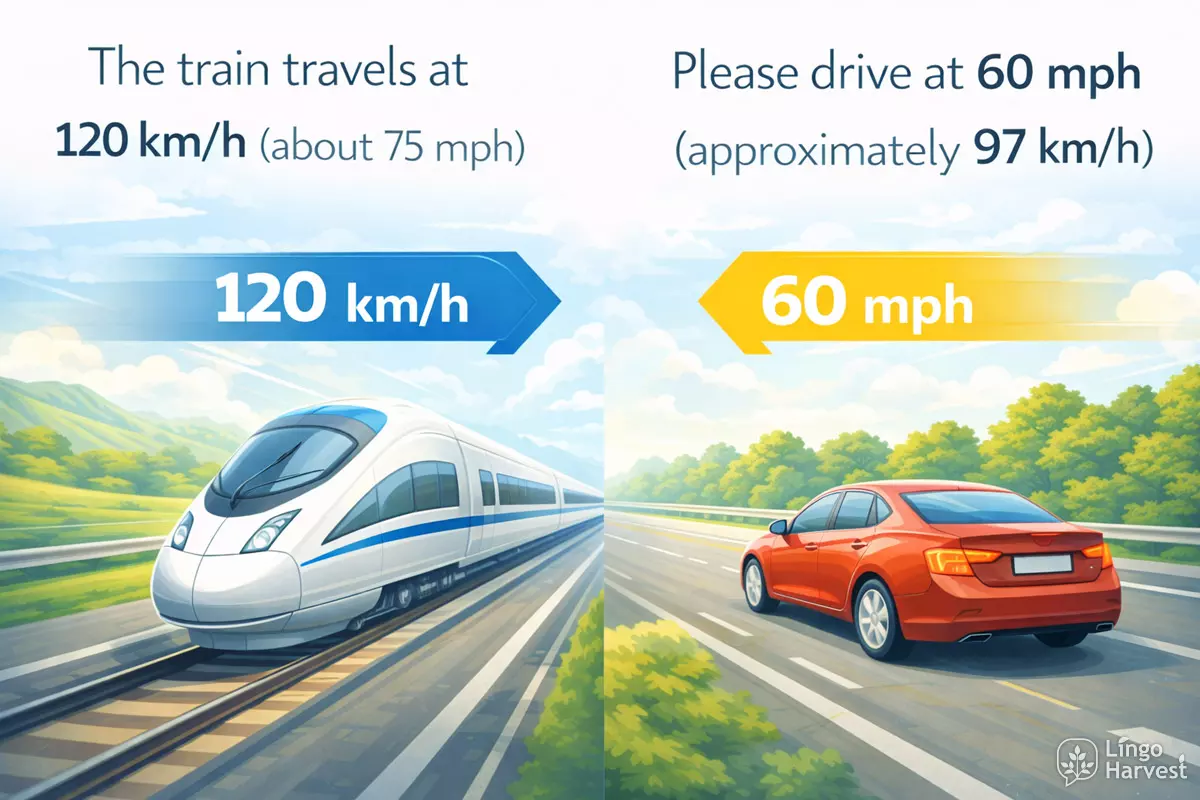
- The train travels at 120 km/h (about 75 mph).
- Please drive at 60 mph (approximately 97 km/h).
- He was cycling at 25 km/h (roughly 16 mph).
- The speed limit here is at 50 km/h (around 31 mph).
- She ran at 10 mph (close to 16 km/h).
Changes or Differences: by [amount or percentage]
- Fuel efficiency improved by 10% over last year.
- He increased his running speed by 2 km/h (about 1.2 mph).
- Sales dropped by 5% in May.
- The speed was reduced by 20 mph (roughly 32 km/h).
Rates: per [unit]
- The car uses about 6 liters per 100 km (about 39 mpg).
- Speeding fines increase per km/h (or per mph) over the limit.
- He earns $20 per hour.
- The population grows by 2% per year.
Direct Comparison Table: km/h and mph in Context
| Example (Metric) | Equivalent (Imperial) |
|---|---|
| at 80 km/h | at 50 mph |
| limit of 100 km/h | limit of 62 mph |
| increased by 10 km/h | increased by 6 mph |
| reduced by 20 km/h | reduced by 12 mph |
| per 10 km/h over the limit | per 6 mph over the limit |
These illustrations help clarify how prepositions work with measurements and rates. Notice that "at" is used for stating a specific speed, "by" for indicating a change or difference, and "per" for expressing rates or frequency. The choice between km/h and mph depends on the region, but the grammatical patterns stay consistent.
Practice: rewrite data sentences with correct prepositions
Understanding which preposition to use with numbers, rates, and measurements is essential for clear and accurate communication. Below, you’ll find exercises to help you choose the correct prepositions for common data expressions. Pay attention to context: “at,” “by,” and “per” each serve specific functions when describing speed, change, and frequency.
Rewrite the following sentences using the correct preposition
- The speed limit is 70 km/h.
- Sales increased 12% last year.
- We produce 500 units day.
- This train travels 300 kilometers hour.
- Our costs fell 8% in March.
- She earns $20 hour.
- Water boils 100°C.
- The price dropped 5% overnight.
- The meeting starts 9 a.m.
- The company grew 10% each year.
Show answers
- The speed limit is at 70 km/h.
- Sales increased by 12% last year.
- We produce 500 units per day.
- This train travels at 300 kilometers per hour.
- Our costs fell by 8% in March.
- She earns $20 per hour.
- Water boils at 100°C.
- The price dropped by 5% overnight.
- The meeting starts at 9 a.m.
- The company grew by 10% each year.
Common patterns for prepositions with measures and rates
- Speed or temperature: at 80 km/h, at 20°C
- Change or difference: by 15%, by $10
- Frequency or rate: per hour, per day, per person
- Cost: $5 per item, $100 per night
- Time points: at 6 p.m., at midnight
- Growth or reduction: increased by 7%, decreased by 3%
- Travel: at a speed of 90 km/h
- Production: 200 units per week
- Temperature: at minus 5°C
- Price: rose by $2, fell by 10%
- Efficiency: 50 miles per gallon
- Population: 100 people per square kilometer
Quick reference: Which preposition to use?
| Type of Expression | Correct Preposition & Example |
|---|---|
| Speed, temperature, time point | at (at 100 km/h, at 5°C, at 10 a.m.) |
| Change, increase or decrease | by (by 8%, by $5) |
| Frequency, rate, unit per time | per (per day, per person, per liter) |
| Ratio, density, cost per unit | per (per square meter, per hour, per seat) |
Short practice: identify and correct mistakes
Read these sentences and correct the preposition if needed:
- He drives in 60 km/h.
- The price increased with 4%.
- Tickets cost $15 by person.
- We meet in 8 a.m.
- The rent is $800 on month.
- She earns $20 on hour.
- Sales grew on 15% last year.
- The train was moving with 100 km/h.
- I drink coffee two times on day.
- Our internet speed is 100 megabits in second.
Show answers
- He drives at 60 km/h.
- The price increased by 4%.
- Tickets cost $15 per person.
- We meet at 8 a.m.
- The rent is $800 per month.
- She earns $20 per hour.
- Sales grew by 15% last year.
- The train was moving at 100 km/h.
- I drink coffee two times per day.
- Our internet speed is 100 megabits per second.