Prepositions with Geographical Names: in Spain, on the coast, etc.

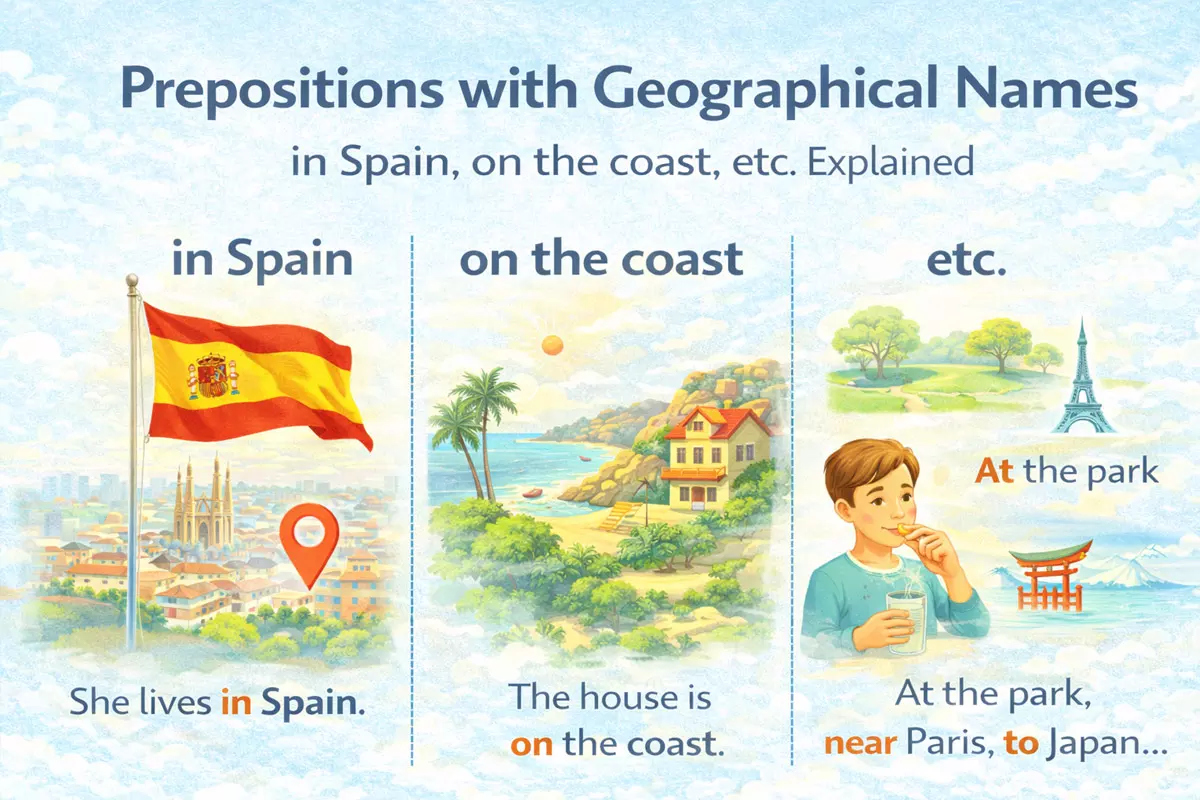 This article explains when to use in, on, and at with countries, cities, borders, coasts, and addresses. It covers common travel phrases, tricky place names, and offers practice for describing locations on a simple map.
Choosing the correct preposition for place names can be confusing, especially when referring to countries, cities, or natural landmarks. This article explains how to select the appropriate preposition for different types of locations, such as when to use in, on, or at with specific geographical terms. By understanding the rules and common patterns, you can describe places more accurately and confidently, ensuring your sentences sound natural and clear in English.
Basic rules for in with countries and cities
When talking about locations such as countries or cities, English typically uses the preposition in. This is the standard way to indicate that someone or something is located within the boundaries of a city or a country. The choice of in helps to show that the place is a larger area or a defined space where activities or events can occur.
When to use "in" with place names
Use in when referring to:
- Countries: in France, in Japan, in Brazil
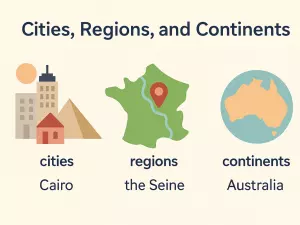
- Cities or towns: in Madrid, in Toronto, in Cairo
- Continents: in Africa, in Europe
- Large regions or provinces: in Bavaria, in Ontario
- Neighborhoods or districts: in Soho, in the Old Town
The preposition in is not used for smaller, more specific places like streets or squares—those usually take on or at instead.
Common mistakes to avoid
- ❌ on Spain → ✅ in Spain
- ❌ at Paris → ✅ in Paris
- ❌ on Tokyo → ✅ in Tokyo
Remember, in is used with larger geographic units. For islands or specific locations (like "on the island" or "at the airport"), other prepositions may be correct.
Examples of "in" with countries and cities

- She lives in Germany.
- They are staying in New York.
- My friends work in Australia.
- He was born in Rome.
- We met in Istanbul.
- There is snow in Moscow in winter.
- The conference is in Geneva.
- I studied in South Korea.
- Our office is in London.
- She grew up in Buenos Aires.
- They got married in Prague.
- He found a job in Dubai.
Summary table: Prepositions with different place types
| Type of Place | Correct Preposition | Example |
|---|---|---|
| Country | in | in Italy |
| City | in | in Tokyo |
| Street | on | on Baker Street |
| Specific place/building | at | at the museum |
| Island | on | on Crete |
To sum up, in is the go-to preposition for countries and cities, helping you speak naturally and clearly when describing locations or origins.
On for coasts, borders and lines on a map
The preposition on is frequently used with geographical features that are represented as lines or edges, rather than areas. This includes references to coastal regions, borders between countries, and other linear features such as rivers or roads on a map. The idea is to suggest contact or adjacency along a boundary, margin, or edge.
Common uses of "on" in geographic contexts
- on the coast (e.g., a city on the Mediterranean coast)
- on the border (e.g., a town on the French-German border)
- on the river (e.g., a village on the Nile)
- on the shore (e.g., houses on the shore of Lake Superior)
- on the equator (e.g., a country on the equator)
- on the fault line (e.g., a city on a major fault line)
- on the map (e.g., marked on the map)
- on the edge (e.g., a settlement on the edge of the desert)
- on the peninsula (e.g., a resort on the Yucatán peninsula)
- on the road (e.g., a café on the main road)
- on the route (e.g., a stop on the migration route)
- on the line (e.g., a station on the Green Line)
- on the frontier (e.g., military posts on the frontier)
- on the boundary (e.g., a marker on the property boundary)
- on the trail (e.g., a lodge on the hiking trail)
How "on" changes meaning with geography
Using on signals a physical or abstract connection to a margin or dividing line. For example, saying "on the coast" suggests direct proximity to the sea, while "on the border" means right along the dividing line between two territories. This contrasts with in, which usually denotes being inside an area, such as "in Spain" or "in the city."
| Expression | Typical Meaning |
|---|---|
| on the coast | Located directly by the sea or ocean |
| on the border | Situated right at the dividing line between two countries or regions |
| on the river | Positioned along the bank of a river |
| on the map | Indicated or shown on a geographical representation |
| on the edge | At the margin or boundary of an area |
| on the route | Located along a specific path or travel line |
In summary, on is best for describing locations that touch or follow a geographical line or boundary, rather than those entirely contained within an area. This use helps clarify spatial relationships and is especially useful in travel descriptions, geography, and map reading.
At for specific points and addresses
When referring to very precise locations, such as particular points, addresses, or landmarks, English speakers commonly use the preposition at. Unlike broader prepositions like "in" or "on," which indicate general areas or surfaces, "at" zeroes in on a specific spot. This distinction is important when talking about meeting places, addresses, or notable points within a city or region.
Usage patterns
"At" is typically used for:
- Street addresses (e.g., at 15 Oxford Street)
- Notable buildings (e.g., at the museum, at the library)
- Intersections or corners (e.g., at the corner of Main and 5th)
- Transportation points (e.g., at the bus stop, at the airport)
- Events or gatherings (e.g., at the concert, at the conference)
- Landmarks (e.g., at the Eiffel Tower)
- Institutions or companies (e.g., at Google headquarters)
- Homes or residences (e.g., at John’s house)
- Specific rooms or locations inside larger spaces (e.g., at the front desk)
- Designated meeting points (e.g., at the entrance)
Examples in context
Here are some common scenarios where "at" is the correct preposition:
- Meet me at the train station.
- She’s waiting at the main entrance.
- They live at 22 Park Avenue.
- Turn left at the traffic lights.
- We arrived at the airport early.
- He’s at school right now.
- I’ll see you at the cinema.
- There’s a café at the corner.
- The party is at Sarah’s place.
- She works at the hospital.
- Our meeting is at Room 204.
- The taxi dropped us at the hotel entrance.
Comparing "at" with "in" and "on"
Choosing between "at," "in," and "on" often depends on how specific you want to be. "At" is for exact points, "in" for enclosed spaces or areas, and "on" for surfaces or lines. Here’s a comparison:
| Preposition | Example Use |
|---|---|
| At | at 10 Downing Street (a specific address) |
| In | in London (a city, general area) |
| On | on Oxford Street (a street, surface) |
| At | at the station (a specific point) |
| In | in the station (inside the building) |
| On | on the platform (a surface within the station) |
Understanding when to use "at" helps you communicate locations accurately, especially when giving directions or arranging meetings. Remember: "at" pinpoints, while "in" and "on" describe more general or spatial relationships.
Common travel and tourism collocations
When talking about travel and geography, certain preposition and noun combinations naturally occur together in English. These set expressions are useful for sounding more natural when describing locations, planning trips, or sharing travel experiences.
Typical phrases with prepositions and geographical terms

Many English phrases for destinations and landscapes use specific prepositions. Here are some widely used examples:
- in the mountains (e.g., We stayed in the mountains last summer.)
- on the island (e.g., There’s a small village on the island.)
- at the beach (e.g., Let’s meet at the beach after lunch.)
- by the river (e.g., The hotel is by the river.)
- in the city center (e.g., Our apartment is in the city center.)
- on the coast (e.g., They live on the coast.)
- in Spain (e.g., I studied in Spain for a year.)
- at the airport (e.g., Arrive at the airport two hours early.)
- on the border (e.g., The town is on the border with France.)
- in the countryside (e.g., We spent a week in the countryside.)
- at the port (e.g., The ferry leaves at the port.)
- on the mainland (e.g., The ferry returns to the mainland.)
- in the desert (e.g., You can see camels in the desert.)
- on the map (e.g., Can you find it on the map?)
- at the market (e.g., Buy fresh fruit at the market.)
- in the valley (e.g., The town lies in the valley.)
Comparing prepositions with geographical features
To help you remember which preposition to use with different types of places, here’s a quick overview:
| Location Type | Typical Preposition Collocation |
|---|---|
| Countries, cities, regions | in Spain, in Paris, in Europe |
| Water, coasts, islands | on the coast, on the island, by the sea |
| Airports, ports, stations | at the airport, at the port, at the station |
| Natural features (mountains, valleys, rivers) | in the mountains, in the valley, by the river |
| Borders, maps, edges | on the border, on the map, at the edge |
Useful tips for learners
Choosing the right preposition can be tricky, but focusing on these common pairings will help you sound more fluent. Pay attention to how native speakers use these expressions in context, and don’t hesitate to practice them in your travel conversations.
Tricky place names and exceptions to remember
Some geographical names simply don’t follow the usual preposition patterns. While we often say “in Spain” or “on the coast,” certain locations defy easy rules. Here’s a closer look at the most frequent exceptions and irregularities you’re likely to encounter.
Unusual Prepositions with Countries, Cities, and Regions
Many place names use “in,” but there are interesting exceptions—especially with islands, regions, and certain cities. For example:
- On the Isle of Wight (not “in” the Isle of Wight)
- On Malta (but “in” Sicily)
- In the Netherlands (plural country name)
- In the United States / In the Philippines (plural or compound names often take “the”)
- At Oxford (university context), but in Oxford (city context)
- On the Riviera (coastal region)
- On the border (not “in” the border)
- In the Alps (mountain ranges use “the” and “in”)
- On the Nile (referring to the river, not a city)
- In the Sahara (deserts use “the” and “in”)
- At the Equator / at the North Pole
- On the Pacific (ocean context)
- In the Midwest (US region)
- At Niagara Falls (the site, not the city)
When “at” is Preferred
Smaller places, points, and events often use “at” rather than “in” or “on.” For example:
- At the airport
- At the station
- At the crossroads
- At home
- At sea (when aboard a ship)
- At school
- At work
- At the bus stop
- At the entrance
- At the cinema
- At the supermarket
- At the hotel reception
Special Cases: “The” in Place Names
Some locations require “the” as part of their names, which affects the preposition used. Here’s a comparison of common forms:
| Place Name | Correct Preposition |
|---|---|
| The Netherlands | in the Netherlands |
| The United Kingdom | in the United Kingdom |
| The Bahamas | in the Bahamas |
| The Arctic | in the Arctic |
| The Amazon (river) | on the Amazon |
| The Mediterranean (sea) | on the Mediterranean |
| The Alps | in the Alps |
| The Midwest | in the Midwest |
Some of these patterns come down to tradition or idiomatic usage. When in doubt, consult a reputable dictionary or listen to native speakers for confirmation. Place name prepositions can be unpredictable, so it’s worth memorizing the most common exceptions.
Practice: describe locations on a simple map correctly
Understanding how to use prepositions with geographical names helps you give clear directions and talk about places accurately. Let’s apply these rules to some practical tasks using imaginary maps and well-known place types.
Common Patterns for Describing Locations
- in + country, city, region: in France, in Madrid, in the Alps
- on + coast, island, border, river: on the coast, on an island, on the border, on the Nile
- at + specific point or building: at the station, at the crossroads, at the airport
- near + place: near the mountains, near Berlin
- between + two places: between Italy and Switzerland
- opposite + place: opposite the church
- next to + place: next to the museum
- behind + place: behind the library
- in front of + place: in front of the school
- across from + place: across from the park
Practice Task: Match the Place to the Description
Imagine a simple map with these locations: a river, a park, a school, a station, and a museum. Match the prepositional phrase to the most logical location.
- The school is _____ the park.
- The station is _____ the river.
- The museum is _____ the school.
- The park is _____ the river.
- The station is _____ the museum.
- The library is _____ the station.
- The café is _____ the museum.
- The university is _____ the city center.
- The supermarket is _____ the library.
- The lake is _____ the park.
Show answers
- next to
- on
- opposite
- near
- behind
- near
- next to
- in
- opposite
- in
Quick Quiz: Choose the Correct Preposition
- Madrid is ___ Spain.
- Sicily is ___ island in the Mediterranean.
- The city lies ___ the border with Portugal.
- They live ___ the coast.
- The famous tower is ___ the center of the city.
- Toronto is ___ Canada.
- We stayed ___ the mountains.
- The island is ___ the Pacific Ocean.
- The village sits ___ a hill.
- She grew up ___ a farm.
Show answers
- in
- on an
- on
- on
- in
- in
- in
- in
- on
- on
Sample Sentences for Reference
- We stayed in Paris for a week.
- The hotel is on the beach.
- Our house is near the river.
- The restaurant is at the corner.
- He lives between two mountains.
- The bank is opposite the cinema.
- The playground is next to the library.
- The bus stop is behind the supermarket.
- The monument is in front of the museum.
- The café is across from the post office.
Try describing your own neighborhood or favorite city using these patterns. This will help you become more confident and precise when talking about places in English.