Prepositions with Locations: at home, at work, at school

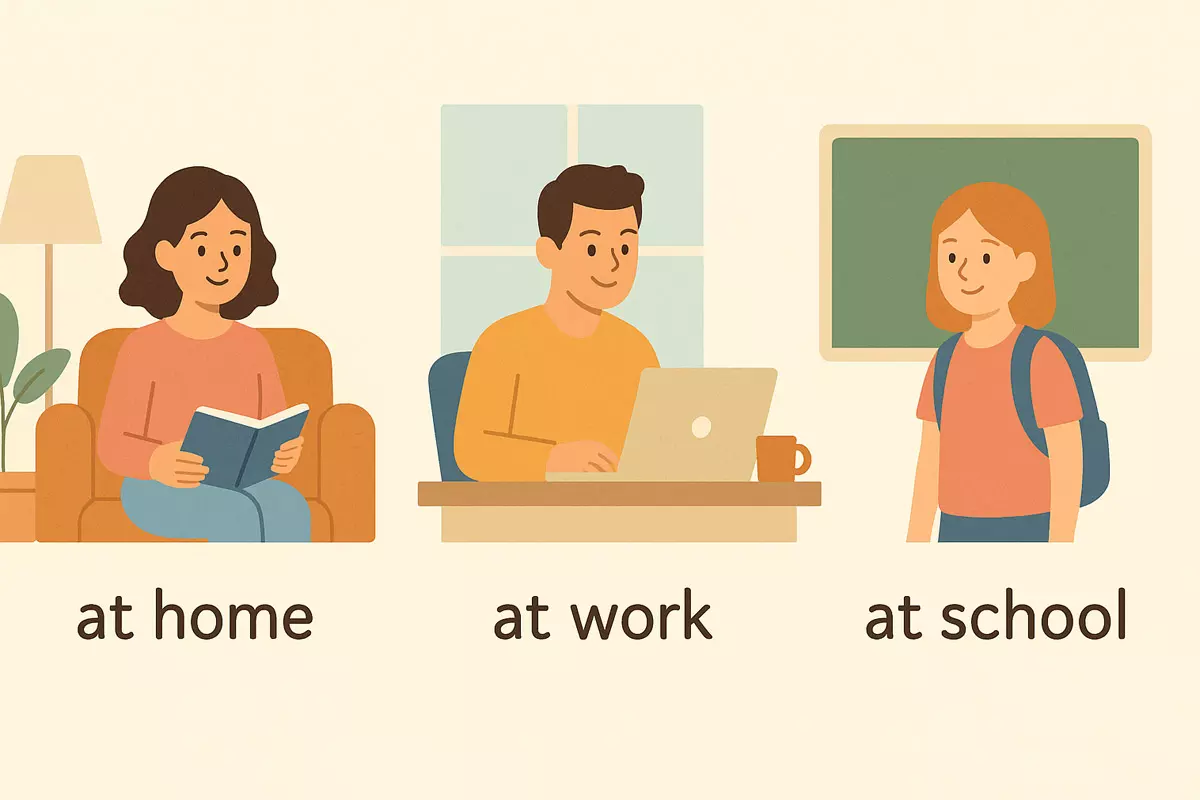 Here we how to use at, in, and on for places, explains differences between public and private locations, reviews set expressions, discusses daily routines, points out regional exceptions and mistakes, and provides practice describing your day.
Mastering the use of prepositions in English is essential for clear and natural communication, particularly when talking about locations such as your home, workplace, or school. Choosing the correct connecting words, like at, in, or on, can make your speech sound more fluent and help avoid misunderstandings. For example, we say at home, at work, and at school to indicate specific places, while in is used for larger areas like in a city or in a country. Paying attention to these small words can greatly improve your English skills.
at vs in vs on: Quick Overview
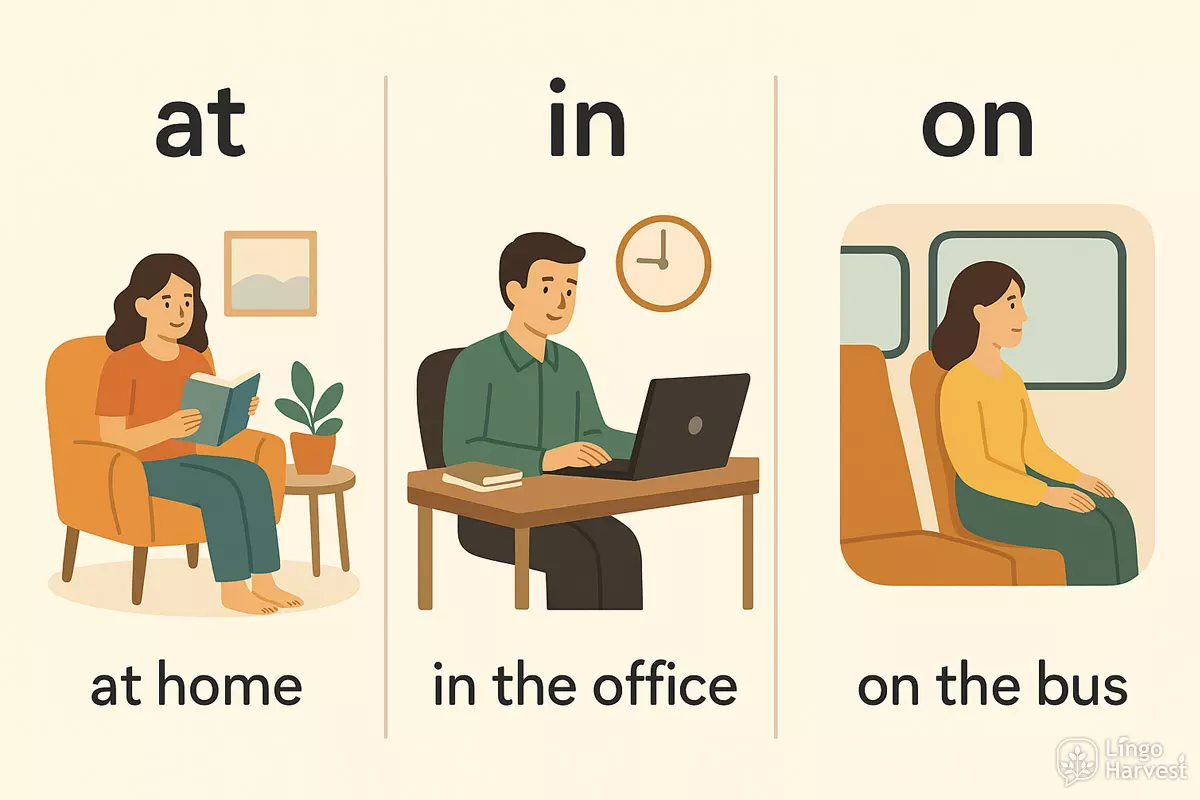
Understanding the difference between "at," "in," and "on" is key when talking about locations like home, work, or school. Each preposition gives a slightly different sense of where something or someone is, and choosing the right one depends on context and convention.
General Meanings and Usage
- at — Used for specific points or places, often seen as a spot or address. It answers "where exactly?"
- in — Refers to being inside a space or area; it describes being contained within boundaries.
- on — Used for surfaces or things that are attached to, or touching, a surface.
Common Examples with Locations
- at home ✅ (correct: specific place, not the building itself)
- in the house ✅ (inside the building, more general)
- at work ✅ (refers to your workplace, not the building)
- in the office ✅ (inside the office room or building)
- at school ✅ (general location, as a student or staff)
- in school ✅ (inside the building, or enrolled as a student)
- on campus ✅ (on the grounds or property of a university or college)
- on the street ✅ (physically located on the road or sidewalk)
- in the city ✅ (within the city limits)
- at the station ✅ (specific place, e.g., train/bus station)
- on the bus ✅ (aboard or riding the bus)
- in the car ✅ (inside the car)
- at the airport ✅ (specific location, not inside a plane)
- on the plane ✅ (aboard the aircraft)
- in a room ✅ (inside a particular room)
- on the floor ✅ (touching or lying on the surface)
- at the door ✅ (right by the door, not inside or outside)
- in bed ✅ (lying under the covers, not just on top)
- on the bed ✅ (on the surface of the bed, not covered)
Quick Reference: Choosing the Right Preposition
| Preposition | Typical Use with Locations | Example |
|---|---|---|
| at | Specific points or places | at home, at work, at the station |
| in | Enclosed spaces | in the house, in a room, in the city |
| on | Surfaces or forms of transport | on the street, on the bus, on the floor |
Choosing between these prepositions helps clarify exactly where something happens. For example, "at home" means you are present at your place of residence, while "in the house" means you are physically inside the building. Similarly, "at work" is about being present at your workplace in general, not necessarily inside a particular room. Using the right preposition makes your meaning clear and natural.
Public vs Private Places
Understanding when to use prepositions like "at" with locations often depends on whether the place is generally accessible to everyone or restricted to certain people. In English, there's a distinction between locations that are open to the public and those considered private or personal. This difference often influences which prepositions are natural or idiomatic.
General Patterns
We commonly use "at" with both types of places, but the nuance can change. For instance, "at home" and "at work" refer to private or semi-private spaces, while "at the station" or "at the park" typically describe public settings. The use of "at" often suggests being present in a general area, not necessarily inside a specific building.
Examples: Private vs. Public Locations
- Private: at home, at my friend's house, at John's apartment, at work, at school, at the office
- Public: at the library, at the airport, at the bus stop, at the cinema, at the park, at the museum, at the hospital, at the supermarket, at the restaurant, at the bank
Comparing Usage
The preposition "at" is commonly used for both categories, but the meaning shifts slightly depending on context. For private places, it often implies familiarity or regular presence. For public locations, it emphasizes being present at a point or area accessible to many.
| Type of Place | Typical Examples with "at" |
|---|---|
| Private or Personal | at home, at work, at my cousin's house, at the doctor's office, at school |
| Public or Shared | at the airport, at the bank, at the park, at the station, at the concert |
| Borderline/Context-dependent | at the hospital (as a patient/visitor), at the university (as a student/visitor), at church (for service or event) |
| Special Cases | at sea, at the movies, at the post office, at the party |
Key Takeaways
- Use "at" for both private and public locations, but be aware of context and idiomatic usage.
- Some expressions are set phrases and may not follow strict rules ("at school" vs. "at the school").
- When in doubt, consider whether the location is generally accessible or personal to decide on the most natural preposition.
Common Expressions (at the station, at the airport)
When talking about travel or transportation, English speakers often use specific prepositions and phrases to describe their location or actions. “At the station” and “at the airport” are two of the most common ways to refer to being present at these transit hubs. These expressions are used to indicate that someone is within the general area of the train or bus station, or the airport—not necessarily inside a particular building or on a vehicle.
Typical Phrases for Travel Locations
Here are some frequently used expressions that incorporate these prepositions in context:
- I’ll meet you at the station.
- She’s waiting at the airport for her flight.
- There’s a taxi stand at the station.
- He arrived at the airport two hours early.
- My friend will pick me up at the station.
- The information desk is at the airport entrance.
- We bought tickets at the station counter.
- They are checking in at the airport now.
- The train leaves from the station at 6 pm.
- Security checks start at the airport before boarding.
- I left my bag at the station by mistake.
- Let’s grab a coffee at the airport café.
- Announcements at the station are sometimes hard to hear.
- There’s free Wi-Fi at the airport.
- We met some tourists at the station.
- Boarding begins at the airport gate 20 minutes before departure.
Comparing Usage: “At the Station” vs “In the Station”
Sometimes learners ask about the difference between “at” and “in” for these locations. “At” is used for general presence or meeting points, while “in” suggests being inside the building or enclosed area.
| Expression | Typical Meaning |
|---|---|
| at the station / at the airport | Somewhere in the area, not specific; could be inside or outside |
| in the station / in the airport | Inside the building or enclosed space |
| on the platform | Standing on the area where you board the train |
| at gate 5 | Located at a specific boarding gate in the airport |
Useful Tips
Use “at” for describing where to meet, wait, or arrive when talking about stations and airports. This preposition emphasizes general location, rather than a precise spot. For more detail, add “in,” “on,” or specify a particular area (like “at the ticket counter” or “at baggage claim”) as needed. This approach helps you sound natural and clear when discussing travel plans or giving directions.
Talking About Daily Life and Routine
Describing everyday activities often involves using prepositions with places, such as "at home," "at work," and "at school." These expressions help clarify where events in your daily schedule take place and make your English sound more natural. When you talk about habits or regular actions, certain prepositions are standard. For instance, say "I have breakfast at home," not "in home." Similarly, "She studies at school" and "He works at work" are correct patterns. Notice how these prepositions connect the action to a location.
Common Expressions with Prepositions for Locations
Here are some typical ways to use these location-based prepositions in sentences about routines:
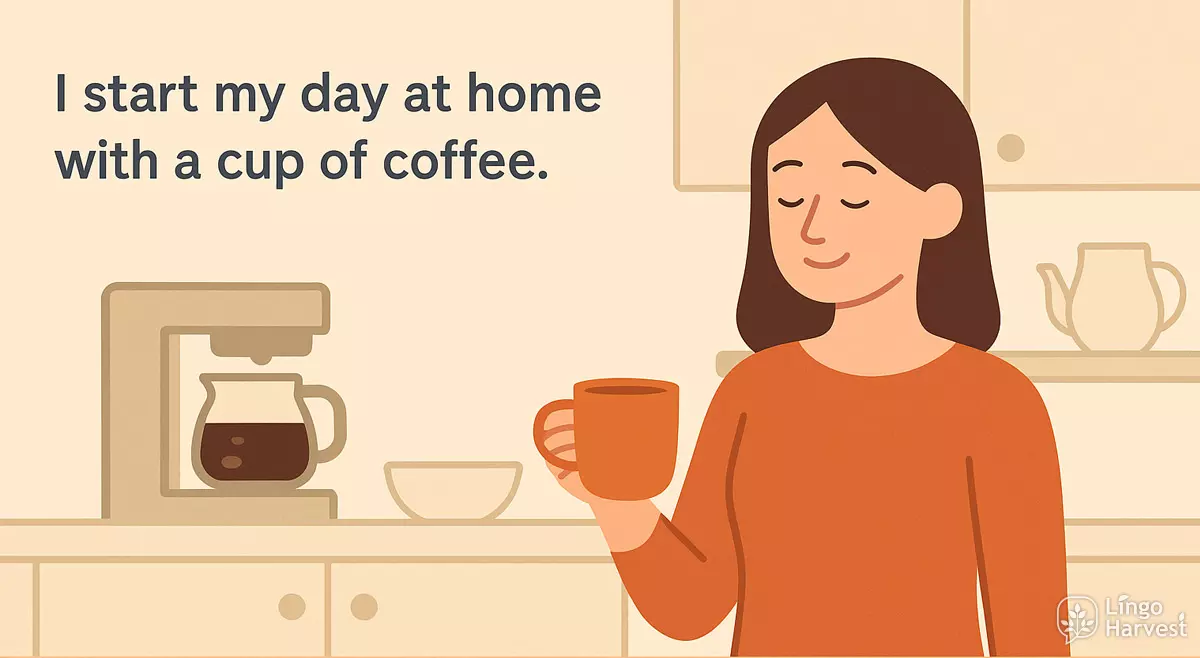
- I start my day at home with a cup of coffee.
- We eat lunch at work in the cafeteria.
- My children have classes at school until 3 PM.
- She relaxes at home after a busy day.
- He checks his email at work every morning.
- They meet friends at school during breaks.
- I read the news at home before leaving.
- We usually finish projects at work by Friday.
- Students eat lunch at school.
- She exercises at home in the evening.
- Team meetings happen at work every Monday.
- Teachers prepare lessons at school after classes.
- He naps at home on weekends.
- People socialize at work in the break room.
Comparing Prepositions for Daily Activities
To clarify how these prepositions fit into typical routines, here’s a structured comparison:
| Preposition + Place | Example in Daily Routine |
|---|---|
| at home | Read the newspaper at home before work. |
| at work | Have meetings at work every Monday morning. |
| at school | Study mathematics at school with classmates. |
| at home | Cook dinner at home in the evening. |
| at work | Finish reports at work before leaving for the day. |
| at school | Play sports at school after classes. |
These patterns are useful for describing not just your own habits, but also for asking others about theirs. For example, "Do you eat breakfast at home or at work?" or "What do you usually do at school after lessons?" Practice using these expressions to make your conversations about everyday schedules clear and precise.
Regional Variations and Exceptions
English prepositions with places like "home," "work," and "school" can differ depending on where you are in the English-speaking world. While "at home," "at work," and "at school" are standard in most varieties, speakers from different regions sometimes use alternative forms, and certain contexts may call for exceptions.
British vs. American Usage
In general, both British and American English prefer "at home" and "at work," but some variations appear in other settings:
- In hospital (UK) vs. in the hospital (US)
- At university (UK) vs. in college (US)
- At the weekend (UK) vs. on the weekend (US)
With "school," both regions usually use "at school" for students, but Americans might say "in school" to mean enrolled or attending.
Non-Standard and Colloquial Exceptions
Some dialects or informal speech introduce exceptions:
- Irish English sometimes uses "in work" instead of "at work."
- Indian English may use "in school" for "attending school," even in physical location contexts.
- South African English occasionally features "at home" and "in the house" interchangeably, though with subtle meaning shifts.
- Australian English tends to follow British patterns but can vary in rural areas.
- Caribbean English might use "in my home" more frequently than "at home."
Structured Comparison of Regional Preferences
| Location Phrase | British English | American English |
|---|---|---|
| Home | at home | at home |
| Work | at work | at work |
| School | at school | at school / in school |
| University/College | at university | in college |
| Hospital | in hospital | in the hospital |
| Weekend | at the weekend | on the weekend |
Special Contexts and Fixed Phrases
There are also set expressions and idioms that break the usual patterns:
- "At home with" (comfortable or familiar with something)
- "In school uniform" (wearing the uniform, not location-based)
- "At work on" (focusing on a task, not a place)
- "Home from work" (returning, not stationary)
- "At the office" vs. "in the office" (location vs. inside the building)
- "At class" (rare in standard English, but possible in some dialects)
- "In class" (inside the classroom, actively participating)
- "At the house" (specific house, not one’s own home)
- "In my place" (inside my apartment/house)
- "At headquarters" (organizational location)
- "In residence" (formal, e.g., artist in residence)
- "On campus" (American English for university grounds)
- "At the shop" vs. "in the shop" (at the location vs. inside the building)
Summary
While the standard forms are widely understood, exposure to different dialects and contexts can reveal a range of prepositional choices for places like home, work, and school. Awareness of these differences helps with both comprehension and effective communication across regions.
Common Mistakes to Avoid
Misusing prepositions with places like "home," "work," and "school" is a frequent issue for English learners. These words often follow different rules compared to other location nouns, and confusion can lead to unnatural or incorrect sentences. Let's look at the most typical pitfalls and how to avoid them.
Mixing Up "at" with "in" or "to"
Learners sometimes use "in" or "to" instead of "at" with these locations, which changes the meaning or creates errors. For example, "I'm in home" or "I'm to work" are not correct in standard English.
- Incorrect: I'm in home. ❌
- Correct: I'm at home. ✅
- Incorrect: She goes at school. ❌
- Correct: She goes to school. ✅
- Incorrect: He's in work. ❌
- Correct: He's at work. ✅
Adding "the" Where It Doesn't Belong
Another common error is placing "the" before "home," "work," or "school" when it isn't needed. These words are used without "the" in most contexts.
- Incorrect: I'm at the home now. ❌
- Correct: I'm at home now. ✅
- Incorrect: She is at the work. ❌
- Correct: She is at work. ✅
Forgetting the Different Prepositions for Movement vs. Location
"At" describes being in a place, while "to" is used for movement towards it. Mixing these up is a frequent mistake.
- Incorrect: I go at work every morning. ❌
- Correct: I go to work every morning. ✅
- Incorrect: She is to school right now. ❌
- Correct: She is at school right now. ✅
Omitting "at" Entirely
Some learners drop the preposition altogether, especially in direct translations from their native language. This results in sentences that sound incomplete or awkward.
- Incorrect: I am home. ❌ (Acceptable informally, but "at home" is standard for describing location.)
- Correct: I am at home. ✅
Quick Reference Table
| Phrase | Correct Usage | Incorrect Example |
|---|---|---|
| Describing your current location | I am at home | I am in home |
| Talking about presence at work | She is at work | She is in work |
| Stating someone is at school | He is at school | He is in school |
| Talking about movement towards a location | I go to school | I go at school |
| Talking about movement towards work | She goes to work | She goes at work |
Summary Tips
- Use "at" when stating your location: "at home," "at work," "at school."
- Use "to" for movement: "go to school," "drive to work."
- Do not use "the" before "home," "work," or "school" unless referring to a specific building or institution.
- Check for typical translation mistakes from your native language.
Mastering these small differences will make your English sound much more natural and accurate.
Practice: Describe Your Day Locations
Talking about where you spend your day helps you practice using prepositions with common places. Think about your daily routine: where do you start your morning, work or study, relax, and meet friends? Using phrases like at home, at work, and at school is essential for clear communication.
Typical Daily Locations: Vocabulary and Patterns
- I wake up at home.
- I eat breakfast at home.
- I arrive at work at 9 a.m.
- I meet my colleagues at work.
- My children study at school.
- I have lunch at work or at a café.
- I exercise at the gym after work.
- I shop at the supermarket on the way home.
- I relax at home in the evening.
- I read books at home before bed.
- I meet friends at the park on weekends.
- I attend meetings at the office.
- I study English at school or at home.
Practice Task: Write About Your Day
Describe your typical day using at least five different location phrases. Try to use at home, at work, at school, and other suitable locations.
- Where are you in the morning?
- Where do you eat lunch?
- Where do you spend your afternoon?
- Where do you relax in the evening?
- Where do you study or work?
Show answers
- In the morning, I am at home.
- I eat lunch at work or at a café.
- I spend my afternoon at work.
- I relax at home in the evening.
- I study at school.
Compare: Who Is Where During the Day?
See how people’s routines use different prepositions with places. Notice the pattern and variety of locations:
| Person | Day Locations |
|---|---|
| Anna | at home (morning), at work (day), at the gym (evening) |
| Tom | at home (morning), at school (day), at the library (afternoon), at home (evening) |
| Maria | at home (morning), at the supermarket (afternoon), at her friend's house (evening) |
| Sam | at home (morning), at work (day), at the park (evening) |
Quick Check: Choose the Best Preposition
Fill in the blanks with the correct preposition: at, in, or on.
- I am ___ home now.
- She is ___ work until 6 p.m.
- My son is ___ school.
- We relax ___ the park on Sundays.
- He studies ___ the library.
Show answers
- at
- at
- at
- in
- in
Practice using these phrases when describing your daily routine to build confidence with prepositions and locations.