Prepositions Showing Inclusion and Exception: including, except for

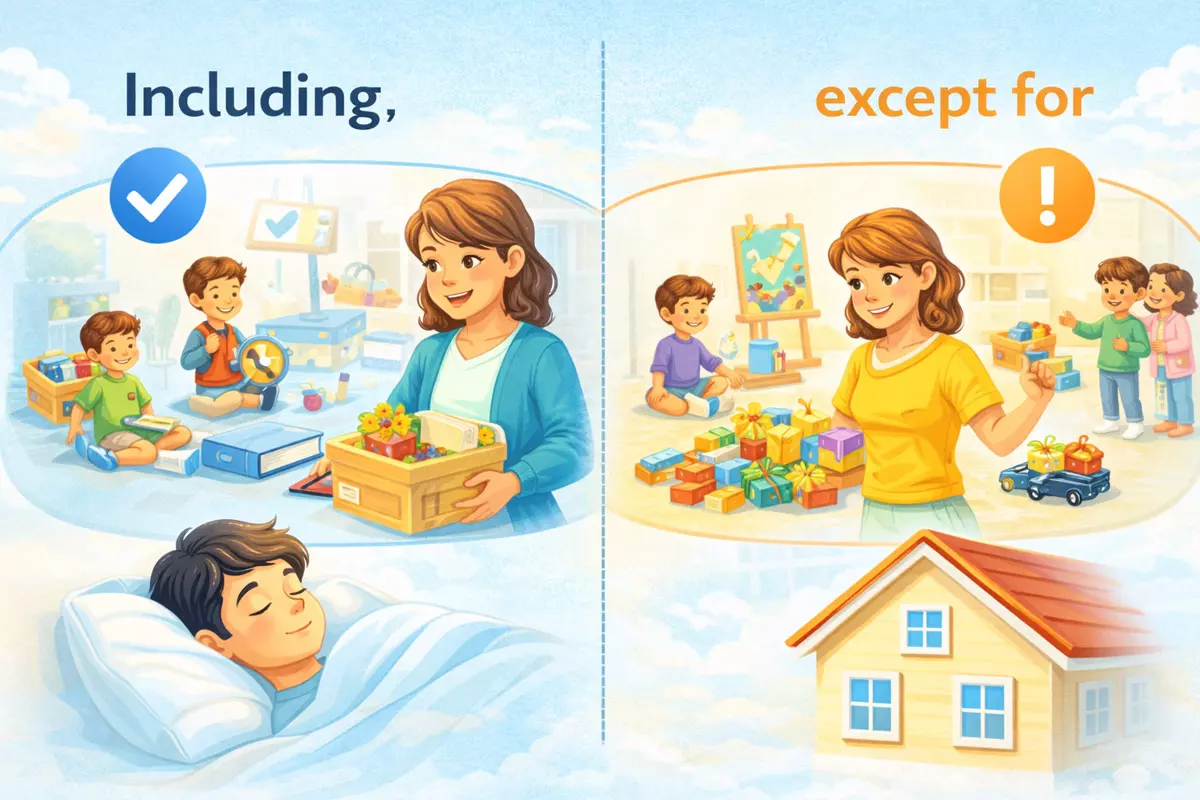 This article explains how including adds items to lists, while except for and apart from show exceptions. It covers correct placement, punctuation, formal and neutral styles, common mistakes, and offers practice rewriting lists for clarity.
Understanding the subtle differences between words that indicate inclusion, such as those showing something is part of a group, and words that signal exclusion, meaning something is left out, can help make your English sound more fluent and precise. These expressions are common in everyday language and mastering their use will allow you to communicate more clearly and naturally. By paying attention to context and practicing with real-life examples, you can develop a stronger grasp of these important distinctions.
How including adds extra items to a list
When you use the word including, you signal that what comes next is part of a larger group, but not the whole group. It’s a way to highlight specific examples or add more details to an existing set. This preposition often introduces extra items that might not be obvious from the main list, helping readers or listeners understand the full scope or important details.
Clarifying with “including”
By inserting including before certain items, you make it clear that these are just some of the possibilities. This is especially useful when the list might be too long or when you want to emphasize particular examples without listing everything.
- All the students, including Sarah and James, went on the trip.
- She bought several fruits, including apples, bananas, and oranges.
- The museum displays many artifacts, including ancient coins.
- We visited several countries, including Italy and France.
- He invited his friends, including his neighbors.
- The class learned new skills, including coding and robotics.
- The price covers all meals, including breakfast and dinner.
- The package contains everything, including batteries.
- Many animals, including pandas, live in this reserve.
- She owns several pets, including a parrot.
Patterns for using “including”

The structure is generally: main group + including + specific examples. It’s common in both written and spoken language, and works with countable and uncountable nouns. Here are some typical patterns:
- We offer many services, including delivery.
- The team has several experts, including engineers and designers.
- There are extra options, including vegetarian meals.
- Many people attended, including the mayor.
- The kit provides everything, including instructions.
Comparison: “including” vs. “except for”
To see how including adds items (while “except for” removes them), here’s a quick comparison:
| Phrase with “including” | Phrase with “except for” |
|---|---|
| Everyone went to the party, including Tom. | Everyone went to the party, except for Tom. |
| All meals are provided, including snacks. | All meals are provided, except for snacks. |
| The zoo has many animals, including lions and tigers. | The zoo has many animals, except for lions and tigers. |
| She collected every card, including the rare ones. | She collected every card, except for the rare ones. |
By using including, you expand the list and make your meaning more precise. It helps listeners or readers focus on the most relevant or surprising details within a broader category.
How except for and apart from mark exceptions
When you want to point out something that is not included in a group or statement, "except for" and "apart from" are two prepositions that help you do just that. They are both used to signal exceptions, but can sometimes differ in nuance and usage depending on the context.
General usage of "except for"
"Except for" is commonly used to show that one or more items are not part of a group or generalization. It often appears before the thing that is not included. For example:
- Everyone passed the test except for John.
- I finished all my work except for the last task.
- The museum is open every day except for Mondays.
This phrase is especially frequent in American English, but is widely understood in all varieties.
How "apart from" functions
"Apart from" can also introduce exceptions, but it sometimes carries an additional meaning of "in addition to." When used to mark an exception, it is very similar to "except for." For example:
- No one knew the answer apart from Lisa.
- Apart from a few spelling mistakes, your essay is excellent.
- We saw no animals apart from some birds.
In British English, "apart from" is often preferred in both exception and addition senses.
Key differences
While both forms can indicate something is not included, "except for" is almost always used only for exceptions, whereas "apart from" sometimes means both "except for" and "as well as." Context usually makes the meaning clear.
Common sentence patterns
- All the students left, except for one.
- There was nothing left apart from crumbs.
- I don’t eat meat, except for chicken.
- Apart from a headache, I feel fine.
- The shop is open daily except for Sundays.
- He answered all the questions apart from the last one.
- The street was empty except for a stray cat.
- Apart from Tom, nobody volunteered.
- The film was boring except for the ending.
- They finished everything apart from the dessert.
- Except for one detail, your report is perfect.
- Apart from a few errors, your presentation was great.
Summary of usage
Overall, both "except for" and "apart from" help mark out what doesn’t belong in a set or statement. The main thing to remember is to check whether you want to show only an exception ("except for") or possibly both an exception and an addition ("apart from"), depending on your meaning and context.
Punctuation and position in sentences and lists
When using prepositions like including and except for, their placement in a sentence and the punctuation that follows can affect clarity and meaning. Including usually introduces a list or specifies particular examples, while except for highlights exceptions. Both are commonly found after the main clause, but their use in lists and sentences differs slightly.
Using "including"
Including is often placed after the item or group it refers to, followed by a comma if it introduces extra information. In lists, a comma is used before including when it appears at the end:
- We visited several countries, including France and Italy.
- All the students, including Sarah, participated.
- The price covers everything including taxes and fees.
If the list is restrictive (essential to the meaning), the comma may be omitted:
- Only employees including managers attended the meeting.
Using "except for"
Except for typically follows the main noun or phrase and is separated by a comma if it adds non-essential information:
- Everyone, except for John, arrived on time.
- The museum is open daily except for Mondays.
- All items are on sale except for electronics.
If the exception is essential, a comma is not used:
- All members except for the treasurer must attend.
Lists and Serial Commas
When including or except for is used in a list, place it before the last item or after all items, depending on what is being specified. A comma is generally used before these phrases when they appear at the end of a list.
Common Patterns
- All guests are welcome, including children.
- No one except for staff is allowed beyond this point.
- The package contains everything you need, including instructions.
- The shop is open every day except for Sunday.
- All the ingredients, including spices, are fresh.
- Everyone except for the youngest child went swimming.
- All passengers, including those with tickets, must check in.
- No changes are allowed except for medical emergencies.
- The offer applies to all products except for discounted items.
- She likes all fruits, including durian.
- No one was absent except for Tom.
- The event is free for all, including non-members.
Quick Reference: Placement and Punctuation
| Phrase | Typical Position & Punctuation |
|---|---|
| including | After the item or group; comma before if non-essential ✅ "We visited many cities, including Paris." |
| except for | After the main group; comma before if non-essential ✅ "Everyone, except for Anna, agreed." |
| List usage | Before last item or after all items; use comma for clarity ✅ "They bought apples, oranges, and bananas, including rare varieties." |
| Essential exceptions | No comma if the phrase is crucial to the meaning ✅ "All stores except for the main branch are closed." |
Being aware of these patterns helps you use including and except for smoothly and correctly in both writing and speech.
Formal vs neutral uses in writing and speaking
When choosing between "including" and "except for," context and tone play a big role. In more official documents or academic writing, these prepositions are used precisely and sometimes with additional structure. In everyday conversation or casual emails, their use is often more relaxed and direct.
Common patterns in formal contexts
Writers in formal settings tend to use full clauses and avoid contractions. For example, "including" often introduces a detailed or exhaustive list, while "except for" is used to specify clear exclusions without ambiguity.
- Including: "The report covers all departments, including Human Resources and Finance."
- Except for: "All participants, except for those under 18, must sign the waiver."
Neutral and informal usage

In spoken English and informal writing, people use these prepositions more loosely. The lists or exceptions might be incomplete or implied, and contractions are common.
- "I brought everything, including dessert."
- "Everyone came except for Mike."
Comparing usage: formal vs neutral
Below is a comparison of how "including" and "except for" typically appear in different registers:
| Register | "Including" | "Except for" |
|---|---|---|
| Formal writing ✅ | "All relevant documents, including financial statements, must be submitted." | "All candidates, except for those with incomplete applications, will be considered." |
| Neutral/informal → | "Bring your stuff, including snacks." | "Everyone’s invited except for Alex." |
| Academic/official | "The sample comprised 50 students, including both undergraduates and postgraduates." | "No one, except for the principal investigator, had access." |
| Spoken language | "We saw everyone, including your cousin." | "Nothing’s changed except for the date." |
Tips for choosing the right tone
- In emails to colleagues, use straightforward phrasing: "Let me know if you have any questions, including about the schedule."
- For reports or official documents, prefer full sentences and explicit lists: "The following issues were identified, including delays and cost overruns."
- When speaking, brevity is fine: "All done except for one thing."
- Be careful with ambiguity in formal contexts—specify what is included or excluded.
Overall, the choice between more formal or neutral expressions with "including" or "except for" depends on your audience and purpose. Adjust your sentence structure and detail level accordingly for clarity and appropriateness.
Typical errors that change list meaning
Misusing “including” and “except for” can lead to confusion, especially when listing items. Small changes in preposition or punctuation often shift the entire scope of what is covered or left out. These errors can result in misunderstandings—sometimes even the opposite of what the speaker or writer intended.
Common pitfalls with "including"
Writers sometimes use “including” when they mean “such as,” or they forget to clarify if the list is complete or partial. Another frequent issue is placing “including” at the wrong point in the sentence, making it unclear which items are part of the main group.
- Adding items after “including” that don’t belong to the main category.
- Using “including” with a complete list, implying there are more items.
- Omitting a comma before “including,” which can make the sentence ambiguous.
- Switching word order so it’s unclear what is included.
- Using “including” with non-examples (items that should be exceptions).
Frequent mistakes with "except for"
“Except for” is meant to show exclusion, but its placement and structure are crucial for clarity. Errors often arise when speakers mix up which items are excluded, or when “except for” is used with negatives, leading to double negatives.
- Excluding the wrong item by placing “except for” in the wrong spot.
- Using “except for” with negatives, creating confusion (e.g., “No one came except for John”).
- Applying “except for” to the entire group instead of a single item.
- Leaving out necessary commas, making it unclear what is omitted.
- Combining “except for” with “including” in one sentence, muddling the meaning.
Side-by-side comparison: subtle changes, big impact
| Error Example | Intended or Actual Meaning |
|---|---|
| All employees, including managers and assistants, must attend. | Everyone (managers and assistants are part of “all employees”). |
| All employees except for managers and assistants must attend. | Everyone except managers and assistants must attend. |
| I like fruit including apples, oranges, and bananas. | I like fruit; apples, oranges, and bananas are examples (not the full list). |
| I like fruit except for apples, oranges, and bananas. | I like all fruit but not apples, oranges, or bananas. |
Further patterns to watch out for
- Forgetting to specify if “including” introduces an exhaustive or partial list.
- Misplacing “except for,” which can shift which items are left out.
- Using both “including” and “except for” together, which confuses the reader.
- Assuming “including” means “all of the following,” when it’s usually just examples.
- Neglecting parallel structure when listing with these prepositions.
- Overusing “including” to add items that don’t clearly belong in the category.
- Omitting clarifying words after “except for,” which can make the sentence vague.
- Using “except” without “for” in contexts where “except for” is needed for clarity.
- Failing to match the verb tense or structure before and after these prepositions.
- Confusing “besides” (meaning “in addition to”) with “except for.”
Careful use of these prepositions—and attention to sentence structure—helps prevent changing the intended meaning of your lists. Always check which items your preposition includes or excludes, and revise if there’s any ambiguity.
Practice: rewrite lists with clear inclusion and exception
When describing groups or lists, it's important to show clearly who or what is included or excluded. Using prepositions like "including" or "except for" helps the reader understand exactly what you mean. Let's look at how to rephrase sentences and lists to make inclusion and exception obvious.
Rewriting Lists for Clarity
Consider a basic list: "All my friends came to the party." If you want to specify someone extra or someone who didn't come, you can use prepositions to be more precise.
- All my friends, including Sarah, came to the party. (Sarah is part of the group, possibly unexpectedly.)
- All my friends came to the party except for Tom. (Everyone but Tom attended.)
Practice: Make These Lists Clearer
- Rewrite: "Everyone passed the test."
- Rewrite: "The museum is open every day."
- Rewrite: "She invited her coworkers to dinner."
- Rewrite: "All the students got the homework right."
- Rewrite: "We visited several cities on our trip."
- Rewrite: "The store sells fruit."
- Rewrite: "All the books are on the shelf."
- Rewrite: "The team members received awards."
- Rewrite: "The restaurant serves desserts."
- Rewrite: "The club meets weekly."
Show answers
- Everyone except for John passed the test. / Everyone, including the new student, passed the test.
- The museum is open every day except for Mondays. / The museum is open every day, including holidays.
- She invited her coworkers to dinner, including her manager. / She invited her coworkers to dinner except for Mark.
- All the students got the homework right except for Emily. / All the students, including the exchange student, got the homework right.
- We visited several cities on our trip, including Paris and Rome. / We visited several cities on our trip except for Berlin.
- The store sells fruit, including exotic varieties. / The store sells fruit except for bananas.
- All the books are on the shelf except for the dictionary. / All the books, including the old ones, are on the shelf.
- The team members received awards, including the coach. / The team members received awards except for Alex.
- The restaurant serves desserts, including vegan options. / The restaurant serves desserts except for ice cream.
- The club meets weekly, including during the summer. / The club meets weekly except for holidays.
Common Patterns Using Inclusion and Exception
- including: Adds a specific example or subgroup to a general list.
- except for: Removes a specific example or subgroup from a general list.
- besides: Can mean "in addition to" or "apart from," so check context.
- apart from: Similar to "except for," often used for exceptions.
- other than: Also signals an exception.
- as well as: Adds extra items, may need punctuation for clarity.
Transforming Factual Lists
Look at how the meaning changes with different prepositions:
| Original Statement | With Inclusion/Exception |
|---|---|
| He finished all the tasks. | He finished all the tasks, including the difficult ones. |
| Everyone attended the meeting. | Everyone attended the meeting except for the director. |
| The zoo has many animals. | The zoo has many animals, including pandas and koalas. |
| Every child received a gift. | Every child received a gift except for Sam. |
| All the rooms are booked. | All the rooms are booked except for the suite. |
| The package contains snacks. | The package contains snacks, including chocolate bars. |
| She brought her pets to the vet. | She brought her pets to the vet except for her cat. |
| The report covers all topics. | The report covers all topics, including recent updates. |
| We cleaned every room. | We cleaned every room except for the attic. |
| The recipe uses common spices. | The recipe uses common spices, including cumin and paprika. |
By adding these prepositions, you help your reader understand precisely what is part of your list—and what is left out.