Common Preposition Mistakes Across English Levels from A1 to C1

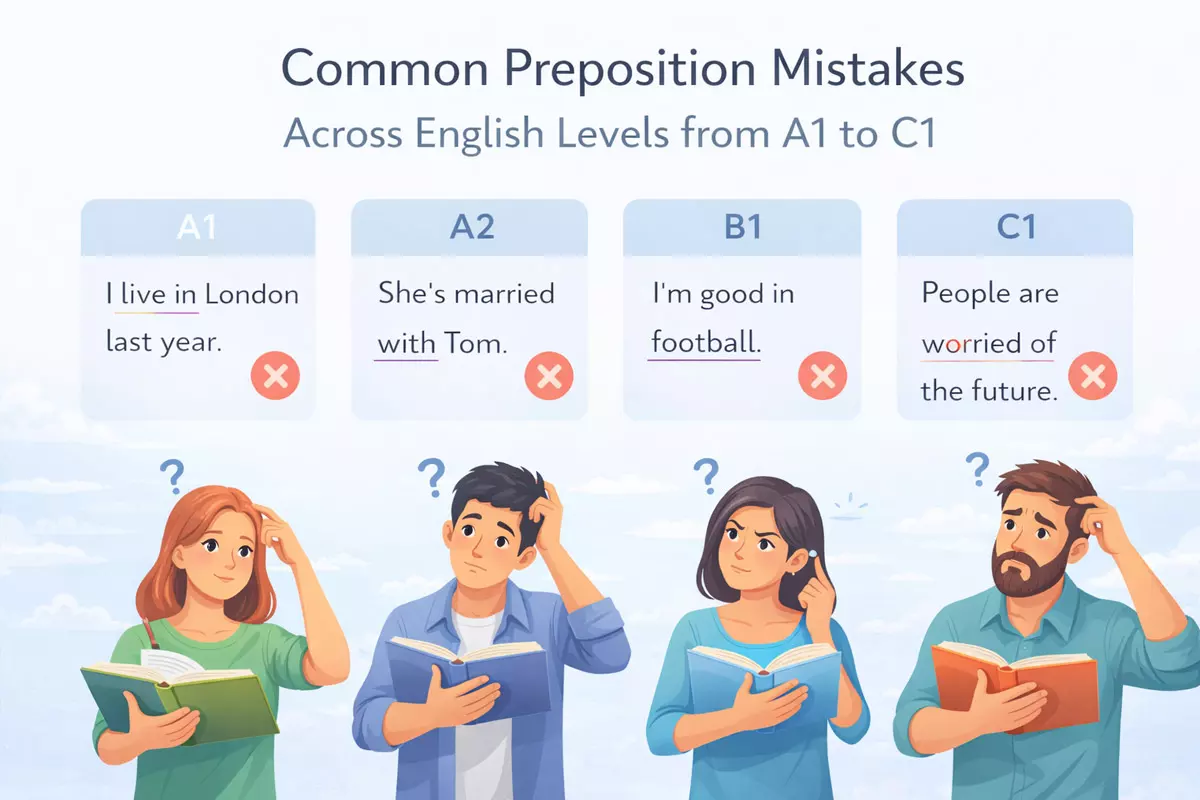 Here we why prepositions are challenging from A1 to C1, details typical mistakes at each level, and provides strategies, practice tasks, and a checklist to help you recognize, diagnose, and improve your preposition use over time.
- Why prepositions stay difficult from A1 to C1
- Beginner-level confusions with basic place and time words
- Intermediate mistakes with verb, noun and adjective patterns
- Advanced errors in academic and formal writing
- Strategies to notice and correct your own preposition issues
- Diagnostic practice tasks to identify your weak areas
- Revision checklist to keep improving over time
Mastering the small but essential words that connect ideas in English is often more challenging than it seems, regardless of a learner’s level. These connectors, such as conjunctions and prepositions, play a crucial role in ensuring sentences flow smoothly and ideas are clearly expressed. Many learners, from beginners to advanced, frequently make similar mistakes with these words, which can lead to confusion and undermine confidence in both writing and speaking. Developing a solid understanding of these connectors is key to achieving clarity and fluency in English communication.
Why prepositions stay difficult from A1 to C1
English learners often find prepositions challenging throughout their studies, even as their overall language skills improve. This is not just a beginner’s problem; intermediate and advanced students also struggle with these small but tricky words. The reasons are both linguistic and practical, and they affect learners at every stage.
Unpredictable Usage and Limited Rules
Unlike verb tenses or noun plurals, prepositions rarely follow clear patterns. In many cases, the “correct” preposition depends on idiomatic usage, not on logic. For example, we say “interested in,” “good at,” and “married to”—even though the prepositions don’t always match their direct translation from other languages. This unpredictability means learners must memorize combinations rather than apply a rule.
Different Meanings in Different Contexts
A single preposition can have several meanings depending on the sentence. For instance, “on” can refer to location (“on the table”), time (“on Monday”), or even involvement (“on a team”). Confusion increases as proficiency grows and learners encounter more abstract or figurative uses.
First Language Interference
Native language habits play a major role in preposition mistakes. For example, Russian speakers might say “married with” (influenced by their own language structure), while Spanish speakers often confuse “in” and “on” for places. As learners progress, these habits can persist unless actively corrected.
Common Problem Areas (with Examples)
- in / on / at (places and times): in London, on the bus, at the station, in the morning, on Friday, at midnight
- for / since: for two hours, since yesterday
- to / at / with (after verbs): listen to, arrive at, agree with
- by / with (means vs. agent): sent by email, written with a pen
- about / of / for (after adjectives): afraid of, excited about, famous for
- prepositions in phrasal verbs: look after, get on, put up with
- prepositions in expressions: in time, on time, at the weekend, in advance
- prepositions for movement: go to, walk into, run across
- prepositions for cause or reason: because of, due to, thanks to
- prepositions with adjectives: good at, interested in, tired of, proud of
- prepositions for possession: the roof of the house
- prepositions in questions: What are you talking about?
Comparing Preposition Use Across Levels
| Level | Typical Preposition Errors |
|---|---|
| A1–A2 | Confusing basic time/place prepositions (in/on/at), omitting prepositions, direct translations from L1 (e.g., “married with” instead of “married to”). |
| B1–B2 | Misusing prepositions in phrasal verbs, after adjectives, and in idiomatic expressions (“interested for” instead of “interested in”). |
| C1 | Errors with abstract or figurative uses, subtle distinctions in meaning (“at risk of” vs. “in danger of”), and less common collocations. |
Why Mastery Takes So Long
The sheer number of collocations, idioms, and exceptions means prepositions require ongoing exposure and practice. Even advanced speakers make occasional mistakes, especially in writing or formal contexts. Regular feedback and attentive reading are essential for reducing errors over time.
Beginner-level confusions with basic place and time words
New English learners often stumble over simple prepositions when talking about where or when things happen. These mix-ups aren’t just about memorizing words—they come from differences between English and a learner’s native language, or from the way English prepositions often overlap in meaning. Getting these right is important for everyday conversations and avoiding misunderstandings.
Common Place Preposition Mix-ups

For locations, beginners frequently confuse “in,” “on,” and “at.” Each has specific uses, but their meanings can seem similar at first glance. For instance, “at the station” vs. “in the station” describes being nearby versus being inside the building. Here are some classic trouble spots:
- at school vs. in school → My children are at school right now.
- on the bus vs. in the bus → I usually read a book on the bus.
- at home vs. in home ❌ → I prefer to stay at home tonight.
- in the room vs. at the room ❌ → There are five people in the room.
- on the table vs. in the table ❌ → Your keys are on the table.
- in a city vs. at a city ❌ → They live in a big city.
- on the street vs. in the street (US/UK difference!) → We saw a street performer on the street.
- at the corner vs. on the corner → There is a small shop at the corner.
Time Words That Cause Trouble
Prepositions of time are another stumbling block. “At,” “on,” and “in” are used for different time expressions, and it’s easy to get them mixed up. A few common errors include:
- in Monday ❌ (correct: on Monday) → We have a team meeting on Monday.
- on 5 o’clock ❌ (correct: at 5 o’clock) → The train leaves at 5 o’clock.
- in the evening (correct!), but at the evening ❌ → I usually go for a walk in the evening.
- on July ❌ (correct: in July) → They got married in July.
- in the weekend (UK: at the weekend, US: on the weekend) → We usually visit our grandparents at the weekend.
- in night ❌ (correct: at night) → The streets are very quiet at night.
Quick Reference: Place vs. Time Prepositions
To help clarify which preposition to use, here’s a side-by-side comparison of some frequent situations:
| Situation | Correct Preposition & Example |
|---|---|
| Months | in: in April |
| Specific days | on: on Friday |
| Clock times | at: at 3:00 |
| Buildings | in: in the library |
| Events | at: at a party |
| Transportation | on: on the train |
| Enclosed spaces | in: in the car |
| Surfaces | on: on the desk |
| Weekend | at/on: at the weekend (UK), on the weekend (US) |
| Night | at: at night |
Getting comfortable with these patterns takes time and practice. Beginners should focus on noticing these prepositions in real conversations and written examples, which will help them build the right instincts for everyday English.
Intermediate mistakes with verb, noun and adjective patterns
When learners reach B1–B2 English, confusion often grows around which prepositions to use with certain verbs, nouns, and adjectives. At this stage, the vocabulary expands, but the rules for preposition use can feel inconsistent or illogical compared to a learner’s native language. These errors can make speech sound unnatural or even change the intended meaning.
Common errors with verbs and prepositions
Some verbs require specific prepositions, while others don’t need one at all. Intermediate learners often select the wrong preposition by translating directly or by analogy with similar verbs.
- depend on (not of): "It depends on the weather."
- listen to: "She listens to music every day."
- explain to someone: "He explained the rules to me."
- wait for: "I’m waiting for the bus."
- agree with (a person), on (a topic): "I agree with you on this point."
- apply for (a job): "She applied for a new position."
- believe in: "He believes in hard work."
- pay for: "Who paid for dinner?"
- arrive at (a place), in (a city/country): "We arrived at the station," "They arrived in London."
Noun + preposition patterns
Certain nouns are followed by particular prepositions, and misuse can cause confusion. Here are commonly mixed-up patterns:
- reason for: "The reason for his absence..."
- increase in: "An increase in prices..."
- solution to: "The solution to the problem..."
- interest in: "Her interest in art..."
- damage to: "Damage to the car..."
Adjective + preposition combinations
Adjectives also often pair with fixed prepositions, which must be memorized. Here are some that regularly cause mistakes:
- afraid of: "She’s afraid of spiders."
- good/bad at: "He’s good at math."
- famous for: "Paris is famous for its cafes."
- interested in: "Are you interested in sports?"
- married to: "She’s married to a doctor."
- similar to: "This is similar to that."
- responsible for: "He’s responsible for the project."
- angry about (something), with (someone): "She’s angry about the delay," "He’s angry with his brother."
Overview of typical intermediate patterns
| Expression | Correct Preposition |
|---|---|
| depend | on |
| interested | in |
| apply | for |
| afraid | of |
| reason | for |
| arrive | at / in |
| good | at |
| solution | to |
| wait | for |
Why these errors happen
Preposition patterns rarely follow logic and are difficult to predict. Many intermediate-level mistakes come from literal translation, false friends, or overgeneralization. The best way to improve is to learn these collocations as set expressions and pay attention to how native speakers use them in context.
Advanced errors in academic and formal writing
Writers at higher proficiency levels often encounter subtle preposition challenges, especially in academic or formal contexts. These issues may not be noticed at lower levels, but can undermine clarity, precision, and professionalism in advanced texts. Even experienced users of English sometimes misuse prepositions with abstract nouns, academic collocations, or formal phrasings.
Common advanced prepositional mistakes
- Confusing “in” and “on” when referring to academic fields (e.g., “research in biology” vs. “research on genetics”)
- Incorrect use of “by,” “with,” and “through” in passive constructions (“analyzed by/with/through a method”)
- Omitting prepositions after certain verbs (“discuss about the issue” instead of “discuss the issue”)
- Mixing up “to,” “for,” and “of” in purpose or result clauses (“crucial to/for/of understanding”)
- Overusing “of” with abstract nouns (“the influence of to society” instead of “the influence on society”)
- Using “at” instead of “in” with institutions (“studied at Oxford” vs. “studied in Oxford”)
- Confusing “between” and “among” in complex comparisons
- Incorrect prepositions in formal reporting verbs (“report on,” “report about,” “report of”)
- Wrong preposition after adjectives (“relevant for” vs. “relevant to”)
- Misplacing prepositions in noun phrases (“opportunity of attending” instead of “opportunity to attend”)
- Omitting required prepositions in fixed expressions (“in accordance with,” “with respect to”)
- Using “during” instead of “in” or “over” for time spans (“during the years” vs. “over the years”)
- Incorrect collocations with “regard” (“in regard to” vs. “with regard to”)
- Using “on” instead of “about” for topics (“a lecture on/about migration”)
- Confusing “at the end of” and “in the end” in conclusions
- Mixing up “because of” and “due to” in formal linking
- Incorrect use of “to” after nouns (“access to information” not “access of information”)
- Misusing prepositions after “concerned” (“concerned with” vs. “concerned about”)
- Using “by” instead of “from” for sources (“data by interviews” instead of “data from interviews”)
- Adding unnecessary prepositions (“emphasize on the importance” instead of “emphasize the importance”)
Comparison of typical advanced prepositional errors
| Incorrect Usage | Correct Usage |
|---|---|
| discuss about the topic | discuss the topic |
| in accordance to regulations | in accordance with regulations |
| relevant for the problem | relevant to the problem |
| the effect to the environment | the effect on the environment |
| concerned about policy | concerned with policy |
| report of the findings | report on the findings |
| analyzed by this method | analyzed using this method |
| studied at Oxford | studied in Oxford |
| the opportunity of attending | the opportunity to attend |
| lecture about migration | lecture on migration |
Strategies for improvement
Recognizing these advanced preposition errors requires both exposure to natural academic language and deliberate practice. Reading academic journals, reviewing formal writing samples, and maintaining a personal list of collocations can help. Paying attention to prepositions in context and using reputable style guides are effective ways to internalize correct usage.
Strategies to notice and correct your own preposition issues
Recognizing and fixing preposition mistakes requires a mix of self-awareness, observation, and practical techniques. Many learners struggle with these small but tricky words, so building a toolkit for self-correction is essential. Here are some effective ways to develop your accuracy and confidence with prepositions.
Pay Attention to Common Error Patterns

Frequent mistakes often cluster around certain verbs, adjectives, and phrases. Start by reviewing which combinations are tricky for you. Keep a personal list of sentences where you’re unsure or have made errors. Over time, you’ll spot patterns unique to your own usage.
- Listen to music (not "listen music") → I often listen to music while I work.
- Interested in something (not "interested on") → She is really interested in astronomy.
- Arrive at a place (not "arrive to") → We usually arrive at the office at 9 a.m.
- Depend on (not "depend of") → Children depend on their parents for support.
- Good at (not "good in" for skills) → He is very good at playing the piano.
- Married to (not "married with") → She is married to a French engineer.
- Wait for (not "wait" alone) → We had to wait for the bus for 20 minutes.
- Different from (not "different than" in formal English) → This design is very different from the old one.
- Go to school (not "go at school") → The kids go to school by bus.
- Afraid of (not "afraid from") → He is afraid of spiders.
- Responsible for → She is responsible for the marketing team.
- Similar to → Your idea is similar to mine.
- Look at (not "look on") → Please look at the board.
- Arrive in a city/country (not "arrive to") → They arrived in London late at night.
- Talk about (not "talk on" or "talk for") → We need to talk about your progress.
- Focus on → Try to focus on the main problem.
- Belong to → This book belongs to my brother.
- Interested in (not "interested by") → I’m interested in learning Italian.
- Good for health (not "good to health") → Regular exercise is good for health.
Compare with Native Usage
Reading and listening to authentic English exposes you to correct preposition patterns. When you spot a difference between your version and a native example, pause and analyze it. Try shadowing: repeat sentences aloud, focusing on prepositions.
Use Focused Practice and Mini-Tests
Short, regular exercises can help reinforce accuracy. Create your own fill-in-the-gap sentences or use online quizzes. After each session, review errors and write a correct version.
Check With Reference Tools
Whenever you’re unsure, consult trusted resources like learner dictionaries or grammar guides. These often include example sentences and typical collocations.
Keep a Personal Correction Log
A simple table or notebook can help you track your most frequent mistakes and their corrections. Here’s a template you might find useful:
| Incorrect Phrase ❌ | Corrected Version ✅ |
|---|---|
| She is married with a doctor | She is married to a doctor |
| I’m good in maths | I’m good at maths |
| Arrive to the airport | Arrive at the airport |
| Depend of my parents | Depend on my parents |
| Wait the bus | Wait for the bus |
Ask for Feedback
Whether in class, with a tutor, or among peers, ask others to point out any awkward preposition use. Sometimes, outside perspectives can catch what you miss.
Reflect and Self-Correct
After writing or speaking, review your work specifically for prepositions. Reading aloud can help you notice awkwardness or missing words. Consistent attention to these details will gradually reduce errors and increase your confidence. Over time, you’ll develop an instinct for which prepositions “sound right” in context.
Diagnostic practice tasks to identify your weak areas
Understanding which prepositions are most challenging at different proficiency levels is key to improving your English accuracy. Below you’ll find a range of practical exercises designed to help you recognize your personal difficulties with prepositions, from basic usage at A1 to more nuanced challenges at C1. Try each activity without a dictionary or grammar guide for the most accurate self-assessment.
1. Spot the error: Common preposition confusions
Read each sentence and decide if the preposition is correct. If not, replace it with the correct one.
- I arrived to the station late.
- She’s interested on learning French.
- Let’s meet in Friday morning.
- The cat jumped in the table.
- This book was written by Shakespeare.
- He apologized for his mistake.
- We discussed about the problem.
- I’m looking forward to see you.
- The keys are on my bag.
- He’s married with a doctor.
Show answers
- to → at
- on → in
- in → on
- in → on
- Correct
- Correct
- about → (no preposition)
- to see → to seeing
- on → in
- with → to
2. Fill in the blank: Preposition selection
Choose the correct preposition for each gap. Some sentences may require no preposition at all.
- I’m good ____ math.
- He depends ____ his friends for help.
- They arrived ____ the airport early.
- This painting is different ____ the others.
- She insisted ____ paying for dinner.
- We’ll see you ____ Monday.
- He’s afraid ____ spiders.
- The movie starts ____ 8 p.m.
- She’s responsible ____ organizing the event.
- I prefer tea ____ coffee.
Show answers
- at
- on
- at
- from
- on
- on
- of
- at
- for
- to
3. Compare prepositions by level
See which prepositions typically cause problems at different proficiency stages. Identify which ones you find most confusing.
| Level | Common Preposition Mix-Ups |
|---|---|
| A1-A2 |
|
| B1-B2 |
|
| C1 |
|
4. Self-reflection checklist
- Do you often confuse prepositions of time (in/on/at)?
- Are there verbs or adjectives that always make you guess the preposition?
- Can you spot when your mother tongue influences your preposition use?
- Which prepositions do you hesitate with most in writing or speaking?
Keep a record of your mistakes as you work through these tasks. Patterns will show you which areas to focus on next.
Revision checklist to keep improving over time
Staying on top of preposition usage requires steady practice and self-awareness. Here’s a practical guide you can use to regularly identify and address your most common errors, whether you’re at a beginner or advanced level. By reviewing your language in context and focusing on tricky areas, you’ll gradually reduce mistakes and develop lasting confidence.
Self-monitoring strategies
- Record yourself or write short texts and highlight all prepositions.
- Check each preposition against a reliable grammar resource or your class notes.
- Look for recurring mistakes (e.g., “in Monday” instead of “on Monday”).
- Ask a teacher, tutor, or language partner to review your work for unnoticed errors.
- Keep a personal list of prepositions you often confuse.
Common patterns to review
- Time: in the morning, at night, on Friday
- Place: at home, in the park, on the bus
- Movement: go to, arrive at, walk into
- Preposition + verb: listen to, depend on, wait for
- Adjective + preposition: interested in, good at, afraid of
- Preposition omission: discuss (no preposition), enter (no preposition)
- False friends: married to (not with), similar to (not with)
- Idiomatic use: by accident, on purpose, in charge of
- Frequent collocations: look at, arrive in (a city), arrive at (a place)
- Prepositions after nouns: reason for, advantage of, solution to
Weekly revision plan
| Task | How to do it |
|---|---|
| Spot your most frequent mistakes | Review your writing and spoken notes, marking all incorrect prepositions ❌. |
| Collect corrected examples | Rewrite sentences with the right prepositions ✅; keep them in a notebook. |
| Practice with targeted exercises | Choose exercises focusing on your weak points (e.g., time or place prepositions). |
| Test yourself regularly | Quiz yourself or use flashcards with sentences missing prepositions; check your answers. |
| Apply prepositions in context | Use new patterns in real conversations or writing; get feedback from others. |
Tips for steady improvement
- Pay attention to prepositions in authentic materials (films, podcasts, articles).
- Repeat and recycle tricky phrases until they feel natural.
- Don’t be afraid to ask for clarification when you hear a new pattern.
- Update your error list every month to track progress.
- Celebrate small wins—fewer mistakes mean real growth!
Consistent, focused revision is the best way to gradually master preposition usage at any level. Use this checklist as a living tool, adapting it as your skills develop and your most common mistakes change over time.