Prepositions in Passive Voice Structures: Form, Use and Clarity

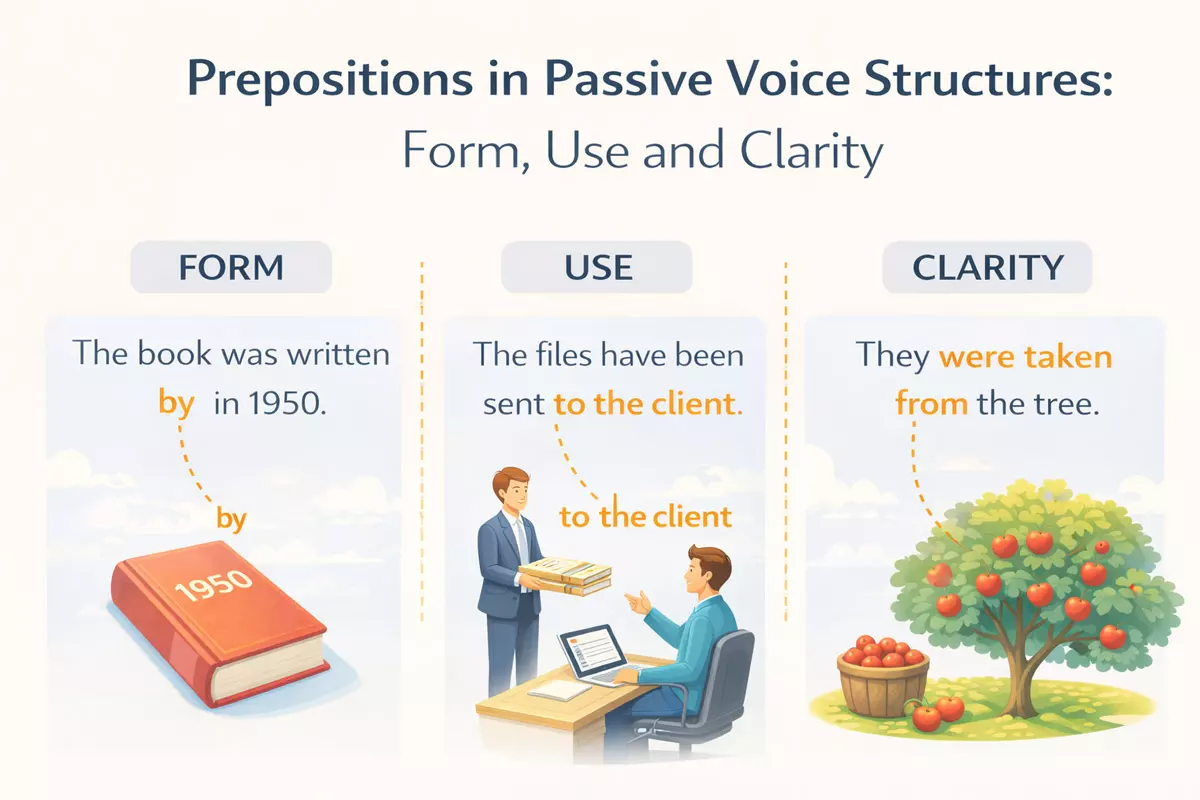 This article explains how to use prepositions like by, with, and through in passive constructions, discusses fixed prepositions after participles, and offers guidance on phrasal verbs, academic passive, and clear reporting. It also includes practice for formal writing.
- The Agent vs. Instrument distinction: Precise use of 'by', 'with', and 'through'
- Stative Passives: Fixed prepositions after participles (e.g., 'covered in', 'filled with')
- Phrasal Verbs in Passive: Avoiding the 'dropped preposition' error in transformation
- Academic Passive: Using 'as' and 'to' for categorization and attribution
- Register-driven placement: Managing prepositions in complex passive chains
- Clarity audit: Identifying 'dangling' agents in technical and news reporting
- Practice: Converting active voice into sophisticated passive structures for formal reports
Understanding how certain words link actions to their receivers can be challenging, particularly when transforming sentences from active to passive voice. Mastering the correct way to connect these elements not only improves sentence structure but also enhances clarity and effectiveness in communication. By recognizing the roles that different parts of a sentence play, writers and speakers can express their ideas more precisely and ensure that their intended meaning is easily understood by their audience.
The Agent vs. Instrument distinction: Precise use of 'by', 'with', and 'through'
Understanding how to clearly express who or what performs an action, and what is used to perform it, is crucial in passive voice structures. English relies on prepositions like by, with, and through to make these distinctions. Each preposition signals a different relationship between the verb, the doer, and the means of the action.
When to Use by: Identifying the Agent
Use by to show who or what actually performs the action in a passive sentence. This "agent" is the person, animal, or force responsible for the verb. For example:
- The cake was eaten by the children.
- The window was broken by the storm.
- The song was written by her.
- The letter was delivered by the postman.
- The decision was made by the committee.
Leaving out the agent is also common when it’s unknown or unimportant.
How with Signals the Instrument
The preposition with introduces the instrument or means used to carry out the action—not the doer, but the tool. For instance:
- The door was opened with a key.
- The picture was painted with a brush.
- The steak was cut with a sharp knife.
- The note was written with a pen.
- The hole was dug with a shovel.
This helps clarify what facilitated the action, distinguishing it from who performed it.
Using through for Means or Process

Through is less common in passive constructions, but it can express the process, medium, or channel by which something happens. For example:
- The news was spread through social media.
- The money was transferred through the bank.
- The message was conveyed through a translator.
- Help was provided through a local charity.
- The error was corrected through an update.
"Through" emphasizes the route or method rather than the agent or tool.
Comparison Table: Prepositions in Passive Voice
| Preposition | Role in Passive Voice | Typical Example |
|---|---|---|
| by | Identifies the agent (doer of the action) | The book was read by Maria. |
| with | Introduces the instrument or tool used | The lock was opened with a code. |
| through | Shows the means, process, or channel | The rumor was spread through email. |
Quick Reference: Distinguishing Agents and Instruments
- By = Who/what did it? ✅
- With = What tool or object was used? ✅
- Through = What process or medium enabled it? ✅
Misusing these prepositions can obscure meaning. For example, "The window was broken with the boy" is incorrect; the boy is the agent, not the instrument. Use "by" for people or forces, "with" for tools, and "through" for channels or processes. This careful distinction keeps passive sentences clear and precise.
Stative Passives: Fixed prepositions after participles (e.g., 'covered in', 'filled with')
Many English participles, especially in passive constructions, are closely linked with specific prepositions. These combinations express a state or condition rather than an action, which is why they are called "stative passives." The preposition is not optional—changing it often makes the phrase ungrammatical or changes its meaning entirely. For learners, memorizing these fixed pairs is essential for natural and accurate usage.
Why Are Prepositions Fixed After Participles?
The choice of preposition is often idiomatic. For example, we say "interested in" but not "interested at," and "filled with" rather than "filled by." These combinations have developed through usage and are rarely predictable from grammar rules alone. Using the wrong preposition can lead to confusion or mark your English as non-native.
Common Participles with Fixed Prepositions
Here are some widely used participle-preposition pairs that express states or conditions:
- accustomed to → She is accustomed to working under tight deadlines.
- addicted to → He became addicted to checking his phone constantly.
- amazed at/by → We were amazed by how quickly she learned the system.
- annoyed with/by/at → She was annoyed at the constant interruptions.
- associated with → This brand is often associated with high quality.
- based on → The decision was based on recent customer feedback.
- committed to → He is committed to improving his professional skills.
- concerned about/with → Parents are concerned about their children’s safety.
- connected to/with → The device is connected to the main network.
- convinced of → She is convinced of the importance of teamwork.
- covered in/with → The field was covered in snow.
- dedicated to → This book is dedicated to her family.
- disappointed in/with/by → He was disappointed with the final results.
- divorced from → She has been divorced from her husband for years.
- equipped with → The classroom is equipped with modern technology.
- filled with → The room was filled with excitement.
- frightened of/by → The child was frightened by the loud noise.
- interested in → She is interested in learning new languages.
- married to → He has been married to his partner for ten years.
- opposed to → Many residents are opposed to the new construction plan.
- pleased with/about → She was pleased with her exam results.
- related to → This issue is closely related to budget planning.
- satisfied with/by → Customers were satisfied with the service.
- shocked at/by → Everyone was shocked by the sudden announcement.
- surprised at/by → I was surprised at how calm he remained.
- tired of → She is tired of repeating the same explanation.
- worried about → He is worried about missing the deadline.
Patterns and Meaning Differences
Some participles work with more than one preposition, but the meaning may change. For example, "annoyed with" usually refers to people, while "annoyed by" can refer to things or actions. Similarly, "covered in" often describes a complete surface, while "covered with" may focus more on the material.
| Participle + Preposition | Example Sentence |
|---|---|
| covered in | The cake was covered in chocolate. |
| filled with | The jar was filled with honey. |
| interested in | She is interested in art history. |
| equipped with | The car is equipped with airbags. |
| committed to | He is committed to improving his skills. |
| married to | She is married to a doctor. |
| worried about | They are worried about the deadline. |
| opposed to | Many are opposed to the new law. |
| related to | This issue is related to our project. |
| associated with | His name is associated with quality work. |
Tips for Mastery
- Learn common participle–preposition pairs as fixed expressions.
- Notice patterns in reading and listening practice.
- Pay attention to meaning shifts when different prepositions are used.
- Practice with real-life examples to reinforce correct combinations.
- Understanding these set phrases is key to producing clear, natural English that accurately expresses states or conditions.
Phrasal Verbs in Passive: Avoiding the 'dropped preposition' error in transformation
When transforming sentences with phrasal verbs into the passive voice, it’s easy to accidentally omit the necessary preposition or particle. This mistake can distort meaning or make sentences grammatically incorrect. Phrasal verbs, which consist of a verb plus a preposition or adverb, require their full structure to remain intact in passive constructions. For example, in “look after,” both “look” and “after” are essential—dropping “after” in the passive form changes the meaning completely.
Understanding the Structure
The passive form of a phrasal verb typically keeps the preposition immediately after the verb phrase. Omitting it is a frequent error, especially for learners who focus only on the main verb during transformation.
Common Errors and How to Avoid Them
- Error: The children were taken by.
- Correct: The children were taken care of by their grandmother.
- Error: The noise was put by.
- Correct: The noise was put up with by the neighbors.
Examples of Phrasal Verbs in the Passive Voice
Maintaining the full phrasal structure is essential. Here are some typical patterns to illustrate proper transformation:
- The meeting was called off due to rain. (call off)
- The mistake was pointed out by the teacher. (point out)
- The issue was brought up at the conference. (bring up)
- The new rules were put into effect last month. (put into effect)
- The problem was dealt with swiftly. (deal with)
- The plan was carried out by the team. (carry out)
- The house was looked after by a caretaker. (look after)
- The offer was turned down by the applicant. (turn down)
- The invitation was sent out yesterday. (send out)
- The rumor was passed on by several people. (pass on)
- The error was picked up during review. (pick up)
- The decision was agreed upon by all parties. (agree upon)
- The room was cleaned up after the event. (clean up)
- The problem was sorted out quickly. (sort out)
- The secret was found out by accident. (find out)
- The law was carried out strictly. (carry out)
- The error was accounted for in the report. (account for)
- The song was played back for the audience. (play back)
- The idea was laughed at by everyone. (laugh at)
Tips for Correct Transformation
- Always identify the full phrasal verb before making it passive.
- Check if the object of the verb can logically become the subject.
- Retain all particles or prepositions—don’t drop them in the passive.
- If unsure, compare with active forms to confirm accuracy.
Comparison: Active vs Passive with Phrasal Verbs
| Active Voice | Passive Voice |
|---|---|
| They looked after the dog. | The dog was looked after by them. |
| We called off the meeting. | The meeting was called off. |
| She pointed out the mistake. | The mistake was pointed out by her. |
| He put up with the noise. | The noise was put up with by him. |
| They turned down the offer. | The offer was turned down by them. |
Remember, clarity and accuracy in passive voice require careful attention to the complete phrasal structure. Leaving out essential prepositions or adverbs can result in sentences that are incomplete or misleading. Always double-check that all parts of the phrasal verb appear in your passive sentences.
Academic Passive: Using 'as' and 'to' for categorization and attribution
Academic writing often requires precise ways to show how people, ideas, or things are categorized or attributed in passive voice structures. Two prepositions—as and to—play a central role in these expressions, each with distinct uses. Understanding the difference helps writers maintain clarity and accuracy in formal contexts.
When to Use 'as' in Passive Structures

The preposition as is frequently used after passive verbs to indicate a role, category, or identity. It answers the question "in what capacity?" or "in what way is something viewed or described?" This structure is common in research, reports, and academic summaries.
- The method was regarded as effective by the research team.
- She is recognized as a leading expert in her field.
- The policy was interpreted as a step forward.
- These results are classified as preliminary.
- The compound is known as a catalyst.
- His actions were perceived as controversial.
- The discovery is described as groundbreaking.
- The site was designated as a protected area.
- This approach is viewed as outdated.
- The event was celebrated as a major achievement.
Using 'to' for Attribution in Passive Voice
The preposition to is typically used to attribute actions, characteristics, or works to a person or source. It points to the originator or the person/group responsible for something, often in passive constructions.
- The theory is attributed to Einstein.
- The quotation is ascribed to Shakespeare.
- The invention was credited to Tesla.
- The discovery was traced to early researchers.
- The error was assigned to a technical glitch.
- The manuscript is dedicated to her mentor.
- The cause was linked to environmental factors.
- The result was compared to previous findings.
- The effect was related to temperature changes.
- The project was entrusted to the new committee.
Comparison of 'as' and 'to' in Academic Passive
| Function | Typical Passive Structure |
|---|---|
| Role or categorization (using 'as') | is/was + past participle + as + category/role e.g. The patient was diagnosed as diabetic. |
| Attribution to a source or agent (using 'to') | is/was + past participle + to + person/group/source e.g. The discovery is attributed to Dr. Smith. |
| Describing perception or interpretation (with 'as') | is/was + past participle + as + description e.g. The result was interpreted as significant. |
| Assigning responsibility or origin (with 'to') | is/was + past participle + to + cause/origin e.g. The failure was linked to budget cuts. |
Summary
In summary, as is used for roles, categories, or perceptions, while to signals attribution or origin. Choosing the correct preposition supports clarity and precision in passive voice constructions, which is especially important in academic and technical writing.
Register-driven placement: Managing prepositions in complex passive chains
Understanding how formality and context influence preposition placement in passive structures is essential for clear and effective communication. In academic and technical registers, prepositions are often positioned at the end of long passive chains, sometimes resulting in sentences that sound awkward or overly formal. In contrast, more conversational registers tend to prefer splitting the prepositional phrase or rephrasing entirely to maintain flow and clarity.
Influence of Register on Preposition Position
The level of formality determines not only the structure of a passive sentence but also the acceptability of leaving prepositions at the end. For instance, in formal writing, "The outcome was decided upon by the committee" is favored over the more direct, "The committee decided upon the outcome." Register also shapes how much complexity is tolerated before clarity suffers.
- Academic: The proposal was referred to by several reviewers.
- Technical: The device was operated on by a trained technician.
- Conversational: That’s the book I was talking about.
- Legal: The contract was entered into by both parties.
- Bureaucratic: The request was acted on in accordance with procedure.
- Journalistic: The case was reported on last night.
- Instructional: The steps were gone through carefully.
- Literary: The subject was mused upon at length.
- Business: The figures were accounted for in the final report.
- Scientific: The sample was experimented on in the lab.
Complex Passive Chains and Preposition Placement
Long passive constructions with multiple clauses often lead to confusion about where to position the preposition. In some cases, moving the preposition earlier in the sentence or rephrasing into the active voice can dramatically improve readability. However, in highly formal contexts, ending with a preposition may still be preferred for precision.
| Register | Example (Preposition Placement) | Alternative (More Natural/Clarity) |
|---|---|---|
| Academic | The theory was built upon by later researchers. | Later researchers built upon the theory. |
| Conversational | This is the topic I was asked about. | I was asked about this topic. |
| Technical | The component was worked on by several teams. | Several teams worked on the component. |
| Legal | The agreement was entered into by both parties. | Both parties entered into the agreement. |
| Business | The budget was signed off on by management. | Management signed off on the budget. |
Strategies for Clarity in Passive Chains
When dealing with lengthy or nested passive sequences, clarity should guide prepositional placement. Consider the following approaches:
- Rephrase to active voice when possible.
- Move the preposition earlier if it aids understanding.
- Break up long sentences into shorter ones.
- Use relative clauses for smoother integration.
- Match the register: reserve end-position prepositions for formal writing.
- Favor natural phrasing in spoken or informal contexts.
- Avoid stacking multiple prepositional phrases at the end of a sentence.
- Use clear referents to avoid ambiguity.
- Check for unintended changes in meaning when repositioning prepositions.
- Read aloud to ensure the sentence flows smoothly.
Ultimately, balancing register expectations with the need for clarity will guide writers and speakers in making effective choices about preposition placement in complex passive chains.
Clarity audit: Identifying 'dangling' agents in technical and news reporting
In technical writing and journalism, passive voice constructions often result in the agent—the performer of an action—being omitted or obscured. This can leave readers guessing about responsibility, especially when the prepositional phrase that should clarify the agent is missing or vague. Identifying these so-called "dangling" agents is crucial for maintaining transparency and precision.
Why 'dangling' agents matter
When the agent is left out, the reader may not know who enacted the process or decision. In technical documents, this can make procedures hard to follow or audit. In news stories, unclear agency can obscure accountability, making reports less trustworthy.
Common patterns where agents are omitted
Writers frequently rely on passive structures for objectivity or focus, but this can backfire if the actor is essential to understanding. Typical contexts include:
- Instructions and manuals ("The device was calibrated before use.")
- Policy descriptions ("It was decided that...")
- Incident reports ("The error was discovered at 3 a.m.")
- News leads ("The statement was released yesterday.")
- Scientific articles ("Samples were collected from...")
- Legal documents ("The contract was signed.")
- Technical updates ("The system was upgraded in May.")
- Press releases ("A new product was launched.")
- Financial reports ("Funds were allocated to...")
- Emails and memos ("The meeting was postponed.")
Spotting and revising ambiguous passives
To improve clarity, look for passive constructions where:
- The sentence omits "by [agent]" entirely
- The agent is a vague noun ("by authorities," "by sources")
- The context does not make the agent obvious
- Key information is missing, leading to ambiguity
Examples of ambiguous vs. clarified agents
Below is a comparison of sentences with and without clear agency, showing how including a prepositional phrase (e.g., "by the technician") can resolve confusion:
| Ambiguous Passive | Clarified Agent |
|---|---|
| The results were published. | The results were published by the research team. |
| The system was shut down. | The system was shut down by the IT department. |
| The announcement was made. | The announcement was made by the spokesperson. |
| The error was corrected. | The error was corrected by the technician. |
| The policy was updated. | The policy was updated by the board. |
| The report was submitted. | The report was submitted by the analyst. |
| The samples were collected. | The samples were collected by field researchers. |
| The data was reviewed. | The data was reviewed by auditors. |
| The contract was signed. | The contract was signed by both parties. |
| The funds were allocated. | The funds were allocated by the finance committee. |
Best practices for clear attribution
Whenever possible, specify the agent responsible for an action, especially in contexts where accountability and traceability are important. Use prepositional phrases (usually introduced by "by") to make agency explicit. This approach not only enhances readability but also strengthens the credibility of both technical and news writing.
Practice: Converting active voice into sophisticated passive structures for formal reports
Mastering the transformation of active sentences into refined passive constructions is essential for formal writing, especially in reports where objectivity and clarity are priorities. This section provides targeted exercises and guidance to help you develop nuanced passive structures, including the effective use of prepositions and agent phrases for a more polished academic or professional tone.
Common Patterns for Passive Constructions
When converting active sentences, consider not only the basic subject-verb-object shift but also the inclusion of relevant prepositions (such as by, with, to, at, for, or about) to clarify the agent or instrument, or to specify the context. Here are common patterns and vocabulary often used in formal passives:
- by + agent (when the doer is important): “was completed by the team”
- with + instrument: “was measured with a calibrated device”
- to + recipient: “was delivered to the client”
- at + location/time: “was presented at the conference”
- for + purpose/beneficiary: “was developed for industrial use”
- about + topic: “was discussed about extensively”
- upon + condition: “was activated upon request”
- from + source: “was obtained from the archive”
- over + period: “was observed over several months”
- through + method: “was achieved through collaboration”
Transformation Exercise: Active to Passive in Formal Contexts
Convert the following active sentences into sophisticated passive forms suitable for reports. Pay special attention to the clarity of prepositional phrases and the inclusion of agents or instruments only when necessary.
- The research team analyzed the data using advanced software.
- The committee will review your application next week.
- The technician repaired the equipment with specialized tools.
- They distributed the survey to all participants.
- A surge in demand prompted the company to increase production.
- Scientists observed the phenomenon during the experiment.
- We have included the results in the appendix.
- The authorities issued new guidelines for public safety.
- The artist created the sculpture from recycled materials.
- The manager will announce the decision at the meeting.
Show answers
- The data was analyzed using advanced software by the research team.
- Your application will be reviewed by the committee next week.
- The equipment was repaired with specialized tools by the technician.
- The survey was distributed to all participants.
- Production was increased by the company due to a surge in demand.
- The phenomenon was observed during the experiment by scientists.
- The results have been included in the appendix.
- New guidelines for public safety were issued by the authorities.
- The sculpture was created from recycled materials by the artist.
- The decision will be announced at the meeting by the manager.
Expanded Passive Forms: Formal Report Language
To further refine your passive constructions, consider the following techniques:
- Use nominalizations: “The analysis was conducted…” instead of “They analyzed…”
- Emphasize process over agent, omitting the doer if unimportant
- Employ hedging: “It is believed that…” or “It has been suggested that…”
- Integrate prepositional phrases for clarity: “was carried out under controlled conditions”
- Combine multiple prepositional phrases: “was approved by the board in March for immediate implementation”
- Choose passive infinitives for recommendations: “To be completed by the end of the quarter”
- Use passive gerunds: “Being monitored by experts”
- Apply modal passives: “should be considered,” “can be observed”
- Frame results impersonally: “It was found that…” or “It has been demonstrated…”
- Include agent phrases only if critical for context
Quick Check: Spot the Prepositional Phrase
Identify the prepositional phrase(s) in each of the following passive sentences:
- The samples were examined under a microscope by the technician.
- The proposal was submitted to the board for approval.
- The data has been stored in a secure location since March.
- The equipment was operated with extreme caution during the trial.
- The results were shared with the team after the meeting.
- The report was prepared by the analyst for the client.
- The materials were kept in sealed containers until the inspection.
- The device was connected to the network during installation.
- The medication was administered to the patient by a nurse.
- The experiment was repeated under identical conditions in the laboratory.
Show answers
- under a microscope; by the technician
- to the board; for approval
- in a secure location; since March
- with extreme caution; during the trial
- with the team; after the meeting
- by the analyst; for the client
- in sealed containers; until the inspection
- to the network; during installation
- to the patient; by a nurse
- under identical conditions; in the laboratory