During vs Over vs Throughout: Length of Time and Usage Guide

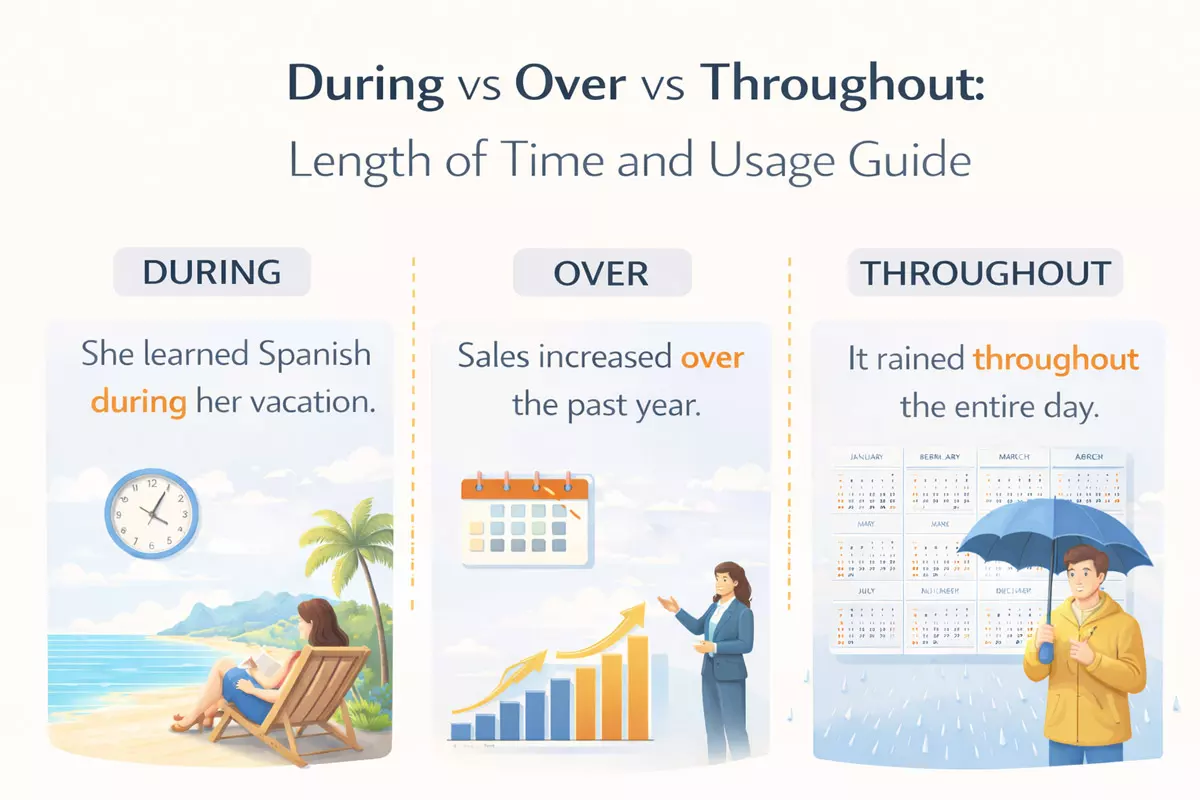 The article explains how to use during, over, and throughout to distinguish specific events, trends, and uninterrupted periods. It covers their nuances, common collocations, and how context shapes meaning, with examples from history and science.
- The Interval Logic: Differentiating specific events (during) from continuous periods (throughout)
- Measuring change: Using 'over' for trends, developments, and comparative time-spans
- Emphasis on Totality: 'Throughout' as a tool for indicating 'from start to finish' without interruption
- Static vs. Dynamic contexts: When 'during' identifies a point in time vs. 'over' identifying duration
- Collocation constraints: Common patterns with 'holiday', 'period', 'century', and 'duration'
- Nuance and Intent: How switching between 'during' and 'throughout' alters authorial focus
- Practice: Comparative analysis of temporal prepositions in historical and scientific contexts
Selecting the correct word to express the duration of an event can be challenging, particularly with terms such as during, over, and throughout, each carrying a slightly different meaning. During is typically used to indicate something happening at some point within a period or event, while over often suggests that something continues at intervals or spans an entire period. Throughout, on the other hand, emphasizes that something occurs continuously from the beginning to the end of a period. Understanding these subtle distinctions will help you communicate more precisely and naturally in English.
The Interval Logic: Differentiating specific events (during) from continuous periods (throughout)
Understanding the distinction between "during" and "throughout" is about recognizing how English expresses time and duration. "During" is typically used to highlight something that happens at one or more points within a defined timeframe—think of it as spotlighting specific events within a larger block of time. In contrast, "throughout" signals something continuous or regular stretching across the entire period in question, with little to no interruption.
Pinpointing vs. Spanning: How "During" and "Throughout" Work
When someone says an event happened "during" a meeting, they're referring to something that occurred at some moment while the meeting was in session—not necessarily the whole time. "Throughout" a meeting, on the other hand, implies that something persisted from the start to the end of the meeting, covering the entire span.
- During: Used for particular incidents or actions within a period (e.g., "He sneezed during the performance").
- Throughout: Used for ongoing actions or states that last the whole period (e.g., "She was nervous throughout the interview").
- "During" can imply frequency, but not continuity; "throughout" emphasizes unbroken presence or repetition.
- Both relate to time, but the focus—spot event vs. entire duration—is different.
Practical Examples: Spot the Difference
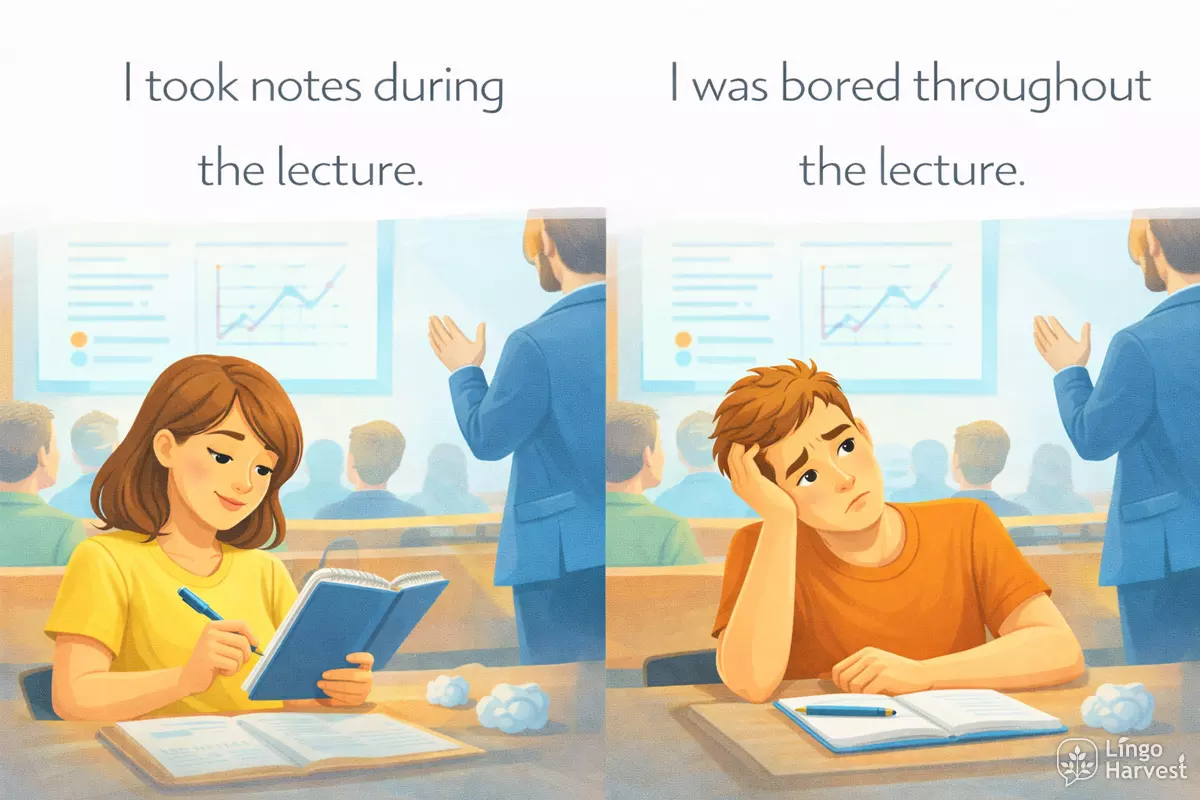
Consider the following situations to clarify the contrast:
- I took notes during the lecture. → (at specific times, not the whole time)
- I was bored throughout the lecture. → (the entire lecture)
- It rained during the night. → (at some point in the night)
- It rained throughout the night. → (all night long)
- People laughed during the movie. → (at certain moments)
- There was tension throughout the meeting. → (never stopped)
- I fell asleep during the flight. → (at one point, not the whole time)
- He was uncomfortable throughout the flight. → (from takeoff to landing)
- The lights flickered during the storm. → (intermittently)
- The power was out throughout the storm. → (the entire storm)
Summary Table: "During" vs. "Throughout" in Use
| Usage | Example Sentence |
|---|---|
| Specific moment(s) within a period (during) |
I coughed during the concert. |
| Continuous, unbroken action over the whole period (throughout) |
Applause continued throughout the concert. |
| Repeated events, not constant (during) |
She asked questions during the lesson. |
| State or activity from start to finish (throughout) |
He smiled throughout the lesson. |
In summary, "during" pinpoints events or actions happening at intervals inside a timeframe, while "throughout" covers what persists or repeats the whole way through. Choosing the right word clarifies whether you mean an isolated event or an uninterrupted stretch.
Measuring change: Using 'over' for trends, developments, and comparative time-spans
When you want to highlight how something changes or evolves within a specific period, 'over' is the preposition that naturally fits. It's commonly chosen to mark the span during which a trend, increase, decrease, or transformation happens. This usage is especially frequent in news, reports, and everyday conversation about progress or decline.
Highlighting trends and progress
'Over' is ideal for expressing measurable movement or development. For example, you might say, “The population doubled over the last decade,” which points to a change that occurred within a defined frame. This construction is used for both positive and negative trends.
- Sales have increased over the past year.
- Unemployment rates dropped over the summer.
- Technology advanced rapidly over the 2010s.
- The river’s level fluctuated over the spring months.
- She improved her skills over several weeks.
- Interest in the topic grew over time.
- They renovated the house over two years.
- Crime rates declined over the previous decade.
- Profits soared over the holiday season.
- The city expanded over the 20th century.
Comparing time-spans and developments
'Over' also helps compare how something has changed from one period to another. It's especially useful when discussing data, statistics, or historical developments.
| Example Phrase | Usage Context |
|---|---|
| Over the last five years, emissions have fallen. | Describes environmental change within a set period. |
| Profits doubled over the last quarter. | Compares financial performance between time-spans. |
| Over centuries, the language has evolved. | Highlights gradual development across longer eras. |
| Over the course of the project, new challenges emerged. | Tracks developments or obstacles during an activity. |
Key takeaways for 'over' in time expressions
- Use 'over' to focus on change, progress, or development within a time frame.
- It fits naturally with statistics, trends, or comparisons.
- Unlike 'during' or 'throughout', 'over' emphasizes the process or evolution, not just presence or continuity.
- Common with words like years, months, centuries, time, period, season, and course.
In summary, 'over' is your go-to preposition for discussing how things shift, grow, or decline across a measurable period, making it essential for anyone describing trends or comparing time-based developments.
Emphasis on Totality: 'Throughout' as a tool for indicating 'from start to finish' without interruption
When you need to express the idea that something happens during the entire span of a period, “throughout” is the most precise choice. This word highlights completeness—suggesting there is no break or gap in the action or state. Unlike “during” or “over,” which can imply occurrence at any point or intermittently within a timeframe, “throughout” insists on continuity from the beginning to the end.
How 'Throughout' Functions in Sentences
“Throughout” is commonly used to show that an event, feeling, or condition persists for the whole duration. It works well with time periods, locations, and even abstract states. Here are some typical uses:
- She felt nervous throughout the interview. ✅
- It rained throughout the night. ✅
- There was laughter throughout the house. ✅
- He remained calm throughout the ordeal. ✅
- The museum is open throughout the year. ✅
- They traveled throughout the country. ✅
- New policies were implemented throughout the company. ✅
- Celebrations took place throughout the city. ✅
- The theme recurs throughout the novel. ✅
- He worked throughout his life to improve education. ✅
Key Points of Distinction
While “during” and “over” can suggest something happens at some point or repeatedly in a period, “throughout” is unique in highlighting unbroken presence or action. For those learning English, this distinction helps avoid ambiguity when you mean “from start to finish without any interruption.”
| Usage | Meaning/Effect |
|---|---|
| During | At some point(s) within a period; does not imply continuity |
| Over | Can mean “at intervals throughout” or “across the span of”; sometimes continuous, but not always |
| Throughout | From the beginning to the end, with no interruption or gaps; totality is emphasized |
When Should You Use 'Throughout'?
Opt for “throughout” when you want to stress that something persists for an entire period or across all parts of a place or process. It’s especially useful for emphasizing total coverage or unbroken duration, whether you’re talking about time, space, or experience. This makes your meaning clear and avoids the vagueness that can come with “during” or “over.”
Static vs. Dynamic contexts: When 'during' identifies a point in time vs. 'over' identifying duration
Understanding how "during" and "over" function in relation to time can help you communicate with greater precision. "During" typically highlights a specific, often static, point or event within a broader timeframe, whereas "over" suggests a dynamic process or continuous activity that stretches across a duration.
How "during" pinpoints moments

When using "during," the focus is usually on a particular event, phase, or occurrence within a set period. It's less about the entirety of the span and more about what happens at any instant inside that window. For example:
- She fell asleep during the movie.
- He stayed calm during the storm.
- Questions arose during the meeting.
- Lights went out during the performance.
- They laughed during dinner.
- We met during the break.
- I got a call during the lecture.
These examples show "during" as tied to a particular event or a static moment within a longer activity.
How "over" expresses ongoing or dynamic duration
"Over" differs by emphasizing a process or something that unfolds throughout an interval. It's about the ongoing nature, not just a point. Notice the distinction in these uses:
- She improved over the summer. → (continuous progress)
- The city changed over the years.
- We traveled over the weekend.
- He worked over the holidays.
- Prices dropped over the past decade.
- The team trained over several months.
- Habits formed over time.
Here, "over" covers the full stretch of time, highlighting movement or development.
Comparison of "during" vs. "over" in time expressions
To clarify the difference, here are common time expressions and how each preposition shifts the meaning:
| Expression with "during" | Expression with "over" |
|---|---|
| during the meeting (at some point in the meeting) |
over the meeting (throughout the meeting) |
| during the night (at a moment in the night) |
over the night (from start to end of the night) |
| during the exam (at a specific point in the exam) |
over the exam period (across the whole exam period) |
| during the crisis (at a point in the crisis) |
over the crisis (through the duration of the crisis) |
| during lunch (sometime in lunch) |
over lunch (throughout the lunch period) |
Quick tips for choosing between "during" and "over"
- Use "during" when you want to refer to something happening at a particular moment in a period.
- Choose "over" for actions, changes, or processes that span the whole duration.
- "During" fits best with events or interruptions; "over" fits with development or gradual change.
- Remember: Not all time periods work naturally with both; e.g., "over the exam" is less common than "over the exam period."
Understanding these nuances helps you express timing and duration with clarity.
Collocation constraints: Common patterns with 'holiday', 'period', 'century', and 'duration'
Understanding which prepositions to use with words like "holiday", "period", "century", and "duration" helps your English sound more natural. These nouns often appear with "during", "over", or "throughout"—but not every combination is correct or idiomatic. Here’s how these words typically pair up in real usage.
Usual prepositions with each noun
- During a holiday / a period / the century / the duration
- Over the holiday / a period / the century
- Throughout the holiday / the period / the century / the duration
Typical patterns and their nuances
The choice of preposition can subtly change the meaning. "During" usually refers to something happening at some point inside the time frame. "Over" emphasizes the span or spread of events across the time. "Throughout" highlights that something persisted for the entire length.
Common usage examples
- We traveled during the holiday.
- Many changes occurred over the century.
- It rained throughout the period.
- The rule applies for the duration of the event. (Note: "for" works with "duration," not "during" or "over".)
- She read several books over the holidays.
- There were protests throughout the century.
- He felt relaxed during his holiday.
- We stayed indoors throughout the duration of the storm.
- Profits increased over the period.
- They worked hard during the period of transition.
- Improvements continued throughout the duration of the project.
- Many traditions evolved over the centuries.
- She was unavailable during the duration of her trip. ❌ (unnatural; "for the duration" is correct here.)
- Classes are closed over the holidays.
- There was unrest throughout the century.
- We met several times during the period of negotiations.
Structured comparison of preposition use
| Noun | During | Over | Throughout |
|---|---|---|---|
| holiday | ✅ (e.g., during the holiday) | ✅ (e.g., over the holiday) | ✅ (e.g., throughout the holiday) |
| period | ✅ (during the period) | ✅ (over the period) | ✅ (throughout the period) |
| century | ✅ (during the century) | ✅ (over the century) | ✅ (throughout the century) |
| duration | ❌ ("during the duration" is not natural) | ❌ ("over the duration" is rare) | ✅ (throughout the duration) |
Key takeaways
- During is flexible with most time nouns except duration, where for is preferred.
- Over works well when talking about events spread across a period or a holiday.
- Throughout stresses continuity for the whole time frame, especially with period, century, and duration.
- For duration, avoid during the duration and over the duration; use for the duration or throughout the duration instead.
- Knowing these common pairings helps you choose the right preposition and sound more fluent.
Nuance and Intent: How switching between 'during' and 'throughout' alters authorial focus
Choosing between "during" and "throughout" is more than a matter of style—it shapes how readers perceive the relationship between actions and timeframes. "During" typically suggests that something happens at one or more points within a larger period, but not necessarily the whole time. In contrast, "throughout" emphasizes continuity, implying that an action or condition persists from beginning to end of the referenced span.
Shifting Emphasis: Partial vs. Continuous
Writers use these terms to fine-tune the sense of duration and frequency. Imagine a narrative about a conference:
- During the conference, she visited several workshops. (Suggests she attended some, but not all, sessions.)
- Throughout the conference, she took detailed notes. (Implies she was note-taking the entire time.)
This subtle shift can alter the reader's impression of engagement, presence, or emphasis on consistency.
Common Patterns and Authorial Choices
Authors often select "during" when they want to spotlight individual events or discrete moments. "Throughout," on the other hand, is favored for describing ongoing states or repeated actions that span an entire period. Consider these examples that illustrate the typical uses and effects:
- During the exam, he coughed twice.
- Throughout the exam, he felt nervous.
- She smiled during the movie.
- The rain fell throughout the night.
- Noise was present during construction.
- Silence reigned throughout the building.
- He laughed during dinner.
- The mood was tense throughout the meeting.
- Lights flickered during the storm.
- Morale stayed high throughout the project.
- Interruptions occurred during the lecture.
- Confusion lingered throughout the discussion.
- Applause broke out during her speech.
- Enthusiasm was evident throughout the performance.
- She checked her phone during the break.
- Security was tight throughout the event.
- Complaints arose during the process.
- Excitement lasted throughout the evening.
Comparing Usage: Clarity and Reader Expectations
Writers can leverage these distinctions to clarify meaning or to subtly influence the pace and focus of a passage. When an author replaces "during" with "throughout," it signals to readers that something is more persistent and possibly more significant. This can affect tone, pacing, and even the perceived importance of the described actions.
| Expression | Implication |
|---|---|
| During the meeting, she spoke. | She spoke at some point(s), not continuously. |
| Throughout the meeting, she took notes. | She took notes consistently from start to finish. |
| During the year, sales increased. | There were moments or periods of increase. |
| Throughout the year, sales increased. | The increase was steady or ongoing all year. |
| During the performance, the lights dimmed. | The lights dimmed at one or more points. |
| Throughout the performance, the audience was silent. | The silence lasted for the entire performance. |
Ultimately, these choices let authors direct attention—either to isolated incidents or to sustained experiences—helping to craft more precise and evocative narratives.
Practice: Comparative analysis of temporal prepositions in historical and scientific contexts
Understanding the nuanced use of "during," "over," and "throughout" is crucial for accurate communication in both historical and scientific writing. Each preposition implies a different relationship with time, and their correct application can alter the meaning of a sentence, especially when describing events or processes.
Comparing Usage in Context
Consider how these prepositions function when we describe events in history or ongoing processes in science. "During" often refers to a specific event or period, "over" suggests a span or duration, and "throughout" emphasizes coverage of the entire period.
- During the Renaissance, art and science flourished in Europe.
- Over several decades, the scientific method evolved.
- Throughout the 20th century, technological innovation accelerated.
Structured Comparison Table
Below is a table highlighting key distinctions and examples to clarify how each temporal preposition is applied in historical and scientific contexts.
| Preposition | Typical Use | Example (Historical/Scientific) |
|---|---|---|
| During | Points to a specific event or defined period within a larger timeframe. | During the experiment, temperature was monitored closely. |
| Over | Indicates a time span that something extends across, often with change or development. | Over the last century, medical knowledge has grown significantly. |
| Throughout | Stresses continuous presence or activity for the entire duration. | Throughout history, societies have recorded astronomical events. |
| Incorrect usage | Mixing up prepositions can result in awkward or unclear sentences. | ❌ Over the Renaissance, art flourished. (should be "During") |
Practice: Identify the Correct Preposition
- _____ the Middle Ages, advances in architecture were notable.
- _____ the last 50 years, computing power has increased exponentially.
- _____ the entire study, researchers observed no anomalies.
- _____ World War II, many scientific breakthroughs occurred.
- _____ the last ice age, the climate changed dramatically.
- _____ the 19th century, industrialization spread rapidly.
- _____ the process, safety protocols were followed.
- _____ the 1800s, telegraphy became widespread.
- _____ ancient times, people have used herbs as medicine.
- _____ the experiment, data was collected every hour.
Show answers
- During
- Over
- Throughout
- During
- Over
- Throughout
- During
- Throughout
- Throughout
- During
Discussion: Subtle Differences in Meaning
Choosing the right preposition can subtly shift the focus of a statement. For instance, "over the century" suggests gradual change, while "throughout the century" implies consistent presence or repetition. Try rewriting the following sentences by substituting different prepositions and observe how the meaning changes.
- The theory developed over several years. (What happens if you use "during" or "throughout"?)
- New laws were enacted during the reign of Queen Victoria. (How does this differ from "over"?)
- Pollution levels remained high throughout the decade. (What if you use "over" instead?)