Because of vs Due to vs Owing to: Reason Prepositions Explained

 The article distinguishes adjectival due to from adverbial because of, reviews grammar rules for due to, discusses formal alternatives like owing to and on account of, covers clausal transformation, sentence placement, redundancy, and optimal usage in academic or news…
- The Syntactic Split: Differentiating Adjectival (due to) from Adverbial (because of) usage
- Prescriptive Grammar rules: When 'due to' must follow the verb 'to be'
- Register and Formality: Using 'owing to' and 'on account of' for professional and legal distance
- Clausal Transformation: Converting 'because' (conjunction) into prepositional reason markers
- Sentence Placement: Fronting 'owing to' for emphasis vs. mid-sentence causal links
- Redundancy check: Eliminating 'the reason why is due to' and other tautological errors
- Practice: Stylistic editing—selecting the optimal reason marker for academic and news registers
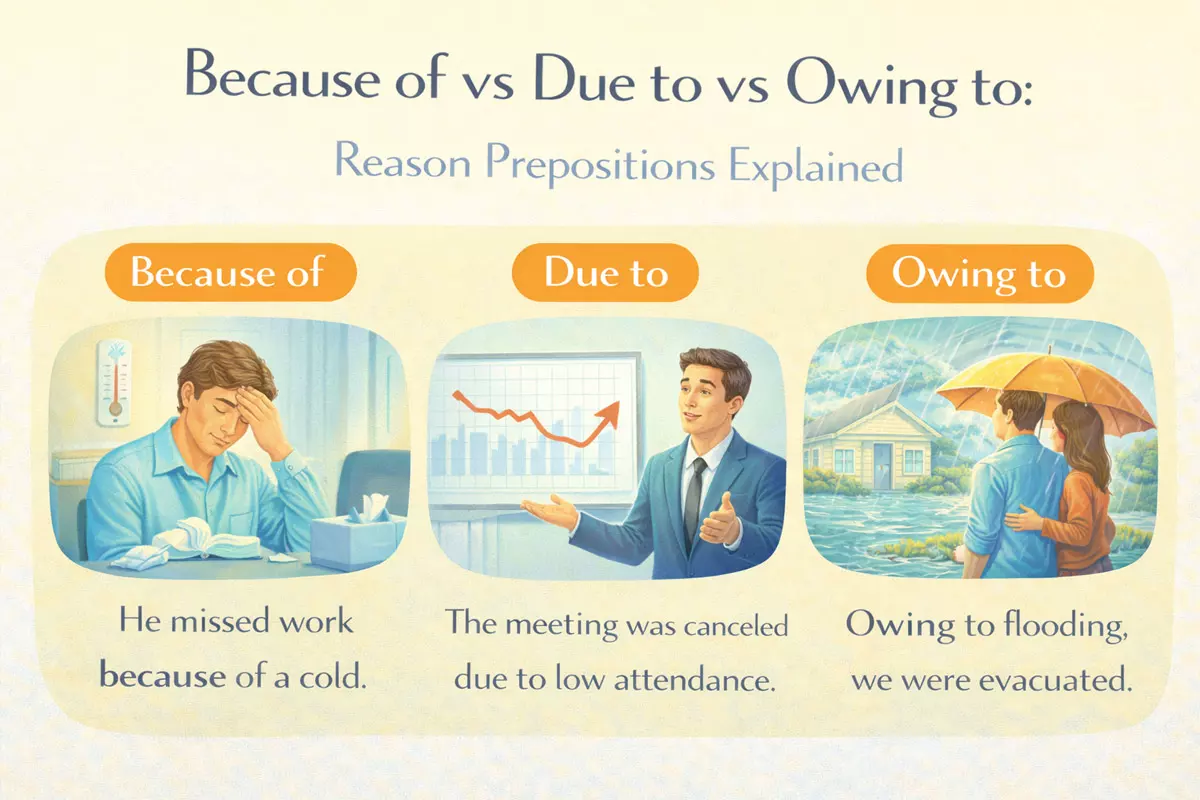
Phrases like because of, due to, and owing to are often used to express reasons or causes, but they are not always interchangeable. Because of is generally used after a verb to explain why something happens, as in The game was canceled because of rain. Due to typically follows a form of the verb to be and modifies nouns, for example, The cancellation was due to rain. Owing to is similar to due to and is often used in more formal writing, as in The event was postponed owing to unforeseen circumstances. Choosing the right phrase helps clarify your meaning.
The Syntactic Split: Differentiating Adjectival (due to) from Adverbial (because of) usage
Understanding the difference between "due to" and "because of" hinges on how each functions within a sentence. "Due to" typically acts as an adjective, modifying nouns. On the other hand, "because of" is used adverbially, explaining the reason for a verb, adjective, or another adverb. This distinction isn't just stylistic—it's rooted in grammar and can affect clarity and correctness, especially in formal writing.
Adjectival Role: "Due to"
"Due to" should follow a form of the verb "to be" (is, was, were, etc.) and directly relate to a noun. It's best used when you want to attribute a state or condition to a specific cause.
- The flight delay was due to fog.
- Her absence is due to illness.
- The cancellation was due to a scheduling conflict.
- His success is due to hard work.
- The damage was due to flooding.
- The confusion was due to poor instructions.
- The low turnout was due to bad weather.
- The error was due to a miscalculation.
- Her fatigue was due to jet lag.
- The closure was due to renovations.
Adverbial Role: "Because of"
"Because of" modifies verbs and tells us why something happened. It doesn't directly modify a noun but instead gives the reason for an action or event.
- The flight was delayed because of fog.
- She missed the meeting because of illness.
- The event was canceled because of a scheduling conflict.
- He succeeded because of hard work.
- The house was damaged because of flooding.
- People were confused because of poor instructions.
- Few attended because of bad weather.
- The team lost because of a miscalculation.
- She felt tired because of jet lag.
- The store closed because of renovations.
Quick Comparison

To clarify the difference, here's a side-by-side look at how each phrase fits into typical sentence structures:
| "Due to" (Adjectival usage) | "Because of" (Adverbial usage) |
|---|---|
| The cancellation was due to rain. | The event was canceled because of rain. |
| His absence is due to illness. | He was absent because of illness. |
| The damage was due to negligence. | The building was damaged because of negligence. |
| The delay was due to traffic. | We arrived late because of traffic. |
Tips for Usage
- If you can substitute "caused by" for the phrase, "due to" is likely correct.
- When modifying a verb or whole clause, "because of" is usually the better choice.
- In formal contexts, following these guidelines improves clarity and precision.
- For informal speech, the distinction is often blurred, but careful writers and editors still observe it.
Recognizing the grammatical function of each phrase helps avoid common errors and ensures your writing is both correct and clear.
Prescriptive Grammar rules: When 'due to' must follow the verb 'to be'
Traditional grammar guides often insist that "due to" should function as an adjective phrase, modifying a noun or pronoun. This means "due to" is typically correct only after a form of the verb "to be" (am, is, are, was, were, etc.), and not as a general-purpose preposition for giving reasons. In other words, "due to" is best used when it describes a state or condition directly linked to a noun.
Classic Pattern: Linking Verb + 'due to'
The classic structure pairs "due to" with a linking verb, so it acts like an adjective. For example:
- The cancellation was due to bad weather.
- Her absence is due to illness.
- The delay was due to technical problems.
- His success is due to hard work.
In these sentences, "due to" describes the noun (cancellation, absence, delay, success), not the verb.
Incorrect Uses (Prescriptively Speaking)
Purists argue that "due to" should not be used directly after an action verb or at the start of a clause. For those cases, "because of" or "owing to" is preferred:
- ❌ The game was postponed due to rain. (Prescriptively incorrect)
- ✅ The game was postponed because of rain.
- ✅ The postponement was due to rain.
The distinction is about what is being modified: "due to" should link to a noun, not a verb or a whole event.
Quick Reference: When to Use 'due to' vs 'because of'
| Use "due to" when... | Use "because of" when... |
|---|---|
| It follows a form of "to be" and describes a noun | It explains the reason for an action (verb) |
| The failure was due to a power outage. | The machine failed because of a power outage. |
| The closure is due to renovations. | They closed the store because of renovations. |
| The confusion was due to unclear instructions. | People were confused because of unclear instructions. |
Summary of Prescriptive Advice
To follow strict grammar rules, reserve "due to" for contexts where it directly modifies a noun after a linking verb. For most other cases—especially when explaining why something happened—"because of" or "owing to" is the safer choice. While modern usage is more flexible, knowing this distinction helps you write with precision and formality when needed.
Register and Formality: Using 'owing to' and 'on account of' for professional and legal distance
In professional, legal, and formal writing, the choice of prepositional phrases to express reason can signal a level of distance, impartiality, or objectivity. Phrases like owing to and on account of are often preferred over simpler alternatives such as because of, especially in documents where a formal tone and explicit causality are needed. These expressions help writers maintain a sense of professionalism and avoid sounding conversational or subjective.
Why Choose 'Owing to' and 'On Account of'?
Writers often select these phrases to match the formality of contracts, academic texts, or official correspondence. They are perceived as less direct and more measured, which is suitable for contexts where the writer must appear neutral or detached. For example, in legal disclaimers or policy statements, these choices help establish a clear, impersonal connection between cause and effect.
- Owing to unforeseen circumstances, the meeting has been postponed.
- The contract was amended on account of regulatory changes.
- Access is restricted owing to security concerns.
- The event was canceled on account of severe weather.
- Delays occurred owing to technical difficulties.
- The policy was updated on account of recent incidents.
- Production slowed owing to supply chain issues.
- Refunds were issued on account of defective products.
- Entry is limited owing to maintenance work.
- Procedures changed on account of new legislation.
- Travel was suspended owing to public health advisories.
- Appointments were rescheduled on account of staff shortages.
- Fines were imposed owing to non-compliance.
- Fees were waived on account of special circumstances.
- Permits were denied owing to incomplete applications.
- Training was introduced on account of performance reviews.
- Access was delayed owing to high demand.
- Deadlines were extended on account of unexpected events.
Comparing Formality and Register
The following table highlights how these phrases compare in tone and typical usage:
| Expression | Typical Context & Register | Example |
|---|---|---|
| Owing to | Formal, professional, legal | Owing to the evidence presented, the case was dismissed. |
| On account of | Formal, official, business | The policy changed on account of new regulations. |
| Because of | Informal, everyday | The flight was late because of bad weather. |
| Due to | Neutral, both formal and informal | The closure was due to maintenance. |
Professional and Legal Nuances
Choosing these more formal prepositions can also shift responsibility or clarify causation in sensitive documents. In legal writing, for instance, on account of may be used to avoid direct attribution of fault, while owing to can express cause without emotional implication. This subtlety is crucial in risk management, HR communications, and policy drafting, where language precision impacts liability or interpretation.
Clausal Transformation: Converting 'because' (conjunction) into prepositional reason markers
Turning a “because” clause into a prepositional phrase is a common way to vary sentence structure and formality in English. While “because” introduces a full clause (with subject and verb), prepositional markers like “because of”, “due to”, and “owing to” are followed by a noun phrase. This switch helps you write more concisely and adapt your tone, especially in formal contexts.
How to Transform 'Because' Clauses
To convert a “because” clause into a prepositional phrase, identify the reason in the clause and rephrase it as a noun phrase. Then, use the appropriate prepositional marker to introduce it. Here’s a simple pattern:
- Original: She left early because she felt sick.
- Transformed: She left early because of illness.
This transformation is especially useful to avoid repetition or to create smoother transitions in writing.
Common Patterns for Transformation
Here are typical ways to restructure sentences:
- “because + subject + verb” → “because of / due to / owing to + noun phrase”
- “He missed the train because he overslept.” → “He missed the train because of oversleeping.”
- “The match was postponed because it rained.” → “The match was postponed due to rain.”
- “She succeeded because she worked hard.” → “She succeeded owing to her hard work.”
Expanded List: Clausal to Prepositional Reason Markers
Below are more examples to illustrate how a full clause with “because” can be shifted to a prepositional phrase:
- He stayed home because he was ill. → He stayed home because of illness.
- The flight was delayed because it was foggy. → The flight was delayed due to fog.
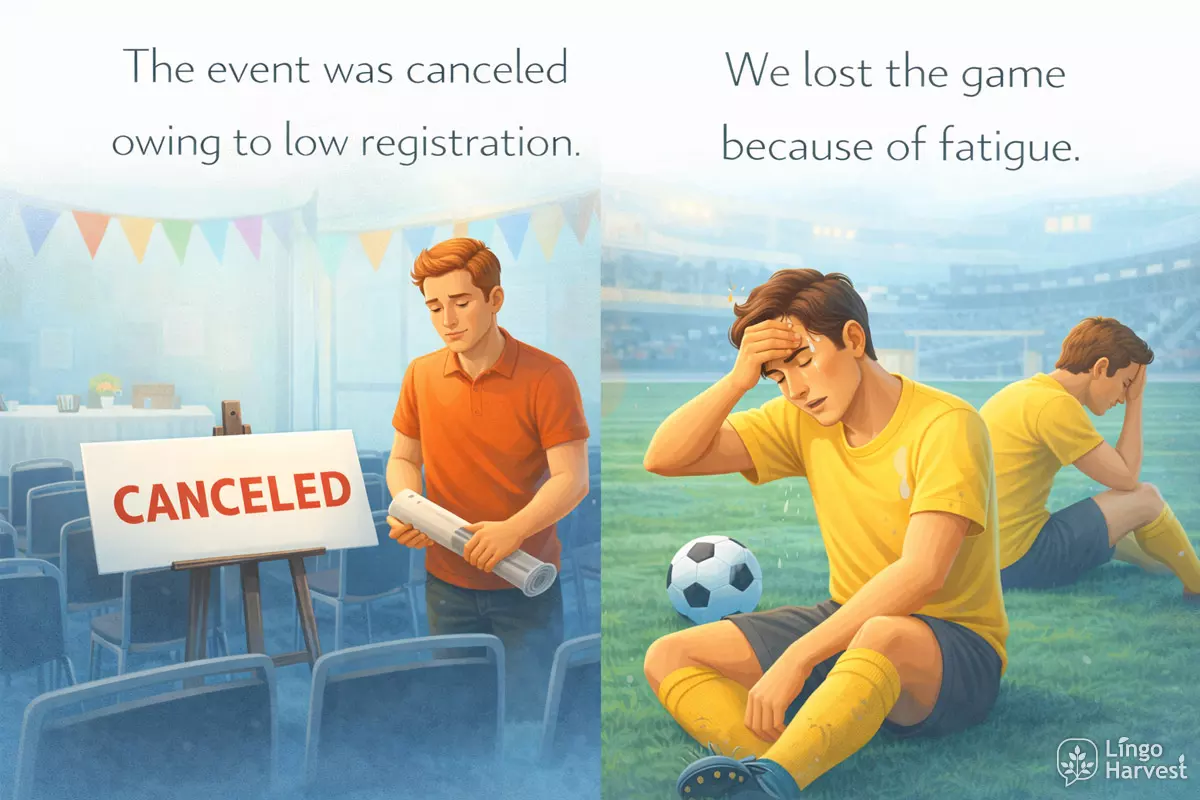
- The event was canceled because not enough people registered. → The event was canceled owing to low registration.
- We lost the game because our team was tired. → We lost the game because of fatigue.
- They left because the music was too loud. → They left due to the loud music.
- She got a promotion because she impressed her boss. → She got a promotion owing to her impressive performance.
- The picnic was spoiled because it rained heavily. → The picnic was spoiled because of heavy rain.
- He was late because his car broke down. → He was late due to a car breakdown.
- The road is closed because there was an accident. → The road is closed owing to an accident.
- She was absent because she had a fever. → She was absent because of a fever.
When to Use Each Reason Marker
“Because of” is widely accepted in both speech and writing and is suitable for most situations. “Due to” is often more formal and typically follows the verb “to be.” “Owing to” is also formal and usually appears at the beginning or middle of a sentence.
| Clause with 'because' | Prepositional Reason Marker | Notes |
|---|---|---|
| The flight was canceled because it snowed. | The flight was canceled due to snow. | More formal; after 'to be' |
| They succeeded because they worked as a team. | They succeeded because of teamwork. | Neutral; flexible position |
| The picnic was ruined because it rained. | The picnic was ruined owing to the rain. | Formal; often written |
| He missed class because he was sick. | He missed class because of illness. | Common, all contexts |
| The store closed because there were no customers. | The store closed due to lack of customers. | Formal/business English |
Tips for Natural Usage
- Check if the subject and verb in the “because” clause can be replaced with a concise noun phrase.
- “Because of” is the safest choice for most contexts.
- In formal writing, prefer “due to” after forms of “to be” (e.g., “was,” “is”).
- “Owing to” is best in formal or written English, often at the start of a sentence.
By mastering these transformations, you can make your English more versatile, clear, and suited to different situations.
Sentence Placement: Fronting 'owing to' for emphasis vs. mid-sentence causal links
Choosing where to place prepositional phrases like "owing to" can subtly change the tone and focus of your sentence. Placing "owing to" at the beginning of a sentence draws attention to the reason, highlighting it for the reader. In contrast, using it mid-sentence integrates the cause more smoothly, often making the statement feel more neutral or explanatory.
Fronted "Owing to" for Emphasis
Starting a sentence with "owing to" makes the cause stand out. This structure is especially common in formal writing or when you want to foreground the reason:
- Owing to heavy rainfall, the match was postponed.
- Owing to unforeseen circumstances, the event was canceled.
- Owing to the late delivery, we had to reschedule the meeting.
This pattern is useful when you want the reader to immediately focus on the reason before introducing the main subject or result.
Mid-Sentence "Owing to" for Neutral Causal Links
Inserting "owing to" after the subject or verb often blends the reason more naturally into the sentence. This is typical in both spoken and written English when the cause is important but not the main focus:
- The flight was delayed owing to technical issues.
- Attendance dropped owing to the bad weather.
- Production slowed owing to a shortage of materials.
This placement provides a smooth flow, allowing the sentence to move from subject to action, then to cause.
Comparing Sentence Placement Patterns
Below is a structured comparison of fronted and mid-sentence usage with "owing to" and related expressions:
| Pattern | Example |
|---|---|
| Fronted "Owing to" | Owing to staff illness, the store closed early. |
| Mid-sentence "Owing to" | The store closed early owing to staff illness. |
| Fronted "Because of" | Because of the noise, I couldn’t sleep. |
| Mid-sentence "Due to" | The delay was due to traffic congestion. |
| Fronted "Due to" | Due to unforeseen events, the seminar was postponed. |
| Mid-sentence "Because of" | She left early because of a family emergency. |
Key Takeaways
- Use fronted "owing to" when you want to emphasize the reason.
- Prefer mid-sentence placement for a more neutral, flowing sentence.
- Switching placement can subtly shift the focus or tone.
- This flexibility applies to "because of" and "due to" as well.
- Formal writing often favors fronted placement for emphasis.
- Casual writing typically uses mid-sentence positioning.
- The choice affects both clarity and emphasis.
Understanding these patterns helps you tailor your writing for both clarity and effect, allowing you to control which information stands out to your reader.
Redundancy check: Eliminating 'the reason why is due to' and other tautological errors
Redundant phrases often creep into our writing, especially when explaining causes or reasons. One of the most common offenders is the phrase “the reason why is due to.” This construction is not only wordy but also repetitive, since both “the reason why” and “due to” serve to indicate cause. Using both together adds no extra meaning and can make sentences cumbersome.
Why avoid tautological expressions?
Tautologies repeat an idea unnecessarily, which can confuse readers and weaken your writing. When using prepositions like “because of,” “due to,” or “owing to,” it's best to keep sentences clear and precise by choosing one way to express the cause.
Common Redundant Patterns to Watch For
Writers often create redundancy when combining multiple cause-related phrases in a sentence. Here are typical patterns to avoid:
- The reason why is because...
- The reason why is due to...
- The reason is because...
- The reason is due to...
- Owing to the fact that...
- Because of the reason that...
- Due to the reason that...
- On account of the reason that...
- As a result of the reason that...
- Owing to the reason that...
- For the reason why...
- The reason why is owing to...
- It is because of the reason that...
How to Fix Redundant Cause Statements
Instead of doubling up on words that signal cause, choose a single, direct expression. Here are some before-and-after examples:
- ❌ The reason why the match was postponed is due to rain.
✅ The match was postponed due to rain. - ❌ The reason is because she was late.
✅ She was late. or The reason was her lateness. - ❌ Owing to the fact that he was tired, he left early.
✅ Owing to his tiredness, he left early. - ❌ Because of the reason that the road was closed, we were delayed.
✅ Because the road was closed, we were delayed.
Quick Reference: Redundant vs. Concise Forms
| Redundant Form | Concise Alternative |
|---|---|
| The reason why is due to bad weather. | Due to bad weather. |
| The reason is because he was sick. | Because he was sick. |
| Owing to the fact that traffic was heavy... | Owing to heavy traffic... |
| Because of the reason that she overslept... | Because she overslept... |
| Due to the reason that it rained... | Due to rain... |
Remember, clarity is key. When expressing cause, opt for one clear prepositional phrase or clause. This makes your sentences more direct and easier to understand. Eliminating redundancy will help your writing appear more polished and professional.
Practice: Stylistic editing—selecting the optimal reason marker for academic and news registers
When writing for academic or journalistic audiences, choosing the most appropriate reason preposition can subtly influence your text’s clarity and formality. "Because of," "due to," and "owing to" are frequently used to express cause, but their fit depends on context and register. Below, you’ll find editing exercises and examples to help you refine your stylistic choices.
Identifying the Best Reason Preposition
Consider how each reason marker functions:
- Because of: Most neutral; suitable for both spoken and written English, but less formal than the alternatives.
- Due to: More formal; often preferred in academic and news writing, especially after forms of "be."
- Owing to: Formal and slightly old-fashioned; still appropriate in official reports or high-level journalism.
Editing Task: Choose the Most Suitable Marker
For each sentence below, select the most appropriate reason preposition for an academic or news context. Rewrite the sentence if needed.
- The event was canceled _______ heavy rainfall.
- _______ the new regulations, many businesses have adapted their procedures.
- Flight delays occurred _______ a technical fault.
- Production slowed _______ supply shortages.
- The meeting was postponed _______ unforeseen circumstances.
- _______ the pandemic, remote work became standard practice.
- Several roads are closed _______ flooding.
- Attendance dropped sharply _______ poor weather.
- Profits increased _______ higher consumer demand.
- Classes were rescheduled _______ staff illness.
Show answers
- due to
- Owing to
- because of
- because of
- due to
- Owing to
- because of
- because of
- due to
- due to
Comparing Register and Context
Below is a comparison of each marker’s suitability across different types of writing. Use this as a quick reference when editing:
| Reason Preposition | Preferred Context | Register | Example |
|---|---|---|---|
| Because of | General, spoken, informal writing | Neutral | The match was delayed because of rain. |
| Due to | Academic, news, formal writing | Formal | The delay was due to technical problems. |
| Owing to | Academic, official, formal journalism | Very formal | The event was postponed owing to unforeseen circumstances. |
Quick Reference: When to Use Each Marker
- Use because of for everyday explanations or when aiming for a neutral tone.
- Prefer due to after forms of "be" or in headlines and formal reports.
- Choose owing to when you need a formal, slightly elevated register, especially in academic or official contexts.
By practicing these distinctions, your writing will better match the expectations of academic and news audiences, ensuring both clarity and appropriateness.