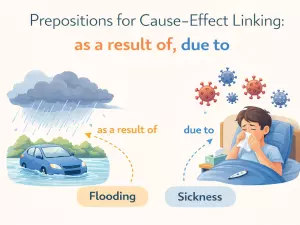
Prepositions of Cause and Reason: because of, due to, thanks to

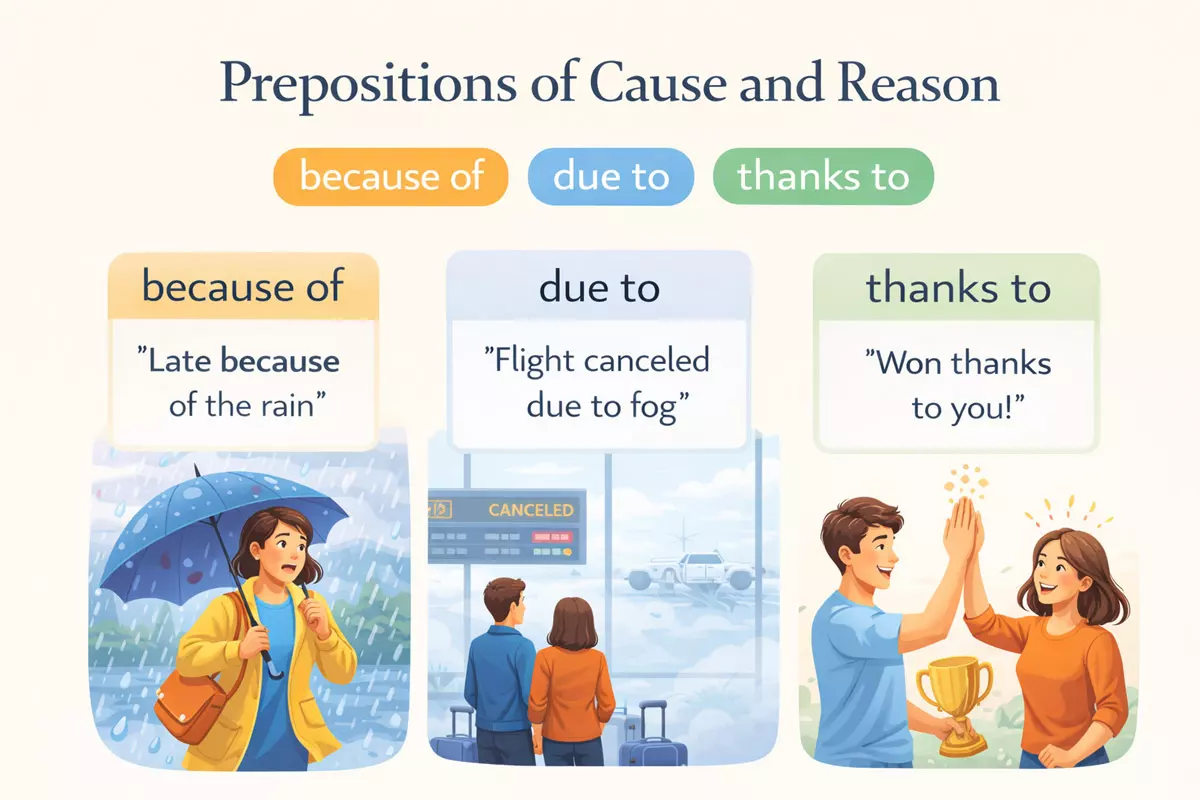 This article explains how to correctly use cause and reason prepositions such as because of, due to, thanks to, owing to, and on account of. It covers stylistic choices, formal register, objectivity, and common structural errors.
- The Logic of Causality: Differentiating between 'because of' (adverbial) and 'due to' (adjective-like)
- Positive Attribution: Using 'thanks to' for beneficial outcomes and successful credit
- Register Control: 'Owing to' and 'on account of' for formal academic and legal distance
- Clausal Compression: Converting 'because' clauses into concise prepositional reason markers
- Neutrality vs. Bias: Selecting prepositions that signal objective facts versus subjective blame
- Structural Errors: Eliminating 'the reason is because of' and other common tautologies
- Practice: Refining causal links in scientific abstracts and business success stories
Understanding how to clearly explain why something happens in English is essential for effective communication. Using connecting words and phrases such as "because of," "due to," and "thanks to" helps link actions to their reasons, making your explanations smoother and more precise. For example, you might say, "The event was canceled due to bad weather," or "She succeeded because of her hard work." By mastering these expressions, you can provide clear, logical explanations in both spoken and written English.
The Logic of Causality: Differentiating between 'because of' (adverbial) and 'due to' (adjective-like)
Understanding the difference between because of and due to helps you express cause and reason more precisely in English. While these phrases often seem interchangeable in casual conversation, their correct usage depends on their grammatical function within a sentence.
Adverbial vs. Adjective-Like Function
Because of functions as an adverbial phrase, modifying verbs and explaining why an action happens. In contrast, due to behaves more like an adjective, modifying nouns and linking directly to the subject. This distinction matters most in formal or academic writing, where clarity and accuracy are essential.
Usage Patterns and Examples
- The flight was delayed because of fog. (modifies "was delayed")
- The delay was due to fog. (modifies "delay")
- She missed the meeting because of traffic.
- Her absence was due to illness.
- We canceled the picnic because of the rain.
- The cancellation was due to the rain.
- The project failed because of poor planning.
- The failure was due to poor planning.
- He succeeded because of his hard work.
- His success was due to hard work.
- They were late because of an accident.
- Their lateness was due to an accident.
- Production stopped because of equipment failure.
- The stoppage was due to equipment failure.
- The event was postponed because of weather conditions.
- The postponement was due to weather conditions.
- He lost his job because of budget cuts.
- His unemployment was due to budget cuts.
Quick Comparison Table

| Usage | Example |
|---|---|
| Adverbial (modifies verb: because of) | We stayed home because of the storm. |
| Adjective-like (modifies noun: due to) | Our absence was due to the storm. |
| Adverbial (action reason) | She smiled because of the compliment. |
| Adjective-like (noun reason) | Her smile was due to the compliment. |
Key Points to Remember
- Use because of to explain why something happens (focus on the action).
- Use due to to describe the cause of a noun or state (focus on the condition).
- In spoken English, the distinction is often blurred, but in writing, following these rules improves clarity.
Mastering these subtle differences will make your English sound both more natural and more precise, especially in formal contexts.
Positive Attribution: Using 'thanks to' for beneficial outcomes and successful credit
When you want to express that something good happened as the result of a particular cause, "thanks to" is the natural preposition to use. This phrase implies not only causation, but also a sense of gratitude or positive acknowledgment. In contrast to "because of" or "due to," which are neutral and can describe both positive and negative outcomes, "thanks to" is reserved for situations where the result is beneficial or where someone or something deserves credit for a success.
Common Uses of "thanks to"
- Highlighting a positive result caused by someone’s actions or a helpful factor.
- Giving credit or showing appreciation for support, effort, or luck.
- Emphasizing improvement, achievement, or successful outcomes.
Examples of "thanks to" in Context
- We finished the project early thanks to everyone's hard work.
- The garden looks beautiful thanks to all the rain this spring.
- She got the job thanks to her impressive portfolio.
- Our team won the match thanks to a last-minute goal.
- Thanks to your advice, I avoided a big mistake.
- The event was a success thanks to careful planning.
- He recovered quickly thanks to prompt medical attention.
- We found our way thanks to the detailed map.
- Our sales increased thanks to the new marketing strategy.
- Thanks to her patience, the class understood the lesson.
- The campaign raised more money thanks to generous donors.
- She was able to travel abroad thanks to a scholarship.
- The children learned a lot thanks to the interactive activities.
- Thanks to technology, staying in touch is now easier than ever.
- His confidence grew thanks to supportive friends.
When to Choose "thanks to" Over Other Prepositions
Use "thanks to" when you want to emphasize that the result is favorable or that someone or something deserves appreciation for making it happen. Avoid using "thanks to" with negative outcomes, as it would sound sarcastic or incorrect in most contexts.
- ✅ Correct: The picnic was perfect thanks to the sunny weather.
- ❌ Incorrect: The flight was delayed thanks to a storm. (Use "because of" or "due to" instead.)
Comparing "thanks to" with "because of" and "due to"
| Expression | Typical Use | Example |
|---|---|---|
| thanks to | Positive, credit or gratitude | We arrived on time thanks to your directions. |
| because of | Neutral or negative, factual cause | The game was canceled because of rain. |
| due to | Formal, often negative or neutral | The delay was due to technical problems. |
Using "thanks to" is a simple way to show appreciation and highlight what or who made a positive difference. It’s an essential tool for expressing gratitude and acknowledging success in both formal and informal English.
Register Control: 'Owing to' and 'on account of' for formal academic and legal distance
In academic and legal writing, expressing causation often requires a degree of formality and precision. Terms like owing to and on account of are favored in these contexts because they help maintain an objective, impersonal tone. This stylistic distance is crucial in research papers, official reports, contracts, and judgments, where neutrality and clarity are highly valued.
Why Choose 'Owing to' and 'On Account of'?
Writers select these expressions to convey reasons without sounding subjective or conversational. They are less direct than "because of" or "thanks to," which can seem too informal or emotionally loaded for scholarly or legal texts. Additionally, these prepositional phrases blend smoothly with passive constructions, which are common in formal documents.
- Owing to is often used to attribute causes in technical or scientific explanations.
- On account of is frequent in legal contexts, formal letters, and policy documents.
- Both avoid personal tone, helping maintain a professional register.
- These phrases typically precede nouns or noun phrases, not clauses.
- They are well-suited to written, not spoken, English.
- Use is especially prevalent in British English, though both are understood internationally.
- They allow for variation in sentence structure, especially when fronting reasons.
- Both can be replaced by "because of" in less formal contexts, but with a loss of formality.
- They rarely introduce direct causes involving people’s intentions or emotions.
- These forms are favored in documents requiring legal precision or academic rigor.
Comparing Usage in Formal Contexts
| Expression | Typical Contexts | Example Sentence | Register |
|---|---|---|---|
| Owing to | Academic articles, reports, scientific explanations | The event was postponed owing to unforeseen circumstances. | Formal, impersonal |
| On account of | Legal documents, official correspondence, policy statements | The agreement was terminated on account of a breach of contract. | Formal, legalistic |
| Because of | Everyday speech, informal writing | The class was canceled because of the weather. | Neutral, informal |
| Thanks to | Informal, positive outcomes | Production increased thanks to new technology. | Conversational, positive |
Patterns and Pitfalls
When using these formal prepositions, be cautious to match them with appropriate sentence structures. For example, avoid using them before clauses or verbs; they should introduce a noun or noun phrase. Also, be wary of redundancy: "Owing to the fact that..." can usually be simplified to "Owing to...".
Summary: When to Prefer Formal Distance
Relying on owing to and on account of is most appropriate when the goal is to sound objective, professional, and detached. In academic and legal English, this register control signals authority, careful reasoning, and respect for the conventions of the field.
Clausal Compression: Converting 'because' clauses into concise prepositional reason markers
Transforming complex sentences into more compact forms is a key skill in writing and speaking. In English, this often means changing a full clause starting with "because" into a shorter phrase with a prepositional marker like "because of", "due to", or "thanks to". These prepositions help streamline communication by focusing on the reason without using a full subordinate clause.
Why Compress Clauses?
Reducing a "because" clause to a prepositional phrase can make your sentences clearer and more direct, especially in formal or written contexts. It's also useful for varying sentence structure and avoiding repetition.
Common Prepositional Reason Markers
Writers and speakers often choose among several prepositions to indicate cause or reason. Here are some of the most frequent ones:
- because of → The flight was delayed because of bad weather.
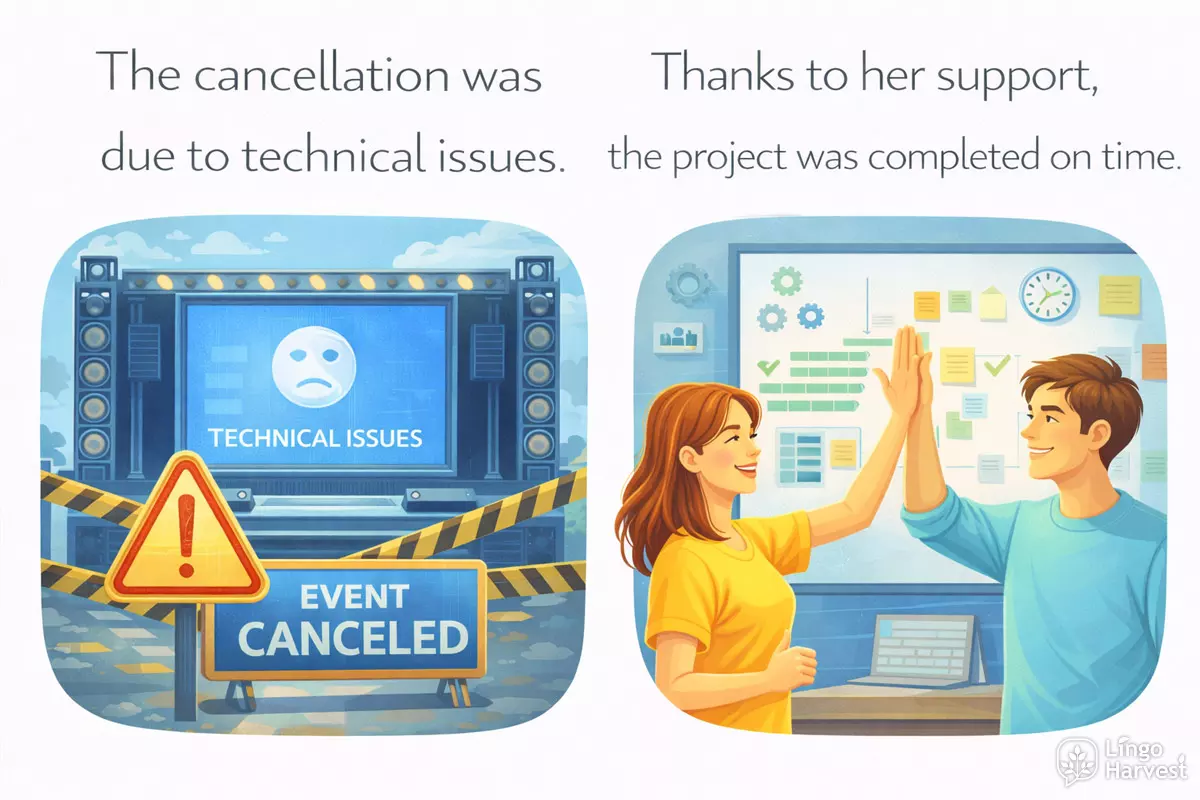
- due to → The cancellation was due to technical issues.
- thanks to → Thanks to her support, the project was completed on time.
- owing to → Owing to heavy traffic, we arrived late.
- as a result of → As a result of the merger, several departments were reorganized.
- on account of → The match was postponed on account of rain.
- by reason of → He was exempted by reason of medical conditions.
- for → She was praised for her dedication.
- through → He succeeded through hard work and persistence.
- from → She was shaking from exhaustion.
- in view of → In view of recent changes, the policy will be updated.
- for lack of → The event was canceled for lack of funding.
- from fear of → He stayed silent from fear of causing trouble.
- on grounds of → The application was rejected on grounds of incomplete information.
- as a consequence of → As a consequence of the error, the data had to be reprocessed.
- due to the fact that → The delay occurred due to the fact that the system crashed.
- as a consequence of → As a consequence of her decision, the schedule changed.
- by virtue of → By virtue of his experience, he was chosen for the role.
How to Convert: Patterns and Examples
The process is straightforward: identify the "because" clause and replace it with a prepositional phrase, often moving the noun or noun phrase after the preposition. For example:
- Because he was tired → Because of his tiredness
- Because the weather was bad → Due to the bad weather
- Because she helped → Thanks to her help
- Because there was traffic → Owing to traffic
This not only shortens the sentence, but often makes it more suitable for formal writing.
Comparing 'because', 'because of', 'due to', and 'thanks to'
The table below illustrates how a clause with "because" can be compressed using different prepositional markers. Notice the shift from a full clause to a concise phrase:
| Full 'because' clause | Compressed prepositional phrase |
|---|---|
| She stayed home because she was sick. | She stayed home because of illness. |
| The event was canceled because it rained. | The event was canceled due to rain. |
| We finished early because you helped. | We finished early thanks to your help. |
| The flight was delayed because the fog was thick. | The flight was delayed owing to thick fog. |
Points to Remember
- Use a noun or noun phrase after the preposition (e.g., "because of the storm," not "because of it was raining").
- Due to and owing to are more formal; thanks to often suggests a positive outcome.
- Clausal compression is especially useful in academic, business, or official writing.
Adopting these patterns will help you write and speak with greater precision and efficiency.
Neutrality vs. Bias: Selecting prepositions that signal objective facts versus subjective blame
How we explain causes in English often depends on the prepositions we choose. Certain expressions like because of, due to, and thanks to can subtly shift the tone from objective to subjective, either presenting information neutrally or assigning responsibility. Understanding these differences helps writers and speakers communicate precisely and avoid unintended implications.
Prepositions and Their Implications
Some prepositions simply state a cause, while others suggest an attitude—either positive or negative—toward that cause. For instance, because of is generally neutral, but thanks to carries a positive connotation, implying approval or gratitude. On the other hand, due to can sometimes feel formal or slightly negative, especially in contexts where blame or responsibility is implied.
- because of – states a fact without emotion or judgment
- due to – often used formally; can imply blame in negative contexts
- thanks to – highlights positive outcomes or credits someone/something
- as a result of – neutral, focuses on the outcome
- owing to – usually neutral but slightly formal
- on account of – neutral but more common in formal or written English
- as a consequence of – neutral, emphasizes result
- by reason of – very formal, legalistic
- through – sometimes suggests means rather than cause
- for lack of – often negative, points to absence as the reason
- from (in cause context) – neutral, but rare
- out of (motivation) – can imply emotion or intent
- owing to the fact that – wordy, neutral, formal
- resulting from – neutral, often used in scientific/technical contexts
- thanks entirely to – emphasizes positive credit
- due entirely to – emphasizes blame or responsibility
- in consequence of – archaic or formal, neutral
- for want of – negative, stresses lack as cause
Comparing Neutral and Biased Prepositions
To clarify the subtle distinctions, compare how these prepositions function in real sentences. Notice how the choice affects whether the statement feels factual or judgmental.
| Neutral Expression | Biased/Subjective Expression |
|---|---|
| The meeting was postponed because of the storm. | The meeting was postponed due to poor planning. |
| Production increased as a result of new equipment. | Production increased thanks to the new manager. |
| The road was closed owing to heavy snow. | The project was delayed for lack of resources. |
| The event was canceled as a consequence of the weather. | The event was canceled due entirely to mismanagement. |
| She succeeded as a result of hard work. | She succeeded thanks to her mentor’s support. |
Tips for Choosing the Right Preposition
- Use because of, as a result of, or owing to for clear, neutral statements.
- Reserve thanks to for positive outcomes or when you wish to credit someone or something.
- Be cautious with due to in negative contexts; it can sound accusatory.
- Consider audience and context—formal writing often favors neutral or less emotionally loaded prepositions.
- Check if the preposition introduces unintended judgment or bias.
By selecting cause-and-reason prepositions thoughtfully, you can ensure your message stays objective or, when appropriate, expresses the intended attitude—whether gratitude, blame, or simple fact.
Structural Errors: Eliminating 'the reason is because of' and other common tautologies
Writers and speakers often slip into repeating themselves when expressing cause and reason, especially with phrases like "the reason is because of." This construction is redundant, since "reason" and "because of" both signal a cause, making the meaning repetitive. Streamlining your sentences not only improves clarity but also makes your English sound more natural.
Why Tautologies Happen
Tautologies happen when the same idea is expressed twice. With cause-and-reason phrases, this often occurs when speakers try to sound more formal or emphatic and accidentally repeat the cause (for example, combining reason with because, or using two cause markers in one structure). The fix is simple: keep only one clear cause structure.
Common Redundant Patterns (Avoid)
- The reason is because of...
- The reason why is because...
- The reason is due to...
- The reason why is due to...
- The reason is thanks to...
- The reason why is thanks to...
- It happened because of the reason that...
- It happened due to the reason that...
- Since because...
- As because...
- Owing to the reason that...
- Thanks to the reason that...
- Due to the fact that because...
- The cause is because of...
- The cause is due to...
- The cause is thanks to...
- Owing to the fact that because...
- Thanks to the fact that because...
Clear Alternatives (Use Instead)
- The reason is that... → The reason is that the data was incomplete.
- The reason why ... is that... → The reason why we postponed the launch is that the tests failed.
- because + clause → We postponed the launch because the tests failed.
- because of + noun phrase → We postponed the launch because of failed tests.
- due to + noun phrase → The delay was due to technical issues.
- thanks to + noun phrase → We finished on time thanks to your help.
- since + clause → Since the system was down, we worked offline.
- as + clause → As it was late, we ended the meeting.
- owing to + noun phrase → Owing to staff shortages, the office closed early.
- as a result of + noun phrase → As a result of the update, the app runs faster.
- the cause was... → The cause was a power outage.
How to Fix These Errors
To avoid redundancy, simply use one clear structure. Choose either a preposition of cause or a noun like "reason," but not both together. Here are some corrected forms:
- The reason is that he was late. ✅
- He was late because of traffic. ✅
- His lateness was due to traffic. ✅
- Thanks to her help, we finished early. ✅
Quick Reference: Redundant vs. Correct Forms
| Redundant (Incorrect) | Concise (Correct) |
|---|---|
| The reason is because of the rain. | The reason is the rain. It is because of the rain. |
| The reason why we left is due to noise. | We left due to noise. The reason we left is the noise. |
| The cause is thanks to her effort. | Thanks to her effort, we succeeded. Her effort is the cause. |
| It happened due to the reason that he forgot. | It happened because he forgot. It happened due to his forgetfulness. |
| Owing to the reason that the bus was late, we missed the meeting. | Owing to the late bus, we missed the meeting. We missed the meeting because the bus was late. |
Takeaway
When expressing reasons, avoid doubling up on cause words. Stick to one structure—either a preposition such as "because of," "due to," or "thanks to," or a noun like "reason" or "cause." This approach keeps your English precise and easy to understand.
Practice: Refining causal links in scientific abstracts and business success stories
Clear causal relationships are essential for both scientific abstracts and business case studies. Using the right prepositions—such as because of, due to, and thanks to—helps clarify why events happened and makes your communication more precise.
Identifying and Improving Causal Statements
When reviewing texts, pay attention to how cause and effect are linked. Sometimes, sentences are vague or awkward. Practicing with authentic examples sharpens your ability to choose the best preposition and structure.
- Because of the new policy, sales increased by 20%.
- Due to unexpected weather conditions, the experiment was postponed.
- Thanks to efficient teamwork, the project finished ahead of schedule.
- Because of limited resources, the company delayed the launch.
- Due to a technical error, results were inconclusive.
- Thanks to client feedback, the product was improved.
- Because of increased demand, production doubled.
- Due to market fluctuations, profits declined.
- Thanks to technological advances, costs were reduced.
- Because of regulatory changes, procedures were updated.
- Due to supply chain disruptions, delivery times increased.
- Thanks to a successful marketing campaign, brand awareness grew.
- Because of staff shortages, service slowed down.
- Due to insufficient data, the hypothesis could not be tested.
- Thanks to cross-department collaboration, solutions were found quickly.
Common Patterns and Usage
Choosing the most fitting preposition depends on context and tone. Here's a comparison of typical usage in scientific and business writing:
| Preposition | Typical Context | Example |
|---|---|---|
| because of | Neutral/Objective cause | The study was delayed because of funding issues. |
| due to | Formal, often after "be" verb | The delay was due to funding issues. |
| thanks to | Positive outcomes/credit | Results improved thanks to new equipment. |
Refining Causal Links: Quick Practice
Revise these sentences by selecting the most suitable preposition (because of, due to, or thanks to):
- ______ the team's dedication, the deadline was met.
- The experiment failed ______ a calculation error.
- Production was interrupted ______ a power outage.
- Sales increased ______ the new advertising strategy.
- The analysis was inconclusive ______ limited sample size.
- The flight was delayed ______ severe weather conditions.
- The project succeeded ______ effective collaboration.
- The event was canceled ______ lack of funding.
- Customer satisfaction improved ______ recent service changes.
- The system crashed ______ an unexpected software bug.
Show answers
- Thanks to the team's dedication, the deadline was met.
- Because of a calculation error, the experiment failed.
- Due to a power outage, production was interrupted.
- Because of the new advertising strategy, sales increased.
- Due to limited sample size, the analysis was inconclusive.
- Because of severe weather conditions, the flight was delayed.
- Thanks to effective collaboration, the project succeeded.
- Due to lack of funding, the event was canceled.
- Thanks to recent service changes, customer satisfaction improved.
- Because of an unexpected software bug, the system crashed.
Tips for Stronger Causal Sentences
- Match the preposition to the tone: use thanks to for positive outcomes, because of for neutral or general causes, and due to for formal contexts.
- Place the causal phrase at the start for emphasis, or after the main clause for a softer effect.
- Avoid redundancy: do not mix causal prepositions in the same sentence.
- Focus on clarity—state both cause and effect directly.