Prepositions with Phrases: at night, in the morning, on time

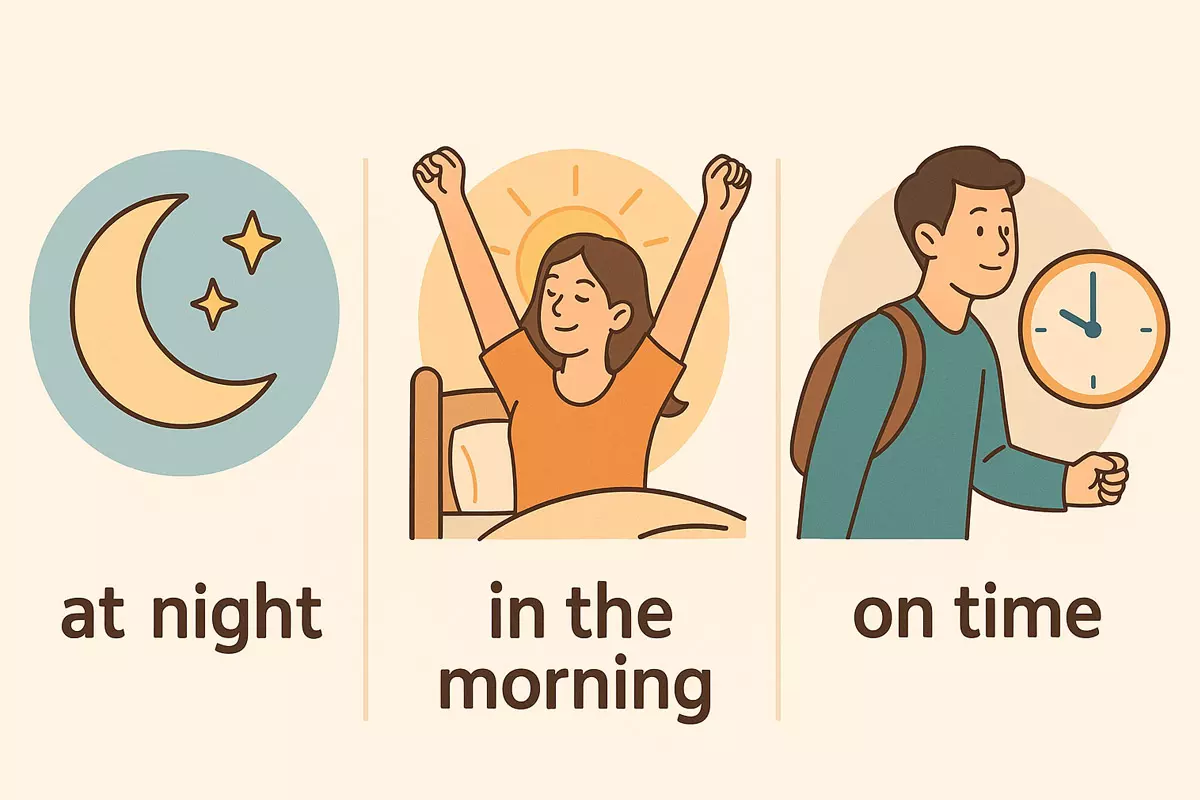 Here we how to use at, in, and on with time expressions, explains the difference between on time and in time, discusses weekend phrases, highlights common fixed phrases, and includes practice with rhythm, stress, and sentence rewriting.
Mastering the use of small words and phrases in English, particularly those related to times of day and punctuality, can be challenging for learners. Knowing when to say at night, in the early hours, or on time adds precision and fluency to your speech. For example, saying during the night instead of at night can subtly change the meaning, while being able to distinguish between early, punctual, and late helps convey your message more clearly. Paying attention to these details can make your English sound both natural and accurate.
Meaning and Context of at/in/on with Time Phrases
Understanding how to use at, in, and on with different time expressions helps clarify when events happen. Each preposition brings a unique sense of time, and their usage often depends on the specificity or generality of the time phrase. Choosing the correct preposition is essential for clear and natural English.
General Patterns for Time Prepositions
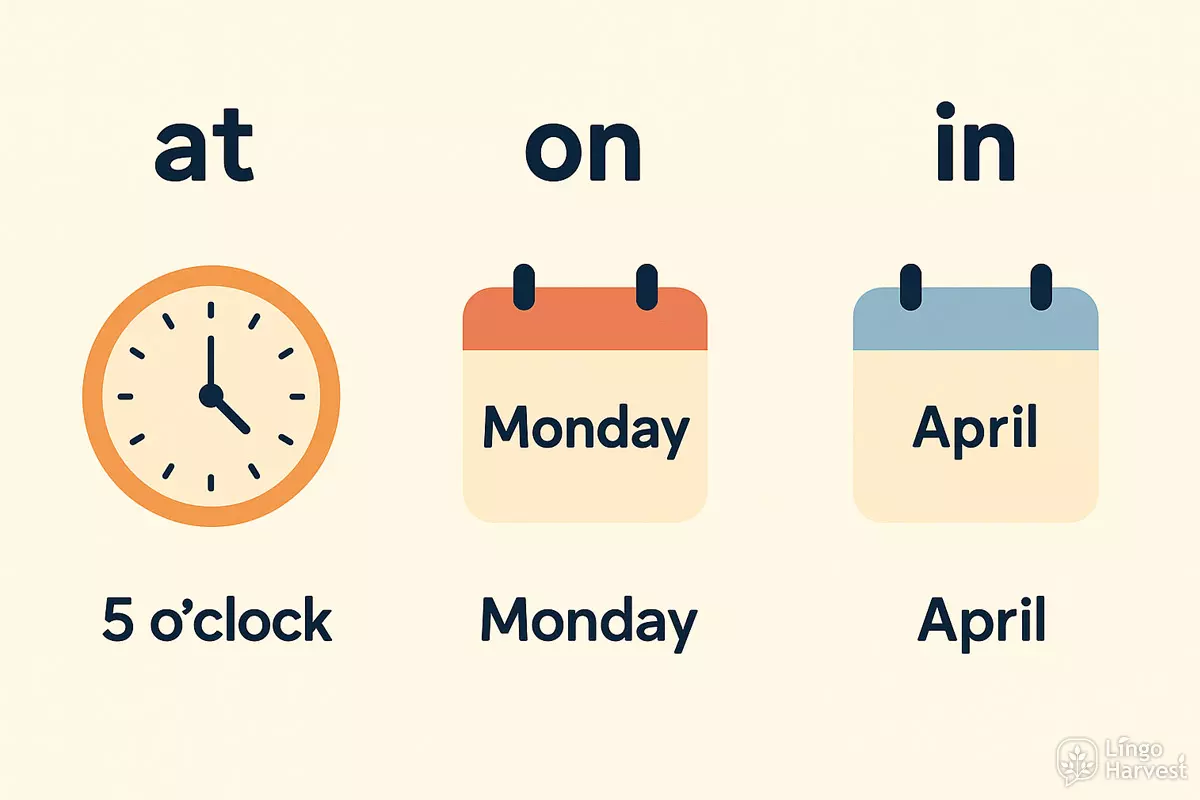
- At points to a specific moment: at 5 o'clock, at night, at midnight.
- In refers to longer, less precise periods: in the morning, in June, in 2022.
- On connects to particular days and dates: on Monday, on Christmas Day, on the weekend.
Examples of Common Time Phrases
- at night
- at noon
- at sunrise
- in the morning
- in the afternoon
- in the evening
- in September
- in a few minutes
- on Monday
- on New Year’s Eve
- on time
- on the weekend (US English); at the weekend (UK English)
- on my birthday
- at the moment
- in the 21st century
- on the first day of school
Comparing at, in, and on with Time Phrases
| Preposition | Typical Use with Time |
|---|---|
| at | Specific times or precise points: at 6 PM, at night, at the moment |
| in | Longer periods or general times: in the morning, in 2023, in winter, in two days |
| on | Days and dates: on Tuesday, on July 4th, on the weekend, on time |
Special Cases and Exceptions
Some time phrases are fixed and do not follow the usual rules. For example, we say at night but in the morning. The phrase on time means something happens as scheduled, while in time means before a deadline. It is helpful to memorize these exceptions to avoid confusion.
Summary
Selecting the correct preposition for time phrases depends on the level of specificity and established usage. Pay attention to set expressions, and with practice, choosing between at, in, and on becomes more intuitive.
Compare on time vs in time
Understanding the difference between "on time" and "in time" can help you sound more natural and precise in English. Both phrases relate to time, but they are used in different contexts and carry distinct meanings.
Key Differences
"On time" means something happens at the exact scheduled or agreed moment—neither early nor late. It's about being punctual. For example, if a train is scheduled to arrive at 7:30 and it arrives at 7:30, it is "on time." "In time," on the other hand, refers to doing something before a deadline or before it's too late. It suggests there is a time limit, but not a fixed moment. For example, arriving "in time" for a movie means you got there before the movie started, not necessarily at the exact advertised start time.
Usage Examples
- The meeting started on time at 9:00 AM.
- She finished her homework in time to watch her favorite show.
- The bus was on time today—no delays.
- He arrived in time to catch the last train.
- All flights are expected to depart on time.
- We got to the concert just in time before the doors closed.
- Your payment must be made on time to avoid a penalty.
- They reached the airport in time for their flight.
- The show started on time, as advertised.
- He submitted the assignment in time to meet the deadline.
Summary Table
| Phrase | Meaning & Example |
|---|---|
| On time | Punctual; at the scheduled moment The train left on time at 8:00 AM. |
| In time | Before a deadline or before it's too late She arrived in time to see the opening scene. |
Quick Tips
- Use "on time" for fixed times and schedules (✅).
- Use "in time" when talking about being early enough for something, often to avoid missing it (→).
- Remember: "on time" = punctual; "in time" = not too late.
Recognizing when to use each phrase helps you communicate more accurately, especially when talking about events, deadlines, or appointments.
Weekend Expressions (at the weekend vs on the weekend)
Understanding how to use prepositions with weekend-related phrases depends largely on which variety of English you are using. In British English, the phrase “at the weekend” is standard, while American English prefers “on the weekend.” The meaning is the same in both cases: they refer to the period from Friday evening to Sunday night.
British vs. American Usage
When talking about weekend plans or routines, native speakers choose different prepositions based on regional norms. This difference is important for learners aiming for accuracy in either British or American contexts.
- British English: "at the weekend"
- American English: "on the weekend"
Examples in Context
These phrases are used to describe activities, plans, or events happening during the weekend. Here are some sample sentences to illustrate the difference:
- We usually go hiking at the weekend. ✅ (UK)
- Do you want to meet on the weekend? ✅ (US)
- I relax at the weekend after a busy week. (UK)
- They often travel on the weekend. (US)
- She works part-time at the weekend. (UK)
- We have a barbecue on the weekend. (US)
- My friends visit at the weekend. (UK)
- I study for exams on the weekend. (US)
- Traffic is lighter at the weekend. (UK)
- There's a market on the weekend near my house. (US)
Quick Reference: Usage Comparison
| British English | American English |
|---|---|
| at the weekend | on the weekend |
| I play football at the weekend. | I play soccer on the weekend. |
| Are you free at the weekend? | Are you free on the weekend? |
| Shops close early at the weekend. | Stores close early on the weekend. |
Summary
Choosing between “at the weekend” and “on the weekend” simply depends on the type of English you are using. Both expressions refer to the same period, but matching your usage to your audience will make your speech or writing sound more natural.
Fixed Phrases You Must Learn as Chunks
When learning prepositions in English, it’s much more effective to memorize certain expressions as whole units rather than trying to translate word by word. Many time-related phrases, for example, always use a specific preposition—changing it would make the phrase sound strange or incorrect. These expressions are best learned as “chunks,” or fixed combinations, so you can use them naturally and confidently.
Why Memorize Whole Expressions?
Prepositions rarely follow logic from your native language. For instance, we say at night, but in the morning, and on time. There’s no clear rule that predicts which preposition goes with which phrase. That’s why it’s helpful to treat each as a set phrase and practice using them together.
Common Time Phrases with Prepositions
- at night
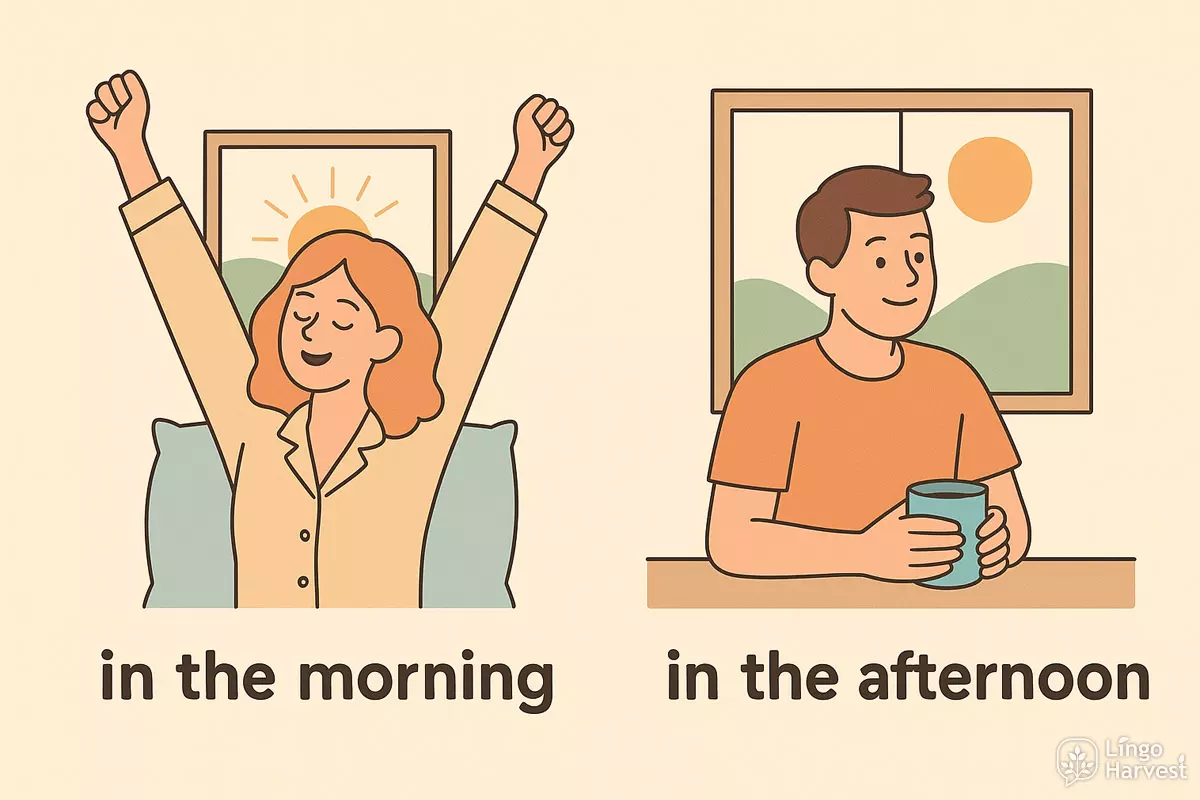
- in the morning
- in the afternoon
- in the evening
- on Monday
- on the weekend (US) / at the weekend (UK)
- at noon
- at midnight
- on time
- in time
- at sunrise
- at sunset
- in January
- in 2023
- at the moment
- at the same time
- on Christmas Day
- at Christmas
- in the 21st century
Spot the Differences
Some similar phrases can be confusing because they use different prepositions. Here’s a quick comparison of a few common expressions:
| Phrase | Correct Preposition |
|---|---|
| at night | at |
| in the morning / afternoon / evening | in |
| on Monday / on the weekend (US) | on |
| at the weekend (UK) | at |
| on time / in time | on / in |
To speak naturally, commit these patterns to memory as single units. Practicing them as “chunks” helps you avoid common mistakes and sound more fluent.
Spoken Rhythm and Stress Patterns
Understanding how to say prepositional phrases like "at night", "in the morning", and "on time" naturally involves more than knowing their meanings. The way we emphasize and group words in speech can change the listener’s perception, so let’s explore how native speakers typically handle these expressions.
Natural Stress in Prepositional Phrases
In English, prepositions such as "at", "in", and "on" are usually unstressed, while the main noun carries the emphasis. This creates a smooth, rhythmic flow:
- at night (night is stressed)
- in the morning ("the" is weak, "morning" is strong)
- on time (stress falls on "time")
The preposition blends into the background, helping the key information stand out.
Common Patterns in Connected Speech
When these phrases appear in sentences, they often link to adjacent words. Notice how the rhythm groups the preposition with its noun, not with the previous word:
- We’ll meet at night.
- I wake up in the morning.
- She arrived on time.
- He studies at night and works in the afternoon.
- The train leaves on time every day.
- Do you feel tired in the morning?
- They finish work at night.
- Please be on time for the meeting.
- I like jogging in the morning.
- Let’s talk at night when it’s quiet.
Intonation and Emphasis Variations
The stress may change for emphasis. For example, if someone is frustrated about punctuality, they might stress "on time" more distinctly:
- "You must be on time!"
But in normal speech, the focus usually falls on the noun part of the phrase.
Comparison of Prepositional Phrase Stress
Here’s a comparison of how different prepositional phrases are typically stressed in everyday speech:
| Phrase | Stressed Syllable |
|---|---|
| at night | night (main focus) |
| in the morning | morning (main focus), "the" is reduced |
| on time | time (main focus) |
| at noon | noon (main focus) |
| in the evening | evening (main focus), "the" is reduced |
| on Monday | Monday (main focus) |
| at dawn | dawn (main focus) |
| in winter | winter (main focus) |
| on holiday | holiday (main focus) |
| at midnight | midnight (main focus) |
Tips for Practicing Rhythm and Emphasis
To sound more natural, try saying these phrases aloud, focusing on the main noun. Record yourself and listen for a gentle, quick preposition and a strong, clear noun. Over time, this will help your English sound more fluent and easy to understand.
Practice: Rewrite Sentences with Correct Phrases
Understanding how to use prepositional phrases like "at night," "in the morning," and "on time" is essential for clear communication. Below, you'll find practical exercises to help you master these common expressions. Read each sentence carefully and rewrite it using the correct prepositional phrase. This will help reinforce your understanding and highlight common mistakes.
Rewrite the Sentences
Look at each sentence below. Some use the wrong preposition, or the phrase is missing. Rewrite each one so that it uses the correct phrase: "at night," "in the morning," or "on time."
- She always wakes up at morning.
- The train arrived in time for the meeting.
- Do you prefer to study on night or in the night?
- He never goes jogging at the morning.
- They usually have coffee on the morning.
- We need to arrive at time for the appointment.
- My cat is very active in night.
- I finish my homework on time every day.
- She likes to read in the morning and watch TV at night.
- The bus leaves in the morning, so don’t be late.
Show answers
- She always wakes up in the morning.
- The train arrived on time for the meeting.
- Do you prefer to study at night?
- He never goes jogging in the morning.
- They usually have coffee in the morning.
- We need to arrive on time for the appointment.
- My cat is very active at night.
- I finish my homework on time every day.
- She likes to read in the morning and watch TV at night.
- The bus leaves in the morning, so don’t be late.
Quick Reference: Correct Usage Patterns
Refer to the list below for the standard ways to use these time phrases. This can help you avoid common mistakes in your writing and speech.
- at night – for the period after sunset, before morning
- in the morning – for the early part of the day, after midnight until noon
- on time – for punctuality, when something happens exactly as scheduled
Spot the Error
Decide if the sentence is correct (✅) or incorrect (❌). If incorrect, rewrite it properly.
- We arrived at the station on time.
- Owls hunt in the night.
- I usually feel energetic in the morning.
- He likes to read at the night.
Show answers
- ✅ Correct
- ❌ Incorrect. Correct: Owls hunt at night.
- ✅ Correct
- ❌ Incorrect. Correct: He likes to read at night.
Practicing these exercises will help you use "at night," "in the morning," and "on time" naturally and accurately in your daily English.