Prepositions in Conditional Phrases: in case of, in the event of

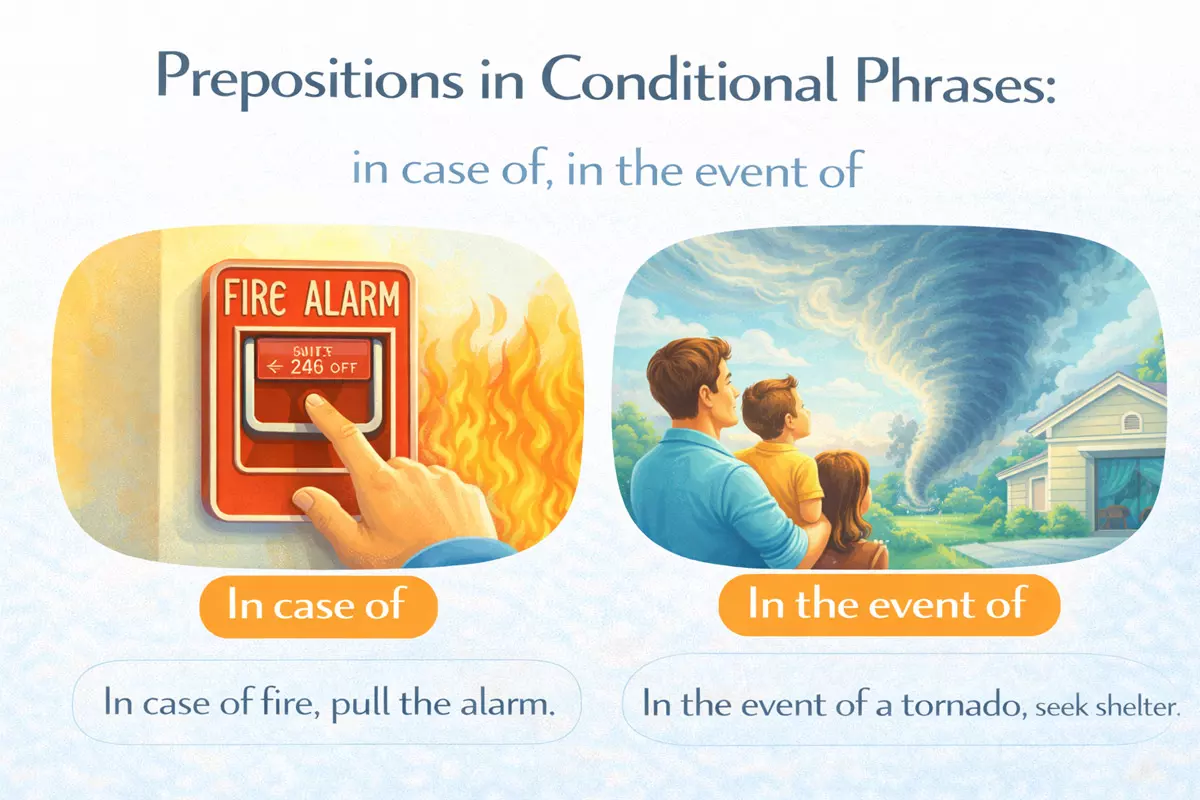 The article distinguishes between using in case of and in the event of in preparation and legal contexts, explains proper grammar after conditional markers, addresses common misuses, and provides guidance for writing clear emergency and contingency procedures for…
- The Precautionary Principle: Differentiating 'in case of' (preparation) from 'if' (condition)
- Formal Contingency: 'In the event of' for emergency protocols and legal contracts
- Syntactic Requirements: Using noun phrases vs. full clauses after conditional markers
- Instructional Clarity: Formulating safety procedures and standard operating manuals
- Hypothetical Scope: Linking conditional prepositions to future outcome scenarios
- Common Misusage: Correcting the 'in case that' vs. 'in case of' structural confusion
- Practice: Drafting emergency guidelines and contingency plans for professional environments
Understanding how to express possible situations and their outcomes is essential for clear communication in English. This article examines two common prepositions—"if" and "in case"—that are frequently used to introduce hypothetical circumstances and discuss potential results. By learning how to use these prepositions correctly, you can clarify your meaning when talking about things that could happen in the future or situations you want to be prepared for. This knowledge helps improve both spoken and written communication skills.
The Precautionary Principle: Differentiating 'in case of' (preparation) from 'if' (condition)
Understanding the difference between “in case of” and “if” is essential for clear communication, especially when discussing possible future events. “In case of” is typically used to refer to actions taken as a precaution before something happens, while “if” sets up a conditional scenario that only triggers a response when or if a specific event occurs. This distinction shapes how we prepare for and react to uncertainty.
Preparation Versus Condition: Core Meanings
“In case of” signals readiness. It’s about planning or acting now to avoid problems later, regardless of whether the event actually happens. For example, “Take an umbrella in case of rain” means you bring the umbrella as a precaution, not because it’s definitely going to rain. On the other hand, “if” introduces a situation that may or may not happen, and the action will only occur if that situation becomes real. For example, “If it rains, take an umbrella” means you will only take the umbrella when it actually starts to rain.
Common Usage Patterns
Let’s look at some typical ways these phrases are used in English:
- “In case of fire, use the stairs.” (Precaution: know what to do ahead of time)
- “If there is a fire, use the stairs.” (Condition: only act if the fire actually occurs)
- “Carry extra batteries in case of a power outage.”
- “If there is a power outage, use the backup batteries.”
- “Lock the door in case of intruders.”
- “If someone tries to enter, call the police.”
- “Bring snacks in case of delays.”
- “If your flight is delayed, inform your contacts.”
- “Take notes in case of a test.”
- “If there is a test, you will need your notes.”
- “Wear boots in case of snow.”
- “If it snows, wear your boots.”
Comparison Table: ‘In case of’ vs. ‘If’
| Expression | Typical Use & Example |
|---|---|
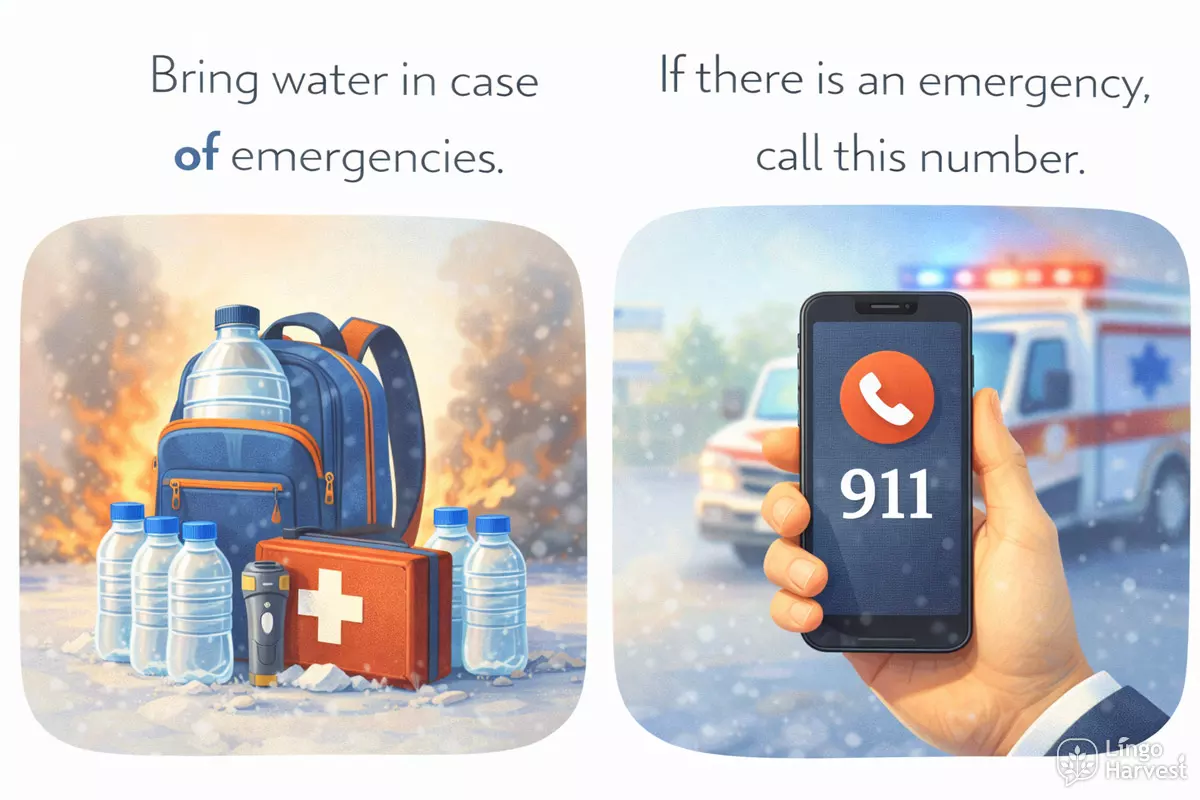
| In case of | Preparation or precaution “Bring water in case of emergencies.” |
| If | Conditional action “If there is an emergency, call this number.” |
| In case of | Advance planning “Leave early in case of traffic.” |
| If | Response to a situation “If you are late, call ahead.” |
Practical Tips
When deciding which phrase to use, consider whether you want to emphasize being prepared before something happens (use “in case of”), or whether you are talking about what to do only if a situation actually arises (use “if”). This small shift can make instructions clearer and avoid confusion, especially in safety procedures or planning contexts. By mastering these distinctions, you can communicate plans and contingencies more precisely, ensuring that your intentions are understood and followed correctly.
Formal Contingency: 'In the event of' for emergency protocols and legal contracts
When outlining procedures for emergencies or drafting legal agreements, clarity and formality are crucial. The phrase 'in the event of' is widely used in these contexts to introduce hypothetical scenarios, establish official protocols, or specify obligations and responses. Unlike colloquial alternatives, this construction signals a structured, pre-defined response to a possible future occurrence, making it especially suitable for policy documents, contracts, and safety guidelines.
Why Use 'In the event of'?
This phrase is preferred for its unambiguous and formal tone. It avoids the uncertainty or casualness of phrases like "if something happens" or "should there be." In legal and procedural writing, precision matters—a single phrase can define the scope of action, responsibility, or liability.
Common Contexts and Examples
- Emergency evacuation procedures: "In the event of fire, proceed to the nearest exit."
- Contractual obligations: "In the event of late delivery, the client reserves the right to cancel the order."
- Insurance policies: "Benefits will be paid in the event of accidental injury."
- Corporate policies: "Employees must notify HR in the event of a workplace accident."
- Data protection: "In the event of a data breach, all affected users will be informed within 72 hours."
- Medical protocols: "In the event of an allergic reaction, administer epinephrine immediately."
- Travel terms: "Refunds will be issued in the event of flight cancellation."
- Lease agreements: "In the event of property damage, tenants are required to notify the landlord."
- Event planning: "In the event of inclement weather, the ceremony will move indoors."
- Supply chain contracts: "In the event of supplier default, alternative arrangements must be made."
- School policies: "Parents will be contacted in the event of student illness."
- Financial agreements: "Interest rates may change in the event of market volatility."
- Warranty terms: "Repairs are covered in the event of manufacturing defects."
- Shipping terms: "In the event of lost goods, compensation is provided."
- Employment contracts: "Severance pay is granted in the event of redundancy."
Comparison: 'In the event of' vs. 'In case of'
| Phrase | Typical Use & Tone |
|---|---|
| 'In the event of' | Highly formal; used in legal documents, contracts, and official protocols to specify actions or consequences tied to a specific occurrence. |
| 'In case of' | More general and slightly less formal; commonly used in instructions and warnings, especially for public safety notices. |
Practical Tips for Use
- Choose 'in the event of' for legal, contractual, or policy documents requiring precision.
- Pair the phrase with clear, direct actions or consequences to avoid ambiguity.
- Reserve for situations where a formal or official tone is expected.
- Avoid overusing in everyday instructions—opt for simpler alternatives when appropriate.
Selecting the right conditional phrase shapes the clarity and enforceability of rules or agreements. 'In the event of' remains the gold standard for expressing formal contingency in high-stakes or regulated environments.
Syntactic Requirements: Using noun phrases vs. full clauses after conditional markers
When working with prepositional conditional phrases such as in case of and in the event of, the structure that follows these markers is important. Both expressions are typically followed by a noun phrase, not a full clause. This sets them apart from the conjunction if, which is followed by a full subject-verb clause.
Prepositions Require Noun Phrases
After prepositional conditional phrases, you should use a noun or a noun phrase to indicate the possible event or circumstance. For example:
- In case of fire, use the stairs. (✅ correct)
- In the event of an emergency, call 911. (✅ correct)
- In case of you are late, call me. (❌ incorrect)
- In the event of you forget, let me know. (❌ incorrect)
Contrast with "If" Clauses
Unlike these prepositional forms, the word if introduces a full clause with a subject and verb:
- If you are late, call me. (✅ correct)
- If there is a fire, use the stairs. (✅ correct)
Common Noun Phrases After Prepositional Conditionals
Writers and speakers often use a variety of noun phrases after these prepositional markers. Here are some typical examples:
- In case of rain → In case of rain, the event will be moved indoors.
- In case of delay → In case of delay, please inform the coordinator immediately.
- In case of power failure → In case of power failure, emergency lights will turn on automatically.
- In case of emergency → In case of emergency, contact the nearest staff member.
- In case of accident → In case of accident, fill out an incident report.
- In the event of fire → In the event of fire, evacuate the building calmly.
- In the event of illness → In the event of illness, notify your supervisor as soon as possible.
- In the event of cancellation → In the event of cancellation, tickets will be refunded.
- In the event of strike → In the event of strike, public transport may be limited.
- In the event of loss → In the event of loss, report the item to security.
- In case of equipment failure → In case of equipment failure, stop work immediately.
- In the event of natural disaster → In the event of natural disaster, follow official instructions.
Summary: Structural Comparison
| Conditional Marker | What Follows? |
|---|---|
| in case of / in the event of | Noun phrase (e.g., fire, emergency, rain) |
| if | Full clause (e.g., if it rains, if you are late) |
Remember, using a full clause after in case of or in the event of is ungrammatical. Stick to noun phrases for clarity and correctness in formal and informal writing.
Instructional Clarity: Formulating safety procedures and standard operating manuals
When drafting clear safety instructions and standard operating procedures, the way conditional phrases are used can determine how effectively staff understand and follow protocols. Prepositions like in case of and in the event of are common in manuals, but their precise use can make a significant difference in clarity.
Choosing the Right Preposition
The distinction between in case of and in the event of is subtle but important in formal documentation. In case of typically introduces instructions for what to do if a situation arises, while in the event of is more formal and often reserved for rare or serious occurrences.
- In case of fire, use the nearest exit.
- In the event of system failure, contact the IT department immediately.
- Store chemicals in a secure cabinet in case of accidental spillage.
- Evacuate the building in the event of an earthquake alarm.
- Keep first aid kits accessible in case of injury.
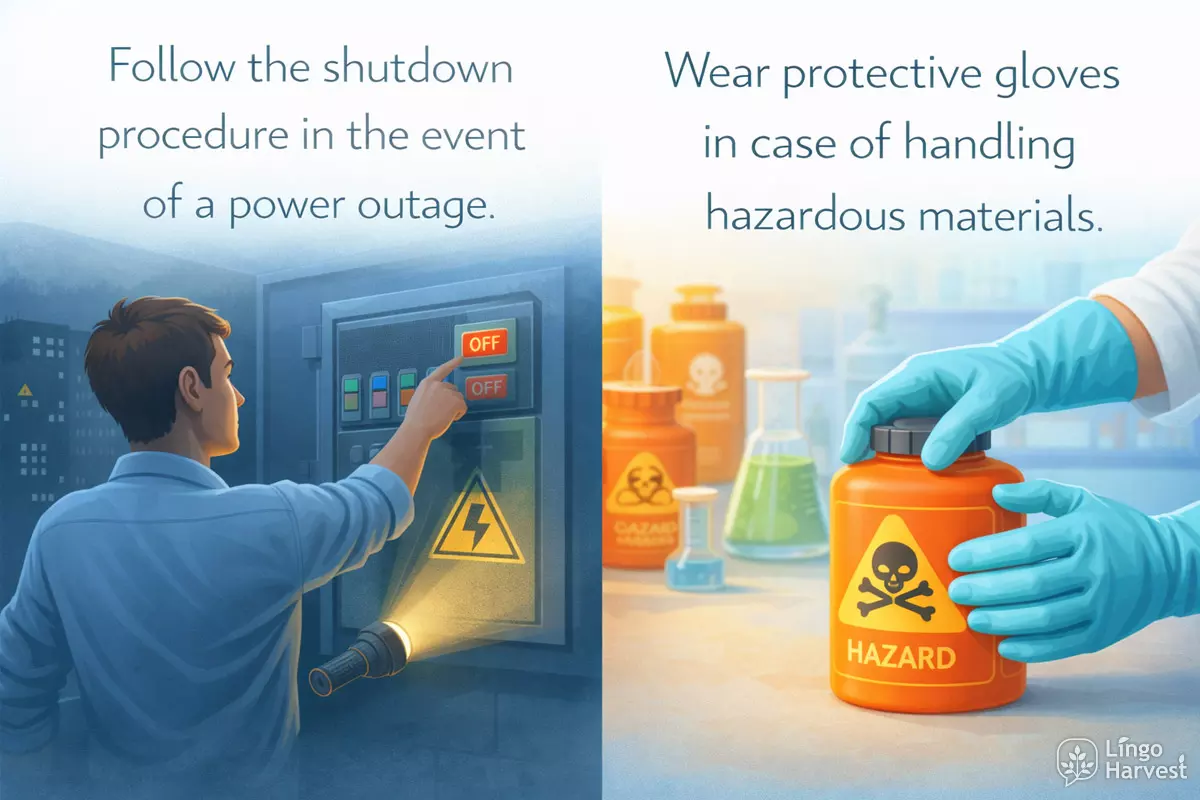
- Follow the shutdown procedure in the event of a power outage.
- Wear protective gloves in case of handling hazardous materials.
- Notify your supervisor in the event of equipment malfunction.
- Turn off the main valve in case of a gas leak.
- Activate backup generators in the event of extended power loss.
- Seal all containers in case of severe weather warnings.
- Follow emergency exit signs in the event of evacuation orders.
Clarity Through Consistency
Maintaining consistent usage of these phrases throughout your safety manuals helps prevent confusion. Switching between them without reason can lead to misunderstandings, especially among non-native speakers or new employees. Always match the phrase to the seriousness and probability of the situation described.
Comparing Usage in Safety Language
| Phrase | Typical Use in Manuals |
|---|---|
| in case of | Used for likely or routine incidents (e.g., fire, minor spills, injury) |
| in the event of | Used for rare, significant, or formal events (e.g., system failure, evacuation, natural disaster) |
| in case | Less formal, often followed by a clause: "Take an umbrella in case it rains." |
| in the event that | Even more formal, typically in legal or technical documentation: "In the event that the system malfunctions, alert the supervisor." |
Best Practices for Clear Instructions
- Use simple, direct language and avoid ambiguity.
- Place conditional phrases at the start of instructions for better visibility.
- Match the formality of the preposition to the seriousness of the situation.
- Test instructions with new users to ensure understanding.
- Review manuals regularly for consistent and accurate use of conditional phrases.
- Effective safety documentation relies on precise, consistent language.
- By thoughtfully selecting and applying prepositions in conditional phrases, you ensure that procedures are easy for everyone to follow, reducing risk and enhancing workplace safety.
Hypothetical Scope: Linking conditional prepositions to future outcome scenarios
Understanding how conditional prepositions like "in case of" and "in the event of" function is crucial for expressing hypothetical or anticipated situations. These phrases allow speakers and writers to clearly signal that an action, plan, or rule is contingent upon a particular future occurrence. Their usage frames potential outcomes and helps set expectations for what might happen if a certain condition is met.
How Conditional Prepositions Shape Future Scenarios
Conditional prepositions are used to introduce situations that may or may not happen. They are especially common in formal communication, including instructions, policies, and emergency procedures. By employing these structures, one can describe what will or should occur if a particular event takes place, thus mapping out possible futures.
- In case of fire, use the stairs.
- In the event of a power outage, backup generators will activate.
- In case of illness, notify your supervisor immediately.
- In the event of rain, the ceremony will move indoors.
- In case of emergency, break the glass.
- In the event of a delay, passengers will be informed.
- In case of lost property, contact customer service.
- In the event of cancellation, tickets will be refunded.
- In case of unexpected expenses, use the contingency fund.
- In the event of a medical emergency, dial 911.
- In case of network failure, switch to backup systems.
- In the event of severe weather, classes may be canceled.
Subtle Differences and Contextual Use
While both expressions introduce hypothetical conditions, they can differ in formality and the kinds of scenarios they commonly describe. "In case of" is often used for practical advice or instructions, while "in the event of" tends to appear in formal documents or legal language. However, their functions overlap significantly.
| Conditional Preposition | Typical Use Case | Example Outcome |
|---|---|---|
| In case of | Immediate action or precaution | In case of fire → Evacuate the building |
| In the event of | Formal or planned response | In the event of a delay → Notify all passengers |
| In case of | Everyday advice or warnings | In case of illness → Contact HR department |
| In the event of | Official policy or contingency planning | In the event of cancellation → Issue refunds |
Key Takeaways for Future-Oriented Communication
Using these prepositions effectively helps clarify what steps should be taken if a particular situation arises. Whether drafting safety instructions, company policies, or public notices, choosing the right phrase can make a difference in how clearly the hypothetical scenario and its outcomes are communicated. Ultimately, the choice between "in case of" and "in the event of" depends on context, tone, and the level of formality required.
Common Misusage: Correcting the 'in case that' vs. 'in case of' structural confusion
Many English learners and even native speakers struggle with the difference between "in case of" and phrases like "in case that." The confusion often arises because these expressions look and sound similar, yet their grammatical roles and usage are quite distinct. Understanding the correct structure for each can help you avoid awkward or incorrect sentences.
Recognizing Typical Errors
A frequent mistake is using "in case that" as a substitute for "in case of," or vice versa. However, these phrases are not interchangeable. "In case of" is a prepositional phrase followed by a noun or noun phrase, while "in case that" is not standard English usage; the correct form is simply "in case" followed by a clause.
- ❌ Incorrect: In case that fire, use the stairs.
- ✅ Correct: In case of fire, use the stairs.
- ✅ Correct: Take an umbrella in case it rains.
- ❌ Incorrect: In case of it rains, take an umbrella.
Understanding the Structures
Below is a quick reference to clarify the proper usage of each form. Notice the difference in what follows each phrase:
| Phrase | Structure | Example |
|---|---|---|
| in case of | in case of + noun/noun phrase | In case of emergency, call 911. |
| in case | in case + clause (subject + verb) | Take your phone in case you get lost. |
| in the event of | in the event of + noun/noun phrase | In the event of cancellation, you will be notified. |
| in the event that | in the event that + clause | In the event that you cannot attend, please inform us. |
Quick Tips for Avoiding Confusion
- Use in case of only with nouns (e.g., "in case of rain," not "in case of it rains").
- Use in case with a subject and verb (e.g., "in case you are late").
- Avoid "in case that"; it is not considered standard English.
- Remember: "in the event of" mirrors "in case of" and is followed by a noun, while "in the event that" takes a full clause.
Expanded Examples for Practice
- In case of power failure, use the backup generator.
- Bring a sweater in case it gets cold.
- In the event of an accident, notify the supervisor immediately.
- Lock the doors in case you leave the house.
- In case of emergency, break the glass.
- Call your parents in case you need help.
- In the event that the meeting is postponed, you will receive an email.
- Keep some cash in case the ATM is out of order.
- In case of a medical issue, contact your doctor.
- Take notes in case you forget important details.
By mastering these structures, you'll communicate more clearly and avoid common pitfalls in conditional phrases involving prepositions.
Practice: Drafting emergency guidelines and contingency plans for professional environments
Clear and precise language is essential when preparing emergency guidelines and contingency plans in the workplace. Conditional phrases with prepositions, especially "in case of" and "in the event of," help clarify instructions and reduce ambiguity during stressful situations. Below, you'll find practical strategies and example phrases for integrating these structures effectively into professional documents.
Common Usage Patterns
- In case of + noun: In case of fire, use the nearest exit.
- In the event of + noun: In the event of a medical emergency, notify the supervisor immediately.
- Both are followed by a condition or situation, not a full clause.
- These prepositional phrases often appear at the start of sentences, especially in instructions.
Sample Emergency Instructions
- In case of power failure, remain calm and await further instructions.
- In the event of severe weather, all staff should proceed to the designated shelter area.
- In case of chemical spill, evacuate the laboratory immediately.
- In the event of fire alarm activation, do not use elevators.
- In case of personal injury, contact the first aid officer without delay.
- In the event of a security breach, follow lockdown procedures.
- In case of gas leak, do not operate electrical switches.
- In the event of lost access badge, report to security.
- In case of equipment malfunction, inform the technical team.
- In the event of evacuation, assemble at the main entrance.
- In case of suspicious package, do not touch and alert authorities.
- In the event of data loss, notify IT support immediately.
Comparing "In case of" vs. "In the event of"
| Phrase | Typical Context/Example |
|---|---|
| In case of | More common in practical, immediate instructions. In case of fire, break the glass. |
| In the event of | Used in formal documents or to anticipate less likely scenarios. In the event of system failure, refer to the backup protocol. |
| In case of | Implies readiness for a situation that may happen. In case of emergency, dial 911. |
| In the event of | Emphasizes occurrence of a specific, perhaps unusual event. In the event of natural disaster, follow the evacuation plan. |
Practice: Identify the Correct Phrase
Choose the most appropriate phrase for each situation:
- ______ fire, use the stairs, not the elevator.
- ______ a network outage, employees should work offline.
- ______ lost property, contact reception.
- ______ an earthquake, move away from windows.
- ______ severe weather, outdoor activities will be postponed.
- ______ a medical emergency, call the emergency number immediately.
- ______ power failure, save your work frequently.
- ______ flight cancellation, passengers will be rebooked.
- ______ equipment malfunction, stop the machine at once.
- ______ a security breach, notify the IT department.
Show answers
- In case of
- In the event of
- In case of
- In the event of
- In case of
- In the event of
- In case of
- In the event of
- In case of
- In the event of
Drafting Your Own Guidelines
Try writing a few emergency instructions for your workplace using "in case of" and "in the event of." Consider different scenarios such as IT issues, severe weather, or unauthorized access. Practice helps internalize which phrase suits each context best.