British vs American Preposition Differences: Real Usage Guide

 The article compares British and American English prepositions, covering weekend expressions, university and hospital phrases, team-related language, and form completion.
- Temporal Markers: Comparing 'at the weekend' (BrE) with 'on the weekend' (AmE)
- Institutional Logic: 'At university/hospital' (BrE) vs. 'In university/the hospital' (AmE)
- Transport and Motion: Dialectal shifts in 'fill in' vs. 'fill out' and 'on/in a team'
- Prepositional Deletion: Identifying cases where AmE omits prepositions (e.g., 'write me')
- Phonetic Influence: How regional stress patterns affect prepositional 'dropping' and linking
- Publication Standards: Editorial preferences for BrE vs. AmE in international journalism
- Practice: Code-switching exercises for localized accuracy in speech and writing
Have you ever noticed that your friend from the UK says they are “at the weekend,” while you say you are “on the weekend”? These small differences in how English speakers use prepositions can be confusing, even for those who have studied the language for years. Such subtle shifts in phrasing highlight the interesting quirks that separate British and American English, revealing how regional variations shape the way people express everyday ideas.
Temporal Markers: Comparing 'at the weekend' (BrE) with 'on the weekend' (AmE)
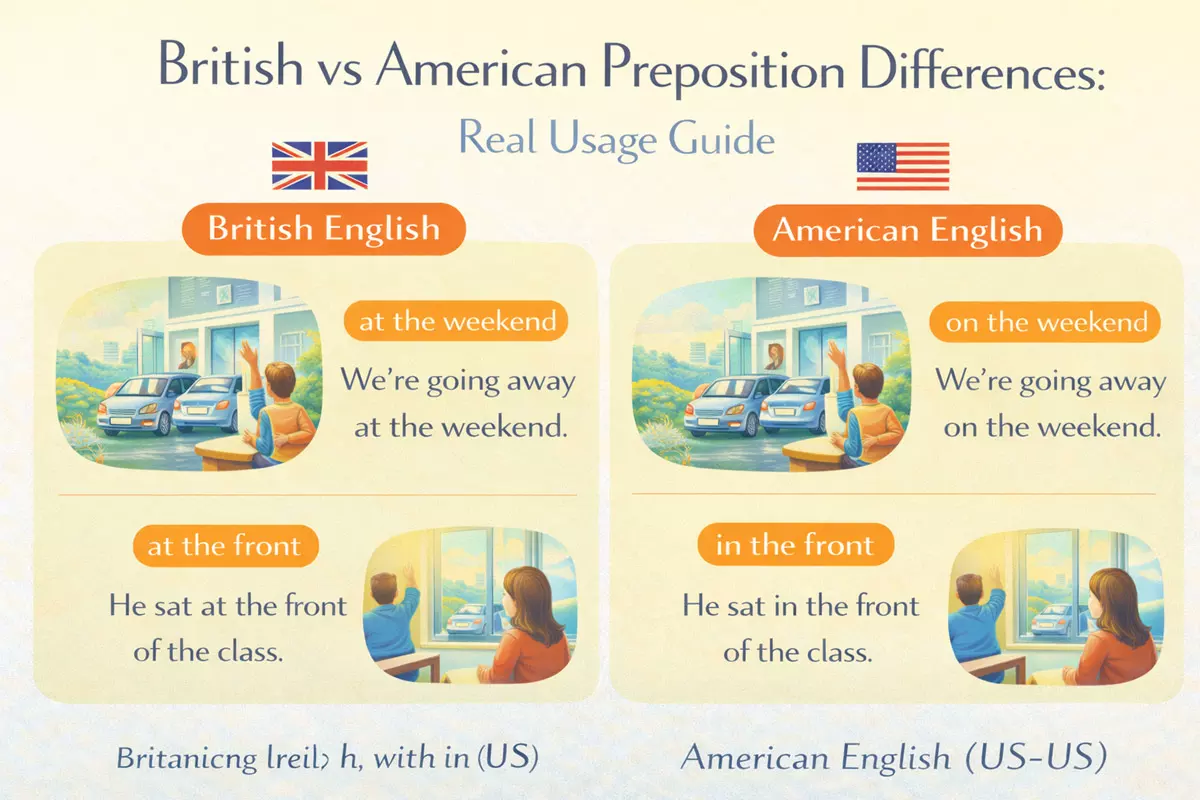
When talking about plans or routines involving the weekend, speakers from the UK and the US use different prepositions. British English typically uses at the weekend, while American English favors on the weekend. These differences can stand out in conversation and writing, especially for learners or anyone communicating internationally.
Which Form Sounds Natural Where?
British speakers will naturally say, “Are you doing anything at the weekend?” while Americans would ask, “What are you doing on the weekend?” Swapping these can sound odd to native ears, though both are generally understood.
Common Usage Patterns
You’ll notice these prepositional choices in a variety of typical sentences. Here are some examples:
- BrE: I’ll see you at the weekend.
- AmE: Let's meet on the weekend.
- BrE: Do you work at the weekend?
- AmE: She travels on the weekend.
- BrE: Plans for the weekend (no preposition sometimes, but at is standard when one is used).
- AmE: I relax on the weekend.
- BrE: What do you usually do at the weekend?
- AmE: He goes hiking on the weekend.
- BrE: I visit my parents at the weekend.
- AmE: She works out on the weekend.
Summary of Differences

| Expression | Preferred Variety | Example Sentence |
|---|---|---|
| at the weekend | British English | We’re going to the coast at the weekend. |
| on the weekend | American English | We’re going to the beach on the weekend. |
| over the weekend | Both (neutral) | I finished my project over the weekend. |
| during the weekend | Both (less common) | Did you travel during the weekend? |
Practical Tips for Learners
- Match your usage to your audience: use at for UK listeners, on for US.
- “Over the weekend” is widely understood and works in both varieties.
- For formal writing, stick to the local convention of your target readers.
Understanding these prepositional nuances helps you sound more natural and avoids small misunderstandings in cross-Atlantic communication.
Institutional Logic: 'At university/hospital' (BrE) vs. 'In university/the hospital' (AmE)
Choosing the right preposition with places like "university" and "hospital" depends on whether you’re following British or American English conventions. British English typically uses "at" to express being present within an institution for its intended purpose, while American English often prefers "in" or includes the definite article. This difference reflects a subtle logic about whether we’re talking about the institution as a concept or just a physical location.
British English: 'At' for Institutional Roles
In the UK, "at" is used when referring to someone’s engagement with the institution in its official capacity. For example, "She’s at university" means she’s enrolled as a student, not just inside a university building. The same goes for "at hospital" — it implies someone is admitted as a patient, not merely visiting the premises.
- He’s at university in Manchester. (He studies there.)
- My brother is at hospital. (He is receiving treatment, not just visiting.)
- She teaches at school.
- The nurse is at work.
American English: 'In' and Definite Articles for Locations
Across the Atlantic, speakers usually opt for "in" plus an article, emphasizing the physical setting rather than the institutional role. "She’s in the hospital" means she is physically inside, regardless of whether she’s a patient or visitor. Similarly, "in university" is less common; Americans more often say "in college" or "at college," but "in school" is widely used for students.
- He’s in the university library.
- My brother is in the hospital.
- She works in school.
- The doctor is in the office.
Comparison of Prepositional Usage
| British English | American English |
|---|---|
| at university | in college / at college |
| at hospital | in the hospital |
| at school | in school |
| at work | at work / in the office |
| at church | in church / at church |
| at home | at home |
| at prison | in prison |
Patterns and Nuances
Notice that in British usage, omitting the article is common when focusing on the role: "at university" (student), "at hospital" (patient). In American usage, the article is usually included: "in the hospital." This distinction helps native speakers infer whether someone is there for the institution’s primary purpose or just physically present. Understanding these prepositional patterns is essential for sounding natural in either variety of English and for interpreting what’s actually meant in context.
Transport and Motion: Dialectal shifts in 'fill in' vs. 'fill out' and 'on/in a team'
The ways people talk about forms and team participation reveal subtle, yet telling, differences between British and American English. These differences often show up in the choice of prepositions, and can sometimes trip up learners or even native speakers when switching between dialects.
Forms: 'Fill in' vs. 'Fill out'
In the UK, you’re likely to hear someone say “fill in the form,” while in the US, “fill out the form” is the standard. Both mean to complete the requested information, but the preposition choice is a clear dialect marker. For everyday documents, applications, and surveys, the choice of preposition signals regional usage more than any real difference in meaning.
- UK: Please fill in this form before your appointment.
- US: Please fill out this form before your appointment.
- UK: I need to fill in my tax return.
- US: Did you fill out the survey yet?
- UK: You must fill in all the required fields.
- US: Don't forget to fill out the application.
Team Membership: 'On a team' vs. 'In a team'
Another notable difference is how each variety describes team membership. Americans typically say someone is “on a team,” while Britons favor “in a team.” This applies in both sports and workplace contexts.
- US: She’s on the soccer team.
- UK: He’s in the football team.
- US: Are you on the project team?
- UK: I’m in the debate team.
- US: He plays on the basketball team.
- UK: She’s in the hockey team.
Side-by-Side Comparison
For clarity, here’s how these forms line up in context:
| British English | American English |
|---|---|
| Fill in a form | Fill out a form |
| In a team | On a team |
| Fill in your details | Fill out your details |
| In the football team | On the soccer team |
Why Do These Differences Exist?
Some of these distinctions are historical and reflect wider patterns in how British and American speakers conceptualize physical and metaphorical spaces. “Fill in” may suggest inserting information into blank spaces, while “fill out” emphasizes completing the whole document. Similarly, “in a team” frames the group as a container, whereas “on a team” suggests membership as part of a lineup or list.
Other Related Expressions
Here are more ways preposition choices show up in similar contexts:
- Sign in (UK) vs. sign up (US) for events
- Live in a street (UK) vs. live on a street (US)
- Stay at hospital (UK) vs. stay in the hospital (US)
- Write to someone (UK) vs. write someone (US, no preposition)
- Speak to (UK) vs. speak with (US)
- Meet someone (UK) vs. meet with someone (US)
- Monday to Friday (UK) vs. Monday through Friday (US)
- At the weekend (UK) vs. on the weekend (US)
- Different to (UK) vs. different from/than (US)
- Write in pencil (UK) vs. write with a pencil (US)
Understanding these small shifts helps avoid confusion and communicates more naturally with speakers from different backgrounds. It’s a reminder that preposition usage is flexible, context-driven, and sometimes unpredictable, but these patterns can still be learned and recognized.
Prepositional Deletion: Identifying cases where AmE omits prepositions (e.g., 'write me')
In American English, certain verbs often appear without prepositions that are required in British English. This characteristic can be surprising for learners and even native speakers across the Atlantic. The omission typically happens with verbs related to communication or giving, resulting in more direct constructions. For example, Americans might say "call me" or "write me," while British speakers would use "call me" but prefer "write to me." This small difference can make speech sound more informal or brisk in American usage.
Common Verbs Affected by Preposition Dropping
The tendency to skip prepositions isn’t random; it usually occurs with a specific set of verbs. Some of the most frequent include:
- Write (AmE: "write me", BrE: "write to me")
- Email (AmE: "email me", BrE: "email me" or "email to me" – less common in BrE)
- Call (both: "call me")
- Text (AmE: "text me", BrE: "text me" or sometimes "text to me")
- Tell (both: "tell me")
- Show (AmE: "show me", BrE: "show me")
- Send (AmE: "send me", BrE: "send to me")
- Give (AmE: "give me", BrE: "give me")
- Read (AmE: "read me the story", BrE: "read the story to me")
- Bring (AmE: "bring me", BrE: "bring to me")
- Loan (AmE: "loan me money", BrE: "loan me money" or "loan money to me")
- Pass (AmE: "pass me the salt", BrE: "pass me the salt" or "pass the salt to me")
- Show (AmE: "show me", BrE: "show me")
- Teach (AmE: "teach me", BrE: "teach me" or "teach to me")
- Offer (AmE: "offer me help", BrE: "offer me help" or "offer help to me")
- Promise (AmE: "promise me", BrE: "promise me")
Patterns and Usage Notes
You’ll notice that not every verb follows the same rule. Some, such as “call,” don’t require a preposition in either dialect. Others, like “write,” show a clear divide. In general, verbs of giving and communication are where American English most often skips “to” before the object pronoun. British English, on the other hand, tends to insert the preposition, especially in formal writing or when there’s a risk of ambiguity.
Comparative Examples

| Verb & Phrase | American English | British English |
|---|---|---|
| Write | Write me soon. | Write to me soon. |
| Send | Send me the details. | Send the details to me. |
| Read | Read me the story. | Read the story to me. |
| Bring | Bring me my bag. | Bring my bag to me. |
| Email me the file. | Email me the file. | |
| Loan | Loan me $5. | Loan $5 to me. |
| Text | Text me when you arrive. | Text me when you arrive. |
When to Use Which Form?
If you’re communicating with Americans, omitting the preposition sounds natural and is widely accepted. In British contexts, especially in writing or more formal settings, including the preposition is often preferred. However, spoken British English is gradually accepting preposition-free forms, especially with verbs like “email” and “text.”
Summary
American English regularly drops prepositions after certain verbs, especially in informal speech and writing. British English tends to keep the preposition, particularly in formal contexts. Understanding these subtle differences helps avoid misunderstandings and makes your English sound more native, whichever side of the Atlantic you’re on.
Phonetic Influence: How regional stress patterns affect prepositional 'dropping' and linking
Regional pronunciation patterns play a major role in how speakers of British and American English use, omit, or connect prepositions in everyday speech. The rhythm, stress, and intonation of spoken language can cause some prepositions to be less audible, entirely omitted, or smoothly linked to the following word. These subtle shifts are often unconscious, shaped by local accents and the natural flow of conversation.
Why Stress Patterns Matter
English prepositions are usually unstressed. In rapid speech, especially in dialects with a "clipped" rhythm or strong reduction of unstressed syllables, prepositions like "to," "at," and "of" may get dropped or reduced to a barely perceptible sound. For example, in some British regional accents, "I'm going to the shop" might sound closer to "I'm goin' t'shop" or even "I'm goin' shop." In many American dialects, prepositions might be linked or assimilated, especially before vowels.
Common Patterns: Linking and Dropping
Reduced prepositions and linking are more than just “slurred” speech—they follow predictable patterns influenced by region and context. Here are some widespread examples:
- British (Northern England/Scotland): "Are you coming with?" (dropping the object after the preposition)
- British (Estuary/London): "I'm going out tonight" pronounced as "I'm goin' owt tonight"
- American (General): "I'm gonna go" (linking "going to")
- American (Southern): "Fixing to" pronounced as "fixin' to" or even "finna"
- British (West Country): "Where's he to?" (using "to" at the end, often dropped in American English)
- British (Received Pronunciation): Linking "r" in "far away" sounds like "farraway"
- American (New York): "You want in?" (object omitted)
- British (Liverpool): "Give it me" (no preposition "to")
- American (Midwest): "Needs washed" instead of "needs to be washed"
- British (Yorkshire): "I'm going home" pronounced as "I'm goin' 'ome" (h-dropping, preposition omitted)
- American (General): "Out of it" pronounced as "outta it"
- British (Northern): "I'll go with" (object implied, preposition left hanging)
- American (General): "Kinda" for "kind of"
- British (Various): "I'm off to work" pronounced as "I'm off t'work"
- American (West Coast): "Hop on in" (sometimes "on" is dropped: "Hop in")
- British (Cockney): Glottal stop replaces "t" in "out," so "out of" becomes "ou' of"
Table: Prepositional Use and Reduction by Region
| Region/Accent | Typical Prepositional Feature | Example | Standard Form |
|---|---|---|---|
| British (Yorkshire) | Preposition Dropping | "I'm going shop" | "I'm going to the shop" |
| American (Midwest) | Preposition Reduction | "Needs washed" | "Needs to be washed" |
| British (West Country) | Final Preposition Use | "Where's he to?" | "Where is he?" |
| American (General) | Linking/Assimilation | "Outta here" | "Out of here" |
| British (Northern England/Scotland) | Stranded Preposition | "Are you coming with?" | "Are you coming with me/us?" |
What Drives These Differences?
The combination of stress timing, syllable reduction, and local slang all shape how prepositions sound—or disappear—in speech. British English often favors dropping or reducing prepositions in informal settings, while American English tends to link or assimilate them into the next word. These patterns aren’t just quirks; they reflect deep-rooted phonetic habits and can signal a speaker’s regional identity. Understanding these tendencies is key for anyone aiming to sound natural in either variety.
Publication Standards: Editorial preferences for BrE vs. AmE in international journalism
Editors at global news organizations regularly face choices about which variant of English—British or American—to use in their reporting. These editorial decisions impact how prepositions and other grammatical features appear to international audiences. The choice often depends on the target readership, the publication’s history, and sometimes the geographical context of the story.
General Editorial Tendencies
Many international outlets adopt a consistent style guide, such as The Guardian’s preference for British English or The New York Times’ adherence to American English. However, organizations with a broad global audience, like Reuters or the BBC World Service, may blend elements or adapt based on region.
- Audience location: Publications often match their language to the majority of their readers.
- Source material: Direct quotes maintain the original variety, especially in prepositions.
- Clarity: Editors sometimes choose the form less likely to cause confusion for international readers.
- Brand identity: Some outlets use language as part of their recognizable voice.
Preposition Usage in Editorial Practice
The most noticeable differences in prepositions between the two varieties appear in everyday reporting—particularly in headlines, captions, and direct speech. Below is a comparison of common prepositional choices in British and American news writing:
| British English | American English |
|---|---|
| at the weekend | on the weekend |
| in hospital | in the hospital |
| different from/to | different from/than |
| Monday to Friday | Monday through Friday |
| write to someone | write someone |
| live in a street | live on a street |
| talk to/with someone | talk with/to someone |
| in a team | on a team |
| next at bat | next up to bat |
| meet at the weekend | meet on the weekend |
Editorial Guidelines for Consistency
Most publications require writers to follow a style guide—either in-house or external, like the AP Stylebook or Oxford Style Manual. Editors may flag inconsistent prepositional use for revision, especially in collaborative or international teams. Some organizations provide glossaries or quick-reference charts for journalists working on stories that cross linguistic lines.
Tips for Writers and Editors
- Consult the publication’s official style guide before submitting copy.
- Retain original prepositions in quotes, unless clarity demands adaptation.
- When in doubt, prioritize your core audience’s expectations.
- Be alert to subtle shifts in meaning caused by preposition changes.
- If writing for a global outlet, consider neutral phrasing where possible.
Editorial preferences for British or American English are rarely about correctness and more about clarity, consistency, and audience familiarity. Understanding these conventions helps writers produce work that feels both natural and professional, no matter where their readers are.
Practice: Code-switching exercises for localized accuracy in speech and writing
Switching between British and American usage, especially with prepositions, requires both awareness and practice. Below, you'll find targeted activities and tips to help you internalize regional preferences, whether you’re preparing for travel, exams, or professional communication.
Spot the Difference: British vs American Prepositions
Identify which version (British or American) is used in each sentence. Try to rewrite each sentence in the other variety:
- He lives in Main Street.
- Please write your name on the form.
- She’s at university in Cambridge.
- We met on the weekend.
- The meeting is scheduled for Monday.
- He studies maths at university.
- They will meet on the weekend.
- I’ll see you in hospital tomorrow.
- She lives in Fifth Avenue.
- He works in a team of five people.
Show answers
- British; American: He lives on Main Street.
- Both use on here; no change.
- British; American: She’s in college in Cambridge.
- British: at the weekend; American: on the weekend.
- Both use for here; no change.
- British: at university; American: in college.
- British: at the weekend; American: on the weekend.
- British: in hospital; American: in the hospital.
- British; American: She lives on Fifth Avenue.
- Both use in here; no change.
Preposition Substitution Drill
Replace the underlined preposition with its regional counterpart:
- She’s in hospital. (British)
- We’ll see you on the weekend. (American)
- He waited in line. (American)
- I’ll meet you at the car park. (British)
- The shop is open from Monday to Friday. (Both)
- He lives on Main Street. (American)
- She’s at university this year. (British)
- Let’s meet at the cinema. (British)
- The elevator is out of order. (American)
- We’re staying in a hotel near the station. (Both)
Show answers
- She’s in the hospital. (American)
- We’ll see you at the weekend. (British)
- He waited in a queue. (British)
- I’ll meet you in the parking lot. (American)
- No change needed; both use “from … to”.
- He lives in Main Street. (British)
- She’s in college this year. (American)
- Let’s meet at the movies. (American)
- The lift is out of order. (British)
- No change needed; both use in a hotel.
Common Prepositional Patterns: Quick Reference Table
Use this table to compare some high-frequency differences in context:
| British English | American English | Example Context |
|---|---|---|
| at the weekend | on the weekend | Let’s meet at/on the weekend. |
| in hospital | in the hospital | She’s in hospital/in the hospital. |
| in a team | on a team | He plays in/on a team. |
| different to/from | different from/than | This is different to/from/than last year. |
| at the weekend | on the weekend | We’ll go hiking at/on the weekend. |
| in a queue | in line | Please wait in a queue/in line. |
| write to someone | write someone | I’ll write to/write you soon. |
| Monday to Friday | Monday through Friday | Open Monday to/through Friday. |
| at the weekend | on the weekend | I’ll call you at/on the weekend. |
| in future | in the future | Please do this in future/in the future. |
Writing Task: Localize These Sentences
Convert the following sentences from British to American usage or vice versa:
- He lives in a flat on the second floor, next to the lift.
- I’ll see you at the weekend in the car park.
- She waited in a queue for the bus.
- Please write to me when you arrive at university.
- The shop is open from Monday to Friday.
- They met in the city centre near the post office.
- He was taken to hospital after the accident.
- She studies maths at university.
- Let’s meet at the cinema this evening.
- The train arrived at the platform on time.
Show answers
- He lives in an apartment on the third floor, next to the elevator. (American)
- I’ll see you on the weekend in the parking lot. (American)
- She waited in line for the bus. (American)
- Please write me when you arrive at college. (American)
- The store is open Monday through Friday. (American)
- They met downtown near the post office. (American)
- He was taken to the hospital after the accident. (American)
- She studies math in college. (American)
- Let’s meet at the movies this evening. (American)
- The train arrived at the platform on time. (American; no change needed)
Tips for Practicing Code-switching
- Read region-specific news and note preposition patterns.
- Listen to podcasts from both the UK and US; jot down differences.
- Practice rewriting sentences for the audience you’re addressing.
- Ask a native speaker to check your writing for regional accuracy.
- Keep a personal list of tricky prepositions as you encounter them.