Prepositions in English Humor and Slang: Informal Usage Guide

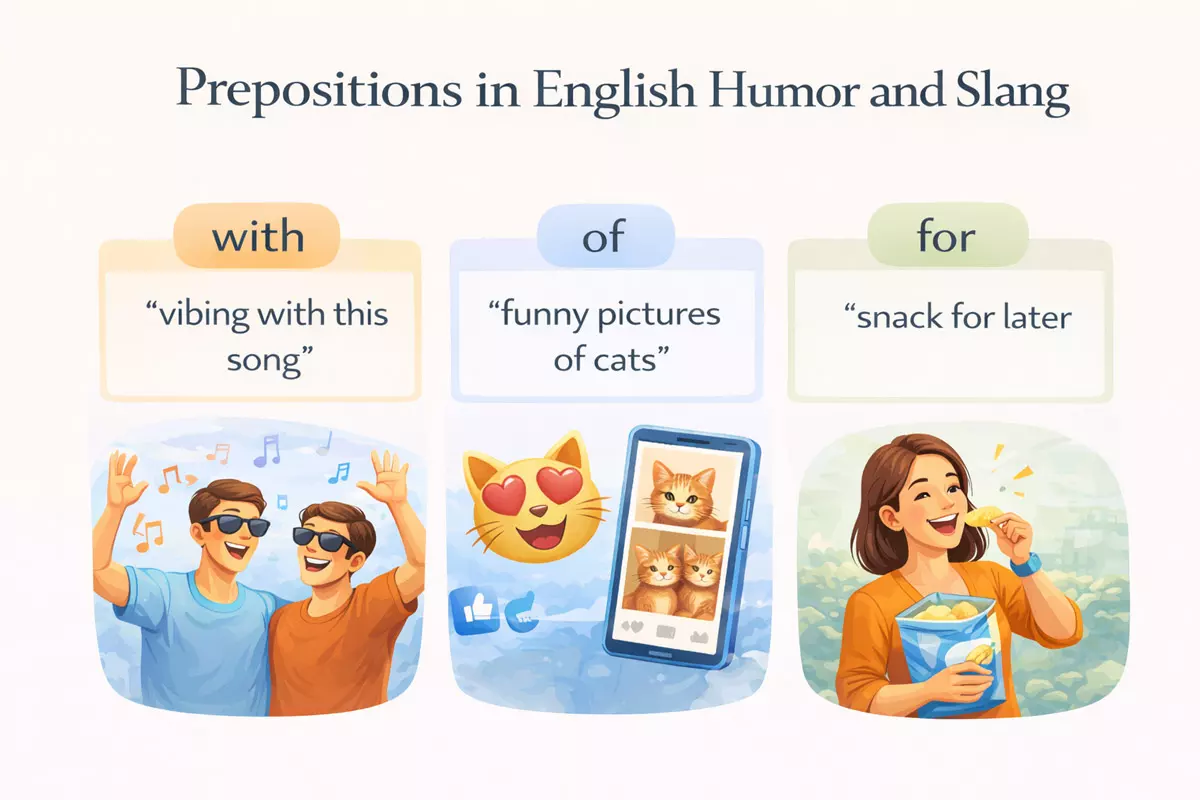 Here we how English prepositions shape humor, slang, and culture. It covers puns and ambiguity, fixed slang like up for and on fleek, dropped prepositions in comedy, idioms, register mixing, tone, and Gen Alpha/Z slang decoding.
- The Logic of Subversion: How puns and wordplay exploit prepositional ambiguity
- Slang Syncretism: Analyzing fixed prepositional slang like 'down for', 'up for', and 'on fleek'
- Grammatical Erosion: Intentional dropping of prepositions in rapid-fire comedic dialogue
- Cultural Idiomaticity: Understanding 'out of pocket', 'about that life', and 'low-key' structures
- Register Collision: The comedic effect of using formal prepositions in low-stakes slang contexts
- Offensive vs. Playful tone: Navigating the social boundaries of informal prepositional usage
- Activity: Decoding 'Gen Alpha' and 'Z' slang prepositions and matching them to standard English
Have you ever noticed how English speakers cleverly twist small connecting words to create punchlines or playful banter? This guide delves into the quirky ways native speakers bend grammar rules, especially when it comes to those tricky little words, in order to add humor and personality to informal conversations. By examining these creative uses, you'll gain insight into how language can be manipulated for comedic effect and learn to appreciate the subtle art of wordplay in everyday English interactions.
The Logic of Subversion: How puns and wordplay exploit prepositional ambiguity
English humor often thrives on the slipperiness of prepositions, which can subtly shift meaning and create opportunities for clever wordplay. Puns and jokes frequently rely on the dual roles that prepositions play—sometimes indicating direction, sometimes describing relationships, and occasionally just causing confusion. This flexibility gives comedians and everyday speakers fertile ground for subverting expectations and tickling the funny bone.
Why Prepositions Are Ripe for Humor
Prepositions are notorious for their multiple meanings and context-dependent uses. A phrase like "get over it" can mean physically crossing an obstacle or emotionally moving past an issue. The ambiguity lets speakers craft lines that surprise listeners or flip a sentence's meaning midstream. Such twists are the bread and butter of English puns, memes, and playful banter.
Classic Patterns: Prepositional Double Meanings in Jokes
- Literal vs. figurative: "I'm on a diet" (staying atop a diet book?)
- Sound-alike confusion: "I’m into fitness... fitness whole pizza in my mouth!"
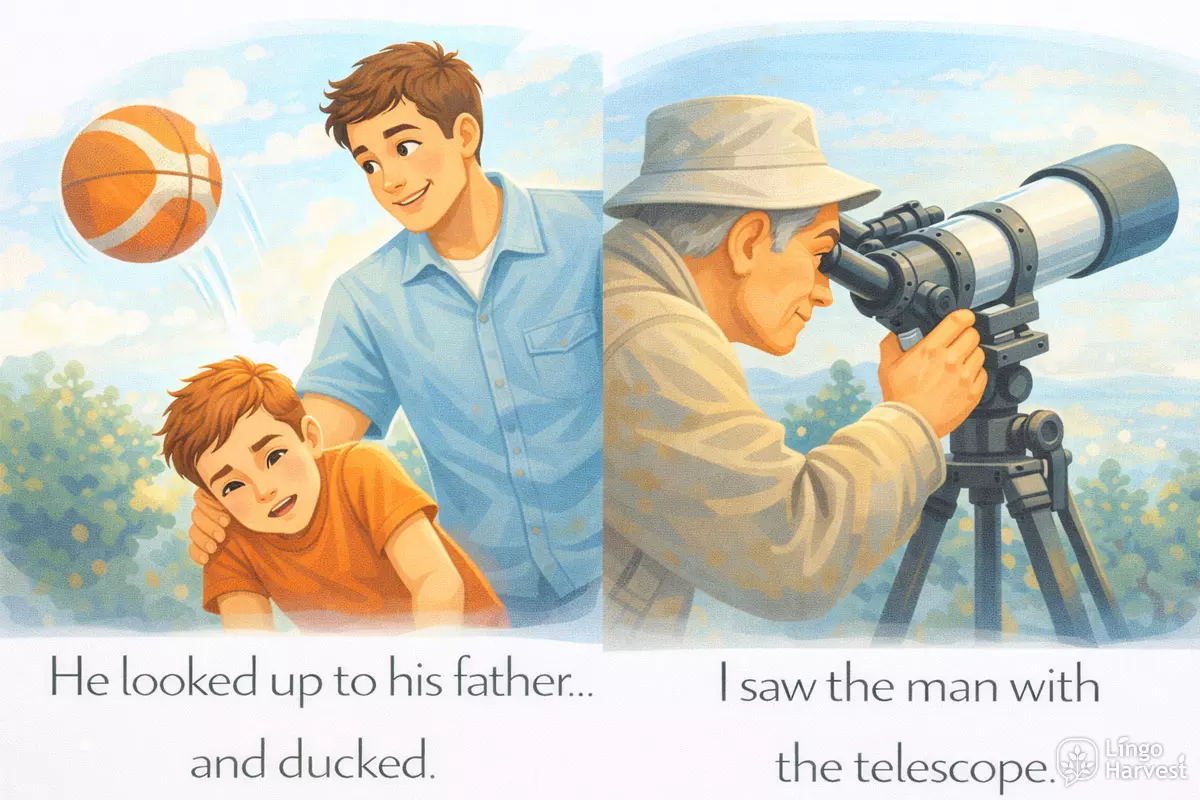
- Unexpected pairings: "He looked up to his father... and ducked."
- Misplaced modifiers: "I saw the man with the telescope."
- Shifting reference points: "She walked in on the joke."
- Reversing roles: "Let’s table the discussion—on the table."
- Literal extension: "I’m out of money. Out of ideas, too."
- Spatial/temporal blends: "We’re out for lunch, but back by noon."
- Breaking expectations: "He fell for her. She tripped him."
- Overlapping senses: "I’m under the weather and under my blanket."
Common Prepositions and Their Humorous Potential
Certain prepositions crop up repeatedly in English jokes. Their everyday meanings make them easy targets for playful reinterpretation. Here are some of the most humor-friendly prepositions, along with typical ways they're twisted in informal speech:
- On: “On fire” (excited or literally burning?)
- In: “In trouble” vs. “in style”
- Out: “Out of sorts,” “out cold,” “out and about”
- Up: “Up to no good,” “what’s up?”
- Over: “Get over it,” “over the moon”
- Under: “Under pressure,” “under the table”
- With: “With flying colors,” “with a twist”
- For: “For good,” “for kicks”
- By: “By the book,” “by accident”
- Off: “Off the hook,” “off the record”
- Down: “Down and out,” “down for the count”
- At: “At large,” “at odds”
Ambiguity in Action: Joke Structures Using Prepositions
Wordplay using prepositions often fits into recognizable joke templates. These structures highlight just how easily meanings can pivot:
- Switching objects: “I’m on a seafood diet. I see food and I eat it.”
- Reinterpreting idioms: “He’s under the impression—literally, the printing press fell on him.”
- Layering meanings: “She’s out of this world—her house is in orbit.”
- Contradictory pairings: “We’re up for anything, except getting up.”
Visual Comparison: Literal vs. Figurative Prepositional Use in Humor
| Literal Prepositional Use | Figurative/Idiomatic Use |
|---|---|
| I’m on the roof. | I’m on cloud nine. |
| She’s in the car. | She’s in hot water. |
| He’s under the table. | He’s under the weather. |
| They’re out of the house. | They’re out of luck. |
| We’re up the hill. | We’re up for anything. |
By embracing the ambiguity of prepositions, English humorists can play with expectations and create punchlines that rely on quick shifts between literal and figurative language. This constant toggling not only amuses but also highlights the inventive, flexible nature of informal English.
Slang Syncretism: Analyzing fixed prepositional slang like 'down for', 'up for', and 'on fleek'
Prepositional slang often involves set phrases where the preposition is “fixed” and doesn’t follow the usual literal meaning. These expressions are especially common in informal English, where the preposition becomes inseparable from the meaning. For example, being “down for” something means you’re willing or eager to do it, while “up for” expresses a similar idea, even though “down” and “up” are opposites in other contexts.
Why Are These Phrases Considered Fixed?
Fixed prepositional slang phrases can’t be freely changed without losing their meaning or sounding unnatural. The preposition and following word combine to create a new, idiomatic sense. Swapping the preposition or changing the order typically doesn’t work. For instance, “on fleek” means something is perfectly styled or exactly right, but “in fleek” or “at fleek” makes no sense.
Common Fixed Prepositional Slang Expressions
These combinations are widely used in conversation, text, and pop culture. Here are some popular examples:
- down for – willing to participate (“I’m down for pizza tonight.”)
- up for – open to or interested in (“Are you up for a movie?”)
- on fleek – perfectly done, stylish (“Her eyebrows are on fleek.”)
- out of pocket – acting unusually or being unavailable
- in the zone – focused and performing well
- off the chain – amazing or exciting
- in the loop – informed or included
- on point – exactly right or well done
- off the hook – impressive or released from responsibility
- on deck – next in line or ready
- at it – engaged in an activity (“They’re at it again.”)
- in your feels – experiencing strong emotions
- on fire – doing extremely well
- in the cut – in a secret or lowkey place
- off the grid – not connected or unreachable
Comparing Similar Phrases
Some slang expressions look similar but carry different nuances. Let’s compare how “up for” and “down for” are used, as well as how “on fleek” fits into the mix:
| Phrase | Meaning / Typical Usage | Example |
|---|---|---|
| down for | Willing, eager, ready to participate | “Are you down for a road trip this weekend?” |
| up for | Open to, interested in doing something | “Who’s up for some ice cream?” |
| on fleek | Perfectly styled, flawless, impressive | “Your outfit is on fleek today!” |
| off the chain | Very exciting, excellent | “That party was off the chain.” |
| in the loop | Kept informed, aware of what’s happening | “Keep me in the loop about the plans.” |
Observations on Prepositional Slang
These expressions highlight how English slang can “syncretize” – blending words into fixed, new meanings that can’t be broken down or modified without losing their impact. Recognizing these set phrases is key for understanding informal conversations and pop culture references. Trying to substitute prepositions or change their order rarely works, and often results in confusion or awkwardness. In summary, fixed prepositional slang phrases are a creative and evolving part of English, making informal speech rich and expressive. Knowing their meanings and usage helps with both understanding and joining in on casual, everyday interactions.
Grammatical Erosion: Intentional dropping of prepositions in rapid-fire comedic dialogue
English-language humor often relies on bending or breaking grammatical rules for comedic effect, and one classic maneuver is omitting prepositions in fast-paced exchanges. This stylistic shortcut pops up in sitcom banter, stand-up routines, and everyday joking between friends. The result is dialogue that feels punchy, irreverent, and sometimes even absurd—perfect for delivering a quick laugh.
Why Do Comedians Skip Prepositions?
Comedic timing thrives on brevity. Leaving out prepositions can make dialogue snappier, help punchlines land faster, and add a sense of informality or rebellion against "proper" English. Sometimes it also mimics the way people actually talk when they're excited, annoyed, or trying to be funny.
Common Patterns and Examples
You’ll spot this trend most often with common verbs and familiar idioms, especially when context fills in the blanks. Here are some typical examples where prepositions are dropped, either for speed or style:
- “Hop (in) the car!” → “Hop in the car — we’re going to be late.”
- “Jump (on) the call.” → “Jump on the call when you’re ready, and I’ll share my screen.”
- “Let’s grab (at) this chance.” → “Let’s grab this chance while we still have time.”
- “I’ll meet you (at) the corner.” → “I’ll meet you at the corner near the café.”
- “Come (to) my place.” → “Come to my place after work, and we’ll talk it through.”
- “Slide (into) my DMs.” → “If you have questions, slide into my DMs and I’ll reply later.”
- “He’s good (at) math.” → “He’s good at math, so he helped us check the calculations.”
- “Wait (for) me!” → “Wait for me — I just need to grab my jacket.”
- “Throw (in) the towel.” → “Don’t throw in the towel yet; we still have a few options.”
- “Sit (on) the fence.” → “Stop sitting on the fence and choose a side.”
- “Look (at) this!” → “Look at this — the results are much better than last time.”
- “Get (to) the point.” → “Can you get to the point? We don’t have much time.”
- “Hold (on) a second.” → “Hold on a second — I need to check one detail.”
- “Come (over) tonight.” → “Come over tonight if you’re free, and we’ll watch a movie.”
- “She’s (on) fire!” → “She’s on fire today — she solved three problems in ten minutes.”
- “It’s (in) the bag.” → “Relax, it’s in the bag — we’ve prepared everything.”
- “Step (up) your game.” → “If you want the promotion, you’ll need to step up your game.”
- “Hang (out) with us.” → “You should hang out with us this weekend if you’re not busy.”
- “Check (on) him.” → “Can you check on him and make sure he got home safely?”
- “Move (out) the way!” → “Move out of the way — you’re blocking the door.”
Effects on Humor and Tone
Deliberately skipping these small words can make speech sound more direct or brusque. It’s a way to parody hurried speech or to mock the "rules" of formal grammar. In some sketches or films, this strategy pokes fun at bureaucratic or robotic speech by contrasting it with loose, clipped slang.
Contrast: Standard vs. Eroded Forms
To see how dropping prepositions changes the rhythm and feel of a sentence, compare the following:
| Standard Form | Comedic/Eroded Form |
|---|---|
| Listen to me for a second. | Listen me for a second. |
| Pay attention to the instructions. | Pay attention the instructions. |
| Apologize for the mistake. | Apologize the mistake. |
| Depend on your team. | Depend your team. |
| Believe in yourself. | Believe yourself. |
| Agree with me on this. | Agree me on this. |
| Focus on the main goal. | Focus the main goal. |
| Search for a solution. | Search a solution. |
Should You Use This Trick?
While this style is common in comedy and casual speech, it’s best avoided in formal writing. For learners, recognizing these dropped words can help with understanding native speakers in real-life situations, movies, or stand-up. As a bonus, it’s also a fun way to play with English and appreciate its flexibility in informal settings.
Cultural Idiomaticity: Understanding 'out of pocket', 'about that life', and 'low-key' structures
Grasping the nuances of English humor and slang often means decoding cultural idioms and their grammatical quirks. Phrases like “out of pocket,” “about that life,” and “low-key” may look simple, but their meanings depend on social context and informal rules rather than textbook grammar. These expressions combine prepositions and everyday words in ways that can puzzle learners and even native speakers from different regions. Below, we’ll unpack how these idioms work and why they’re so common in casual speech.
Unpacking Common Slang Structures

Some slang expressions use prepositions creatively, forming patterns that don’t always follow standard logic. Here are a few examples showing how prepositional phrases become slang:
- Out of pocket: Can mean “unreachable/unavailable” (“I’ll be out of pocket this afternoon”) or “acting wild/inappropriately” (“She was really out of pocket last night”).
- About that life: Used to describe someone who truly lives or embraces a certain lifestyle, often with a hint of challenge or authenticity (“He says he’s about that life, but I doubt it”).
- Low-key: Means “secretly,” “moderately,” or “not openly” (“I’m low-key excited for the party”).
- On point: Something is exactly right or well done (“Her style is on point”).
- In your feelings: Deeply affected emotionally (“He’s really in his feelings today”).
- Off the chain: Extremely impressive or wild (“That concert was off the chain!”).
- In the cut: Lying low, staying out of sight (“He’s in the cut, just watching”).
- On the low: Secretly, quietly (“Let’s keep this on the low”).
- Under the weather: Feeling ill (“I’m a bit under the weather”).
- Up in the air: Uncertain, undecided (“Our plans are up in the air”).
- Out of line: Inappropriate, disrespectful (“That comment was out of line”).
- On the grind: Working hard (“She’s always on the grind”).
- In the loop: Informed, kept up to date (“Keep me in the loop”).
- Off the hook: Excused from responsibility, or something exciting (“You’re off the hook for the meeting”).
- Down for: Willing or ready (“I’m down for pizza tonight”).
- On fleek: Perfect, flawless (“Eyebrows on fleek”).
- Off the wall: Strange or unconventional (“That idea is off the wall”).
- Out of the blue: Unexpectedly (“She called out of the blue”).
- In the bag: Certain to be accomplished (“Victory is in the bag”).
- Off the record: Not officially recorded (“This is off the record”).
Why These Structures Work in Slang
Informal English often bends grammar for emphasis, rhythm, or cultural reference. Many of these idioms rely on prepositions to shift meaning away from the literal. For example, “low-key” uses “key” metaphorically, while “out of pocket” changes with context. The prepositions hint at relationships—physical, emotional, or social—that are understood by community members.
Comparing Idiomatic Patterns
Let’s look at how these idioms operate across usage, literal meaning, and typical context:
| Expression | Literal Meaning | Slang/Idiomatic Use | Typical Context |
|---|---|---|---|
| out of pocket | Not in one’s pocket | Unavailable / acting wild | Work emails, social events |
| about that life | Concerned with a way of living | Truly living a lifestyle | Challenging authenticity |
| low-key | On a lower setting | Secretly / moderately | Emotions, intentions |
| on the grind | Physically on a grindstone | Working hard | Work, hustle culture |
Takeaway for Learners
Mastering these patterns means listening for context, not just memorizing definitions. When in doubt, check how native speakers use these phrases in real life—social media and TV dialogue are great sources. Understanding the flexible, creative use of prepositions in slang opens up a richer, more playful side of English communication.
Register Collision: The comedic effect of using formal prepositions in low-stakes slang contexts
When speakers insert formal prepositions into casual or slangy English, it often creates a jarring—and funny—contrast. This deliberate clash between the expected informality of the context and the stuffy precision of prepositional phrases is a common trick in English humor. By intentionally using “proper” prepositions in everyday, even silly scenarios, speakers poke fun at both language itself and the social boundaries implied by formality.
Why Does This Sound Funny?
The humor comes from the mismatch between the register of the preposition and the tone of the conversation. Formal prepositions (like “upon,” “concerning,” or “with regard to”) are usually reserved for academic, legal, or official settings. When these are dropped into chatty, low-stakes slang, the result can sound mock-serious, sarcastic, or absurd.
Classic Examples of Formal Prepositions in Slang Contexts
- “I am, as per usual, running late.”
- “We’re going to the movies, in accordance with Friday tradition.”
- “Upon further consideration, I will have fries with that.”
- “He left the party at approximately 2 a.m.—on account of extreme boredom.”
- “With reference to last night: never again.”
- “I am, with regard to pizza, always available.”
- “Pursuant to our group chat, let’s meet at 7.”
- “In light of my hunger, I require snacks.”
- “Notwithstanding my exhaustion, I’ll join the game.”
- “For the avoidance of doubt, yes, I want dessert.”
- “By virtue of my laziness, I am still in bed.”
- “I am, as per my last text, very confused.”
- “Insofar as Netflix is concerned, I am a loyal customer.”
- “Let’s proceed, in the event of rain, to the pub.”
- “In accordance with my vibe, I refuse to wear pants.”
- “On the basis of nothing, I declare today a holiday.”
- “With respect to your question: no idea.”
- “Pursuant to my cravings, pizza is required.”
- “In regard to your meme: solid effort.”
- “By reason of procrastination, nothing is done.”
Intentional Overstatement for Comic Effect
Speakers often exaggerate the formality of their language to signal irony or playful self-mockery. This is especially common in group chats, memes, and internet banter. The overblown prepositional phrases highlight how unnecessary (and funny) such language is in casual settings.
Common Pairings: Formal Prepositions and Everyday Topics
You’ll notice that this technique works best when the subject matter is trivial or mundane. Here are some typical pairings:
- Food orders (“Upon reflection, I’ll have a large soda.”)
- Personal habits (“In light of current laziness, I’m staying in.”)
- Pop culture references (“Insofar as Taylor Swift is concerned, I am a fan.”)
- Plans with friends (“Pursuant to our agreement, see you at 8.”)
- Reactions to memes or messages (“With respect to your latest meme, 10/10.”)
Contrast with True Formal Usage
The table below shows how the same prepositional phrases function differently in formal and informal contexts. The humor emerges from this contrast.
| Formal Context | Slang/Humorous Context |
|---|---|
| “In accordance with company policy, all forms must be submitted by Friday.” | “In accordance with my laziness, I won’t be leaving the couch.” |
| “Pursuant to section 2.3, the agreement is terminated.” | “Pursuant to my cravings, it’s time for ice cream.” |
| “With respect to your application, we regret to inform you…” | “With respect to pizza toppings: pineapple is elite.” |
| “By virtue of his experience, he was promoted.” | “By virtue of my mood, I declare it pajama day.” |
Takeaway
Using formal prepositions in everyday banter is a simple, effective way to generate laughs by highlighting the absurdity of mixing linguistic registers. This playful misuse is a hallmark of English humor, especially in digital and youth culture.
Offensive vs. Playful tone: Navigating the social boundaries of informal prepositional usage
Understanding when an informal prepositional phrase is seen as clever banter or crosses into rudeness is a tricky aspect of English humor and slang. Context, familiarity with your audience, and cultural norms all play a role in how these expressions are received. What may sound witty among friends can feel inappropriate or even offensive in a more formal or unfamiliar setting.
Playful Prepositional Twists in Everyday Speech
Creative manipulation of prepositions often adds a lighthearted or tongue-in-cheek tone. Here are some familiar examples that rarely cause offense:
- “Out of it” (distracted or confused)
- “On a roll” (experiencing success or luck)
- “Under the weather” (feeling ill)
- “Up for it” (willing or enthusiastic)
- “In on it” (included in a secret or plan)
- “Off the hook” (freed from responsibility or trouble)
- “Down with that” (agreeable or supportive)
- “Off one’s rocker” (crazy or eccentric)
- “Over the top” (excessive or dramatic)
- “On your case” (criticizing or nagging)
- “Out to lunch” (not paying attention)
- “Under someone’s skin” (annoying or bothering someone)
- “In your face” (bold or confrontational, but sometimes playful)
Where Lines Blur: When Slang Turns Sharp
Not every playful phrase is safe in all contexts. Some prepositional idioms can be interpreted as mocking, dismissive, or even vulgar depending on intonation, relationship, and situation. Consider the following:
- “Off with you!” (dismissive; can sound rude)
- “Up yours!” (explicitly offensive)
- “In your face!” (playful among friends, but aggressive if used harshly)
- “Get over it” (can be supportive or dismissive based on delivery)
- “On your back” (can have sexual or accusatory connotations)
- “Down and dirty” (implies roughness; context is everything)
- “Under your thumb” (suggests control, may be negative)
- “On the rag” (offensive way to refer to menstruation)
- “Out of your league” (can be playful or insulting)
- “Up to no good” (mischievous, but sometimes negative)
Comparing Playful and Offensive Uses
The difference between humor and insult often comes down to subtle cues. Here’s a comparison of similar phrases and how their tone or intent shifts:
| Expression | Typical Tone/Context |
|---|---|
| “On a roll” | Playful, positive; celebrating success |
| “On your back” | Potentially offensive; can imply sexual innuendo or nagging |
| “In your face” | Can be playful among friends (teasing after a win) or aggressive if shouted |
| “Off with you!” | Dismissive; may offend if not used jokingly |
| “Up for it” | Enthusiastic, inviting, rarely offensive |
| “Up yours!” | Direct insult; always offensive |
| “Under the weather” | Neutral, harmless |
| “On the rag” | Rude, disrespectful, should be avoided |
Tips for Navigating Informal Prepositional Humor
- Gauge your audience: Friends may appreciate playful language; strangers or colleagues may not.
- Pay attention to tone and body language—sarcasm or a smile can change the meaning entirely.
- When in doubt, choose neutral phrases to avoid misunderstandings.
- Be aware that some expressions have double meanings, especially in mixed company.
- Apologize promptly if a joke doesn’t land—intent matters, but so does impact.
Knowing the fine line between lighthearted banter and offense is essential for anyone experimenting with English slang and humor, especially when using prepositions in creative ways.
Activity: Decoding 'Gen Alpha' and 'Z' slang prepositions and matching them to standard English
Modern slang in English frequently twists or reimagines prepositions, especially among younger speakers. Understanding these fresh uses can help you follow memes, chats, and social posts more naturally. This activity invites you to interpret recent slang prepositional phrases from Gen Alpha and Gen Z, then connect them to their standard English equivalents.
Common Slang Prepositions and Their Standard Counterparts
Below is a list of informal prepositional expressions currently popular in youth culture, along with their traditional meanings or uses in standard English. Some are playful transformations, while others are direct borrowings with new twists.
- Lowkey about – secretly interested in; standard: interested in
- On fleek – looking perfect; standard: looking good
- Out of pocket – acting wild/unpredictable; standard: out of control
- For the vibe – just for the mood/experience; standard: for fun
- In my feels – feeling emotional; standard: feeling emotional
- By the drip – because of fashion/style; standard: because of the style
- From the jump – since the beginning; standard: from the start
- With the squad – together with friends; standard: with friends
- Under the radar – unnoticed; standard: not attracting attention
- Off the grid – disconnected; standard: not online or reachable
- On blast – made public/embarrassed; standard: publicly exposed
- For the clout – to gain attention/status; standard: for popularity
- In the loop – informed; standard: kept informed
- Off the rip – right away; standard: immediately
- At me – mention/tag me; standard: address me directly
- On god – seriously/truly; standard: honestly
- In my bag – performing well or being emotional; standard: doing well/feeling emotional
- With the sauce – with style/confidence; standard: stylishly
- Off one – acting strange (sometimes under the influence); standard: acting oddly
- Out of pocket for that – acting inappropriately; standard: out of line
Matching Task: Slang vs. Standard English
Try to match each Gen Z or Alpha expression to its closest standard English meaning. Some may have more than one possible equivalent.
- Lowkey about
- On blast
- For the clout
- In my feels
- With the squad
- Off the grid
- From the jump
- On god
- Out of pocket
- On the same page
- In the loop
- Under the radar
Show answers
- Secretly interested in
- Publicly exposed or criticized
- For popularity or status
- Feeling emotional
- With friends
- Not online or reachable
- From the start
- Honestly or seriously
- Inappropriate or too extreme
- In agreement or sharing the same understanding
- Informed and up to date
- Not attracting attention
Quick Reference Table: Slang Prepositions vs. Standard English
| Slang Prepositional Phrase | Standard English Meaning |
|---|---|
| Out of pocket | Out of control/unpredictable |
| For the vibe | For fun/just for the experience |
| By the drip | Because of the style/fashion |
| Off the rip | Immediately/right away |
| With the sauce | With style/confidence |
| At me | Address me directly/tag me |
Exploring these playful uses helps you decode informal English and join in on contemporary humor and communication. Take note: context is key, as meanings can shift quickly in online communities.