Advanced Adjective + Preposition Patterns for B2–C1 Learners

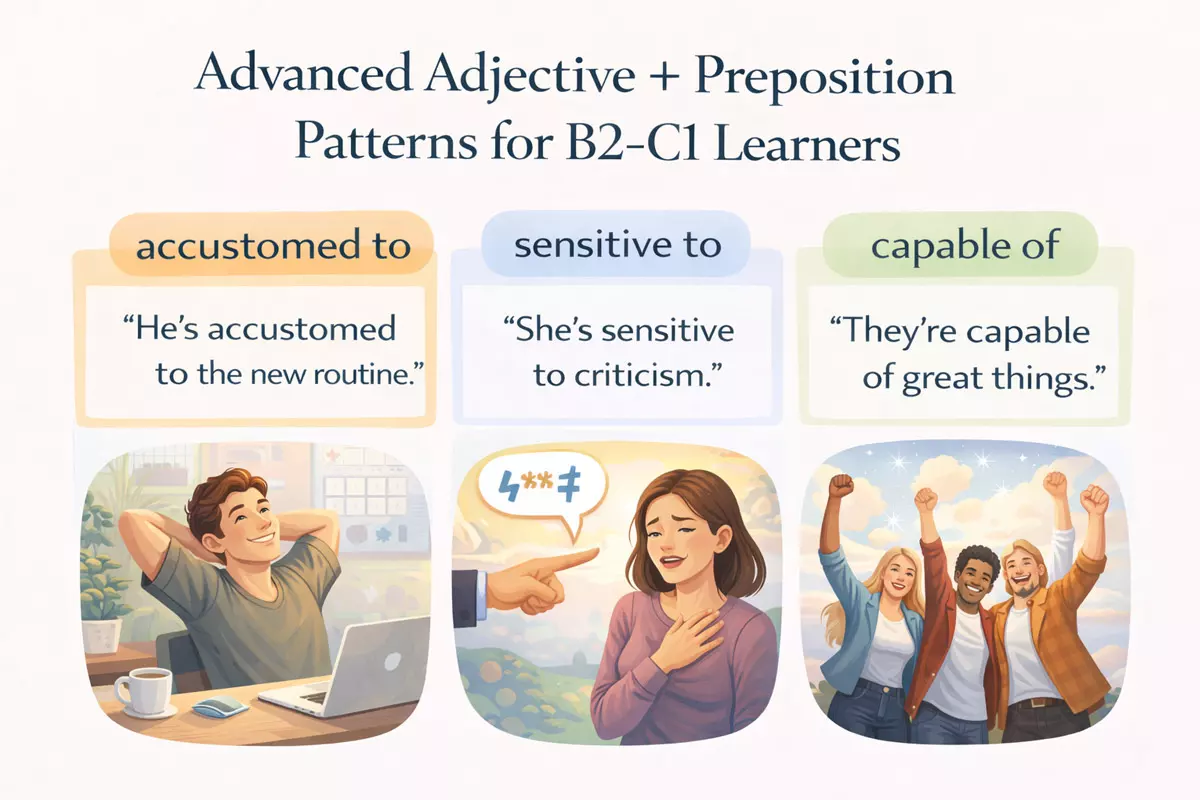 Here we why adjectives require specific prepositions, highlights subtle meaning shifts in adjective-preposition pairs, covers common academic combinations, examines register differences, addresses translation issues, and provides practice in formal…
- The Logic of Adjectival Complements: Why certain qualities require specific prepositions
- Semantic Nuance: Meaning shifts in 'responsible for' vs 'responsible to', 'mad at' vs 'mad about'
- Subtle Distinction Workshop: 'Familiar with' vs 'Familiar to' and 'Consistent with' vs 'Compatible with'
- Academic Adjectives: Mastering fixed partners like 'inherent in', 'conducive to', and 'integral to'
- Register Contrast: Identifying informal clusters vs sophisticated written alternatives
- The 'Adjective + of' vs 'Adjective + for' trap: Evaluating character vs evaluating actions
- Translation Interference: Mapping and correcting L1-influenced adjectival mismatches
- Syntactic Variation: Adjectives followed by prepositional phrases in complex clauses
- Practice: Refinement tasks using formal debates and essay-based context
Understanding how descriptive words naturally pair with other words can be quite challenging for upper-intermediate and advanced English learners, but mastering these subtle combinations is essential for achieving greater fluency. When you use adjectives and their typical partners correctly, your speech and writing will sound more natural and precise, allowing you to express your ideas clearly and confidently in a wide range of situations. This skill not only improves your communication but also helps you better understand native speakers.
The Logic of Adjectival Complements: Why certain qualities require specific prepositions
English adjectives often need particular prepositions to link them to further information, and these "adjectival complements" can seem unpredictable. However, there's usually a logic behind which preposition follows which adjective, rooted in meaning, origin, and sometimes even history. Understanding these patterns helps advanced learners move beyond memorization and use adjective-preposition combinations more confidently.
Semantic Relationships: How Meaning Guides the Choice
Prepositions after adjectives reflect specific relationships. For example, interested in points to the object of curiosity, while afraid of identifies the source of fear. These choices are not random; they signal the kind of connection between the adjective and what follows.
- Good at (skill or ability): She is good at singing.
- Responsible for (duty or cause): He is responsible for the project.
- Famous for (reason for fame): The city is famous for its art.
- Similar to (comparison): This song is similar to the last one.
- Opposed to (opposition): They are opposed to the idea.
- Capable of (ability): She is capable of great things.
- Afraid of (source of fear): He is afraid of spiders.
- Interested in (focus of interest): We are interested in robotics.
- Angry with/at (target of anger): She is angry with her friend.
- Married to (relationship): He is married to a doctor.
- Dependent on (reliance): The result is dependent on effort.
- Familiar with (knowledge): Are you familiar with this term?
- Different from (distinction): This is different from the old system.
- Sorry for/about (regret): I am sorry for the mistake.
- Proud of (source of pride): She is proud of her achievements.
- Accustomed to (habit): He is accustomed to the climate.
- Late for (reason for lateness): They were late for the meeting.
- Kind to (recipient of kindness): Be kind to animals.
- Upset about (reason for upset): He’s upset about the news.
- Impressed by/with (source of impression): I am impressed by your work.
Patterns and Exceptions: When Logic Meets Idiom
While many adjective-preposition combinations follow clear patterns, some are set by usage and tradition. For instance, good at (not good in for skills), or interested in (not interested on). These forms must be learned as fixed expressions. However, recognizing the meaning behind each pairing can help you remember and apply them correctly.
Comparing Common Patterns
To see how these combinations are structured, look at the following table. It compares adjectives that take different prepositions depending on context, highlighting the shift in meaning:
| Adjective | Preposition & Usage Example | Typical Meaning |
|---|---|---|
| Angry | Angry with a person Angry about something |
Directed at someone or a situation |
| Good | Good at (a skill) Good for (beneficial) |
Ability or benefit |
| Sorry | Sorry for (an action) Sorry about (a situation) |
Regret for actions or events |
| Familiar | Familiar with (knowledge) Familiar to (recognizable by someone) |
Knowledge vs. recognition |
Summary: Building Intuition
Mastering adjectival complements means tuning into both meaning and convention. The more you notice the logic behind these pairings, the easier it becomes to use them naturally. Practice with real examples and pay attention to how prepositions shift or clarify the sense of each adjective.
Semantic Nuance: Meaning shifts in 'responsible for' vs 'responsible to', 'mad at' vs 'mad about'
Understanding how adjective + preposition combinations subtly shift in meaning is crucial for advanced learners. Two of the most common sources of confusion are the pairs “responsible for” vs “responsible to” and “mad at” vs “mad about.” The preposition you choose can completely change the relationship or emotion you’re describing.
‘Responsible for’ vs ‘Responsible to’: Different Focus
“Responsible for” highlights what someone must do or manage, while “responsible to” emphasizes to whom someone is answerable or owes accountability. These distinctions matter in the workplace, in legal contexts, and even in everyday situations.
- Responsible for: used to talk about duties or tasks someone must perform.
Example: She is responsible for organizing the meeting. - Responsible to: used to express a relationship of accountability.
Example: He is responsible to the board of directors.
‘Mad at’ vs ‘Mad about’: Emotional Direction
The phrase “mad at” expresses anger toward a person or thing, while “mad about” can mean being enthusiastic or obsessed, especially in British English. In American English, “mad about” sometimes still means angry, but it’s less common.
- Mad at: shows you are angry with someone or something.
Example: She was mad at her friend for being late. - Mad about: often means you are crazy about or deeply enthusiastic.
Example: He’s mad about jazz music.
Comparison Table: Shifting Meanings

| Pattern | Meaning | Example |
|---|---|---|
| Responsible for | Having duty or obligation | She’s responsible for the budget. |
| Responsible to | Accountable to a person/group | He’s responsible to his manager. |
| Mad at | Angry with (someone/something) | I’m mad at my brother. |
| Mad about | Enthusiastic about / obsessed with | She’s mad about tennis. |
More Examples of Adjective + Preposition Shifts
The following list highlights other pairs where a simple preposition change alters the meaning. Noticing these patterns helps you avoid misunderstandings and sound more natural in advanced English.
- Good at (skilled in) vs. Good for (beneficial to)
- Angry at (person/thing) vs. Angry about (situation)
- Sorry for (feeling sympathy) vs. Sorry about (regret for something)
- Famous for (reason) vs. Famous in (place)
- Different from (not the same as) vs. Different to (UK: not the same as)
- Interested in (showing interest) vs. Interested by (rare, but means something captured your interest)
- Concerned about (worried) vs. Concerned with (involved in)
- Married to (person) vs. Married with (children)
- Afraid of (fear) vs. Afraid for (concern about someone’s safety)
- Close to (relationship) vs. Close with (relationship, especially emotional)
Why These Nuances Matter
Choosing the right preposition isn’t just a grammar issue; it shapes the meaning and tone of your sentence. Subtle shifts can affect clarity, formality, and even politeness. Advanced users notice these differences and adjust their language for precision and appropriateness in context.
Subtle Distinction Workshop: 'Familiar with' vs 'Familiar to' and 'Consistent with' vs 'Compatible with'
Understanding subtle differences between adjective + preposition combinations is essential at the upper-intermediate and advanced levels. Learners often confuse pairs like "familiar with" and "familiar to," as well as "consistent with" and "compatible with," since they seem similar but are used differently in context.
‘Familiar with’ vs ‘Familiar to’: Recognizing the Subject and Object
"Familiar with" is used when someone has knowledge or experience of something, while "familiar to" means something is well known or easily recognized by someone. The direction of familiarity changes depending on which preposition you use.
- Familiar with: She is familiar with the new software. (She knows about it.)
- Familiar to: Her face was familiar to everyone in the office. (Everyone recognized her.)
- Are you familiar with this concept?
- This melody is familiar to most listeners.
- He’s not familiar with the procedure.
- The smell was familiar to him from childhood.
- They are familiar with the rules.
- The name is familiar to me, but I can’t place it.
‘Consistent with’ vs ‘Compatible with’: Agreement vs. Suitability
The phrase "consistent with" describes when one thing agrees or matches with another, especially with facts or principles. In contrast, "compatible with" means that two things can exist or work together without conflict.
| Pattern | Typical Use & Example |
|---|---|
| Consistent with | Shows agreement or alignment. His story is consistent with the evidence. ✅ |
| Compatible with | Means able to function together. This charger is compatible with your phone. ✅ |
| Consistent with | Used for theories, statements, or behavior. Your results are consistent with our findings. |
| Compatible with | Used for objects, systems, or people. The software isn’t compatible with older computers. ❌ |
Quick Reference: Common Pitfalls and Tips
- Use familiar with for skills, knowledge, or experience.
- Use familiar to when something is recognized by someone.
- Use consistent with for agreement between facts, results, or principles.
- Use compatible with for things that can work together or coexist.
- Avoid: This device is consistent with your laptop. ❌ (Should be "compatible with")
- Avoid: Your accent is familiar with me. ❌ (Should be "familiar to")
Mastering these distinctions will help you write and speak with greater accuracy and nuance at the B2–C1 level. Pay attention to the subtle shifts in meaning as you encounter these patterns in academic texts and everyday conversation.
Academic Adjectives: Mastering fixed partners like 'inherent in', 'conducive to', and 'integral to'
Understanding how certain adjectives pair with specific prepositions is essential for sounding natural and precise in academic English. These combinations, often called "fixed partners" or "collocations," are not random; they are established patterns that advanced learners need to master in order to express complex ideas clearly.
Why do these adjective + preposition patterns matter?
Academic writing and formal discussions rely on accuracy. Using the correct preposition after adjectives like "inherent," "conducive," or "integral" can change the meaning of your sentence—or make it clear that you understand the nuances of English. For example, "conducive for" is incorrect, while "conducive to" is accepted.
Common Academic Adjective + Preposition Combinations
Here are some widely used pairings you’ll encounter in academic texts and lectures. Learning these will help you write and speak with more confidence:
- inherent in – The risks are inherent in the process.
- conducive to – A quiet environment is conducive to learning.
- integral to – Critical thinking is integral to scientific research.
- compatible with – The results are compatible with previous findings.
- subject to – The proposal is subject to approval.
- relevant to – The data is relevant to our hypothesis.
- distinct from – This method is distinct from earlier approaches.
- applicable to – The theory is applicable to various contexts.
- opposed to – Some are opposed to the new policy.
- appropriate for – This solution is appropriate for all age groups.
- analogous to – The structure is analogous to a tree.
- beneficial to – Exercise is beneficial to mental health.
- indicative of – The symptoms are indicative of infection.
- contingent on/upon – Success is contingent on effort.
- immune to – Some species are immune to the virus.
- responsible for – The manager is responsible for the outcome.
- consistent with – The evidence is consistent with the theory.
- akin to – Her approach is akin to that of a scientist.
Patterns in Context
Let’s see how these combinations function in academic sentences:
- Participation is integral to the learning process.
- These outcomes are inherent in the nature of the experiment.
- Group work is often conducive to creative solutions.
Quick Reference: Typical Academic Adjective + Preposition Pairings
| Adjective | Preposition Partner | Example |
|---|---|---|
| inherent | in | Uncertainty is inherent in all scientific research. |
| conducive | to | Silence is conducive to concentration. |
| integral | to | Collaboration is integral to success. |
| compatible | with | The theory is compatible with the data. |
| relevant | to | These findings are relevant to our topic. |
| subject | to | The results are subject to change. |
| responsible | for | He is responsible for the final report. |
| applicable | to | This rule is applicable to all cases. |
Tips for Mastery
- Notice these patterns in journal articles, textbooks, and lectures. - When learning a new adjective, check which preposition it naturally takes. - Practice by writing your own sentences and getting feedback. - Be aware that direct translation from your first language may lead to mistakes. With regular exposure and conscious practice, these fixed adjective + preposition partners will soon feel like a natural part of your academic English toolkit.
Register Contrast: Identifying informal clusters vs sophisticated written alternatives
Recognizing the contrast between casual and more formal adjective + preposition patterns is essential for B2–C1 learners aiming to adapt their writing and speech to different contexts. Informal clusters are common in conversation or friendly texts, while advanced written alternatives are favored in academic, professional, or official documents.
Informal vs Formal: Why Does Register Matter?
Choosing the right register affects how your message is received. Using colloquial combinations in a formal essay can make your arguments seem less credible. Conversely, overusing formal alternatives in everyday conversation may sound unnatural or distant. Understanding when to use each set of patterns helps you communicate appropriately and effectively.
Common Informal Clusters and Their Sophisticated Counterparts
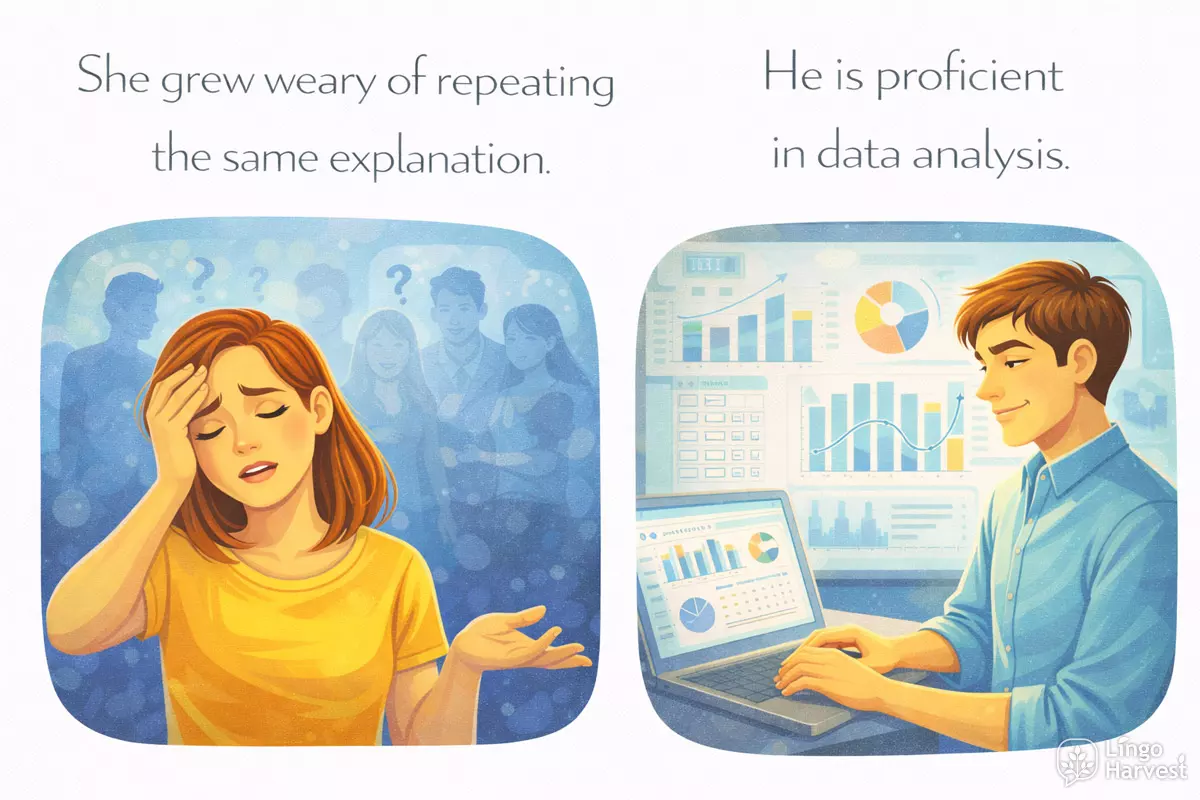
Many everyday adjective + preposition pairings have more polished equivalents. Here are some typical clusters and their advanced written alternatives:
- tired of → weary of → She grew weary of repeating the same explanation.
- good at → proficient in → He is proficient in data analysis.
- scared of → apprehensive about → She felt apprehensive about the upcoming exam.
- happy about → delighted by → The team was delighted by the positive feedback.
- mad at → incensed with → He was incensed with the supplier over the delay.
- okay with → amenable to → She is amenable to changing the schedule.
- sure about → convinced of → They are convinced of the plan’s success.
- keen on → enthusiastic about → He is enthusiastic about learning new skills.
- worried about → concerned about → Parents are concerned about online safety.
- fed up with → dissatisfied with → Customers were dissatisfied with the service.
- used to → accustomed to → She is accustomed to working remotely.
- full of → replete with → The report is replete with useful examples.
- proud of → proud of / pleased with → She was pleased with the final outcome.
- interested in → engaged in → He is engaged in community projects.
- bad at → inept at → He felt inept at handling the situation.
- angry at → indignant at → She was indignant at the unfair accusation.
- upset about → perturbed by → Investors were perturbed by the sudden drop.
- sorry for → apologetic for → He was apologetic for the misunderstanding.
- close to → adjacent to / closely associated with → The office is adjacent to the station.
- good for → beneficial to → Regular exercise is beneficial to mental health.
Tips for Choosing the Right Register
- Consider your audience: Is the context academic, professional, or casual?
- Look for register cues in surrounding language—avoid mixing informal and formal styles.
- Practice substituting informal clusters with their sophisticated equivalents when writing essays or reports.
- When in doubt, opt for clarity and appropriateness over complexity.
Developing sensitivity to register empowers you to adjust your language for any situation, making your communication clearer and more effective.
The 'Adjective + of' vs 'Adjective + for' trap: Evaluating character vs evaluating actions
Many upper-intermediate and advanced learners stumble when choosing between “adjective + of” and “adjective + for.” This isn’t just about memorizing collocations—it’s about understanding how English speakers subtly judge character versus actions. The preposition you choose can signal whether you’re describing someone’s personality or assessing what they’ve done in a specific situation.
Describing People vs. Describing Actions
When we use “adjective + of,” we often highlight a person’s inherent qualities or character traits. In contrast, “adjective + for” tends to focus on the appropriateness, suitability, or consequences of actions, especially in relation to a particular situation.
- It was kind of you to help. (judging the person’s character)
- That was kind of you. (again, person-focused)
- It was kind of her to offer. (personality or character)
- It’s unusual for him to be late. (judging the action in context)
- This is typical for students during exams. (action or situation)
- It’s essential for you to rest. (action that is necessary)
Common Adjectives: Different Meanings with “of” and “for”
Some adjectives can be paired with both “of” and “for,” but the meaning changes depending on which preposition you use. Here’s a breakdown to make sense of these patterns:
| Adjective + of (Character/Person) | Adjective + for (Action/Situation) |
|---|---|
| It was brave of her to speak up. | Speaking up was brave for someone so shy. |
| It’s careless of you to forget. | For a teacher, forgetting names is careless. |
| It was generous of them to donate. | For a small company, that donation was generous. |
| It’s rude of him to interrupt. | Interrupting is rude for anyone. |
| It’s sensible of you to leave early. | For tourists, leaving early is sensible. |
Tips for Avoiding This Trap
- Use “of + person” when you want to evaluate someone’s character or intentions (e.g., “It was thoughtful of you”).
- Use “for + situation” when you want to judge how an action fits a context (e.g., “That’s unusual for him”).
- Double-check: If the sentence makes sense without a person, “for” is usually correct. If talking about someone’s quality, “of” is likely needed.
Mastering this subtle distinction will help you sound more natural and precise, especially when giving opinions or feedback about people and their actions.
Translation Interference: Mapping and correcting L1-influenced adjectival mismatches
Learners at the B2–C1 level often encounter subtle errors when pairing adjectives with prepositions, especially when their first language (L1) uses different structures. These mismatches can lead to unnatural or incorrect English, even when the meaning seems clear in the learner’s mind. Understanding how native language patterns interfere is key to mastering advanced adjective + preposition combinations.
Common Sources of L1 Interference
Many languages use prepositions differently, or sometimes not at all, after adjectives. For example, in Russian, German, or French, the preposition accompanying an adjective may differ from English, or a different case structure might be used instead. This leads to direct translations such as "interested on something" instead of "interested in something".
Typical Mismatches and Correction Strategies
To help learners avoid these pitfalls, it’s useful to map common L1-induced errors and their correct English forms. Below is a structured comparison of typical mismatches caused by direct translation from various languages, with guidance on the accurate English pairing.
| Common Error (from L1 influence) | Correct English Form |
|---|---|
| responsible for something ✅ responsible of something ❌ (Sp. influence) |
She is responsible for the project. |
| interested on something ❌ (Ru. influence) | interested in something He is interested in art. |
| afraid from spiders ❌ (Ar. influence) | afraid of spiders She is afraid of spiders. |
| married with someone ❌ (It./Sp. influence) | married to someone He is married to Anna. |
| good in math ❌ (direct translation) | good at math She’s good at math. |
| similar with something ❌ (Gr. influence) | similar to something This is similar to mine. |
| angry against someone ❌ (Fr./Sp. influence) | angry with someone He’s angry with his brother. |
| capable for something ❌ | capable of something She is capable of leading. |
| proud about something ❌ (common error) | proud of something They’re proud of their work. |
| famous by something ❌ (Pt. influence) | famous for something The city is famous for its food. |
Practical Tips for Avoiding Interference
- Notice which prepositions your native language uses after adjectives and compare them with English patterns.
- Create your own personalized list of tricky adjective + preposition pairs.
- Listen for these collocations in authentic English materials to reinforce correct usage.
- Practice using the correct combinations in sentences, both spoken and written.
- Ask for feedback from teachers or native speakers when in doubt.
By systematically mapping out and correcting these mismatches, advanced learners can make their English more natural and idiomatic, reducing interference from their first language.
Syntactic Variation: Adjectives followed by prepositional phrases in complex clauses
Exploring how adjectives are paired with prepositional phrases reveals a lot about sentence complexity at higher proficiency levels. In more advanced English, adjectives frequently introduce additional meaning by being immediately followed by prepositional phrases, especially inside longer or multi-clause sentences. This structure helps speakers add detail, clarify relationships, and express subtle attitudes or conditions.
Common Patterns and Usage
Many adjectives naturally combine with specific prepositions, but in complex clauses, these combinations often carry extra nuance. For example, compare simple and expanded forms:
- afraid of — She is afraid of spiders.
- interested in — He is interested in learning new languages.
- responsible for — They are responsible for organizing the event.
- capable of — She is capable of handling difficult situations.
- accustomed to — We are accustomed to working under pressure.
- concerned about — Parents are concerned about their children’s safety.
- opposed to — They are opposed to increasing taxes.
- famous for — The region is famous for its beautiful scenery.
- similar to — This technique is similar to the one we used before.
- relevant to — Your comments are relevant to the discussion.
- different from — Her style is different from mine.
- dependent on — The outcome is dependent on several factors.
- angry about — He was angry about the delay.
- good at — She is good at solving puzzles.
- familiar with — Are you familiar with this software?
- proud of — They are proud of their achievements.
- keen on — He is keen on hiking in the mountains.
- involved in — She is involved in several projects.
- essential for — Patience is essential for success.
- ready for — We are ready for the challenge.
Adjectives + Prepositional Phrases in Multi-Clause Sentences
In complex clauses, these adjective + preposition patterns often function as descriptive modifiers, qualifying nouns or pronouns and linking ideas. For example:
- I am confident of winning the competition because I have trained hard.
- She was upset about missing the meeting, which she considered important.
- The team, proud of its record, welcomed the challenge that lay ahead.
- Anyone unfamiliar with the process should ask for help before starting.
This placement allows for more precise expression, especially in sentences containing multiple clauses or embedded information.
Comparing Structures: Simple vs. Complex Clauses
To better understand the syntactic flexibility, compare how these patterns function in both straightforward and more layered sentences:
| Simple Clause Example | Complex Clause Example |
|---|---|
| She is afraid of dogs. | She is afraid of dogs that bark loudly when strangers approach. |
| They are responsible for the budget. | They are responsible for the budget, which must be reviewed quarterly by all managers. |
| He is interested in science. | He is interested in science because it explains so much about the world around us. |
| We are accustomed to noise. | We are accustomed to noise since our office is located near a busy street. |
Tips for Mastery ✅
- Notice which adjectives commonly pair with which prepositions; many are fixed and must be memorized.
- Practice embedding these patterns in longer sentences for richer expression.
- Pay attention to how meaning shifts when you move the adjective + preposition phrase within the sentence.
- Review authentic texts to see these structures used in context.
Mastering these advanced adjective + preposition patterns will help you build more nuanced, precise, and sophisticated sentences at the B2–C1 level.
Practice: Refinement tasks using formal debates and essay-based context
Applying advanced adjective + preposition combinations in formal debates and essay writing allows learners to express nuanced opinions and construct more sophisticated arguments. Below you'll find targeted exercises and strategies to refine your command of these patterns, designed for upper-intermediate and advanced English users.
Debate-Focused Sentence Transformation
Transform the following debate statements by replacing the underlined phrases with suitable adjective + preposition patterns. This will help you sound more precise and academic in spoken arguments.
- She is very interested in the outcome of the new policy.
- The committee was not happy about the decision.
- Many participants felt uncomfortable with the proposed changes.
- Citizens are afraid of the potential consequences.
- Our team is responsible for delivering the final report on time.
- I am confident about the results of the next round of testing.
- They were surprised by how quickly the situation changed.
- He is good at explaining complex ideas in simple terms.
- We are dependent on accurate data to make a fair decision.
- She felt proud of her contribution to the project.
Show answers
- She is deeply invested in the outcome of the new policy.
- The committee was dissatisfied with the decision.
- Many participants felt apprehensive about the proposed changes.
- Citizens are concerned about the potential consequences.
- Our team is in charge of delivering the final report on time.
- I am optimistic about the results of the next round of testing.
- They were taken aback by how quickly the situation changed.
- He is skilled at explaining complex ideas in simple terms.
- We are reliant on accurate data to make a fair decision.
- She felt pleased with her contribution to the project.
Common Advanced Adjective + Preposition Combinations
Below is a list of high-frequency adjective-preposition patterns suitable for essays and debates. Practice using each in your own sentences:
- Accustomed to → She is accustomed to working under pressure.
- Adept at → He is adept at solving complex technical problems.
- Allergic to → Many people are allergic to certain food additives.
- Apprehensive about → Investors are apprehensive about the market’s stability.
- Beneficial to → Regular exercise is beneficial to both physical and mental health.
- Capable of → The system is capable of processing large volumes of data.
- Committed to → The company is committed to reducing its environmental impact.
- Consistent with → Her explanation is consistent with the available evidence.
- Crucial to → Clear communication is crucial to successful teamwork.
- Dependent on → The final outcome is dependent on user feedback.
- Engaged in → She is currently engaged in a long-term research project.
- Familiar with → He is familiar with international regulations.
- Indifferent to → She seemed indifferent to public criticism.
- Liable for → The supplier is liable for any manufacturing defects.
- Relevant to → This information is highly relevant to the discussion.
- Responsible for → He is responsible for managing the entire department.
- Skeptical about → Many experts are skeptical about the proposed solution.
- Subject to → The agreement is subject to final approval.
- Susceptible to → Older systems are more susceptible to security breaches.
- Sympathetic to → The audience was sympathetic to her point of view.
Table: Adjective + Preposition Patterns in Academic Contexts
| Adjective + Preposition | Sample Usage in Debate/Essay |
|---|---|
| Crucial to | The ability to adapt is crucial to success in a fast-changing environment. |
| Skeptical about | Many experts remain skeptical about the effectiveness of the new policy. |
| Committed to | The organization is committed to improving access to education. |
| Consistent with | Her findings are consistent with previous research in the field. |
| Liable for | The company may be liable for damages caused by negligence. |
| Engaged in | Students are actively engaged in community service projects. |
| Susceptible to | Individuals with weaker immune systems are susceptible to infection. |
| Relevant to | The data is particularly relevant to current environmental debates. |
Essay Context: Fill-in-the-Blank Practice
Insert the most suitable adjective + preposition phrase in each blank to complete these academic sentences:
- The results of the experiment are ________ previous studies.
- Researchers are ________ finding a sustainable solution.
- He is ________ criticism regarding his methodology.
- The participants were ________ the risks involved.
- The new policy is ________ international regulations.
- She is ________ improving her professional skills.
- This material is ________ environmental damage.
- The outcome is heavily ________ external economic factors.
- He remains ________ the long-term benefits of the proposal.
- Employees are ________ following strict safety guidelines.
Show answers
- consistent with
- committed to
- susceptible to
- apprehensive about
- consistent with
- committed to
- susceptible to
- dependent on
- skeptical about
- responsible for
For best results, practice integrating these patterns into both spoken and written arguments. Try recording yourself or peer-reviewing essays to identify areas where more precise adjective-preposition combinations would clarify your stance or analysis.