Complex Multi-Word Prepositions: Full Guide with Common English Forms

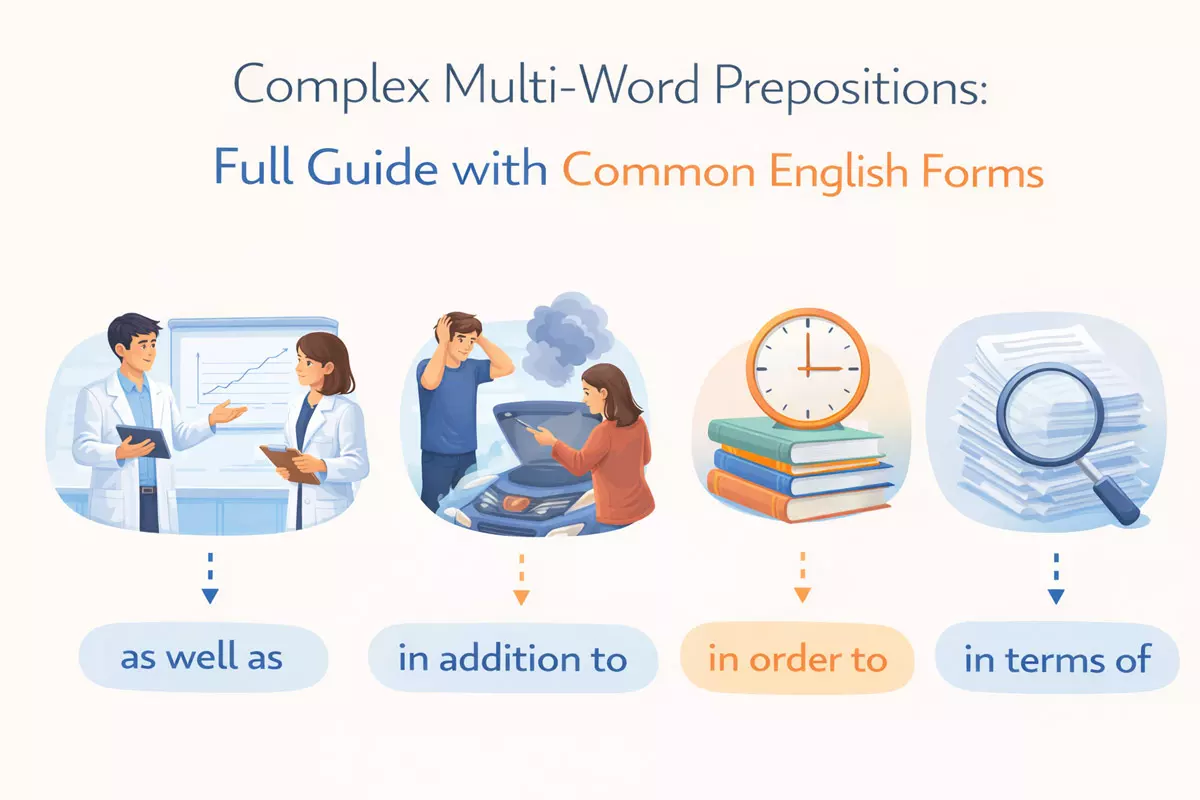 Here we two-word and three-word prepositions, their functions in concession, causality, and substitution, register choices like despite versus notwithstanding, word placement, punctuation, avoiding common errors, paraphrasing, and real-world case studies.
- Structural taxonomy: Two-word (along with) vs Three-word clusters (in addition to)
- Functional categories: Concession, Causality, Representation and Substitution
- Register and Stylistic Precision: Choosing 'despite' vs 'notwithstanding'
- Syntactic positioning: Fronting for cohesion and parenthetical usage
- Punctuation mechanics: Comma placement with long introductory phrases
- Grammar traps: Avoiding 'despite of' and other common L1 interference
- Information flow: Using multi-word prepositions to manage sentence focus
- Practice: Paraphrasing workshop to upgrade from simple to complex forms
- Contextual analysis: Case studies from business, legal and academic texts
Mastering English involves more than just learning individual words; it also requires understanding how complex prepositional phrases link ideas clearly and accurately. This guide examines the role of extended prepositional expressions in constructing coherent sentences, offering practical examples and highlighting common patterns that can help you communicate more effectively and confidently in both spoken and written English. By focusing on these structures, you can enhance your fluency and express your thoughts with greater nuance.
Structural taxonomy: Two-word (along with) vs Three-word clusters (in addition to)
Understanding multi-word prepositions involves looking closely at their internal structure. Most of these expressions fall into two main patterns: compact two-word compounds (like "along with") and more elaborate three-word clusters (such as "in addition to"). Recognizing these patterns helps in both comprehension and usage, as each type has its own set of common examples and behaviors in sentences.
Two-word prepositional compounds
Two-word prepositions typically pair a simple preposition with a modifier to create a single idea. These units are concise and often interchangeable with single-word prepositions, though sometimes they offer a more precise or formal tone. Here are some of the most common two-word forms:
- along with → The report, along with its appendices, was submitted on time.
- apart from → Apart from minor errors, the analysis was accurate.
- because of → The event was postponed because of severe weather.
- due to → The delay was due to technical difficulties.
- except for → Except for one section, the document meets all requirements.
- next to → The laboratory is located next to the main building.
- out of → The device ran out of battery during testing.
- prior to → Prior to approval, the proposal was reviewed by the committee.
- as for → As for funding, additional resources will be required.
- regarding → Regarding the schedule, no changes are expected.
- according to → According to the survey, satisfaction levels have increased.
- instead of → Instead of manual processing, the system uses automation.
- ahead of → The team completed the task ahead of schedule.
- close to → The results were close to the predicted values.
- far from → The outcome is far from certain.
- near to → The facility is near to the city center.
- thanks to → Thanks to early intervention, recovery was faster.
These pairs are relatively fixed in English, with little room for variation. They often answer questions about reason, time, or comparison.
Three-word prepositional clusters
Three-word prepositions are typically built from a pattern like "preposition + noun + preposition" (e.g., "in front of" or "in spite of"). This structure allows for more nuanced meanings or relationships between ideas. Many of these expressions are formal and commonly found in writing. Below is a comparison of typical two-word and three-word prepositional forms, showing how they function and differ in English:
| Two-word Prepositions (e.g., along with) |
Three-word Prepositions (e.g., in addition to) |
Common Uses / Nuances |
|---|---|---|
| because of | in front of | Indicating cause or position |
| due to | in addition to | Expressing reason or supplement |
| apart from | in spite of | Excluding, contrasting, or conceding |
| instead of | on top of | Replacement, location, or hierarchy |
| according to | with respect to | Reference or relation |
| next to | on behalf of | Proximity or representation |
| prior to | by means of | Temporal sequence or method |
| out of | as well as | Origin, cause, or addition |
Three-word clusters often convey relationships that are less direct or more abstract, such as concession ("in spite of") or addition ("in addition to"), while two-word forms tend to be more concrete. Both types are essential for fluent, nuanced English, and mastering their patterns will greatly expand your expressive range.
Summary: Choosing between two-word and three-word forms
Selecting the right type depends on meaning, tone, and context. For instance, "due to" and "because of" are often used interchangeably, but "in addition to" always signals something extra is being included. Awareness of these structural differences makes your writing and speech both clearer and more precise.
Functional categories: Concession, Causality, Representation and Substitution
Multi-word prepositions in English serve a range of logical roles, helping speakers connect ideas with clarity and precision. Four key functions are especially common: expressing contrast (concession), indicating reasons (causality), showing examples or representation, and substituting one thing for another. Understanding how these prepositional phrases operate can make your writing and speech more nuanced.
Concession: Expressing Contrast or Unexpected Results
Concessive prepositions introduce information that contrasts with the main clause or signals an unexpected outcome. They help you soften statements or acknowledge other perspectives. Common forms include:
- in spite of → In spite of limited time, the team completed the report.
- despite → Despite strong evidence, the proposal was rejected.
- for all → For all his experience, he struggled with the new system.
- notwithstanding → Notwithstanding the risks, the trial proceeded under strict supervision.
- even with → Even with additional support, the results remained inconclusive.
- regardless of → Regardless of cost, safety must remain the priority.
Example: In spite of the rain, the festival continued as planned.
Causality: Giving Reasons and Explaining Causes
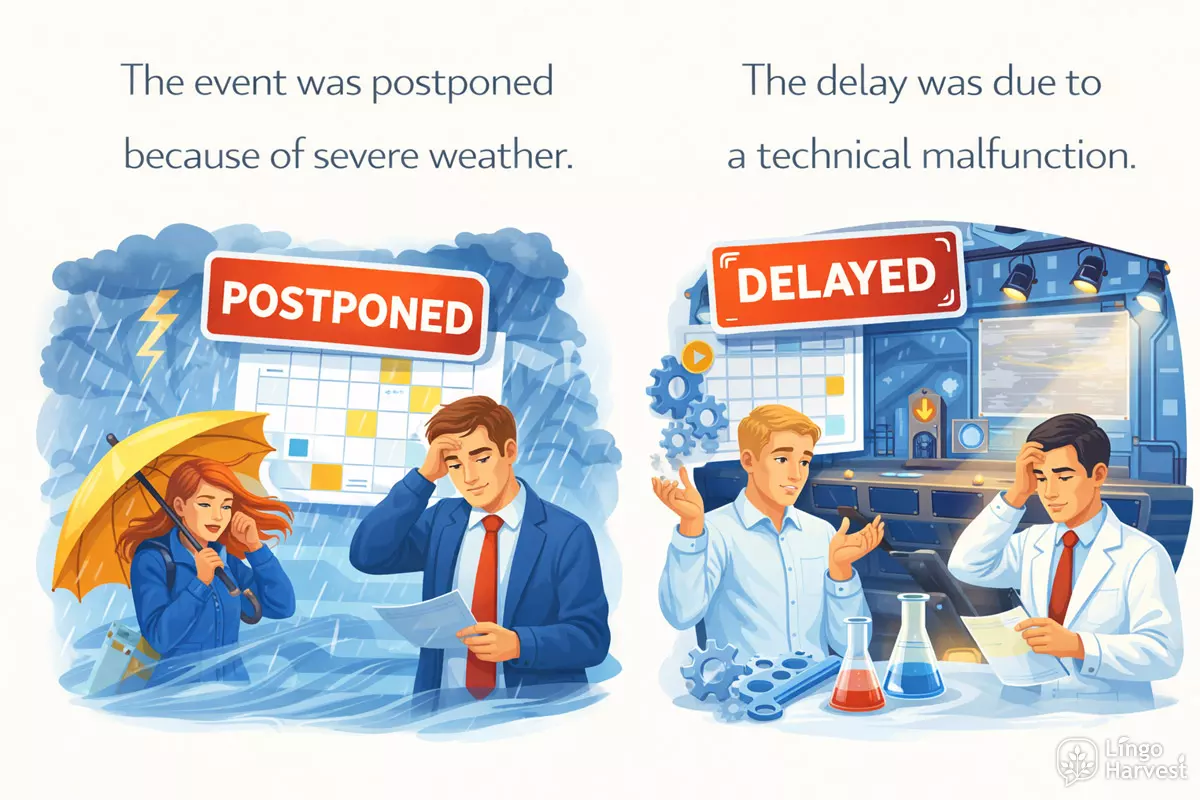
Causal prepositions clarify why something happens, linking causes to effects. They’re essential for expressing logical relationships in arguments and explanations. Typical examples are:
- because of → The event was postponed because of severe weather.
- due to → The delay was due to a technical malfunction.
- owing to → Owing to budget cuts, the program was scaled back.
- on account of → The flight was canceled on account of poor visibility.
- as a result of → As a result of new regulations, procedures were updated.
- thanks to → Thanks to early intervention, recovery times improved.
- for the sake of → For the sake of accuracy, the data was rechecked.
- by virtue of → By virtue of her expertise, she was appointed to lead the project.
Example: The match was canceled due to heavy snow.
Representation: Giving Examples or Showing Types
Some prepositional phrases introduce examples, instances, or representations. They clarify what something stands for or illustrate a point. Useful expressions include:
- in the form of → The company received support in the form of grants.
- by way of → The speaker introduced the topic by way of a short case study.
- in the shape of → A cloud in the shape of a triangle appeared on the radar image.
- in the guise of → The message arrived in the guise of a routine update.
- in the person of → The award was accepted in the person of the project leader.
- in the name of → The policy was introduced in the name of public safety.
- in the capacity of → She attended the meeting in the capacity of an external advisor.
- as far as → As far as the available data shows, the trend is stable.
Example: The company received support in the form of grants.
Substitution: Indicating Replacement or Exchange
When you want to show one thing is used instead of another, substitution prepositions are the tool. These phrases are common in both formal and informal contexts:
- instead of → Instead of paper forms, the clinic uses digital records.
- in place of → In place of a full report, a brief summary was provided.
- in lieu of → In lieu of payment, the contractor accepted additional time off.
- on behalf of → On behalf of the research team, she presented the findings.
- in exchange for → In exchange for funding, the university shared its data.
- as opposed to → As opposed to short-term fixes, the plan focuses on structural reform.
- rather than → Rather than delay the launch, the team released a limited version.
Example: She opted for tea instead of coffee.
| Function | Common Multi-Word Prepositions |
|---|---|
| Concession | in spite of, despite, for all, notwithstanding, even with, regardless of |
| Causality | because of, due to, owing to, on account of, as a result of, thanks to, by virtue of |
| Representation | in the form of, by way of, in the shape of, in the name of, in the capacity of |
| Substitution | instead of, in place of, in lieu of, on behalf of, in exchange for, rather than |
Recognizing these categories helps you choose the right phrase for each context. Whether you’re showing contrast, giving reasons, providing examples, or indicating replacements, mastering these forms will improve both your comprehension and production of complex English sentences.
Register and Stylistic Precision: Choosing 'despite' vs 'notwithstanding'
Selecting between despite and notwithstanding often depends on the desired level of formality and stylistic nuance. Both serve to introduce contrast or concession, but their usage can signal a writer’s sensitivity to register and context. Understanding these subtle distinctions helps writers and speakers match their language to the intended audience and communicative purpose.
Formality and Context
Despite is widely used in both spoken and written English, making it a versatile choice for most situations, from academic essays to everyday conversation. In contrast, notwithstanding tends to appear in more formal, legal, or academic texts. It's less common in casual speech and can sound stilted if misapplied.
Stylistic Preferences
Writers often choose despite for clarity and brevity, while notwithstanding can lend an air of formality or emphasis. Notwithstanding is also found after the noun phrase it modifies, a position rarely occupied by despite. Here are some patterns:
- Despite the rain, the match continued. ✅
- The match continued, despite the rain. ✅
- Notwithstanding the rain, the match continued. ✅
- The match continued, the rain notwithstanding. ✅
- Despite of the rain, the match continued. ❌ (incorrect)
Common Uses and Collocations
While both terms introduce a contrast, despite typically precedes nouns, pronouns, or gerunds. Notwithstanding can introduce a clause but is more often paired with nouns or noun phrases, especially in legal or official writing. Below is a comparison of their typical usage:
| Expression | Typical Register & Example |
|---|---|
| Despite + noun/gerund | Neutral/Informal Despite feeling tired, she finished her work. |
| Notwithstanding + noun | Formal/Legal Notwithstanding the objections, the law passed. |
| noun + notwithstanding | Very formal The objections notwithstanding, the law passed. |
| Despite + pronoun | Neutral Despite this, we succeeded. |
| Notwithstanding + clause (rare) | Formal/Technical Notwithstanding that the evidence was weak, he was convicted. |
Quick Reference: When to Use
- Choose despite for everyday writing and speech.
- Opt for notwithstanding in formal, legal, or academic texts.
- For post-nominal placement (after the noun), only use notwithstanding.
- Never use despite of; use in spite of if needed.
- Consider your audience and the tone you wish to achieve.
Being mindful of these distinctions ensures your prepositional choices align with both your message and your audience’s expectations, enhancing clarity and stylistic precision.
Syntactic positioning: Fronting for cohesion and parenthetical usage
Positioning complex multi-word prepositions within sentences can influence both clarity and cohesion. In English, these prepositional phrases are not strictly limited to the middle or end of a clause; they can be moved to the front (fronting) or used parenthetically for emphasis or flow. This flexibility allows writers and speakers to highlight relationships, background information, or logical connections.
Fronting for Emphasis and Cohesion
Moving a multi-word preposition to the beginning of a sentence or clause can foreground the relationship it expresses. This technique is common in formal writing, academic texts, and when contrasting ideas or linking back to previous discourse.
- In light of recent events, the policy was revised.
- In accordance with these guidelines, all submissions must be anonymous.
- By means of extensive testing, the results were validated.
- In response to your query, we have updated the schedule.
- On behalf of the committee, I thank you for your support.
- In the absence of further evidence, the case remains unsolved.
- With regard to your proposal, we see several advantages.
- For the sake of clarity, let’s restate the main points.
- In contrast to earlier findings, these results are inconclusive.
- In terms of productivity, the new system excels.
Fronting not only connects ideas smoothly but also clarifies what aspect is being foregrounded, supporting reader comprehension. This is particularly effective when referencing earlier statements or when the prepositional phrase sets the context for what follows.
Parenthetical Usage
Multi-word prepositions can also function parenthetically, inserted mid-clause to add context, clarification, or a non-essential detail. These insertions are often set off by commas.
- The new regulation, in accordance with international standards, will take effect next year.
- The results, for the sake of comparison, are listed below.
- He spoke, on behalf of the entire team, at the ceremony.
- The plan, in light of feedback, has been adjusted.
- This solution, by means of automation, saves time.
Parenthetical placement allows the writer to provide supplementary information without interrupting the main flow of the sentence. It’s useful for clarifying reasoning or specifying sources of authority or causality.
Comparison of Syntactic Positioning
Below is a table illustrating how the same multi-word prepositional phrase can appear in different syntactic positions, affecting emphasis and flow:
| Position | Example Sentence |
|---|---|
| Fronted | In view of recent developments, the meeting was postponed. |
| Parenthetical | The meeting, in view of recent developments, was postponed. |
| Standard (end position) | The meeting was postponed in view of recent developments. |
| Within subordinate clause | They postponed the meeting because, in view of recent developments, attendance was uncertain. |
Understanding these options helps writers and speakers use complex prepositional forms with greater flexibility, improving both textual cohesion and reader engagement. Experimenting with placement can subtly shift focus, clarify logic, and make writing more dynamic.
Punctuation mechanics: Comma placement with long introductory phrases
Understanding where to place a comma after a lengthy opening phrase can make your writing clearer and more polished. In English, when sentences start with a long introductory group of words—especially those containing complex multi-word prepositions like “in light of,” “in accordance with,” or “with respect to”—a comma is commonly used to signal the end of the introduction before the main clause begins.
Why use a comma after long introductory phrases?
A comma after a substantial preface helps the reader quickly identify the main subject and verb. This is especially helpful when the opening phrase is more than four words or features prepositional expressions that could otherwise blur the sentence’s structure.
Typical multi-word prepositions in introductory phrases
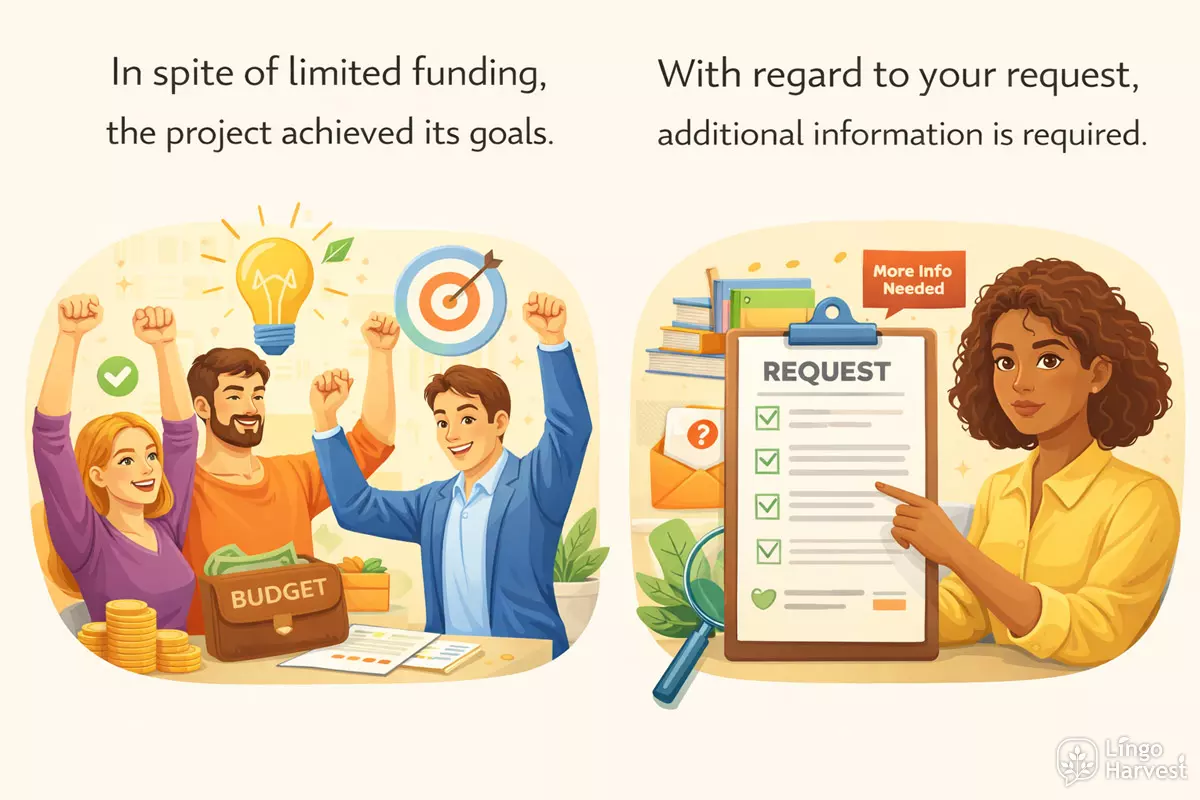
Writers often open sentences with prepositional phrases to provide context, clarify relationships, or set the tone. Here are some common multi-word prepositions that frequently appear at the start of sentences:
- In spite of → In spite of limited funding, the project achieved its goals.
- With regard to → With regard to your request, additional information is required.
- In accordance with → In accordance with company policy, all data must be encrypted.
- On account of → The event was postponed on account of safety concerns.
- In relation to → The report raises questions in relation to long-term sustainability.
- In connection with → The investigation was launched in connection with the complaint.
- With reference to → With reference to the previous email, please find the updated file.
- For the sake of → For the sake of clarity, key terms are defined below.
- In contrast to → In contrast to earlier findings, the latest results were inconclusive.
- On the basis of → On the basis of the evidence, the hypothesis was rejected.
- By means of → The data was collected by means of online surveys.
- In view of → In view of recent developments, the strategy was revised.
- In the course of → Several issues emerged in the course of the discussion.
- In response to → In response to public feedback, the policy was amended.
- In addition to → In addition to technical skills, communication is essential.
- In favor of → The committee voted in favor of the proposal.
- In opposition to → Several groups spoke in opposition to the new regulations.
- In the event of → In the event of an emergency, follow the evacuation procedures.
Comma usage: Examples and guidance
Whenever you begin a sentence with a longer prepositional phrase, especially one containing three or more words, a comma is typically required. This punctuation clarifies where the introduction ends and the core message begins. Consider these examples:
- In accordance with the latest regulations, all employees must wear identification badges.
- With regard to your recent request, we will respond by next week.
- On the basis of the available evidence, the committee reached its decision.
Shorter introductory prepositional phrases (usually three words or fewer) often do not require a comma unless omitting it would cause confusion. For example:
- In 2023 the policy changed. ✅ (comma optional)
- After lunch we resumed the meeting. ✅ (comma optional)
Comparing comma placement: Long vs. short introductory phrases
| Introductory Phrase | Comma Needed? |
|---|---|
| In the event of a system failure | Yes, use a comma: In the event of a system failure, please contact IT support. |
| With respect to your question | Yes, use a comma: With respect to your question, further research is needed. |
| During lunch | No comma usually needed: During lunch we discussed the project. |
| In 2024 | No comma usually needed: In 2024 the new rules take effect. |
Quick tips for writers
- When in doubt, add a comma after a long opening phrase, especially if it contains a complex prepositional expression.
- If the introductory group is short and clarity is not compromised, the comma is usually optional.
- Read your sentence aloud: if you naturally pause after the introductory phrase, a comma is likely appropriate.
In summary, proper punctuation after long introductory prepositional phrases—especially those featuring multi-word forms—enhances clarity and flow. Mastering this small detail can make your writing more professional and easier to read.
Grammar traps: Avoiding 'despite of' and other common L1 interference
Many learners struggle with multi-word prepositions because their native language (L1) has similar-looking structures or uses prepositions differently. One of the most frequent mistakes is adding unnecessary words, like “of” after “despite,” resulting in the incorrect “despite of.” This usually happens because some prepositions in English, such as “because of” or “in spite of,” do require “of,” while others like “despite” do not.
Why do these mistakes happen?
Direct translation from your first language can lead to errors. English prepositional phrases often look similar, but small differences change the meaning or make a sentence incorrect. Learners may also mix up forms that sound right in speech but are not standard in writing.
Common interference patterns to watch for
Some typical L1-based mistakes include:
- Adding “of” after “despite” (Incorrect: despite of the rain ❌ Correct: despite the rain ✅)
- Confusing “in spite of” and “despite” (only “in spite of” uses “of”)
- Using “according to me” (should be “in my opinion” or “I think” in standard English)
- Mixing up “because” and “because of” (e.g., “because the rain” ❌ instead of “because of the rain” ✅)
- Translating prepositions word-for-word from your native language, leading to unnatural phrases
- Overusing “for” or “to” with expressions that don’t require them (e.g., “discuss about” instead of “discuss”)
- Using “since” as a synonym for “because of” (they are not always interchangeable)
- Putting “on” after “concerned” (e.g., “concerned on” instead of “concerned about”)
- Using “until to” instead of just “until”
- Using “regarding” with “of/to” (e.g., “regarding of the issue” ❌)
- Confusing “due to” and “because of” (they are not always interchangeable in formal writing)
- Using “between to” instead of “between” or “among”
- Incorrect placement of prepositions at the end of sentences (sometimes fine, but not always correct)
Comparing multi-word prepositions: Which take “of” and which don’t?
Knowing which phrases require “of” and which don’t is essential to avoid common pitfalls. Here’s a quick comparison of frequently confused multi-word prepositions:
| Expression | Correct Form | Common Error |
|---|---|---|
| despite | despite the rain | despite of the rain ❌ |
| in spite of | in spite of his effort | in spite his effort ❌ |
| because of | because of traffic | because traffic ❌ |
| according to | according to the report | according the report ❌ |
| due to | due to illness | due illness ❌ |
| instead of | instead of tea | instead tea ❌ |
| regardless of | regardless of cost | regardless cost ❌ |
| regarding | regarding your request | regarding of your request ❌ |
Tips to avoid L1 interference
- Memorize common multi-word prepositions as “chunks,” not individual words
- Double-check usage with reliable English examples, especially in formal writing
- Compare expressions side by side to spot subtle differences
- Remember: Not every preposition or phrase translates directly from your language
- Practice with real sentences or short dialogues to reinforce correct forms
By paying attention to these details and regularly reviewing tricky prepositional phrases, you can avoid typical errors and improve your English fluency.
Information flow: Using multi-word prepositions to manage sentence focus
Multi-word prepositions such as “in light of,” “with regard to,” and “in the event of” don’t just connect ideas—they help you guide your reader’s attention. By placing these prepositional phrases thoughtfully, you can shift the emphasis within a sentence, clarify relationships, and manage how information is introduced or highlighted.
Shifting Emphasis with Placement
Where you place a multi-word preposition can subtly change what your reader notices first. Starting a sentence with one of these phrases often foregrounds context or background information, while placing it later can keep the main idea up front.
- At the beginning: In light of recent events, the policy was revised.
- Mid-sentence: The policy was revised in light of recent events.
Both sentences communicate the same facts, but the first highlights the reason, while the second keeps the focus on the action.
Common Multi-Word Prepositions for Structuring Sentences
Writers use a variety of these constructions to introduce background, reasons, limitations, or contrasts. Here are some frequently used multi-word prepositions that help shape the flow of information:
- In accordance with → In accordance with the policy, all files must be archived.
- With respect to → With respect to participant safety, strict guidelines were followed.
- By means of → The data was collected by means of an online questionnaire.
- In spite of → In spite of limited resources, the project met its objectives.
- On behalf of → On behalf of the committee, I would like to thank you.
- In front of → The speaker placed the chart in front of the audience.
- In addition to → In addition to cost, quality must be considered.
- In contrast to → In contrast to earlier studies, these results were inconclusive.
- In relation to → The report raises concerns in relation to long-term funding.
- On account of → The session was postponed on account of technical issues.
- In favor of → The board voted in favor of the revised proposal.
- In connection with → The investigation was initiated in connection with the complaint.
- In response to → In response to feedback, the guidelines were updated.
- In reference to → In reference to your message, please see the attached document.
- For the sake of → For the sake of clarity, key terms are defined below.
- With the exception of → With the exception of one case, the results were consistent.
- In the absence of → In the absence of clear evidence, no conclusion was drawn.
- In the course of → Several issues emerged in the course of the discussion.
- In the event of → In the event of an emergency, contact the coordinator immediately.
- With regard to → With regard to scheduling, the deadline remains unchanged.
Comparing Sentence Focus: Before and After Multi-Word Prepositions
| Sentence Start | Sentence End |
|---|---|
| In accordance with new guidelines, all staff must wear badges. | All staff must wear badges in accordance with new guidelines. |
| With respect to your request, we will respond soon. | We will respond soon with respect to your request. |
| In the event of a fire, use the stairs. | Use the stairs in the event of a fire. |
| In addition to his degree, he has several certificates. | He has several certificates in addition to his degree. |
| On account of the weather, the meeting was postponed. | The meeting was postponed on account of the weather. |
Tips for Managing Sentence Flow
- Place the multi-word preposition at the start to set background or context.
- Use mid-sentence placement for a more direct, action-focused statement.
- Choose phrases that naturally fit the tone and complexity of your writing.
- Vary your prepositions to avoid repetition and keep your writing clear.
Careful use of multi-word prepositions lets you highlight details, clarify relationships, and direct your reader’s attention exactly where you want it.
Practice: Paraphrasing workshop to upgrade from simple to complex forms
Upgrading your writing often means moving beyond basic linking words like "because" or "after" and choosing more sophisticated multi-word prepositions. This hands-on section helps you recognize opportunities to replace simple connectors with more nuanced, advanced alternatives, making your sentences clearer and more formal.
Step 1: Identify and Replace Simple Prepositions
Start by spotting basic prepositions in sentences. Next, rewrite the sentences using more complex multi-word forms. This not only improves your style but also demonstrates a stronger command of English.
- Simple: because of
- Complex: due to, owing to, on account of
- Simple: after
- Complex: subsequent to, following
- Simple: before
- Complex: prior to, in advance of
- Simple: about
- Complex: with regard to, in connection with, in relation to
- Simple: during
- Complex: in the course of, throughout the duration of
- Simple: for
- Complex: for the purpose of, with a view to
- Simple: instead of
- Complex: in lieu of, as opposed to
- Simple: despite
- Complex: in spite of, notwithstanding
- Simple: according to
- Complex: in accordance with, in line with
Step 2: Paraphrasing Practice
Try rewriting the following sentences, swapping the simple prepositions for more advanced, multi-word options. This exercise will build your confidence in using them naturally.
- She arrived after the meeting started.
- They canceled the trip because of the weather.
- He spoke about the new policy.
- We finished the project before the deadline.
- They continued working during the storm.
- She accepted the job offer instead of her previous one.
- Despite his efforts, he didn't win.
- According to the manager, the rules have changed.
Show answers
- She arrived subsequent to the meeting starting.
- They canceled the trip due to the weather.
- He spoke in relation to the new policy.
- We finished the project prior to the deadline.
- They continued working throughout the duration of the storm.
- She accepted the job offer in lieu of her previous one.
- Notwithstanding his efforts, he didn't win.
- In accordance with the manager's statement, the rules have changed.
Step 3: Compare Forms in Context
Below is a structured comparison of basic and advanced prepositional forms commonly used in formal writing.
| Simple Preposition | Complex Multi-Word Preposition |
|---|---|
| because of | owing to, due to, on account of |
| after | subsequent to, following |
| before | prior to, in advance of |
| about | in relation to, with regard to, in connection with |
| during | in the course of, throughout the duration of |
| for | for the purpose of, with a view to |
| instead of | in lieu of, as opposed to |
| despite | in spite of, notwithstanding |
| according to | in accordance with, in line with |
| until | up to the point of, pending |
Step 4: Create Your Own Sentences
Challenge yourself to write three original sentences for each complex prepositional form you’ve learned. Focus on clarity and appropriateness for formal or academic contexts. By practicing the transformation from basic to sophisticated linking phrases, you will build a more versatile and precise writing style, suitable for advanced English tasks.
Contextual analysis: Case studies from business, legal and academic texts
Understanding how complex multi-word prepositions function in real-world scenarios is crucial for mastering their use. Their application varies widely across professional fields, with subtle shifts in meaning and formality depending on the context. Let’s look at how these prepositional phrases are deployed in business correspondence, legal documents, and academic writing.
Business Communication
In business, clarity and precision are vital. Multi-word prepositions often help specify relationships between actions, stakeholders, or timeframes. Consider these common expressions:
- In accordance with company policy
- With regard to your request
- In line with our strategy
- In response to your inquiry
- By means of this memo
- On behalf of the management
- In connection with the recent changes
- In relation to market trends
- With reference to our conversation
- In the event of a delay
These constructions clarify intent and responsibility, reducing ambiguity in official communications.
Legal Documentation
Legal English relies heavily on precise phrasing to define obligations, rights, and procedures. Multi-word prepositions are indispensable for expressing complex relationships:
- Subject to the terms outlined
- Pursuant to section 4(a)
- In accordance with applicable law
- For the purposes of this agreement
- By virtue of this act
- In consideration of the payment
- In the absence of evidence
- In the course of proceedings
- In compliance with regulations
- With respect to the contract
- On the basis of the facts presented
- In default of payment
These patterns help ensure legal clarity and prevent misinterpretation.
Academic Writing
Researchers and scholars often use multi-word prepositions to articulate nuanced arguments, connect ideas, and frame evidence. Here are frequently encountered forms:
- In terms of methodology
- With respect to previous studies
- In light of recent findings
- As a result of the experiment
- By means of statistical analysis
- For the purpose of this study
- In support of the hypothesis
- In contrast to earlier research
- In favor of a new approach
- In opposition to the theory
- In view of the data collected
Such phrases help writers present complex information with academic rigor and cohesion.
Comparing Usage Across Fields
The degree of formality, specificity, and frequency of certain multi-word prepositions can vary significantly between business, legal, and academic texts. The table below highlights some typical examples and their primary contexts:
| Prepositional Phrase | Common Context(s) |
|---|---|
| In accordance with | Business, Legal |
| With respect to | Academic, Legal |
| By virtue of | Legal |
| In light of | Academic, Business |
| In connection with | Business, Legal |
| For the purpose of | Academic, Legal |
| In the event of | Business, Legal |
| As a result of | Academic |
| Subject to | Legal, Business |
| In relation to | Business, Academic |
By examining authentic language from each domain, it becomes clear that mastering complex multi-word prepositions is essential for effective, context-sensitive communication in specialized English.