Prepositions in Fixed Phrases: Understanding at Least, at All, by Far

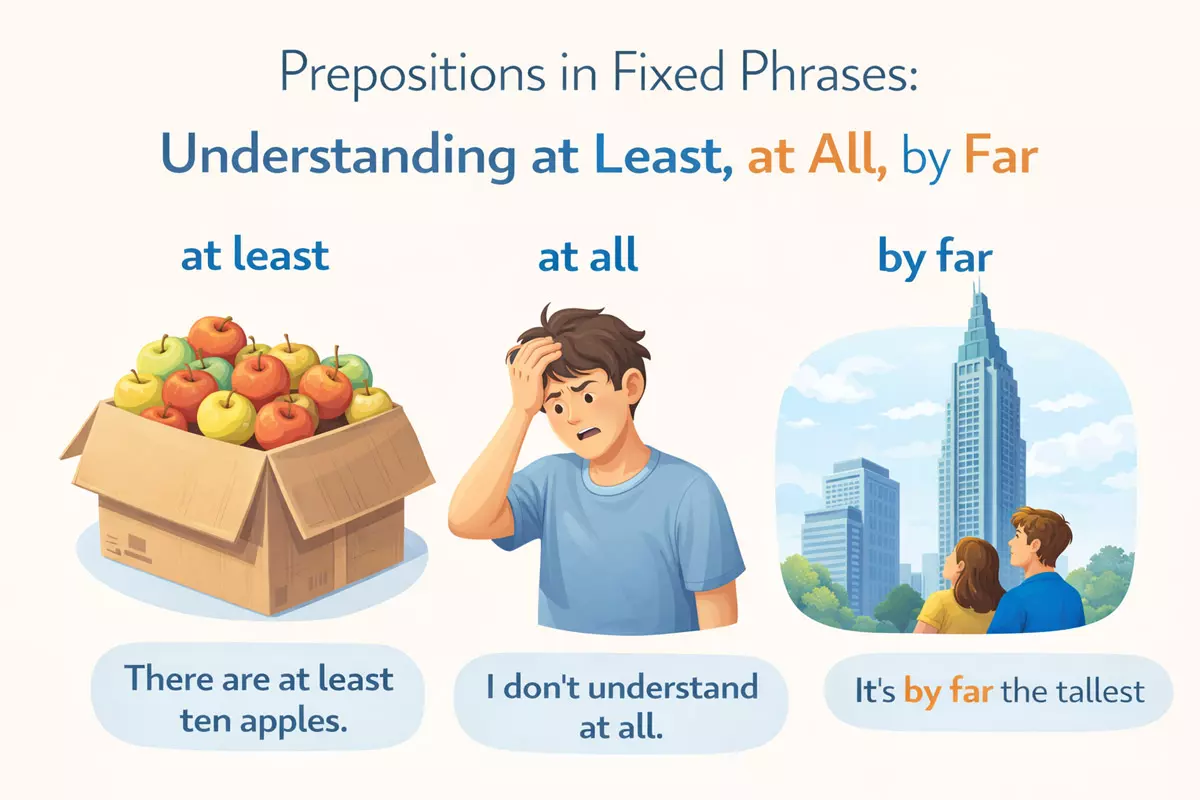 Here we why fixed prepositional phrases are resistant to change, how phrases like by far and at all intensify meaning, the pragmatic use of at least, prosody in natural speech, phrase placement, semantic distinctions, translation issues, and practice tips.
- The Anatomy of Idiomaticity: Why fixed prepositional phrases resist lexical substitution
- Emphasis and Intensification: Using 'by far' and 'at all' to modify adjectives and negatives
- Pragmatic markers: 'at least' as a tool for concession and silver-lining argumentation
- Prosody and Phonology: Sentence stress and linking in natural speech (e.g., 'not-at-all' vs 'at-all')
- Positional flexibility: How changing the phrase's place shifts the focus of the sentence
- Semantic boundaries: Differentiating 'at the end' vs 'in the end' vs 'at least' vs 'at last'
- Avoiding 'Translationese': Why literal equivalents in L1 fail to capture idiomatic nuance
- Tone and Register: When fixed phrases sound conversational versus formal or argumentative
- Practice: Audio-visual drills and contextual rewriting for natural emphasis
Have you ever wondered why certain word combinations, such as at least or by far, sound perfectly natural while others seem awkward or incorrect? Learning to use these fixed expressions, which depend on specific prepositions, is essential for sounding fluent and confident in English. By paying attention to these common phrases, you can improve your communication skills and better understand native speakers, making your conversations smoother and more effective in everyday situations.
The Anatomy of Idiomaticity: Why fixed prepositional phrases resist lexical substitution
Fixed prepositional phrases, like at least, at all, and by far, are so deeply embedded in English that swapping out their prepositions or components typically produces confusion or ungrammatical results. Their resistance to change stems from their idiomatic nature: the phrase as a whole carries a meaning not easily inferred from its parts. When we try to substitute a different preposition, the phrase often loses its intended sense or ceases to function in the same way.
What Makes These Phrases "Fixed"?
The "fixedness" of such expressions comes from repeated usage over time, which cements their structure and meaning. Speakers recognize these combinations as single units of meaning, rather than as phrases constructed on the fly. For example, at all always signals emphasis in negatives or questions ("I don’t like it at all"), and "by far" intensifies superlatives ("She is by far the best player"). Attempting to use in all or on far would sound odd or even unintelligible to native speakers.
Why Substitution Fails: Idiomatic Meaning vs. Literal Meaning
The idiomatic meaning of these prepositional phrases cannot be predicted by simply analyzing each word individually. For instance, at least sets a minimum, while by far amplifies a degree. Replace the preposition, and the phrase no longer signals the same concept. This is why you don't hear on least or with far in English.
Common Fixed Prepositional Phrases
Here are several examples of fixed prepositional expressions that resist substitution. Each is widely used and instantly recognized:
- at least → At least three participants failed to complete the survey.
- at all → I do not agree with that conclusion at all.
- by far → This is by far the most effective solution.
- in fact → In fact, the results were even stronger than expected.
- on purpose → He left out the detail on purpose.
- for good → The company closed the branch for good.
- in advance → Please submit your request in advance.
- by chance → I met my former professor by chance.
- on average → On average, students spend two hours on homework each day.
- in general → In general, the method works well for most cases.
- at random → The participants were selected at random.
- by mistake → The email was sent to the wrong address by mistake.
- in vain → They searched for the missing file in vain.
- on time → The train arrived on time despite the storm.
- at risk → The coastal region is at risk of flooding.
- in charge (of) → She is in charge of the final review.
- under control → The situation is under control now.
- on fire → The building was on fire when the firefighters arrived.
- in trouble → The company is in trouble because of rising costs.
- out of order → The elevator is out of order until further notice.
Comparing Acceptable and Unacceptable Substitutions
| Phrase | Substitution Attempt & Acceptability |
|---|---|
| at least | ✅ at least ❌ on least, in least |
| by far | ✅ by far ❌ with far, at far |
| at all | ✅ at all ❌ in all, on all |
| in advance | ✅ in advance ❌ at advance, on advance |
| on purpose | ✅ on purpose ❌ at purpose, in purpose |
| by chance | ✅ by chance ❌ on chance, at chance |
| for good | ✅ for good ❌ at good, in good |
| in vain | ✅ in vain ❌ at vain, on vain |
| on time | ✅ on time ❌ at time, in time (different meaning) |
| out of order | ✅ out of order ❌ off order, from order |
Takeaway: Learning the Whole, Not the Parts
Mastering these expressions means learning them as complete units. Trying to analyze or modify them word by word leads to errors. For learners and even native speakers, awareness of these fixed structures helps avoid awkward constructions and ensures clear, idiomatic communication.
Emphasis and Intensification: Using 'by far' and 'at all' to modify adjectives and negatives
When you want to make a statement much stronger or more definite, certain prepositional phrases come in handy. Both by far and at all serve as intensifiers, but they work in different ways and contexts.
By Far: Strengthening Comparisons

The phrase by far is used to emphasize that something is much greater or more extreme than other things in comparison. It commonly appears with superlative forms, making the difference unmistakably clear. For example:
- This is by far the best restaurant in town.
- She is by far the youngest player on the team.
- That was by far the most difficult exam I’ve taken.
- This route is by far safer than the alternative.
- He is by far the most experienced engineer here.
- The blue dress was by far the most popular choice.
- The new model is by far more efficient.
- This is by far my favorite book.
- That was by far the quickest solution.
- The results were by far better than expected.
At All: Negative Emphasis and Minimization
In negative sentences and questions, at all is used to stress the complete absence or minimal degree of something. It often softens requests or makes negatives stronger. Here are some common patterns:
- I don’t like coffee at all.
- Are you hungry at all?
- He didn’t help at all.
- She wasn’t surprised at all.
- There isn’t any milk left at all.
- The instructions weren’t clear at all.
- I can’t swim at all.
- They didn’t complain at all.
- Is there any chance at all of rain?
- He wasn’t interested at all.
- That didn’t bother me at all.
- If you need any help at all, just ask.
Direct Comparison: By Far vs. At All
The table below highlights how these two fixed phrases function differently in a sentence:
| Phrase | Typical Usage & Example |
|---|---|
| by far | Used with superlatives or comparatives to show a large difference. “This was by far the easiest task.” |
| at all | Used in negatives or questions to stress minimal degree or absence. “I don’t mind at all.” |
| by far | Emphasizes the extent or magnitude in a positive statement. “He is by far the best candidate.” |
| at all | Emphasizes total lack or nonexistence. “There isn’t any time at all.” |
Summary Tips
- Use by far to make a superlative or comparative stand out.
- Use at all in negatives or questions for extra emphasis on absence.
- Both phrases add clarity and strength to your statements, but choose based on context and sentence type.
Pragmatic markers: 'at least' as a tool for concession and silver-lining argumentation
The phrase “at least” serves a unique communicative function in English, frequently softening negative statements or introducing a positive aspect in an otherwise disappointing situation. This small fixed phrase is a pragmatic marker that allows speakers to concede a drawback while highlighting something beneficial—what’s often called a “silver lining.” By using “at least,” speakers can acknowledge problems without sounding overly negative, and they can reframe a conversation to focus on what remains positive or acceptable.
Concession and mitigation in conversation
Often, “at least” is used to introduce a concession, helping to balance criticism or bad news. For example, when someone says, “The event was canceled, but at least we got a refund,” the phrase shifts attention away from the disappointment and toward a mitigating factor. This pragmatic strategy is especially common in spoken English, where maintaining rapport and showing understanding are crucial.
Silver-lining argumentation
Beyond concession, “at least” is a tool for expressing optimism in difficult circumstances. It helps speakers find or create a positive aspect, no matter how minor, to counterbalance a setback. This usage reflects a psychological tendency to seek reassurance or to comfort oneself and others.
Common contexts and examples
Speakers use “at least” in a variety of situations, from casual conversations to formal writing. Here are some typical scenarios and concise examples:
- Minimizing disappointment: “I didn’t win, but at least I made it to the finals.”
- Highlighting a positive: “It’s raining, but at least the plants will be happy.”
- Offering consolation: “You lost your wallet? At least your phone wasn’t stolen.”
- Softening criticism: “The essay is short, but at least it’s well organized.”
- Expressing gratitude: “We’re late, but at least we’re safe.”
- Focusing on survival: “The car broke down, but at least nobody was hurt.”
- Finding value: “The food was cold, but at least it tasted good.”
- Accepting partial success: “Not everyone agreed, but at least we reached a compromise.”
- Emphasizing effort: “It wasn’t perfect, but at least you tried.”
- Reframing loss: “We didn’t finish, but at least we started.”
Comparison with similar pragmatic markers
It’s useful to compare “at least” with other expressions that serve related functions, such as “still,” “anyway,” and “on the bright side.” These markers help manage the flow of conversation and the emotional tone, but each has its own nuances.
| Marker | Typical Function | Example |
|---|---|---|
| at least | Concession, silver-lining, mitigation | “I missed the bus, but at least I got some exercise walking.” |
| still | Contrast, persistence of a point | “It was a tough exam. Still, I think I did okay.” |
| anyway | Dismissal, topic shift, minimization | “We didn’t win, anyway it was fun.” |
| on the bright side | Optimistic reframing | “It’s cold, but on the bright side, there are no mosquitoes.” |
Takeaways
Using “at least” strategically allows speakers to navigate challenging interactions, express empathy, and maintain a constructive tone. Mastery of this pragmatic marker enriches both everyday conversation and more formal forms of argumentation, making it a subtle but powerful tool in English communication.
Prosody and Phonology: Sentence stress and linking in natural speech (e.g., 'not-at-all' vs 'at-all')
How words are pronounced together in fixed phrases can reveal a lot about their meaning and usage. In English, certain expressions—such as "at all," "not at all," and "by far"—take on unique patterns of stress and linking. These subtle shifts in rhythm or emphasis play a significant role in how natural and native-like your speech sounds.
Stress Patterns in Common Fixed Phrases
Fixed prepositional phrases often have predictable stress. For example, in "not at all," the main stress usually falls on "all," while "not at" is spoken quickly and smoothly. In contrast, "at all" without "not" is often used as an intensifier and also places the main stress on "all," but the initial "at" can be even more reduced.
- not at all → /ˌnɒtətˈɔːl/ (reduced "not at," strong "all")
- at all → /ətˈɔːl/ (very reduced "at," strong "all")
- at least → /ətˈliːst/ (stress on "least")
- by far → /baɪ ˈfɑːr/ (stress on "far")
- at best → /ətˈbɛst/ (stress on "best")
- at most → /ətˈmoʊst/ (stress on "most")
- by chance → /baɪ ˈtʃæns/ (stress on "chance")
- at random → /ət ˈrændəm/ (stress on "random")
- by heart → /baɪ ˈhɑːrt/ (stress on "heart")
- at once → /ət ˈwʌns/ (stress on "once")
Linking and Reduction in Connected Speech
In natural English, smaller words like prepositions and articles are often "reduced," meaning they're pronounced quickly and with less emphasis. For example, the "t" in "not at all" often links smoothly to the following vowel, making it sound almost like one word. This linking is an important part of sounding fluent and helps listeners process speech more easily.
- The "t" of "not" and "at" may merge: "not at all" → "no-tat-all"
- Vowel reduction: "at" becomes /ət/ or even /t/
- In "by far," the "by" is typically unstressed and flows into "far"
Comparing Pronunciation and Intonation
Meaning can shift depending on stress. For instance, in "not at all," a rising intonation might signal surprise or politeness, while a flat tone may indicate firmness. In "at all," stressing "at" instead of "all" is rare and might happen only for contrast.
| Phrase | Typical Stress & Linking |
|---|---|
| not at all | Reduced "not at," strong "all"; linking "t" to "a" in "at" |
| at all | Highly reduced "at," main stress on "all"; smooth linking |
| by far | Unstressed "by," strong "far"; clear distinction between words |
| at least | Reduced "at," main stress on "least"; quick transition |
| at best | Reduced "at," main stress on "best"; connected speech |
| at most | Reduced "at," main stress on "most"; seamless linking |
| by chance | Unstressed "by," strong "chance"; gentle linking |
| at once | Reduced "at," main stress on "once"; fluid connection |
Takeaways for Learners
Listening closely to how native speakers join words and shift the stress in these phrases can help you sound more fluent. Practice saying these expressions in sentences, paying special attention to how quickly the preposition is spoken and where the emphasis lands. These prosodic features are subtle but crucial for clear, natural communication.
Positional flexibility: How changing the phrase's place shifts the focus of the sentence
Moving fixed prepositional phrases like "at least," "at all," and "by far" within a sentence can subtly, but significantly, adjust what the listener or reader pays attention to. In English, word order often signals what’s important—so playing with the position of these phrases can highlight different aspects of your message.
Common patterns and their effects
Generally, these set expressions have typical 'homes' in a sentence. For example, "at least" often appears before the element it qualifies, while "at all" usually sits at the end. Shifting them can make a statement sound either more emphatic or more tentative, or bring a certain nuance to the foreground.
- At least at the start: "At least he tried." (Emphasizes consolation or minimum achievement.)
- Before the number or noun: "He has at least five books." (Focus on the minimum quantity.)
- After the verb: "He has five books at least." (Echoes the minimum, but can sound more casual or afterthought-like.)
- At all at the end: "She didn’t come at all." (Total negation—emphasizes the action didn’t happen in any way.)
- Mid-sentence for emphasis: "She at all didn’t come." (Rare, often unidiomatic, but can occur in poetic or dialectal speech.)
- By far before the superlative: "She is by far the best player." (Strongest emphasis on superlative quality.)
- After the adjective: "She is the best player by far." (The superlative is stated, then reinforced.)
- At the very end: "This is the most interesting, by far." (Adds emphasis as a final thought.)
Comparing focus shifts with placement
To see how positioning changes the reader’s focus, compare these variations:
| Phrase Placement | Effect on Focus |
|---|---|
| At least, he finished the race. | Draws attention to a consolation or minimum achievement. |
| He finished the race, at least. | Gives the impression of an afterthought or softens the statement. |
| By far, this is the easiest method. | Strongly highlights the superiority right from the start. |
| This is the easiest method by far. | Confirms and amplifies the superlative at the end, leaving a strong final impression. |
| She didn't help at all. | Total emphasis on the absence of help. |
| At all, she didn't help. | Unusual; may be used for poetic effect or in some dialects, but not standard. |
Key takeaways for writers and learners
- Placing these prepositional phrases at the start of a sentence often signals emphasis or sets a tone of contrast.
- End placement tends to reinforce or echo the main point, leaving a lingering impression on the reader.
- Mid-position use is rare and can sound awkward unless it is chosen deliberately for stylistic reasons.
- When in doubt, use the most common position for clarity, but feel free to experiment for nuance or effect.
- Understanding how these phrases interact with sentence structure gives you greater control over meaning and tone.
- Try shifting these phrases in your own sentences to observe how the focus and emphasis change.
Semantic boundaries: Differentiating 'at the end' vs 'in the end' vs 'at least' vs 'at last'
Understanding the subtle distinctions between phrases like "at the end," "in the end," "at least," and "at last" is essential for clarity in both spoken and written English. Each of these expressions serves a distinct function, often marking time, emphasizing outcomes, or setting minimum expectations. Let's break down their meanings and usage contexts.
Time and Outcome: "At the end" vs "In the end"
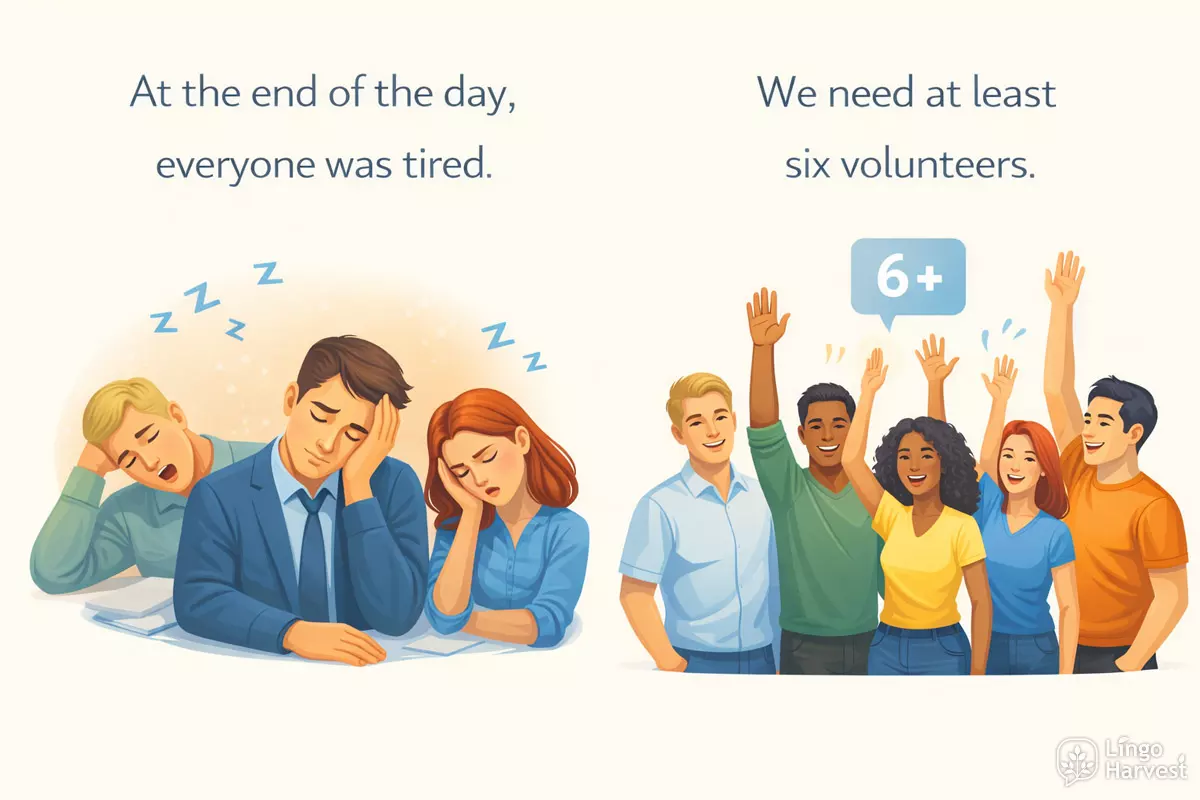
"At the end" is typically used to specify a particular point in time, often referring to the conclusion of a physical object, event, or period. For example, "at the end of the movie" pinpoints a precise moment. In contrast, "in the end" highlights the final result or outcome after a series of events or processes, as in "In the end, we decided not to go."
- At the end of the day, everyone was tired.
- In the end, she forgave him.
- The keys were at the end of the hallway.
- In the end, it didn’t matter.
Minimums and Relief: "At least" vs "At last"
"At least" is used to introduce a minimum quantity or to soften a statement, offering consolation or a positive aspect in an otherwise negative situation. For example, "I have at least five dollars." On the other hand, "at last" expresses relief or satisfaction that something long-awaited has finally happened: "At last, the rain stopped."
- At least you tried your best.
- We need at least six volunteers.
- At last, he arrived home.
- The results are here at last.
Quick Comparison Table
| Phrase | Primary Meaning | Typical Usage | Example |
|---|---|---|---|
| At the end | Specific point in time or place | Physical or temporal conclusion | At the end of the book, there’s a glossary. |
| In the end | Final result or outcome | Summary of a process or story | In the end, they reached an agreement. |
| At least | Minimum requirement or consolation | Setting a lower bound; offering comfort | At least you finished on time. |
| At last | Relief at final occurrence | After waiting or delay | At last, the package arrived. |
Common Patterns and Pitfalls
Here are some useful patterns and typical mistakes learners make:
- At the end of + noun (at the end of the year, at the end of the street)
- In the end, + clause (In the end, he gave up)
- At least + number/statement (At least three people, At least you tried)
- At last, + result (At last, they found the answer)
- Incorrect: "At the end, I was happy" (should be "In the end, I was happy")
- Incorrect: "At last, five people came" (should be "At least five people came")
Grasping these boundaries helps avoid ambiguity and ensures your English sounds natural and precise.
Avoiding 'Translationese': Why literal equivalents in L1 fail to capture idiomatic nuance
When translating fixed English phrases such as “at least,” “at all,” or “by far,” direct word-for-word substitution from one’s native language almost never works. These prepositional expressions have meanings and uses that are deeply tied to English idiomatic logic, not just the individual words themselves. Relying on literal translation often results in awkward or incorrect phrasing, and can even obscure the speaker’s intended nuance.
How Literal Translation Causes Problems
Direct equivalents in another language might seem logical, but they rarely carry the exact same shade of meaning. For example, translating “at least” word-for-word into many languages produces a phrase that sounds odd or overly formal. The real issue is that idiomatic phrases are cultural shortcuts, shaped by usage rather than rules.
- “At least” signals a minimum, sometimes with consolation or a silver lining.
- “At all” is used for emphasis, often in negatives or questions, to mean “in any way.”
- “By far” intensifies a comparison, emphasizing a large difference.
Why Idiomatic Prepositions Resist Substitution
Prepositions in fixed expressions often don’t match those in other languages. This is because English uses prepositions in ways that are sometimes arbitrary from a logical standpoint, but deeply rooted in usage. Attempting to swap in a native-language preposition usually results in a phrase that’s “grammatically correct” but unnatural to native ears.
| English Fixed Phrase | Common Literal Translation Error | Natural English Meaning |
|---|---|---|
| at least | “on minimum”/“in least” | minimum amount; consolation |
| at all | “in all”/“any at all” | in any way (usually with negatives/questions) |
| by far | “with far”/“for far” | to a great degree; much more/less |
| at once | “in once”/“on once” | immediately; simultaneously |
| at hand | “in hand”/“on hand” | available; nearby |
| at all costs | “in all costs”/“for all costs” | no matter what; whatever it takes |
Common Pitfalls for Language Learners
Learners often fall into the trap of over-translating, especially with prepositional phrases. Here are some frequent mistakes:
- Assuming every “at” or “by” in English has a direct equivalent in the native language.
- Using logical substitutions, resulting in phrases like “in least” instead of “at least.”
- Ignoring context and collocation, causing sentences to sound mechanical or stilted.
Tips for Internalizing Idiomatic Usage
- Notice patterns in real-life examples, not just dictionary definitions.
- Practice with authentic phrases in context, not isolated words.
- Listen for intonation and emphasis—especially with “at all” in negatives.
- Compare how similar ideas are expressed in your native language versus English; note the differences.
- Memorize common prepositional chunks as single units, rather than translating piece by piece.
Grasping these nuances takes time, but focusing on phrase-level meaning rather than word-level translation leads to more natural, fluent English. Recognizing where literal equivalents break down is an essential step toward mastering idiomatic prepositional phrases.
Tone and Register: When fixed phrases sound conversational versus formal or argumentative
Understanding how prepositional fixed phrases like "at least," "at all," and "by far" function in real-life English means noticing their tone and context. The same phrase can sound friendly and casual in one situation, but firm or even confrontational in another. Recognizing these differences helps you communicate more naturally and avoid misunderstandings.
Conversational Uses
Many fixed expressions with prepositions are common in everyday speech. They soften statements, show humility, or clarify meaning without sounding stiff. For example:
- “At least we tried.” → Reassuring, informal
- “Is that at all possible?” → Polite, tentative
- “She’s by far the fastest runner.” → Emphatic but relaxed
- “I don’t mind at all.” → Warm, reassuring
- “At least it didn’t rain.” → Casual consolation
- “By far the best choice.” → Strong but neutral praise
- “Do you know him at all?” → Gently probing
- “At least let me finish.” → Mildly pleading
Formal and Argumentative Registers
In more formal writing or debate, these same phrases can sound assertive or even challenging, especially when used to emphasize a point or critique an idea. They may also appear in academic or professional contexts for clarity or precision.
- “This is, by far, the most significant result.” → Academic emphasis
- “The claim is not supported by the evidence at all.” → Strong refutation
- “At least, that is what the data suggest.” → Reserved, formal qualification
- “There is no justification for this action at all.” → Argumentative, critical
- “By far the most cost-effective solution.” → Businesslike, evaluative
- “At least in theory, this should work.” → Cautious, academic
- “Not at all trivial.” → Understated but formal
- “At least, not according to our analysis.” → Reserved, diplomatic
Comparing Tones Across Contexts
The table below compares how these set phrases shift in register and tone depending on context:
| Phrase | Conversational Example | Formal/Argumentative Example | Typical Tone |
|---|---|---|---|
| at least | At least you called. | At least, that is the current consensus. | Reassuring / Reserved |
| at all | I don’t mind at all. | No evidence at all supports this claim. | Warm / Emphatic |
| by far | This is by far my favorite book. | This is by far the most reliable method. | Emphatic / Evaluative |
| not at all | Not at all, you’re welcome! | Not at all relevant to our discussion. | Polite / Dismissive |
Tips for Choosing the Right Register
- Notice the social context: informal chats allow for softer, friendlier phrasing.
- In writing or debate, these phrases can add emphasis or signal disagreement.
- Look for cues in punctuation and word order—commas and pauses often mark more formal or emphatic uses.
- Be aware that tone can shift based on delivery, not just the phrase itself.
By tuning into these nuances, you’ll use fixed prepositional phrases more effectively, matching your intent and context for clearer, more natural communication.
Practice: Audio-visual drills and contextual rewriting for natural emphasis
To build a genuine feel for fixed prepositional phrases such as “at least,” “at all,” and “by far,” it’s essential to hear, see, and actively rework them in context. This section offers a range of practical exercises, focusing on listening, repeating, and rewriting sentences to master both the form and natural emphasis of these expressions.
Listen and Repeat: Emphasis in Context
Read each sentence aloud, placing natural stress on the prepositional phrase in bold. If possible, listen to native examples and mimic the rhythm.
- That’s at least what she told me.
- Is there any sugar at all in this recipe?
- This is by far the best solution available.
- He didn’t try at all during the match.
- We need at least three volunteers.
- It’s by far the coldest winter I remember.
- Did you enjoy the play at all?
- She has at least five cats.
- This is by far the most challenging part.
- He hasn’t called at all this week.
Contextual Rewriting: Make Emphasis Natural
Rewrite the following sentences to include one of the target phrases (“at least,” “at all,” or “by far”) so the emphasis sounds authentic. Consider the context and intended meaning.
- It’s the most interesting book I’ve read. (add emphasis)
- I don’t think she tried. (show total lack of effort)
- You need three people to play. (minimum required)
- Did you like the meal? (ask if there was any enjoyment)
- This is the best pizza in town. (strong superlative)
- He hasn’t answered my messages. (not even once)
- I have two dollars. (minimum amount)
- That was the longest movie! (emphasize length compared to others)
Show answers
- It’s by far the most interesting book I’ve read.
- I don’t think she tried at all.
- You need at least three people to play.
- Did you like the meal at all?
- This is by far the best pizza in town.
- He hasn’t answered my messages at all.
- I have at least two dollars.
- That was by far the longest movie!
Comparative Emphasis: Fixed Phrase Choices
Notice how the meaning shifts with different prepositional phrases. Practice by matching the context to the best choice.
| Situation | Natural Fixed Phrase |
|---|---|
| Expressing a minimum number or amount | at least |
| Indicating total absence or negative emphasis | at all |
| Highlighting a clear superlative or extreme | by far |
| Checking for any degree of something | at all |
| Making sure the listener understands the minimum requirement | at least |
Challenge: Create Your Own Sentences
Try forming your own short sentences with each phrase. Focus on real contexts—requests, comparisons, or clarifications. Aim for natural sounding English.
- at least: “You should stay for at least another hour.”
- at all: “Do you understand at all what I’m saying?”
- by far: “This is by far the most exciting match this season.”
These activities will help you internalize both the structure and the typical emphasis patterns of common prepositional phrases. Practice regularly to make your spoken and written English sound more natural and fluent.