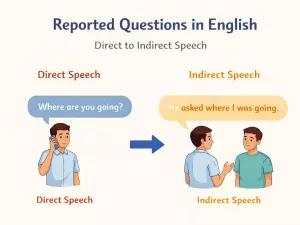
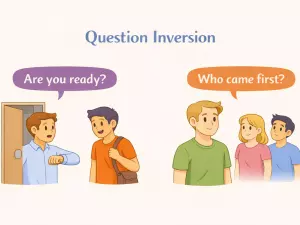
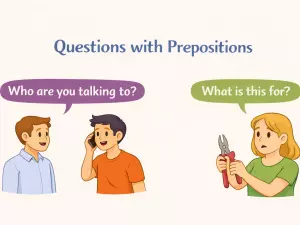
Embedded Questions in English Statements Explained

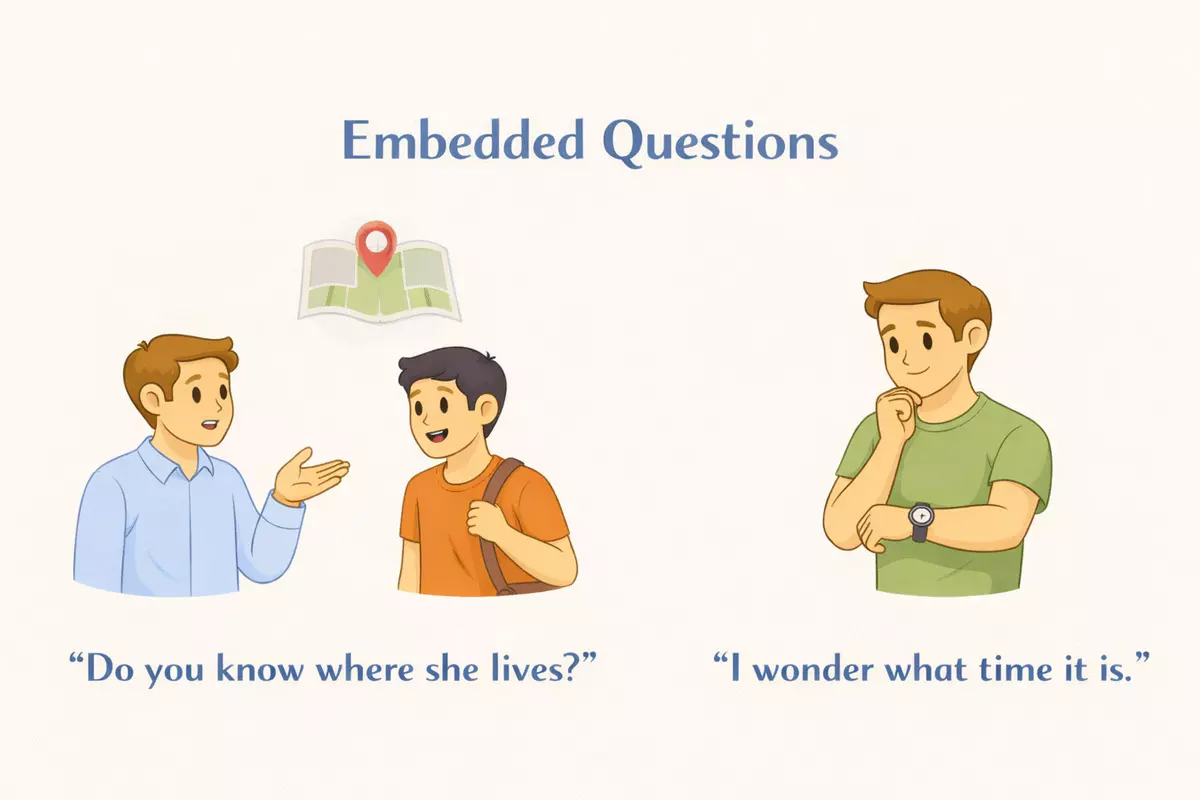 This article explains what embedded questions are, how they differ from direct questions, and the correct word order. It also covers embedded yes/no and WH-questions, reporting verbs, common mistakes, and practice exercises.
Have you ever wondered how to incorporate questions into regular sentences without making them sound awkward? Mastering the art of inserting indirect questions into English statements can greatly enhance both your conversations and your writing, allowing you to communicate more naturally and with greater sophistication. By learning how to rephrase direct questions as indirect ones, you can express curiosity or request information politely, making interactions smoother and more effective in a variety of social and professional situations.
What Embedded Questions Are
In English, an embedded question is a type of indirect question that is included within a statement or another question, rather than standing alone. These are not standard interrogative sentences; instead, they appear inside other clauses and do not follow typical question word order. For instance, instead of asking, “Where is she going?”, you might say, “I wonder where she is going.” This structure is common in polite speech, reported speech, and when expressing uncertainty or curiosity.
Key Features of Embedded Questions
- They are introduced by verbs like know, wonder, ask, remember, explain, and others.
- The word order is subject + verb (declarative), not verb + subject (interrogative).
- They may start with a question word (who, what, where, when, why, how) or with “if”/“whether” for yes-no questions.
- No question mark is used unless the entire sentence is a question.
- They often make questions sound more polite or less direct.
Common Patterns and Examples
Notice how the structure shifts from a direct question to an embedded one:
- Direct: “Where did he go?” → Embedded: “Can you tell me where he went?”
- Direct: “Is she coming?” → Embedded: “I’m not sure if she is coming.”
- Direct: “What time does the movie start?” → Embedded: “Do you know what time the movie starts?”
- Direct: “Why are they late?” → Embedded: “He explained why they were late.”
- Direct: “Who broke the vase?” → Embedded: “I wonder who broke the vase.”
- Direct: “How did you do that?” → Embedded: “Tell me how you did that.”
- Direct: “Will it rain tomorrow?” → Embedded: “Could you tell me whether it will rain tomorrow?”
- Direct: “Has she finished her work?” → Embedded: “Let me know if she has finished her work.”
- Direct: “Where is my phone?” → Embedded: “I can’t remember where my phone is.”
- Direct: “What did he say?” → Embedded: “I didn’t hear what he said.”
Direct vs. Embedded Structure
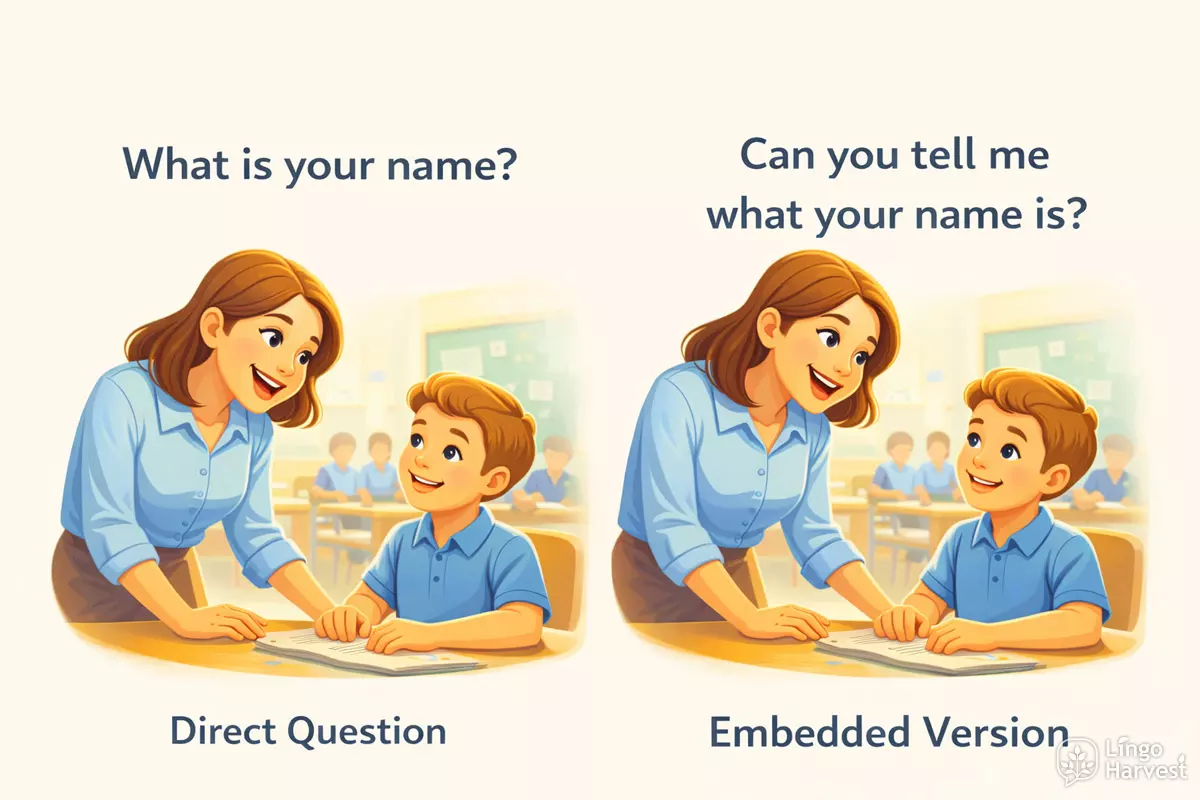
| Direct Question | Embedded Version |
|---|---|
| What is your name? | Can you tell me what your name is? |
| Where did he go? | I wonder where he went. |
| Is it raining? | Do you know if it is raining? |
| Why are you upset? | She asked why you were upset. |
| When does the show start? | Tell me when the show starts. |
Using these forms helps add nuance and politeness to everyday communication. They’re especially useful for expressing curiosity, reporting speech, or asking questions in a less direct way.
Embedded vs Direct Questions
Understanding how embedded and direct questions differ helps you communicate clearly and politely in English. While both types serve to ask for information, their structure, tone, and usage in conversation are quite distinct. Direct questions are what you hear in everyday interrogative sentences—straightforward and often used for quick answers. Embedded questions, on the other hand, are tucked inside statements or other questions, making them sound softer and more formal.
What Sets Them Apart?
- Direct questions use standard question word order (auxiliary + subject + verb):
Where is the station? - Embedded questions appear within another sentence or question and follow statement word order (subject + verb):
Can you tell me where the station is? - Embedded forms are common in polite requests, reported speech, and indirect inquiries.
- Direct forms are typical for interviews, surveys, and informal conversation.
Key Differences at a Glance
| Direct Questions | Embedded Questions | Example Usage |
|---|---|---|
| Question word order | Statement word order | Where does she work? → I wonder where she works. |
| Often starts a sentence | Follows an introductory phrase | What time is it? → Do you know what time it is? |
| Can sound abrupt | More polite/indirect | Did he call? → Could you tell me if he called? |
| Uses auxiliary verbs before the subject | No auxiliary before subject in embedded part | Why did she leave? → Please explain why she left. |
Common Patterns and Examples
- Direct: Who are you? → Embedded: Can you tell me who you are?
- Direct: When will he arrive? → Embedded: Do you know when he will arrive?
- Direct: Is it raining? → Embedded: I wonder if it is raining.
- Direct: What does she want? → Embedded: Could you explain what she wants?
- Direct: Why are they late? → Embedded: Can you tell me why they are late?
- Direct: Did you see him? → Embedded: I’d like to know if you saw him.
- Direct: Where did you go? → Embedded: Tell me where you went.
- Direct: How much does it cost? → Embedded: Could you tell me how much it costs?
- Direct: What happened? → Embedded: I wonder what happened.
- Direct: Can you help me? → Embedded: I’d like to know if you can help me.
In summary, direct questions are straightforward and often less formal, while embedded questions help you sound more polite or indirect. Mastering both forms will make your English more adaptable to different situations.
Word Order in Embedded Questions
When a question is included inside another sentence—such as in indirect speech or reported questions—the structure of the clause changes. Unlike direct questions, which use question word order (auxiliary verb before subject), these embedded forms follow the standard subject-verb-object sequence of a statement. This shift often confuses learners, especially since the initial question word (like "what," "where," or "how") remains, but the rest of the clause does not resemble a direct question.
Direct vs. Embedded Structure
To clarify the difference, compare direct questions with their embedded versions. Notice how auxiliary verbs (like "do," "can," or "is") often disappear, and the subject comes before the verb.
| Direct Question | Embedded Version |
|---|---|
| What time is it? | Can you tell me what time it is? |
| Where did she go? | I wonder where she went. |
| Why are they late? | Do you know why they are late? |
| Who is calling? | Could you tell me who is calling? |
| How does this work? | I don't know how this works. |
Key Patterns to Remember
- No subject-auxiliary inversion: The subject comes before the verb, as in statements.
- Omit “do/does/did” in embedded questions—unless it’s needed for emphasis in a negative clause.
- Question words (“what,” “who,” “where,” etc.) remain at the start of the embedded clause.
- For yes/no questions, use “if” or “whether” as the connector (e.g., “I wonder if he’s coming”).
- Modal verbs (“can,” “will,” “might”) are placed after the subject: “Can you tell me when she will arrive?”
- Don’t use question marks at the end of a statement containing an embedded question.
- Keep tense consistent with the reporting verb, unless the context requires a shift.
- Intonation is neutral or falling, not rising as in direct questions.
- It’s common to use reporting phrases before the embedded clause: “Could you explain…,” “I’d like to know…,” “Tell me…”
- Pronoun and verb agreement follow the rules of normal statements, not questions.
Common Mistakes ❌ and How to Avoid Them ✅
- Incorrect: Can you tell me where is the station?
Correct: Can you tell me where the station is? - Incorrect: I don’t know what does he want.
Correct: I don’t know what he wants. - Incorrect: Please explain how can I do this.
Correct: Please explain how I can do this.
Mastering these structural differences helps make your speech and writing sound natural and clear. Practice by converting direct questions into embedded forms, paying special attention to the order of subjects and verbs within the clause.
Embedded Yes/No Questions
In English, it's common to include a yes/no question inside a statement, rather than asking directly. These are called indirect or reported questions, and they serve to make speech more polite, nuanced, or grammatically correct in complex sentences. The structure of these embedded forms is different from direct questions: the subject comes before the verb, and auxiliary verbs like “do” are removed.
How Structure Changes in Embedded Contexts
The main difference between direct yes/no questions and their embedded versions is word order and the omission of the auxiliary “do/does/did.” Additionally, the introductory phrase (such as “I wonder,” “She asked,” or “Can you tell me”) precedes the question, and the word “if” or “whether” is typically used to introduce the embedded clause.
| Direct Question | Embedded Version |
|---|---|
| Are you coming? | She asked if you were coming. |
| Did he finish the project? | I wonder whether he finished the project. |
| Is it raining? | Can you tell me if it is raining? |
| Will they join us? | Do you know whether they will join us? |
| Do you like coffee? | She wants to know if you like coffee. |
| Have they arrived? | I’m not sure whether they have arrived. |
| Can you help me? | I’m wondering if you can help me. |
| Is this correct? | Could you tell me if this is correct? |
| Are we late? | Let me know whether we are late. |
| Will it work? | They asked if it would work. |
Key Features of Embedded Yes/No Forms
- Use “if” or “whether” to introduce the embedded clause.
- Word order is subject + verb (no question order).
- Do not use “do/does/did” as an auxiliary in the embedded part.
- No question mark is used unless the whole sentence is a question.
- Common introductory phrases: “I wonder,” “She asked,” “Do you know,” “Could you tell me.”
- “Whether” is slightly more formal than “if,” but both are usually acceptable.
Understanding how to form these indirect yes/no questions helps with making requests, reporting speech, and sounding more natural in conversation. Practice recognizing and using these patterns in different contexts to improve both spoken and written English.
Embedded WH-Questions
When a question is incorporated into a larger statement or another question, it often changes form. These indirect or reported questions use words like who, what, where, when, why, and how, but the sentence structure differs from direct questions. Instead of the typical auxiliary verb inversion found in direct queries, these embedded forms follow standard statement word order.
How Structure Changes in Embedded Forms
The word order is a key difference. In direct questions, the auxiliary verb usually comes before the subject ("Where are you going?"). In an embedded form, the subject comes before the verb ("I wonder where you are going"). There's no inversion, and question marks are not used unless the whole sentence is a question.
Common Reporting Verbs
Embedding often occurs after verbs such as:
- ask → Can you ask where the nearest station is?
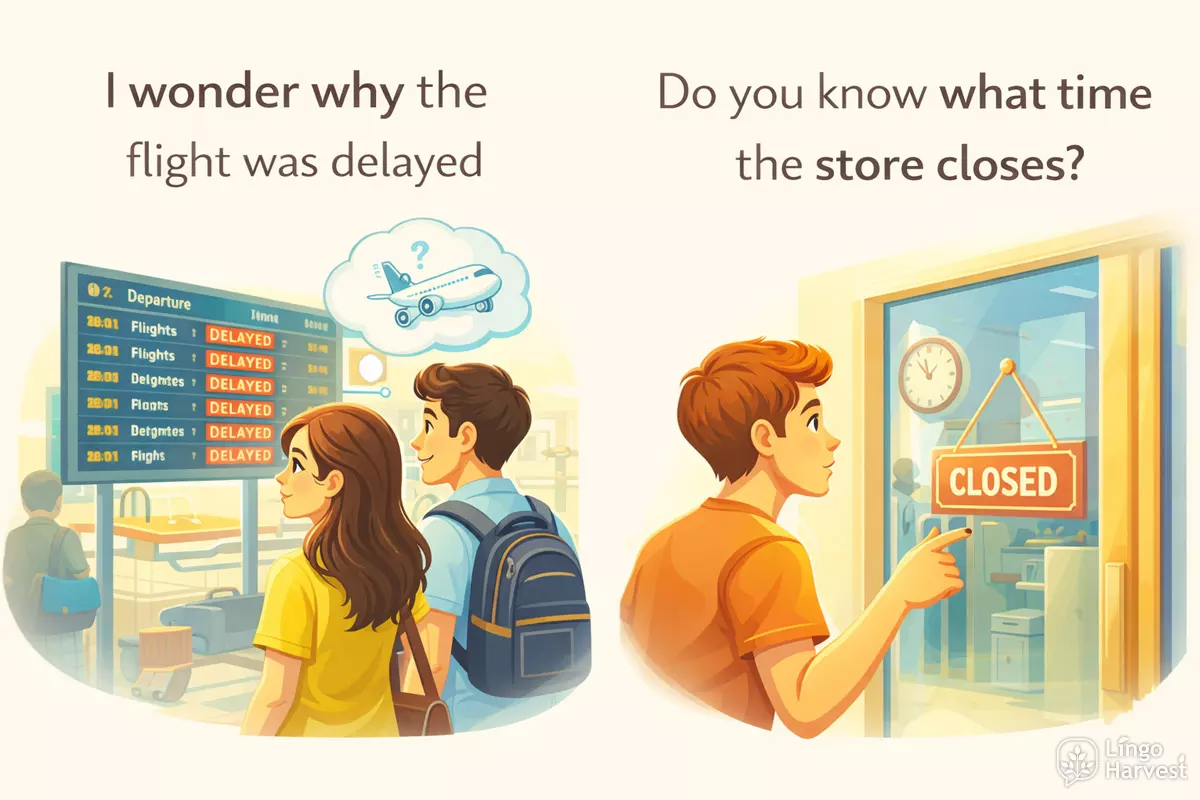
- wonder → I wonder why the flight was delayed.
- know → Do you know what time the store closes?
- remember → I can’t remember where I left my keys.
- forget → She forgot how the password reset works.
- explain → Could you explain why this rule is important?
- tell (someone) → Please tell me where you’re going after class.
- show → Can you show us how you solved the problem?
- find out → I’ll find out when the results are posted.
- understand → I don’t understand why he changed his mind.
- discover → They discovered where the noise was coming from.
- see → I can see what you mean now.
- hear → I heard where the new office will be.
- decide → We need to decide what we should do next.
- learn → You’ll learn how this pattern works with practice.
- guess → I can guess why she’s upset.
- realize → He realized what he had done too late.
- notice → Did you notice where the speaker put the notes?
Examples of Embedded Question Patterns
You’ll notice that the auxiliary verb (do/does/did) is omitted, and the subject comes before the verb. Take a look at these sample transformations:
- Direct: "What did she say?" → Embedded: "I don’t know what she said."
- Direct: "Where is the station?" → Embedded: "Can you tell me where the station is?"
- Direct: "Why did they leave?" → Embedded: "We’re not sure why they left."
- Direct: "How does this work?" → Embedded: "Please explain how this works."
- Direct: "Who is coming?" → Embedded: "I wonder who is coming."
- Direct: "When will it start?" → Embedded: "Do you know when it will start?"
- Direct: "Which bus goes downtown?" → Embedded: "Could you tell me which bus goes downtown?"
- Direct: "What time does it open?" → Embedded: "Let me check what time it opens."
- Direct: "Why are you upset?" → Embedded: "He asked why you were upset."
- Direct: "Where did she put the keys?" → Embedded: "I can’t remember where she put the keys."
- Direct: "Who made this cake?" → Embedded: "Do you know who made this cake?"
- Direct: "How much does it cost?" → Embedded: "Tell me how much it costs."
- Direct: "When did they arrive?" → Embedded: "I’m not sure when they arrived."
- Direct: "What happened?" → Embedded: "Let’s find out what happened."
Typical WH-Words Used
The following question words commonly introduce these indirect clauses:
- who → Do you know who she is?
- what → I can’t remember what he said.
- where → Could you tell me where the meeting is?
- when → Do you know when the train leaves?
- why → I wonder why they canceled the event.
- how → Can you show me how this works?
- which → I’m not sure which option you chose.
- whose → Do you know whose jacket this is?
Comparing Direct and Embedded Forms
| Direct Question | Embedded Form |
|---|---|
| Where are my keys? | I wonder where my keys are. |
| What does he want? | Can you tell me what he wants? |
| Why did she leave? | Do you know why she left? |
| How can I fix this? | Please explain how I can fix this. |
| Who is at the door? | Let’s see who is at the door. |
Key Points to Remember
- Don’t use auxiliary verbs (do/does/did) in the embedded clause.
- Keep the subject before the verb, just like in normal statements.
- Use the WH-word to introduce the clause, without changing its meaning.
- No question mark unless the whole sentence is a question.
Mastering these patterns will help you express questions more naturally in reported speech and polite requests.
Common Reporting Verbs and Phrases
When embedding questions within statements, English relies on specific verbs and expressions to introduce or report what someone asked, wondered, or wanted to know. These reporting verbs help shift direct questions into indirect speech, making the sentence flow naturally. Choosing the right verb or phrase depends on the context, the information being relayed, and the degree of formality.
Frequently Used Verbs for Embedded Questions
Some verbs are especially useful for transforming direct questions into embedded forms. These verbs often signal that a question or request is being reported, rather than asked directly. Here are some of the most common ones:
- ask → She asked where the office was located.
- wonder → I wonder why the system stopped working.
- know → Do you know how this feature works?
- inquire → He inquired whether the documents were ready.
- find out → We need to find out when the deadline is.
- question → They questioned why the decision was made.
- learn → She learned how the process was organized.
- see → I can see what you’re trying to say.
- understand → I don’t understand why this keeps happening.
- check → Please check whether the data is correct.
- explain → Could you explain how this rule applies here?
- discover → They discovered where the error came from.
- clarify → He clarified what the next step would be.
- investigate → The team investigated why the delay occurred.
- determine → We must determine which option is best.
- explore → Researchers are exploring how the change affects users.
- verify → Please verify whether the payment went through.
- confirm → Can you confirm when the meeting starts?
These verbs allow you to introduce indirect questions like, “She asked if you were coming,” or “I wonder what time it starts.”
Typical Phrases for Introducing Embedded Questions
Beyond single verbs, English uses various set phrases to frame indirect questions in statements. These expressions help add politeness, uncertainty, or curiosity:
- would like to know
- am not sure
- have no idea
- can't remember
- don’t know
- am curious about
- need to find out
- am interested in knowing
- want to ask
- was wondering
For example: “I was wondering where you live,” or “He would like to know whether you’ve finished.”
Comparing Reporting Verbs: Nuance and Use
Different verbs and phrases can subtly change the meaning or tone of an embedded question. For instance, wonder suggests curiosity, while ask is more direct. Verify and confirm imply checking facts, and inquire is more formal.
| Verb/Phrase | Typical Context or Nuance |
|---|---|
| ask | Neutral, general use for reporting questions |
| wonder | Suggests curiosity or uncertainty, often informal |
| inquire | More formal, often used in professional or written contexts |
| verify | Implies checking accuracy or correctness |
| was wondering | Polite, indirect way to introduce a question |
| would like to know | Polite request for information, often written or formal |
Selecting the right reporting verb or phrase helps ensure your embedded question matches the level of formality and intent you want to convey. Practicing with a variety of these expressions will make your indirect questions sound more natural and fluent in conversation or writing.
Typical Learner Mistakes
When learning to use embedded questions in English statements, students often run into several recurring problems. These issues can create confusion and lead to sentences that sound unnatural or are grammatically incorrect. Recognizing these common pitfalls can help learners avoid them and build confidence with embedded structures.
Common Issues and Confusions
- Using question word order: Many learners mistakenly keep the auxiliary verb before the subject, as in direct questions (e.g., I don’t know where is he instead of I don’t know where he is).
- Adding unnecessary auxiliary verbs: Some students insert do/does/did into embedded clauses (e.g., Can you tell me what does he want? ❌).
- Forgetting subject-verb inversion: Learners may overcorrect and never invert, even in direct questions, which can cause confusion when switching between forms.
- Omitting the subject: Embedded questions require a subject; dropping it creates incomplete sentences (e.g., I wonder what happened vs. I wonder what did).
- Confusing if/whether and yes/no structure: Learners may forget to use if or whether when embedding yes/no questions (She asked was I coming instead of She asked if I was coming).
- Punctuation errors: Learners often use a question mark at the end of a statement with an embedded question, which is incorrect (I don’t know where he went? ❌).
- Incorrect tense shifts: Sometimes, students change the tense unnecessarily, making the embedded clause inconsistent with the main sentence.
- Using direct question forms with reporting verbs: Phrases like Can you tell me, I want to know, or Do you know should be followed by a statement word order, not a direct question.
- Misplacing question words: Learners may leave out or misplace question words such as what, where, why, or how.
- Overusing or omitting “that”: While “that” is sometimes optional, its unnecessary use or omission can make a sentence awkward.
Direct vs. Embedded: Word Order Comparison
| Direct Question | Embedded in a Statement |
|---|---|
| Where is the station? | Can you tell me where the station is? |
| What does she want? | I wonder what she wants. |
| Why did he leave? | Do you know why he left? |
| Is it raining? | I’m not sure if it is raining. |
| Who are they? | Tell me who they are. |
| How did you do that? | She asked how I did that. |
Quick Tips to Avoid Errors
- After reporting verbs, always use statement word order in the embedded clause.
- Don’t add do/does/did in embedded questions.
- Use if or whether for yes/no embedded questions.
- End the sentence with a period, not a question mark, unless the entire sentence is a direct question.
Understanding where mistakes usually happen makes it easier to self-correct and use embedded questions more naturally in conversation and writing.
Practice Exercises and Self-Check
Test your understanding of how embedded (indirect) questions work within sentences. These tasks will help you recognize patterns, improve your sentence transformation skills, and avoid common mistakes. Try to answer each question before checking the explanations below.
Identify the Embedded Question
Read each sentence and decide which part is the embedded question:
- Can you tell me where she lives?
- I wonder what time the meeting starts.
- He doesn't remember if he locked the door.
- Do you know why they left early?
- She asked how much the tickets cost.
- We need to find out where the error occurred.
- He asked whether the store was still open.
- I can’t recall when they moved abroad.
- Do you remember who recommended this book?
- She explained why the plan was changed.
Show answers
- where she lives
- what time the meeting starts
- if he locked the door
- why they left early
- how much the tickets cost
- where the error occurred
- whether the store was still open
- when they moved abroad
- who recommended this book
- why the plan was changed
Transform Direct to Embedded Format
Rewrite these direct questions as embedded questions within a statement:
- Where did she go?
- What does he want?
- Is it going to rain?
- When will they arrive?
- Why did you call?
- Who broke the window?
- How does this machine work?
- Which option should we choose?
- Did they finish the project?
- Where can I find the instructions?
Show answers
- I don't know where she went.
- Can you tell me what he wants?
- Do you know if it is going to rain?
- Could you tell me when they will arrive?
- I wonder why you called.
- They are trying to find out who broke the window.
- Can you explain how this machine works?
- We need to decide which option we should choose.
- Do you know whether they finished the project?
- Please tell me where I can find the instructions.
Common Errors: Spot the Mistake
Each sentence below contains a mistake typical in forming embedded questions. Identify the error and correct it.
- Can you tell me where does she live?
- I wonder what is he doing.
- Do you know what time does the show start?
- She asked if does he like coffee.
- Could you tell me where are they going?
- I don’t know why did he leave early.
- Do you remember when did the class begin?
- She asked what did you say.
- Can you explain how does this work?
- I wonder where did they meet.
Show answers
- Correct: Can you tell me where she lives? (Remove ‘does’)
- Correct: I wonder what he is doing. (No inversion)
- Correct: Do you know what time the show starts? (Remove ‘does’, verb after subject)
- Correct: She asked if he likes coffee. (Remove ‘does’)
- Correct: Could you tell me where they are going? (No inversion)
- Correct: I don’t know why he left early. (No inversion)
- Correct: Do you remember when the class began? (No inversion)
- Correct: She asked what you said. (No inversion)
- Correct: Can you explain how this works? (No ‘does’)
- Correct: I wonder where they met. (No inversion)
Direct vs. Embedded Questions: Comparison Table
| Direct Question | Embedded Question Example |
|---|---|
| Where is the station? | Could you tell me where the station is? |
| Who called you? | I wonder who called you. |
| Does she like pizza? | Do you know if she likes pizza? |
| What time does it open? | Can you tell me what time it opens? |
| Why did he leave? | I don't know why he left. |
Practicing these patterns will help you recognize indirect questions in everyday conversation and write more naturally in English. Review your answers and notice how word order and auxiliary verbs change in embedded forms.