All vs Whole: How to Talk About Complete Amounts Correctly

 Here we the core meanings of all and whole, the types of nouns each can modify, and differences in sentence position.
- Core meaning of all and whole
- Types of nouns each quantifier can modify
- Differences in sentence position and structure
- Fixed expressions and idiomatic usage
- Common learner confusions and why they happen
- Meaning changes caused by incorrect choice
- Examples with time, objects, and groups
- Practice: choosing all or whole in context
Have you ever wondered whether to say the entire cake or all the cake? Knowing the subtle differences between these expressions can help you communicate more clearly and accurately. The phrase the entire cake emphasizes the wholeness of the cake as a single object, while all the cake refers to the total amount of cake, possibly including pieces or portions. Being aware of these distinctions can improve your everyday conversations and help you express yourself with greater precision.
Core meaning of all and whole
When discussing how to express completeness in English, it’s helpful to look at the distinct ways “all” and “whole” are used. Both words suggest something is entire or complete, but they’re not interchangeable. Understanding their differences helps you choose the right word, especially when talking about groups, objects, or quantities.
How “all” works
“All” generally refers to every individual part within a group or the total amount of something. It emphasizes inclusion—every member or piece is counted. For instance, “all the cookies” refers to every single cookie in a batch. The word often comes before plural nouns or uncountable nouns:
- All the students are in the classroom.
- I spent all my money on food.
- We drank all the water in the bottle.
- I study English all the time.
- I know all of the answers on the test.
- This room has all the furniture we need.
- Please turn off all the lights.
- I texted all my friends today.
- I read all the books on the table.
- All the people are waiting outside.
Notice that “all” can be used with both countable (students, books) and uncountable (water, furniture) nouns.
How “whole” is used

On the other hand, “whole” is typically used to describe a single, undivided unit in its entirety. It focuses on completeness as a single entity, not as a collection of parts. For example, “the whole cake” means the entire cake, not slices. “Whole” is almost always paired with singular, countable nouns:
- I ate the whole apple.
- I waited a whole day.
- The whole class listened to the teacher.
- It rained in the whole city.
- I know the whole story.
- The whole team is ready.
- I stayed there for a whole month.
- The whole family is at home.
- People know it in the whole country.
- The whole world watched the game.
“Whole” is rarely used with uncountable nouns or plural forms.
Key differences at a glance
| “All” | “Whole” |
|---|---|
| Refers to every part or individual in a group | Describes a single item in its entirety |
| Used with plural and uncountable nouns | Used with singular, countable nouns |
| Example: all the apples | Example: the whole apple |
| Example: all the information | Example: the whole story |
When to choose each word
Pick “all” when you want to highlight every member of a set or the total amount of something that can be counted or measured. Use “whole” when you’re describing one complete thing, without dividing it into parts. This distinction helps you communicate clearly whether you mean every unit in a collection or an undivided item.
Types of nouns each quantifier can modify
When choosing between "all" and "whole," it’s important to know which kind of noun each one can accompany. Both words refer to totality, but they don’t work the same way with every noun. The main difference comes down to countability and whether the noun is singular or plural.
“All” – Flexible with Nouns
"All" is highly versatile and can be used with a broad range of nouns:
- Plural countable nouns: all students, all books, all cities
- Uncountable nouns: all water, all information, all music
- Definite nouns (with “the”): all the cookies, all the money
- Possessive forms: all my friends, all his advice
- Pronouns: all of us, all of them
It’s common to use "all" before articles, possessives, and demonstratives (e.g., "all these options," "all your questions"). This makes "all" suitable for groups, masses, and entire categories.
“Whole” – Used with Singular Countable Nouns
On the other hand, "whole" is more restricted. It’s typically used with singular countable nouns to express completeness of a single unit:
- She ate the whole cake by herself.
- People across the whole country saw the news.
- I have lived here my whole life.
- He ate one whole apple after lunch.
- The whole class went on a trip together.
- She worked in the same field her whole career.
"Whole" can also appear with certain collective nouns or time expressions, but generally not with plural or uncountable nouns.
Quick Comparison
To make things clearer, here’s a side-by-side look at which nouns each quantifier can modify:
| “All” | “Whole” |
|---|---|
| all the apples (plural countable) | the whole apple (singular countable) |
| all water (uncountable) | the whole bottle of water (singular countable unit) |
| all my friends (plural countable/possessive) | my whole family (singular collective) |
| all the information (uncountable/definite) | the whole story (singular countable) |
| all of us (pronoun) | the whole group (collective noun) |
Summary
In short, "all" works with plural, uncountable, and some pronouns, making it useful for groups or masses. "Whole" is generally reserved for a single, complete thing or unit. Choosing the right quantifier depends on whether you’re talking about a group, a mass, or just one entire item.
Differences in sentence position and structure
Understanding how “all” and “whole” fit into sentences is key to using them naturally in English. Their placement and the way they interact with nouns or pronouns can change the meaning or even make a sentence sound awkward if used incorrectly.
Where “all” appears in sentences
“All” is flexible and can appear in multiple spots, depending on emphasis and the noun type:
- Before a plural noun: All cats love sunlight.
- Before an uncountable noun: All information must be accurate.
- Before a determiner (the, my, these): All the answers are correct.
- Before pronouns: All of them left early.
- After the verb “to be” for emphasis: The students are all here.
How “whole” fits into sentences
“Whole” is used with singular countable nouns and typically sits right before the noun, but after determiners:
- With “the”: The whole cake was eaten.
- With possessives: My whole day was ruined.
- With demonstratives: This whole situation is confusing.
- With numbers and quantifiers: One whole apple is enough.
Direct comparison of sentence patterns
| “All” Sentence Pattern | “Whole” Sentence Pattern |
|---|---|
| All + plural/uncountable noun All children need sleep. |
(Determiner) + whole + singular noun The whole city was silent. |
| All + the/my/these + plural noun All my friends arrived. |
Possessive + whole + noun Her whole plan failed. |
| All of + pronoun All of us were surprised. |
Quantifier/number + whole + noun One whole week passed. |
| Be + all + prepositional phrase They are all at home. |
Adjective + whole + noun Entire whole world (rare, usually just “whole world”) |
Key points to remember
- “All” is more common with plurals and uncountable nouns, and can be separated from the noun by a determiner or even moved after the verb for emphasis.
- “Whole” always describes a single, countable item and stays close to the noun, never separated by “of.”
- “All of” is required before pronouns or when emphasizing the entire group.
- “Whole” cannot be used with plural nouns (❌ whole cakes), but “all” can (✅ all cakes).
- Both “all” and “whole” can shift meaning by their position: All the cake (every part of the cake, possibly more than one) vs. The whole cake (one complete cake).
Grasping these patterns will help you sound more natural and precise in English, especially when discussing amounts or totals.
Fixed expressions and idiomatic usage
When discussing the complete amount of something, English often relies on established phrases and idioms using “all” or “whole.” These set forms don’t always follow the logic of grammar rules, so it’s useful to recognize the most common patterns. Many of these expressions are fixed—meaning you can’t swap “all” and “whole” without sounding odd or changing the meaning.
Common idioms and set phrases
Some familiar English expressions use “all” or “whole” in ways that you’ll hear in daily conversation and writing. Here are some of the most frequent examples:
- All of a sudden, it started to rain.
- Her clothes were all over the place.
- All in all, it was a good day.
- The lights went out all at once.
- I think about it all the time.
- He built the table all by himself.
- I knew the answer all along.
- She was quiet the whole time.
- The whole world watched the event.
- He told me the whole story.
- She finally told the whole truth.
- The whole point is to learn from mistakes.
- They planned the party — food, music, the whole nine yards.
- We sold the whole lot in one day.
Notice that certain nouns prefer one word over the other. For example, we say “the whole truth” but not “all the truth,” while “all the time” is standard, not “the whole time” (except in specific contexts).
When “all” and “whole” aren’t interchangeable
Some expressions sound natural with only one of these words, and replacing it just doesn’t work. To make this clearer, here’s a table comparing a few set phrases and whether the alternative works or not:
| Expression | Correct? |
|---|---|
| all of a sudden | ✅ (Correct) |
| the whole world | ✅ (Correct) |
| all the world | ❌ (Unusual) |
| the whole of the truth | ❌ (Unusual) |
Tips for using set phrases
- Memorize idiomatic uses as they are—they rarely accept substitutions.
- If in doubt, check how native speakers use the phrase.
- Be aware that “all” is often used with groups or plural nouns (“all the students”), while “whole” is common with singular count nouns (“the whole apple”).
- Some expressions, like “all in all” or “the whole nine yards,” have meanings beyond just “complete amount.”
Recognizing these patterns can help you sound more natural and avoid awkward phrasing when talking about completeness in English.
Common learner confusions and why they happen
Understanding the difference between “all” and “whole” can be tricky, especially for English learners whose native languages use these terms differently—or not at all. Many mix them up because both words relate to completeness or totality, but they follow different grammar patterns and subtle meaning rules. Recognizing these patterns is key to mastering their use.
Mixing up countable and uncountable nouns
A frequent area of uncertainty is knowing which word fits with certain types of nouns. “All” is used with both countable and uncountable nouns, while “whole” usually pairs with singular countable nouns. Learners often mistakenly say “the all cake” instead of “the whole cake” or “whole people” instead of “all people”.
Word order and grammatical structure
Another stumbling block is word placement. “All” usually comes before determiners (like “the,” “my,” “these”), whereas “whole” follows determiners. This difference can cause confusion, especially when translating directly from another language.
| Correct Usage | Incorrect Usage |
|---|---|
| all the students | the all students |
| the whole story | whole the story |
| all of the water | the all water |
| the whole cake | all cake |
Misunderstanding meaning and emphasis

The nuance between “all” and “whole” can also cause missteps. “All” emphasizes every part or member of a group, while “whole” suggests a single, undivided entity. Learners sometimes use “whole” when they mean every individual, or “all” when they want to stress completeness of a single thing.
- “All the books” (every individual book in a set) → I read all the books on the shelf.
- “The whole book” (one book, complete and unabridged) → I read the whole book in one weekend.
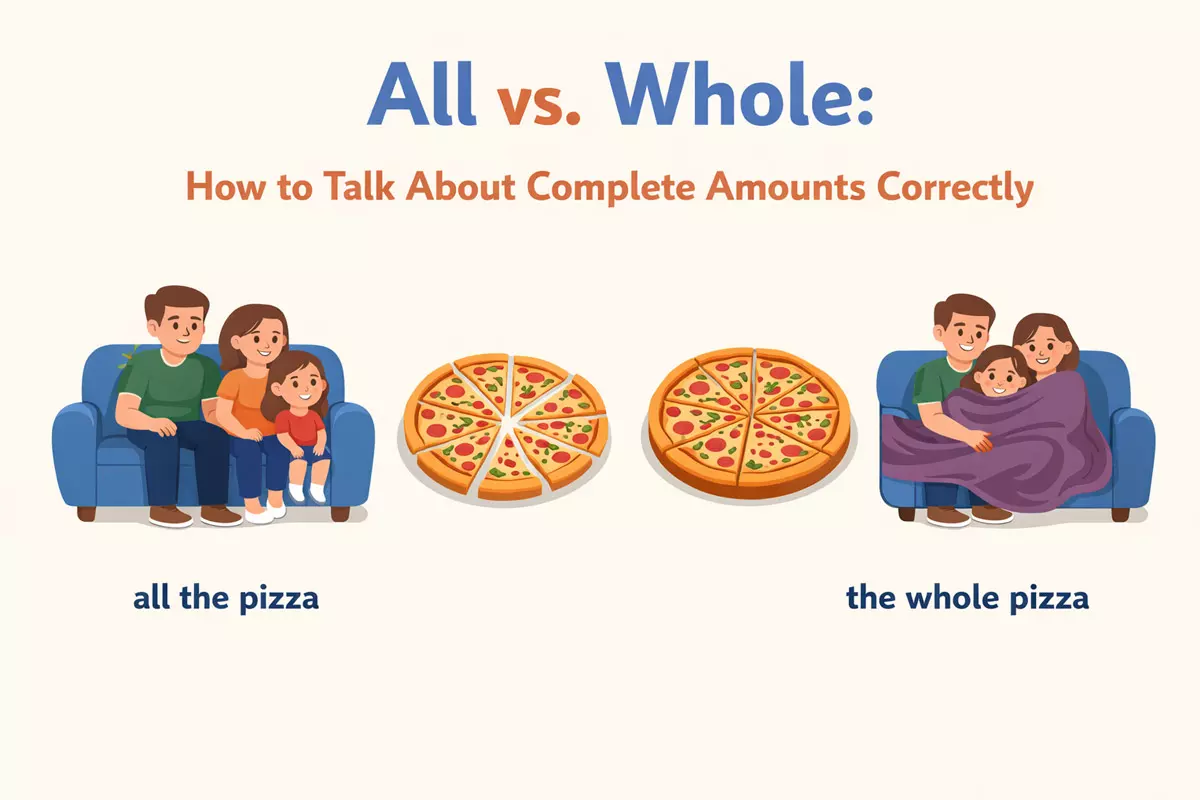
- “All the cake” (every piece of cake, possibly sliced) → We ate all the cake after dinner.
- “The whole cake” (the cake as a single, uncut item) → She brought the whole cake to the party.
Why these mistakes happen
These errors are common because learners often transfer rules from their own languages or generalize from limited exposure. The subtle differences are not always explicitly taught, and context clues in conversation can be misleading. Practice, targeted feedback, and plenty of examples help build intuition for choosing the right word.
Meaning changes caused by incorrect choice
Using all and whole interchangeably can easily lead to confusion or even a completely different message. These words both refer to completeness, but they focus on different aspects—one often emphasizes the sum of parts, while the other highlights an undivided entity. Picking the wrong word can subtly (or not so subtly) alter what you’re trying to communicate.
Common shifts in meaning
- All tends to stress every individual part or member of a group. If you use it with a singular noun, it usually refers to every bit or aspect of that thing.
- Whole focuses on something as a single, undivided unit. It’s about the entirety, not the pieces.
- Choosing one over the other can change whether listeners imagine a group of items or a single item in its entirety.
- Some nouns only work with one or the other, so the wrong choice can even sound unnatural or be grammatically incorrect.
Examples: Subtle to major differences
Let’s look at how the use of all versus whole can affect the meaning of a sentence. Small changes can have a big impact on what’s understood.
| Expression | Interpretation |
|---|---|
| All the cake | Every piece or portion of the cake (could be cut or separated) |
| The whole cake | The entire, uncut cake as a single object |
| All day | Every moment throughout the day (duration is emphasized) |
| The whole day | The day as one continuous block of time (the span as a single unit) |
| All the students | Every individual student in the group |
| The whole class | The group as a single, unified entity |
| All the book | ❌ Incorrect (unnatural phrase in standard English) |
| The whole book | The book in its entirety, every page |
| All my life | The entire duration of my life, every moment |
| My whole life | The total span of my life, as a single experience |
Typical errors and their effects
- Using whole with plurals (the whole students) sounds unnatural and can confuse listeners.
- Using all with singular countable nouns (all the book) is incorrect and may make your meaning unclear.
- Swapping these words can shift emphasis from the collective group to the undivided item, or vice versa, potentially misleading your audience.
- In time expressions, all day and the whole day are similar, but sometimes all can suggest repetition or intensity, while whole can emphasize the block of time.
In summary, careful selection between these terms helps you express exactly what you mean—whether you’re talking about every part, every member, or an undivided total. Misusing them can result in awkward phrasing or a message that misses the mark.
Examples with time, objects, and groups
Understanding when to use "all" versus "whole" can be tricky, especially when talking about time, things, or collections of people. The right choice depends on whether you're describing a complete unit or every part within a group. Here are practical ways these words are used, with plenty of examples to help clarify the distinction.
Talking About Time
"Whole" is commonly used when you want to emphasize an uninterrupted span, while "all" often refers to every part of a period.
- I waited the whole day for your call. (emphasizes the entire, unbroken period)
- She worked all day. (focuses on every part of the day, possibly with breaks)
- We spent the whole weekend at the cabin.
- He was busy all morning.
- The whole year was challenging.
- All year, she saved money for her trip.
Referring to Objects and Things
When discussing objects, "whole" describes a single, complete item, while "all" refers to every item in a group.
- He ate the whole pizza. (one entire pizza)
- She read all the books on the shelf. (every book)
- The whole cake was gone in minutes.
- All the cookies disappeared quickly.
- They fixed the whole car, not just the engine.
- All the cars in the parking lot were covered with snow.
Describing Groups of People
When groups are involved, "all" refers to every member, while "whole" can mean the group as a single unit.
- All the students passed the exam. (every student individually)
- The whole class went on a field trip. (the group as a unit)
- All the team members received medals.
- The whole family gathered for dinner.
- All the employees attended the meeting.
- The whole company celebrated the anniversary.
| Situation | Correct Usage |
|---|---|
| Describing every minute or part of a period | All day, all week, all night |
| Talking about the full, uninterrupted duration | The whole day, the whole month |
| Referring to each item in a set | All the apples, all the chairs |
| Referring to one complete object | The whole apple, the whole chair |
| Describing every member of a group | All the players, all the children |
| Referring to the group as a single unit | The whole team, the whole group |
These patterns can help you choose the best word for expressing completeness, whether you're discussing timeframes, individual items, or groups. Remember, "all" highlights every part or member, while "whole" emphasizes something as a single, undivided entity.
Practice: choosing all or whole in context
Understanding when to use “all” versus “whole” can be tricky, especially since both relate to completeness. Let’s put this into practice by working through a series of examples and identifying the patterns that guide native usage.
Common Usage Patterns
- “All” is often used before plural or uncountable nouns (e.g., all the students, all the water).
- “Whole” is typically used before singular countable nouns (e.g., the whole cake, a whole day).
- With time expressions, “whole” is common: “the whole year,” “a whole month.”
- “All of” is used with pronouns and certain nouns: “all of us,” “all of the money.”
- “Whole of” is less common but appears in phrases like “the whole of Europe.”
Quick Quiz: Which Is Correct?
- I drank _____ bottle of juice. (all / the whole)
- _____ the children were excited about the trip. (All / Whole)
- She spent _____ day reading. (all / the whole)
- He ate _____ the cookies by himself. (all / whole)
- _____ my friends are coming to the party. (All / Whole)
- It rained for _____ week. (all / the whole)
- Did you finish _____ the homework? (all / whole)
- They searched _____ house for the keys. (all / the whole)
- _____ of the information was useful. (All / Whole)
- She read the book in _____ sitting. (all / one whole)
Show answers
- the whole
- All
- the whole
- all
- All
- the whole
- all
- the whole
- All
- one whole
Comparison Table: When to Use Each
| “All” | “Whole” |
|---|---|
| Used with plural nouns: all the apples |
Used with singular countable nouns: the whole apple |
| Used with uncountable nouns: all the milk |
Used with time periods: the whole week |
| Before pronouns: all of them |
With “the” for emphasis: the whole story |
| With “of” for specifics: all of the cake |
With place names (formal): the whole of Europe |
Spot the Error
Read the sentences below. One uses “all” or “whole” incorrectly. Which one is wrong?
- I watched the whole movie last night.
- She ate all cake by herself.
- All the students passed the exam.
- He slept the whole day.
- They visited the whole city in two days.
- I read all books on the list.
- She listened to the whole story carefully.
- We used all the money we had.
- The whole class was silent.
- He drank all water from the bottle.
Show answers
- Sentence 2 is incorrect. It should be “She ate all the cake by herself.”
- Sentence 6 is incorrect. It should be “I read all the books on the list.”
- Sentence 10 is incorrect. It should be “He drank all the water from the bottle.”
Fill in the Blanks
Choose the correct word (“all” or “whole”) to complete each sentence.
- _____ summer was unusually hot.
- He lost _____ his money at the casino.
- They painted the _____ room blue.
- _____ of the cookies are gone.
- I spent _____ day at home.
- She read _____ the emails.
- We walked around the _____ city.
- _____ the students understood the lesson.
- He ate the _____ pizza by himself.
- _____ of the water is cold.
Show answers
- The whole
- all
- whole
- All
- the whole
- all
- whole
- All
- whole
- All
Practicing these distinctions will help you use “all” and “whole” naturally in conversation and writing. Notice how the choice depends on whether you’re referring to the entirety of a singular item, a period of time, or a group of things. With regular review, these patterns will become automatic.