Master in/on/at with 10 Picture Rules (You'll Never Forget)

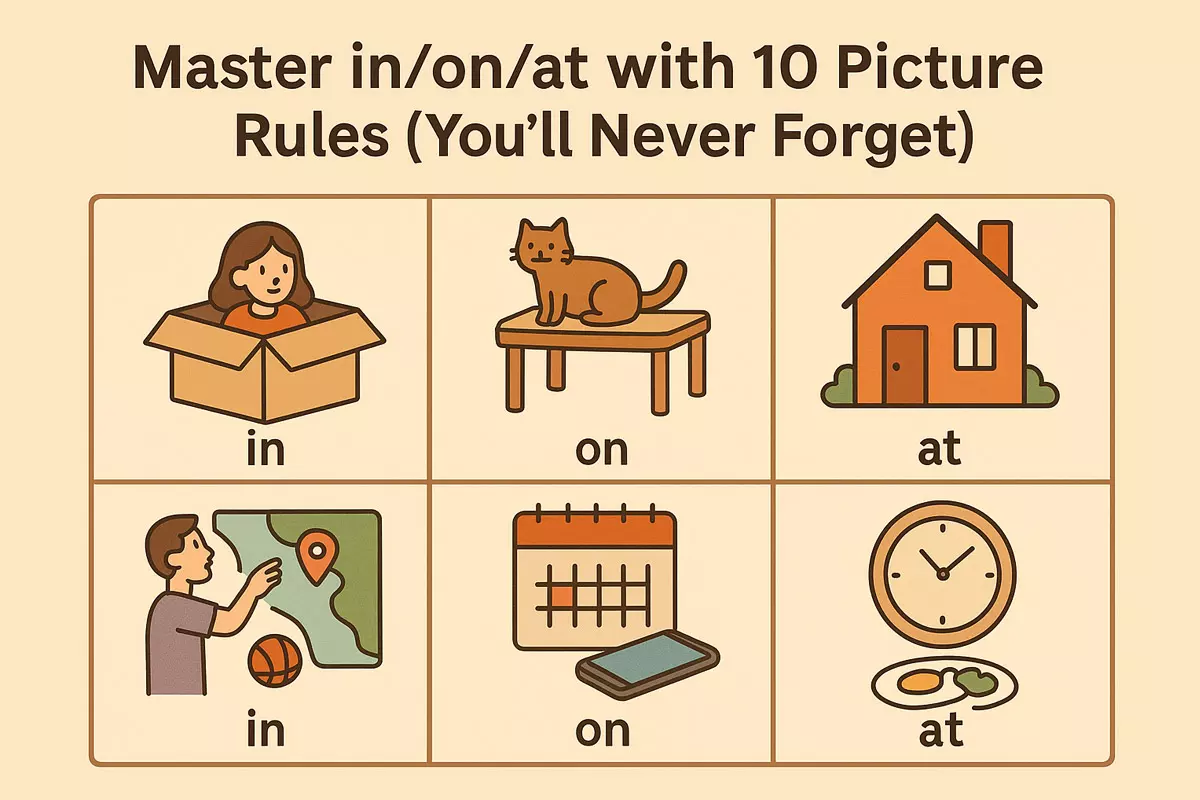 This article explains ten key visual rules for using in, on, and at, with summary charts for time and place. It also includes real-life examples, a quick error correction checklist, and practice exercises describing pictures.
Struggling to remember when to use in, on, or at? These small prepositions can be confusing, even for confident English learners, but mastering them is possible with the right strategies. By using ten simple, picture-based tricks, you can quickly learn to choose the correct word in different situations. These visual methods make the rules clear and memorable, so you can stop second guessing yourself and use in, on, and at with confidence in your everyday conversations and writing.
10 Visual Rules to Remember
Understanding when to use "in," "on," or "at" with English places and times can be tricky, but visualizing the rules helps. Here are memorable guidelines and scenarios, supported by simple images or mental pictures, to clarify when each preposition is appropriate. Try to picture each example as you read for easier recall.
1. In: Enclosed Spaces and Larger Areas
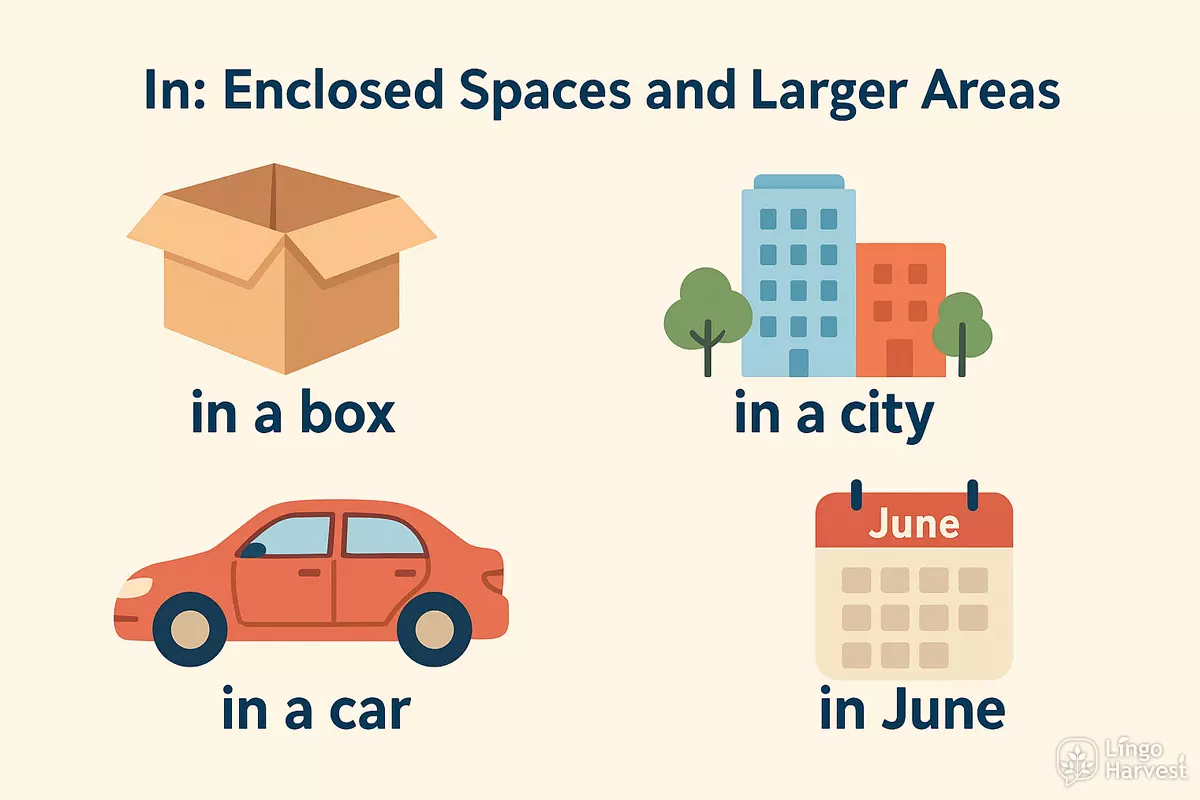
Use in when something is inside boundaries—whether physical (a room) or abstract (a city, month, or country). Imagine a box or container: the object is surrounded.
- in a box
- in a city
- in a car
- in June
2. On: Surfaces and Flat Areas
Choose on when something rests atop a surface. Picture an object sitting on a table or a location shown as a point along a line (like a street).
- on the table
- on the wall
- on the bus
- on Monday
3. At: Specific Points
Select at for precise points or locations. Visualize a dot marking an exact spot.
- at the door
- at school
- at 5:00
- at home
4. Spaces vs. Places
Think of in for larger, enclosed spaces (in a building), on for surfaces (on a floor), and at for points (at the entrance).
5. Vehicles: Big vs. Small
- Use in for small, enclosed vehicles: in a car, in a taxi.
- Use on for large vehicles or public transport: on a bus, on a train, on a plane.
6. Days, Dates, and Times
- In for months, years, seasons: in July, in 2020, in winter.
- On for days and dates: on Monday, on March 5th.
- At for clock times and exact moments: at 8:00, at midnight.
7. Addresses: General vs. Specific
| General Location | Specific Address | Landmark/Point |
|---|---|---|
| in New York | on 5th Avenue | at 50 Main St. |
| in London | on Baker Street | at the station |
| in France | on Rue Cler | at the corner |
| in the city | on Main Street | at the bus stop |
8. Technology: Devices and Screens
- on the phone
- on TV
- on a website
- in a document
- in an app
9. Events and Activities
- at a party
- at a concert
- on a trip
- in a meeting
10. Pictures in Your Mind
Every time you choose between these prepositions, try to form a quick mental image: Is it inside something (in), on top or part of a surface (on), or at a precise spot (at)? This habit will help you remember which one to use, even with new contexts.
Time Use Summary (in June, on Monday, at 7)
Understanding how to use “in,” “on,” and “at” with expressions of time is essential for clear English communication. Each preposition has its own specific uses when referring to months, days, and clock times. Let’s break down how these prepositions work with time, providing practical examples and simple rules to remember.
How Each Preposition Connects to Time
- In is used for longer periods: months, years, seasons, and centuries.
- On fits specific days and dates: weekdays or exact calendar dates.
- At pinpoints a precise moment: clock times, certain fixed phrases, and specific points in the day.
Common Examples
- in June
- in 2024
- in the morning
- on Monday
- on June 15th
- on my birthday
- at 7 (o’clock)
- at noon
- at midnight
- at sunrise
Quick Reference: When to Use Each Preposition
| Preposition | Typical Time Expressions |
|---|---|
| in | months (in June), years (in 2024), seasons (in summer), parts of the day (in the morning) |
| on | days (on Monday), dates (on June 1st), special days (on my birthday), specific weekdays (on Fridays) |
| at | clock times (at 7), exact times (at 6:30), points in the day (at midnight, at noon), fixed expressions (at the moment) |
Tips for Remembering Time Prepositions
- Use in when you’re talking about something more general or a bigger unit of time.
- Use on for something that happens on a specific day or date.
- Use at for an exact hour or a very specific moment.
More Real-Life Examples
- We go on holiday in August.
- The meeting is on Tuesday.
- She wakes up at 6:30 every day.
- My birthday is in December.
- The party starts at 8 PM.
- They arrived on Christmas Day.
- Flowers bloom in spring.
- He called at midnight.
- Classes begin on September 1st.
- The sun sets at 7:45 in summer.
Using these patterns will help you sound natural and accurate when talking about time in English. Remember: practice with real dates and times from your own life to reinforce these rules.
Place Use Summary (in the room, on the table, at home)
Understanding how to choose between "in," "on," and "at" for locations can be confusing, but a few simple rules help clarify the distinctions. Each preposition conveys a different relationship to space: "in" usually means inside something, "on" means on the surface, and "at" points to a specific spot or address. Let’s break down these uses with everyday examples and tips.
Quick Guide to Choosing the Right Preposition
- In: Used for enclosed spaces or areas with boundaries.
Examples: in the kitchen, in a box, in the city, in the car - On: Refers to surfaces or things that touch a surface.
Examples: on the table, on the floor, on the wall, on the bus - At: Points to a specific place, event, or address.
Examples: at home, at school, at the station, at 123 Main Street
Common Situational Examples
- in the room → inside the boundaries of a room
- on the table → resting on the surface of a table
- at home → located at your house (as a point, not inside a structure)
- in the garden → within the garden area
- on the roof → on top of the roof surface
- at the bus stop → at the location where buses stop
- in a building → inside the building
- on the balcony → standing/sitting on the balcony surface
- at the office → at the workplace, not specifying inside/outside
- in a drawer → inside the drawer’s space
- on the shelf → placed on the surface of a shelf
- at the corner → at the point where two streets meet
- in a classroom → within the classroom walls
- on the beach → on the surface of the sand
- at the door → at the entrance/exit point (not inside or on)
Visual Comparison of Preposition Use
| Preposition | Typical Use/Example |
|---|---|
| in | in the room, in a box, in the car, in a city |
| on | on the table, on the wall, on the floor, on the bus |
| at | at home, at the station, at work, at the door |
Tips to Remember
- Use in for spaces you can enter or be surrounded by.
- Choose on for flat or horizontal surfaces.
- Pick at for general locations, events, or points.
- For addresses: use at for the exact place, in for cities/countries.
- Some places can use more than one option, but the meaning changes: in the corner (inside), at the corner (point).
By practicing with these patterns and examples, you’ll quickly build confidence in selecting the right preposition for places and locations in English.
Common Real-Life Examples
Everyday language is filled with situations where choosing between "in," "on," and "at" matters. These prepositions are used to indicate time, place, and position, and mastering them makes your English sound natural and precise.
Typical Situations Using "In," "On," and "At"
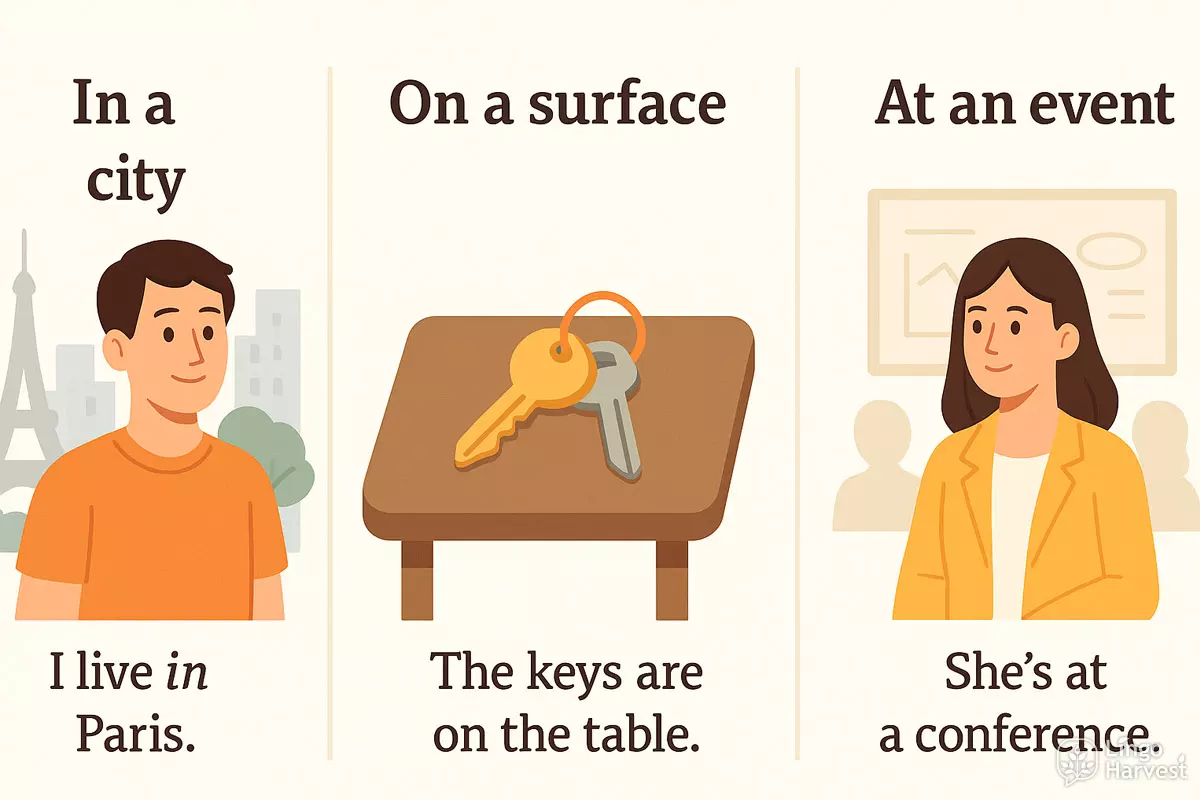
- In a city: "I live in Paris."
- In a room: "She is in the kitchen."
- In a month/year/season: "My birthday is in July." / "The flowers bloom in spring."
- On a surface: "The keys are on the table."
- On a specific date or day: "We met on Monday." / "The party is on June 5th."
- On a street (American English): "The shop is on Main Street."
- On a device: "He’s on the phone."
- At an exact place: "I’ll meet you at the bus stop."
- At a specific time: "Let’s meet at 3 p.m."
- At an event: "She’s at a conference."
- At home/work/school: "He’s at home now."
- At the top/bottom/corner: "The answer is at the top of the page."
Side-by-Side Comparison in Context
| Preposition | Example Sentence |
|---|---|
| in | She is in the car. |
| on | The book is on the shelf. |
| at | They are at the cinema. |
| on | He is on the bus. |
| in | We’re in the park. |
| at | I’ll see you at the entrance. |
Quick Tips for Everyday Conversations
- Use in for enclosed spaces and longer periods (months, years).
- Choose on for surfaces, days, and transportation (bus, train).
- Pick at for specific points, addresses, or events.
These illustrations show how native speakers naturally select the right preposition, depending on location, time, or context. Noticing these patterns in daily life can help you reinforce your understanding and use them confidently.
Fast Error Correction Checklist
Quickly spotting and fixing mistakes with “in,” “on,” and “at” can prevent confusion and boost your confidence in real-life English. Use this section to scan for typical mix-ups and instantly check your usage. Review the rules, look at common errors, and check sample corrections to reinforce the right preposition every time.
Top Steps for Checking Prepositions
- Identify the place or time you’re describing: general area, surface, or exact point?
- Ask yourself: Is it a large space (in), a flat surface (on), or a precise location/time (at)?
- Replace your preposition and reread the sentence—does it sound right?
- Check if your example matches one of the classic rules below.
Common Error Patterns (with Corrections)
- ❌ in the bus stop → ✅ at the bus stop
- ❌ at the morning → ✅ in the morning
- ❌ on the room → ✅ in the room
- ❌ in the table → ✅ on the table
- ❌ at Monday → ✅ on Monday
- ❌ in 5 o’clock → ✅ at 5 o’clock
- ❌ on the airport → ✅ at the airport
- ❌ in the wall → ✅ on the wall
- ❌ in the bus → ✅ on the bus
- ❌ at London → ✅ in London
Quick Reference Table: When to Use Each Preposition
| Preposition | Use With | Example |
|---|---|---|
| in | Enclosed spaces, cities, countries, months, years, parts of the day | in the box, in Paris, in July, in 2023, in the morning |
| on | Surfaces, days, means of transport, floors, devices | on the table, on Monday, on the bus, on the first floor, on TV |
| at | Specific places, precise times, events | at the door, at 6pm, at the party, at school |
Last-Minute Reminders
- If you’re talking about a building as a point (arrival/meeting), use at (at the cinema).
- If you mean inside the building, use in (in the cinema).
- Transport: on for buses/trains/planes; in for cars/taxis.
- For addresses, use at (at 15 King Street), but on for street names (on King Street).
Keep this guide handy whenever you write or speak—making a quick check can save you from the most frequent mistakes with “in,” “on,” and “at.”
Practice: Describe Pictures with in/on/at
Looking at images is a great way to master how to use "in," "on," and "at" for places and times. Let's sharpen your skills by describing different scenes. The following exercises will help you choose the correct preposition for each situation, whether it's about location, time, or position.
How to Approach Picture Descriptions
Start by identifying the main elements in the image: people, objects, and their locations. Think about these questions:
- Is the subject inside something (a room, a building, a country)?
- Is it on a surface (a table, a wall, the floor)?
- Is it at a specific point (a bus stop, the door, the corner)?
This focus will help you decide if "in," "on," or "at" is best.
Common Patterns for Picture Descriptions
- in the car
- on the table
- at the door
- in the classroom
- on the wall
- at the station
- in the park
- on the beach
- at the cinema
- in the photo
- on the left/right
- at the top/bottom
- in the middle
- on the bus
- at the party
- in the background
- on the screen
- at the table (sitting with others)
Try It Yourself: Describe the Scenes
- A girl is reading a book ______ the sofa.
- There is a clock ______ the wall.
- Many people are waiting ______ the bus stop.
- We see a family having a picnic ______ the park.
- Look at the man standing ______ the corner of the street.
- The cat is sleeping ______ the bed.
- A map hangs ______ the classroom wall.
- The children are playing ______ the playground.
- He is sitting ______ the desk, working.
- She is ______ the picture, wearing a red dress.
Show answers
- on
- on
- at
- in
- at
- on
- on
- in
- at
- in
More Practice: Spot the Differences
Look at two imaginary pictures:
- Picture A: A dog is sleeping in the garden.
- Picture B: A dog is sleeping on the sofa.
Now, try to describe other differences using the correct prepositions.
Quick Reference Table: Location Prepositions in Pictures
| Preposition | Example in Picture Description |
|---|---|
| in | The children are in the pool. |
| on | The cat is on the roof. |
| at | She is waiting at the bus stop. |
| on | There is a picture on the wall. |
| in | They are in the kitchen. |
| at | He is at the window looking out. |
Practice regularly with different images, and you'll soon use these prepositions naturally when describing scenes.