Prepositions in Science Papers: Accurate Academic Language Guide

 The article explains precise preposition use in scientific writing. It covers their distribution across IMRaD sections, differences among similar prepositions, quantitative and spatial reporting, causal links, register expectations, and peer-review practice.
- The IMRaD framework: Prepositional distribution across paper sections
- Methodological precision: Differentiating 'by', 'through', 'via', and 'using'
- Describing instrumentation and parameters: 'with', 'at', and 'under' conditions
- Quantitative reporting: 'between' vs 'among', 'per', 'across', and 'within' groups
- Spatial and temporal accuracy: 'throughout', 'subsequent to', and 'adjacent to'
- Causal links in Discussion: 'attributed to', 'consistent with', and 'derived from'
- Avoiding ambiguity: Preposition placement in complex noun strings
- Register expectations: Replacing informal directional prepositions with formal alternatives
- Practice: Peer-review simulation—revising scientific abstracts for lexical density
Learning to use connecting words effectively in scientific writing is often more challenging than it appears, but it is crucial for presenting research clearly and precisely. This guide provides practical tips to help you select appropriate connectors, improving the flow and coherence of your arguments. By mastering these transitions, you can communicate your ideas more logically and persuasively, making your academic writing more accessible and impactful to readers in your field.
The IMRaD framework: Prepositional distribution across paper sections
Understanding how prepositions function within the IMRaD structure (Introduction, Methods, Results, and Discussion) can help writers achieve clarity and precision. Each section of a scientific manuscript tends to favor certain prepositional patterns due to its unique communicative goals and content types.
Introduction: Framing Context and Background
In introductory paragraphs, prepositions help authors establish context, define scope, and connect prior research. Common choices include:
- In (In this study, In recent years)
- Of (analysis of data, review of literature)
- For (implications for practice, reason for change)
- Between (distinction between methods)
- Among (among researchers, among variables)
- With (agreement with findings, consistency with theory)
- By (as suggested by Smith et al.)
- On (focus on outcomes, impact on society)
Methods: Describing Procedures and Materials
The methods section prioritizes accuracy and reproducibility. Here, prepositions often describe sequences, materials, and relationships:
- With (measured with a spectrometer)
- Using (using a standardized test)
- At (at room temperature, at a concentration of...)
- By (measured by weight, analyzed by software)
- From (samples from patients)
- To (added to solution, subjected to analysis)
- Under (under controlled conditions)
- Over (over a period of 24 hours)
- Per (per milliliter, per protocol)
- Between (intervals between measurements)
Results: Reporting Outcomes and Comparisons
When presenting findings, authors use prepositions to compare data, indicate trends, and specify locations or time frames. Typical patterns include:
- Between (differences between groups)
- Among (variation among samples)
- Of (mean of values, percentage of cases)
- In (increase in activity, reduction in error)
- At (peak at 100°C, observed at 5 min)
- Over (increase over time)
- With (associated with, correlated with)
- By (grouped by age, sorted by type)
- To (compared to baseline)
- From (improved from 60% to 80%)
Discussion: Interpreting and Relating Findings
In the discussion, prepositions help authors explain implications, draw connections, and suggest future directions.
- For (implications for policy)
- In (in agreement with, in contrast to)
- With (consistent with results, associated with risk)
- Between (distinction between findings)
- Of (importance of the result)
- By (as shown by analysis)
- To (relevant to practice)
- Among (variation among studies)
Common Prepositional Functions by IMRaD Section
| Section | Frequent Prepositional Uses |
|---|---|
| Introduction | Contextualization (in recent years), scope (of research), relationships (between variables), references (by Smith et al.) |
| Methods | Procedures (with/using instruments), conditions (at temperature), source (from subjects), process (by method) |
| Results | Comparisons (between groups), changes (in value), location/time (at/over period), associations (with factors) |
| Discussion | Implications (for practice), contrasts (in contrast to), connections (with previous work), relevance (to future research) |
Writers benefit from recognizing these patterns, as choosing the most precise preposition for each section enhances clarity and professionalism. Consistently reviewing how prepositions function in each part of the IMRaD structure will support more effective and accurate academic writing.
Methodological precision: Differentiating 'by', 'through', 'via', and 'using'
Clear communication of research methods relies on choosing the correct prepositions. Each of these four—'by', 'through', 'via', and 'using'—conveys a distinct nuance about process, agency, or mechanism in scientific writing. Understanding their differences helps prevent ambiguity and ensures readers can accurately interpret your methodology.
Breaking down the distinctions
- By typically indicates the agent or the means that performs the action. It answers "how" something is done, often focusing on the person or process responsible.
- Through emphasizes a process or sequence, often highlighting a passage or transition from one state to another.
- Via points to the route, pathway, or intermediate step used to achieve a result, especially in technical contexts.
- Using introduces the tool, method, or material applied to accomplish a task, centering on the instrumentality.
Common patterns and examples
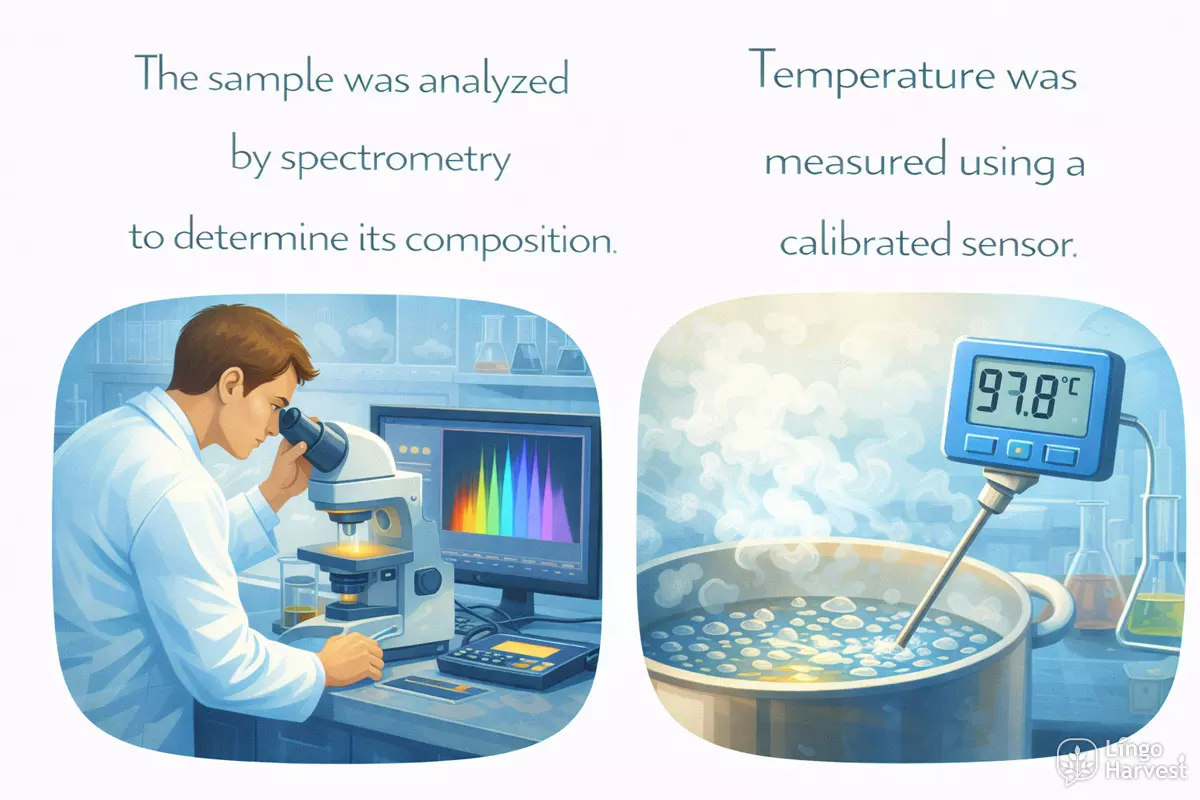
- Analyzed by spectrometry → The sample was analyzed by spectrometry to determine its composition.
- Measured using a calibrated sensor → Temperature was measured using a calibrated sensor.
- Transported via capillary action → Water is transported via capillary action in narrow tubes.
- Purified through filtration → The solution was purified through filtration to remove impurities.
- Detected by fluorescence → The target protein was detected by fluorescence under UV light.
- Separated using chromatography → The compounds were separated using chromatography.
- Delivered via intravenous injection → The medication was delivered via intravenous injection.
- Isolated through centrifugation → The cells were isolated through centrifugation.
- Processed by enzymatic reaction → The substrate was processed by enzymatic reaction.
- Quantified using standard curves → Concentrations were quantified using standard curves.
- Transferred via diffusion → Heat is transferred via diffusion in solids.
- Extracted through solvent partitioning → The compound was extracted through solvent partitioning.
- Recorded by automated software → The measurements were recorded by automated software.
- Visualized using confocal microscopy → The tissue structure was visualized using confocal microscopy.
- Accessed via online databases → The dataset can be accessed via online databases.
- Passed through a membrane → The ions passed through a membrane during the experiment.
Comparing prepositions for methodological clarity
| Preposition | Typical Use/Meaning | Example |
|---|---|---|
| By | Agent or mechanism performing the action | Samples were analyzed by NMR spectroscopy. |
| Through | Process, sequence, or transition | The solution was purified through dialysis. |
| Via | Route, channel, or intermediary | Data were transferred via Bluetooth. |
| Using | Tool, method, or instrument | Concentrations were determined using a colorimeter. |
Tips for precise usage
- Choose by for highlighting who or what executes the action.
- Select through to stress procedural steps or transformations.
- Opt for via when describing the route or medium.
- Use using to present the tool, device, or software applied.
- When in doubt, rephrase the sentence to see which preposition best clarifies the method.
Accuracy in these choices not only strengthens your writing but also helps readers follow complex methods with ease.
Describing instrumentation and parameters: 'with', 'at', and 'under' conditions
Clarity in scientific writing often depends on precise use of prepositions when discussing equipment, settings, and experimental circumstances. Choosing between 'with', 'at', and 'under' can subtly shift meaning, so understanding their typical usage is essential for accuracy and professionalism in academic manuscripts.
'With' for Equipment and Accompanying Features
'With' is used to indicate the instruments, tools, or features present during an experiment or measurement. It connects the method or material to the auxiliary device or property.
- Measured with a spectrophotometer
- Recorded with a digital caliper
- Analyzed with specialized software
- Samples prepared with distilled water
- Tested with a platinum electrode
'At' for Specific Values and Settings
When specifying a particular setting, value, or position, 'at' is the standard choice. It denotes the exact parameter or point being referenced.
- Reaction performed at 25℃
- Measured at 600 nm wavelength
- Operated at 1000 rpm
- Pressure maintained at 2 atm
- Recorded at 1-minute intervals
'Under' for Conditions and Environmental Factors
'Under' highlights the overarching conditions or influences affecting the experiment. It often introduces environmental, physical, or chemical contexts.
- Tested under anaerobic conditions
- Stored under nitrogen atmosphere
- Grown under low-light exposure
- Observed under high pressure
- Operated under vacuum
Quick Reference: Preposition Usage in Scientific Contexts
| Preposition | Common Usage Examples |
|---|---|
| with | with a sensor, with a filter, with agitation, with external bias |
| at | at 37℃, at 10 mM, at a flow rate of 5 mL/min, at pH 7.0 |
| under | under dark conditions, under stress, under controlled humidity, under load |
Summary of Effective Usage
Selecting the right preposition helps your writing convey precise technical meaning. Use 'with' for apparatus or features, 'at' for fixed parameters, and 'under' for background conditions. This approach ensures your descriptions are both concise and unambiguous, supporting reproducibility and clarity in your scientific communication.
Quantitative reporting: 'between' vs 'among', 'per', 'across', and 'within' groups
When describing results or relationships in scientific writing, choosing the correct preposition is essential for clarity and precision. Researchers often compare data sets, describe distributions, or detail experimental conditions, and subtle distinctions in wording can change the meaning of a statement.
Distinguishing 'between' and 'among'
Use between when referring to comparisons involving two distinct entities or groups. For example, "We compared reaction times between the control and experimental groups." In contrast, among is used for relationships or distributions involving more than two parties or items, such as, "The variance among the three treatment groups was significant." This distinction helps avoid ambiguity in reporting findings.
Using 'per', 'across', and 'within' in group analyses
These prepositions each convey a specific quantitative or relational meaning:
- Per — Indicates a ratio or rate, e.g., "5 incidents per 1,000 samples."
- Across — Refers to a comparison or distribution spanning multiple groups or conditions, e.g., "The effect was consistent across all age categories."
- Within — Describes something happening inside a single group or entity, e.g., "Variation within the cohort was minimal."
Patterns and Examples for Scientific Reporting
Writers often struggle to select the most accurate preposition, especially when summarizing statistical analyses or results. Here are common usage patterns and examples that reflect best practices in academic language:
- Difference between two groups
- Distribution among several populations
- Average score per participant
- Measured across different trials
- Comparison within the same sample
- Incidence rate per 100,000 individuals
- Consistency across replicates
- Variance among four experimental conditions
- Change within subjects over time
- Increase between baseline and follow-up
- Homogeneity among subgroups
- Fluctuation within a single measurement period
- Standardized per unit mass
- Analyzed across multiple datasets
- Correlation between two variables
- Variation among geographic regions
- Observed within treatment arms
- Calculated per hour/day/week
Summary Table: Appropriate Preposition Use
| Preposition | Typical Use in Scientific Reporting |
|---|---|
| between | Comparing exactly two groups, items, or variables e.g., "Difference between males and females" |
| among | Comparing or describing relationships within more than two entities e.g., "Distribution among all species studied" |
| per | Expressing rates or ratios e.g., "Incidence per 1,000 person-years" |
| across | Describing patterns or effects spanning multiple groups or conditions e.g., "Consistent findings across experiments" |
| within | Focusing on variation or analysis inside a single group or condition e.g., "Variation within the treatment group" |
Careful selection of these prepositions ensures that quantitative statements are clear, precise, and unambiguous for readers. Misuse can lead to confusion about the scope of comparisons or the structure of the data analysis. Always match the preposition to the logical relationship you intend to describe.
Spatial and temporal accuracy: 'throughout', 'subsequent to', and 'adjacent to'
Precision in describing space and time is vital in scientific writing. Using prepositions like throughout, subsequent to, and adjacent to helps clarify exactly when or where an event, process, or observation occurs. These terms add rigor and help avoid ambiguity, which is particularly important when reporting experimental designs, results, or theoretical frameworks.
Clarifying spatial and temporal relationships
- Throughout indicates something happens across the entire extent or duration of a process or space. For example, "The solution was stirred throughout the reaction."
- Subsequent to means after a particular event or stage. For instance, "Data were collected subsequent to the intervention."
- Adjacent to specifies proximity, often used for physical locations or structures. Example: "The sensor was placed adjacent to the sample chamber."
Usage patterns and typical contexts
When choosing among these prepositions, it helps to consider the type of relationship being described:
- Use throughout for continuous actions or presence over a period or area.
- Apply subsequent to when indicating chronological order.
- Choose adjacent to for describing items or entities that are next to each other in space.
Common scientific examples
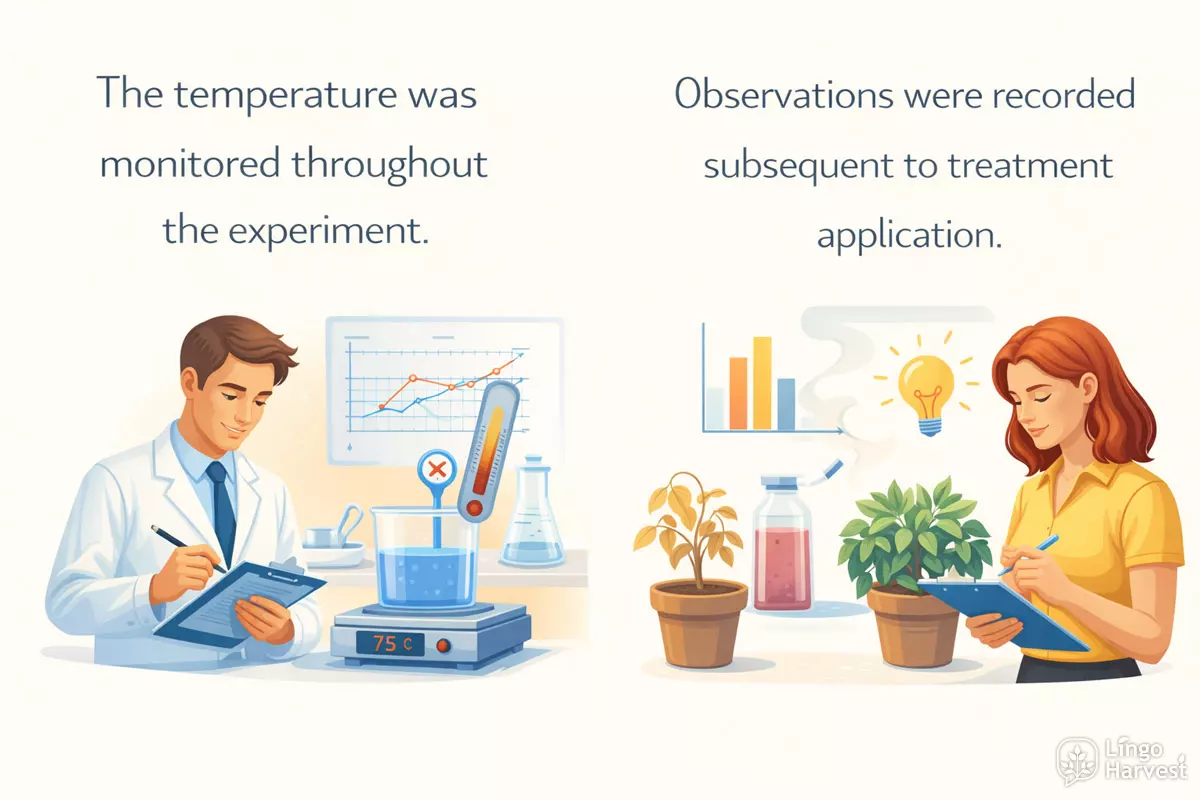
- The temperature was monitored throughout the experiment.
- Observations were recorded subsequent to treatment application.
- Cells located adjacent to the wound site showed increased activity.
- Data analysis was performed throughout the study period.
- Measurements were repeated subsequent to calibration.
- The control group was housed adjacent to the experimental group.
- Temperature fluctuations were observed throughout the day.
- Protein expression increased subsequent to stimulation.
- Contaminants were found adjacent to the discharge pipe.
- Quality checks were performed throughout the manufacturing process.
- Changes appeared subsequent to environmental exposure.
- Electrodes were positioned adjacent to each recording site.
Comparing spatial and temporal focus
| Preposition | Typical Use | Example Phrase |
|---|---|---|
| Throughout | Entire duration or area | Throughout the incubation period |
| Subsequent to | After a specific event/time | Subsequent to data collection |
| Adjacent to | Next to in space | Adjacent to the interface |
Accurately using these prepositions ensures your scientific writing clearly communicates spatial or temporal relationships, making your research more transparent and reproducible. Consider both the context and the specific relationship you want to describe when selecting among these terms.
Causal links in Discussion: 'attributed to', 'consistent with', and 'derived from'
When writing the Discussion section of a scientific paper, making clear connections between results and interpretations is essential. Expressions like attributed to, consistent with, and derived from help to clarify the strength and nature of these links. Using the correct preposition can prevent misinterpretation and signal your confidence or caution in drawing conclusions.
Choosing the Right Phrase for Scientific Reasoning
- Attributed to: Indicates a cause-and-effect relationship, suggesting that your data or observation results from a particular factor.
- Consistent with: Highlights agreement with established knowledge or theories, without claiming direct causation.
- Derived from: Points to origins, often used when discussing data, formulas, or concepts resulting from a specific method or source.
Practical Examples and Patterns
- The observed increase was attributed to higher substrate concentrations.
- Our findings are consistent with previous reports on enzyme kinetics.
- The formula was derived from the Michaelis-Menten equation.
- Reduced activity may be attributed to thermal denaturation.
- These results are consistent with the hypothesis of membrane disruption.
- The value was derived from direct measurements.
- Increased resistance is attributed to genetic adaptation.
- The trend is consistent with earlier climate models.
- The conclusion was derived from a meta-analysis of existing studies.
- Improvements can be attributed to the new protocol.
- Observed patterns are consistent with theoretical predictions.
- The equation was derived from first principles.
- Delay in response is attributed to system lag.
- Results are consistent with findings in related species.
- Values were derived from statistical modeling.
Comparing Nuances: Usage and Implications
| Expression | Implication |
|---|---|
| Attributed to | Suggests a direct or inferred cause; use when evidence points to a specific factor. |
| Consistent with | Indicates agreement or compatibility with existing knowledge; cautious, avoids causal claims. |
| Derived from | Refers to origin or source, often of data, methods, or theories. |
Tips for Clarity
- Use attributed to only when you have strong evidence for causation.
- Apply consistent with to highlight similarity without overreaching.
- Choose derived from when referencing the source or process leading to a result or concept.
- Be cautious: Overstating causality can weaken your argument if not fully justified.
- Mix these phrases appropriately to show nuanced understanding of your findings.
Selecting precise causal language in your Discussion signals both the quality of your analysis and your grasp of academic conventions. Careful use of these expressions ensures your claims are both clear and appropriately qualified.
Avoiding ambiguity: Preposition placement in complex noun strings
Clarity in scientific writing often hinges on how prepositions are positioned within strings of nouns. In technical documents, noun strings—sequences of two or more nouns stacked together—are common, but they can easily become confusing if prepositions are misplaced or omitted. Ensuring the right preposition is in the right place helps readers interpret relationships between each noun accurately.
Why Preposition Placement Matters
When several nouns are combined, the intended meaning can shift dramatically depending on where a preposition appears. For example, "analysis results interpretation" leaves readers guessing: are we interpreting results, or analyzing interpretations? Adding or moving a preposition—such as "interpretation of analysis results"—removes doubt.
Common Pitfalls with Complex Noun Strings
Writers sometimes omit prepositions to keep phrases concise, but this can obscure meaning. Overly dense noun clusters are particularly problematic in scientific English, where precision is essential. Typical errors include:
- Leaving out necessary prepositions (e.g., "protein structure determination" instead of "determination of protein structure")
- Ambiguous stacking (e.g., "cell membrane transport proteins")
- Misplaced prepositions leading to unintended interpretations
Strategies for Clearer Scientific Phrasing
To improve readability, consider these approaches:
- Break up long noun strings with prepositions (e.g., "comparison of gene expression levels")
- Reorder elements for natural phrasing (e.g., "model for climate prediction")
- Use hyphens to clarify compound modifiers when appropriate (e.g., "drug-resistant bacteria")
- Favor active constructions over noun-heavy phrases
- Read aloud to check for natural flow and clarity
Examples: Ambiguous vs. Clear Noun Strings
Below are examples showing how small changes in preposition placement or structure can resolve ambiguity:
- Ambiguous: "Water quality monitoring equipment calibration"
- Clear: "Calibration of equipment for water quality monitoring"
- Ambiguous: "Data analysis method selection"
- Clear: "Selection of data analysis methods"
- Ambiguous: "Air pollution impact assessment"
- Clear: "Assessment of the impact of air pollution"
- Ambiguous: "Soil nutrient content measurement technique"
- Clear: "Technique for measuring soil nutrient content"
- Ambiguous: "Patient blood pressure response"
- Clear: "Patient response to blood pressure changes"
- Ambiguous: "Surface water contamination risk"
- Clear: "Risk of contamination in surface water"
- Ambiguous: "Climate change adaptation policy review"
- Clear: "Review of policies for climate change adaptation"
- Ambiguous: "Machine learning algorithm performance"
- Clear: "Performance of machine learning algorithms"
Guidelines for Academic Writing
When handling technical terminology, always prioritize your reader’s understanding. If a phrase feels dense, add a preposition or rearrange the structure. Consider the following checklist:
- ✅ Is each noun’s relationship to others clear?
- ✅ Does the phrase read smoothly?
- ✅ Can a preposition clarify the meaning?
Choosing clarity over brevity in complex noun strings will strengthen your scientific communication.
Register expectations: Replacing informal directional prepositions with formal alternatives
Academic writing in the sciences prioritizes precision and clarity, especially when describing direction, location, or movement. Informal prepositions—common in everyday speech—can introduce ambiguity or undermine the formality expected in journal articles and reports. Instead, scientific manuscripts benefit from more specific, formal alternatives that improve readability and meet the expectations of scholarly communication.
Why replace informal directional prepositions?
Scientific texts must eliminate vagueness. Phrases like "up to," "down from," or "over" can be interpreted in multiple ways, whereas formal alternatives such as "increased to," "decreased from," or "above" precisely convey the intended meaning. Using formal language not only aligns with disciplinary standards but also facilitates peer review and comprehension by an international audience.
Common informal prepositions and their formal equivalents
Writers often default to casual prepositions out of habit. However, formal science language requires more exact terms. Consider replacing these less formal prepositions and phrases with their academic counterparts:
- Up to → as much as, maximum of
- Down from → decreased from, reduced from
- Over (meaning "more than") → exceeding, greater than
- Under (meaning "less than") → below, fewer than
- Next to → adjacent to
- In front of → anterior to
- Behind → posterior to
- On top of → superior to, overlying
- Below (spatial) → inferior to
- Between → interposed between
- Across → transversely, through
- Through (movement) → via
- Around → surrounding
- By (location) → adjacent to, proximal to
- At (location) → located at, positioned at
- To (direction) → toward
- From (origin) → originating from
- About (approximation) → approximately
- Near → in proximity to
- Far from → distant from
Structured comparison of informal and formal prepositional usage
| Informal Preposition/Phrase | Formal Alternative (Academic Context) |
|---|---|
| Up to 5 mg/L | Maximum of 5 mg/L |
| Over 20°C | Exceeding 20°C |
| Next to the membrane | Adjacent to the membrane |
| In front of the detector | Anterior to the detector |
| Behind the sample | Posterior to the sample |
| Down from baseline | Decreased from baseline |
| Through the filter | Via the filter |
| About 30 minutes | Approximately 30 minutes |
| By the interface | Proximal to the interface |
| Far from equilibrium | Distant from equilibrium |
Summary: Meeting academic expectations with precise prepositions
Choosing accurate, formal prepositions is not just a matter of style; it directly impacts the clarity and professionalism of scientific writing. By systematically replacing vague or conversational directionals with their scholarly equivalents, authors ensure their findings are communicated effectively and taken seriously by the academic community.
Practice: Peer-review simulation—revising scientific abstracts for lexical density
Engaging in peer review is a valuable way for researchers to sharpen their editorial skills and deepen their understanding of clear academic writing. In this exercise, you will act as a peer reviewer, focusing on improving the lexical density of scientific abstracts, especially regarding the use of prepositions and concise phrasing. Lexical density refers to the proportion of content words (nouns, verbs, adjectives, adverbs) to function words (such as prepositions, articles, conjunctions). Higher lexical density often leads to more precise and information-rich academic texts.
Task Instructions
Review the following scientific abstract segments. Identify areas where prepositions or function words can be reduced or replaced with more content-rich vocabulary. Suggest revisions to make the text more concise and dense, without losing meaning. Consider how prepositional phrases can sometimes be replaced by adjectives, compound nouns, or more direct verbs.
- Original: The results of the experiment in the laboratory showed an increase in the rate of reaction with the addition of the catalyst.
Your revision: - Original: Analysis of data from the study indicates that the use of advanced algorithms in the processing of images improves accuracy.
Your revision:
Common Prepositional Phrases and Lexically Dense Alternatives
Here are frequent prepositional phrases found in scientific abstracts, alongside more compact alternatives that increase lexical density:
- in the presence of → with / under
- in order to → to
- in the case of → for / with
- the effect of X on Y → X’s effect on Y / X-induced Y
- the use of → using / by
- with respect to → regarding / concerning
- in addition to → besides
- as a result of → due to / resulting from
- at a rate of → at
- in comparison with → compared to
- in the absence of → without
- in terms of → regarding
- on the basis of → based on
- in agreement with → agreeing with
- with the exception of → except
- for the purpose of → to
- in light of → given
- in support of → supporting
- in response to → responding to
- in relation to → regarding
Checklist for Improving Lexical Density in Abstracts
- Replace prepositional phrases with adjectives or compound nouns when possible.
- Omit unnecessary function words; prioritize content words.
- Use active voice for directness.
- Combine sentences to reduce redundancy.
- Convert verbal phrases to nominalizations judiciously (e.g., “measurement of temperature” to “temperature measurement”).
- Be cautious: do not sacrifice clarity for density.
Peer Review Practice: Sample Abstract Comparison
Compare the following two versions of a sample abstract excerpt. Note the reduction in prepositions and increase in lexical density in the revised version.
| Original Version | Revised (Lexically Dense) Version |
|---|---|
| The investigation of the properties of nanomaterials in the context of biomedical applications has led to the development of new diagnostic tools for the detection of diseases. | Nanomaterial property investigation for biomedical applications enabled new diagnostic tools for disease detection. |
| Results from the analysis of samples in the laboratory indicated changes in the concentration of proteins over time. | Laboratory sample analysis indicated protein concentration changes over time. |
| The use of machine learning in the processing of data resulted in improvements in prediction accuracy. | Machine learning data processing improved prediction accuracy. |
| The impact of environmental factors on the growth of plants was studied in controlled conditions. | Environmental factors’ impact on plant growth was studied under controlled conditions. |
Self-Check: Apply Your Edits
Now, return to your revised versions from the earlier task. Compare them against the checklist and examples above. Are there further improvements you can make to increase lexical density while maintaining clarity?
Show answers
- Possible revision: Laboratory results showed reaction rate increased with catalyst addition.
Or: Laboratory experiments showed increased reaction rate with catalyst. - Possible revision: Study data analysis indicates advanced algorithm use improves image processing accuracy.
Or: Analysis indicates advanced algorithms improve image processing accuracy.