while vs during: Basic Guide for Beginners

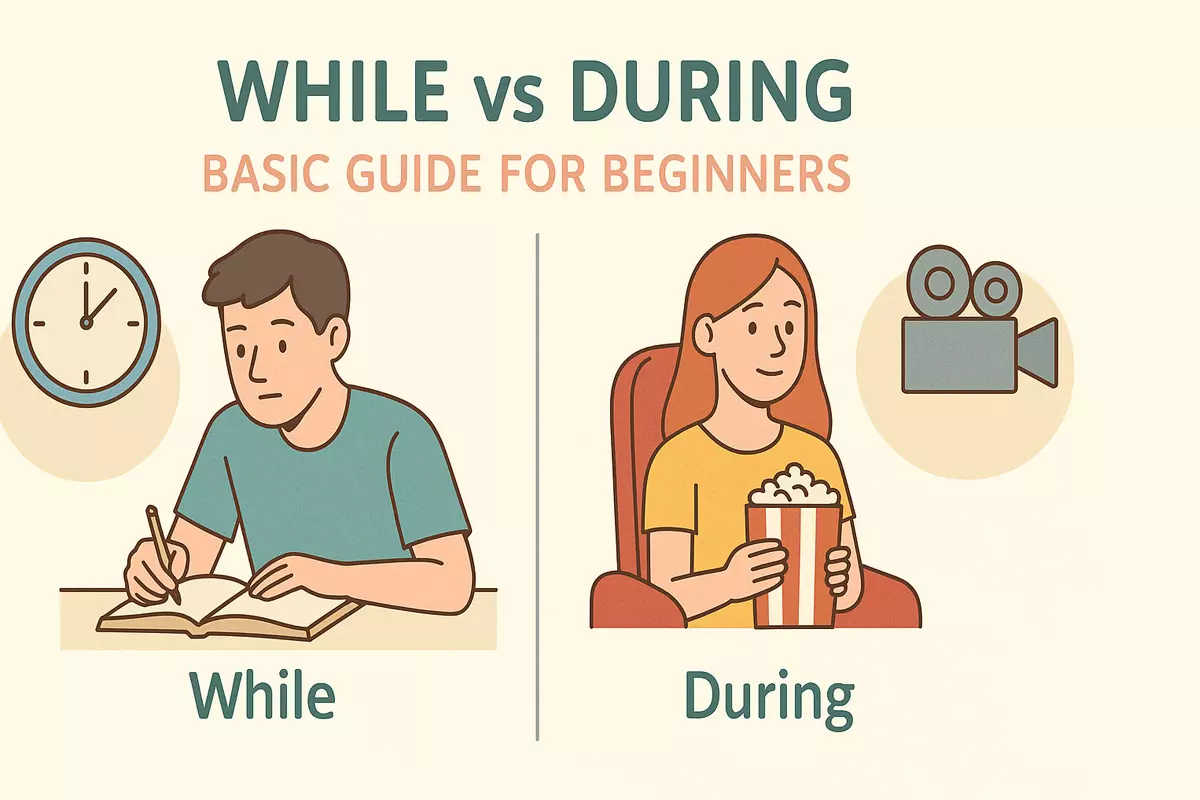 This article explains the core differences between while and during, how to use while with clauses and during with nouns, ways to talk about events happening at the same time, common time expressions and mistakes, and offers practice for correct usage.
Understanding when to use while and during can be challenging for English learners, but mastering their differences makes your speech and writing clearer and more natural. Use while to introduce a clause with a subject and verb, as in While I was studying, the phone rang. In contrast, during is followed by a noun or noun phrase, such as During the meeting, she took notes. By practicing these patterns, you will become more confident in choosing the right word for each situation.
Core Meaning Differences
Understanding how "while" and "during" differ is key to using them correctly in English sentences. Both words relate to time, but they serve distinct functions and appear in different grammatical contexts.
How "while" Works
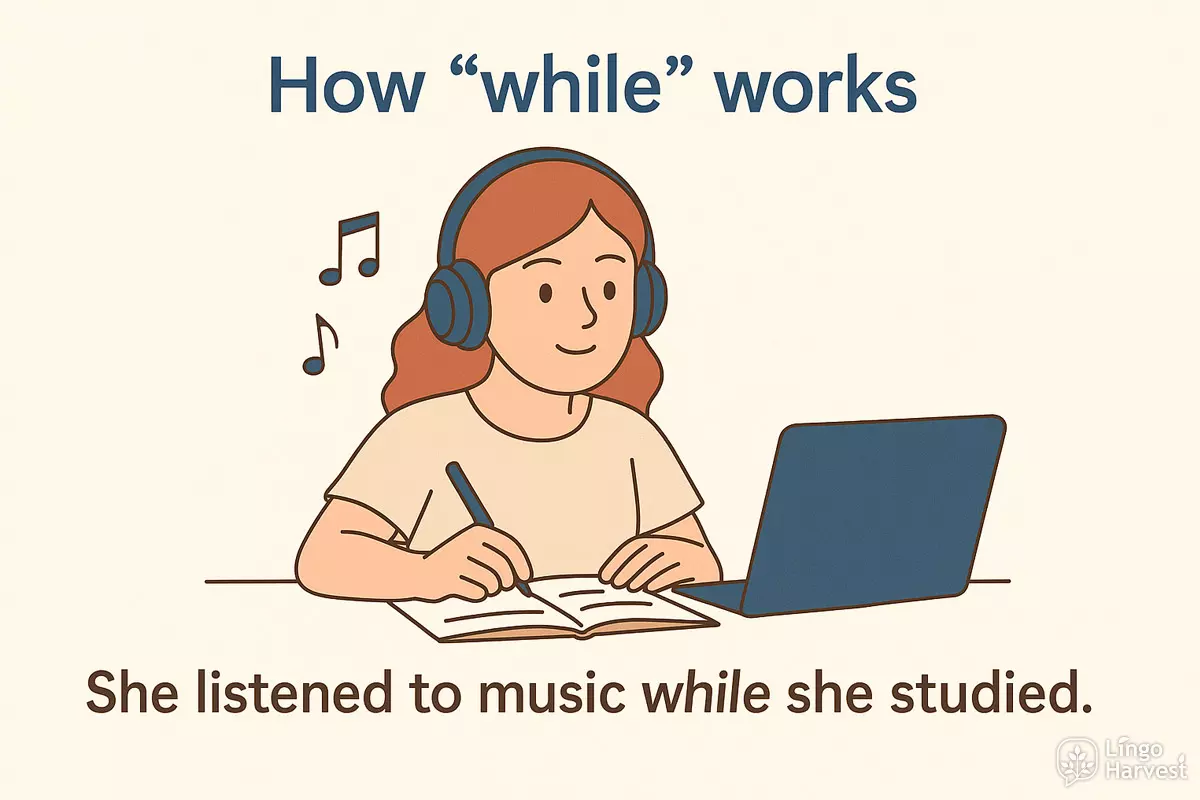
"While" introduces a period in which something else happens, and it's used to link two actions or events that overlap in time. Typically, "while" is followed by a clause (subject + verb), showing two simultaneous activities. For example:
- She listened to music while she studied.
- He called me while he was driving.
- They chatted while waiting for the bus.
Notice that both actions are described with verbs, and "while" acts as a conjunction joining these clauses.
How "during" Works
"During" is used to indicate that something happens within a particular period or event. It is followed by a noun or noun phrase, not a full clause. For example:
- She fell asleep during the movie.
- He ate popcorn during the meeting.
- We traveled during the holidays.
Here, "during" specifies a time frame, but it does not connect two actions directly; it simply places something inside a given period.
Side-by-Side Comparison
| Usage | Example |
|---|---|
| Used before a clause (subject + verb) | I read while I waited for my friend. |
| Used before a noun or noun phrase | I read during my lunch break. |
| Emphasizes two actions happening at the same time | She laughed while she was talking. |
| Focuses on something inside a time period or event | It rained during the concert. |
Quick Reference List
- "While" connects two verbs or clauses.
- "During" is followed by a noun, not a verb.
- Use "while" for simultaneous actions.
- Use "during" for events within a time period.
- "While" = at the same time as (action + action).
- "During" = in the course of (event/time + action).
- Wrong: During I was sleeping, it rained. ❌
- Correct: While I was sleeping, it rained. ✅
- Wrong: While the meeting, he left. ❌
- Correct: During the meeting, he left. ✅
In summary, choose "while" when linking two actions happening together, and "during" when you need to locate an event within a broader period or activity. This distinction will help you avoid common mistakes and make your sentences clearer.
while + Clause vs during + Noun
Understanding how to use "while" and "during" correctly is essential for clear English communication. These words both relate to time, but they are used differently in sentences. "While" introduces a clause (a subject and a verb), whereas "during" is followed by a noun or noun phrase. Knowing the distinction helps you avoid common mistakes and write more naturally.
How "while" Works in Sentences
"While" is used to connect two actions or events happening at the same time. It must be followed by a full clause, which means a subject and a verb are required. This structure helps to show that two things are occurring simultaneously.
- She listened to music while she was studying.
- While I was cooking, my brother was setting the table.
- He called me while he was driving home.
- While they watched TV, it started to rain.
How "during" Is Used
"During" is always followed by a noun or noun phrase, not a full clause. It indicates that something happened at some point within a specific period or event.
- She fell asleep during the movie.
- We met during the conference.
- He felt sick during lunch.
- Many people traveled during the holidays.
Key Differences at a Glance
Below is a structured comparison to help you see the differences clearly:
| Form | Examples |
|---|---|
| while + subject + verb (clause) | While she was reading, it started to rain. |
| during + noun/noun phrase | During the meeting, he took notes. |
| Used to link two actions/events happening at the same time | He cooked while I cleaned. |
| Used to refer to something happening within a time period | We traveled during summer vacation. |
Common Pitfalls and Quick Tips
- ❌ Incorrect: She called me during she was driving.
- ✅ Correct: She called me while she was driving.
- ❌ Incorrect: I fell asleep while the movie.
- ✅ Correct: I fell asleep during the movie.
Remember: Use "while" for two actions with verbs; use "during" before a noun. This distinction will help you sound more natural and accurate in English.
Talking About Events at the Same Time
Understanding how to describe two actions happening together is essential for clear communication in English. Both "while" and "during" help you express simultaneous events, but they are not interchangeable. Each word fits a different sentence structure and context.
How to Use "While"
"While" is typically used before a subject and verb to show that two actions are happening at the same time. It connects two clauses and helps you focus on the activities themselves.
- While I was cooking, she called me.
- He listens to music while he studies.
- The children played outside while it rained.
- While you sleep, your body repairs itself.
- She smiled while talking to her friend.
- While they waited, they chatted.
- I read a book while waiting for the bus.
- The phone rang while I was showering.
- We laughed while watching the movie.
- He worked on his laptop while traveling.
How to Use "During"
"During" is followed by a noun or noun phrase, not a full clause. It highlights a period or event in which something else happens.
- During the meeting, he took notes.
- I ate popcorn during the movie.
- She felt sleepy during the lecture.
- Many people travel during the summer.
- He fell ill during his vacation.
- There was a power cut during the storm.
- She laughed during the show.
- He called me during lunch.
- They met during the conference.
- We talked during the break.
Comparing "While" and "During"
It's easy to mix up these words, but their structures are different. Here's a quick comparison to clarify their usage:
| Use | Example |
|---|---|
| Before a subject + verb (action) | While I was reading, it started to rain. |
| Before a noun/noun phrase (period or event) | During the rain, I stayed inside. |
| Connects two actions | He listens to music while he works. |
| Describes something happening within a time/event | I made notes during the lesson. |
Key Tips
- Use "while" to join two full sentences or actions.
- Use "during" when referring to a specific event or time period expressed as a noun.
- Remember: "while" = action + action; "during" = event/period + action.
- Don't use "during" before a subject and verb.
Common Time Expressions
Understanding the types of time phrases used with "while" and "during" helps beginners use these words more naturally. These time-related expressions signal when an action happens and can clarify the relationship between two events. Some phrases typically go with one word, while others can work with both, depending on the context.
Typical Phrases Used with "While"
- while I was eating
- while you were sleeping
- while it was raining
- while studying
- while waiting for the bus
- while talking on the phone
- while driving
- while cooking dinner
- while watching TV
- while working late
- while reading a book
- while cleaning the house
Common Expressions with "During"
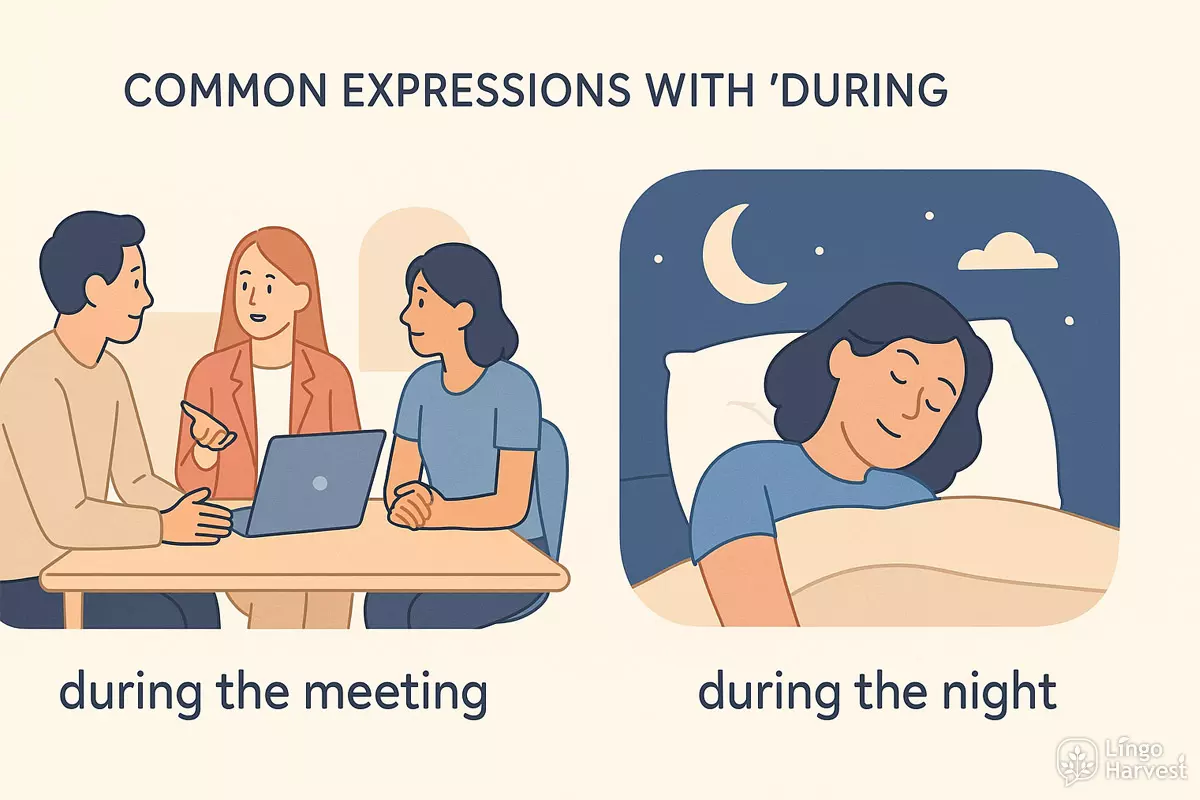
- during the meeting
- during the night
- during class
- during the holidays
- during lunch
- during the movie
- during summer
- during the storm
- during my vacation
- during the game
- during the exam
- during the concert
Comparing "While" and "During" in Use
Both "while" and "during" relate to time, but they connect to sentences differently. "While" usually comes before a subject and verb to show two actions happening at the same time. "During" is followed by a noun or noun phrase, pointing to a specific period or event.
| "While" Example | "During" Example |
|---|---|
| While I was cooking, the phone rang. | The phone rang during dinner. |
| She listened to music while studying. | She listened to music during class. |
| He fell asleep while watching TV. | He fell asleep during the movie. |
| I got a call while driving. | I got a call during my commute. |
Choosing the right time phrase depends on whether you want to connect two actions or describe a period. Practice using these patterns to improve your fluency and confidence.
Typical Learner Confusions
Many English learners find it challenging to decide when to use "while" and when to use "during." The confusion often comes from their similar meanings and overlapping uses in time expressions. However, each word follows different grammar rules and fits best in specific sentence structures.
Common Mistakes with "While" and "During"
Learners often mix these words up because both refer to actions happening at the same time. Here are some of the most frequent misunderstandings:
- Using "during" before a full clause (e.g., ❌ During I was eating, the phone rang.)
- Trying to use "while" directly before a noun (e.g., ❌ While the meeting, she took notes.)
- Noticing the time overlap but ignoring the correct structure
- Forgetting that "during" needs a noun, not a verb phrase
- Confusing "while" with "when" in time clauses
Key Differences in Usage
To clear up the confusion, here is a comparison of how each word is used:
| Word | How to Use Correctly |
|---|---|
| while | Connects two actions or events happening at the same time. Used before a subject + verb. Example: While she was cooking, he set the table. |
| during | Refers to a period of time, followed by a noun. It does not introduce a full clause. Example: During the meeting, she took notes. |
Tricky Example Pairs
It helps to see side-by-side examples that highlight typical errors:
- Correct: She read a book while waiting for the bus.
Incorrect: She read a book during waiting for the bus. - Correct: He fell asleep during the movie.
Incorrect: He fell asleep while the movie. - Correct: While I was studying, it started to rain.
- Correct: I made coffee during the break.
Summary of Pitfalls to Avoid
- Never use "during" before a subject + verb phrase.
- Do not use "while" before a single noun or noun phrase.
- Remember that "while" introduces an event; "during" indicates a time span.
- Check the structure: if you need a noun, use "during"; if you need a clause, use "while."
- Practice with real sentences to build confidence and accuracy.
Practice: Rewrite for Correct Use
Understanding when to use "while" and when to use "during" is essential for clear communication. Below, you’ll find a variety of practice sentences and exercises designed to help you distinguish these two words in real contexts. Read each sentence carefully and choose the correct word for each blank. After you try, you can check your answers at the end of this section.
Rewrite the Sentences
Replace the incorrect word in each sentence with the correct form: "while" or "during".
- I fell asleep during I was watching the movie.
- While the meeting, please turn off your phone.
- She listened to music during doing her homework.
- They talked while the class.
- He made a phone call during his lunch break.
- While the storm, the electricity went out.
- I read a book during the flight.
- We laughed while we ate dinner.
- The baby slept during the entire trip.
- While I was cooking, the phone rang.
Show answers
- I fell asleep while I was watching the movie.
- During the meeting, please turn off your phone.
- She listened to music while doing her homework.
- They talked during the class.
- He made a phone call during his lunch break. (Correct as is.)
- During the storm, the electricity went out.
- I read a book during the flight. (Correct as is.)
- We laughed while we ate dinner. (Correct as is.)
- The baby slept during the entire trip. (Correct as is.)
- While I was cooking, the phone rang. (Correct as is.)
Quick Reference: When to Use "While" vs "During"
Here’s a simple guide to help you decide which word fits:
- Use while before a subject and verb (a full action or event).
- Use during before a noun or noun phrase (a time period or event).
More Practice: Choose the Right Word
Fill in the blanks with either "while" or "during":
- ________ the concert, it started to rain.
- I called her ________ I was walking home.
- He felt sick ________ the night.
- ________ she was studying, her friend visited her.
- Many people left ________ the break.
Show answers
- During the concert, it started to rain.
- I called her while I was walking home.
- He felt sick during the night.
- While she was studying, her friend visited her.
- Many people left during the break.
Common Error Patterns
Review these typical mistakes and their corrections:
- Incorrect: I finished my work during I watched TV.
Correct: I finished my work while I watched TV. - Incorrect: She was tired while the flight.
Correct: She was tired during the flight. - Incorrect: He listened to music during he was cooking.
Correct: He listened to music while he was cooking. - Incorrect: The lights went out while the storm.
Correct: The lights went out during the storm.
Use these exercises to test your understanding and build confidence in using "while" and "during" correctly in everyday English.