Past Continuous with Verbs: Background Actions and Timing

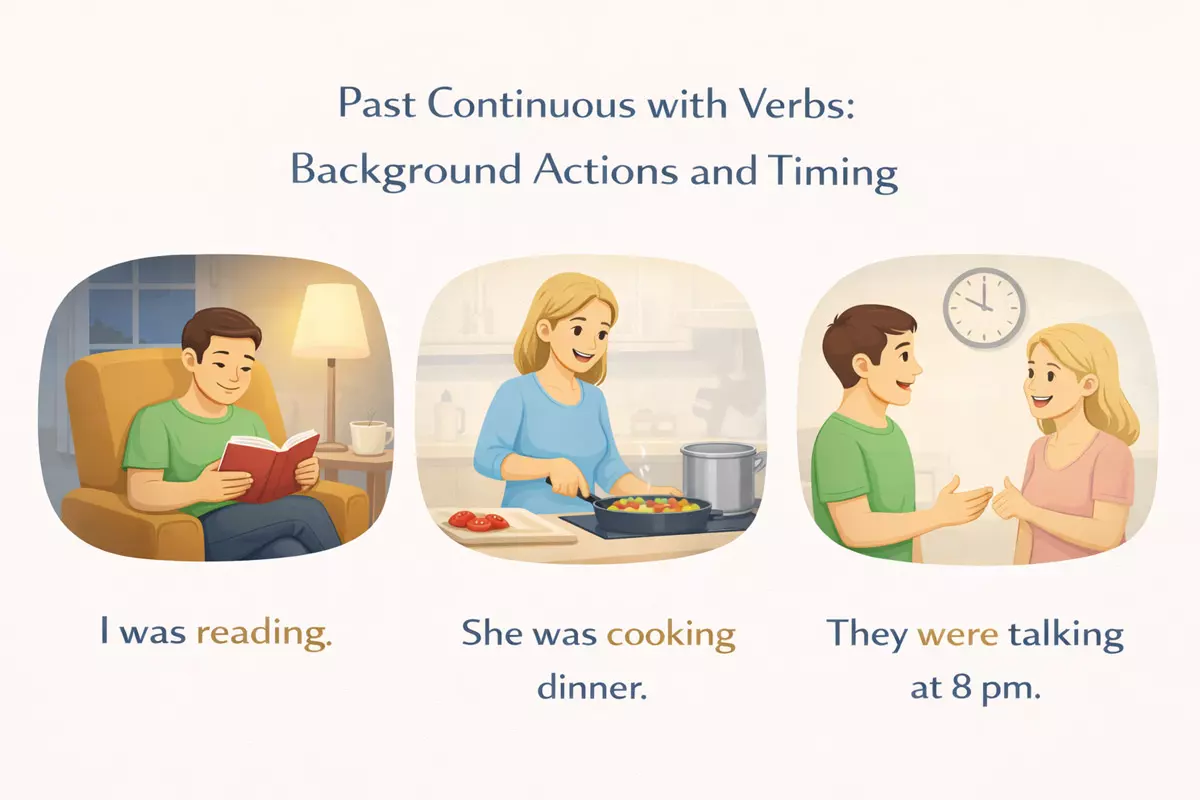 This article explains how the Past Continuous tense is used to describe background actions in the past, how to form it with was and were plus -ing, how it works with when and while, how it differs from Past Simple, and how to avoid common learner mistakes.
To describe what was happening in the background at a particular moment in the past, we often use the past continuous with action verbs. This tense helps set the scene by focusing on an ongoing activity, especially when another event interrupts it. For example, you might explain what you were doing when something unexpected occurred, or what was in progress while another action took place.
What past continuous expresses
This tense is used to show an action in progress at a specific time in the past. It focuses on the ongoing process rather than a completed result, so it often answers “What was happening?” or “What was going on at that moment?”
Common meanings and when to use it
- Action in progress at a stated past time: “At 9 p.m., I was studying.”
- Background activity in a story (setting the scene): “It was raining, and people were hurrying home.”
- Interrupted action (ongoing action + a shorter event): “I was cooking when the phone rang.”
- Two actions happening at the same time: “While I was driving, she was checking the map.”
- Temporary situation around a past period: “That summer, we were living with my aunt.”
- Repeated activity in a limited past window (often with “all day,” “all week”): “He was calling me all evening.”
- Polite or indirect questions about past plans: “Were you hoping to talk to the manager?”
- Annoyance or criticism (typically with “always/constantly”): “She was always borrowing my notes.”
- Incomplete attempt or developing action: “I was trying to explain, but nobody listened.”
- Parallel background vs. main event contrast: “We were watching TV, and suddenly the lights went out.”
Typical time markers and patterns
It commonly appears with time expressions that point to a moment or span in the past, or with clauses showing interruption or overlap.
- Specific time: “at 6,” “at midnight,” “this time yesterday” → “This time yesterday, they were flying to Rome.”
- Background + main event: “was/were + -ing” + “when” + past simple → “I was leaving when I saw her.”
- Two ongoing actions: “was/were + -ing” + “while” + “was/were + -ing” → “While he was working, I was studying.”
- Duration emphasis: “all day,” “all night,” “the whole morning” → “We were waiting all afternoon.”
- Ongoing context: “as,” “while,” “when” (depending on meaning) → “As I was walking home, it started to snow.”
How it differs from past simple in meaning
- Past simple highlights a finished event: “I read the email.” (completed)
- Past continuous highlights the activity in progress: “I was reading the email.” (in the middle of it)
- In narratives, the simple form often moves the story forward, while the continuous form supplies context: “She opened the door. People were talking inside.”
Mini example bank (background actions and timing)
- “The kids were playing in the yard.”
- “We were having dinner when the power went out.”
- “He was working late that week.”
- “I was looking for my keys while you were on the phone.”
- “They were arguing again, so I left the room.”
- “At that moment, she was thinking about quitting.”
- “The train was moving slowly because of the fog.”
- “I was trying to focus, but the music was too loud.”
- “We were waiting outside when the doors finally opened.”
- “He was always interrupting during meetings.”
- “The dog was barking all night.”
- “I was writing notes as the teacher was explaining the rule.”
Form: was/were + -ing
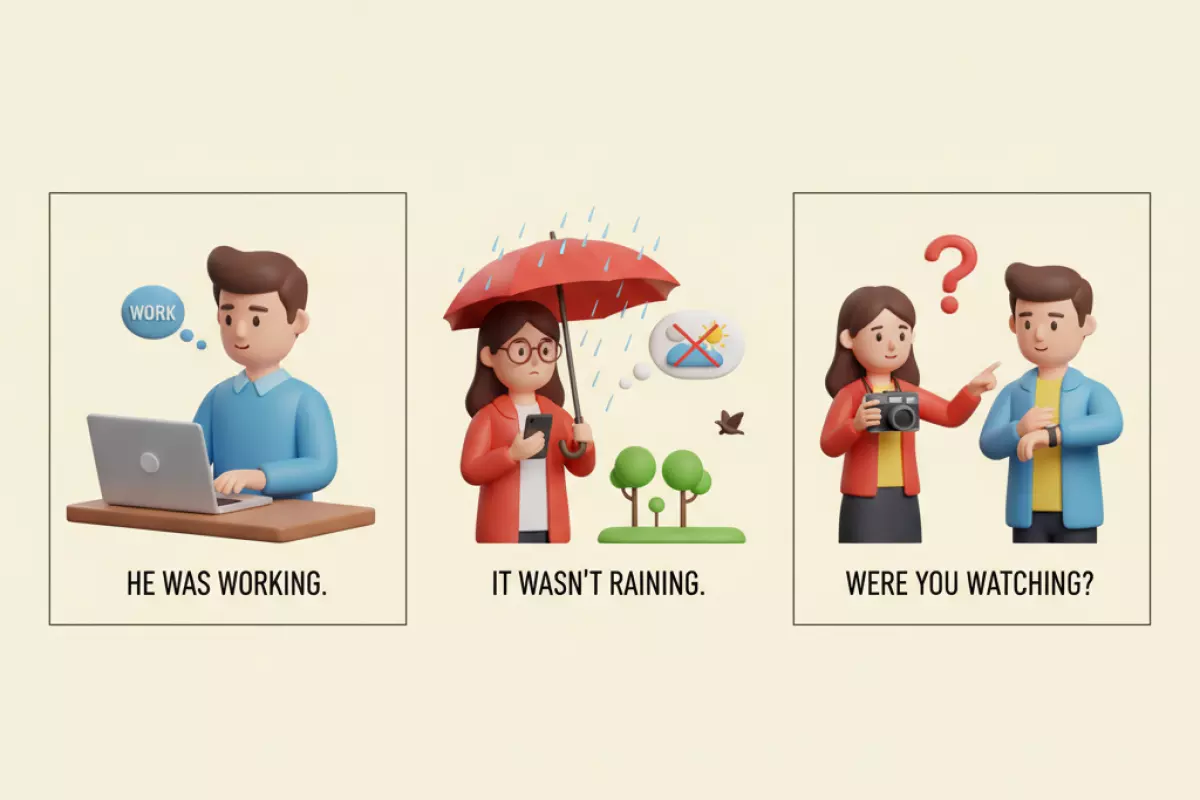
The past continuous is built with the past tense of be plus the verb ending in -ing. This structure is used to show an action in progress at a particular time in the past, often as background information for another event.
Basic pattern
- Affirmative: was/were + verb-ing
- Negative: was/were + not + verb-ing (wasn’t/weren’t + verb-ing)
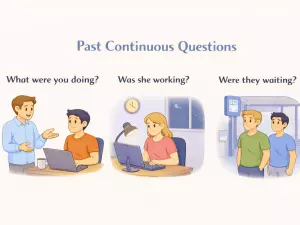
- Yes/No question: Was/Were + subject + verb-ing?
- Wh- question: Wh-word + was/were + subject + verb-ing?
Choosing was vs. were
- I was working.
- He/She/It was sleeping.
- You/We/They were waiting.
- With names and singular nouns, use was: “Maria was driving.”
- With plural nouns, use were: “The children were playing.”
Spelling rules for the -ing form
- Most verbs: add -ing → work → working; watch → watching
- Final -e usually drops → make → making; write → writing
- Final -ie changes to -y → lie → lying; die → dying
- One-syllable verbs with consonant-vowel-consonant often double the last consonant → run → running; sit → sitting
- Two-syllable verbs may double the last consonant when the stress is on the last syllable → begin → beginning; prefer → preferring
- Verbs ending in -y keep the y → study → studying; carry → carrying
Common sentence models (with timing and background meaning)
- At 8 p.m., I was cooking dinner.
- While I was walking home, it started to rain.
- They were talking when the teacher came in.
- She was reading, so she didn’t hear the phone.
- We were driving all night.
- He was working on the report at that time.
- The kids were playing outside while I was cleaning.
- I wasn’t listening when you explained it.
- Were you waiting long?
- What were they doing at midnight?
- Where was she going when you saw her?
- Why were you laughing during the meeting?
Frequent form mistakes to avoid
- ✅ I was studying. ❌ I was study.
- ✅ They were watching TV. ❌ They was watching TV.
- ✅ He wasn’t sleeping. ❌ He didn’t sleeping.
- ✅ Were you working? ❌ Did you working?
- ✅ She was making tea. ❌ She was makeing tea.
Background actions vs main events
Use the past continuous to set the scene and show an activity in progress, then use the past simple to introduce the key event that interrupts it or happens at a specific moment. This pattern helps readers understand timing: one action is “already happening,” and another action “arrives” and changes the situation.
Typical pattern: ongoing action + interrupting event
The most common structure is:
- Past continuous for the longer activity in progress: was/were + -ing
- Past simple for the shorter, completed event: verb (past form)
- Often joined with time links such as when, while, or as to show the relationship
Usage rules that keep the timeline clear
- Use past continuous to describe what was happening around a time: “At 9 p.m., I was studying.”
- Use past simple for a finished action that occurred at a point in time: “At 9 p.m., the phone rang.”
- With when, the clause in past simple often introduces the new event: “I was leaving when I saw her.”
- With while, both actions can be ongoing (two parallel activities): “He was cooking while she was setting the table.”
- If you want to emphasize a sudden change, keep the interrupting action in past simple: “We were talking when the lights went out.”
- Don’t use past continuous for a single completed event: ❌ “I was dropping my keys.” → ✅ “I dropped my keys.”
- Use past continuous to provide context, not to list main plot points in sequence (past simple is better for a chain of events).
Example bank (scene-setting + main event)
- I was walking home when it started to rain.
- They were watching a film when the power went out.
- She was driving to work when she noticed a strange noise.
- We were having dinner when the doorbell rang.
- He was sleeping when his alarm went off.
- The kids were playing outside when they heard a shout.
- I was reading quietly when my phone buzzed.
- She was explaining the plan when someone interrupted.
- We were waiting in line when the store opened.
- They were arguing when the teacher walked in.
- I was carrying the boxes when I slipped.
- He was taking a shower when the water turned cold.
- We were discussing the budget when the manager arrived.
- She was looking for her keys when she found an old photo.
- They were traveling through Spain when they met new friends.
- I was working late when the computer crashed.
When both actions are “background”
Sometimes there is no single interrupting event. If you want to show two activities happening at the same time, use past continuous in both clauses, usually with while or as:
- While I was cooking, he was cleaning the kitchen.
- She was studying as her friends were chatting online.
- They were walking along the beach while the sun was setting.
- As we were driving, we were talking about our next trip.
Past continuous with when and while
Use when and while to show how two past actions connect in time. A common pattern is to put the longer “background” action in the past continuous and the shorter event in the past simple. This helps readers understand what was already in progress and what happened during it.
Core patterns
- Background + interruption: was/were + -ing + when + past simple
Example: I was driving when the phone rang. - Two actions in progress: while + was/were + -ing, was/were + -ing
Example: While I was cooking, he was setting the table. - Time frame first: When/While + clause, main clause (comma often used when the time clause comes first)
Example: When I was walking home, I saw an accident. - Main clause first: main clause + when/while + clause (comma usually not needed)
Example: I saw an accident while I was walking home.
How to choose: when vs. while
- While usually introduces an action that continues for a period of time (a “during this time” feeling): While she was studying, the kids were playing outside.
- When often introduces a specific moment or event, especially an interruption: She was studying when the lights went out.
- Both can be used with the past continuous, but the meaning changes slightly:
✅ When I was living in Madrid, I learned Spanish. (during that period)
✅ While I was living in Madrid, I learned Spanish. (emphasizes the ongoing background) - With a short, sudden action, when is usually more natural than while:
✅ I was falling asleep when the alarm went off.
❌ I was falling asleep while the alarm went off.
Common example sentences (useful models)
- We were having dinner when the doorbell rang.
- He was explaining the plan when someone interrupted him.
- I was looking for my keys when I found an old photo.
- They were waiting at the station when the train finally arrived.
- She was walking to work when it started to snow.
- While I was reading, my phone was charging.
- While the teacher was talking, the students were taking notes.
- While we were traveling, we were saving receipts for expenses.
- When I was working night shifts, I was sleeping during the day.
- When they were renovating the kitchen, they were eating in the living room.
- While the baby was sleeping, I was cleaning the apartment.
- He was crossing the street when he noticed the cyclist.
- We were discussing the budget when the meeting ended.
- While the rain was falling, the wind was getting stronger.
- I was writing an email when my computer froze.
- While she was learning to drive, she was practicing every weekend.
Frequent mistakes to avoid
- Using past continuous for the short event:
✅ I was taking a shower when the phone rang.
❌ I took a shower when the phone was ringing. (changes the meaning; suggests the ringing was ongoing) - Forgetting the auxiliary verb:
✅ They were watching TV when I arrived.
❌ They watching TV when I arrived. - Mixing time words with the wrong sense of duration:
✅ While I was waiting, I checked my messages.
✅ I was waiting when I checked my messages. (different focus; “checked” is the moment inside the waiting)
Past continuous vs past simple
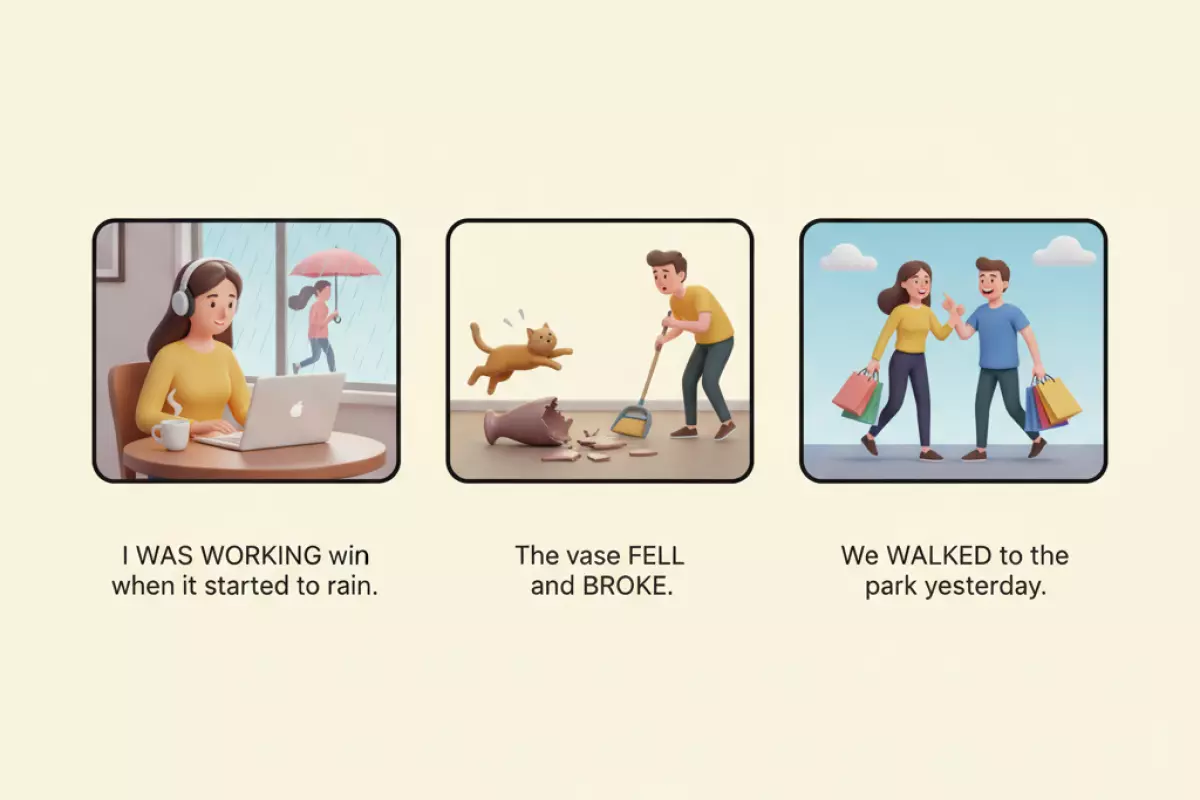
Choose between these two past forms by deciding what you want the listener to notice: the ongoing background of an action in progress, or a completed event that moves the story forward. The -ing form usually sets the scene and shows an action “in the middle,” while the simple form typically reports a finished action, a sequence, or a single point in time.
| What you want to express | Typical form | Common time signals | Example |
|---|---|---|---|
| Action in progress at a specific past moment (background) | was/were + verb-ing | at 8 pm, at that moment, when (setting the scene) | At 8 pm, I was cooking dinner. |
| Completed action or event (foreground) | past simple | yesterday, last night, ago, in 2019 | I cooked dinner last night. |
| Longer action interrupted by a shorter event | was/were + verb-ing + past simple | when, while | I was cooking when the phone rang. |
| Two actions happening at the same time (parallel background) | was/were + verb-ing + was/were + verb-ing | while, as | She was reading while he was working. |
| Sequence of finished actions (story steps) | past simple + past simple | then, after that, later | He opened the door, walked in, and sat down. |
| Temporary activity around a time (not necessarily completed) | was/were + verb-ing | that week, that summer, at the time | That week, we were staying with friends. |
| Habit or repeated action in the past (neutral) | past simple | often, always, every day | We walked to school every day. |
| Repeated action used to show annoyance or emphasis | was/were + always/constantly + verb-ing | always, constantly | He was always losing his keys. |
Common patterns to remember
- Background + event: use the continuous for the longer action and the simple for the interrupting event: “I was driving when I saw a deer.”
- Two backgrounds: use two -ing forms for parallel actions: “While I was studying, my sister was watching TV.”
- Story timeline: use the simple form for the main steps: “We arrived, checked in, and unpacked.”
- Time focus: “at 10 o’clock” often points to an action in progress; “at 10 o’clock” can also mark a finished event if the meaning is a single point: “At 10 o’clock, the meeting ended.”
Example pairs (same situation, different focus)
- I watched the game last night. → the whole event is finished.
- I was watching the game when you called. → the call happened during the activity.
- She worked at a bank in 2020. → a past fact (job as a completed period).
- She was working at a bank when she met her business partner. → the job is background to another event.
- They lived in Paris for five years. → a completed period (start to end).
- They were living in Paris at the time. → temporary situation around that moment.
- He read the email and replied. → sequence of completed actions.
- He was reading the email, so he didn’t hear the door. → ongoing action explains the situation.
- We talked for an hour. → finished duration.
- We were talking for an hour when the lights went out. → duration in progress, then interruption.
- It rained yesterday. → a completed weather fact.
- It was raining when we left. → weather as background at a specific time.
Frequent learner errors to avoid
- ❌ “When I was saw him, I waved.” → ✅ “When I saw him, I waved.” (event = past simple)
- ❌ “I was knowing the answer.” → ✅ “I knew the answer.” (many state verbs rarely take -ing)
- ❌ “While I cooked, the phone was ringing.” (if the ring is a single event) → ✅ “While I was cooking, the phone rang.”
- ❌ “I was going to the store and bought milk.” (unclear timeline) → ✅ “I went to the store and bought milk.” (sequence) / “I was going to the store when I bumped into Sam.” (interruption)
Common mistakes with time words
Time expressions often decide whether the past continuous sounds natural, or whether another tense (usually past simple) is needed. The most frequent problems come from mixing “points in time” with “durations,” using the wrong connector (like when vs. while), or placing the time phrase in a way that changes the meaning.
Typical errors and how to fix them
- ❌ Using past continuous with a finished time that suggests a complete event: “Yesterday I was going to the cinema.” → ✅ “Yesterday I went to the cinema.” (Use past simple for completed actions.)
- ❌ Treating at 5 o’clock like a duration: “I was working at 5 o’clock for two hours.” → ✅ “I was working at 5 o’clock.” / “I worked for two hours.” (Don’t combine a point-in-time marker with a separate duration in a confusing way.)
- ❌ Using when for two long background actions: “When I was cooking, he was studying.” → ✅ “While I was cooking, he was studying.” (Use while for parallel ongoing actions.)
- ❌ Using while for a short interrupting action: “While I was walking home, I saw an accident.” → ✅ “When I was walking home, I saw an accident.” (The “seeing” is a short event that happens during the longer action.)
- ❌ Mixing during with a clause: “During I was driving, it started to snow.” → ✅ “While I was driving, it started to snow.” / “During the drive, it started to snow.” (During needs a noun phrase, not a full clause.)
- ❌ Using for with a point in time: “I was waiting for 8 o’clock.” → ✅ “I was waiting until 8 o’clock.” / “I waited until 8 o’clock.” (For = length of time; until = endpoint.)
- ❌ Confusing since and for: “I was living there since 2019.” → ✅ “I had been living there since 2019.” / “I lived there from 2019 to 2023.” (Since points to a starting time and often needs perfect aspect for “up to a later point.”)
- ❌ Using all day without context, implying completion: “I was working all day yesterday.” → ✅ “I worked all day yesterday.” (If the day is finished and you mean the whole completed period, past simple is more typical.)
- ❌ Overusing past continuous with last night for a single complete action: “Last night I was watched a film.” → ✅ “Last night I watched a film.” (Also note the form: was watching, not was watched.)
- ❌ Wrong tense pairing with when: “When he arrived, I cooked dinner.” (sounds like two completed events in sequence) → ✅ “When he arrived, I was cooking dinner.” (arrival interrupts the ongoing action.)
- ❌ Using at the moment with past time without anchoring: “At the moment, I was living in Paris.” → ✅ “At that moment, I was living in Paris.” / “At the time, I was living in Paris.” (Use a past anchor: that moment, then, at the time.)
- ❌ Misplacing the time phrase so it attaches to the wrong verb: “I was reading when I called you yesterday.” (suggests the call happened yesterday, not the reading) → ✅ “Yesterday, I was reading when I called you.” or “I was reading yesterday when I called you.” (Place the time word next to the action you mean.)
- ❌ Using then as if it means “during”: “Then I was driving, I saw him.” → ✅ “While I was driving, I saw him.” / “Then I drove to the store.” (Then usually shows sequence, not overlap.)
- ❌ Using ago with past continuous: “Two hours ago I was meeting him.” → ✅ “Two hours ago I met him.” / “Two hours ago, I was meeting him” (only if you clearly mean “at that time I was in the middle of the meeting,” and the context supports it).
- ❌ Using in + year as if it always means “background”: “In 2010 I was graduating.” → ✅ “In 2010 I graduated.” (Graduating is typically a single completed event; use continuous only to stress it was in progress at a specific moment.)
Quick pattern reminders for time expressions
- Point in time (at 7, at midnight, when he arrived): often pairs with past continuous to show an action in progress at that moment.
- Duration (for two hours, all morning): often pairs with past simple for a finished period; past continuous is possible when you emphasize “in progress,” but it needs clear context.
- Overlap (while, as, during + noun): use these to show two actions happening at the same time.
- Interruption (when + short event): common pattern is “past continuous + when + past simple.”
- Endpoint (until, by the time): choose the tense based on whether you describe the ongoing background (was working until…) or the completed result (had finished by the time…).
Using past continuous in stories
In narrative writing, the past continuous often sets the scene by showing actions in progress, while other events happen around them. It helps readers track what was already happening, what interrupted it, and what was happening at the same time as something else.
Core pattern: background action + main event
A common structure is an ongoing activity (past continuous) followed by a shorter, completed event (past simple). This makes the timing clear: the longer action was in progress when the shorter action occurred.
- Past continuous (background): “She was walking home…” + past simple (event): “…when she heard a shout.”
- “They were having dinner when the lights went out.”
- “I was looking for my keys when you called.”
- “He was driving too fast when the car skidded.”
- “We were waiting at the station when the train finally arrived.”
Parallel actions: two activities happening at the same time
Use past continuous in both clauses to show simultaneous actions. This is useful for describing busy scenes or overlapping activity.
- “While the band was playing, people were dancing in the street.”
- “She was reading on the sofa as the rain was hitting the windows.”
- “The kids were arguing while their parents were trying to talk.”
- “I was writing notes and my friend was checking the map.”
- “Everyone was talking at once, and nobody was listening.”
Scene-setting details: what was going on around the characters
For atmosphere, the tense can describe ongoing conditions, repeated movement in a moment, or changing situations. These details support the main storyline without advancing it too quickly.
- “The wind was getting stronger, and the sky was turning dark.”
- “Cars were crawling along the road in the fog.”
- “People were whispering in the hallway.”
- “A dog was barking somewhere behind the houses.”
- “The candles were flickering as the door was opening slowly.”
- “The phone was ringing again and again.”
Useful connectors and punctuation patterns
Time words help signal the relationship between actions. Choose connectors based on whether you want interruption, overlap, or a time frame.
- when + past simple for the interrupting event: “I was leaving when she stopped me.”
- while + past continuous for overlap: “While he was sleeping, the storm was moving closer.”
- as for two actions developing together: “As we were walking, the streetlights were coming on.”
- all evening/night/morning for duration in the background: “They were arguing all night.”
- at that moment to focus the reader: “At that moment, I was thinking about leaving.”
Common learner errors to avoid
- ❌ “When I was seeing him, I was waving.” → ✅ “When I saw him, I waved.” (use past simple for a completed, sudden action)
- ❌ “While I cooked, the kids were playing.” → ✅ “While I was cooking, the kids were playing.” (match the overlap with continuous forms)
- ❌ “I was knowing the answer.” → ✅ “I knew the answer.” (many stative verbs don’t usually take the continuous form)
- ❌ “She was arriving and then she was sitting.” → ✅ “She arrived and then she sat.” (use past simple for completed sequence of events)
Homework: past continuous practice tasks
Focus on using the past continuous (was/were + -ing) for actions in progress at a specific time in the past, and for background activities interrupted by a shorter past action (often in the past simple). Pay attention to time markers (e.g., at 8 pm, while, when) and to subject–verb agreement (I/he/she/it was vs. you/we/they were).
1) Form and timing (fill in the verb)
- At 6:30, I ________ (cook) dinner.
- They ________ (not / listen) when the teacher explained the rules.
- What ________ you ________ (do) at midnight?
- My phone ________ (charge) while I slept.
- We ________ (wait) for the bus, but it never came.
- She ________ (drive) home when it started to snow.
- The kids ________ (play) in the yard at that time.
- He ________ (not / watch) TV; he was reading.
- It ________ (rain) heavily all evening.
- Why ________ they ________ (argue) during the meeting?
Show answers
- was cooking
- weren’t listening
- were; doing
- was charging
- were waiting
- was driving
- were playing
- wasn’t watching
- was raining
- were; arguing
2) Background vs. interruption (choose the best option)
- I (was walking / walked) to work when I (was seeing / saw) an old friend.
- While we (were having / had) lunch, the fire alarm (was ringing / rang).
- He (was breaking / broke) his glasses while he (was playing / played) basketball.
- They (were talking / talked) quietly when the manager (was entering / entered) the room.
- When I (was opening / opened) the door, I (was realizing / realized) I forgot my keys.
- She (was studying / studied) all afternoon, so she (was feeling / felt) tired.
- While the baby (was sleeping / slept), someone (was knocking / knocked) loudly.
- We (were not paying / did not pay) attention when the bus (was passing / passed) our stop.
Show answers
- was walking; saw
- were having; rang
- broke; was playing
- were talking; entered
- opened; realized
- was studying; felt
- was sleeping; knocked
- were not paying; passed
3) Error correction (rewrite each sentence correctly)
- We was waiting outside when the shop opened.
- At 9 o’clock, she watched TV.
- While I cooked, the lights were going out.
- They were play tennis when it started raining.
- He didn’t working at that time.
- What you were doing when I called?
- I was knowing the answer, but I didn’t say it.
- When the teacher was speaking, the students laughed.
Show answers
- We were waiting outside when the shop opened.
- At 9 o’clock, she was watching TV.
- While I was cooking, the lights went out.
- They were playing tennis when it started raining.
- He wasn’t working at that time.
- What were you doing when I called?
- I knew the answer, but I didn’t say it.
- When the teacher was speaking, the students laughed. (Also possible: While the teacher was speaking, the students were laughing.)
4) Build sentences from prompts (use past continuous; add past simple if needed)
- (I / read) (when / you / arrive)
- (they / not / sleep) (at 2 a.m.)
- (we / discuss / the plan) (when / the internet / stop)
- (she / drive) (while / her friend / talk / on the phone)
- (the dog / bark) (all night)
- (you / wait / long?)
Show answers
- I was reading when you arrived.
- They weren’t sleeping at 2 a.m.
- We were discussing the plan when the internet stopped.
- She was driving while her friend was talking on the phone.
- The dog was barking all night.
- Were you waiting long?
5) Short writing task (use patterns, not just forms)
- Write 6–8 sentences about a moment that was interrupted (a call, a knock, a sudden problem). Include at least three sentences with when + past simple and two with while + past continuous.
- Write 5 sentences describing a scene at a specific time yesterday (e.g., “At 7:15…”). Use different subjects so you practice was and were.
- Write 4 sentences with negatives and questions (e.g., “Was he…?”, “Why were they…?”, “I wasn’t…”). Keep the meaning clear by adding a time phrase.
Quick checklist for self-checking
- Use was/were + -ing for an action in progress at a past time: “At 8, we were eating.”
- Use past simple for the interrupting event: “We were eating when the doorbell rang.”
- After while, the continuous form is common for the longer background action.
- Avoid stative verbs in -ing for meaning like possession/opinion/knowledge: prefer “I knew,” not “I was knowing.”
- Check agreement: “I/he/she/it was…” and “you/we/they were…”.