Reflexive Pronouns: Myself, Yourself, Himself...

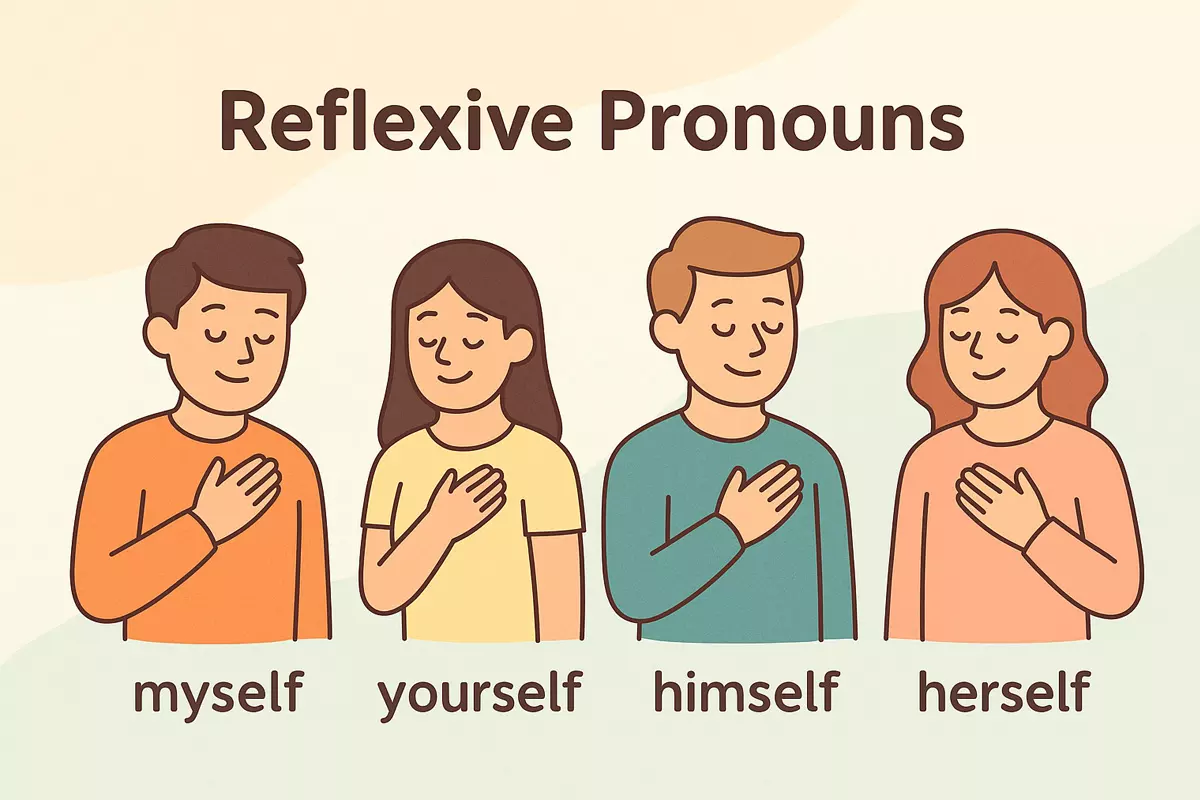 This article explains reflexive pronouns, their different forms, and when to use them. It also covers the difference between emphasis and reflexive meaning, highlights common mistakes, and provides practice exercises.
Have you ever wondered why we use words like myself or herself in sentences such as I made it myself or She fixed it herself? These words are called reflexive pronouns, and they are used to show that the subject of the sentence is also the person doing the action. Using reflexive pronouns helps to make your English clearer and more precise because it shows exactly who is doing something and who is receiving the action.
What Are Reflexive Pronouns?
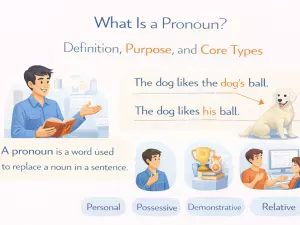
Reflexive pronouns are used when the subject and the object of a verb are the same person or thing. They “reflect” the action back onto the doer. These forms end in -self (singular) or -selves (plural) and are used to express actions someone performs on themselves.
Common Reflexive Pronouns in English
- myself
- yourself
- himself
- herself
- itself
- ourselves
- yourselves
- themselves
How Reflexive Pronouns Work
These pronouns replace the object in a sentence when the subject and object refer to the same person. For example: She prepared herself for the exam. The subject (she) and the object (herself) refer to the same person.
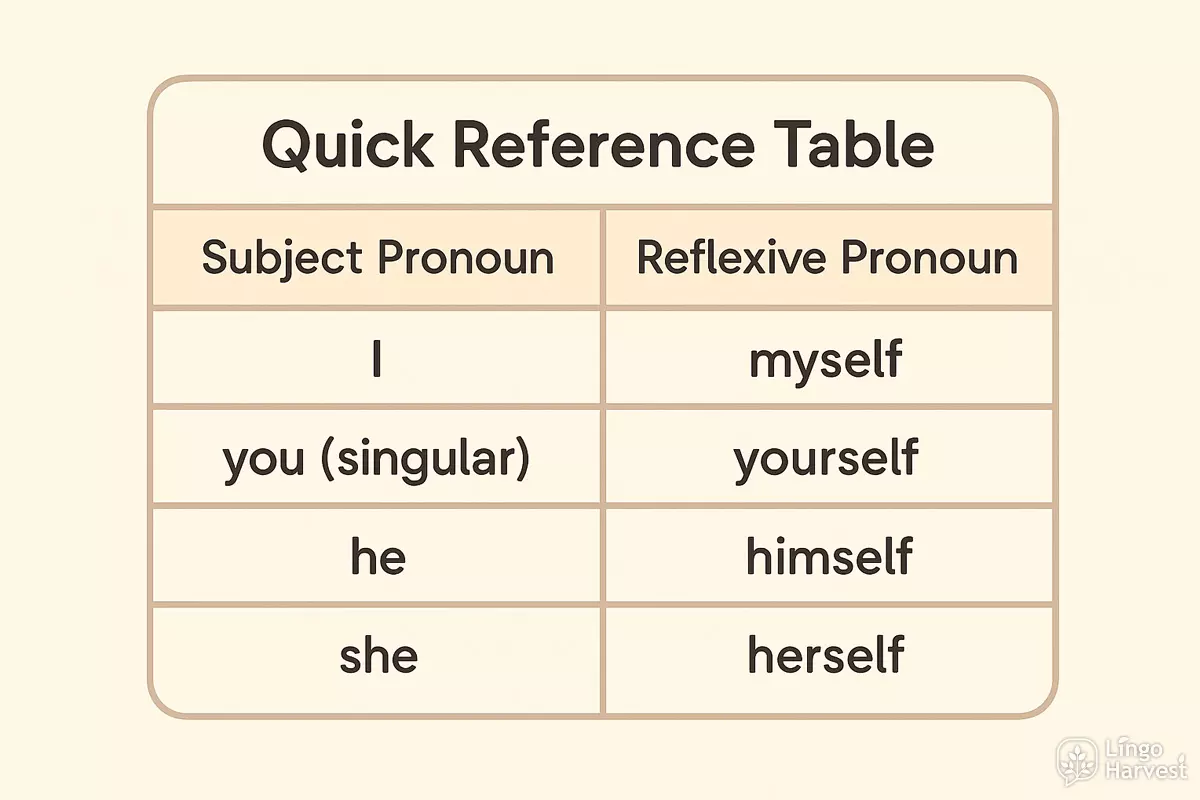
Quick Reference Table
| Subject Pronoun | Reflexive Pronoun |
|---|---|
| I | myself |
| you (singular) | yourself |
| he | himself |
| she | herself |
| it | itself |
| we | ourselves |
| you (plural) | yourselves |
| they | themselves |
Typical Uses
- Emphasizing that someone did something alone: He fixed the car himself.
- When the action returns to the subject: We taught ourselves Spanish.
- To avoid ambiguity: Anna introduced herself.
- With prepositions: They kept the secret to themselves.
Forms of Reflexive Pronouns
Reflexive pronouns are formed from personal pronouns and the endings -self or -selves. They must match the subject in both number and person. For example: She taught herself.
List of English Reflexive Pronouns
- myself (I)
- yourself (you, singular)
- himself (he)
- herself (she)
- itself (it)
- ourselves (we)
- yourselves (you, plural)
- themselves (they)
- oneself (formal or general “one”)
Key Points to Remember
- Reflexive pronouns are not used as subjects.
- They always refer back to the subject in the same clause.
- Avoid nonstandard forms like “hisself” or “theirselves.”
When to Use Reflexive Pronouns
Use reflexive pronouns when the subject and object refer to the same person or thing. These forms help clarify who performs and receives the action.
Common Situations for Reflexive Pronouns
- Actions performed on oneself: She taught herself Spanish.
- After certain verbs: He prides himself on being honest.
- For emphasis: The manager herself approved the plan.
- With “by” to express being alone: He lives by himself.
- Accidental actions: I cut myself while cooking.
- In instructions: Help yourself to tea.
- In idioms: Behave yourself!
- To stress involvement: We built the house ourselves.
Reflexive pronouns play an important role in making meaning clear and sentences precise.
Emphasis vs Reflexive Meaning
Understanding how reflexive pronouns work in English requires distinguishing between their two main uses: showing that someone does something to themselves, and adding special stress to who performed the action. While the forms look identical, their function in a sentence can be quite different.
Reflexive Use: The Action Returns
When a reflexive pronoun refers back to the subject, it means the subject and object are the same person or thing. This use is common after certain verbs and expressions. For example:

- She taught herself to play guitar.
- The cat cleaned itself.
- We found ourselves lost in the city.
- I cut myself while cooking.
- They prepared themselves for the exam.
- You should treat yourself to a day off.
- He blamed himself for the mistake.
- The dog entertained itself for hours.
- I told myself not to worry.
- Did you see yourself in the mirror?
- The children amused themselves at the park.
- She reminded herself of the meeting.
Emphatic Use: Highlighting Who Did It
Sometimes, a reflexive pronoun isn’t needed for grammar, but is used to stress that the subject—and no one else—did the action. This is for emphasis, not because the action comes back to the subject. You’ll often see this use at the end of a sentence or right after the subject:
- I’ll do it myself.
- The manager herself approved the plan.
- You yourself said it was true.
- The kids cleaned the room themselves.
- He himself made the cake.
- We ourselves witnessed the event.
- The president himself attended.
- She herself fixed the problem.
- They themselves organized the party.
- Did you do this yourself?
- I built this table myself.
- The author herself signed the book.
Quick Comparison: Reflexive vs Emphatic
Here’s a side-by-side look at how these pronouns function in both contexts:
| Reflexive Function (Action returns to subject) |
Emphatic Function (Extra focus or contrast) |
|---|---|
| I hurt myself with the knife. | I will do it myself. |
| She introduced herself at the meeting. | The director herself called me. |
| They blamed themselves for the error. | They themselves fixed the problem. |
| He talks to himself sometimes. | He himself finished the report. |
Tips for Telling the Difference
- If removing the pronoun changes the meaning, it’s probably reflexive.
- If the pronoun just adds stress, it’s emphatic (the sentence still makes sense without it).
- Emphatic pronouns often appear after the subject or at the end of the clause.
- Reflexive use is required by the verb; emphatic use is optional for effect.
Common Mistakes to Avoid
Misusing reflexive pronouns is easy, especially for learners getting used to English sentence structure. Many problems come from confusing when to use these forms, or from using them where a simple pronoun would do. Below, you'll find the most frequent pitfalls and how to steer clear of them.
Overusing Reflexives
It’s tempting to add "myself" or "yourself" for emphasis, but this often leads to awkward or incorrect sentences. Remember, these pronouns are only necessary when the subject and object are the same person or group.
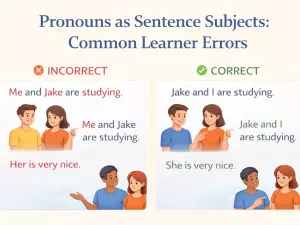
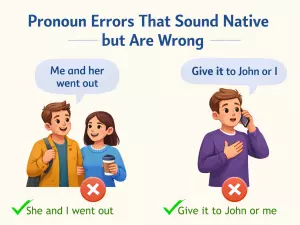
- Incorrect: John and myself will attend the meeting.
- Correct: John and I will attend the meeting.
- Incorrect: Please send the report to myself.
- Correct: Please send the report to me.
Confusing Reflexive and Emphatic Use
Reflexive forms can be used for emphasis, but not all emphatic uses are correct. Don’t add a reflexive just to sound formal.
- Correct emphasis: I baked the cake myself.
- Incorrect emphasis: Myself baked the cake.
Incorrect Placement in Sentences
Placing these pronouns awkwardly can confuse your meaning. Usually, the reflexive follows the verb or comes at the end of a clause.
- Awkward: She herself cleaned the room.
- Better: She cleaned the room herself.
Using the Wrong Form
Mistakes often happen with plural or gendered forms. Make sure to match the pronoun with the subject.
| Incorrect Usage ❌ | Correct Form ✅ |
|---|---|
| He did it themself. | He did it himself. |
| We will do it myself. | We will do it ourselves. |
| They blamed hisself. | They blamed themselves. |
| She looked at hisself in the mirror. | She looked at herself in the mirror. |
List of Common Reflexive Errors
- Using "myself" instead of "I" or "me"
- Choosing "yourself" in place of "you"
- Applying "himself" or "herself" when the subject is plural
- Mixing up "themselves" and "theirselves" (the latter is incorrect)
- Inserting reflexives after prepositions unnecessarily ("between ourselves" vs. "between us")
- Using "itself" for people (should be used for things or animals)
- Starting a sentence with a reflexive ("Myself will...")
- Attaching reflexives to unrelated verbs ("I will explain myself the lesson")
- Replacing possessive forms with reflexives ("my own" vs. "myself")
- Using "ourself" instead of "ourselves"
- Using reflexives after verbs that don’t take an object ("He arrived himself")
- Confusing "each other" with reflexives ("They talked themselves" vs. "They talked to each other")
- Translating directly from another language that uses reflexives differently
- Adding reflexives to passive constructions unnecessarily ("The cake was baked by myself")
- Using "myself" to avoid saying "me" in formal settings
- Forgetting to match the pronoun with the subject in number and gender
Paying attention to these patterns will help you avoid typical slip-ups and use these forms with confidence.
Practice
Understanding how to use reflexive pronouns correctly can be challenging, so it’s useful to see them in action through varied examples and exercises. Reflexive forms help clarify who is performing an action and who receives it, often emphasizing that the subject and object are the same.
Common Reflexive Pronouns in Context
Here are sentences that illustrate how these words function in everyday English:
- She taught herself to play the piano.
- I made myself a sandwich.
- They introduced themselves at the meeting.
- He hurt himself while running.
- We enjoyed ourselves at the party.
- You should treat yourself to a day off.
- The cat cleaned itself after eating.
- Did you both find yourselves lost in the city?
- Help yourselves to some coffee.
- The children entertained themselves all afternoon.
- Sometimes, I talk to myself when I’m thinking.
- She looked at herself in the mirror.
- We prepared ourselves for the exam.
- He convinced himself it was the right decision.
- The dog scratched itself behind the ear.
- Make yourselves comfortable.
Reflexive Pronoun Paradigm
Each reflexive pronoun corresponds directly to a personal pronoun and reflects the action back to the same subject. Use -self for singular forms and -selves for plural forms:
- I → myself
- you → yourself (singular)
- he → himself
- she → herself
- it → itself
- we → ourselves
- you → yourselves (plural)
- they → themselves
Remember: yourselves is used only when addressing more than one person, and themselves is the standard form in modern English (not “theirselves”).
Quick Exercise: Choose the Correct Reflexive
Fill in the blanks with the appropriate reflexive pronoun:
- He made _______ a cup of tea.
- We taught _______ how to code.
- The dog hid _______ under the table.
- You should be proud of _______!
- They found _______ in a difficult situation.
- She looked at _______ in the mirror.
- I told _______ to stay calm.
- You (plural) should make _______ at home.
Show answers
- himself
- ourselves
- itself
- yourself
- themselves
- herself
- myself
- yourselves
Error Spotting
Decide if the following sentences use the correct reflexive pronoun. If not, correct them:
- She blamed himself for the mistake.
- I made myself a cup of coffee.
- The children washed themselves after playing outside.
- You need to believe herself more.
- We prepared ourselves for the presentation.
- They introduced theirselves to the group.
Show answers
- ❌ Incorrect → herself
- ✅ Correct
- ✅ Correct
- ❌ Incorrect → yourself
- ✅ Correct
- ❌ Incorrect → themselves
Practicing with these examples helps reinforce how reflexive pronouns correspond to their subjects and how they clarify meaning in sentences.