Indefinite Pronouns: Someone, Anyone, Everyone, No One

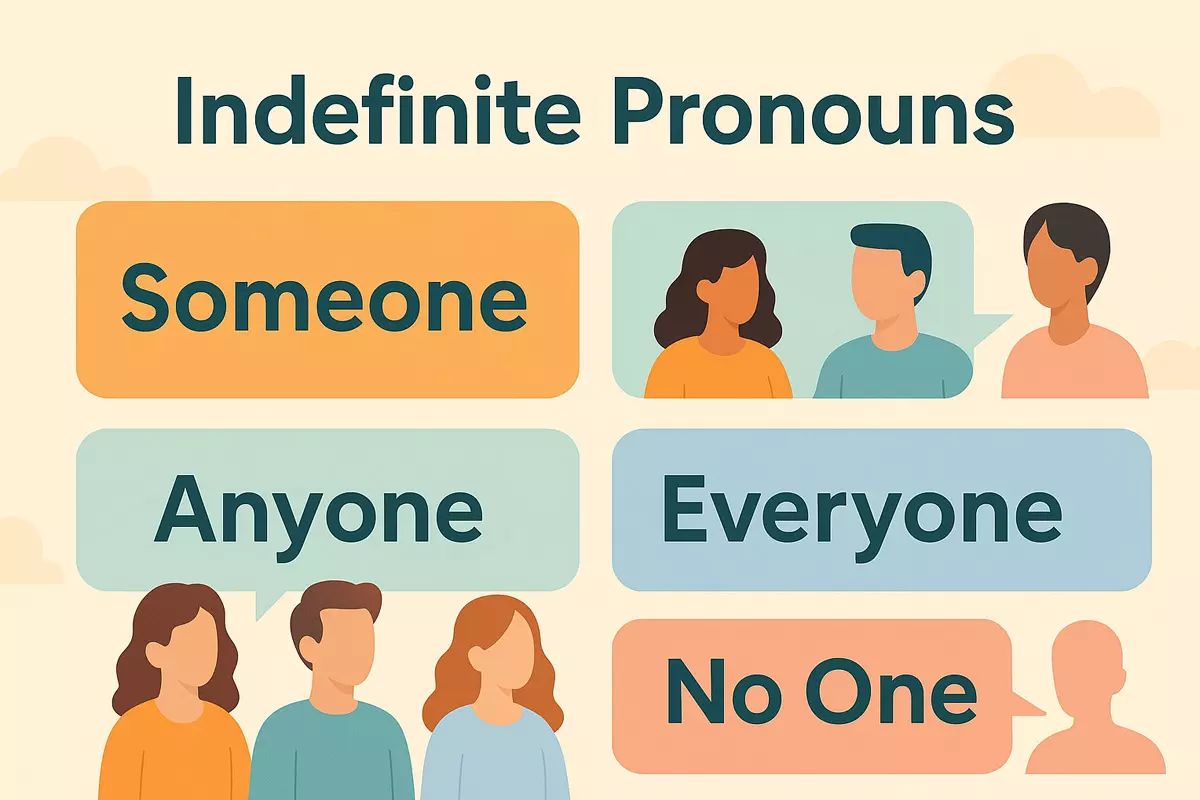 This article explains indefinite pronouns, comparing positive and negative forms like someone, anyone, everyone, no one, and nobody. It discusses formal and informal usage, common mistakes, and includes practice exercises for clarity.
Indefinite pronouns such as somebody, anybody, everybody, and nobody are useful when you want to talk about people in a general way without mentioning anyone specific. These words help you refer to an unknown or nonspecific person or group, making your speech or writing less awkward and more fluid. For example, if you say, “Anybody can join the club,” you mean it is open to all, without naming individuals. Using indefinite pronouns correctly not only makes your communication clearer but also allows you to express ideas in a more natural and concise manner.
What Are Indefinite Pronouns?
Indefinite pronouns are words used to refer to people, things, or amounts in a non-specific way. Instead of naming a particular person or object, these pronouns point to something general or unknown. For example, in the sentence “Someone left their umbrella,” the word “someone” stands for an unidentified person.
How Indefinite Pronouns Work
These pronouns are useful when the speaker does not know or does not need to specify exactly who or what is being discussed. They are common in both spoken and written English, helping to keep conversations and sentences fluid and natural. Indefinite pronouns can refer to singular or plural entities, and some can be either, depending on context.
Common Types and Examples
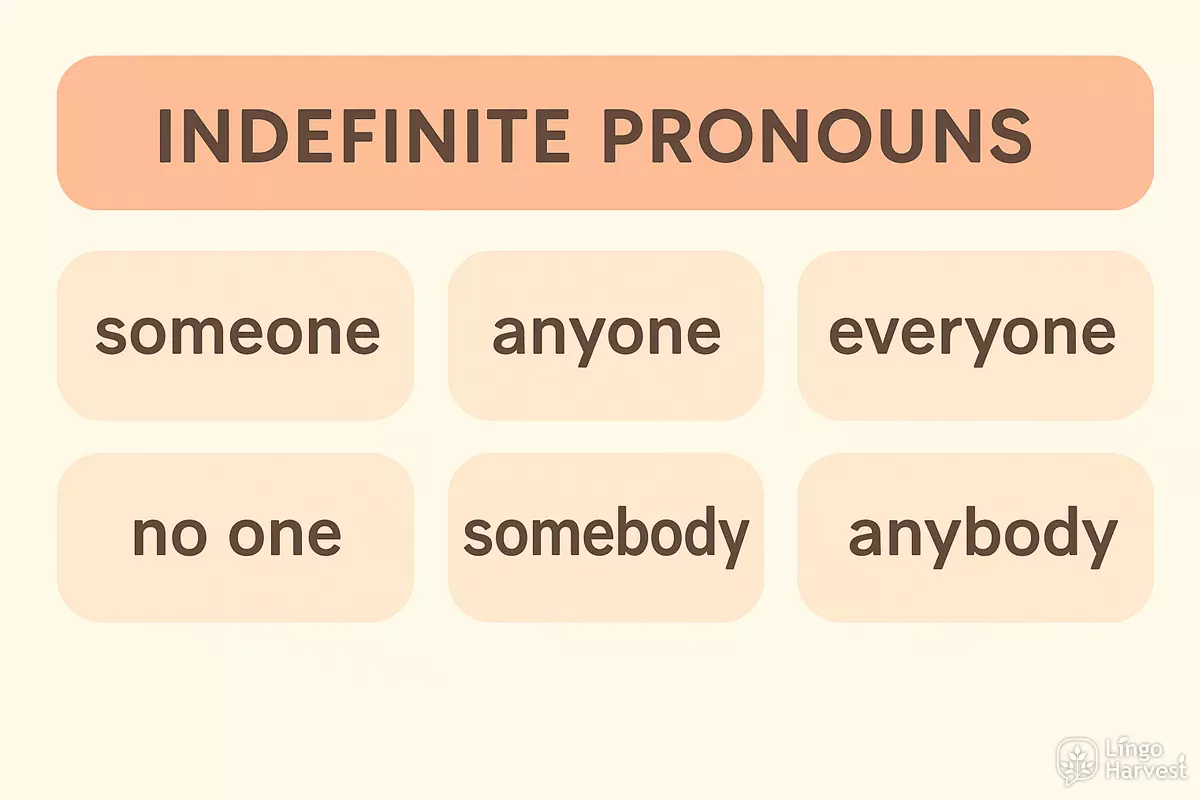
Here are some of the most frequently used indefinite pronouns:
- someone
- anyone
- everyone
- no one
- somebody
- anybody
- everybody
- nobody
- something
- anything
- everything
- nothing
- each
- either
- neither
- one
- all
Singular vs. Plural Usage
Most indefinite pronouns are treated as singular, such as “everyone” or “someone.” However, some can be plural or even both, depending on the context. “All” and “some” are good examples—they can refer to singular or plural nouns.
| Pronoun | Typical Usage | Example Sentence |
|---|---|---|
| everyone | Singular | Everyone is welcome. |
| someone | Singular | Someone left a message. |
| all | Singular/Plural | All are invited. / All is well. |
| none | Singular/Plural | None is missing. / None are missing. |
| both | Plural | Both are correct. |
Why Use Indefinite Pronouns?
These pronouns are practical for keeping statements general, avoiding unnecessary details, or when specific information is unavailable. They are also helpful in forming questions (“Has anybody seen my keys?”) and making negative statements (“Nobody knows the answer”). By using them, communication stays flexible and efficient.
Positive vs Negative Forms
Understanding how indefinite pronouns shift in meaning based on context is essential. Words like someone, anyone, everyone, and no one can express both affirmative and negative ideas, depending on sentence structure and intent. Let’s explore how these forms are used in everyday English.
Affirmative and Negative Usage
Some pronouns naturally carry a positive sense (such as someone and everyone), while others are associated with negative meaning (no one). The choice depends on what you want to communicate: presence or absence, possibility or impossibility.
- Someone – refers to an unspecified but existent person (affirmative): “Someone is at the door.”
- Anyone – can mean ‘any person at all’ (often in questions or negatives): “Is anyone home?” / “I didn’t see anyone.”
- Everyone – means ‘all people in a group’: “Everyone enjoyed the party.”
- No one – means ‘not a single person’: “No one answered the phone.”
Comparison Table: Meaning and Typical Contexts
| Pronoun | Typical Meaning and Use |
|---|---|
| Someone | Affirmative; at least one person exists or is involved. “Someone left their umbrella.” |
| Anyone | Neutral/Negative; any person, often in questions and negatives. “Did anyone call?” / “I don’t know anyone here.” |
| Everyone | Affirmative; all people in a group. “Everyone must sign the form.” |
| No one | Negative; not a single person. “No one knows the answer.” |
Quick Reference: Sample Sentences
To clarify how context determines meaning, here are varied examples:
- Someone forgot their bag.
- Is anyone coming to the meeting?
- Everyone passed the exam.
- No one can solve this puzzle.
- I don’t know anyone in this city.
- Did anyone see what happened?
- Everyone needs to arrive on time.
- No one wants to be late.
- Someone should help her.
- Was anyone else invited?
- Everyone has a different opinion.
- No one was injured.
- Anyone can learn to swim.
- Someone will answer your question.
- No one believed the story.
- Everyone agreed with the decision.
Tips for Choosing the Right Pronoun
- Use someone or everyone for positive statements.
- Select anyone in questions or negatives to refer to people in general.
- Pick no one when talking about the absence of people.
- Remember that double negatives (e.g., “I don’t know no one”) are incorrect in standard English.
By paying attention to these patterns, you can make your speech and writing clearer and more precise.
Someone / Anyone / Everyone: Real-Life Usage
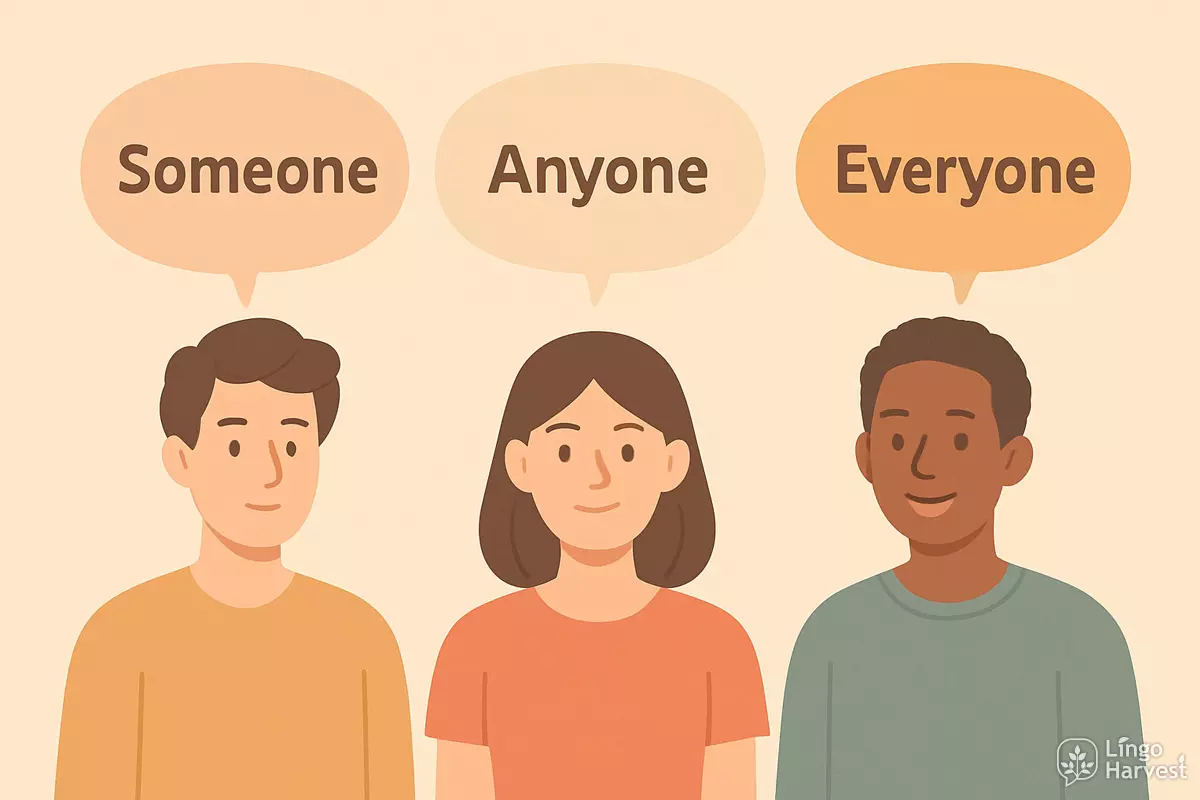
Understanding how to use indefinite pronouns like someone, anyone, and everyone in everyday English is essential for natural communication. These words help us refer to people in general without being specific. The choice among them depends on context, especially on whether we mean a specific but unknown person, any person at all, or all people in a group.
Patterns and Contexts
Each pronoun has its own typical situations. Here are some common usage patterns:
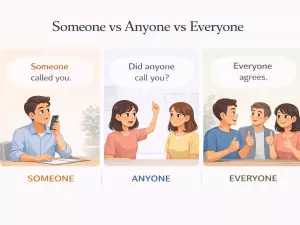
- Someone is used when you mean a particular, but unidentified, person. Example: “Someone left their umbrella.”
- Anyone is more general and is often used in questions or negative sentences. Example: “Is anyone coming to the meeting?”
- Everyone refers to all people in a group. Example: “Everyone enjoyed the concert.”
Practical Examples
To illustrate how these pronouns function in real conversations and writing, see the collection of sample sentences below. Notice how the meaning changes depending on which word is chosen:
- Could someone help me with this box?
- Is anyone sitting here?
- Everyone needs to bring their ID.
- Someone has been calling all morning.
- Anyone can join the club.
- Everyone was excited about the news.
- Did anyone see my keys?
- Someone should tell her the truth.
- Everyone must wear a badge.
- Has anyone finished the assignment?
- Someone forgot to lock the door.
- Everyone was invited to the party.
- If anyone needs help, let me know.
- Someone is at the door.
- Everyone agreed with the decision.
- Can anyone solve this problem?
Usage Comparison Table
| Pronoun | Typical Contexts & Examples |
|---|---|
| Someone | Refers to one unidentified person (often positive statements or offers): → “Someone left their bag here.” |
| Anyone | Refers to any person (often in questions, negatives, or offers): → “Does anyone know the answer?” → “You can ask anyone for help.” |
| Everyone | Refers to all people in a group (statements about groups): → “Everyone is welcome.” |
Quick Tips
- Use someone when you expect a specific person, even if you don’t know who.
- Choose anyone when the identity does not matter, especially in questions or negatives.
- Everyone is for making statements about a whole group, not just one or some people.
Getting comfortable with these pronouns will make your English sound more fluent and accurate in both formal and informal settings.
No One vs Nobody
Both no one and nobody are indefinite pronouns used to refer to the absence of any person. They mean the same thing and are generally interchangeable in most contexts. However, some subtle differences in formality, style, and usage can influence which is preferred.
Formality and Tone
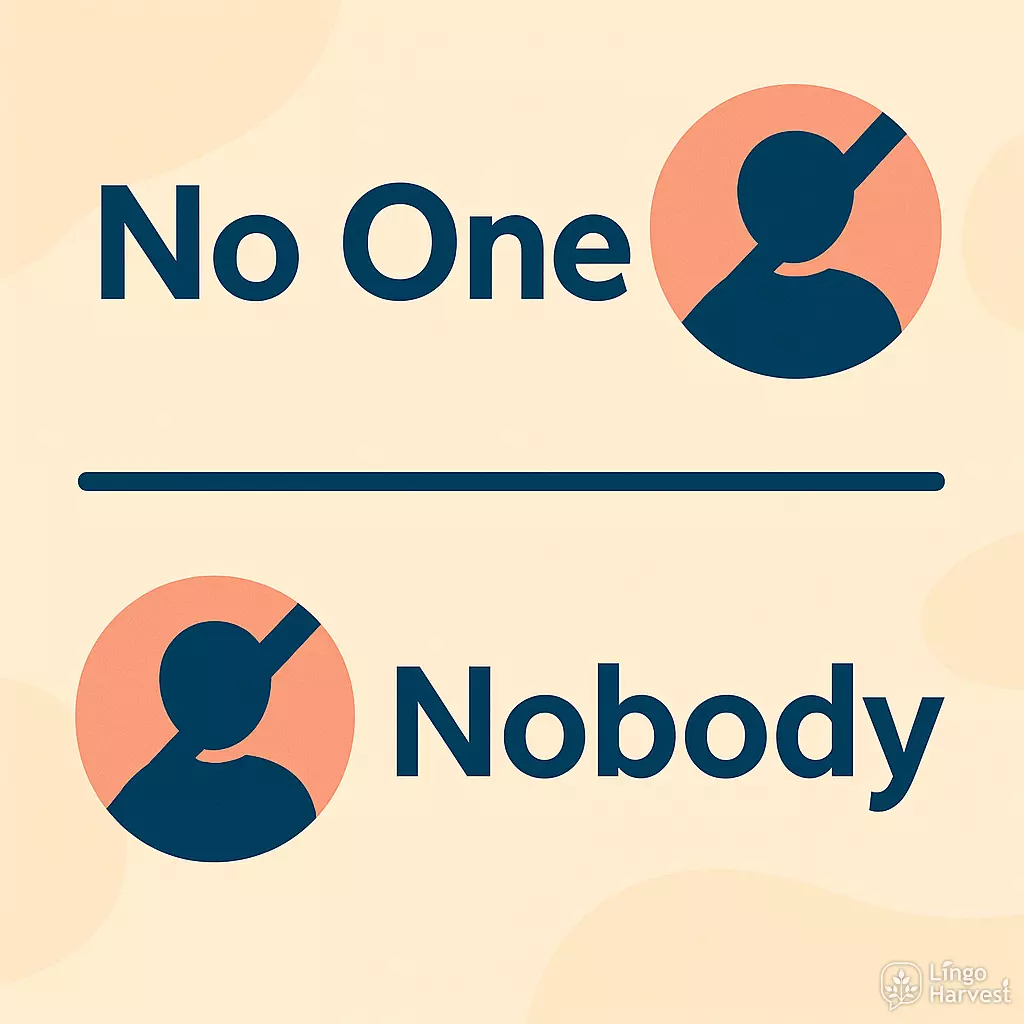
No one is often considered slightly more formal or neutral, making it common in written English, academic texts, and polite conversation. Nobody tends to sound a bit more casual or conversational. In spoken English, both are widely used, but personal preference and context usually guide the choice.
Spelling and Structure
- No one is always written as two words. "Noone" is incorrect.
- Nobody is a single word.
Usage in Sentences
These pronouns can start a sentence, serve as the subject, or appear after verbs. Both take singular verbs:
- No one knows the answer.
- Nobody was in the room.
- I called, but nobody answered.
- No one noticed the mistake.
Common Contexts and Collocations
In some phrases, one form may sound more natural than the other. For example, set expressions or idioms may favor "nobody" (e.g., "nobody's perfect"). In questions or negative statements, both are possible:
- Did no one see what happened?
- Did nobody call you?
- No one ever visits that place.
- Nobody has finished the work yet.
| Pronoun | Typical Contexts & Notes |
|---|---|
| No one | More formal; used in writing; never one word; fits official or academic contexts. |
| Nobody | More informal; common in speech; idiomatic uses ("nobody's business"). |
| Both | Can be the subject of a sentence; always use singular verbs; interchangeable in most cases. |
| Avoid | Do not use "noone" (incorrect spelling). |
Summary List: Key Points
- Both mean "not a single person."
- "No one" is two words; "nobody" is one.
- Personal preference and context often decide which to use.
- Both take singular verbs: "No one is," "Nobody was."
- Do not use "noone."
- Some fixed expressions favor "nobody."
- Both are indefinite pronouns for people only.
- Rarely used as the object; more common as subjects.
- Interchangeable in questions and negatives.
- Subtle tone differences: "no one" (formal), "nobody" (informal).
Formal vs Informal Preference
When choosing between indefinite pronouns like "someone," "anyone," "everyone," and "no one," the context—whether formal or casual—often determines which word fits best. In more official or academic writing, certain pronouns may sound more appropriate, while everyday conversation tends to favor others.
Patterns in Formal and Casual English
Writers and speakers often select indefinite pronouns based on the level of politeness or precision required. For example, "no one" is typically preferred over "nobody" in formal contexts, while "somebody" might feel friendlier or less stiff than "someone" in speech. Similarly, "anyone" is broadly acceptable, but "anybody" might sound more relaxed.
- "Someone" – neutral, slightly formal; preferred in written or official contexts.
- "Somebody" – informal; used in conversation or storytelling.
- "Anyone" – neutral; fits both formal and informal settings, but leans formal in legal or academic documents.
- "Anybody" – informal; common in spoken English.
- "Everyone" – formal and inclusive; often found in speeches and announcements.
- "Everybody" – informal, friendly; used in group settings or casual communication.
- "No one" – formal; preferred in official rules, tests, or policies.
- "Nobody" – informal; more conversational and relaxed.
Comparing Usage by Register
The table below summarizes which indefinite pronouns are typically favored in different types of English, from formal writing to casual speech.
| Indefinite Pronoun | Preferred Context |
|---|---|
| Someone | Formal writing, polite requests, official communication |
| Somebody | Informal conversation, friendly speech, storytelling |
| Anyone | Formal inquiries, instructions, inclusive statements |
| Anybody | Casual questions, spoken English, everyday chat |
| Everyone | Formal addresses, public notices, group references |
| Everybody | Colloquial speech, informal group settings |
| No one | Rules, exam instructions, business or legal documents |
| Nobody | Informal speech, personal anecdotes, familiar exchanges |
Stylistic Considerations
Choosing between these words isn’t always about grammar; it’s also about the image you want to present. For instance, "no one" tends to sound more serious or impersonal, while "nobody" feels more direct and less formal. In job applications or research papers, sticking to the more formal variants is safest. Meanwhile, in friendly emails or chats, the informal options help your tone feel natural and approachable.
Quick Tips for Selection
- Use "someone" and "anyone" for clarity and professionalism.
- Pick "somebody" or "anybody" to sound relatable or casual.
- Opt for "everyone" or "no one" in official or group settings.
- Favor "everybody" or "nobody" when aiming for a conversational tone.
- When in doubt, default to the more formal version in writing.
By understanding these preferences, you can match your indefinite pronoun choices to the situation, making your communication more effective and appropriate for your audience.
Common Mistakes and Confusion Points
It’s easy to mix up pronouns like “someone,” “anyone,” “everyone,” and “no one,” especially for learners who are used to different structures in their native languages. These words look similar but have subtle differences in use and meaning. Let’s clarify some of the typical slip-ups and areas of uncertainty.
Mixing Up “Someone” and “Anyone”
Learners often use “someone” and “anyone” interchangeably, but they aren’t always substitutes. “Someone” refers to a specific but unknown person, while “anyone” means any person at all, with no specificity.
- Someone knocked on the door. (A particular, unidentified person)
- Anyone can answer this question. (It doesn’t matter who)
Confusing “No One” with “Anyone” or “Someone”
Mistakes happen when people use “no one” instead of “anyone” or vice versa, especially in negative sentences. Remember, “no one” already has a negative meaning, so it doesn’t pair with “not.”
- Incorrect: Not no one came to the party. ❌
- Correct: No one came to the party. ✅
Double Negatives
In English, double negatives are generally incorrect with these pronouns. For example, saying “I didn’t see no one” is not standard; it should be “I didn’t see anyone” or “I saw no one.”
Indefinite Pronouns in Questions
A common confusion is which pronoun to use in questions. “Anyone” is standard in most questions, not “someone.”
- Correct: Is anyone here? ✅
- Incorrect: Is someone here? (unless you expect a specific unknown person) ❌
Subject-Verb Agreement
These pronouns are always singular, even though they refer to people in general. Errors happen when people use plural verbs with them.
- Incorrect: Everyone are happy. ❌
- Correct: Everyone is happy. ✅
Summary Table: Typical Usage and Errors
| Pronoun | Typical Error / Confusion |
|---|---|
| Someone | Used in questions where “anyone” fits better; e.g., “Did someone call me?” (when you don’t know if anyone called) |
| Anyone | Used in affirmative sentences instead of “someone”; e.g., “Anyone is at the door.” (should be “Someone is at the door.”) |
| Everyone | Incorrect plural verb: “Everyone know the answer.” (should be “knows”) |
| No one | Double negative: “Didn’t no one arrive.” (should be “No one arrived” or “Didn’t anyone arrive?”) |
Quick Reference: Common Errors to Avoid
- Don’t use “no one” with “not” or another negative.
- Don’t use plural verbs with these pronouns.
- Use “anyone” in most questions and negatives.
- Use “someone” in affirmative statements, not negatives or general questions.
- Remember: “everyone” = all people, “no one” = zero people.
- Don’t use “anyone” when you mean a specific, unidentified person.
- “No one” and “nobody” are interchangeable, but “anyone” is different.
- Never write “noone” (it’s always “no one”).
- Don’t mix up “everyone” and “every one” (the latter refers to each individual item or person specifically).
- Be careful with word order in negatives: “No one saw him,” not “Saw no one him.”
- Do not use “someone” or “no one” in place of “everyone” when you mean all people.
- Don’t use “no one” where “anyone” is required in negatives or questions.
- Remember to capitalize “No one” at the start of a sentence, not “Noone.”
- “Anyone” can be used in conditionals: “If anyone calls, let me know.”
- “Someone” often suggests expectation; “anyone” is open-ended.
By keeping these patterns and distinctions in mind, you can avoid the most frequent pitfalls and use these indefinite pronouns naturally in speech and writing.
Practice
Understanding how to use indefinite pronouns like "someone," "anyone," "everyone," and "no one" can make your English more natural and precise. Below, you'll find exercises, example sentences, and a table comparing these words in different contexts.
Fill in the Blanks
Choose the correct word ("someone," "anyone," "everyone," or "no one") for each sentence:
- ________ left their umbrella in the hallway.
- Is there ________ who can help me with this problem?
- ________ was at the meeting; it was very crowded.
- ________ answered when I knocked on the door.
- If ________ needs extra paper, please let me know.
- Did you see ________ you know at the party?
- ________ likes being ignored.
- ________ knows the answer to this question.
- There is ________ in the room right now.
- ________ can join the club; there are no restrictions.
Show answers
- Someone
- anyone
- Everyone
- No one
- anyone
- anyone
- No one
- Someone / Everyone (context dependent, but "Everyone" is most likely)
- No one
- Anyone
Usage Comparison Table
| Indefinite Pronoun | Common Usage Example | Meaning |
|---|---|---|
| Someone | Someone called you earlier. | One unknown person (positive statement) |
| Anyone | Is anyone home? | Any person, often in questions/negatives |
| Everyone | Everyone enjoyed the show. | All people in a group |
| No one | No one was late today. | Not a single person |
Quick Check: Identify the Pronoun
- Used for a positive statement, but the person is unknown: ________
- Refers to all people in a group: ________
- Used in questions or negatives to mean "any person": ________
- Means "not a single person": ________
Show answers
- Someone
- Everyone
- Anyone
- No one
Make Your Own Sentences
Try creating sentences with each pronoun. For example:
- Someone left the lights on.
- Has anyone seen my keys?
- Everyone is invited to the meeting.
- No one knows the answer.
Write at least one original sentence for each word to reinforce your understanding.