Pronouns in Real Life: The Quick Trick to Sound Natural

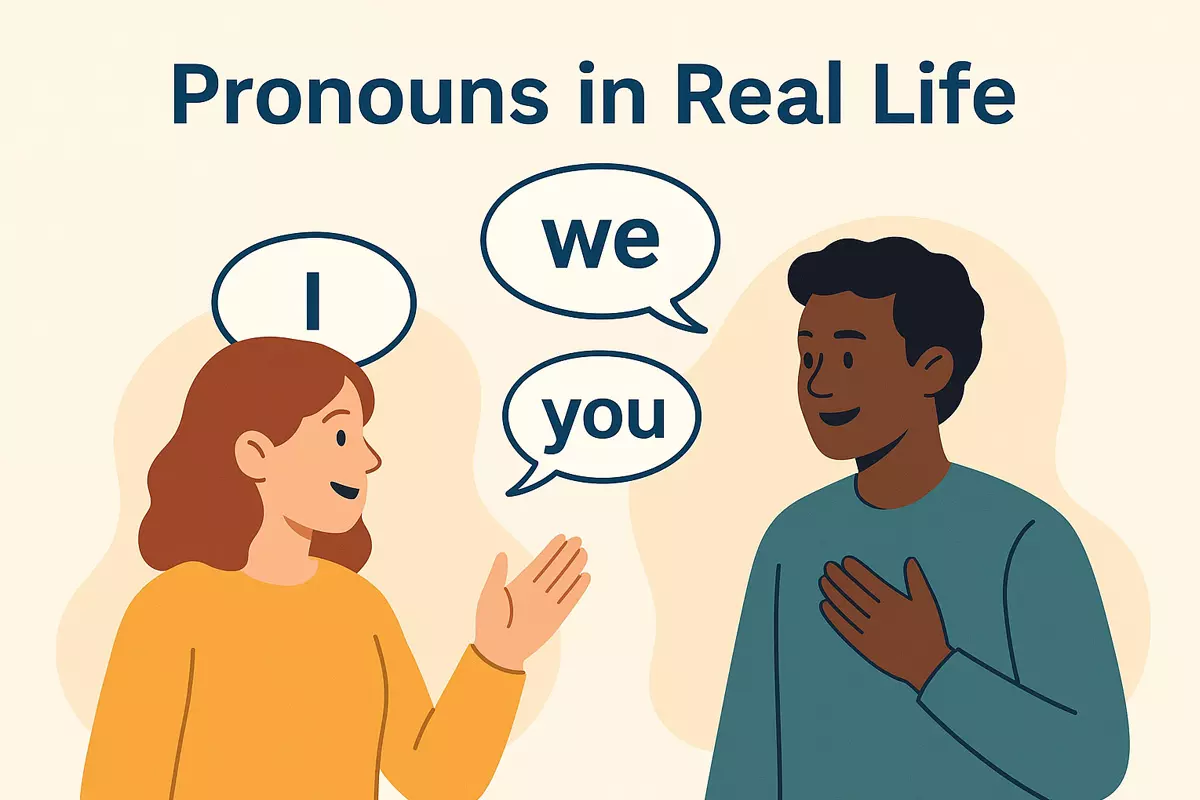 This article explains how to use pronouns in everyday situations, choose the right pronoun for clarity, use contractions and singular they, avoid ambiguous references, fix common mistakes, and practice with mini dialogues.
Have you ever noticed that some conversations feel natural while others seem uncomfortable? Using the correct small words, such as he, she, or they, can have a significant impact on how smoothly your interactions go. Paying attention to these simple pronouns is often the key to sounding confident and making others feel understood. By mastering these everyday terms, you can help ensure your conversations flow easily and leave a positive impression on the people you talk to.
Everyday Situations for Pronouns
Mastering pronouns means understanding how they show up in real conversations, texts, and daily interactions. Whether you’re chatting with friends, writing emails, or giving directions, these small words help your speech flow naturally and avoid awkward repetition.
Typical Moments When Pronouns Matter
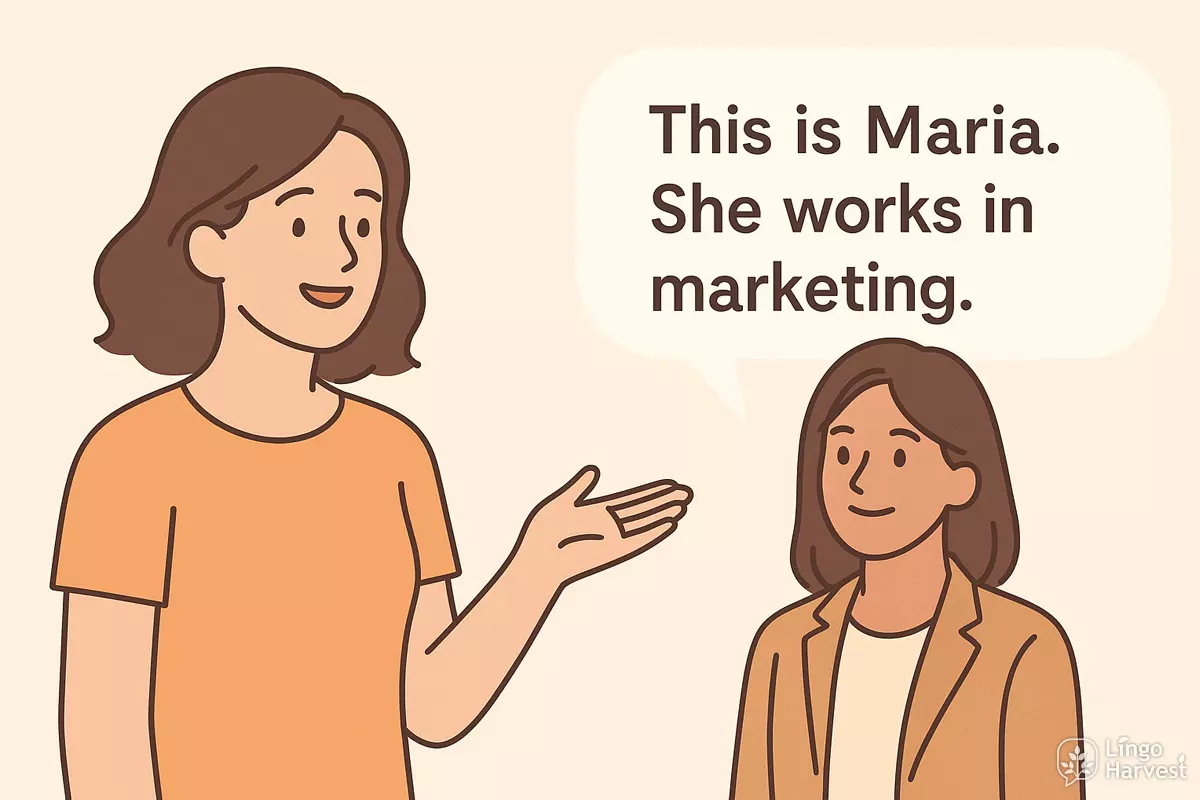
- Introducing yourself or others: “This is Maria. She works in marketing.”
- Describing possessions: “Is this your pen? No, it’s mine.”
- Telling stories: “He went to the store, and then he called me.”
- Giving instructions: “Turn it off when you leave.”
- Making requests: “Could you help me with this?”
- Expressing opinions: “I think they’re right.”
- Clarifying references: “Which book? The one that’s on the table.”
- Apologizing or thanking: “Sorry, I didn’t see you there.”
- Asking questions: “Who did you meet yesterday?”
- Talking about groups: “We should start now.”
- Referring to indefinite people: “Someone left their umbrella.”
- Giving directions: “Take this road until you see it.”
- Making comparisons: “She is taller than him.”
- Describing routines: “He always brings his lunch.”
- Sharing experiences: “We enjoyed ourselves at the party.”
- Talking about feelings: “They feel excited about the trip.”
- Replacing names for variety: “Alex said he’d call.”
- Summarizing: “That’s it for today.”
Common Pronoun Swaps in Context
Choosing the right word can make your sentences clearer and more engaging. Here’s a look at how different forms fit into everyday patterns:
| Situation | Example with Pronoun |
|---|---|
| Talking about yourself | I am going to the meeting. |
| Referring to someone else | She brought her laptop. |
| Including the listener | We can start when you’re ready. |
| Discussing objects | It needs to be fixed. |
| Describing groups | They finished their work. |
Choosing the Right Pronoun for Clarity
Selecting the most appropriate pronoun in conversation or writing can make your message much easier to follow. When you use the wrong form, your listener or reader might become confused about who or what you’re referring to. To avoid this, it’s helpful to know the basic types of pronouns and their common pitfalls.
Common Types of Pronouns
- Subject pronouns: I, you, he, she, it, we, they
- Object pronouns: me, you, him, her, it, us, them
- Possessive pronouns: mine, yours, his, hers, its, ours, theirs
- Reflexive pronouns: myself, yourself, himself, herself, itself, ourselves, yourselves, themselves
- Demonstrative pronouns: this, that, these, those
- Relative pronouns: who, whom, whose, which, that
- Indefinite pronouns: anyone, everyone, someone, nobody, each, both, few, many, several
Tips for Picking the Best Pronoun
- Match the pronoun to its clear noun reference. If there’s any doubt, restate the noun.
- Avoid using “they” or “it” until you’ve introduced what these words refer to.
- Make sure the pronoun agrees in number (singular/plural) and gender if relevant.
- When talking about yourself and others, use “I” last in lists: “Sarah, John, and I went.”
- Don’t mix subject and object pronouns: say “between you and me,” not “between you and I.”
Examples: Clear vs. Unclear References
| Unclear Pronoun Use | Clear Pronoun Use |
|---|---|
| When Anna gave Sarah her book, she thanked her. | When Anna gave Sarah her book, Sarah thanked Anna. |
| They said it would rain, but they didn’t say when. | The weather report said it would rain, but didn’t say when. |
| After the party, they left early. | After the party, the guests left early. |
| Put it on the table. | Put the vase on the table. |
Quick Reference: Pronoun Agreement
- Each student must bring his or her notebook. ✅
- Each student must bring their notebook. (Informal, increasingly accepted) ✅
- Everyone needs his or her ID. ✅
- Everyone needs their ID. (Informal, common in speech) ✅
- The team lost its game. ✅
- The team lost their game. (British English, collective noun) ✅
When you take a moment to double-check which pronoun you’re using and what it refers to, your communication becomes much more natural and easy to understand. This small habit helps your speech and writing flow smoothly, showing respect for your listener or reader.
Contractions and Short Answers (I'm/you're/he's)
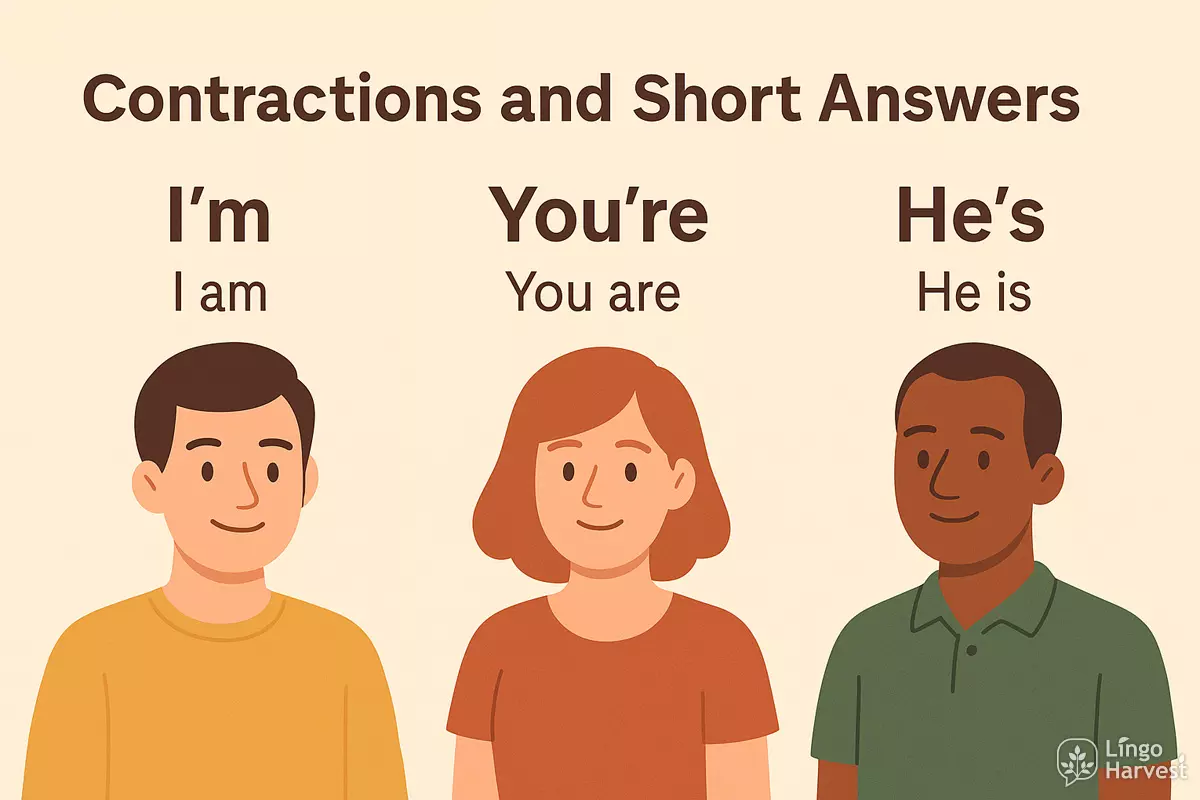
Using shortened forms like "I'm," "you're," and "he's" is one of the quickest ways to sound more fluent and relaxed in English conversations. These contracted forms show up everywhere in everyday speech, making your language flow naturally and efficiently. Native speakers almost always prefer these combinations in casual dialogue, and they’re key to sounding less formal and more approachable.
Why Use Shortened Forms?
Contractions help your sentences sound less stiff and more like real-life conversations. Instead of saying "I am ready," you’ll usually hear "I'm ready." This tiny change makes your English sound friendlier and more spontaneous. In addition to full sentences, short answers are often used to reply quickly or confirm information without repeating the whole sentence.
Common Examples in Context
It’s helpful to see how these forms appear in both statements and quick replies. Here are some of the most common:
- I'm hungry. → Are you? Yes, I am.
- You're late. → Sorry, I am.
- He's busy. → Yes, he is.
- She's here. → No, she isn't.
- We're finished. → Yes, we are.
- They're coming. → No, they aren't.
- It's raining. → Yes, it is.
- I'm not sure. → Neither am I.
- You're right. → Yes, I am.
- He's not home. → No, he isn't.
- We're not ready. → No, we aren't.
- They're not here. → No, they aren't.
Patterns for Quick Responses
When someone asks a yes/no question or makes a statement about you or someone else, you can use these short replies:
- Yes, I am. / No, I'm not.
- Yes, you are. / No, you aren't.
- Yes, he is. / No, he isn't.
- Yes, she is. / No, she isn't.
- Yes, we are. / No, we aren't.
- Yes, they are. / No, they aren't.
Contraction Forms at a Glance
| Full Form | Contracted Form |
|---|---|
| I am | I'm |
| You are | You're |
| He is | He's |
| She is | She's |
| We are | We're |
| They are | They're |
| It is | It's |
| I am not | I'm not |
| He is not | He isn't / He's not |
| We are not | We aren't / We're not |
When to Use Each Form
In spoken English, using contractions is almost always the default, especially among friends, family, or colleagues. Full forms are reserved for emphasis, formality, or clarity. Short answers also help you sound decisive and avoid awkward repetition. If you want to sound natural, practice using these forms in your daily conversations.
Using They for One Person (singular they)
Many people use "they" and "them" to refer to a single individual, especially when someone's gender is unknown, irrelevant, or when a person requests it as their pronoun. This approach helps keep language inclusive and respectful without making assumptions. For example, if someone found a wallet and you don’t know who it belongs to, you might say, “Someone left their wallet here. I hope they come back for it.”
Why Use Singular "They"?
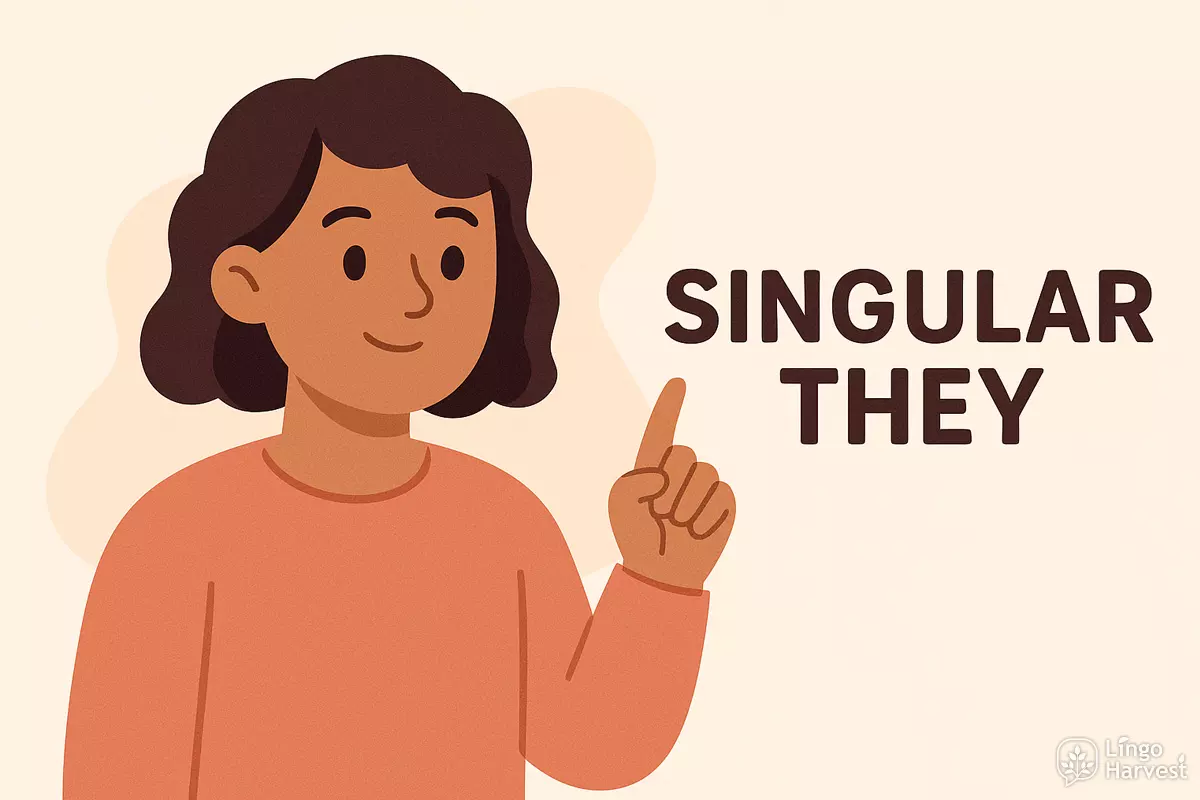
Referring to one person with "they" is not new; it’s been part of English for centuries. It avoids awkward constructions like “he or she,” and acknowledges nonbinary identities. Many style guides and dictionaries now recognize this usage as grammatically correct.
Common Situations for Singular "They"
- When a person’s gender is unknown: “If anyone calls, tell them I’ll call back.”
- For nonbinary individuals: “Alex said they’ll join us at 6.”
- To avoid specifying gender: “Each student should submit their assignment.”
- When talking about hypothetical or general people: “A good friend listens when they’re needed.”
Examples: Sentences with Singular "They"
- “Someone left their umbrella here.”
- “Whoever arrives first should let themselves in.”
- “Every applicant must submit their resume.”
- “Jordan said they are running late.”
- “I spoke to a doctor, and they recommended rest.”
- “Each participant should bring their own lunch.”
- “Nobody wants to admit they’re wrong.”
- “If a customer asks for help, show them where to go.”
- “Chris told me they’d email later.”
- “Someone parked their car in the wrong spot.”
Quick Comparison: Singular "They" vs. Gendered Pronouns
| Gendered Pronoun | Singular "They" Alternative |
|---|---|
| If a student loses his book... | If a student loses their book... |
| Each employee should submit his or her timesheet. | Each employee should submit their timesheet. |
| Ask the manager if he can help you. | Ask the manager if they can help you. |
| Tell your friend that she is welcome. | Tell your friend that they are welcome. |
Tips for Sounding Natural
- Practice using “they” in everyday conversation, even for people you haven’t met yet.
- Listen for cues about people’s pronouns and respect their preferences.
- Don’t overthink it; most native speakers use singular “they” without realizing.
- When in doubt, default to “they” to avoid assumptions.
Using this approach helps make your language more flexible and considerate—an easy way to sound natural and respectful in real life.
Avoiding Ambiguous Reference
Clear pronoun use is essential for smooth, natural conversation. When a pronoun like "he," "she," "it," or "they" could refer to more than one person or thing, listeners may get confused. To keep your speech or writing easy to follow, always make sure it’s obvious what your pronoun is replacing.
Why Ambiguity Happens
Ambiguity often arises when several nouns appear close together, and a pronoun could point to any of them. This is common in both spoken and written English, especially in stories or instructions with multiple subjects.
- Two people, one pronoun: If you mention Anna and Emily, then say "She went to the store," it’s not clear who you mean.
- Multiple objects: Talking about a car and a bike, then saying "It was red" creates uncertainty.
- Long sentences: The more words between the noun and pronoun, the harder it is for listeners to track.
Simple Fixes for Clarity
You can avoid confusion with a few quick strategies:
- Repeat the noun if there’s any doubt (e.g., "Anna went to the store. Emily stayed home. She made dinner." becomes "Emily stayed home. Emily made dinner.").
- Restructure sentences so the pronoun and its noun are close together.
- Use descriptive phrases, such as "the older dog" or "the blue one," for extra clarity.
- Break up long sentences into shorter ones, assigning each pronoun clearly.
Common Tricky Situations
Here are some everyday scenarios where confusion with pronouns can sneak in:
- Describing actions involving two people: "Tom called Jake while he was driving." (Who was driving?)
- Instructions: "Put the book on the table and open it." (Open the book or the table?)
- Storytelling: "Maria told Anna that her car was ready." (Whose car?)
- Email replies: "I spoke to Sam about the meeting, and he said he couldn’t make it." (Which 'he'?)
Quick Reference: Ambiguous vs. Clear Examples
| Unclear Reference | Clear Reference |
|---|---|
| When Jack met Mark, he was tired. | When Jack met Mark, Jack was tired. |
| Sara gave Mia her book. | Sara gave her own book to Mia. |
| The vase was beside the lamp, but it broke. | The vase was beside the lamp, but the vase broke. |
| Lisa called Jen while she was at work. | Lisa called Jen while Jen was at work. |
| Put the pan on the stove and heat it. | Put the pan on the stove and heat the pan. |
Tips for Natural Pronoun Use
- Check each pronoun: Ask yourself, "Could this refer to more than one thing?"
- Read sentences aloud; confusion is easier to spot when you hear it.
- Be especially careful with "it" and "they" in complex sentences.
- When in doubt, use the noun again—natural speech often repeats for clarity.
- In emails and texts, short, clear sentences prevent misunderstandings.
Using these approaches helps keep your communication smooth and your meaning unmistakable, letting your pronouns work for you—not against you.
Common Mistakes and Fixes
Missteps with pronouns often make speech sound awkward or unclear. Recognizing where we slip up is the first step toward sounding more fluent and natural. Let’s look at frequent errors and practical solutions.
Mixing Up Subject and Object Forms
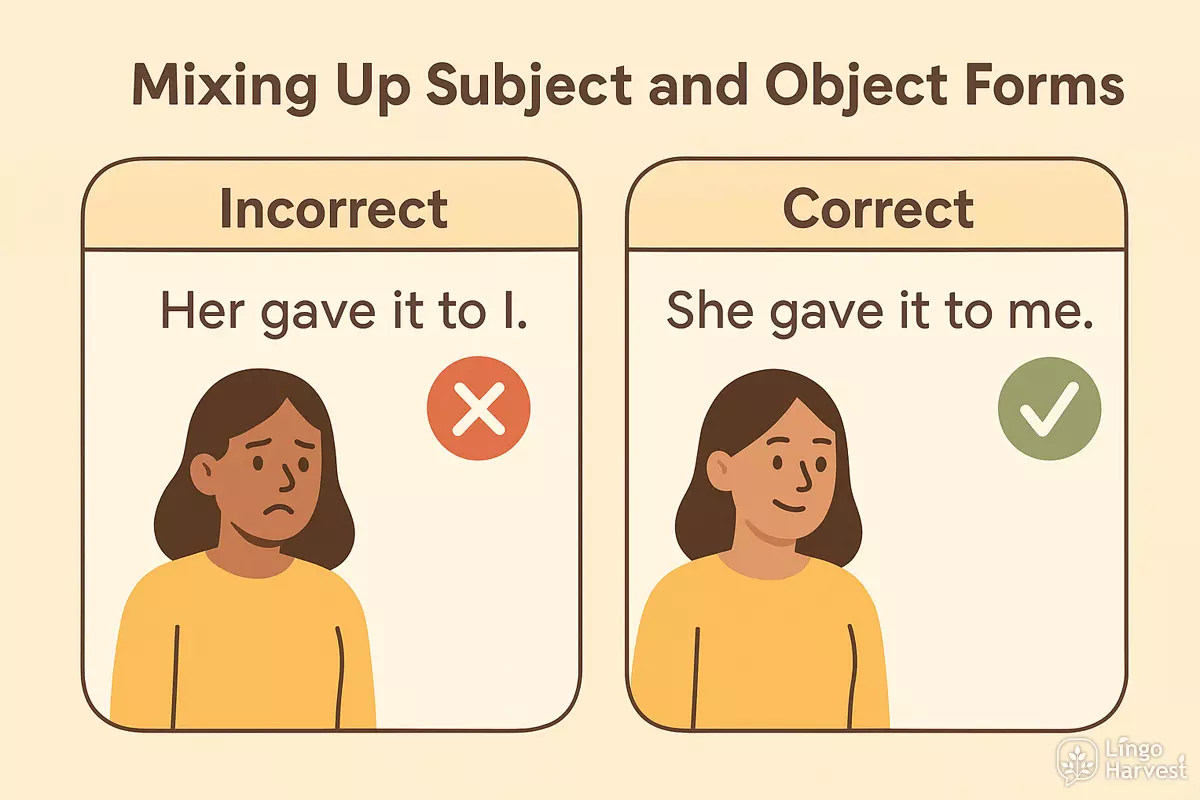
Using the wrong form—like saying “Me and him went” instead of “He and I went”—is a common pitfall. The subject form (I, he, she, we, they) is for the person doing the action, while the object form (me, him, her, us, them) receives the action.
- Incorrect: Her gave it to I.
- Correct: She gave it to me.
- Incorrect: Us will call you.
- Correct: We will call you.
Ambiguous References
Pronouns need clear references. If it’s not obvious who or what “they” or “it” refers to, listeners can get confused.
- Vague: When Sam met Alex, he smiled.
- Clear: When Sam met Alex, Sam smiled.
Using “They” for Singular People
Some struggle with singular “they,” especially when talking about someone whose gender isn’t known. While “they” is accepted, older grammar rules may trip people up.
- Natural: Someone left their bag here.
- Less natural: Someone left his or her bag here.
Pronoun Agreement Errors
Pronouns must agree in number and gender with their antecedents.
- Incorrect ❌: Each student must bring their pencil.
- Correct ✅: Each student must bring his or her pencil. (Formal, but “their” is common in speech)
- Incorrect ❌: The team lost their game. (If “team” is singular)
- Correct ✅: The team lost its game.
Overusing Pronouns
Repeating “he,” “she,” or “it” too much can make sentences sound robotic or unclear. Vary your language by using names or descriptions occasionally.
Quick Reference Table: Tricky Pronoun Pairs
| ❌ Incorrect | ✅ Natural Alternative |
|---|---|
| Me and Sarah are going | Sarah and I are going |
| Between you and I | Between you and me |
| Him and me saw it | He and I saw it |
| Give it to John or I | Give it to John or me |
| Its raining outside | It’s raining outside |
| Who did you see? | Whom did you see? |
Tips for Sounding More Natural
- Listen for pronoun patterns in everyday conversation.
- Read sentences out loud—does it sound right?
- Replace a pronoun with a name to check if the sentence still works.
- Don’t be afraid of singular “they” in informal contexts.
- Practice with varied examples to build confidence.
By watching out for these common slip-ups and applying these quick fixes, you’ll find your English sounding smoother and more natural in no time.
Practice: Mini Dialogues
Short conversations are a great way to see how pronouns work naturally in everyday exchanges. Below, you’ll find a variety of bite-sized dialogues that let you spot, compare, and use personal and possessive pronouns in context. Notice how different speakers refer to themselves and others, sometimes even switching pronoun forms mid-dialogue for clarity or style.
Mini Dialogue Examples
- Anna: Are you coming to the party?
Ben: Yes, I am. Are they invited too? - Lisa: Is this your book?
Mike: No, it's hers. - Tom: We forgot our tickets!
Jill: Don't worry. I have mine. - Sam: Who left their phone here?
Alex: It might be his. - Mom: Can you help me?
Child: Of course, I'll do it for you. - Teacher: Where is your homework?
Student: I gave it to you yesterday. - Emma: This is ours, right?
Olivia: No, theirs is blue. Ours is green. - Dan: Is that seat taken?
Chris: No, you can sit there. - Paul: Who will drive us home?
Sara: He will. - Rob: Did you see my keys?
Jess: I think she has them.
Quick Pronoun Swap Practice
Try replacing the underlined words with the correct pronoun:
- Susan and Tom are ready. Susan and Tom will meet us at 7.
- Is this the cat’s toy?
- Can Mark help with the project?
- The students forgot the students’ books.
Show answers
- They are ready. They will meet us at 7.
- Is this its toy?
- Can he help with the project?
- They forgot their books.
Common Pronoun Mix-Ups
Some pronouns are often confused, especially in quick speech. Here’s a comparison of forms that learners should watch out for:
| Subject Form | Object Form | Possessive Adjective | Possessive Pronoun |
|---|---|---|---|
| I | me | my | mine |
| you | you | your | yours |
| he | him | his | his |
| she | her | her | hers |
| it | it | its | — |
| we | us | our | ours |
| they | them | their | theirs |
Spot the Mistake
Read the following lines and find the incorrect pronoun.
- Me went to the store yesterday.
- This is her car, but she lost hers keys.
- Give it to we, please.
- Is this yours book?
Show answers
- Should be: I went to the store yesterday.
- Should be: she lost her keys.
- Should be: Give it to us, please.
- Should be: Is this your book?
These activities give you practical ways to observe, analyze, and use pronouns as native speakers do, helping you sound more fluent and confident in real conversations.