Ambiguity Repair Strategies in Writing

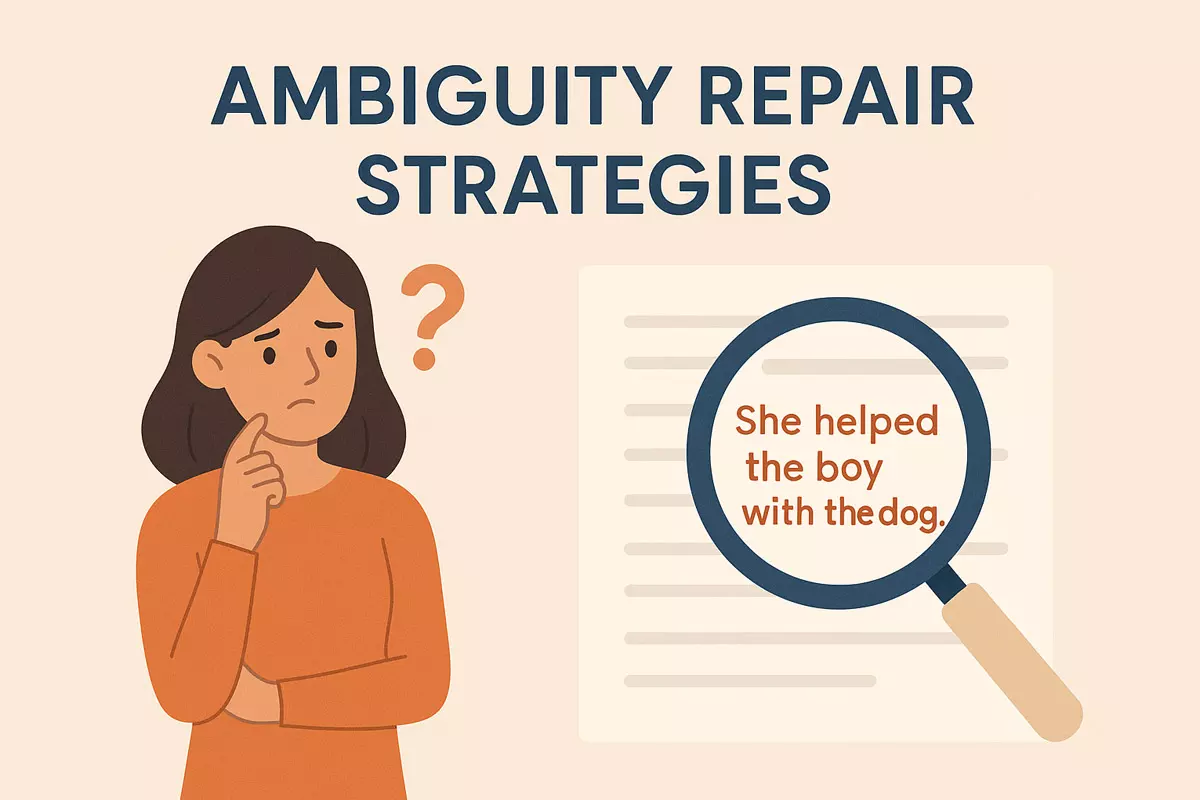 The article defines ambiguity in writing, describes structural and lexical ambiguity, and explains how it weakens clarity. It also offers techniques for removing ambiguity, tips for stronger wording, common traps, and practice with rewriting sentences.
Writers frequently encounter the difficulty of crafting passages that may come across as vague or confusing, which can unintentionally mislead readers and obscure the intended message. To address this challenge, it is essential for writers to develop and apply effective strategies that clarify meaning and enhance the overall readability of their work. Techniques such as revising sentence structure, choosing precise vocabulary, and seeking feedback from others can help ensure that the message is communicated clearly and accurately, allowing readers to fully grasp the writer’s intent.
What Ambiguity Is in Writing
Ambiguity arises when a sentence, phrase, or even a single word can be interpreted in more than one way. In written communication, this means a reader could understand the text differently than the writer intended. Such uncertainty often results from unclear wording, structural issues, or assumptions about shared knowledge. Addressing unclear language is essential for ensuring readers grasp the intended message.
Types of Ambiguity
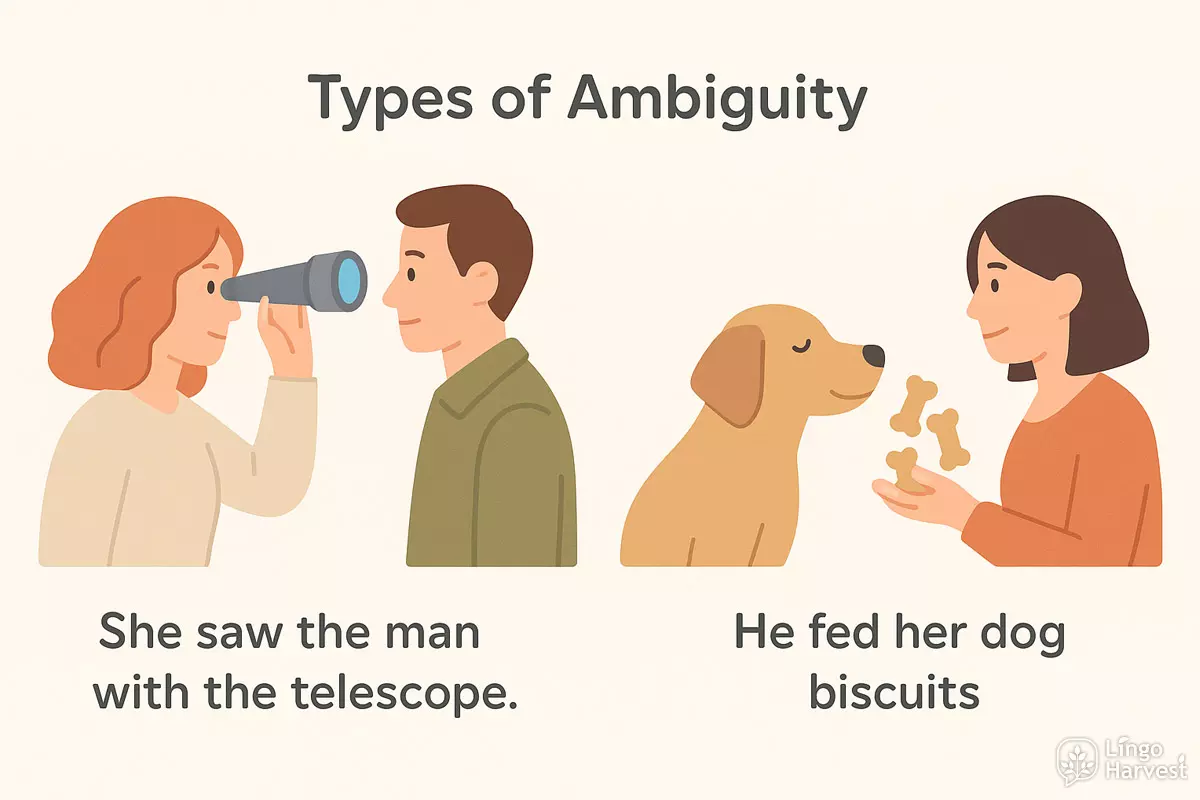
Ambiguity in text can take several forms, each affecting meaning in distinct ways. Recognizing these types can help writers identify and resolve confusing passages.
- Lexical ambiguity: When a word has multiple meanings (e.g., "bank" as a financial institution or river edge).
- Syntactic ambiguity: Ambiguity caused by sentence structure (e.g., "She saw the man with the telescope").
- Semantic ambiguity: When a phrase or sentence has multiple possible interpretations due to meaning (e.g., "He fed her dog biscuits").
- Pragmatic ambiguity: Uncertainty arising from context or assumed knowledge (e.g., "Can you pass the salt?").
- Punctuation ambiguity: Unclear meaning due to missing or misplaced punctuation (e.g., "Let's eat, Grandma" vs. "Let's eat Grandma").
- Referential ambiguity: When it's unclear which noun a pronoun or descriptor refers to (e.g., "The teacher told the student she was late").
- Scope ambiguity: When it’s unclear how much of a sentence an adjective or adverb modifies (e.g., "He only eats vegetables").
- Vagueness: Use of imprecise language that could mean different things to different readers (e.g., "soon," "large amount").
- Elliptical ambiguity: Omission of words that leads to unclear meaning (e.g., "She likes her more than me").
- Structural ambiguity: When the arrangement of words allows for multiple interpretations (e.g., "Old men and women").
Why Ambiguous Writing Occurs
Writers may unintentionally create uncertainty because of rushed drafting, assumptions about shared context, or complex ideas that are hard to condense. Even experienced authors can overlook double meanings or unclear references, especially when familiar with their own subject matter.
Common Signals of Ambiguity
- Confusion or questions from readers
- Multiple possible interpretations of a sentence
- Frequent use of pronouns without clear antecedents
- Sentences that seem awkward or convoluted
- Overuse of vague terms or qualifiers
Understanding these patterns is the first step toward repairing ambiguous passages and improving clarity in writing. Writers who learn to spot and address such issues can communicate more effectively and avoid misunderstandings.
Types of Ambiguity: Structural and Lexical
Understanding the different kinds of ambiguity is key to identifying and repairing unclear writing. Ambiguity generally falls into two main categories: structural (or syntactic) and lexical. Each type can create confusion for readers, but they arise from distinct sources within the sentence.
Structural (Syntactic) Ambiguity
Structural ambiguity happens when a sentence can be interpreted in more than one way due to its syntax or sentence structure. This often results from unclear phrasing, misplaced modifiers, or ambiguous punctuation. For example, the sentence “She saw the man with the telescope” could mean that she used a telescope to see the man, or that the man she saw had a telescope. Writers can reduce structural ambiguity by:
- Reordering words for clarity
- Using punctuation to separate clauses or phrases
- Replacing ambiguous modifiers with more precise language
- Breaking complex sentences into shorter, simpler ones
- Clarifying pronoun references
Lexical Ambiguity
Lexical ambiguity arises when a single word has multiple meanings, and the context doesn’t make it clear which meaning is intended. This is common with homonyms or words with broad definitions. For instance, the word “bank” could refer to a financial institution or the side of a river. Common sources of lexical ambiguity include:
- Homonyms (e.g., bat, bark, lead)
- Polysemy (words with related meanings, e.g., “paper” as material or an academic article)
- Context-dependent vocabulary (e.g., “match” as a contest or a stick for making fire)
- Idiomatic expressions that can be taken literally or figuratively
Writers can address lexical ambiguity by:
- Providing additional context
- Choosing more specific synonyms
- Rephrasing sentences to clarify intended meaning
- Avoiding jargon or technical terms unless defined
Comparison of Structural and Lexical Ambiguity
| Type | Source of Confusion | Typical Example | Repair Strategy |
|---|---|---|---|
| Structural | Sentence structure or syntax | “Visiting relatives can be boring.” | Rewrite or reorder sentence for clarity |
| Lexical | Word with multiple meanings | “He left the bass on the bank.” | Add context or use a more precise word |
Quick Reference: Words Often Causing Lexical Ambiguity
Writers frequently encounter trouble with certain words that have several meanings. Examples include:
- Bat
- Bark
- Lead
- Bank
- Match
- Light
- Fair
- Spring
- Seal
- Set
- Duck
- Ring
- Wave
- Right
- Watch
- Letter
- Park
- File
- Row
- Club
By recognizing and addressing these sources of confusion, writers can make their prose clearer and more effective, reducing misunderstandings for their readers.
Why Ambiguity Weakens Clarity
Ambiguous language muddles meaning and makes it harder for readers to grasp the writer’s intent. When a sentence or phrase can be interpreted in multiple ways, it forces the audience to guess or assume, leading to misunderstandings. This lack of precision slows down comprehension and often causes frustration, especially in contexts where accuracy is essential, such as instructions, legal documents, or academic writing.
Common Sources of Ambiguity
- Vague pronouns (e.g., "it", "they" without clear antecedents)
- Multiple possible referents in a sentence
- Double meanings or homonyms
- Unclear modifiers (e.g., "old friend’s house" vs. "old friend’s house")
- Non-specific quantifiers ("some", "few", "many")
- Imprecise verbs ("do", "get", "make")
- Confusing sentence structure
- Missing context or background information
- Overly broad or general statements
- Idioms that may not translate or be understood literally
- Ambiguous time references ("soon", "later", "recently")
- Unclear subject or agent in passive constructions
- Polysemous words (words with multiple meanings)
- Inconsistent terminology
- Unmarked quotations or dialogue
How Unclear Language Impacts Readers
When readers encounter sentences with more than one possible interpretation, they must pause and puzzle out the intended meaning. This not only disrupts the flow but can also erode trust in the writer’s expertise or reliability. In professional or academic settings, lack of precision may even lead to costly errors or miscommunication.
Direct Comparison: Clear vs. Ambiguous Sentences
| Ambiguous Example | Clear Rewriting |
|---|---|
| She saw the man with the telescope. | She used the telescope to see the man. → OR: She saw the man who had the telescope. |
| They discussed the project with the engineers. | The engineers and they discussed the project together. OR: They talked about the project with the engineers present. |
| He left his book on the table in the hall. | He left his book on the table that is in the hall. OR: He left the book he had in the hall on the table. |
| We will give the prize to the fastest runner in the school. | The fastest runner in the school will receive the prize. OR: The prize will go to the student who runs fastest. |
Consequences of Unresolved Ambiguity
- Reduced reader confidence in the message
- Potential misinterpretation of instructions or facts
- Increased need for clarification or follow-up
- Loss of persuasive impact
- Possible damage to professional credibility
Ultimately, writing that is free of confusion and open-ended language helps ensure the message is understood as intended, fostering stronger communication and minimizing errors.
Techniques to Remove Ambiguous Structures
Clarity in writing often depends on how well sentences are constructed and how precisely ideas are expressed. Ambiguity can creep in through vague pronouns, misplaced modifiers, or unclear references, making it difficult for readers to grasp the intended meaning. Addressing these issues involves a combination of awareness, careful editing, and the application of proven strategies to refine sentence structure and word choice.
Common Approaches for Clarifying Ambiguous Sentences
Writers can use several practical methods to eliminate confusion and enhance readability:
- Specify pronoun references: Replace unclear pronouns with the actual noun they represent.
- Reorder phrases: Move modifying phrases closer to the words they describe.
- Break up long sentences: Divide complex sentences into shorter, clearer ones.
- Choose precise words: Substitute vague terms with specific language.
- Use parallel structure: Ensure lists and comparisons follow a consistent grammatical pattern.
- Clarify conjunctions: Make sure it’s obvious which clauses are being connected.
- Add context: Provide extra information when a term or reference could be interpreted in multiple ways.
- Use punctuation wisely: Insert commas, dashes, or semicolons to separate ideas clearly.
- Check for misplaced modifiers: Confirm that descriptive phrases are right next to what they modify.
- Revise passive voice: Switch to active voice where possible to clarify the agent of action.
- Read aloud: Sometimes, hearing a sentence exposes unintended double meanings.
- Peer review: A second set of eyes can spot ambiguities you might miss.
Resolving Structural Ambiguity: Example Revisions
The following table illustrates how ambiguous constructions can be improved by applying these techniques:
| Ambiguous Sentence | Clear Revision |
|---|---|
| After eating, the dog barked at the mailman. | After the mailman ate, the dog barked. → Who ate? Clarify the subject. |
| She told her friend that she would win. | She told her friend, “You will win.” or She told her friend that she herself would win. |
| Visiting relatives can be annoying. | It can be annoying when relatives visit. or Visiting your relatives can be annoying. |
| He saw the man with a telescope. | Using a telescope, he saw the man. or He saw the man who had a telescope. |
Checklist for Disambiguation
Before finalizing your text, consider these quick checks:
- Are all pronouns clearly linked to their nouns?
- Do modifiers sit next to the words they describe?
- Could any sentence be interpreted in more than one way?
- Is the sequence of actions or ideas logical and easy to follow?
Attention to these details helps ensure your writing is as clear and unambiguous as possible.
Rewriting for Clearer Sentence Logic
Clarifying meaning often means restructuring sentences so that their logical flow is unmistakable. When a sentence is ambiguous, readers can misunderstand who did what, when, or how. Revising for better logic involves more than just fixing grammar; it’s about reshaping the structure so ideas are connected in a straightforward, predictable way.
Common Triggers for Confusing Logic
Writers frequently stumble into unclear logic when sentences:
- Use vague pronouns (“it,” “they,” “this”) without clear antecedents
- Contain multiple possible subjects or actions in a single clause
- Place modifying phrases too far from what they modify
- Rely on passive voice where the subject is important
- List actions or details out of chronological or logical sequence
Practical Techniques for Restructuring Sentences
To make your writing more transparent, try these approaches:
- Specify agents: Always make it clear who is performing the action.
- Reorder information: Place cause before effect, or condition before result, to clarify relationships.
- Break up long sentences: Split complex thoughts into two or more sentences to avoid overload.
- Replace ambiguous words: Swap out pronouns or vague nouns for specific terms.
- Move modifiers: Place descriptive phrases immediately next to what they describe.
- Use transition words: Signal connections with “because,” “however,” “therefore,” etc.
- Eliminate double negatives: Rewrite to state ideas positively for easier understanding.
- Consistent tense and perspective: Maintain the same point of view and verb tense within related sentences.
- Clarify sequences: Present events or steps in the order they occur.
- Read aloud: Hearing the sentence can reveal hidden ambiguities.
- Ask “who did what?”: Ensure that each action in a sentence is clearly assigned to a subject.
- Group related ideas: Keep connected information together to avoid confusion.
Before-and-After Examples of Improved Sentence Logic
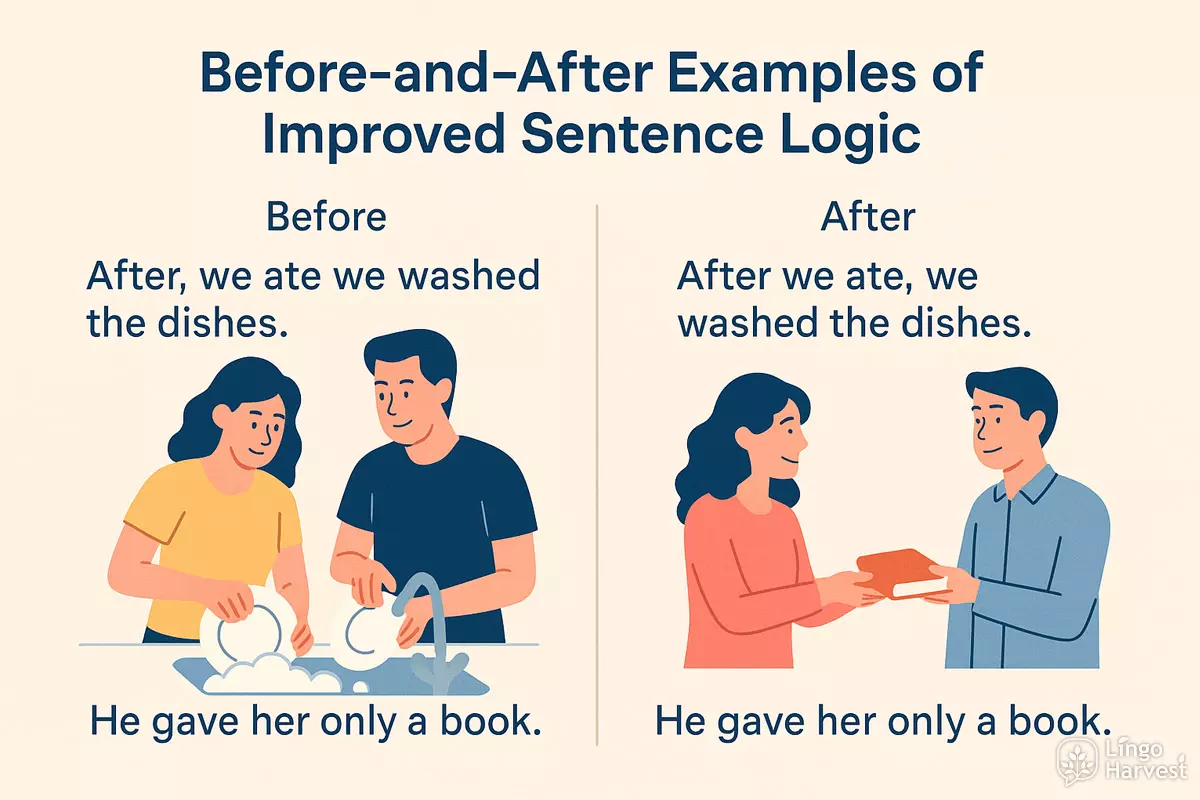
Seeing concrete revisions can help illustrate the impact of these strategies. Here are several examples showing how sentences can be transformed for clarity and logic:
| Original Sentence | Revised for Clear Logic |
|---|---|
| After eating, the dishes were washed. | After we ate, we washed the dishes. |
| The manager told the assistant that she would be promoted. | The manager told the assistant, "You will be promoted." |
| He only gave her a book. | He gave her only a book (and nothing else). |
| Walking down the street, the wallet was found. | Walking down the street, I found the wallet. |
| Because she was late, the meeting started without her. | The meeting started without her because she was late. |
| It was said that the project would finish soon. | The supervisor said the project would finish soon. |
| He promised to call his friend after work, but forgot. | He forgot to call his friend after work, despite his promise. |
| Not everyone disliked the movie. | Some people liked the movie. |
| The report was reviewed by the committee before being sent to the director. | The committee reviewed the report before they sent it to the director. |
| Susan gave her dog a bath wearing pajamas. | While wearing pajamas, Susan gave her dog a bath. |
Checklist for Revising Sentence Logic
When you review your writing, ask yourself:
- Is the agent of each action clear?
- Are ideas presented in a logical order?
- Could any sentence be misread in more than one way?
- Do modifiers sit next to what they describe?
- Are transitions used to show relationships?
With mindful revision, you can ensure your sentences lead readers smoothly from one idea to the next, minimizing confusion and maximizing clarity.
Using Specific Nouns and Strong Verbs
Choosing precise language is one of the most effective ways to clarify meaning and reduce ambiguity in writing. Vague or general terms often leave readers guessing, while exact nouns and vivid verbs make intentions unmistakable. By replacing broad or generic words with concrete alternatives, writers help readers visualize concepts and follow arguments more easily.
Why Precision Matters
Ambiguous words can confuse readers and weaken your message. For example, the word "thing" could refer to an object, idea, event, or even a feeling. Instead, specifying "document," "meeting," or "concern" eliminates uncertainty. Similarly, general verbs like "do" or "make" rarely convey enough action or intent. Swapping them for "assemble," "negotiate," or "draft" gives readers a clearer understanding of the activity.
Examples of Vague vs. Specific Language
- Vague noun: "The animal ran fast." → Specific noun: "The greyhound sprinted."
- Generic verb: "She got the award." → Strong verb: "She earned the award."
- Unclear noun: "They discussed the issue." → Clear noun: "They debated the budget proposal."
- Weak verb: "He went to the store." → Vivid verb: "He dashed to the store."
Common Vague Words and Specific Alternatives
- Thing → device, document, item, artifact, tool
- Stuff → materials, supplies, belongings, ingredients
- Person → engineer, manager, neighbor, classmate
- Do → complete, construct, analyze, repair, organize
- Make → create, assemble, draft, produce, compose
- Get → acquire, obtain, receive, earn, retrieve
- Go → travel, proceed, march, depart, venture
- Put → place, position, install, arrange, attach
- Say → claim, explain, announce, declare, suggest
- Move → shift, transport, relocate, slide, carry
Comparing General and Precise Choices
| General Word | Precise Alternative |
|---|---|
| Thing | Instrument, report, mechanism, artifact |
| Make | Construct, formulate, draft, compose |
| Do | Execute, perform, undertake, resolve |
| Go | Commute, journey, migrate, venture |
| Get | Obtain, retrieve, acquire, secure |
Tips for Choosing the Right Word
- Ask yourself if a more detailed term could replace a general one.
- Consider the action’s intent—does your verb reflect what actually happened?
- Read sentences aloud to spot unclear or weak wording.
- Check if your nouns and verbs help readers picture the situation.
Focusing on concrete nouns and dynamic verbs not only repairs ambiguity but also makes writing more engaging and trustworthy. Readers appreciate clarity and will find your arguments easier to follow when your language leaves little room for misinterpretation.
Common Ambiguity Traps to Avoid
Writers often stumble into vagueness without realizing it, making their texts less clear and potentially confusing for readers. Recognizing the most frequent sources of unclear meaning is the first step toward stronger, more precise communication.
Frequent Sources of Ambiguity
Many unclear passages arise from predictable patterns. Here are several pitfalls to watch out for:
- Vague pronoun references: Using words like "it," "this," or "they" without a clear antecedent.
- Dangling modifiers: Starting a sentence with a descriptive phrase that doesn’t clearly relate to the main clause.
- Unclear subject-verb relationships: Sentences where it's uncertain who is performing the action.
- Ambiguous word choices: Selecting terms with multiple meanings or connotations without context.
- Overuse of passive voice: Hiding the doer of the action, which can blur responsibility.
- Misplaced clauses: Inserting descriptive or qualifying clauses in awkward positions.
- Unspecified time frames: Failing to clarify when something happened.
- Broad quantifiers: Using "some," "many," or "a few" without specifics.
- Poor punctuation: Missing or misused commas and periods can muddle meaning.
- Confusing lists: Listing items in a way that makes relationships unclear.
- Overlapping modifiers: Piling on adjectives and adverbs without clear order.
- Ellipsis overuse: Omitting words that are needed for clarity.
- Assumed knowledge: Expecting readers to understand unstated facts or context.
- Pronoun overloading: Using several pronouns in a row without clear reference.
- Imprecise transitions: Moving between ideas without guiding the reader.
- Nonparallel structure: Mixing grammatical forms within lists or sequences.
- Ambiguous negatives: Phrases like "He didn't say he was unhappy" can be interpreted in multiple ways.
- Unclear comparisons: Statements like "She is better than him" without specifying better at what.
- Shared modifiers: Placing a modifier so it could apply to more than one element.
- Unmarked quotations: Failing to signal where a quotation begins or ends.
Illustrative Examples: Ambiguous vs. Clear
Sometimes, seeing side-by-side examples makes the difference between muddled and precise writing obvious.
| Ambiguous Version | Clear Version |
|---|---|
| After eating, the plates were washed. | After we ate, we washed the plates. |
| She told her friend that her car was stolen. | She told her friend, "My car was stolen." |
| Visiting relatives can be annoying. | It can be annoying when relatives visit. |
| I saw the man with the telescope. | Using a telescope, I saw the man. |
| He gave a book to John and Paul’s brother. | He gave a book to John and to Paul’s brother. |
Quick Tips for Avoiding Confusion
- Reread sentences for multiple possible interpretations.
- Ask someone unfamiliar with your topic to review your text.
- Favor direct statements over convoluted phrasing.
- Use specific nouns and verbs whenever possible.
- Clarify who or what each pronoun refers to.
- Break up long sentences to minimize complexity.
Taking note of these common missteps will help you sharpen your writing and prevent misunderstandings before they arise.
Practice: Rewrite Unclear Sentences
Effective communication depends on clarity. Ambiguous sentences can confuse readers and undermine your message. To strengthen your writing, it’s helpful to practice identifying and revising vague or confusing statements. Below, you'll find exercises and examples to help sharpen this essential skill.
Common Sources of Ambiguity
Writers often struggle with unclear pronouns, misplaced modifiers, or vague references. Addressing these issues is key to clarity. Consider these frequent trouble spots:
- Unclear pronoun reference (“She told her friend she was late.”)
- Ambiguous modifiers (“Walking down the street, the trees looked beautiful.”)
- Vague subjects or objects (“They said it would rain.”)
- Double negatives (“I don’t know nothing about that.”)
- Overly general words (“Stuff was everywhere.”)
- Run-on or fused sentences
- Unspecified time or place (“It happened yesterday.”)
- Imprecise comparisons (“This book is better.”)
- Dangling participles (“After reading the book, the movie was disappointing.”)
- Unclear sequence of events (“He finished his meal after he left.”)
Exercise: Clarify These Sentences
Review each sentence below. Identify the source of confusion, then rewrite it to remove ambiguity.
- When Alex met Jamie, he was nervous.
- The teacher told the student she needed to study harder.
- After eating, the dishes were washed.
- Maria saw the dog with one eye.
- I noticed the painting walking into the room.
- Sam gave Lee her book because she was leaving.
- He promised to call his brother, but he forgot.
- Lisa told Anna that her project was late.
- They said the package would arrive soon.
- While driving to the store, the song played on the radio.
Show answers
- It was Alex who was nervous when he met Jamie.
- The teacher told the student that the student needed to study harder.
- After eating, we washed the dishes.
- Maria, who has vision in only one eye, saw the dog.
- As I walked into the room, I noticed the painting.
- Sam gave Lee her book because Lee was leaving.
- He forgot to call his brother as he had promised.
- Lisa told Anna that Anna’s project was late.
- The delivery company said the package would arrive soon.
- While I was driving to the store, a song played on the radio.
Strategies for Making Sentences Clearer
Use these techniques whenever you spot potential confusion in your writing:
- Replace vague pronouns with specific nouns.
- Move modifiers closer to the words they describe.
- Break up long or complex sentences.
- Add context or background as needed.
- Clarify who is performing each action.
- Specify time, place, and sequence.
- Choose precise vocabulary over general words.
- Revise comparisons to make them explicit.
- Avoid double negatives.
- Read sentences aloud to spot ambiguity.
Before-and-After Examples
Notice how these sentences improve with a few small changes:
| Unclear Version | Clear Revision |
|---|---|
| She put the vase on the table and broke it. | She broke the vase as she put it on the table. |
| After the meeting, Mark told John he would get a promotion. | After the meeting, Mark told John that John would get a promotion. |
| Looking through the window, the garden was beautiful. | Looking through the window, I saw that the garden was beautiful. |
| He discussed the problem with the manager’s assistant. | He discussed the problem with the assistant who works for the manager. |
| The coach told the player he was late. | The coach told the player that the player was late. |
| My cousin’s dog who lives in Canada is very friendly. | The dog that belongs to my cousin who lives in Canada is very friendly. |
| I watched the movie with my friend that you recommended. | I watched the movie that you recommended with my friend. |
| He only ate vegetables at the party. | At the party, he ate only vegetables. |
| The scientist discussed the experiment with the student. | The scientist discussed the experiment with the student who assisted her. |
| As a child, my father read me stories. | When I was a child, my father read me stories. |
With regular practice, you’ll develop an instinct for spotting and repairing ambiguity, leading to clearer, more effective writing.