How Pronouns Replace Nouns Without Losing Meaning

 This article explains how pronoun substitution improves writing flow, covers clear antecedent use, choosing correct pronoun forms, avoiding ambiguous references, ensuring number agreement, balancing repetition and clarity, and offers an editing checklist and practice…
- Why pronoun substitution improves flow
- Antecedents: making the reference obvious
- One noun, many pronouns: choosing the right form
- Avoiding unclear “it”, “this”, and “they”
- Keeping number agreement: singular vs plural references
- Avoiding repetition while keeping clarity
- When to repeat the noun instead of using a pronoun
- Editing checklist for clean pronoun reference
- Practice: rewrite sentences for clarity
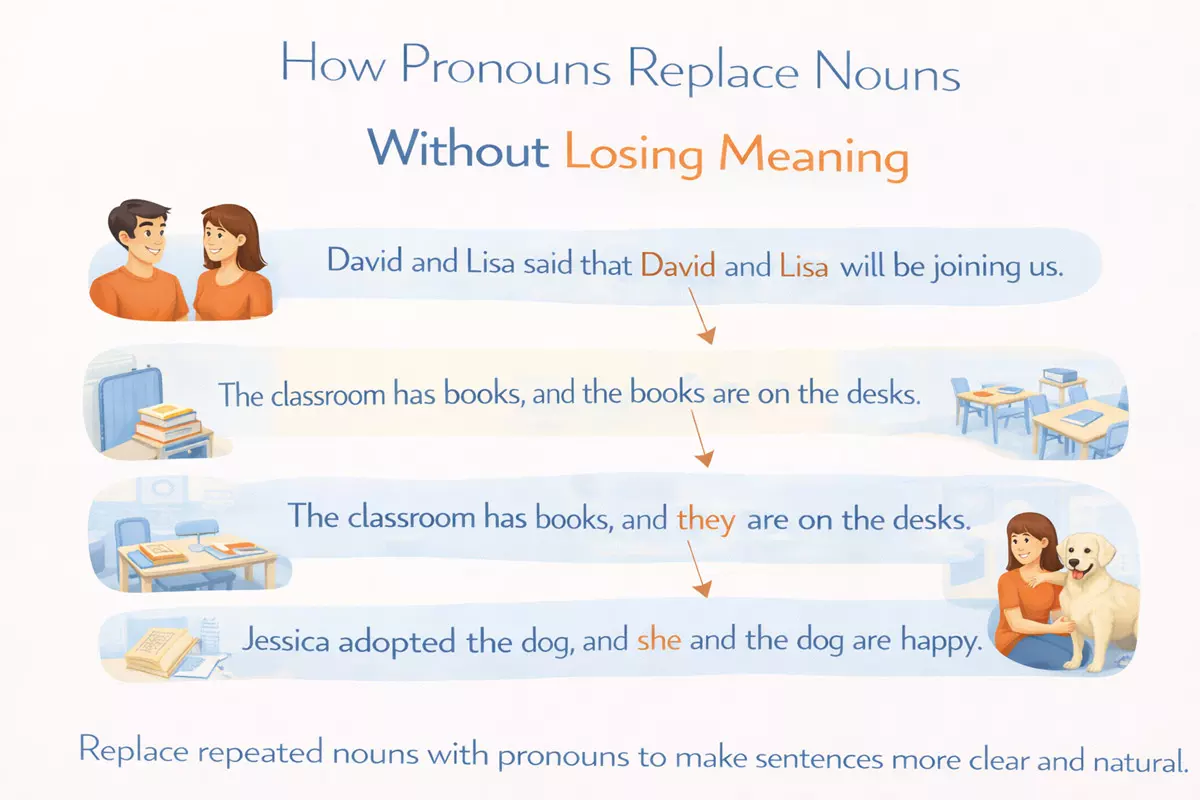
Have you ever noticed how language remains clear even when we replace names or objects with short words like he, she, or it? This clarity is possible because we can use pronouns to stand in for full nouns, which helps make our sentences less repetitive and more concise. By relying on these substitutions, we keep communication efficient and easy to follow, ensuring our ideas are understood without having to repeat the same names or things over and over again. This simple technique is a key reason why language flows smoothly in both writing and conversation.
Why pronoun substitution improves flow
Replacing nouns with pronouns helps sentences connect more smoothly. When a writer constantly repeats the same noun, the text can feel choppy or overly formal. Using pronouns like he, she, they, or it signals that the topic continues from the previous sentence, making the reading experience more natural and less redundant.
Smoother transitions and reduced repetition
Pronouns act as bridges between ideas. They reference something already introduced, so the reader doesn’t have to pause and re-identify the subject each time. This not only saves words but also keeps the narrative or explanation moving forward. Overuse of explicit nouns can distract or tire the reader, while pronouns keep the focus on meaning and action.
Examples: With and without pronoun use
- Without pronouns: The cat jumped on the table. The cat knocked over the vase. The cat ran away.
- With pronouns: The cat jumped on the table. It knocked over the vase. Then it ran away.
In the first version, the repetition of "the cat" is noticeable and slows down the narrative. The second version flows more smoothly, as "it" clearly refers back to the cat.
Common pronoun substitutions that aid flow
- he / she / they instead of repeating a person’s name
- it for objects or animals previously introduced
- this / that for referencing entire ideas or previous statements
- these / those for plural items or ideas
- who / which / that in relative clauses
- one / ones to avoid repeating a noun
- someone / anyone / everyone for indefinite people
- something / anything / everything for indefinite things
- ours / yours / theirs for possessive references
- himself / herself / themselves for reflexive actions
Comparison: Repetition vs. pronoun substitution
| Repetitive Noun Use | Pronoun Substitution |
|---|---|
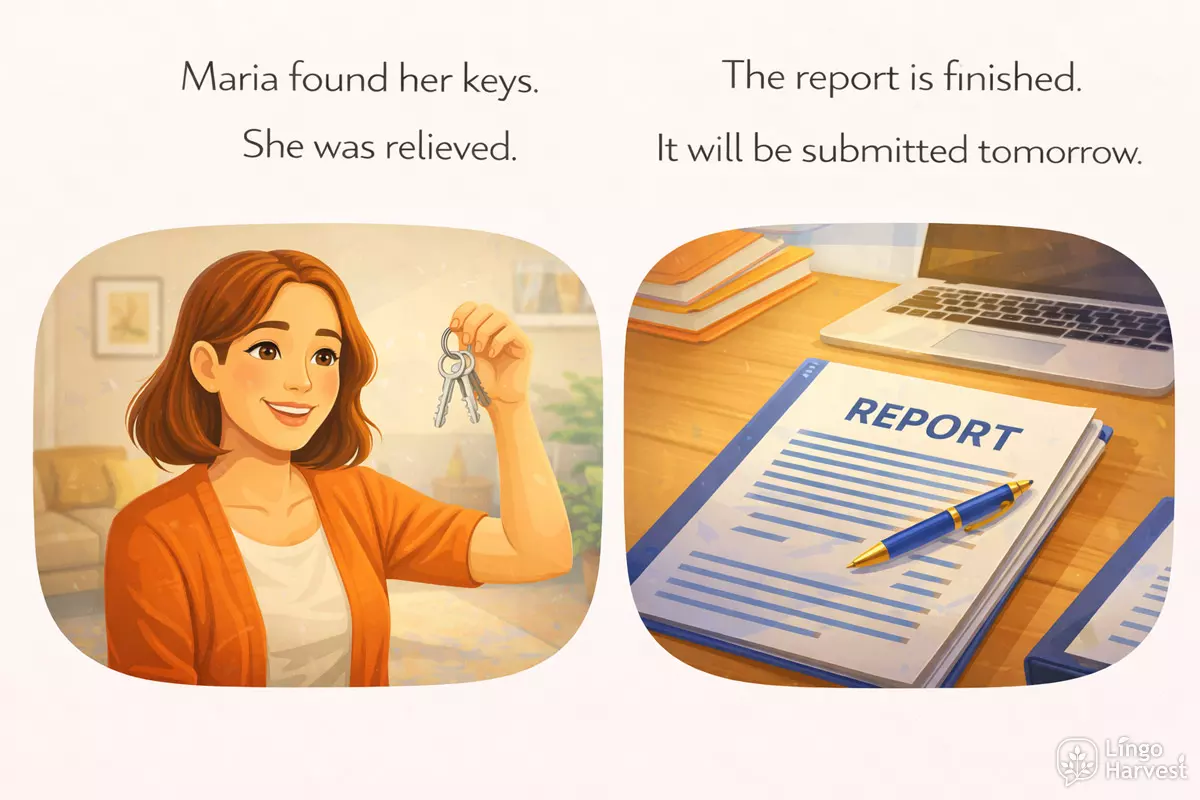
| Maria found Maria's keys. Maria was relieved. | Maria found her keys. She was relieved. |
| The report is finished. The report will be submitted tomorrow. | The report is finished. It will be submitted tomorrow. |
| Children like stories. Children listen attentively. | Children like stories. They listen attentively. |
| The cake was delicious. The cake disappeared quickly. | The cake was delicious. It disappeared quickly. |
By substituting pronouns for repeated nouns, writing becomes less cumbersome and more engaging. This technique helps maintain the reader’s interest and ensures the message is delivered with clarity and ease.
Antecedents: making the reference obvious
When we use pronouns, they stand in for nouns or noun phrases mentioned earlier—these are called antecedents. Clear communication relies on making sure readers or listeners can easily connect each pronoun to its intended referent. If the link between a pronoun and its antecedent is ambiguous or missing, confusion arises, and the sentence loses its intended meaning.
How to Ensure Clarity with Pronouns
Writers and speakers should introduce nouns clearly before replacing them with pronouns. Here are some practical strategies for keeping references unmistakable:
- Place the noun close to the pronoun in the text.
- Only use a pronoun when its referent is obvious from context.
- Avoid using multiple nouns of the same gender or number right before a pronoun, unless context makes the reference clear.
- Restate the noun if there is any risk of ambiguity.
- Use demonstratives (this, that, these, those) to specify which noun you mean, if needed.
Common Pitfalls and Solutions
Ambiguous or vague references are a frequent issue. Here are typical situations and how to avoid them:
- Ambiguous pronoun: "Maria told Ana that she was late." (Who is "she"?) ❌
- Solution: "Maria told Ana, 'You are late.'" or "Maria, who was late, told Ana." ✅
- Vague reference: "They said it would rain." (Who are "they"? What is "it"?)
- Solution: Specify: "The weather forecast said rain is expected."
Examples of Clear Antecedents
Here is a list of sentences showing how pronouns can successfully replace nouns when the reference is obvious:
- Sarah brought her umbrella. She expected rain.
- The dog wagged its tail.
- The committee reached its decision.
- Tom and Jerry finished their homework.
- The plants need water because they are wilting.
- My phone is missing. Have you seen it?
- After the party, everyone thanked the host.
- The book is on the table. Please hand it to me.
- When the children saw the ice cream truck, they cheered.
- The window is open. Can you close it?
- The teacher collected the tests and graded them.
- Anna and Lisa said they would arrive by noon.
- The computer crashed, but it was quickly repaired.
- My parents sold their house.
- The cake was delicious. I baked it myself.
Comparing Pronoun Use: Clear vs. Unclear
| Unclear reference | Clear reference |
|---|---|
| Jessica gave Emily her book. (Whose book?) | Jessica gave her book to Emily. (Jessica's book) |
| The box was too heavy, so it broke. (What broke?) | The box was too heavy, so the handle broke. |
| When Alex met Sam, he was excited. (Who was excited?) | When Alex met Sam, Alex was excited. |
| Put the vase on the table and dust it. (Which item?) | Dust the vase after putting it on the table. |
Making the noun–pronoun connection easy to follow is essential for effective language use. By carefully introducing and repeating nouns as needed, and by choosing pronouns wisely, you help your audience stay oriented and engaged.
One noun, many pronouns: choosing the right form
When a noun gets replaced by a pronoun, the right choice depends on several factors: number, gender, person, and sometimes even formality. Using a mismatched pronoun can lead to confusion, so it’s important to consider what the noun refers to and what context you’re in. English, for example, offers a variety of options, from personal pronouns to possessive and reflexive forms.
Factors that influence pronoun selection
- Number: Is the noun singular or plural?
- Gender: Does the noun have an associated gender (he, she, it)?
- Person: Are you talking about yourself (I, we), the person you’re speaking to (you), or someone else (he, she, they)?
- Case: Is the pronoun the subject, object, or showing possession?
- Formality/Social context: Some languages use formal and informal pronouns.
Common pronoun types and their uses
- Subject pronouns: I, you, he, she, it, we, they
- Object pronouns: me, you, him, her, it, us, them
- Possessive adjectives: my, your, his, her, its, our, their
- Possessive pronouns: mine, yours, his, hers, its, ours, theirs
- Reflexive pronouns: myself, yourself, himself, herself, itself, ourselves, yourselves, themselves
- Demonstrative pronouns: this, that, these, those
- Relative pronouns: who, whom, whose, which, that
- Indefinite pronouns: someone, everyone, anyone, nobody, each, both, few, many, all
- Interrogative pronouns: who, what, which, whose
- Reciprocal pronouns: each other, one another
Choosing the correct pronoun: A comparison
| Noun Example | Possible Pronoun Replacements |
|---|---|
| the teacher | he, she, they, him, her, them, his, her, their |
| the book | it, its |
| the children | they, them, their, themselves |
| my friend and I | we, us, our, ourselves |
| someone | they, them, their |
| the cat | it, its |
| the students | they, them, their, themselves |
| the company | it, its, they, them, their |
Tips for accurate substitution
- Check the original noun’s number and gender before choosing a pronoun.
- Match the pronoun’s case to its function in the sentence (subject, object, or possessive).
- Be aware of context: sometimes a gender-neutral pronoun is best (for example, “they” for an unknown person).
- Watch out for ambiguity—make sure it’s clear what your pronoun refers to.
- Practice with varied sentences to build confidence and accuracy in pronoun use.
Mastering the art of substituting nouns with pronouns helps your writing flow and keeps communication clear, concise, and natural. Choosing the right form isn’t just about grammar—it’s about making sure your meaning stays intact.
Avoiding unclear “it”, “this”, and “they”
When pronouns like “it”, “this”, or “they” are used without a clear reference, readers can easily lose track of what’s being discussed. To keep your writing precise, always make sure each pronoun unmistakably refers back to a specific noun or idea. Ambiguous pronouns can confuse readers and disrupt the flow of information.
Common pitfalls with vague pronouns
Writers often use pronouns to avoid repeating nouns, but sometimes the noun isn’t obvious from context. For example:
- Unclear: The team met with the client, but they were late.
- Clear: The team met with the client, but the client was late.
Here, “they” might refer to either the team or the client, making the meaning ambiguous.
Strategies to clarify pronoun reference
Consider these approaches for making your pronouns clear:
- Repeat the noun when ambiguity is possible.
- Use a descriptive phrase instead of a pronoun (“the software update” instead of “it”).
- Place the pronoun close to its noun to avoid confusion.
- Restructure sentences so each pronoun’s referent is obvious.
- Introduce complex ideas with a noun phrase before using “this” or “these”.
Examples of vague vs. clear pronoun use
Below are some sentences where unclear pronouns cause confusion, followed by improved versions:
- Unclear: The data was analyzed and then it was published.
Clear: The data was analyzed and then the report was published. - Unclear: The book was placed on the shelf, but it was damaged.
Clear: The book was placed on the shelf, but the shelf was damaged. - Unclear: The students discussed the exam. This was difficult.
Clear: The students discussed the exam. The exam was difficult. - Unclear: The instructions were confusing, so they ignored them.
Clear: The instructions were confusing, so the students ignored them. - Unclear: The cat chased the dog, but it escaped.
Clear: The cat chased the dog, but the dog escaped. - Unclear: The solution was tested. This proved effective.
Clear: The solution was tested. The testing proved effective. - Unclear: The committee reviewed the proposal and they approved it.
Clear: The committee reviewed the proposal and approved it. - Unclear: The experiment failed, which was disappointing.
Clear: The failure of the experiment was disappointing. - Unclear: The phone rang, but it was ignored.
Clear: The phone rang, but the call was ignored. - Unclear: The presentation was long, and this made the audience restless.
Clear: The length of the presentation made the audience restless.
Summary of effective techniques
- Check every pronoun for a nearby, unmistakable noun.
- Rephrase sentences if two or more nouns could be the referent.
- Favor clarity over repetition—sometimes repeating the noun helps the reader.
- Especially in technical or academic writing, be extra vigilant with “it”, “this”, and “they”.
Clear pronoun reference makes writing easier to follow and helps readers stay engaged with your ideas.
Keeping number agreement: singular vs plural references
Making sure pronouns match the number of their nouns is essential for clarity. When a noun is singular, its pronoun should be singular; when plural, the pronoun must reflect that change. This matching process helps readers and listeners follow who or what is being referenced, avoiding confusion.
Why number agreement matters
Pronouns stand in for nouns, but if the form doesn’t match the original noun’s number, the meaning can shift or become ambiguous. For example, using "they" for a single object that was previously "it" could suggest multiple objects, causing misunderstanding. Consistent number agreement keeps sentences precise and easy to follow.
Common pronoun shifts: singular and plural

Take a look at these examples to see how pronouns replace nouns while preserving singular or plural reference:
- The cat slept. It was tired.
- The cats slept. They were tired.
- Maria found her keys. She was relieved.
- Maria and John arrived. They were early.
- A child forgot his book.
- Children forgot their books.
- The company announced its decision.
- The companies announced their decisions.
- The dog wagged its tail.
- The dogs wagged their tails.
- A student finished her homework.
- Students finished their homework.
- That book is mine. It is new.
- Those books are mine. They are new.
- The tree lost its leaves.
- The trees lost their leaves.
- An apple fell from its branch.
- Apples fell from their branches.
Patterns and exceptions
Most English pronouns have distinct forms for singular and plural, but some exceptions (like "you") are the same for both. Singular "they" is also increasingly common for referring to someone whose gender is unknown or non-binary, though context usually makes number clear.
| Noun Example | Singular Pronoun | Plural Pronoun |
|---|---|---|
| Cat | it | they |
| Student | he / she / they | they |
| Book | it | they |
| Child | he / she / they | they |
| Company | it | they |
| Tree | it | they |
Tips for accurate number agreement
- Identify if your noun is singular or plural before choosing a pronoun.
- Remember that collective nouns (like "team" or "family") can be tricky; context determines if you use "it" or "they."
- Be attentive with indefinite pronouns (everyone, each, someone)—these are usually singular, so use "he/she/they" as appropriate.
- Check for agreement especially in long sentences, where it’s easy to lose track.
In summary, matching pronouns to the number of their nouns is a simple but vital part of clear communication. It ensures that meanings don’t shift and that your writing or speech remains easy to understand.
Avoiding repetition while keeping clarity
Using pronouns helps writers and speakers avoid repeating the same nouns over and over, which makes sentences less awkward and more natural. However, swapping out nouns for pronouns must be done thoughtfully to ensure the listener or reader always knows what each pronoun refers to. Choosing the right pronouns at the right time lets us streamline our language while still making our meaning clear.
When to Replace Nouns with Pronouns
Replacing a noun with a pronoun works best when the noun has been clearly mentioned earlier, and there’s no ambiguity about what the pronoun means. If several possible nouns could be referenced, repeating the noun or rephrasing the sentence is often better for clarity.
- After introducing a person: “Sarah went to the store. She bought apples.”
- For objects already named: “The book is on the table. It is blue.”
- With groups: “The students finished the test. They left the classroom.”
- For places: “The museum opens at nine. It has a new exhibit.”
- When discussing ideas: “Honesty is important. It builds trust.”
Potential Pitfalls and Solutions
While pronouns reduce repetition, overusing them or using them without clear references can confuse readers. If two or more nouns are possible antecedents, restate the noun or rephrase for clarity. Sometimes, alternating between the noun and the pronoun helps keep things clear.
- If two people are mentioned: “Anna told Maria that she would be late.” (Unclear who “she” is.)
- Possible fix: “Anna told Maria, ‘I will be late.’”
- Or: “Anna told Maria that Anna would be late.”
Common English Pronouns and Their Uses
The following table shows some of the most frequent English pronouns, their types, and typical usages. This helps writers and speakers pick the right pronoun to avoid unnecessary repetition and confusion.
| Pronoun | Example Usage | Type | Refers To |
|---|---|---|---|
| I | I am ready. | Personal (subject) | Speaker |
| He | He likes music. | Personal (subject) | Male person |
| She | She called back. | Personal (subject) | Female person |
| It | It is raining. | Personal (subject/object) | Thing, animal, idea |
| They | They arrived early. | Personal (plural/neutral) | People, things, or unknown gender |
| We | We will help. | Personal (subject) | Speaker + others |
| Me | Give me the keys. | Personal (object) | Speaker |
| Him | Ask him later. | Personal (object) | Male person |
| Her | Tell her the news. | Personal (object) | Female person |
| Them | See them outside. | Personal (object, plural) | People/things |
| Who | Who is there? | Relative/interrogative | Person |
| Which | Which is yours? | Relative/interrogative | Thing/animal |
| That | The book that fell. | Relative | Person/thing |
Quick Tips for Effective Pronoun Use
- Introduce nouns before using pronouns.
- Switch between pronouns and nouns if confusion is possible.
- Keep pronoun references close to their nouns.
- Use gender-neutral pronouns if the gender is unknown.
- Reread sentences to check for possible ambiguity.
- Use names again when discussing multiple people or things.
- Remember context helps listeners understand pronoun meaning.
- Pronouns can save space and keep sentences from sounding repetitive.
- Use “they” for singular, unknown, or nonbinary people when appropriate.
- If in doubt, repeat the noun for clarity.
By paying attention to these strategies, you can make your language both concise and easy to follow, ensuring your audience always knows who or what you’re referring to.
When to repeat the noun instead of using a pronoun
Sometimes, using a pronoun can create confusion, especially if several nouns have been introduced or if clarity is crucial. In these cases, repeating the original noun helps your reader or listener follow along without ambiguity. This is particularly important in formal writing, academic texts, or technical documentation, where precision matters more than brevity.
Situations where repeating the noun is clearer
- Introducing a new topic: When a noun appears for the first time, always use the noun itself rather than a pronoun.
- Multiple subjects: When more than one noun is present, and a pronoun could refer to any of them.
- Long gaps between mentions: If there are several sentences between uses, repeating the noun avoids confusion.
- Emphasis or contrast: When you want to highlight or contrast two ideas or items.
- Technical or scientific writing: In contexts where accuracy is critical and misinterpretation must be avoided.
- Cross-gender or number ambiguity: If pronouns could be misread due to gender-neutral or plural forms.
- Instructions and procedures: When step-by-step actions need to reference specific items.
- Legal or contractual language: For clear, unambiguous references.
- Storytelling with multiple characters: To keep the narrative clear when several people or objects are involved.
- Non-native speakers: When writing for audiences who may not infer pronoun references easily.
Common pitfalls of pronoun overuse
Overusing pronouns can cause readers to lose track of what or whom you’re referring to. This often happens in texts with:
- Several similar nouns in close proximity
- Long, complex sentences
- Abstract or unfamiliar subjects
Repeating the noun helps prevent these misunderstandings.
Examples of clarity by noun repetition
Here are practical examples where repeating the noun is preferable to using a pronoun:
- Ambiguous: Sarah gave Anna her book.
Clear: Sarah gave Anna Sarah’s book. - Ambiguous: The cat chased the dog, but it was too fast.
Clear: The cat chased the dog, but the dog was too fast. - Ambiguous: After the meeting, John called Mike because he was late.
Clear: After the meeting, John called Mike because Mike was late. - Ambiguous: The report was sent to the manager and the assistant, but she did not read it.
Clear: The report was sent to the manager and the assistant, but the manager did not read the report.
Comparing pronoun use vs. noun repetition
| Pronoun Use | Noun Repetition |
|---|---|
| Mary met Jane at the park. She was late. | Mary met Jane at the park. Jane was late. |
| The bicycle hit the car because it was speeding. | The bicycle hit the car because the car was speeding. |
| The engineer reviewed the plans before he approved them. | The engineer reviewed the plans before the engineer approved the plans. |
| After the experiment, it was recorded. | After the experiment, the experiment was recorded. |
In summary, choosing between a pronoun and the original noun depends on context and the need for clarity. When in doubt, repeating the noun can prevent misunderstandings and ensure your message is understood exactly as intended.
Editing checklist for clean pronoun reference
When reviewing your writing, it's important to ensure that every pronoun clearly points to its intended noun. This avoids confusion and helps your reader follow your ideas smoothly. A well-edited passage uses pronouns that are unambiguous and efficiently replace nouns without making the meaning unclear.
Key steps for reviewing pronoun use
- Identify every pronoun and check which noun it refers to.
- Ask: would a first-time reader know what “she,” “it,” or “they” means in each sentence?
- Revise any sentence where the pronoun could refer to more than one noun.
- Replace unclear pronouns with the specific noun, especially after long or complex sentences.
- Watch for gendered pronouns and make sure they match the noun’s gender—if the noun is not gendered, consider neutral alternatives.
- Be careful with “this,” “that,” “these,” and “those”—make sure it’s obvious what they stand for.
- Eliminate unnecessary repetition, but never at the cost of clarity.
- After editing, reread the passage aloud to catch any lingering ambiguities.
Common pronoun pitfalls to avoid
- Using a pronoun before the noun it refers to has been introduced.
- Letting more than one possible noun intervene between a noun and its pronoun.
- Switching pronoun forms (he/she/they) mid-paragraph without explanation.
- Referring to an entire idea or sentence with “it” without clear context.
Examples of clear vs. unclear references
| Unclear Example | Clear Revision |
|---|---|
| When Laura met with Anna, she was late. | When Laura met with Anna, Anna was late. |
| They told the students that they would have to leave early. | The teachers told the students that the students would have to leave early. |
| Put the vase on the table and fill it. (What should be filled?) | Put the vase on the table and fill the vase. |
| John gave Mike his book. (Whose book?) | John gave Mike John’s book. |
Final review tips
After completing your draft, take one final pass focusing only on pronouns and their connections to nouns. This targeted check can catch subtle ambiguities that general editing might miss. If in doubt, err on the side of specificity for the sake of your reader.
Practice: rewrite sentences for clarity
Improving clarity often means replacing repeated nouns with the right pronouns. This helps sentences flow naturally and avoids unnecessary repetition. Try the exercises below to see how pronouns can substitute for nouns without making the meaning unclear.
Exercise: Replace nouns with pronouns
Rewrite the following sentences by replacing repeated nouns with appropriate pronouns, making sure the meaning is still clear:
- Maria gave Maria’s book to Maria’s brother because Maria knew Maria’s brother would enjoy the book.
- The dog chased the cat, and the dog caught the cat by the tail.
- The teacher told the students that the students should submit the students’ homework by Friday.
- When the phone rang, the phone startled John, so John dropped the phone.
- Lisa saw Lisa’s friend at the market, and Lisa waved at Lisa’s friend.
- Daniel emailed Daniel’s manager because Daniel wanted Daniel’s manager to review Daniel’s report.
- Emma met Emma’s cousin at the airport, and Emma gave Emma’s cousin a ride home.
- The company changed the company’s policy after the company received feedback from the company’s customers.
- When the train arrived, the train surprised the tourists, so the tourists stepped back from the train.
- Tom borrowed Tom’s neighbor’s ladder because Tom needed the ladder to fix the roof.
Show answers
- Maria gave her book to her brother because she knew he would enjoy it.
- The dog chased the cat, and it caught it by the tail.
- The teacher told the students that they should submit their homework by Friday.
- When the phone rang, it startled John, so he dropped it.
- Lisa saw her friend at the market, and she waved at her.
- Daniel emailed his manager because he wanted him to review his report.
- Emma met her cousin at the airport, and she gave him a ride home.
- The company changed its policy after it received feedback from its customers.
- When the train arrived, it surprised the tourists, so they stepped back from it.
- Tom borrowed his neighbor’s ladder because he needed it to fix the roof.
Common mistakes to avoid
Using pronouns can sometimes create confusion if it is not clear what or whom the pronoun refers to. Here are some examples of unclear sentences and how to improve them:
- Unclear: When Anna met Sarah, she was excited.
Who was excited?
Clear: When Anna met Sarah, Anna was excited. - Unclear: The box was too heavy, so it fell.
What fell—the box or something else?
Clear: The box was too heavy, so the box fell.
Quick reference: Pronoun replacements
Below is a table showing how nouns are replaced with pronouns in various contexts. Use this as a guide when revising sentences.
| Noun Phrase | Pronoun Replacement |
|---|---|
| The teacher | he / she / they |
| Maria's book | her book / it |
| John and Lisa | they |
| The students' homework | their homework / it |
| The cat | it |
| Sarah and her friend | they |
| The phone | it |
| Lisa's friend | her / him |
| Anna | she |
| The box | it |
Challenge: Identify unclear pronoun references
Read the sentences below. For each, decide if the pronoun clearly refers to a noun or if the meaning is ambiguous. If it is unclear, rewrite the sentence for clarity.
- Tom told Mike that he would be late to the meeting.
- Sara gave her sister her jacket.
- The children put the toys in the box because they were broken.
- Rachel called Emily while she was driving.
- Alex met Jordan after he finished work.
- When Paul spoke to Daniel, he seemed upset.
- Laura thanked Emma because she helped her.
- The manager warned the assistant that she needed to be more careful.
- When the teacher spoke to the student, he was nervous.
- Mark emailed Ben after he read the report.
Show answers
- Unclear (Who is "he"? Tom or Mike?)
Clear: Tom told Mike that Mike would be late to the meeting. (if Mike is late) - Unclear (Whose jacket?)
Clear: Sara gave her sister Sara’s jacket. (if it was Sara’s jacket) - Unclear ("they" could mean children or toys)
Clear: The children put the toys in the box because the toys were broken. - Unclear (Who was driving?)
Clear: Rachel called Emily while Rachel was driving. - Unclear (Who finished work? Alex or Jordan?)
Clear: Alex met Jordan after Alex finished work. - Unclear (Who seemed upset?)
Clear: When Paul spoke to Daniel, Daniel seemed upset. - Unclear (Who helped whom?)
Clear: Laura thanked Emma because Emma helped Laura. - Unclear (Who needed to be more careful?)
Clear: The manager warned the assistant that the assistant needed to be more careful. - Unclear (Who was nervous?)
Clear: When the teacher spoke to the student, the student was nervous. - Unclear (Who read the report?)
Clear: Mark emailed Ben after Mark read the report.
Remember, the goal is to use pronouns to make sentences smoother, but not at the expense of clarity. When in doubt, repeat the noun or rephrase the sentence to make your meaning unmistakable.