Personal Pronouns by Person: First, Second, Third

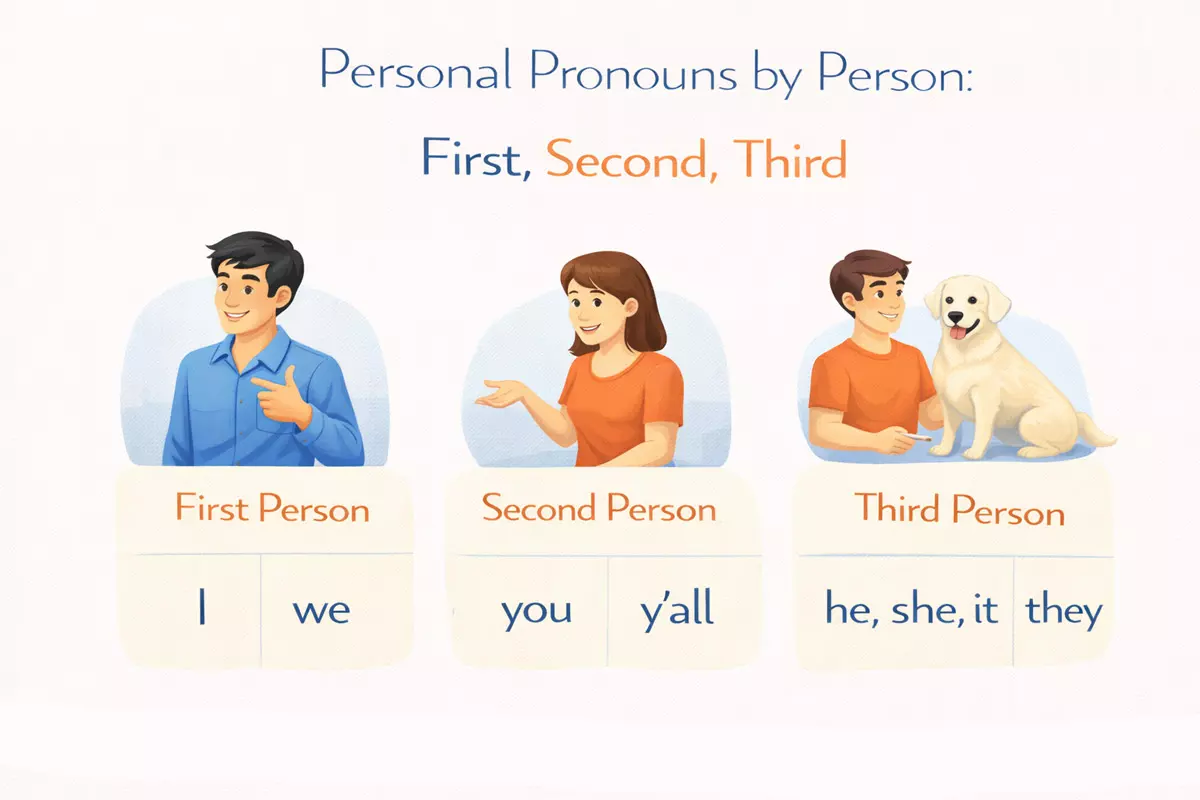 Here we what first, second, and third person mean in grammar, explains how to use personal pronouns like I, we, you, he, she, it, and they, discusses common mistakes, and provides short dialogues for pronoun practice.
- What “person” means in grammar: 1st, 2nd, 3rd
- First person: I/me/my vs we/us/our
- Second person: you/your and when it’s singular or plural
- Third person: he/him, she/her, it/its, they/them
- Choosing he/she/they for people and it for things
- Pronouns in simple sentences and questions
- Common learner mistakes with personal pronouns
- Practice: pick the correct pronoun in short dialogues
Understanding how to refer to ourselves, the people we speak to, and others is fundamental for effective communication in any language. These forms of reference, such as using appropriate pronouns and addressing others correctly, help avoid confusion and ensure that our messages are clear. Mastering these basics not only allows us to express our thoughts accurately but also helps build respectful and meaningful interactions in daily conversations. Developing this skill is a vital step in achieving fluency and confidence when communicating with others.
What “person” means in grammar: 1st, 2nd, 3rd
In grammar, “person” refers to the perspective from which a sentence is expressed. This concept helps us distinguish who is speaking, who is being spoken to, and who or what is being spoken about. Understanding grammatical person is crucial for choosing the correct personal pronouns and verb forms in English.
Overview of grammatical person
English recognizes three main persons: first, second, and third. Each one plays a different role in communication:
- First person: The speaker or writer is referring to themselves. Examples: “I,” “we.”
- Second person: The speaker is addressing someone directly. Example: “you.”
- Third person: The speaker is talking about someone or something else. Examples: “he,” “she,” “it,” “they.”
How person affects pronouns and verbs
The person of the subject determines which pronoun and verb form to use. For example, “I am,” “you are,” and “he is” all use different pronouns and verb conjugations because of their person.
Examples of personal pronouns by person
Here’s a breakdown of the most common English personal pronouns organized by grammatical person and number:
| Person | Singular Pronouns | Plural Pronouns |
|---|---|---|
| First | I, me, my, mine | we, us, our, ours |
| Second | you, your, yours | you, your, yours |
| Third | he, him, his, she, her, hers, it, its | they, them, their, theirs |
Quick reference: when to use each person
- Use first person when you’re talking about yourself or your group.
- Use second person when addressing your reader or listener directly.
- Use third person when referring to other people, animals, or things.
Recognizing the differences between these perspectives makes your communication clearer and helps avoid confusion in both writing and speech.
First person: I/me/my vs we/us/our
When expressing ideas from a personal perspective, English uses distinct pronouns to show whether one person is speaking (singular) or a group (plural). The singular set includes "I," "me," and "my," while the plural set features "we," "us," and "our." These words change depending on who is included and the role in the sentence.
Singular: Talking about yourself
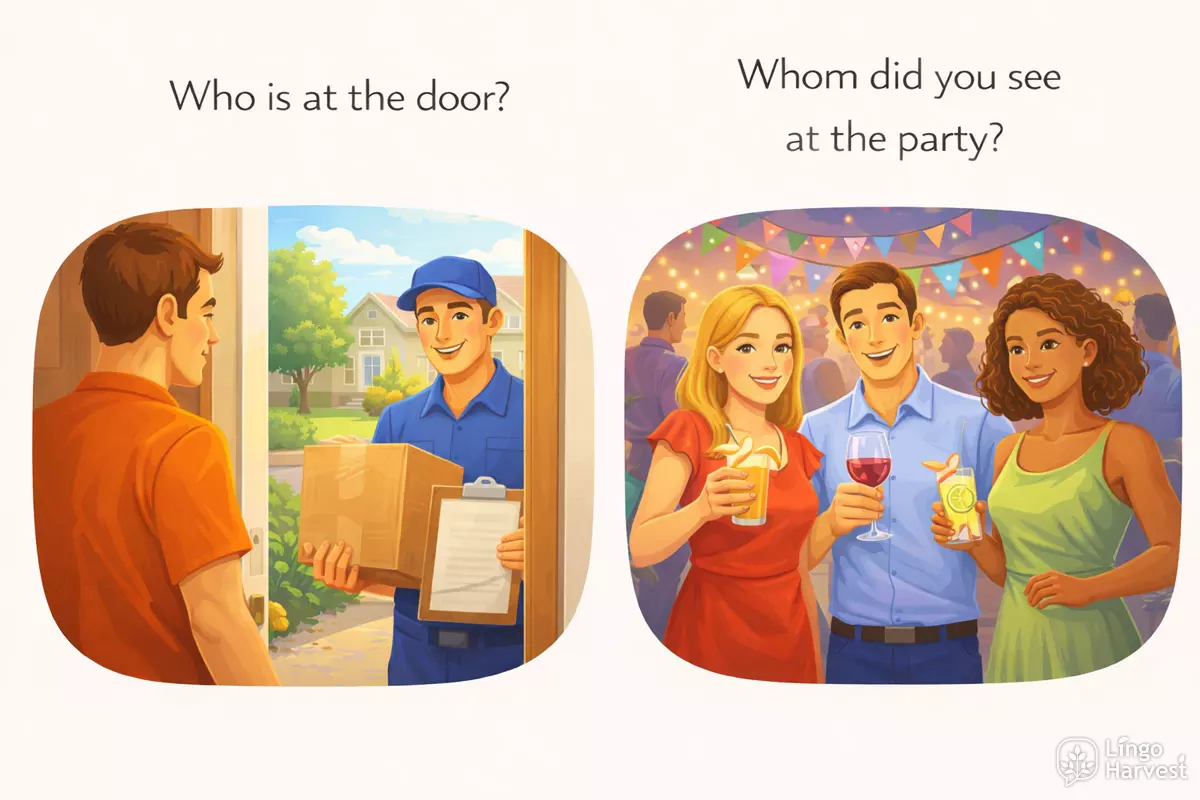
The words "I," "me," and "my" refer only to the speaker. "I" is used as the subject, "me" as the object, and "my" shows possession.
- I am learning Spanish.
- Could you help me with this?
- This is my favorite book.
- I will call you later.
- The teacher gave me a compliment.
- My advice is to start early.
- I think it’s a good idea.
- Please give me a moment.
- My phone is charging.
- I enjoyed the concert.
Plural: Including yourself and others
When you are part of a group, choose "we," "us," and "our." "We" acts as the subject, "us" as the object, and "our" shows belonging.
- We are going to the park.
- The teacher told us to line up.
- Our team won the match.
- We love Italian food.
- Can you join us for dinner?
- Our project is due tomorrow.
- We finished the assignment.
- Come with us to the movie.
- Our plan is to leave early.
- We appreciate your help.
Comparing forms and usage
The difference between singular and plural first-person pronouns is essential for clarity. Using the wrong form can change the meaning or cause confusion. Here is a comparison of the main forms:
| Function | Singular (Speaker only) | Plural (Speaker + others) |
|---|---|---|
| Subject | I | We |
| Object | Me | Us |
| Possessive | My | Our |
Tips for choosing the right word
Think about who is included: use "I," "me," and "my" for yourself only, and "we," "us," and "our" when you’re talking about a group that includes you. Double-check the sentence role—subject, object, or possession—to select the correct form. Using these pronouns accurately helps your writing and speaking sound natural and clear.
Second person: you/your and when it’s singular or plural
In English, the second person pronouns are you and your, covering both singular and plural forms. Unlike many other languages, English does not distinguish between talking to one individual or to a group—the same word, you, is used in both cases. This can sometimes cause confusion, especially when context doesn’t make it clear whether one person or several are being addressed.
How “you” and “your” work
Both you (subject or object) and your (possessive adjective) function identically whether you’re speaking to a single person or a group. The word itself doesn’t change, but the meaning depends on context. For example:
- You are invited to the meeting. (could be one person or more)
- Is this your bag? (addressing someone directly, singular or plural)
- You need to finish your assignments. (could refer to a class or just one student)
Singular vs. plural: How do we tell?
Since English doesn’t have distinct forms for singular and plural in the second person, speakers often rely on context or add clarifying words. In informal speech, people sometimes use phrases like “you guys,” “you all,” “y’all,” or “you lot” to make it clear they’re talking to more than one person. Here are some common variations:
- You (standard, both singular and plural)
- You guys (informal, plural, especially in American English)
- You all or y’all (informal, plural, common in Southern US English)
- You lot (informal, plural, mainly British English)
Summary of second person forms
| Form | Function | Example |
|---|---|---|
| you | Subject or object, singular or plural | You are welcome. / I saw you. |
| your | Possessive adjective, singular or plural | Your book is here. |
| yours | Possessive pronoun, singular or plural | This is yours. |
| you all, you guys, y’all, you lot | Plural (informal/regional) | Are you all coming? / You guys did great! |
Quick examples of “you” and “your” in use
- Can you help me?
- Where is your house?
- You all did a fantastic job.
- This seat is yours.
- Are you guys ready?
- You need to sign here.
- Did your team win?
- Y’all have a good night!
- You lot should listen.
- You can call me anytime.
- Is this yours?
- Your appointment is at 3 PM.
In summary, English uses the same second person forms for both singular and plural, with context or extra words clarifying the number when needed. Regional and informal expressions help make distinctions where the standard language does not.
Third person: he/him, she/her, it/its, they/them
The third person in English covers pronouns used to talk about people, animals, or things that are not the speaker or the listener. These pronouns change depending on gender, number, and sometimes animacy. Understanding when and how to use them is key for clear and accurate communication.
Overview of Third Person Pronouns
Third person pronouns include masculine (he/him), feminine (she/her), neuter (it/its), and plural/gender-neutral (they/them). Each form has subject and object cases, as well as possessive forms.
- He/him/his: Refers to a male person or animal. Example: "He brought his book."
- She/her/her(s): Refers to a female person or animal. Example: "She loves her cat."
- It/its: Refers to things, animals (when gender is unknown or irrelevant), or abstract concepts. Example: "The dog wagged its tail."
- They/them/their(s): Used for groups, people whose gender is unknown, or nonbinary individuals. Example: "They finished their homework."
Forms and Uses
Third person pronouns shift depending on their grammatical role in a sentence. Here's a breakdown:
| Pronoun | Subject | Object | Possessive Adjective | Possessive Pronoun | Reflexive |
|---|---|---|---|---|---|
| Masculine | he | him | his | his | himself |
| Feminine | she | her | her | hers | herself |
| Neuter | it | it | its | its* | itself |
| Plural/Neutral | they | them | their | theirs | themselves |
*"Its" is rarely used as a possessive pronoun.
Examples in Context
To make these forms clearer, here are sample sentences:
- He called his friend because he needed help.
- She brought her notes, but she forgot her pen.
- It is raining, and its sound is soothing.
- They finished their project; the teachers praised them.
- Each student should bring their own lunch. (singular "they")
- The cat cleaned itself.
- That book is hers, not mine.
- The team congratulated themselves after the win.
Special Notes on Usage
- Singular "they" is widely accepted for individuals whose gender is unknown or nonbinary: "Somebody left their umbrella."
- Use "it" for objects, animals (unless gender is known), or when referring to a situation: "It is important to listen."
- Possessive "its" has no apostrophe; "it's" means "it is" or "it has." ❌ "The dog wagged it's tail." ✅ "The dog wagged its tail."
- Reflexive forms ("himself," "herself," etc.) are used when the subject and object refer to the same entity: "She prepared herself."
Mastering these pronouns helps avoid ambiguity and ensures that sentences are both respectful and grammatically correct.
Choosing he/she/they for people and it for things
When referring to people in English, personal pronouns such as he, she, and they are the standard choices. These pronouns help indicate a person's gender, or, in the case of "they," can refer to someone whose gender is unknown or unspecified. In contrast, the pronoun it is generally reserved for objects, animals (when gender is unknown), or abstract concepts, not for individuals.
Using he, she, and they for people
Selecting the correct pronoun for a person depends on context and, increasingly, on the individual’s preference. Here are the common uses:
- He – used for a male individual.
Example: He is my brother. - She – used for a female individual.
Example: She is the new manager. - They – used for groups of people, or for a single person when gender is unknown, unspecified, or non-binary.
Example: Someone left their bag. I hope they come back for it.
Applying it for things and animals
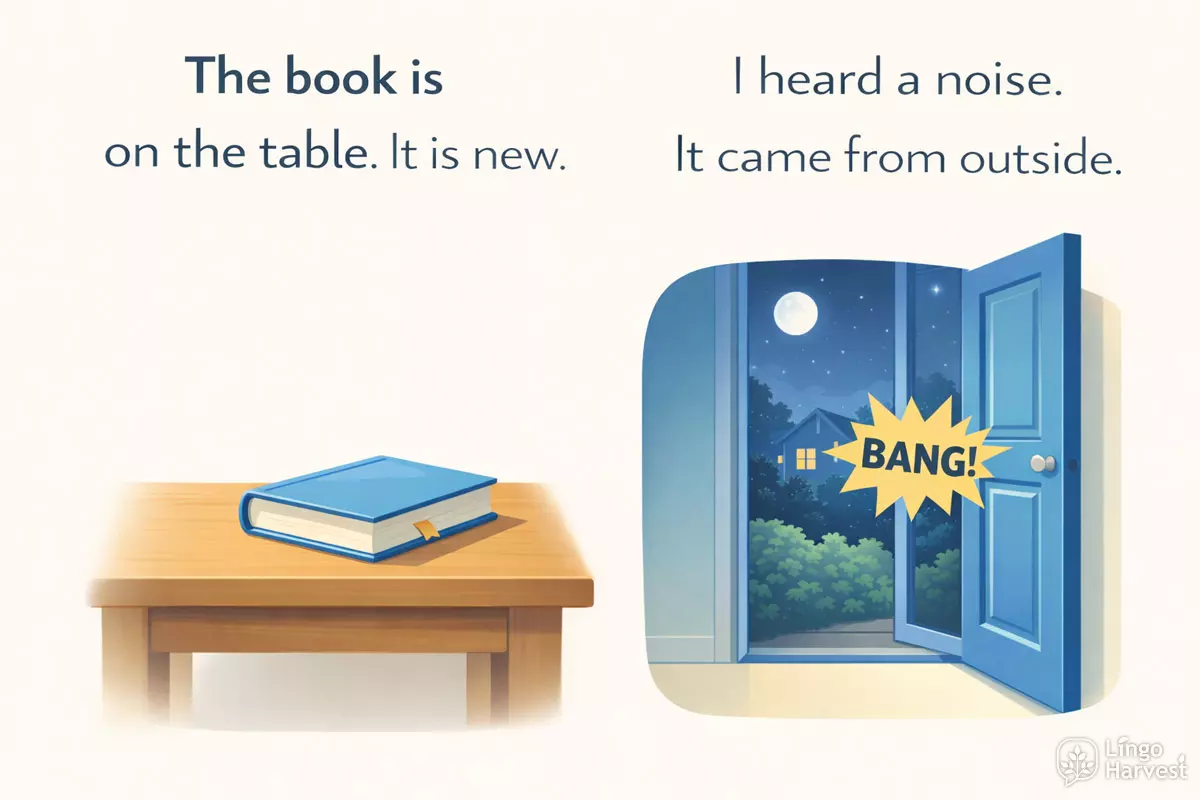
The pronoun it is used when talking about inanimate objects, ideas, or animals whose gender is not known or not relevant. For example:
- The book is on the table. It is new.
- I heard a noise. It came from outside.
- There’s a cat in the garden. It looks hungry. (if the cat’s gender is unknown)
Quick reference: When to use each pronoun
| Pronoun | Typical Use | Example |
|---|---|---|
| He | Male person | He is a doctor. |
| She | Female person | She likes music. |
| They | Unknown gender, non-binary, or group | They are waiting outside. |
| It | Thing, animal (unknown gender), idea | It is raining. |
Common mistakes and tips
- ❌ Avoid using it for a person, unless referring to a baby (less common and increasingly avoided) or in rare poetic/literary contexts.
- ✅ Use they for a single person if you do not know their gender or wish to be gender-neutral.
- ✅ Reserve he and she for known male or female individuals, respectively.
- Check with individuals about their pronoun preferences when possible.
Choosing the appropriate pronoun not only clarifies your meaning but also shows respect for people’s identities and helps your English sound natural.
Pronouns in simple sentences and questions
Personal pronouns play a crucial role in everyday communication, acting as substitutes for nouns to avoid repetition and clarify who is involved in an action. When constructing straightforward statements or inquiries, these words help indicate the subject or object without extra detail.
Using personal pronouns in basic statements
In English, personal pronouns are frequently used as the subject of a sentence. Here are several common examples showing pronouns in action:
- I am learning English.
- You look happy.
- He is at school.
- She likes music.
- It is raining.
- We are friends.
- They have a dog.
- Mary and I are going out. (We)
- John called, but he left a message.
- The cat is hungry. It wants food.
Notice how each pronoun replaces a noun or group of nouns and helps keep sentences concise.
Forming questions with personal pronouns
When asking questions, pronouns often appear after the auxiliary (helping) verb. Here are some basic question patterns:
- Are you ready?
- Is she coming?
- Do they know the answer?
- Can we start now?
- Will he help us?
- Does it work?
- Am I late?
- Have you seen this movie?
- Did we forget something?
- Should they wait?
Comparison of personal pronouns by person
To clarify usage, here’s a quick reference showing how first, second, and third person pronouns work in both singular and plural forms:
| Person | Singular | Plural | Example in a sentence |
|---|---|---|---|
| First | I | We | I am here. → We are here. |
| Second | You | You | Are you okay? → Are you all okay? |
| Third | He / She / It | They | She is late. → They are late. |
This overview highlights how pronouns change depending on the person and number, and how they fit naturally into both declarative and interrogative sentence structures. Mastering these patterns makes everyday conversation clearer and more efficient.
Common learner mistakes with personal pronouns
Learners of English often face difficulties with personal pronoun usage, leading to confusion or awkward sentences. Many of these errors stem from differences between the learner’s native language and English, as well as the subtle rules governing pronoun choice.
Confusing subject and object forms
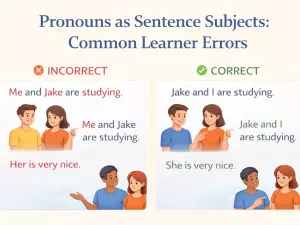
Mixing up subject (I, he, she, we, they) and object (me, him, her, us, them) pronouns is a frequent slip. For example, saying “Her went to the store” instead of “She went to the store.” This mistake can interfere with clarity and sometimes change the meaning of a sentence.
- Incorrect: Me like ice cream. ❌
- Correct: I like ice cream. ✅
- Incorrect: Give it to I. ❌
- Correct: Give it to me. ✅
Using the wrong person or number
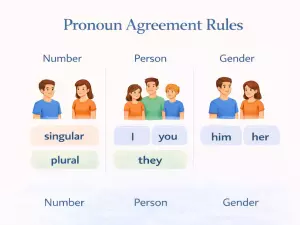
Pronouns must agree with the person (first, second, third) and number (singular, plural) they refer to. Learners sometimes use “they” when referring to a single person, or “he” when talking about themselves.
- Incorrect: He am going to the party (talking about oneself). ❌
- Correct: I am going to the party. ✅
- Incorrect: They is my friend (referring to one person). ❌
- Correct: He/She is my friend. ✅
Gender mistakes in the third person
Assigning the wrong gender to third-person pronouns is especially common for speakers of languages without gendered pronouns. Accidentally using “he” for a woman or “she” for a man can cause confusion or offense.
- Incorrect: My mother, he is a teacher. ❌
- Correct: My mother, she is a teacher. ✅
- Incorrect: John loves her dog (if John is male). ❌
- Correct: John loves his dog. ✅
Reflexive pronoun confusion
Learners sometimes use reflexive pronouns (myself, yourself, himself, etc.) incorrectly, often where a regular object pronoun is needed.
- Incorrect: Please give it to myself. ❌
- Correct: Please give it to me. ✅
- Incorrect: She did it by her. ❌
- Correct: She did it by herself. ✅
Comparison of common pronoun forms
| Subject Pronoun | Object Pronoun | Reflexive Pronoun |
|---|---|---|
| I | me | myself |
| you | you | yourself |
| he | him | himself |
| she | her | herself |
| it | it | itself |
| we | us | ourselves |
| they | them | themselves |
Other frequent issues
- Omitting pronouns entirely: “Is raining” instead of “It is raining.”
- Overusing names: “Maria went to Maria’s house” instead of “Maria went to her house.”
- Using “it” for people: “Where is my brother? It is outside.” Correct: “He is outside.”
- Mixing singular “they” with plural verbs: “They is coming” (should be “They are coming” even for singular ‘they’).
- Inconsistent reference: Changing pronouns mid-sentence, confusing the listener or reader.
Understanding these patterns and reviewing the common forms can help learners avoid many typical mistakes with English personal pronouns.
Practice: pick the correct pronoun in short dialogues
Understanding how to select the right personal pronoun is essential for clear communication. Below, you'll find a series of mini-dialogues where you can test your knowledge by choosing the appropriate pronoun. These exercises cover first, second, and third person usage in different contexts.
Choose the best pronoun to complete each dialogue
-
Anna: "____ am going to the store. Do you want anything?"
Ben: "No, thank you."- a) She
- b) I
- c) They
-
Teacher: "____ need to finish your homework by tomorrow."
Students: "Okay!"- a) We
- b) You
- c) He
-
Tom: "Where is Sarah?"
Mike: "____ is in the library."- a) She
- b) He
- c) I
-
Lisa: "Are ____ coming to the party tonight?"
John: "Yes, I am."- a) you
- b) he
- c) we
-
Parents: "____ will pick you up after school."
Child: "Thanks, Mom and Dad!"- a) She
- b) We
- c) I
-
Peter: "Did ____ see my keys anywhere?"
Jane: "No, I haven't."- a) you
- b) they
- c) we
-
Maria: "How was the concert?"
Alex: "____ was amazing!"- a) He
- b) It
- c) She
-
Manager: "____ will start the meeting now."
Team: "Ready!"- a) She
- b) I
- c) They
-
Emma: "Did ____ enjoy the movie?"
Liam: "Yes, we did."- a) they
- b) you
- c) she
-
Tom: "Who left this note?"
Sarah: "____ did."- a) I
- b) He
- c) They
Show answers
- b) I
- b) You
- a) She
- a) you
- b) We
- a) you
- b) It
- b) I
- b) you
- a) I
Common personal pronouns in context
- I: Refers to the speaker (first person singular)
- You: Refers to the listener(s) (second person)
- He: Male person (third person singular)
- She: Female person (third person singular)
- It: Non-human or object (third person singular)
- We: Speaker plus others (first person plural)
- They: More than one person or thing (third person plural)
Use these examples to reinforce your understanding of how person affects pronoun choice in short exchanges. Practicing with real dialogues helps build confidence in selecting the correct form in conversation and writing.