Pronoun Position in a Sentence: Where Pronouns Belong

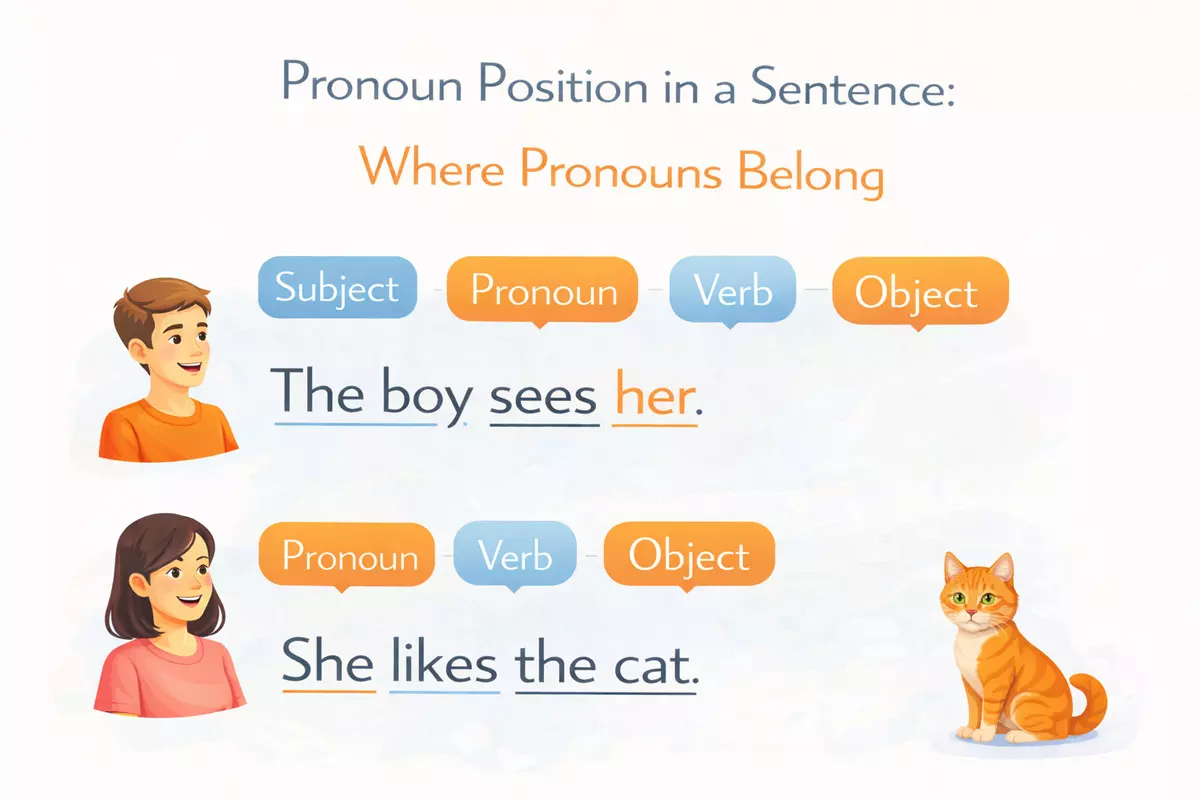 Here we English pronoun placement, including subject and object order, use with negatives and auxiliary verbs, placement in questions and imperatives, handling double objects, common mistakes, and offers practice with sentence reordering.
- Basic word order: subject pronouns before verbs
- Object pronouns after verbs and prepositions
- Pronouns with negation: placement with not
- Pronouns with auxiliary verbs: do/does/did, be, have
- Pronouns in questions: inversion and short answers
- Pronouns in imperative sentences: tell me, give it
- Double objects: give me it vs give it to me
- Common placement errors and quick fixes
- Practice: reorder words to form correct sentences
Knowing how to correctly position pronouns within your sentences can significantly improve clarity and engagement in your writing. Pronouns, which are words that replace nouns, must be placed thoughtfully to ensure that readers easily understand what or whom you are referring to. If pronouns are misplaced or used ambiguously, your sentences may become confusing, and the intended message might be lost. By learning the proper placement and reference for pronouns, you can make your writing smoother and more effective for your audience.
Basic word order: subject pronouns before verbs
In English, personal pronouns that act as the subject of a sentence are placed directly before the verb. This arrangement helps listeners and readers quickly identify who is performing the action. The subject pronoun signals the “doer,” and the verb follows to describe the action or state. This word order is a core rule in English sentence structure, whether you are making a statement, asking a question (with auxiliary verbs), or giving instructions. Placing the subject pronoun in front of the verb keeps sentences clear and natural.
Common subject pronouns
- I → I am ready to start.
- you → You can sit here.
- he → He works from home.
- she → She called this morning.
- it → It looks expensive.
- we → We finished the task.
- they → They arrived on time.
Examples in simple sentences
- She runs every morning.
- We are learning Spanish.
- I like chocolate.
- They finished the project.
- You should try this recipe.
- He travels often for work.
- It looks interesting.
Comparison: Correct vs. Incorrect order
- ✅ He eats breakfast. (correct)
- ❌ Eats he breakfast. (incorrect)
- ✅ They will arrive soon. (correct)
- ❌ Will arrive they soon. (incorrect for a statement)
Why this order matters
Placing the subject pronoun before the verb avoids confusion and aligns with the expectations of native speakers. If you reverse or rearrange these elements in a statement, the sentence can sound unusual or lose its meaning. This is especially important for learners who speak languages with different grammatical structures.
Quick reference: Subject pronoun + verb patterns
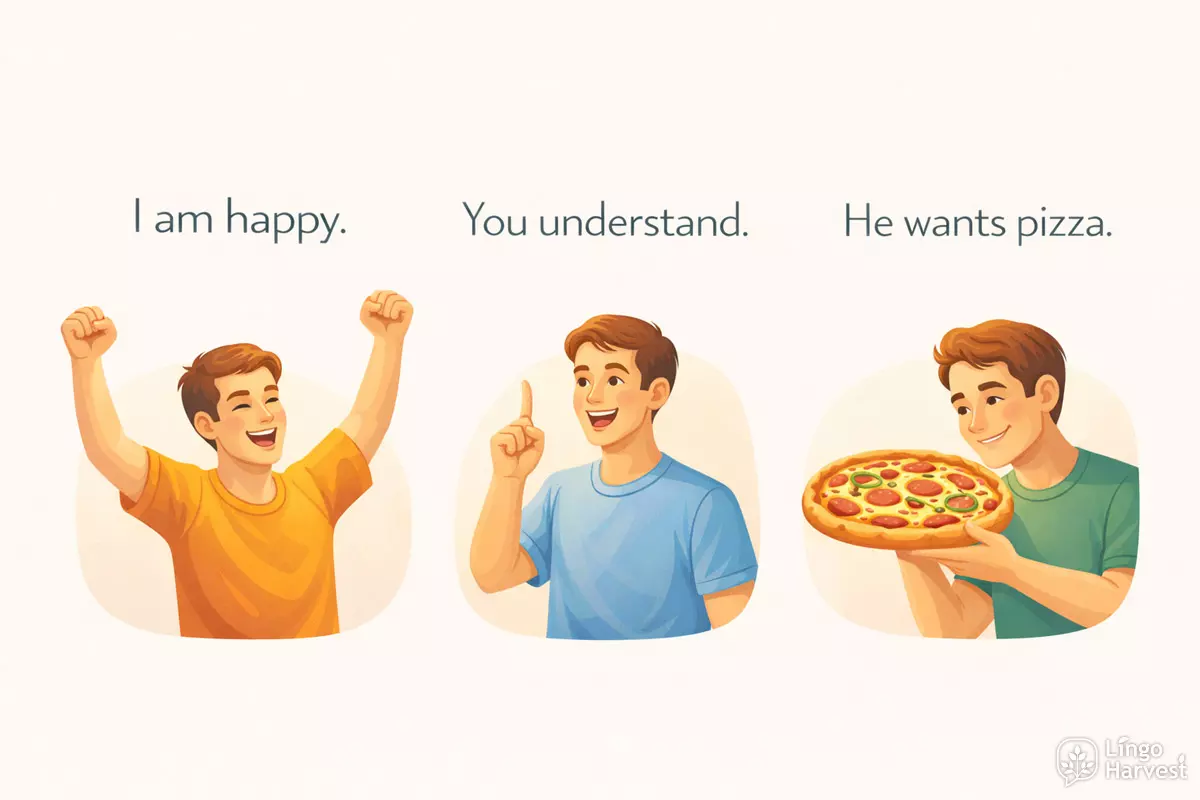
- I am happy.
- You understand.
- He wants pizza.
- She sings well.
- It works.
- We help each other.
- They play football.
- He is sleeping.
- We will call you.
- It rains a lot here.
Understanding this structure will make your sentences sound natural and clear, and it’s one of the easiest ways to improve your everyday English communication.
Object pronouns after verbs and prepositions
When using pronouns as the receiver of an action or as the object of a preposition, certain forms are required. These pronouns (like me, him, her, us, and them) follow verbs or prepositions directly, never standing before the verb as the subject does. For example, in "She called him," the word him is necessary after the verb to show who was called.
Common placements for object forms
Object pronouns are placed immediately after the verb or preposition they relate to. This placement helps make sentences clear and natural. Consider these examples:
- Can you help me?
- They invited us to the party.
- He saw her at the station.
- She gave the book to him.
- I’ll go with you.
- The teacher spoke to them.
- This gift is for me.
- Show us your drawing.
- We sat beside her.
- He called them yesterday.
- She asked me a question.
- Don’t talk about him.
- Let me try.
- He’s coming with us.
- They depend on you.
Object pronoun forms vs. subject forms
It’s easy to mix up the forms, especially for beginners. Here’s a handy comparison showing how the two types differ:
| Subject Pronoun | Object Pronoun |
|---|---|
| I | me |
| you | you |
| he | him |
| she | her |
| it | it |
| we | us |
| they | them |
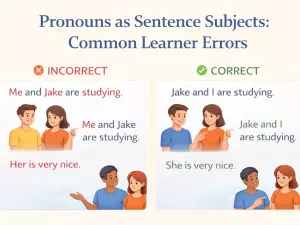
Grammatically, using a subject form after a verb or preposition is incorrect (❌ "Give it to I"). Always use the object form in these positions (✅ "Give it to me").
Quick tips for correct usage
- After action verbs, use the object pronoun: "She knows him."
- After prepositions (to, for, with, about, etc.), use the object form: "Talk to us."
- Never use a subject pronoun in these spots: avoid "for they" or "with he".
Getting comfortable with these patterns will help your sentences sound natural and avoid common mistakes when placing pronouns after verbs and prepositions.
Pronouns with negation: placement with not
When forming negative sentences in English, the position of pronouns in relation to the word not is important for clarity and correctness. Typically, object pronouns come before not only in very specific cases, but most often they directly follow the verb and precede not only when there is an auxiliary involved. Understanding these placement rules helps sentences sound natural and avoids confusion.
Basic placement patterns
In standard negative sentences, the negative word not is placed after the auxiliary verb (such as do, does, will, can, etc.), and the pronoun comes after not if it is the object. For example:
- I do not know him.
- She will not invite them.
If the pronoun is the subject, it always comes before the auxiliary (and thus before not):
- He does not like pizza.
- They have not seen the movie.
Special cases: contractions and short answers
Often, negatives are contracted (e.g., don't, isn't). The pronoun’s position remains the same:
- I don’t know her.
- We aren’t calling him.
In short answers, the pronoun usually comes before the negative word:
- He isn’t.
- We can’t.
Imperatives and infinitives with negation
When giving negative commands or instructions, the structure shifts. The pronoun may follow not:
- Do not touch it.
- Please don’t disturb me.
With infinitives, not comes before the pronoun:
- Try not to disturb him.
- Remember not to forget them.
Common patterns: examples for reference
Here are practical examples showing typical placement of pronouns and not in various sentence types:
- She cannot see us.
- We have not met them.
- He did not tell me.
- I will not help you.
- They should not bother him.
- Don’t ask her.
- He isn’t blaming me.
- Let’s not forget it.
- They aren’t calling us.
- Try not to disturb them.
- She won’t see him again.
- He does not understand her.
- Please don’t interrupt me.
- We must not lose it.
- You shouldn’t blame yourself.
Quick reference: pronoun placement in negatives
| Sentence type | Example (pronoun in bold) |
|---|---|
| Simple negative | I do not see him. |
| Negative imperative | Do not touch it. |
| Negative infinitive | Try not to disturb them. |
| Negative contraction | We aren’t calling her. |
| Short answer | He isn’t. |
In summary, the location of pronouns in negative structures is determined by whether the pronoun is the subject or object, and by the sentence type (statement, command, infinitive, or short answer). Practicing these patterns ensures your English sentences are both clear and grammatically correct.
Pronouns with auxiliary verbs: do/does/did, be, have
When using pronouns alongside auxiliary verbs, word order becomes especially important for clarity and grammatical correctness. Auxiliaries like “do,” “does,” “did,” forms of “be,” and “have” often come before pronouns in questions, but follow them in statements and negatives. Understanding this positioning helps you form natural-sounding sentences and avoid common mistakes.
Position in Statements and Questions
In positive statements, the subject pronoun comes first, directly followed by the auxiliary verb:
- She is reading.
- We have finished.
- They do like pizza.
For questions, the auxiliary verb typically moves before the pronoun:
- Are you coming?
- Did he call?
- Have they arrived?
Negatives and Short Answers
To form negatives, “not” is added after the auxiliary and before the main verb. The pronoun remains right after the auxiliary in short answers:
| Incorrect ❌ | Correct ✅ |
|---|---|
| No, they don’t. | No, they haven’t. |
| Yes, he has. | Yes, he does. |
| No, she isn’t. | No, she hasn’t. |
| Yes, they are. | Yes, they do. |
| No, you aren’t. | No, you don’t. |
| Yes, we have. | Yes, we are. |
| No, it doesn’t. | No, it isn’t. |
| Yes, she is. | Yes, she has. |
| No, he hasn’t. | No, he didn’t. |
| Yes, they did. | Yes, they were. |
Examples of Pronoun Placement
Here’s a summary showing how pronouns interact with auxiliary verbs in different sentence types:
| Sentence Type | Example |
|---|---|
| Positive statement | She is working. |
| Negative statement | They do not agree. |
| Yes/No question | Have you seen this? |
| Short answer | Yes, I have. |
| Wh-question | Why did he leave? |
| Emphasis | I do like coffee! |
Common Patterns with Pronouns and Auxiliaries
- He does not know the answer.
- Is she coming to the meeting?
- Did we forget something?
- They are waiting outside.
- I have finished my work.
- Are you ready?
- No, she isn’t.
- Yes, we did.
- Why have they left?
- He has not replied yet.
Carefully placing pronouns before or after auxiliary verbs, depending on the sentence type, ensures your English is accurate and easy to understand.
Pronouns in questions: inversion and short answers
When forming questions in English, the position of pronouns often changes compared to statements. This shift, known as inversion, involves placing the auxiliary verb before the subject pronoun. For example, instead of “She is coming,” you would ask, “Is she coming?” This structure is essential for clear, correct questions, both in spoken and written English.
Inversion with pronouns in questions

With yes/no questions, the auxiliary verb (like “do,” “is,” or “can”) comes before the subject pronoun. Here are common patterns:
- Are you ready?
- Does he know?
- Will they arrive soon?
- Have we met before?
- Can she help?
- Did it rain?
- Should I call?
- Was he upset?
- Would you agree?
- Has it finished?
Notice how the subject pronoun always follows the auxiliary verb in these examples.
Pronouns in wh- questions
When asking for specific information, wh- words (who, what, where, etc.) come first, followed by the auxiliary, then the pronoun. For example:
- Where are you going?
- Why did she leave?
- When will they call?
- How can we help?
- What does he want?
- Which one do you prefer?
- Who did you see?
- How have they managed?
Again, the pronoun stays right after the auxiliary verb.
Short answers with pronouns
Short answers often use pronouns to avoid repetition. Instead of repeating the whole question, English speakers reply concisely:
- Are you tired? → Yes, I am. / No, I’m not.
- Has she eaten? → Yes, she has. / No, she hasn’t.
- Can they come? → No, they can’t. / Yes, they can.
- Do we know him? → Yes, we do. / No, we don’t.
- Did it work? → Yes, it did. / No, it didn’t.
- Will you help? → Yes, I will. / No, I won’t.
- Should I stay? → No, you shouldn’t. / Yes, you should.
- Was he late? → Yes, he was. / No, he wasn’t.
These responses keep the pronoun and auxiliary verb, dropping the rest for clarity.
Comparison: statements vs. questions
The following table shows how the order of pronouns and verbs changes between statements and questions:
| Statement | Question (with inversion) |
|---|---|
| You are ready. | Are you ready? |
| She can swim. | Can she swim? |
| They will help. | Will they help? |
| He has finished. | Has he finished? |
| We did it. | Did we do it? |
Understanding these patterns helps you use pronouns naturally in both questions and short answers, making your English clear and correct.
Pronouns in imperative sentences: tell me, give it
Imperative sentences—commands, requests, or instructions—often use pronouns as their objects. In these types of sentences, object pronouns usually come immediately after the verb. This placement is important for clarity and natural-sounding English. For instance, in "Tell me" or "Give it," the pronoun ("me," "it") directly follows the action word. This structure is consistent, regardless of which object pronoun you use.
Typical word order with object pronouns
When giving a command, the verb comes first, followed by the object pronoun:
- Show me the instructions.
- Send her the details by email.
- Pass them the documents.
- Buy us some tickets.
- Tell him the truth.
- Bring it to the office.
- Ask me if you need help.
- Call them after the meeting.
- Remind her about the deadline.
- Give us a few minutes.
- Leave it on the table.
- Take him to the station.
- Help me with this task.
- Show them the final version.
- Send it as soon as possible.
- Explain this step by step.
- Tell us what happened.
- Pass me the salt, please.
What about negative commands?
When you tell someone not to do something, the pronoun still comes after the verb, but after "don't":
- Don't tell him the secret.
- Don't give it to anyone else.
- Don't show me the results yet.
- Don't send them the files without approval.
- Don't ask her about the surprise.
Multiple pronouns and imperative sentences
If an imperative sentence contains both an indirect and a direct object pronoun, native speakers typically use a noun for one and a pronoun for the other to avoid confusion. For example:
- Give him the book.
- Show us your homework.
- Tell me the answer.
If both are pronouns, the indirect object comes first:
- Give me it. ❌ (rare, usually avoided)
In natural English, people prefer:
- Give it to me. ✅
Summary: Object pronoun placement in commands
The position of pronouns in commands is direct and straightforward: the object pronoun follows the verb. When more than one object is present, English often prefers a pronoun plus a noun, or uses a prepositional phrase ("to me," "for her") for clarity. This word order helps keep instructions concise and clear.
Double objects: give me it vs give it to me
When English sentences contain two objects—a direct object and an indirect object—word order becomes important, especially with pronouns. Native speakers often feel that some combinations are natural, while others sound awkward or even incorrect. For example, "give it to me" is common and accepted, but "give me it" is less standard and may seem odd.
Understanding Object Placement
In sentences with both a direct and indirect object, English typically allows two structures:
- Verb + indirect object pronoun + direct object noun (e.g., "Give me the book.")
- Verb + direct object noun + to/for + indirect object pronoun (e.g., "Give the book to me.")
However, when both objects are pronouns, the prepositional form ("give it to me") is strongly preferred. The alternative ("give me it") is rare and often avoided in standard English.
Examples of Double Object Patterns
Notice how naturalness changes depending on which objects are pronouns or nouns:
- "Show me the report." ✅
- "Show it to me." ✅
- "Show me it." ❌ (awkward, rarely used)
- "Send her the letter." ✅
- "Send it to her." ✅
- "Send her it." ❌ (unusual)
- "Pass John the salt." ✅
- "Pass it to John." ✅
- "Pass him it." ❌ (stilted)
- "Tell them the answer." ✅
- "Tell it to them." ✅
- "Tell them it." ❌ (not standard)
Why "give me it" Sounds Awkward
When both objects are pronouns, the sentence becomes hard to process. Using "to" or "for" clarifies meaning and prevents ambiguity. This is why "give it to me" is nearly always the preferred structure.
Summary Table: Double Object Patterns with Pronouns
| Structure | Acceptability |
|---|---|
| Give me the keys. | ✅ Natural (pronoun + noun) |
| Give the keys to me. | ✅ Natural (noun + to + pronoun) |
| Give me them. | ❌ Uncommon/awkward (pronoun + pronoun) |
| Give them to me. | ✅ Standard (pronoun + to + pronoun) |
Key Takeaways
- When both objects are pronouns, always use the prepositional form ("give it to me").
- Mixing a pronoun and a noun allows both structures, but word order still matters.
- Awkward or unclear sentences can often be fixed by switching to the "to/for + pronoun" pattern.
Understanding how to place pronouns in double object constructions helps your sentences sound more natural and clear.
Common placement errors and quick fixes
Understanding where to put pronouns often trips up both learners and native speakers. Misplacing them can make sentences sound awkward, ambiguous, or even change their meaning. Below, you’ll find some typical mistakes and straightforward ways to correct them.
Misplaced pronouns in compound sentences
Sometimes, pronouns are inserted too early or too late in a sentence with multiple clauses, leading to confusion about what or whom they refer to. For example:
- Incorrect: She said yesterday she would come.
- Better: She said she would come yesterday.
Placing the pronoun closer to the verb it relates to often clarifies the sentence.
Ambiguous reference
A pronoun should clearly refer to a single noun. If it’s not obvious, rewrite the sentence:
- Unclear: When Emily met Sarah, she smiled. (Who smiled?)
- Clear: When Emily met Sarah, Emily smiled.
Pronoun placement with infinitives and phrasal verbs
Pronouns usually go between a phrasal verb and its particle, or before an infinitive:
- Correct: Turn it off. ✅
- Incorrect: Turn off it. ❌
- Correct: I want him to help.
- Incorrect: I want to help him. (Changes the meaning.)
Order of multiple pronouns
When sentences require more than one pronoun, their order matters. The general rule is: indirect object before direct object.
| Correct Order | Incorrect Order |
|---|---|
| Give me it. | Give it me. |
| Show her them. | Show them her. |
| Send us them. | Send them us. |
| Tell him it. | Tell it him. |
Quick reference: frequent pitfalls and solutions
- Don’t split subject and verb with a pronoun phrase: He quickly it finished ❌ → He finished it quickly ✅
- Place reflexive pronouns right after the subject or verb: She herself did it.
- After prepositions, use object pronouns: between you and me (not I).
- In questions, pronouns often come right before the main verb: Did you see him?
- With negatives, keep the pronoun close to the verb: I didn’t see her, not I didn’t her see.
- Don’t repeat pronouns unnecessarily: My sister, she is coming ❌ → My sister is coming ✅
- For emphasis, use the correct position: It was him who called (not He was it who called).
- When using “both,” the pronoun follows: They both left.
Getting pronoun placement right takes practice, but checking for clarity and following these patterns will help you avoid the most common slip-ups.
Practice: reorder words to form correct sentences
Arranging words in the right order helps you master where pronouns should appear in English sentences. Below, you'll find exercises to practice putting pronouns in their natural positions, whether the sentence is affirmative, negative, or interrogative. Try to focus on both subject and object pronouns, as well as possessive forms.
Task 1: Rearrange the words
Each group of jumbled words forms a correct sentence when ordered properly. Pay special attention to where pronouns are placed within each sentence. Write your answers before checking below.
- book / her / gave / I / to
- they / us / invited / to / party / the
- my / forgot / he / name
- me / can / you / help / please
- his / lost / wallet / he
- see / did / them / you / yesterday
- borrow / can / your / I / pen
- explained / she / it / to / me
- our / found / teacher / we / keys
- sent / message / a / him / I
- the / called / her / doctor
- us / showed / photos / their / they
- want / something / I / to / tell / you
- visited / last week / them / we
- it / understand / I / don't
Show answers
- I gave her the book.
- They invited us to the party.
- He forgot my name.
- Can you help me please?
- He lost his wallet.
- Did you see them yesterday?
- Can I borrow your pen?
- She explained it to me.
- We found our teacher's keys.
- I sent him a message.
- The doctor called her.
- They showed us their photos.
- I want to tell you something.
- We visited them last week.
- I don't understand it.
Task 2: Spot the pronoun placement
Identify and correct the misplaced pronouns in these sentences. Rewrite the sentences correctly.
- To me she gave the letter.
- Can the keys you give me?
- Him I told the truth.
- Sent I it to her yesterday.
- Us they invited to the meeting.
- Her did you show the report?
- Them we will send the details tomorrow.
- Me please help with this task.
- To him explained she the problem.
- It gave she to me last night.
Show answers
- She gave the letter to me.
- Can you give me the keys?
- I told him the truth.
- I sent it to her yesterday.
- They invited us to the meeting.
- Did you show her the report?
- We will send them the details tomorrow.
- Please help me with this task.
- She explained the problem to him.
- She gave it to me last night.
Patterns: Where do pronouns go?
- Subject pronouns usually start the sentence: She called.
- Object pronouns follow the verb: He saw them.
- Indirect objects (as pronouns) often come before the direct object: I gave him a gift.
- Possessive pronouns show ownership: My book is on the table.
- In questions, subject and object pronouns follow the auxiliary/modal: Can you help me?
Practicing these patterns will help you develop a natural sense of pronoun placement in various sentence types.