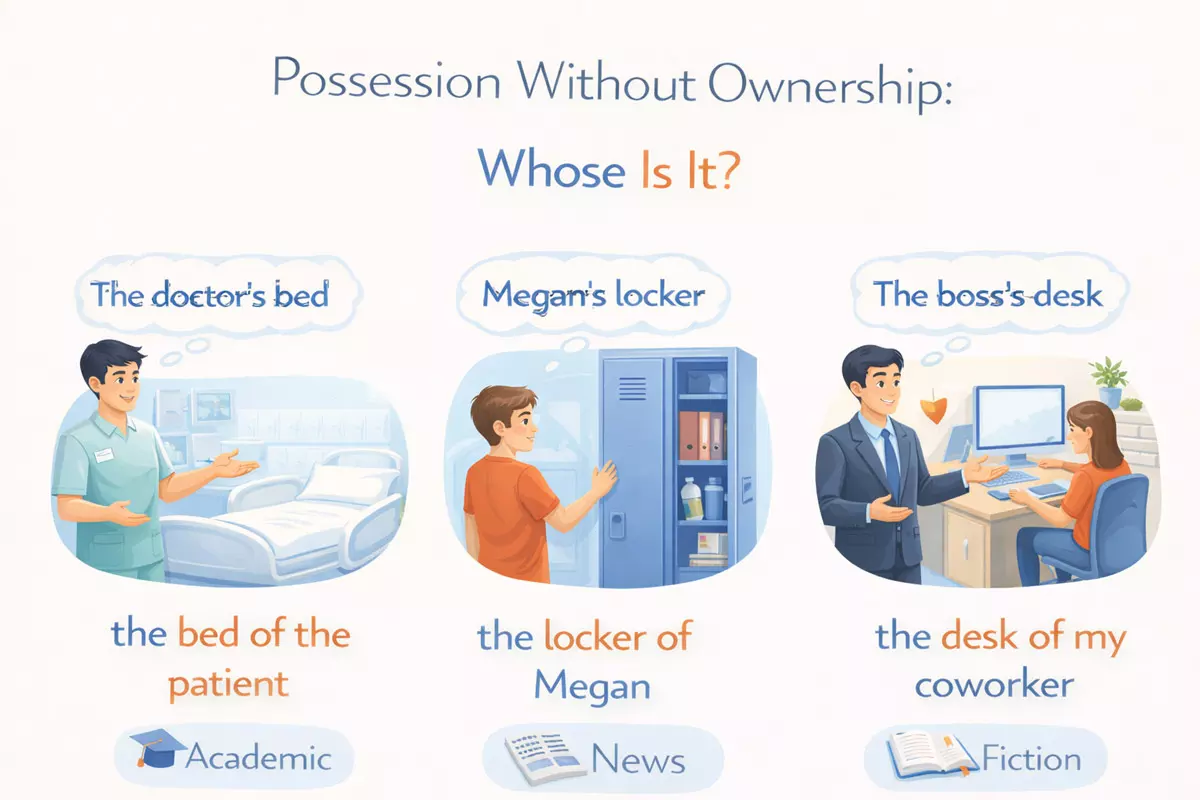
Possession Without Ownership: Whose Is It?

 The article explains how English expresses possession and ownership, how to ask and answer questions about who owns something, the use of possessive pronouns and nouns, and ways to avoid ambiguity, with practice through real-life examples and dialogues.
- Possession vs ownership: what English actually expresses
- How to ask about possession: whose, who does it belong to
- Core answer patterns: It’s mine, It’s Anna’s, It belongs to me
- Pronouns vs possessive nouns: mine vs my, yours vs your
- Common contexts: lost items, borrowing, shared spaces
- Avoiding ambiguity with it/they and clear references
- Whose + noun vs whose as a pronoun
- Mini practice: quick Q&A dialogues with whose
Simply possessing an object does not necessarily mean you own it, as there is a significant difference between physical control and legal ownership. This distinction highlights important questions about property rights and the limits of personal claims, reminding us that true ownership often depends on laws, agreements, or recognized authority rather than just having something in your hands. Understanding this gap is crucial in navigating issues of control, entitlement, and the responsibilities that come with possession.
Possession vs ownership: what English actually expresses
English draws a subtle line between having something and actually owning it. While the language often blurs these ideas in daily conversation, a closer look reveals distinct grammatical and lexical choices for each. English speakers regularly use possessive forms to indicate relationships, but these forms don’t always signal true legal or permanent rights.
How English signals “having”
The most common way to show that something belongs to someone at the moment is with possessive pronouns or the ’s construction. These forms answer the question “Who has it right now?” rather than “Who owns it?” For example:
- my book → I left my book on the table.
- your keys → Are these your keys?
- Sarah’s bag → Sarah’s bag is under the chair.
- their house → Their house is near the park.
- the cat’s toy → The cat’s toy is missing.
- our seats → Our seats are in the front row.
- John’s phone → John’s phone is ringing.
- his laptop → He forgot his laptop at work.
- her umbrella → She took her umbrella with her.
- the teacher’s pen → The teacher’s pen is on the desk.
- my car → My car is parked outside.
- the children’s playground → The children’s playground was renovated.
- its cover → The book lost its cover.
- the manager’s office → The manager’s office is on the third floor.
- my friend’s jacket → My friend’s jacket is too warm.
- the company’s policy → The company’s policy changed last year.
These constructions often describe use, association, or responsibility rather than legal ownership.
Expressing ownership in English
To make legal ownership explicit, English typically relies on verbs and fixed phrases rather than possessive forms:
- own → She owns the apartment.
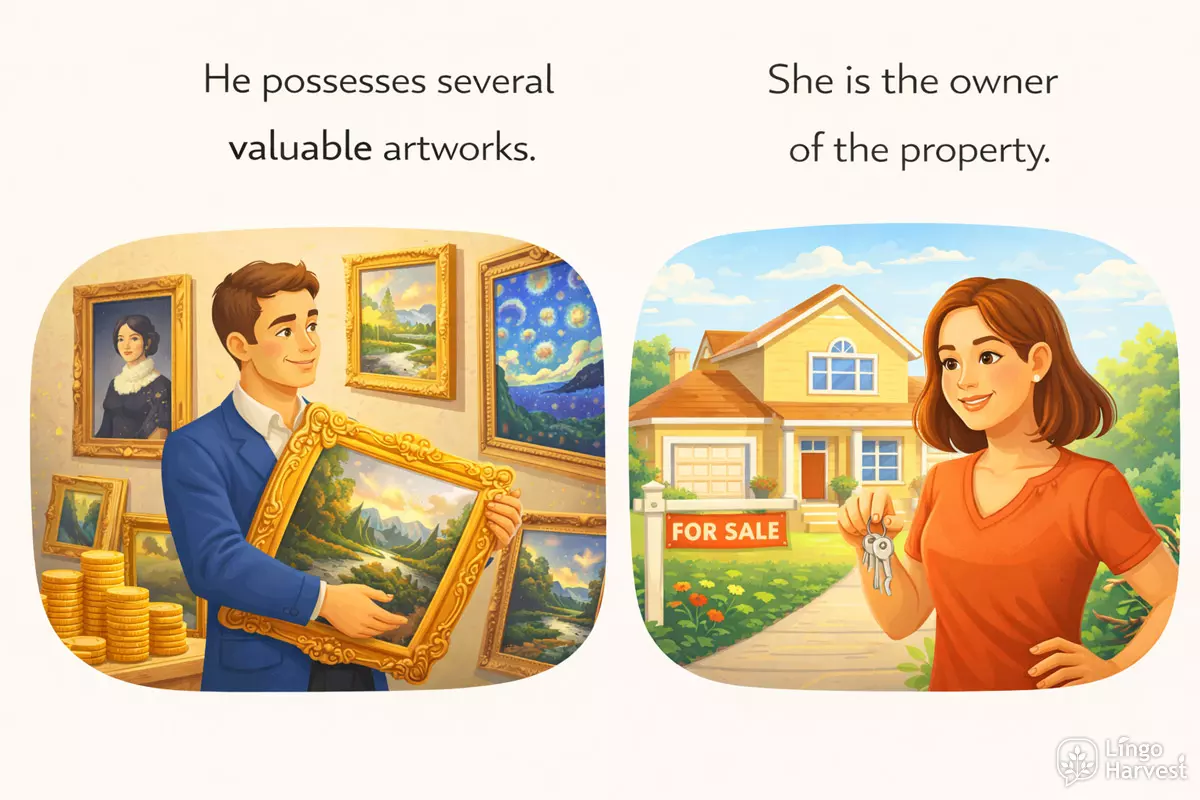
- possess → He possesses several valuable artworks.
- be the owner of → She is the owner of the property.
- hold the title to → He holds the title to the land.
- have legal rights to → They have legal rights to the trademark.
- be in possession of → The company is in possession of the documents.
- be entitled to → She is entitled to the inheritance.
- be the proprietor of → He is the proprietor of a small hotel.
- hold ownership of → The organization holds ownership of the assets.
- have a claim to → Several parties have a claim to the land.
Notice that these expressions are less common in everyday speech; people often rely on context or additional explanation to clarify whether they mean temporary possession or actual ownership.
Quick comparison: possession vs. ownership in English
| Form/Expression | What it signals |
|---|---|
| my/your/his/her/our/their + noun | Current holder or user; not always the owner |
| ’s (possessive ’s) | Relationship to the object; may be possessor or caretaker |
| own/ownership | Legal or permanent rights |
| have/has | Simple possession; often temporary or situational |
| be in possession of | Formal/legal possession, not always ownership |
Everyday confusion: who owns what?
In real life, English often leaves the distinction vague. “That’s my car” could mean you own it, you’re borrowing it, or even just using it at the moment. Legal documents, on the other hand, must use precise terms to avoid this ambiguity. Understanding these subtle differences helps clarify not only what English grammar conveys, but also what it leaves unsaid—making it essential to pay attention to both words and context.
How to ask about possession: whose, who does it belong to
Understanding how to question possession is essential when you want to clarify ownership, especially in situations where ownership is not obvious. English offers several ways to ask about who something belongs to, ranging from direct questions to more nuanced forms. The choice depends on context, formality, and what you already know about the object or its possible owner.
Common Question Structures
The most direct way is to use whose. This pronoun replaces the owner in a sentence and can be used with or without a noun:
- Whose book is this?
- Whose are these keys?
- Whose idea was it?
Alternatively, you can ask about ownership using belong to. A more formal option is to whom, which is mainly used in careful writing or formal situations:
- Who does this umbrella belong to?
- To whom does this phone belong?
- Whose → the fastest and most natural option in everyday English
- belong to → neutral and explicit when you want to highlight ownership
- to whom → formal and mostly written, not common in casual speech
Common learner mistake: Using to whom in casual conversation, where whose sounds more natural.
Expanded Examples for Context
Here are more examples that show different ways to frame these questions:
- Whose jacket did you find?
- Who owns this notebook?
- Do you know whose shoes those are?
- Can you tell me whose bag this is?
- Who is the owner of these headphones?
- Is this your pen or someone else’s?
- Which one is yours?
- Does this belong to anyone here?
- Who left this behind?
- Are these gloves yours?
- Who claims this item?
- Is anyone missing a wallet?
Choosing the Right Form
The context and your relationship to the other person influence the formality and directness of your question. “Whose” is neutral and works in most cases. “Who does it belong to?” feels slightly more formal or indirect, suitable if you want to avoid assumptions. In writing or formal speech, “To whom does it belong?” may appear, but it is rare in casual conversation.
Patterns: “Whose” vs. “Who does it belong to”
Sometimes, it helps to see the structures side by side:
| Using “Whose” | Using “Who does it belong to” |
|---|---|
| Whose phone is this? | Who does this phone belong to? |
| Whose dog is in the yard? | Who does the dog in the yard belong to? |
| Whose lunch is on the table? | Who does the lunch on the table belong to? |
| Whose car is parked outside? | Who does the car parked outside belong to? |
These patterns can be adapted for almost any object or situation. Remember, both forms are correct; your choice depends on how direct or polite you want to be, as well as the context.
Summary Tips
- Use whose for concise, direct questions.
- For a less direct approach, try “Who does this/that belong to?”
- Adjust formality based on your audience and situation.
- Both structures help clarify possession when ownership is unclear.
Asking about possession is a basic but important skill in English, useful in daily life, lost-and-found situations, and even polite conversation.
Core answer patterns: It’s mine, It’s Anna’s, It belongs to me
Expressing whose something is often relies on a few clear phrases in English. These patterns help clarify possession, whether you’re talking about your own items or those belonging to someone else. The forms you choose depend on context, formality, and the relationship between the people involved.
Common ways to show possession
To indicate who an object belongs to, English speakers use a mix of pronouns, possessive forms, and descriptive structures. Here are some widely used options:
- It’s mine. (Shows personal possession)
- It’s Anna’s. (Shows another person’s possession)
- It belongs to me. (Explicit ownership, slightly more formal)
- It’s yours.
- It’s his/hers/ours/theirs.
- It belongs to Anna.
- That’s my book.
- That book is mine.
- This pen is hers.
- The keys are theirs.
- Is this your umbrella?
- Whose is this?
- It’s not mine.
- It’s not John’s.
- That bag belongs to you, right?
Comparing forms: Pronouns, Names, and “Belongs to”
Different structures can sound more casual or more formal. Using a possessive pronoun like “mine” or “yours” is direct and common in conversation. Names followed by an apostrophe-s (’s) are clear for showing someone else’s possession. The phrase “belongs to” is often used for extra clarity or in more formal settings.
| Pattern | Example |
|---|---|
| Possessive pronoun | This is mine. |
| ’s (apostrophe-s) with a name | That’s Anna’s. |
| Belongs to + noun/pronoun | It belongs to me. |
| Possessive adjective + noun | That’s my coat. |
| Whose + noun/question | Whose keys are these? |
Choosing the right option
Use possessive pronouns (“mine,” “yours”) for short, direct answers, especially in spoken English. The name plus ’s pattern is helpful when you want to specify a person. “Belongs to” works well when you need to be extra clear or in slightly more formal situations. In all cases, the goal is to make ownership obvious and avoid confusion about whose item is being discussed. These patterns are essential for everyday English, making it easy to talk about what’s yours—or someone else’s—without misunderstanding.
Pronouns vs possessive nouns: mine vs my, yours vs your
Understanding how English indicates possession can be confusing, especially when distinguishing between possessive pronouns and possessive adjectives (sometimes called possessive determiners). The difference impacts how we express ownership, relationships, and belonging in a sentence. Let’s break down how “mine” contrasts with “my,” and how “yours” differs from “your,” with examples and practical guidance.
Possessive adjectives vs. possessive pronouns
Possessive adjectives (like “my” and “your”) come before a noun to show who owns something. Possessive pronouns (“mine,” “yours”) replace the noun altogether, making sentences less repetitive and more natural.
- My book is on the table. (possessive adjective + noun)
- This book is mine. (possessive pronoun replaces noun)
- Your shoes are dirty.
- Are these shoes yours?
Side-by-side comparison
The difference is clearer when you see both forms in action. Here’s a comparison to help:
| Possessive Adjective | Possessive Pronoun |
|---|---|
| my car | The car is mine. |
| your idea | The idea was yours. |
| my seat | That seat is mine. |
| your pen | Is this pen yours? |
| my responsibility | The responsibility is mine. |
| your problem | That problem is yours. |
Common mistakes and tips
It’s easy to mix up these forms, especially for learners. Here are some quick pointers:
- Never use “mine” before a noun: ❌ mine book (✅ Use “my book” instead.)
- Don’t use “my” without a noun: ❌ This is my. (✅ Use “This is mine.”)
- “Yours” stands alone: ✅ Is this yours?
- “Your” must have a noun: ✅ Your keys are here.
Quick reference list
Some useful pairs to recognize at a glance:
- my / mine
- your / yours
- his / his
- her / hers
- our / ours
- their / theirs
- its / (no possessive pronoun form)
In summary, use possessive adjectives before nouns to specify ownership, and possessive pronouns when you want to avoid repeating the noun. This distinction helps keep your sentences clear and concise, making your language sound more natural and fluent.
Common contexts: lost items, borrowing, shared spaces
Situations involving possession but not legal ownership come up frequently in everyday life, often creating uncertainty about who can use, keep, or return an item. These scenarios raise interesting questions about responsibility, rights, and social expectations.
Lost and Found: Who Controls a Lost Object?
When someone finds a misplaced wallet or umbrella, they become the temporary holder, but not the owner. The finder may have physical possession, but generally, there’s an expectation to attempt to return it to its rightful owner. In some places, local laws require finders to hand items over to authorities, while in others, social norms guide the process.
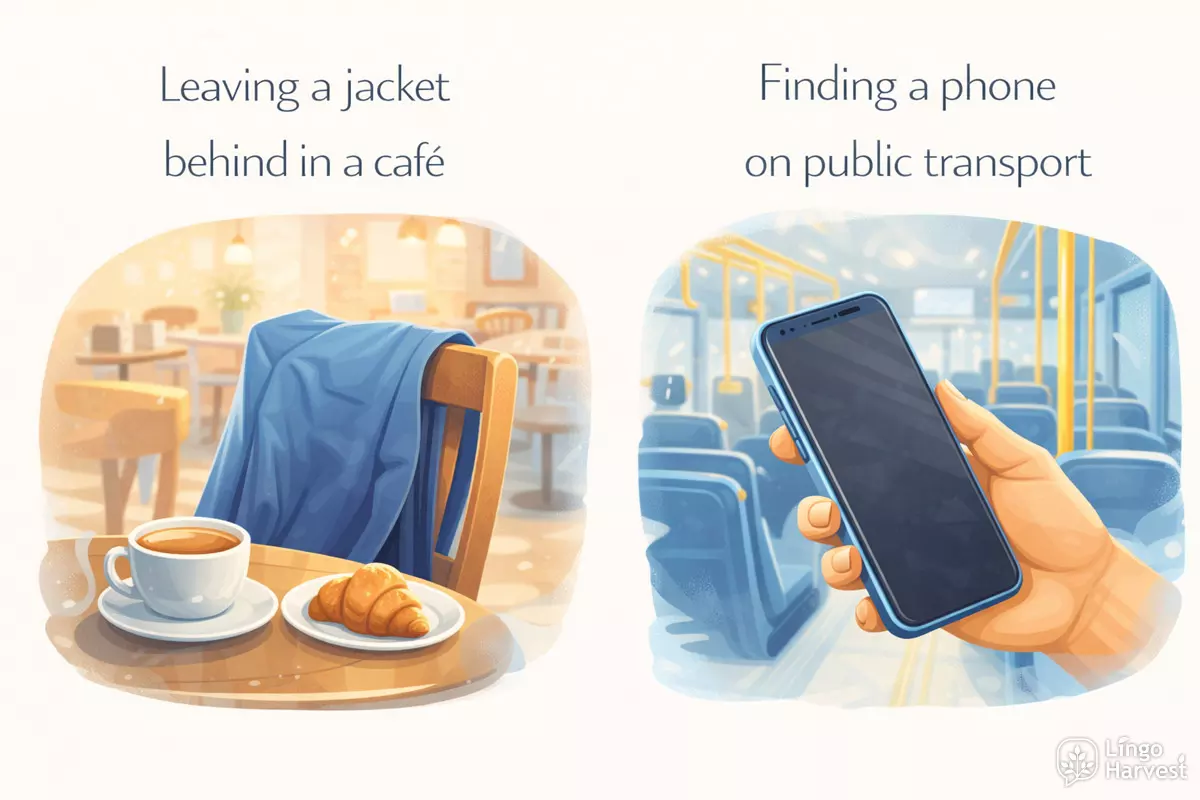
- Leaving a jacket behind in a café
- Finding a phone on public transport
- Misplaced keys in a shared office
- Children’s toys left in a park
- Unattended bags at a gym
Borrowing: Temporary Use, Not Transfer of Ownership
Borrowing is a classic example of having something in your possession without actually owning it. Whether it’s a book from a friend or a neighbor’s lawnmower, the item is expected to be returned in good condition. Trust plays a huge role, and misunderstandings can arise if boundaries aren’t clear.
- Lending and returning tools
- Library books
- Borrowed clothing for an event
- Sharing bicycles or scooters
- Temporary use of electronics
Shared Spaces: Blurred Lines of Access
In communal areas, multiple people may use the same item, but no one person owns it outright. This often happens in workplaces, apartments, or even among roommates. Clear communication helps avoid conflict over shared resources.
| Scenario | Who Has Possession? |
|---|---|
| Company coffee machine | All employees, but not their personal property |
| Apartment laundry room | Residents share access, not ownership |
| Books in a waiting room | Available to visitors, but owned by the facility |
| Shared kitchen utensils in a co-living space | Everyone can use them; no single owner |
| Office supplies (e.g., staplers) | Accessible to staff, property of the company |
Why These Distinctions Matter
Understanding the difference between holding, using, and owning helps avoid misunderstandings and disputes. In many cultures, respecting these boundaries is a sign of trustworthiness and good citizenship. Whether you’re borrowing a pen, using a communal fridge, or picking up a lost scarf, being mindful of the distinction between possession and ownership keeps relationships smooth and reduces conflict.
Avoiding ambiguity with it/they and clear references
Choosing the right pronoun and making sure your reader knows what it refers to can be surprisingly tricky, especially when discussing concepts like possession without clear ownership. Words like “it” or “they” are useful shortcuts, but if their meanings aren’t obvious, confusion creeps in. Whenever a pronoun could point to more than one thing, readers may be left guessing who or what is meant.
Common sources of confusion
Pronouns can create ambiguity in a few typical ways:
- Multiple nouns nearby: “The box was given to Sam by Alex because it was heavy.” (What was heavy—box or Alex?)
- Switching topics: “The team lost, and they blamed the weather.” (Does “they” refer to the team or someone else?)
- Introducing new objects or people: “Jordan handed the keys to Jamie after they arrived.” (Who arrived?)
Strategies for clarity
To ensure your references are clear, try these approaches:
- Repeat the noun when needed: “The document was signed by the manager because the manager was responsible.”
- Restructure sentences: “Because it was heavy, Alex gave the box to Sam.”
- Add clarifying details: “Jordan handed the keys to Jamie after Jamie arrived.”
- Use descriptive phrases: “The old bicycle, which belonged to no one, was left in the yard. It became rusted.” (Here, “it” is clearer, but you could say “The bicycle became rusted.” for extra clarity.)
Examples of ambiguous and clear references
Below are example sentences where pronoun use may cause confusion, alongside clearer alternatives.
- Ambiguous: “Alex gave Sam the book after they finished it.”
Clear: “Alex gave Sam the book after Sam finished reading it.” - Ambiguous: “The company sold the laptop to the employee, but they didn’t want it.”
Clear: “The company sold the laptop to the employee, but the employee didn’t want the laptop.” - Ambiguous: “When the students met the teachers, they were excited.”
Clear: “When the students met the teachers, the students were excited.” - Ambiguous: “The car hit the pole, but it was not damaged.”
Clear: “The car hit the pole, but the pole was not damaged.” - Ambiguous: “Jordan told Chris to call them.”
Clear: “Jordan told Chris to call Jordan.” or “Jordan told Chris to call Chris’s parents.” - Ambiguous: “The report was reviewed by Alex and Jamie, but they didn’t sign it.”
Clear: “The report was reviewed by Alex and Jamie, but Alex didn’t sign it.” - Ambiguous: “The dog chased the cat, and it ran away.”
Clear: “The dog chased the cat, and the cat ran away.” - Ambiguous: “Pat gave Taylor the keys because they were late.”
Clear: “Pat gave Taylor the keys because Taylor was late.” - Ambiguous: “The committee discussed the proposal with the board, and they approved it.”
Clear: “The committee discussed the proposal with the board, and the board approved it.” - Ambiguous: “Morgan met with Riley after they finished work.”
Clear: “Morgan met with Riley after Riley finished work.”
Quick checklist for clear references
- Ask yourself: Can every pronoun only refer to one thing?
- Consider your reader: Would a stranger understand what “it” or “they” means?
- When in doubt, repeat the noun or use a more specific phrase.
Careful attention to pronoun use helps your writing stay precise, especially when discussing complicated questions of possession and ownership. Taking a moment to clarify “it” or “they” saves your reader from unnecessary guesswork.
Whose + noun vs whose as a pronoun
Understanding the different ways we use "whose" in English can help clarify sentences about possession. Sometimes, "whose" introduces a noun—like "whose book" or "whose idea"—while other times it stands alone as a pronoun, as in "Whose is this?" The choice depends on what information you want to highlight and how much context your listener or reader already has.
When "whose" comes before a noun
In this pattern, "whose" directly describes a following noun. This form is common when you want to specify the object or thing in question, not just the owner. Consider these examples:
- Whose jacket is on the chair?
- Do you know whose pen this is?
- She wondered whose keys had been left behind.
- Whose idea was it to start early?
- Can you tell me whose car is blocking the driveway?
- Whose phone keeps ringing?
- We need to find out whose dog this is.
- Whose handwriting is on the envelope?
- Do you remember whose birthday it is today?
- He asked whose shoes were by the door.
This structure is especially useful when the object is important to the question or sentence.
When "whose" stands alone as a pronoun
"Whose" can also be used without a noun following it, especially when the object is obvious or already mentioned. Here, "whose" acts as a pronoun, replacing both the owner and the item. For example:
- Whose is this?
- That umbrella—whose is it?
- These gloves—whose?
- Whose are these books?
- Whose was left behind?
- Whose could this belong to?
- He found a wallet and asked, "Whose?"
- Whose was chosen for the role?
- Whose will be next?
- Whose did you take?
This form is typical in informal situations or when the context makes the object clear.
Comparing "whose" + noun and "whose" as a pronoun
The main difference lies in whether you mention the object or leave it implied. Here’s a structured comparison:
| "Whose" + noun | "Whose" as pronoun |
|---|---|
| Whose bag is this? | Whose is this? |
| Whose shoes are these? | Whose are these? |
| Whose idea was it? | Whose was it? |
| Whose car is parked outside? | Whose is parked outside? |
Both forms are correct, but the choice depends on context and clarity. If the item is obvious, the shorter, pronoun version is natural. If not, specifying the noun avoids confusion. This flexibility allows English speakers to tailor their questions or statements to the situation, making conversations about possession both efficient and precise.
Mini practice: quick Q&A dialogues with whose
Questions with whose are common when we want to ask about the owner of something, but not necessarily the possessor. Practicing these dialogues helps you become more comfortable using whose in everyday English.
Quick-fire question and answer examples
Below are sample exchanges where one person asks about an item, and the other identifies the owner. Notice the structure and how short, natural replies work:
- Whose book is this? — It’s Sarah’s.
- Whose keys are on the table? — They’re mine.
- Whose phone rang? — John’s phone.
- Whose shoes are these by the door? — Those are my brother’s.
- Whose idea was it to go hiking? — It was Emily’s idea.
- Whose umbrella did you borrow? — I borrowed Anna’s.
- Whose turn is it now? — It’s yours.
- Whose handwriting is on this note? — That’s the teacher’s.
- Whose laptop is charging here? — That belongs to Tom.
- Whose dog barked all night? — Our neighbor’s dog.
- Whose mug is this? — It’s not mine; maybe Alex’s.
- Whose bag did you find? — I found Lisa’s bag.
- Whose painting won the prize? — Michael’s painting did.
- Whose advice did you follow? — My mentor’s advice.
Practice Task: Match the question to the correct answer
Try to link each question with the most logical answer. This helps train your ear for natural responses.
- Whose jacket is on the chair?
- Whose voice did you hear?
- Whose birthday is next week?
- Whose car is blocking the driveway?
- Whose laptop is this on the desk?
- Whose phone is ringing?
- Whose umbrella is by the door?
- Whose idea was this plan?
- Whose keys are on the counter?
- Whose bag did you pick up?
- a) It’s my sister’s birthday.
- b) That’s Mark’s car.
- c) It’s probably Julia’s jacket.
- d) I think I heard Sam’s voice.
- e) That’s Nina’s laptop.
- f) It’s Alex’s phone.
- g) It must be Daniel’s umbrella.
- h) It was the team leader’s idea.
- i) They’re Emma’s keys.
- j) I grabbed Chris’s bag by mistake.
Show answers
- Whose jacket is on the chair? → c) It’s probably Julia’s jacket.
- Whose voice did you hear? → d) I think I heard Sam’s voice.
- Whose birthday is next week? → a) It’s my sister’s birthday.
- Whose car is blocking the driveway? → b) That’s Mark’s car.
- Whose laptop is this on the desk? → e) That’s Nina’s laptop.
- Whose phone is ringing? → f) It’s Alex’s phone.
- Whose umbrella is by the door? → g) It must be Daniel’s umbrella.
- Whose idea was this plan? → h) It was the team leader’s idea.
- Whose keys are on the counter? → i) They’re Emma’s keys.
- Whose bag did you pick up? → j) I grabbed Chris’s bag by mistake.
Common sentence patterns with "whose"
Here are some useful patterns for forming questions and answers using whose:
- Whose + noun + is/are + this/that/these/those?
- Whose + noun + verb (past tense)?
- It’s/They’re + [name/possessive].
- That/Those belongs to + [name/pronoun].
- It was + [name]’s + noun.
Practicing these structures and dialogues will make conversations about possession much more fluent and natural. Try creating your own short exchanges using the patterns above!