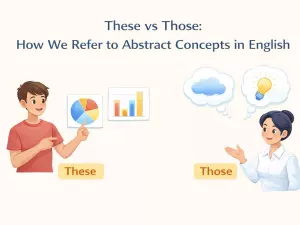
Demonstrative Pronouns vs Demonstrative Adjectives

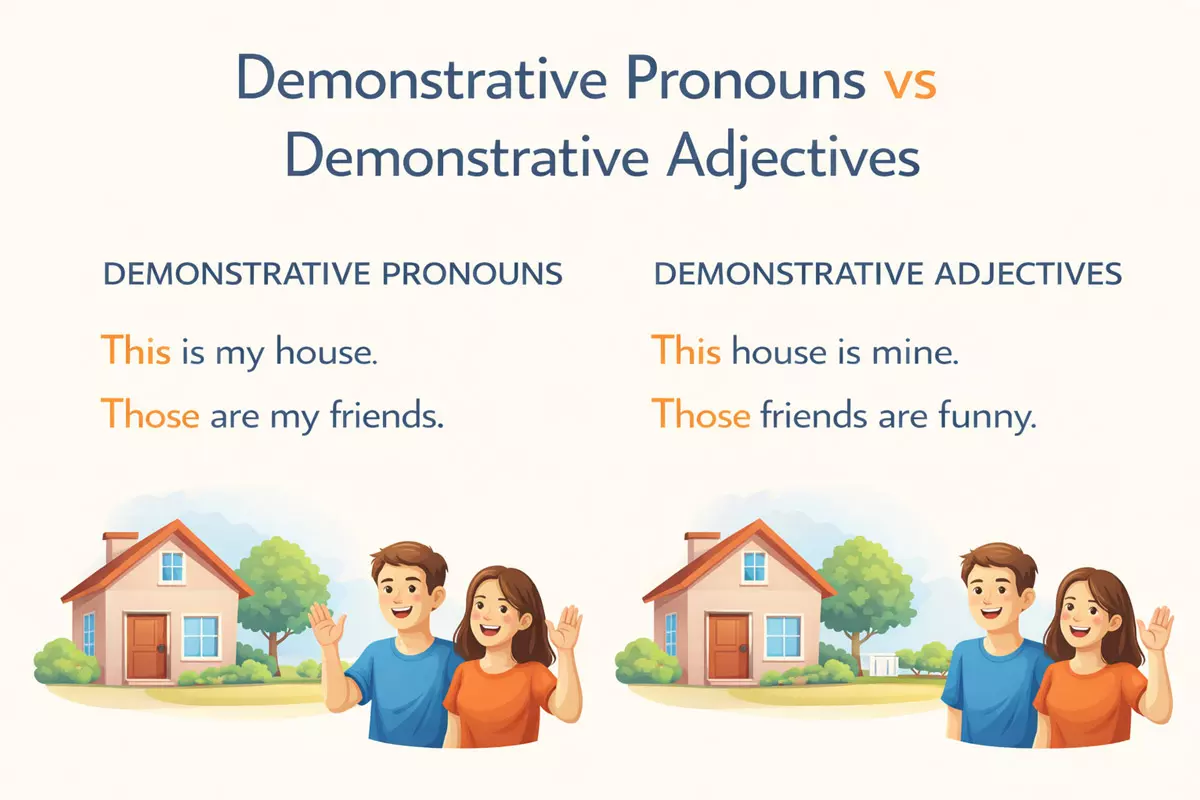 The article explains demonstratives, showing how this, that, these, and those work as adjectives and pronouns. It covers spotting their roles, context and distance, common errors, using them in replies, and practice with corrections and rewrites.
- What demonstratives are and what they point to
- Demonstrative adjectives: this book, those people
- Demonstrative pronouns: this is good, those are mine
- How to spot the difference in a sentence
- Distance and context: near vs far, now vs then
- Common mistakes: missing noun after demonstrative adjective
- Using demonstratives in answers and short replies
- Quick conversions: adjective ↔ pronoun rewrites
- Practice: label and correct demonstrative usage
Words like this and those can function as either pronouns or modifiers, depending on how they are used in a sentence. When used as pronouns, they stand alone and replace nouns, as in This is my favorite. When used as modifiers, they describe nouns directly, as in These books are interesting. Recognizing the difference between these roles can help you construct clearer, more precise sentences and improve your overall communication skills.
What demonstratives are and what they point to
Demonstratives are words we use to indicate or “point out” specific people, objects, or ideas in relation to the speaker or listener. In English, the main demonstrative words are “this,” “that,” “these,” and “those.” They help clarify which item or person is being referred to, especially when there could be confusion.
The core function of demonstratives
The primary job of demonstratives is to signal distance and number. They show whether something is close or far (near vs. far), and whether it’s singular or plural. For example, “this” and “these” refer to things that are near, while “that” and “those” refer to things that are farther away.
- This – singular, near the speaker (e.g., This pen is blue.)
- These – plural, near the speaker (e.g., These books are heavy.)
- That – singular, farther from the speaker (e.g., That chair looks comfortable.)
- Those – plural, farther from the speaker (e.g., Those dogs are barking.)
What demonstratives can refer to
Demonstratives can point to physical objects, people, ideas, or even moments in time. Here are some common things they indicate:
- Objects in the room (e.g., This mug, those shoes)
- People nearby or far away (e.g., That man, these children)
- Events or actions (e.g., This is what I meant; that was amazing)
- Ideas in conversation or writing (This is important; those are just examples)
- Times (This morning, that year)
- Animals (This cat, those birds)
- Feelings or moods (This feels right, that seems odd)
- Situations (This is complicated, that was unexpected)
- Directions (That way, these paths)
- Choices or options (This or that?)
How demonstratives show distance and number

To see how demonstrative words organize meaning, check the table below:
| Form | Number | Distance | Example |
|---|---|---|---|
| This | Singular | Near | This apple is sweet. |
| These | Plural | Near | These cookies are fresh. |
| That | Singular | Far | That mountain is tall. |
| Those | Plural | Far | Those cars are old. |
Summary
In short, demonstrative words help us specify exactly which person, thing, or idea we mean, using both distance and number. Whether we’re talking about something in the room or an idea from a previous conversation, demonstratives clarify what we’re referencing for everyone involved.
Demonstrative adjectives: this book, those people
Demonstrative adjectives are words used to specify which noun you mean, often by indicating distance or number. In English, the main demonstrative adjectives are "this," "that," "these," and "those." They always come directly before a noun, helping to clarify exactly which item or group is being discussed. For instance, in "this book," the word "this" tells us which book, while in "those people," "those" points out a specific group.
How demonstrative adjectives work
These adjectives modify nouns, but never stand alone. Their job is to answer questions like "Which one?" or "Which ones?" Here are some key points:
- This and these refer to something near the speaker (singular and plural).
- That and those refer to something farther away (singular and plural).
- They come before the noun: this chair, those apples.
- They cannot replace the noun (unlike demonstrative pronouns).
Examples of demonstrative adjectives in sentences
- This car is very fast.
- I don’t like that movie.
- Can you hand me these papers?
- Those shoes are new.
- This idea sounds interesting.
- That house was built in 1920.
- These cookies are delicious.
- Those children are playing outside.
- This problem needs a solution.
- That answer is correct.
- These questions are difficult.
- Those birds are migrating south.
- This painting is famous.
- That restaurant is popular.
- These students are ready.
- Those bags belong to me.
Quick reference: demonstrative adjectives
| Form | Used for | Example |
|---|---|---|
| This | Singular, near | This phone |
| That | Singular, far | That mountain |
| These | Plural, near | These keys |
| Those | Plural, far | Those dogs |
Common mistakes
Learners sometimes confuse demonstrative adjectives with demonstrative pronouns. Remember, adjectives always need a noun to follow them. For example:
- ✅ These books are mine.
- ❌ These are mine books. (Incorrect: "These" is a pronoun here, so "books" shouldn't follow directly.)
In summary, demonstrative adjectives play a key role in pointing out specific nouns, making communication clearer and more precise.
Demonstrative pronouns: this is good, those are mine
Demonstrative pronouns are words like “this,” “that,” “these,” and “those” used to point to specific things or people without repeating their names. Instead of saying the noun again, these words stand in for what’s being referred to. For example, in “This is good,” “this” replaces whatever was mentioned earlier. Similarly, “Those are mine” uses “those” to indicate a group that’s already clear from context.
How demonstrative pronouns work
Unlike demonstrative adjectives, which come before nouns (“this book,” “those apples”), demonstrative pronouns stand alone. Their main job is to replace nouns that the listener or reader already knows about. It’s a way to keep sentences clear and avoid repetition. Here are some typical uses:
- This is my favorite. (Refers to something nearby and singular)
- That was amazing. (Refers to something farther away or just mentioned)
- These are delicious. (Points to multiple items close to the speaker)
- Those were expensive. (Indicates multiple items farther away or previously discussed)
Common demonstrative pronoun examples
Everyday English is full of sentences using these pronouns. Here are more examples to show the variety of contexts:
- This is yours.
- That looks interesting.
- These belong on the shelf.
- Those aren’t working.
- This feels heavy.
- That was unexpected.
- These are clean.
- Those need to be fixed.
- This isn’t right.
- That is what I meant.
- These are the best.
- Those are from yesterday.
Singular vs. plural and distance
Demonstrative pronouns change based on number (singular or plural) and distance (near or far from the speaker):
| Near | Far |
|---|---|
| This (singular) These (plural) |
That (singular) Those (plural) |
Quick tips
- Use “this/these” for things close to you; “that/those” for things farther away.
- They always replace a noun, not describe it.
- Context is important—make sure it’s clear what the pronoun refers to.
Demonstrative pronouns help keep language concise and clear, especially when referring to ideas, objects, or people already known in the conversation.
How to spot the difference in a sentence
When you encounter words like “this,” “that,” “these,” or “those,” the trick is to look at what comes right after them. Are they standing alone, or are they right before a noun? This small detail changes their function. If the word points directly to a person, place, or thing without a noun following, it acts as a pronoun. If it’s immediately before a noun, it behaves as an adjective, describing which one you mean.
Quick ways to identify their roles
- If the demonstrative word is followed by a noun, it’s working as an adjective (e.g., “that book”).
- If the demonstrative stands alone or is followed by a verb or punctuation, it’s a pronoun (e.g., “That is mine.”).
- Check for noun phrases: “these apples” (adjective), “these are apples” (pronoun).
- Remember: Adjectives modify nouns; pronouns replace nouns.
Common sentence patterns
You can often spot the function by recognizing typical structures:
- Demonstrative Adjective: Demonstrative + noun (“this car,” “those shoes”)
- Demonstrative Pronoun: Demonstrative + verb (“this is,” “those were”)
- Look for implied nouns: If there’s no noun after the demonstrative, it usually stands in for something already mentioned.
Examples in context
To make this distinction even clearer, here are some sample sentences that show both uses. Notice the placement of the demonstrative and whether a noun follows.
| Demonstrative Adjective (modifies a noun) |
Demonstrative Pronoun (stands alone) |
|---|---|
| This book is interesting. | This is interesting. |
| Those shoes are new. | Those are new. |
| That idea sounds good. | That sounds good. |
| These cookies are delicious. | These are delicious. |
| Those problems were difficult. | Those were difficult. |
| This answer is correct. | This is correct. |
| That movie was long. | That was long. |
| These questions are easy. | These are easy. |
| Those people left early. | Those left early. |
| This chair is broken. | This is broken. |
Tips for remembering
- Ask yourself: “Is there a noun right after the demonstrative?” If yes, it’s an adjective.
- If the word replaces a noun or refers to something mentioned earlier, it’s a pronoun.
- Practice by swapping the word with a regular pronoun (“he,” “it”). If the sentence still works, you’re likely looking at a demonstrative pronoun.
With these strategies, distinguishing between demonstrative adjectives and pronouns becomes a quick, almost automatic process as you read or write.
Distance and context: near vs far, now vs then
Understanding how demonstratives work requires paying attention to both spatial and temporal relationships. Demonstrative pronouns and adjectives help us specify whether something is physically close or far away, or whether we are talking about the present moment or something in the past. This distinction is central to their function in English.
Near and far: distinguishing proximity
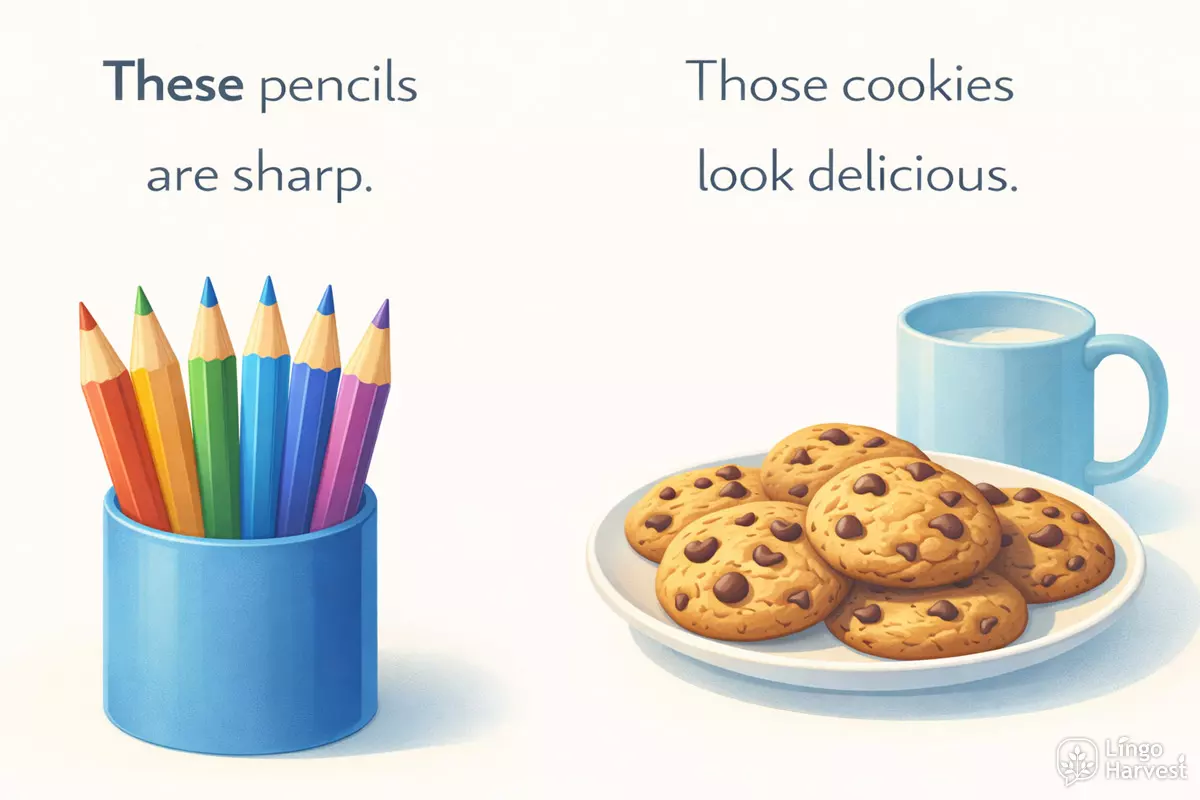
English uses this and these for things that are close to the speaker, while that and those refer to things that are farther away. This applies whether the demonstrative is acting as a pronoun or an adjective.
- This (near, singular): This is my seat.
- These (near, plural): These pencils are sharp.
- That (far, singular): That was your idea.
- Those (far, plural): Those cookies look delicious.
Notice how the choice depends on the perceived distance—either physical (the object is close or far) or metaphorical (the idea or event feels recent or distant).
Now and then: temporal context
Demonstratives also signal time. This and these often refer to things happening now or very recently, while that and those can refer to earlier events or things no longer present.
- This week (the current week)
- That day (a day in the past)
- These times (current period)
- Those years (a period in the past)
The same words shift between indicating physical and temporal distance, depending on context.
At a glance: forms and usage
| Form | Example (Proximity/Time) | Function |
|---|---|---|
| This | This book (here/now) | Near, singular |
| These | These shoes (here/now) | Near, plural |
| That | That song (there/then) | Far, singular |
| Those | Those days (there/then) | Far, plural |
Context and clarity
Choosing the right demonstrative depends on both where and when the subject exists in relation to the speaker. For objects in the same room, this and these feel natural; for memories or distant items, that and those are more appropriate. The context—physical or temporal—guides listeners to the intended reference, preventing confusion.
Common mistakes: missing noun after demonstrative adjective
Leaving out the noun after a demonstrative adjective is a frequent slip, especially for learners distinguishing between demonstrative adjectives and pronouns. Demonstrative adjectives like “this,” “that,” “these,” and “those” always need a noun immediately after them. If the noun is missing, the sentence becomes incomplete or confusing.
Why does this error happen?
It’s easy to mix up demonstrative adjectives with demonstrative pronouns because they look identical. However, demonstrative adjectives modify nouns, while pronouns stand alone. When the noun is forgotten, what should be an adjective becomes a dangling word.
Incorrect vs. correct usage
Here are some common examples where the noun is mistakenly left out, followed by the correct form:
- ❌ I prefer these. (Incorrect if you meant “these books”)
✅ I prefer these books. - ❌ Could you pass me that? (Incorrect if you meant “that pen”)
✅ Could you pass me that pen? - ❌ This is interesting. (Incorrect if you meant “this article”)
✅ This article is interesting. - ❌ I don’t like those. (Incorrect if you meant “those shoes”)
✅ I don’t like those shoes. - ❌ Have you seen these? (Incorrect if you meant “these pictures”)
✅ Have you seen these pictures? - ❌ That is expensive. (Incorrect if you meant “that jacket”)
✅ That jacket is expensive. - ❌ She likes this. (Incorrect if you meant “this idea”)
✅ She likes this idea. - ❌ Please open those. (Incorrect if you meant “those windows”)
✅ Please open those windows. - ❌ I will take that. (Incorrect if you meant “that seat”)
✅ I will take that seat. - ❌ This tastes great. (Incorrect if you meant “this soup”)
✅ This soup tastes great.
How to avoid this mistake
To prevent this issue, remember:
- If “this,” “that,” “these,” or “those” comes before a noun, you’re using a demonstrative adjective—never leave the noun out.
- If you want to avoid repeating the noun, use the demonstrative pronoun form instead (e.g., “I prefer these” is correct only if the noun is clear from context).
- When in doubt, check if your sentence makes sense on its own or if it needs a noun to be clear.
Practicing with real examples and double-checking your sentences can help reinforce the difference. Over time, you’ll find it easier to spot when a noun is missing after a demonstrative adjective.
Using demonstratives in answers and short replies
Demonstrative pronouns and adjectives are especially helpful for keeping answers brief and clear. Instead of repeating information, English speakers often use words like “this,” “that,” “these,” or “those” to refer to something already mentioned or easily understood from context. This approach helps avoid redundancy and makes conversations flow more naturally.
How demonstratives replace nouns in responses
When replying to questions, you can use demonstrative pronouns to stand in for a noun or a whole idea. This is common in both written and spoken English. For example:
- “Which book do you want?” — “That.”
- “Are these your keys?” — “Yes, those are mine.”
- “I prefer this.” (instead of repeating “I prefer this dress.”)
- “Do you like these?” — “No, I like those.”
- “Is that your car?” — “No, this is.”
Short replies with demonstrative adjectives
Sometimes, demonstrative adjectives appear in short replies when the noun is still present, but often shortened:
- “Which sandwich is yours?” — “This sandwich.”
- “Who made these cookies?” — “Those cookies? Sam did.”
- “Do you want that apple?” — “No, I want this apple.”
Patterns and typical usage
Quick responses using demonstratives are common in everyday dialogue. Notice how the demonstrative (pronoun or adjective) helps avoid repetition and keeps the exchange concise:
| Prompt | Efficient Reply |
|---|---|
| “Would you like this or that?” | “That, please.” |
| “Who brought these?” | “Those are from Jane.” |
| “Are these yours?” | “Yes, these are mine.” |
| “Is this your bag?” | “No, that’s not mine.” |
| “Which shoes do you want?” | “These.” |
| “Do you like these or those?” | “I like those.” |
| “Was that your idea?” | “Yes, that was.” |
| “Are those your friends?” | “No, these are.” |
| “Do you want this one or that one?” | “This one.” |
| “Have you seen these?” | “No, I haven’t seen those.” |
Tips for clarity
- Use this / these for something close to you, either physically or within the current conversation.
- Use that / those for items that are farther away or have already been mentioned.
- In spoken English, pointing or gesturing often helps clarify which object you mean.
- In written communication, context usually makes the reference clear without gestures.
- Mastering these patterns helps your English sound more natural and keeps communication efficient, especially in fast-paced conversations or messaging.
Quick conversions: adjective ↔ pronoun rewrites
Switching between demonstrative adjectives and pronouns in sentences is a practical skill for clear communication. Both forms use the same words—this, that, these, those—but their roles differ. Adjectives describe and point out nouns, while pronouns stand in for nouns already understood from context. Recognizing when to rewrite a phrase for clarity or emphasis can make writing and speaking more precise.
How to spot and convert
Demonstrative adjectives always appear next to the noun they modify (e.g., this book), while demonstrative pronouns replace the noun entirely (e.g., This is interesting). To convert between them, ask: is the noun present? If so, it’s likely an adjective; if not, it’s a pronoun.
| Adjective Example | Pronoun Rewrite |
|---|---|
| This car is fast. | This is fast. |
| Those cookies smell good. | Those smell good. |
| I like that movie. | I like that. |
| These shoes fit well. | These fit well. |
| Read this article. | Read this. |
| Can you pass me those pens? | Can you pass me those? |
| That answer is correct. | That is correct. |
| These apples are fresh. | These are fresh. |
| I remember this day. | I remember this. |
| Do you want that seat? | Do you want that? |
Tips for switching forms
- If the noun is obvious from the situation, use the pronoun to avoid repetition.
- When introducing something new or being specific, use the adjective plus noun.
- For emphasis or contrast, pronouns can make statements more direct.
- Check for agreement in number: this/that for singular, these/those for plural.
Practicing these rewrites strengthens your grasp of when to use each form, helping both your grammar and your style.
Practice: label and correct demonstrative usage
Understanding the difference between demonstrative pronouns and demonstrative adjectives can be tricky. Below, you'll find practical exercises to identify and correct common mistakes. Review each sentence and decide whether the bolded word is used as a pronoun or an adjective. If the usage is incorrect, rewrite the sentence properly.
Identify and Correct Demonstratives in Context
Read each sentence. For each, decide if the demonstrative (in bold) is a pronoun or an adjective. If it’s misused, rewrite the sentence correctly.
- This is my favorite book.
- I don’t like those shoes.
- Can you pass me that?
- These apples are fresh.
- I will take that one, please.
- Look at this dog over there!
- Those are delicious.
- Where did you get these?
- This car is new.
- She prefers those cookies.
- He likes that blue shirt.
- These are expensive.
- Did you see that?
- Please hand me those pencils.
- This tastes great.
- These chairs are uncomfortable.
- Who owns that?
- Those birds are noisy.
- I want this one.
- Can you help me with these?
Show answers
- 1. Pronoun. Correct.
- 2. Adjective. Correct.
- 3. Pronoun. Correct.
- 4. Adjective. Correct.
- 5. Pronoun. Correct.
- 6. Adjective. "This dog" (adjective). Correct.
- 7. Pronoun. Correct.
- 8. Pronoun. Correct.
- 9. Adjective. Correct.
- 10. Adjective. "Those cookies" (adjective). Correct.
- 11. Adjective. "That blue shirt" (adjective). Correct.
- 12. Pronoun. Correct.
- 13. Pronoun. Correct.
- 14. Adjective. "Those pencils" (adjective). Correct.
- 15. Pronoun. Correct.
- 16. Adjective. "These chairs" (adjective). Correct.
- 17. Pronoun. Correct.
- 18. Adjective. "Those birds" (adjective). Correct.
- 19. Pronoun. Correct.
- 20. Pronoun. Correct.
Common Mistakes: Spot and Fix
Sometimes, demonstratives are misapplied. Read these sentences and decide if the usage is accurate. If not, correct the sentence.
- I like this better than the red one. (Is “this” clear? Should it be followed by a noun?)
- These is my friend. (Is the agreement correct?)
- He bought that car, not this. (Is “this” used clearly?)
- Give me those book. (Is the noun form correct?)
- I don’t like that. (Is the reference clear from context?)
- This are my keys. (Is the verb form correct?)
- Can you move these chair closer? (Is the noun form correct?)
- She chose those instead of this. (Is the contrast clear?)
- That are expensive. (Is the demonstrative correct?)
- I’ll take this, not those. (Is “this” specific enough?)
Show answers
- “This” is unclear; it should be followed by a noun or replaced with “this one.”
- “These” is plural, but “friend” is singular. Correct: “This is my friend.”
- “This” is unclear; it should be “this one” or “this car.”
- “Those” is plural, but “book” is singular. Correct: “Give me those books.”
- The sentence is unclear unless the context clearly identifies what “that” refers to.
- “This” is singular, but the verb is plural. Correct: “These are my keys.”
- “These” is plural, but “chair” is singular. Correct: “these chairs.”
- The contrast is unclear; it should be “those ones” or “those items” for clarity.
- “That” is singular, but the verb is plural. Correct: “Those are expensive.”
- “This” may be unclear unless the object is obvious; adding a noun improves clarity.
Quick Reference: Demonstrative Forms
Below is a summary of demonstrative forms and their typical uses as pronouns and adjectives.
| Form | Used as Pronoun | Used as Adjective |
|---|---|---|
| This | This is tasty. (stands alone) | This cake is tasty. (modifies noun) |
| That | That is expensive. | That shirt is expensive. |
| These | These are heavy. | These bags are heavy. |
| Those | Those are mine. | Those keys are mine. |
Use this table to quickly check whether a demonstrative is acting as a pronoun (standing alone) or as an adjective (modifying a noun).