Relative Pronouns Explained: Who, Whom, Which, That

 Here we how and why we use relative clauses, core rules for who, whom, which, and that, subject versus object roles, when to use or skip commas, omitting pronouns, using prepositions, and how to join sentences with relative pronouns.
- What relative clauses do and why we use them
- Who/that for people, which/that for things: core rules
- Subject vs object roles inside the relative clause
- Whom: what it means and when learners can skip it
- Restrictive vs non-restrictive: commas and meaning
- Omitting the relative pronoun: when zero is correct
- Prepositions with relatives: the person I spoke to
- Practice: join sentences using relative pronouns
In English grammar, words like who, whom, which, and that serve as connectors, helping to link ideas and add clarity to your sentences. Knowing how to use these connecting words correctly can greatly improve the flow of your writing and make your communication more effective. By mastering their usage, you can ensure that your ideas are expressed precisely and your messages are easily understood by your readers, allowing for smoother and clearer interactions in both written and spoken English.
What relative clauses do and why we use them
Relative clauses allow us to add extra information about a noun without starting a new sentence. Instead of two short sentences, we can connect them smoothly with words like who, which, that, or whom. This makes our writing and speech more precise and natural, helping the listener or reader understand exactly which person or thing we mean.
How relative clauses add detail
Think of these clauses as descriptive tools. They help identify or give more information about a subject or object. For example, in the sentence "The book that I borrowed was fascinating," the phrase "that I borrowed" tells us which book is meant.
- The teacher who lives next door is friendly.
- The cake that she made was delicious.
- The city which we visited was beautiful.
- The student whom you met is my cousin.
- The shoes that are on the floor belong to Tom.
- The movie which won the award is on TV tonight.
- The artist who painted this is famous.
- The book that you see is new.
- The friend whom I called answered quickly.
- The car which broke down was old.
- The people who live here are kind.
- The building that collapsed was empty.
- The team which won the match celebrated.
- The letter that arrived yesterday is important.
- The woman whom you saw is my aunt.
Purposes for using relative clauses
We use these clauses for several reasons:
- Identifying: To specify exactly which person or thing we mean ("The dog that barked was mine.")
- Adding extra information: To give more details about a noun ("My brother, who is a doctor, lives abroad.")
- Combining sentences: To avoid repetition and make our language flow better ("She wore a dress. The dress was red." → "She wore a dress that was red.")
Types of relative clauses
There are two main types: defining (or restrictive) and non-defining (or non-restrictive). Defining clauses tell us which person or thing we mean, while non-defining clauses simply add extra information.
| Type | Function | Example |
|---|---|---|
| Defining | Specifies exactly who or what is meant; essential to the meaning | The man who called you is here. |
| Non-defining | Adds extra, non-essential information | My car, which is red, is parked outside. |
In summary, these clauses help us speak and write about people and things more clearly and efficiently. They connect ideas, add detail, and make communication smoother.
Who/that for people, which/that for things: core rules
In English, choosing the right relative pronoun depends on whether you’re talking about a person or a thing. For people, “who” and sometimes “that” are used. For objects, animals, or concepts, “which” and “that” are your go-to words. The distinction helps sentences stay clear and precise.
“Who” and “that” for people

When referring to people, “who” is generally preferred. “That” is also possible, especially in informal contexts, but “who” is considered more correct in formal writing. Here are some examples:
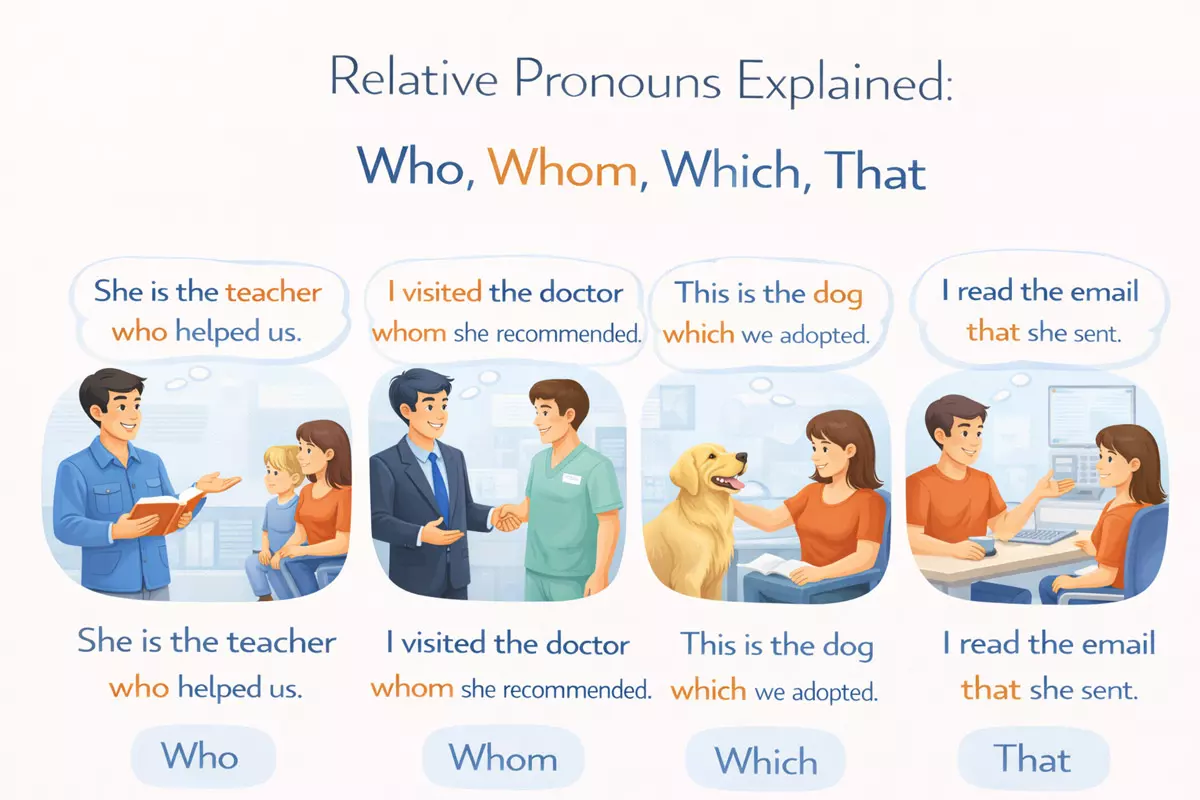
- The teacher who helped me was very patient.
- She’s the friend that always listens.
- Anyone who wants to join is welcome.
- He’s the person that fixed the computer.
Note: “Whom” can be used instead of “who” when it refers to the object of a verb or preposition, but “who” is much more common in everyday speech.
“Which” and “that” for things
When talking about animals (non-personal), objects, places, or abstract things, “which” and “that” are used. “That” is often used for essential (restrictive) information, while “which” introduces additional (non-restrictive) details, often set off by commas.
- The book that you lent me was fascinating.
- The car which is parked outside belongs to my neighbor.
- The movie that we watched last night was exciting.
- Her idea, which was quite clever, saved us time.
If you can remove the clause without changing the meaning of the sentence, “which” is usually correct.
Quick reference: Relative pronouns for people vs. things
| Referent | Preferred Pronouns | Example |
|---|---|---|
| People | who, that | The student who won the prize is here. |
| Things/Objects | which, that | The phone that rings is mine. |
| Animals (non-personal) | which, that | The dog that barked is friendly. |
| Groups/Organizations | that (sometimes who) | The team that won played well. |
Common mistakes to avoid
- Don’t use “which” for people: ❌ The man which called you is here.
- Don’t use “who” for things: ❌ The book who is on the table is mine.
- When in doubt, use “that” for both people and things in informal contexts, but switch to “who” for people and “which” for things in formal writing.
Getting comfortable with these patterns makes your English sound more natural and precise. Practice by identifying the subject of your relative clause, then match it with the appropriate pronoun.
Subject vs object roles inside the relative clause
Understanding how relative pronouns function within their own clauses is key to choosing the right word. Sometimes the relative pronoun is the "doer" (the subject), while in other cases, it’s the receiver (the object) of the action. This distinction affects both grammar and style, especially when deciding between who, whom, which, and that.
How to identify the role
Ask yourself: does the relative pronoun replace the person or thing doing the verb, or is it on the receiving end? For example:
- Subject: The person who called you is my friend. (Who = the caller, the subject of "called")
- Object: The person whom you called is my friend. (Whom = the one being called, the object of "called")
Common patterns and examples
English speakers often use who for subjects and whom for objects when referring to people. For things, which and that can serve as either, but sometimes omission is possible (especially for objects). Here’s a breakdown of how these pronouns are used:
| Relative Pronoun | Role in Clause | Example |
|---|---|---|
| who | Subject (person) | The artist who painted this lives next door. |
| whom | Object (person) | The woman whom I met was helpful. |
| which | Subject or object (thing/animal) | This is the book which won the award. |
| that | Subject or object (person/thing) | The car that I drive is blue. |
| — (omitted) | Object (informal/optional) | The movie (that) we watched was great. |
Quick tips and reminders
- If the pronoun is followed by a verb, it's usually the subject: "the man who works here".
- If the pronoun is followed by a noun/pronoun, it's likely the object: "the friend whom I trust".
- That is often used for both people and things in everyday speech, especially as an object.
- Whom is formal and mostly seen in written English; in speech, "who" often replaces it.
- You can drop the pronoun when it's an object (e.g., "the book I read"), but not when it's the subject.
- For non-human subjects, "which" tends to be more formal than "that".
Grasping whether the relative pronoun is acting as the subject or object helps clarify sentence meaning and ensures your writing sounds natural and precise. This awareness also guides you in omitting pronouns where possible, streamlining your style.
Whom: what it means and when learners can skip it
Many English learners find "whom" confusing and even intimidating. In modern English, "whom" is technically the object form of "who," used when referring to the person receiving an action. For example: "To whom did you give the book?" Here, "whom" is the object of the verb "give." However, outside formal writing or speech, native speakers rarely use "whom" in everyday conversation.
When to Use "Whom"
You should use "whom" when it functions as the object of a verb or preposition—never as the subject. A quick test: if you can replace it with "him" or "her," "whom" is technically correct. Some classic examples include:
- Whom did you see at the party?
- The student to whom the award was given...
- With whom are you speaking?
- For whom is this gift intended?
In all these cases, "whom" is receiving the action.
When You Can Skip "Whom"
In most informal contexts, especially when speaking, "who" has replaced "whom" almost everywhere. Even in writing, using "who" instead of "whom" is not usually considered a serious error, except in highly formal or academic contexts. Here are situations where you can safely use "who" without worrying:
- Everyday conversations: "Who did you meet?"
- Emails and casual messages
- Social media posts
- When clarity is unaffected
- If the sentence would sound stiff or unnatural with "whom"
Common Patterns and Examples
Learners often wonder how to decide between "who" and "whom." Here are some useful sentence patterns:
- To whom should I address the letter?
- Whom are you inviting?
- Who/Whom did you see?
- With whom did you travel?
- Who/Whom are you talking about?
- The person whom I mentioned is here.
- She is the one whom everyone admires.
- Who/Whom do you trust?
- For whom did you bake the cake?
- Whom did the teacher call on?
- Who/Whom can we ask for help?
- The man whom they arrested was innocent.
Summary Table: "Who" vs. "Whom" in Relative Clauses
| Form | Use/Function | Example |
|---|---|---|
| Who | Subject of clause | The person who called is my friend. |
| Whom | Object of verb or preposition | The person whom you called is my friend. |
| Who (informal for "whom") | Object in informal speech/writing | The person who you called is my friend. |
| Whom (after prepositions) | Object of preposition (formal) | The student to whom the prize was given... |
Takeaway for Learners
If you're aiming for natural, modern English, you can usually avoid "whom" except in very formal writing or when clarity absolutely requires it. Understanding the difference is useful for reading advanced texts or acing grammar tests, but in daily life, using "who" is almost always acceptable.
Restrictive vs non-restrictive: commas and meaning
Understanding the difference between restrictive and non-restrictive clauses is essential for clear writing, especially when using relative pronouns like “who,” “which,” and “that.” The main distinction lies in whether the information is essential to the meaning of the sentence or simply additional detail. Punctuation, especially the use of commas, signals this difference to the reader.
What is a restrictive clause?

A restrictive clause provides information that is crucial to the identity or meaning of the noun it modifies. Without this clause, the sentence would lose important context. These clauses do not require commas. For example:
- The book that you lent me was fascinating.
- Students who study hard often succeed.
- The car which broke down is mine.
Here, the clause identifies which book, which students, or which car, and cannot be omitted without changing the meaning.
What is a non-restrictive clause?
A non-restrictive clause adds extra information that can be removed without altering the fundamental meaning of the sentence. These clauses are always set off with commas. For example:
- My brother, who lives in Canada, is visiting soon.
- The meeting, which was scheduled for Monday, has been postponed.
- Her laptop, which she bought last year, is already out of date.
In these cases, the clauses provide additional details, but the sentence makes sense without them.
Key differences at a glance
| Clause Type | Function | Punctuation | Example |
|---|---|---|---|
| Restrictive | Essential information for meaning | No commas | The shoes that fit best are sold out. |
| Non-restrictive | Extra, non-essential detail | Set off by commas | The shoes, which I bought yesterday, fit perfectly. |
Common patterns and tips
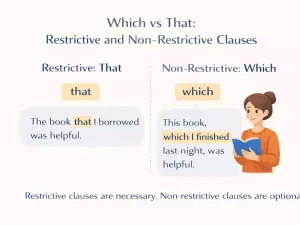
- Use “that” for restrictive clauses (no commas): “The film that won the award is French.”
- Use “which” for non-restrictive clauses (with commas): “The film, which won an award, is French.”
- “Who” and “whom” follow the same rules: “The artist who painted this is famous.” vs. “My aunt, who loves art, visited the museum.”
- Removing a restrictive clause changes the meaning; removing a non-restrictive clause just omits detail.
- Never use commas with restrictive clauses, even if they seem like extra information.
- Always set off non-restrictive clauses with commas to avoid confusion.
- Non-restrictive clauses are more common in written, formal, or descriptive styles.
- Restrictive clauses help specify or narrow down the noun they modify.
- American English usually prefers “that” for restrictive, “which” for non-restrictive—British English allows “which” for both.
- Rely on context: Ask if the clause is necessary for identification (restrictive), or just additional (non-restrictive).
In summary, knowing when to use commas with relative pronouns not only clarifies your meaning but also helps your writing sound more natural and precise.
Omitting the relative pronoun: when zero is correct
In English, it’s often possible to leave out the relative pronoun (such as “who,” “that,” or “which”) in certain types of clauses. This is known as the “zero relative pronoun.” However, you can only do this in specific situations, mainly when the pronoun would serve as the object of the relative clause, not the subject.
When can you drop the relative pronoun?
You can omit the pronoun if it refers to the object in a defining relative clause. For example, instead of saying “The book that I borrowed,” you can simply say “The book I borrowed.” The sentence remains clear and grammatical.
- The cake (that) she baked was delicious.
- Here’s the song (which) I mentioned earlier.
- That’s the house (that) they built last year.
- The advice (which) you gave helped me a lot.
- He’s the person (who/whom) I called yesterday.
- This is the movie (that) everyone loves.
- There’s the email (which) you forgot to send.
- The shoes (that) I bought are on sale.
- The friend (whom) you met at the party is here.
- The project (that) we finished won an award.
- That’s the photo (which) I took in Paris.
- The car (that) we rented broke down.
- The teacher (whom) you admired retired.
- This is the question (which) nobody could answer.
- That’s the dog (that) I was talking about.
- The film (which) we watched was amazing.
- The key (that) I lost was found.
- The friend (who/whom) you called has arrived.
- The opportunity (that) you missed was unique.
- The meal (which) I prepared took hours.
When should you keep the pronoun?
You cannot leave out the pronoun if it is the subject of the relative clause. For instance, “The man who called is my uncle” cannot become “The man called is my uncle.” The meaning changes, and the sentence becomes ungrammatical.
| Situation | Can you omit? |
|---|---|
| Relative pronoun as object | ✅ Yes (e.g. The car [that] I bought) |
| Relative pronoun as subject | ❌ No (e.g. The man who called) |
| Non-defining (extra information) | ❌ No (e.g. My sister, who lives abroad, ...) |
| After prepositions (formal) | ❌ No (e.g. The person to whom I spoke) |
Quick tips
- Only omit the pronoun in defining clauses when it is not the subject.
- Never drop it in non-defining clauses (those with commas).
- If in doubt, keep the pronoun—omission is optional, not required.
Understanding when you can skip the relative pronoun helps make your writing more natural and concise, but always check if the pronoun is acting as the object. If it’s the subject, it must stay.
Prepositions with relatives: the person I spoke to
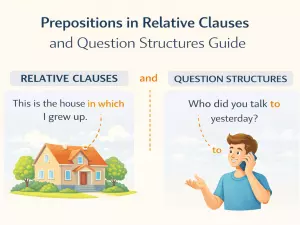
When using relative clauses, prepositions often end up at the end of the clause, especially in everyday English. This is common in sentences like “the person I spoke to” or “the book I was looking for.” Placing the preposition at the end is natural and widely accepted in modern speech and writing.
Preposition at the end: Natural and common
Most native speakers put the preposition after the relative clause. This is informal, but also the standard in conversation and most writing, especially when the relative pronoun (who, which, that) is omitted:
- This is the friend I told you about.
- The company she works for is hiring.
- That’s the house we stayed in last summer.
- Do you know the person you were talking to?
- Here’s the email I replied to yesterday.
- The chair I’m sitting on is broken.
- That’s the woman I borrowed the book from.
- The topic we discussed was interesting.
- The man I shared a taxi with was very friendly.
- Is this the restaurant you heard about?
- The reason I’m calling for is urgent.
- The person you should speak with is over there.
- The file you asked for is ready.
- The team he belongs to won the match.
- The place I’m thinking of is near here.
Preposition before the relative pronoun: Formal style
For more formal writing, you might put the preposition before the relative pronoun. In this structure, “whom” or “which” is required; “that” cannot be used after a preposition, and “who” is rare. Notice how the tone changes:
- The person to whom I spoke was helpful.
- The company for which she works is hiring.
- The house in which we stayed was beautiful.
- The colleague with whom I shared the office has retired.
This style is grammatically correct but can sound stiff or old-fashioned in everyday conversation.
Omitting the relative pronoun
In informal English, the relative pronoun (who, which, that) is often left out when it would be the object of the verb or preposition. The preposition then appears at the end:
- The movie (that) I was talking about is on tonight.
- The man (who) I went with is my neighbor.
- The project (which) she applied for was canceled.
Summary: Placement patterns
Choosing where to put the preposition depends on formality and style. Here’s a comparison:
| Style | Example |
|---|---|
| Informal (preposition at end) | This is the person I spoke to. |
| Formal (preposition before pronoun) | This is the person to whom I spoke. |
| Omitted pronoun, preposition at end | This is the person I spoke to. |
Understanding these patterns helps you sound natural and clear in both speaking and writing. Adjust your usage based on the situation—informal for conversation, formal for academic or official texts.
Practice: join sentences using relative pronouns
Joining two shorter statements into a single, flowing sentence with a relative pronoun is a fundamental English skill. This exercise will help you understand how to combine ideas using words like who, whom, which, and that. Review the examples and try the practice tasks below to reinforce your understanding.
Common Patterns for Combining Sentences
- Use who for people as the subject: The man is my uncle. He is wearing a hat. → The man who is wearing a hat is my uncle.
- Use whom for people as the object (more formal): The woman was friendly. We met her yesterday. → The woman whom we met yesterday was friendly.
- Use which for things or animals: The book is interesting. I bought it yesterday. → The book which I bought yesterday is interesting.
- Use that for people, things, or animals (less formal, often in defining clauses): This is the car. I want to buy it. → This is the car that I want to buy.
Join the Sentences
Combine the following pairs into one sentence using the correct relative pronoun. Write your answers before checking below.
- The teacher spoke clearly. She explained the topic well.
- The cake was delicious. You made it for my birthday.
- The students finished early. Their project was difficult.
- The movie was exciting. We watched it last night.
- The doctor examined the patient. The patient had a fever.
- The artist lives next door. I admire him.
- The phone is ringing. It is on the table.
- The woman smiled at me. I met her at the conference.
- The car broke down. My friend drives it.
- The book is missing. It was on this shelf.
Show answers
- The teacher who explained the topic well spoke clearly.
- The cake that/which you made for my birthday was delicious.
- The students whose project was difficult finished early.
- The movie that/which we watched last night was exciting.
- The doctor who examined the patient found that the patient had a fever.
- The artist whom I admire lives next door.
- The phone that/which is on the table is ringing.
- The woman whom I met at the conference smiled at me.
- The car that/which my friend drives broke down.
- The book that/which was on this shelf is missing.
Extra Challenge: Identify the Relative Pronoun
For each sentence below, underline the relative pronoun and decide if it refers to a person, animal, or thing.
- The dog that barks every morning is friendly.
- The student who got the highest score will get a prize.
- The letter which arrived today has no return address.
- The man whom you saw is my uncle.
- The book that you recommended was helpful.
- The woman who called you earlier is waiting outside.
- The device which stopped working is still under warranty.
- The colleague whom I met yesterday was very polite.
- The cat that sleeps on the sofa is very calm.
- The person who wrote this email did not sign it.
Show answers
- that – animal
- who – person
- which – thing
- whom – person
- that – thing
- who – person
- which – thing
- whom – person
- that – animal
- who – person
Practicing these forms will help you write and speak with more complex, nuanced sentences. Pay attention to which relative pronoun best fits the meaning and formality of your sentence.