Interrogative Pronouns: Who, What, Which, Whose

 Here we how interrogative pronouns like who, what, which, and whose work, their specific uses and differences, question word order, using them as subjects or objects, and includes practice for forming and following up on questions.
- What interrogative pronouns are and how they function
- Who vs what: people vs things (with exceptions)
- Which vs what: choosing from a set vs open choice
- Whose: asking about possession
- Question word order basics and common patterns
- Interrogative pronouns as subjects vs objects
- Short answers and follow-up questions for clarity
- Practice: build questions from prompts and answers
Forming questions in English relies on specific words that guide us in seeking information, clarifying options, or identifying ownership. Words like who, what, where, when, why, and how are essential for asking about people, things, places, times, reasons, and methods. Additionally, words such as which and whose help us specify choices or determine possession. Learning how to use these question words correctly can make your conversations more effective and help you communicate more clearly with others.
What interrogative pronouns are and how they function
Interrogative pronouns are special words used to ask questions, specifically when you want to find out about people, things, ownership, or choices. Words like who, what, which, and whose help us form questions in English, replacing the noun or information we’re seeking. Instead of stating facts, these pronouns invite answers by standing in for the unknown part of a sentence.
How these pronouns work in sentences
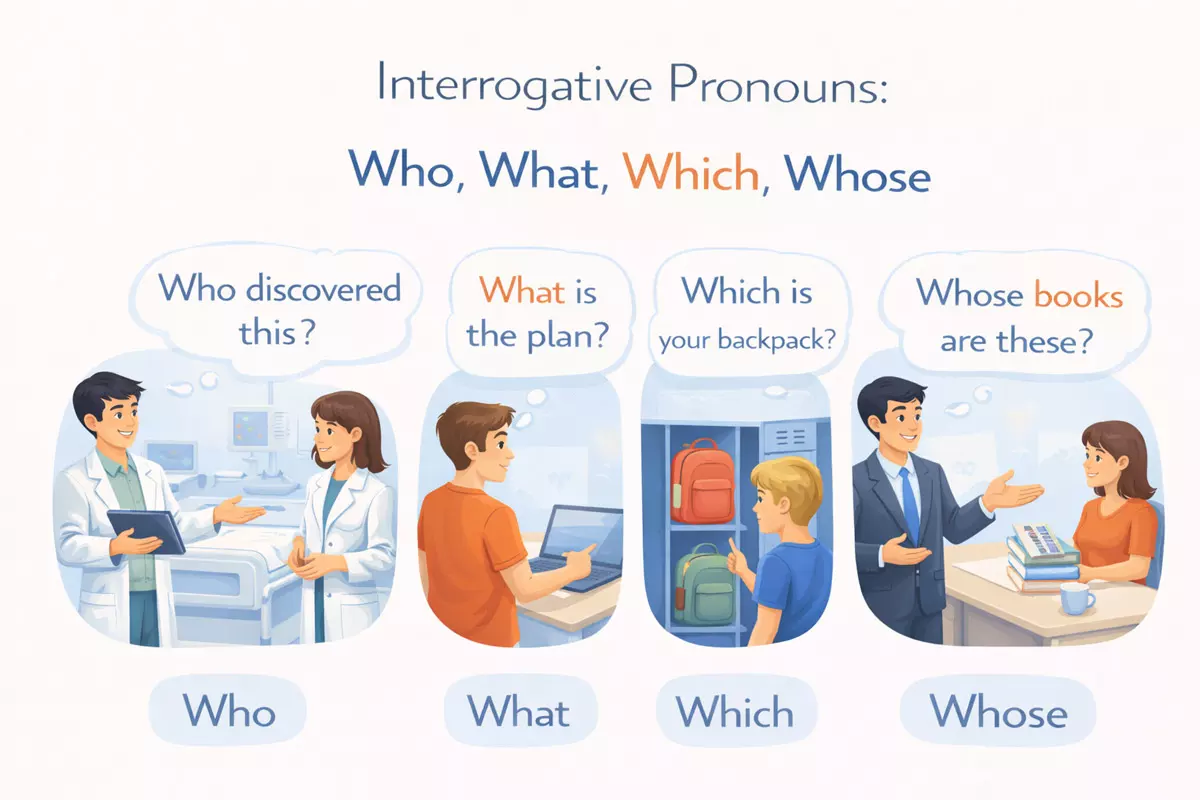
Interrogative pronouns usually appear at the beginning of a question. Their role is to signal that the speaker is requesting specific information. Here’s how each is typically used:
- Who – asks about a person’s identity: Who called you?
- Whose – inquires about possession: Whose book is this?
- What – asks about things, ideas, or information: What happened?
- Which – requests a choice from a known group: Which color do you prefer?
Key features of interrogative pronouns
- They introduce direct questions (e.g., What is your name?).
- They can also introduce indirect questions (e.g., I wonder who called.).
- They stand in for the item, person, or concept the question is about.
- Unlike regular pronouns, they do not refer to something already mentioned.
- Sometimes they can also function as adjectives (modifying a noun), but strictly as pronouns, they replace the noun.
Common examples and their uses
| Interrogative Pronoun | Typical Question/Use |
|---|---|
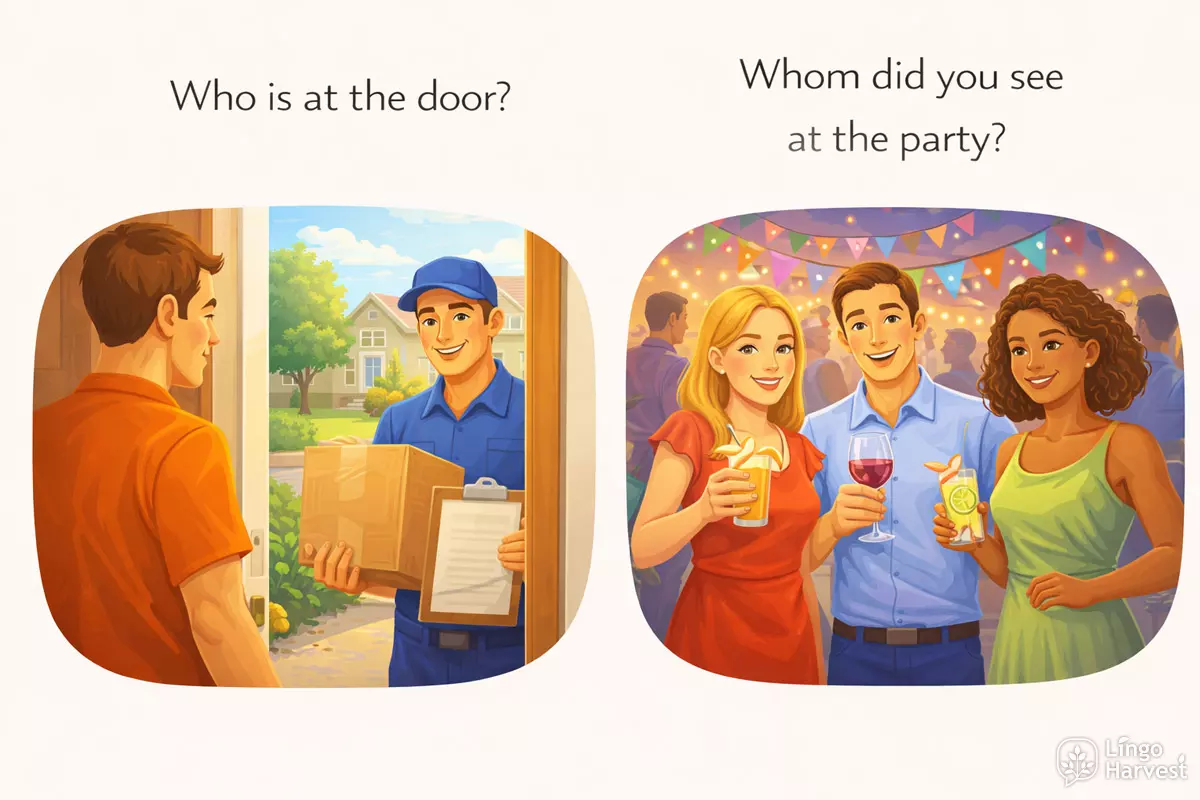
| Who | Who is at the door? |
| Whom | Whom did you see at the party? |
| Whose | Whose keys are these? |
| What | What are you doing? |
| Which | Which movie did you watch? |
Summary of their function
To sum up, these pronouns are essential for forming questions that target unknown information. They are flexible, appearing in direct and indirect queries, and are a basic building block in English communication. By mastering their use, you can ask clear, precise questions and better understand responses in conversation.
Who vs what: people vs things (with exceptions)
Understanding when to use "who" and when to use "what" is key to forming correct questions in English. Generally, "who" is reserved for people, while "what" is used for things, ideas, or unknown objects. However, there are exceptions and some gray areas where the choice depends on context or the speaker’s intent.
Standard usage: People vs. things
- Who asks about people: Who is at the door?
- What asks about objects, animals (non-personified), ideas, or actions: What is making that noise?
Common exceptions and tricky cases
Sometimes, the line between "who" and "what" blurs:
- When asking about someone's job or role, both are possible but with a nuance:
- Who is she? (Expecting a name or identity)
- What is she? (Asking about occupation: "She's a doctor.")
- For animals, "who" is rarely used unless the animal is personified or named:
- What is that? (for an unknown animal)
- Who is barking? (if talking about a pet dog known to the family)
- In competitions or group contexts, "what" can refer to people as members of a group:
- What team won? (team = group of people)
Quick comparison: "who" vs "what"
| Use "who" for... | Use "what" for... |
|---|---|
| People (individuals or groups) Who called you? |
Things, ideas, unknown objects What caused the problem? |
| Named animals (sometimes) Who is Rex? |
Animals (general or unknown) What is that in the tree? |
| Personified characters Who is the villain? |
Professions/roles (when asking about type) What is he? A teacher? |
| Unknown people Who left this note? |
Groups, objects, concepts What group is this? |
More examples for clarity
- Who painted this picture? ✅ (a person)
- What painted this picture? ❌ (incorrect unless referring to, for example, a robot or animal artist)
- What is your name? ❌ (unnatural, prefer "Who is your name?")
- Who is your favorite author? ✅
- What is your favorite book? ✅
- Who do you see in the photo? ✅
- What do you see in the photo? ✅ (if asking about objects or scenery)
- Who is next? ✅ (the next person)
- What is next? ✅ (the next thing or event)
- Who won the prize? ✅
- What won the prize? ✅ (if the prize was awarded to a film, company, team, etc.)
Summary
Choosing between "who" and "what" depends on whether the question is about a person or a thing, but context matters. Some situations allow for both, with a subtle difference in meaning. Paying attention to whether your subject is human, animal, object, or group will help you select the correct interrogative pronoun.
Which vs what: choosing from a set vs open choice
Deciding between which and what often comes down to whether you’re referring to a specific, limited group or leaving the options completely open. Which is used when there’s a defined set to pick from, while what is better for open-ended questions where any answer is possible.
When to Use "Which"
Use which if the options are limited or known to the speaker and listener. It signals that the answer should come from a particular group or list. For example:
- Which color do you prefer: red or blue?
- Which book did you borrow from the library?
- Which of these keys opens the door?
- Which movie are we watching tonight?
- Which student answered the question?
- Which route should we take?
- Which team won the match?
- Which seat is yours?
- Which dessert would you like?
- Which language do you speak at home?
When to Use "What"
What is chosen when the possibilities are not restricted. It’s the word for open questions, inviting any answer:
- What do you want for dinner?
- What is your favorite sport?
- What happened at school today?
- What time is it?
- What makes you happy?
- What did you see?
- What should we do next?
- What color do you like? (when no options are given)
- What language do you want to learn?
- What is that noise?
- What are you thinking about?
- What can I do for you?
Direct Comparison
The difference becomes clear when you look at similar questions side by side. See how the meaning shifts depending on which pronoun is used:
| Example with "Which" | Example with "What" |
|---|---|
| Which cake do you want? (There are several cakes to choose from.) | What cake do you want? (Any cake, no specific options given.) |
| Which subjects are you studying this semester? (A list is implied.) | What subjects interest you? (Any subjects, no list.) |
| Which phone did you buy? (You had a few in mind.) | What did you buy? (Open-ended; could be anything.) |
| Which countries have you visited? (Referring to a known or limited group.) | What countries would you like to visit? (No restriction.) |
| Which door should I use? (There are several doors.) | What should I do? (No options specified.) |
Quick Tips
- Choose which if you or your listener know the available options.
- Pick what for open, unlimited choices.
- Sometimes, in casual speech, people use what even with limited choices, but for clarity and correctness, use which when a set is clear.
Understanding the subtle distinction between these two pronouns helps you ask clearer, more precise questions. If you’re ever unsure, consider whether your question points to a specific set or leaves the answer completely open.
Whose: asking about possession
When you want to find out who owns something, “whose” is the interrogative pronoun you need. It helps you ask about the owner of an object, animal, or even an idea. Unlike “who,” which asks about identity, or “what,” which asks about things, “whose” always focuses on possession or belonging. You might use it in daily conversations, formal writing, or when you need clarity about something's owner.
How to Use “Whose” in Questions
“Whose” usually comes at the beginning of a question and is followed by a noun. The noun tells us what is being possessed. Here are some typical structures:
- Whose book is this?
- Whose keys did you find?
- Whose idea was that?
- Whose jacket is hanging there?
- Whose car is blocking the driveway?
- Whose turn is it?
- Whose dog barked all night?
- Whose phone keeps ringing?
- Whose decision was it to leave early?
- Whose painting won the prize?
- Whose shoes are these?
- Whose homework did the teacher collect?
- Whose voice did you hear?
- Whose bag was left on the bus?
- Whose parents are coming to the meeting?
- Whose idea was the best?
- Whose team won the match?
- Whose birthday is it today?
- Whose favorite song is playing?
- Whose mistake was it?
Common Mistakes with “Whose”
It’s easy to confuse “whose” with “who’s.” Remember:
- Whose = belonging to whom (possessive)
- Who’s = who is or who has (contraction)
For example, “Whose coat is this?” ✅ versus “Who’s coming to dinner?” ✅. Mixing them up can lead to misunderstandings. Here are some more clarifying examples:
| Correct Usage ✅ | Incorrect Usage ❌ |
|---|---|
| Whose umbrella did you borrow? | Who’s umbrella did you borrow? |
| Whose shoes are these? | Who’s shoes are these? |
| Whose idea was that? | Who’s idea was that? |
| Who’s coming to the meeting? | Whose coming to the meeting? |
| Who’s been here before? | Whose been here before? |
Summary
“Whose” helps you ask about ownership or association. By pairing it with a noun, you make your questions clear and direct. Paying attention to the difference between “whose” and “who’s” will help you avoid common errors in both speaking and writing.
Question word order basics and common patterns
When asking questions with interrogative pronouns like who, what, which, and whose, English generally follows a predictable word order. The structure depends on whether the pronoun serves as the subject or another part of the sentence.
Standard question structure
Most questions start with the interrogative pronoun, followed by an auxiliary verb (such as is, are, do, did), the subject, and then the main verb. However, if the pronoun is the subject, the order is simpler.
- Who called you? (pronoun as subject)
- What did she say? (pronoun as object)
- Which book did you read?
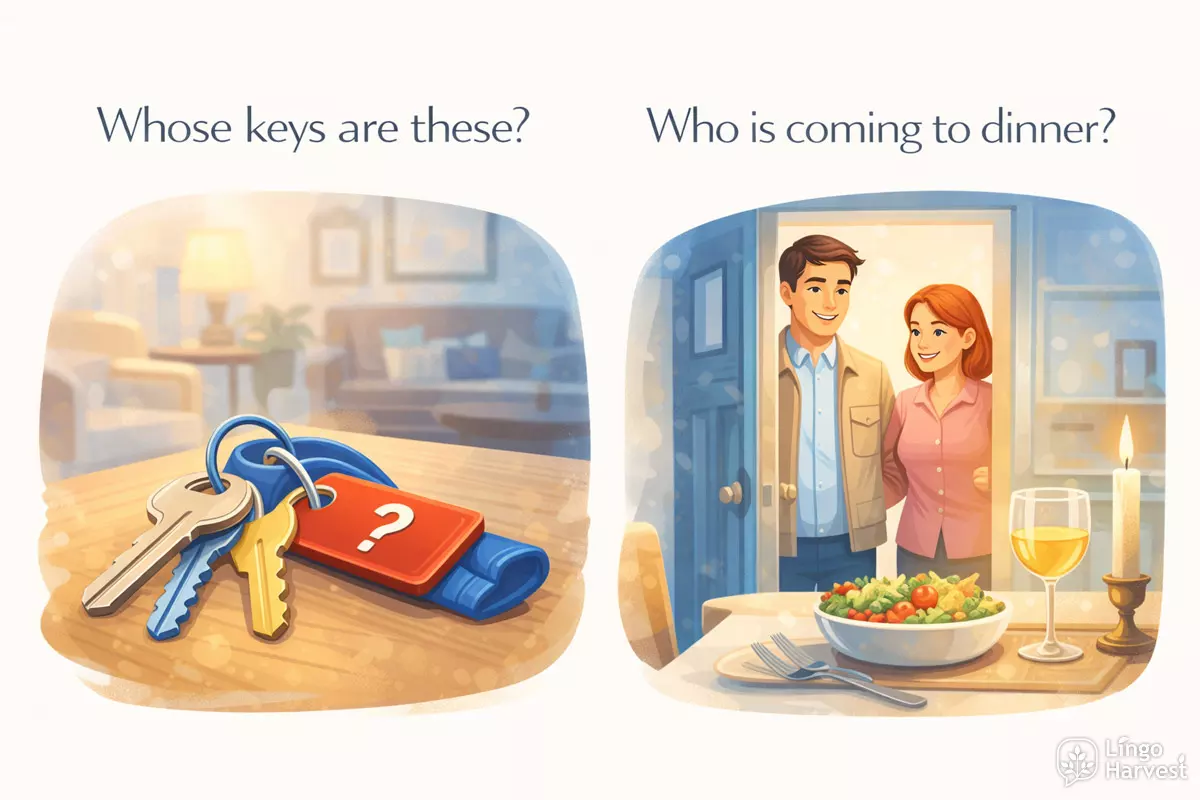
- Whose keys are these?
- Who is coming to dinner?
- What happened here?
- Which is your favorite?
- Whose idea was it?
- Who did you see?
- What are you doing?
- Which of these do you prefer?
- Whose bag did you find?
- Who knows the answer?
- What makes you happy?
- Which team won?
- Whose turn is it?
Subject vs. object questions
When the question word is the subject, there’s no need for auxiliary verbs or inversion. If it’s the object, the auxiliary comes before the subject.
- Who ate the cake? (subject)
- Who did you invite? (object)
- What helped you most? (subject)
- What did you lose? (object)
Common patterns by interrogative pronoun
| Interrogative Pronoun | Example Pattern | Sample Question |
|---|---|---|
| Who | Who + verb (subject question) Who + auxiliary + subject + verb (object question) |
Who is there? Who did you call? |
| What | What + verb (subject question) What + auxiliary + subject + verb (object question) |
What happened? What did he buy? |
| Which | Which + noun + auxiliary + subject + verb | Which movie did you watch? |
| Whose | Whose + noun + is/are + this/that/these/those | Whose bag is this? |
Key points to remember
- Start with the question word.
- Use inversion (auxiliary before subject) unless the pronoun is the subject.
- For possessive questions, whose comes before the noun.
- Context and emphasis may shift word order slightly, but these patterns are most common.
- Subject questions are more straightforward: no auxiliary, no inversion.
This framework covers the main structures for forming questions with who, what, which, and whose. Understanding these word order patterns helps you form clear, natural questions in English.
Interrogative pronouns as subjects vs objects
Understanding whether an interrogative pronoun is acting as the subject or object in a question helps clarify both the meaning and the structure. In English, pronouns like who, whom, what, which, and whose can serve different roles depending on what you’re asking about. When a pronoun is the subject, it performs the action in the sentence. As an object, it receives the action. For example, compare: “Who called you?” (the person who called is the subject) and “Whom did you call?” (the person called is the object). The distinction is especially clear with who/whom but can also appear with other question words.
Spotting the difference
You can often tell the function by checking what comes after the pronoun and whether a verb follows directly. Here are some patterns:
- Who broke the vase? → Who is the subject.
- Whom did you meet? → Whom is the object.
- What happened here? → What is the subject.
- What did you see? → What is the object.
- Which arrived first? → Which is the subject.
- Which did you choose? → Which is the object.
- Whose phone rang? → Whose is the subject (possessive).
- Whose did you borrow? → Whose is the object (possessive).
- Who wants coffee? → Who is the subject.
- Whom should I invite? → Whom is the object.
- What makes you happy? → What is the subject.
- Which do you prefer? → Which is the object.
- Whose book is this? → Whose is the subject (possessive).
- Whose did you see at the café? → Whose is the object (possessive).
Overview: Subject vs Object usage
| Pronoun | As Subject | As Object |
|---|---|---|
| Who | Who called you? | Whom did you call? |
| What | What happened? | What did you see? |
| Which | Which is better? | Which did you buy? |
| Whose | Whose keys are missing? | Whose did you find? |
When forming questions, pay attention to the word order and the verb placement. If the pronoun is immediately followed by a verb, it’s likely the subject. If it’s followed by an auxiliary (do/does/did) and then a subject, it’s functioning as the object. This distinction is important for both spoken and written English, especially in formal contexts.
Short answers and follow-up questions for clarity
When using interrogative pronouns like who, what, which, and whose, it’s common to respond with brief answers or ask for more details. Short replies help keep conversations natural and efficient, especially in spoken English. Follow-up questions can clarify meaning or request additional information if the initial answer is too vague.
Short answer patterns
- Who: "Who won the game?" — "Sarah."
- What: "What is that noise?" — "A car alarm."
- Which: "Which color do you prefer?" — "Blue."
- Whose: "Whose book is this?" — "Mine."
Notice that the answer often repeats just the necessary information, omitting the rest of the sentence. This keeps the exchange brief and to the point.
Common follow-up question forms
If the first reply isn’t detailed enough, speakers often use follow-up questions. These can help clarify or expand on the original topic:
- "Who exactly is coming?"
- "What do you mean by that?"
- "Which one did you pick, the red or the green?"
- "Whose idea was it, yours or someone else’s?"
- "Who else was there?"
- "What happened next?"
- "Which route did you take?"
- "Whose responsibility is it?"
- "Who told you that?"
- "What time did it start?"
- "Which dish is vegetarian?"
- "Whose turn is it now?"
Comparison of short answers and follow-up questions
| Question Type | Example Short Answer | Example Follow-up Question |
|---|---|---|
| Who | Anna. | Who else was involved? |
| What | The report. | What specifically did you change? |
| Which | The left door. | Which door did you mean? |
| Whose | John’s. | Whose keys are on the table? |
| Who | The manager. | Who gave you this information? |
Tips for more effective communication
- Use short, direct answers when the context is clear.
- If you need more information, ask a targeted follow-up question.
- Echo part of the original question for clarity, especially in noisy or group settings.
- Be specific in your follow-up to avoid confusion.
- Don’t hesitate to ask for repetition or clarification if an answer seems incomplete.
Mastering concise answers and useful follow-up questions helps conversations flow smoothly and minimizes misunderstandings when using interrogative pronouns.
Practice: build questions from prompts and answers
Building questions with interrogative pronouns like who, what, which, and whose is a practical way to strengthen your English skills. In this exercise, you’ll get prompts and answers; your task is to form the correct question using the appropriate interrogative pronoun. Pay close attention to the context, as it often determines which pronoun is most suitable.
Task 1: Create questions from prompts and answers
For each prompt, look at the answer and write the most natural question. Focus on choosing between who, what, which, and whose based on the information given.
- Prompt: This book belongs to Anna.
Answer: Anna. - Prompt: Someone called you this morning.
Answer: My boss. - Prompt: There is a pen and a pencil on the desk. You want to know the preferred item.
Answer: The pencil. - Prompt: Something made a loud noise outside.
Answer: A cat. - Prompt: One of these bags is yours. (There are two bags.)
Answer: The blue one. - Prompt: You see several coats. You want to know the owner of a specific coat.
Answer: It's David's. - Prompt: Someone left their phone on the table.
Answer: Sarah did. - Prompt: You hear a strange sound. You want to know what it is.
Answer: It's the alarm. - Prompt: There are three types of juice. You want to know the listener’s choice.
Answer: Orange juice. - Prompt: Someone is at the door.
Answer: The mail carrier.
Show answers
- Whose book is this?
- Who called me this morning?
- Which do you prefer, the pen or the pencil?
- What made that loud noise outside?
- Which bag is yours?
- Whose coat is this?
- Who left their phone on the table?
- What is that strange sound?
- Which juice would you like?
- Who is at the door?
Common patterns with interrogative pronouns
Here’s a quick reference of typical question structures using these pronouns, which can help you form your own questions more confidently:
- Who + verb...? (Who broke the window?)
- What + verb...? (What happened?)
- Which + noun + verb...? (Which movie do you want to see?)
- Whose + noun + verb...? (Whose keys are these?)
Challenge: Mix and match
Try using the following answers to write your own questions. Select the correct interrogative pronoun and use the information in each answer.
- The red one.
- My brother.
- Her laptop.
- Chocolate cake.
- The teacher.
- His shoes.
- Strawberry ice cream.
- My cousin.
- The blue car.
- Anna’s phone.
Show answers
- Which one do you want?
- Who is coming to dinner?
- Whose laptop is this?
- What is your favorite dessert?
- Who explained the lesson?
- Whose shoes are on the floor?
- What flavor do you prefer?
- Who is visiting you?
- Which car is yours?
- Whose phone is ringing?
Practicing with prompts and answers helps you become more comfortable choosing and using who, what, which, and whose in natural conversation. Try making your own prompts for even more practice!