Complete Pronoun Cheat Sheet for Learners

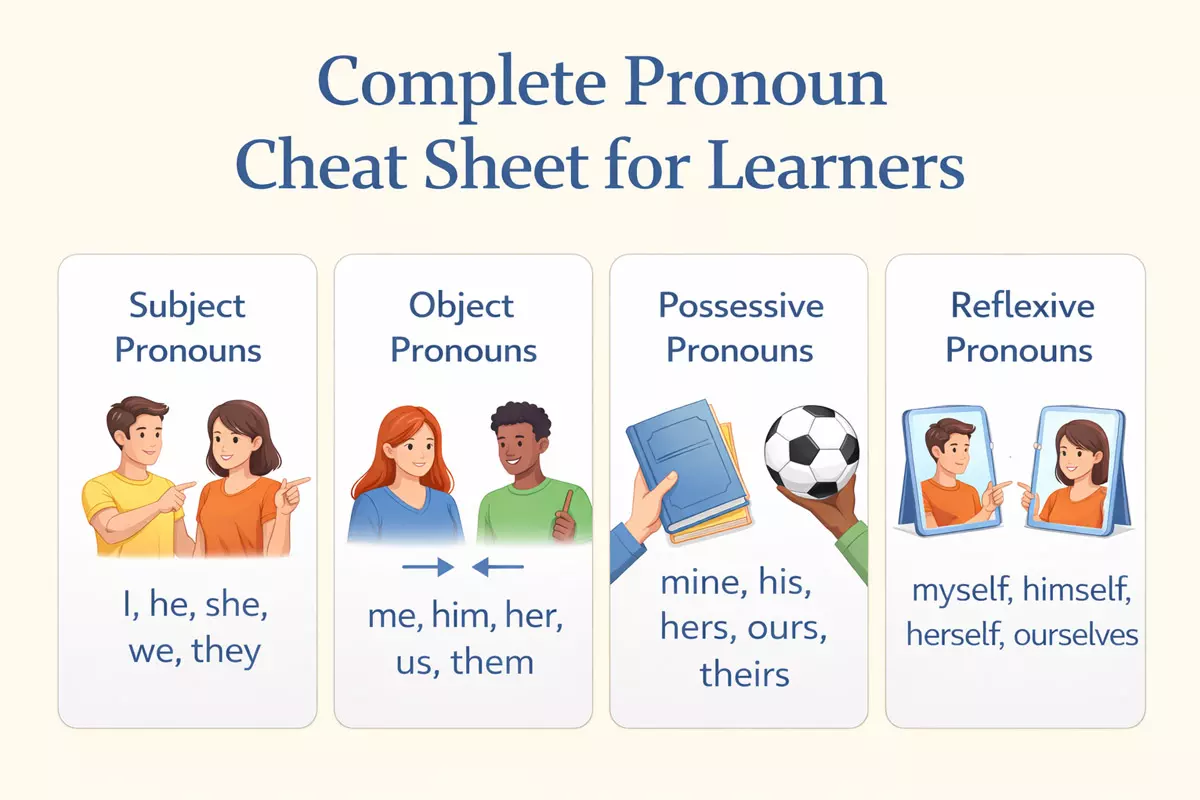 The article summarizes all main pronoun types, covering personal, possessive, reflexive, demonstrative, relative, interrogative, and indefinite pronouns. It also explains common errors, agreement rules, and provides a brief practice section.
- All core pronoun types in one overview
- Personal pronouns: subject and object forms
- Possessive adjectives vs possessive pronouns
- Reflexive pronouns and typical uses
- Demonstratives and basic pointing patterns
- Relative and interrogative pronouns at a glance
- Indefinite pronouns: common forms and agreement
- Quick error list and mini practice section
Understanding pronouns like he, she, and they can be challenging for language learners, yet mastering them is essential for effective and respectful communication. This guide offers clear explanations and practical tips to help you use these fundamental words correctly in various contexts. By learning the proper use of pronouns, you can avoid misunderstandings and express yourself more accurately, making your conversations smoother and more inclusive.
All core pronoun types in one overview
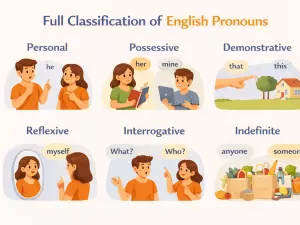
Understanding the main categories of pronouns helps you use them correctly in any context. Each type serves a different purpose, from replacing nouns to showing ownership or asking questions. Here’s a clear breakdown of the essential pronoun groups, with definitions and practical examples for each.
Personal Pronouns
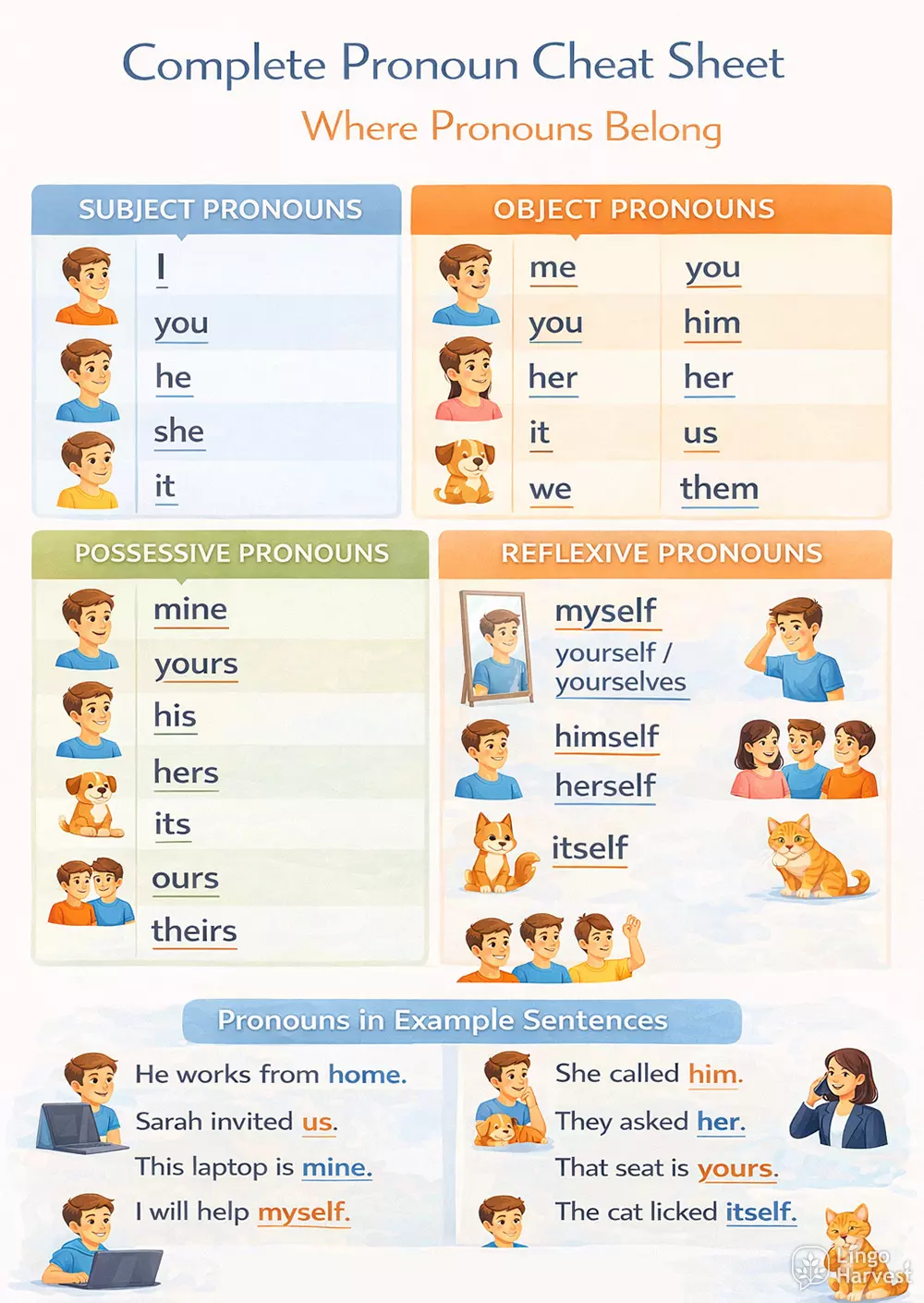
Personal pronouns stand in for people or things and change form depending on their function in the sentence (subject or object). Examples include:
- I, me → I am ready to start.
- you → You can wait here.
- he, him → He works late on Mondays.
- she, her → She called earlier.
- it → It looks interesting.
- we, us → We finished the project.
- they, them → They arrived on time.
Possessive Pronouns
These indicate ownership or belonging. They can act as stand-alone words (mine, yours) or accompany nouns (my, your).
- mine → This notebook is mine.
- yours → Is this seat yours?
- his → The blue jacket is his.
- hers → The final decision was hers.
- its → The company changed its policy.
- ours → The responsibility is ours.
- theirs → The mistake was theirs.
Reflexive Pronouns
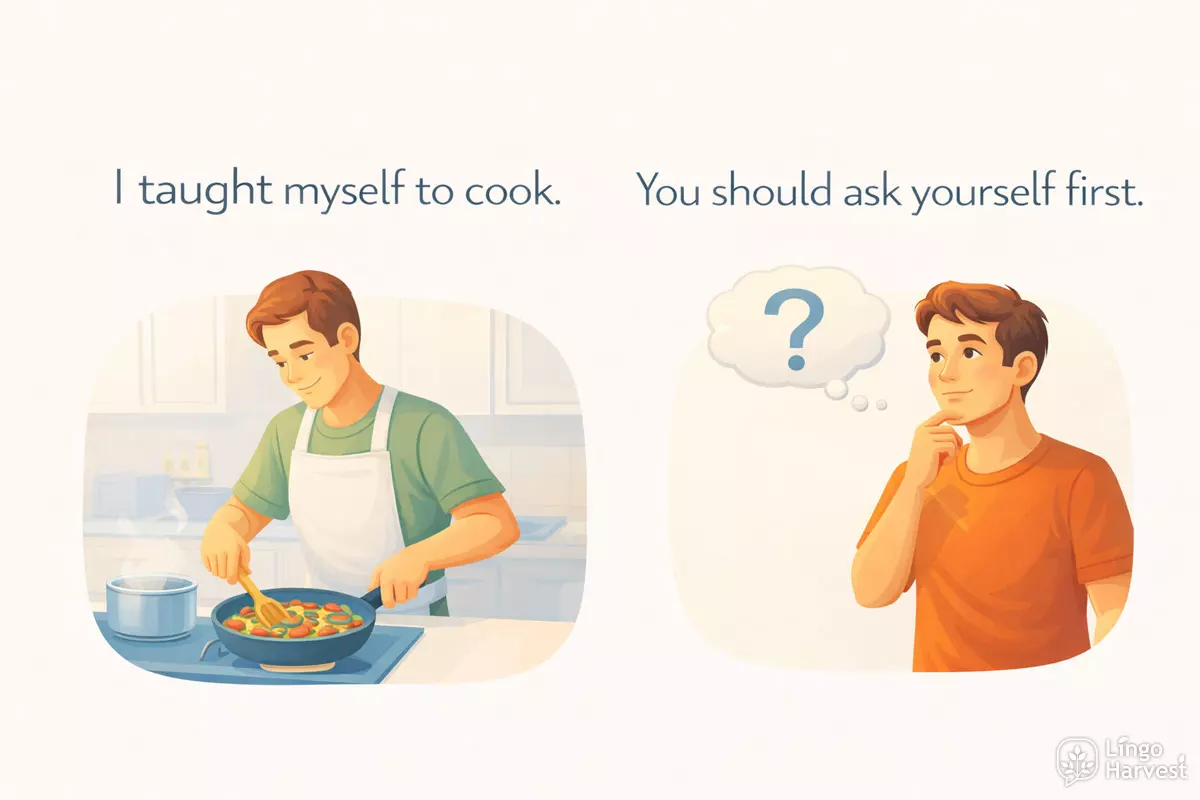
Reflexive pronouns reflect the action back to the subject. They end in -self or -selves:
- myself → I taught myself to cook.
- yourself → You should ask yourself first.
- himself → He fixed the problem himself.
- herself → She introduced herself to the team.
- itself → The system updates itself automatically.
- ourselves → We prepared ourselves for the exam.
- yourselves → Please make yourselves comfortable.
- themselves → They explained themselves clearly.
Demonstrative Pronouns
Demonstratives point to specific things or people. The main forms are:
- this → I like this better.
- that → That sounds interesting.
- these → These are my keys.
- those → Those belong to her.
Interrogative Pronouns
These are used for asking questions about nouns. Common examples:
- who → Who is waiting outside?
- whom → Whom did you invite?
- whose → Whose bag is this?
- what → What happened here?
- which → Which option do you prefer?
Indefinite Pronouns
Indefinite pronouns refer to non-specific people or things. Here are some of the most frequent ones:
- everyone → Everyone enjoyed the presentation.
- somebody → Somebody left their phone here.
- anyone → Anyone can join the discussion.
- nobody → Nobody answered the call.
- everything → Everything is ready now.
- something → I need something to drink.
- each → Each has a different role.
- few → Few understood the problem.
- many → Many were surprised by the result.
- all → All agreed with the decision.
Relative Pronouns
Relative pronouns connect clauses and relate to a noun mentioned previously. Typical forms:
- who → She’s the colleague who helped me.
- whom → The person whom I met was kind.
- whose → That’s the author whose book we read.
- which → The report which arrived today is important.
- that → The task that we finished was difficult.
| Pronoun Type | Function | Examples |
|---|---|---|
| Personal | Replaces people or things as subjects/objects | I, you, he, her, them |
| Possessive | Shows ownership or relation | mine, yours, theirs |
| Reflexive | Refers back to the subject | myself, ourselves, themselves |
| Demonstrative | Points to specific things/people | this, those |
| Interrogative | Used to ask questions | who, what, which |
| Indefinite | Refers to non-specific things/people | anyone, few, something |
| Relative | Connects clauses, refers to nouns | who, that, which |
Knowing the distinctions between these groups helps you select the right word for any situation. Each kind of pronoun plays a specific role, making your sentences clearer and more efficient.
Personal pronouns: subject and object forms
Understanding how to use subject and object pronouns correctly is essential for clear communication in English. Subject pronouns (like I, she, they) do the action in a sentence, while object pronouns (such as me, him, them) receive the action. Confusing these forms can lead to sentences that sound unnatural or even change the meaning entirely.
Subject vs. Object: What’s the Difference?
Subject pronouns replace the person or thing doing the action. Object pronouns replace the person or thing receiving the action. For example, “He called me” clearly shows who is performing the action and who is affected by it. Mixing them up (“Me called he”) doesn’t work in standard English.
| Subject Pronoun | Object Pronoun | Example Sentence |
|---|---|---|
| I | me | I see them. / They see me. |
| you | you | You know her. / She knows you. |
| he | him | He likes us. / We like him. |
| she | her | She helps me. / I help her. |
| it | it | It follows you. / You follow it. |
| we | us | We trust them. / They trust us. |
| they | them | They call him. / He calls them. |
Quick Reference: When to Use Each Form
- Subject pronouns start sentences: She is late. We are ready.
- Object pronouns come after verbs or prepositions: Give it to me. Wait for us.
- Some pronouns are the same in both roles (you, it).
- Check who is acting and who is receiving the action to choose correctly.
Common Mistakes to Avoid ❌
- “Me and John went home.” → Correct: “John and I went home.”
- “She gave the book to he.” → Correct: “She gave the book to him.”
- “Them are here.” → Correct: “They are here.”
Practice swapping subject and object forms in sentences to build confidence. Mastery of these pronouns helps your English sound smooth and natural in both speech and writing.
Possessive adjectives vs possessive pronouns
Understanding the difference between possessive adjectives and possessive pronouns is crucial for clarity and accuracy in English. Both types show ownership or belonging, but they function differently in a sentence.
How they work in sentences
Possessive adjectives always come before a noun, directly describing whose item or person is being referred to. In contrast, possessive pronouns stand alone, replacing the noun to avoid repetition.
- My book is on the table. ("My" describes whose book.)
- The blue car is ours. ("Ours" replaces "our car".)
- Is this your pen?
- This seat is mine.
- Her idea was interesting.
- The decision is theirs.
- His shoes are new.
- The fault was yours.
- Its color is bright.
- The choice is ours.
Comparison chart
Here’s a quick reference showing each form and how they are used:
| Possessive Adjective (before noun) |
Possessive Pronoun (replaces noun) |
Example |
|---|---|---|
| my | mine | This is my cup. → This cup is mine. |
| your | yours | Is this your seat? → Is this seat yours? |
| his | his | His coat is blue. → The blue coat is his. |
| her | hers | Her phone is new. → The new phone is hers. |
| its | — | Its tail is long. (No pronoun form) |
| our | ours | Our house is big. → The big house is ours. |
| their | theirs | Their answers are correct. → The correct answers are theirs. |
Quick tips
- Never use a possessive adjective alone: ❌ "This is my."
- Don’t use a possessive pronoun before a noun: ❌ "Mine book."
- Remember: its has no possessive pronoun form.
- Possessive pronouns can end a sentence; adjectives cannot.
Mastering these forms helps your English sound natural and avoids confusion. Use this section as a reference whenever you’re unsure which form to use.
Reflexive pronouns and typical uses
Reflexive pronouns are words like “myself,” “yourself,” “themselves,” and so on. They refer back to the subject of the sentence, showing that the action is performed by and for the same person or thing. English learners often encounter these pronouns in daily conversation, storytelling, and instructions.
Common forms of reflexive pronouns
Reflexive pronouns are easy to spot: they all end in -self (singular) or -selves (plural). Here’s a handy overview:
| Subject Pronoun | Reflexive Pronoun |
|---|---|
| I | myself |
| you (singular) | yourself |
| he | himself |
| she | herself |
| it | itself |
| we | ourselves |
| you (plural) | yourselves |
| they | themselves |
Typical uses in sentences
Reflexive pronouns have several key functions in English:
- When the subject and object are the same: She taught herself Spanish.
- For emphasis: I’ll do it myself.
- With prepositions, to show “for/by oneself”: He lives by himself.
- After certain verbs: Enjoy yourself at the party!
- In instructions: Please help yourself to some coffee.
- Describing accidental actions: He hurt himself playing soccer.
- To avoid confusion: The cat washed itself.
- When someone does something alone: I went to the movie by myself.
- In idioms: Suit yourself.
- For polite offers: Make yourself at home.
- With “each other” for reciprocal actions (not strictly reflexive, but related): They congratulated themselves on their success.
- To clarify: The children dressed themselves this morning.
Common mistakes to avoid ❌
Learners sometimes confuse reflexive pronouns with object pronouns, or use them unnecessarily. Here are examples to watch out for:
- Incorrect: ~She gave myself a gift.~
- Correct: She gave herself a gift.
- Incorrect: ~John and myself went to the store.~
- Correct: John and I went to the store.
Reflexive forms help make English sentences clearer and more precise. Remember, use them only when the subject and object are the same person or thing, or when you want to emphasize the doer of the action.
Demonstratives and basic pointing patterns
Learning how to indicate objects, people, or ideas in space or conversation is a key part of mastering pronouns. In many languages, specific words—called demonstratives—help us point out or refer to things based on distance, context, or relevance. These words typically signal whether something is near or far from the speaker, or if it has been previously mentioned.
Common demonstratives in English
- This (singular, near): Used for one thing or person close to the speaker. This book (the book here, near me).
- That (singular, far): Refers to a single item farther away. That chair (the chair over there).
- These (plural, near): Used for multiple items close by. These apples (the apples next to me).
- Those (plural, far): Refers to several things at a distance. Those cars (the cars across the street).
Pointing patterns and context
Demonstratives don’t just express physical distance; they can also indicate emotional closeness or importance. For example, “I love this idea!” suggests enthusiasm or personal involvement, while “That’s not what I meant” might distance the speaker from the subject.
Other languages may have more nuanced systems for pointing. Some even distinguish between “near me,” “near you,” and “far from both of us.” Here’s a quick comparison of demonstrative forms in English, Spanish, and Japanese:
| Language | Near Speaker | Near Listener | Far from Both |
|---|---|---|---|
| English | This / These | (no special form) | That / Those |
| Spanish | Este / Esta / Estos / Estas | Ese / Esa / Esos / Esas | Aquel / Aquella / Aquellos / Aquellas |
| Japanese | Kore (これ), Kono (この) | Sore (それ), Sono (その) | Are (あれ), Ano (あの) |
Usage tips and pitfalls
- Use this and these for things physically or emotionally close.
- Switch to that or those when referring to items farther away or less relevant.
- Mind the singular/plural distinction: “this/that” for one, “these/those” for more than one.
- Some languages require gender or case agreement; always check the rules for your target language.
- Context can shift meaning: “That’s great!” may sound supportive or, in some cases, distant or sarcastic.
Getting comfortable with demonstratives means not just memorizing words, but understanding how speakers use them to navigate space, relationships, and conversation flow. Practice noticing how native speakers point things out in real life or in media—you’ll start to hear the subtle differences in no time.
Relative and interrogative pronouns at a glance
Understanding how to use relative and interrogative pronouns helps you connect ideas and ask questions smoothly in English. These pronouns act as bridges—linking parts of a sentence or introducing questions about people, things, places, and more.
Relative pronouns: Linking clauses
Relative pronouns introduce clauses that describe a noun, adding essential or extra information. They're key for forming complex sentences. Here are the most common relative pronouns and their typical uses:
- who – refers to people (The woman who called you is here.)
- whom – formal, for people as the object (The person whom you met.)
- whose – shows possession (The student whose book is missing.)
- which – for animals and things (The car which broke down.)
- that – for people, animals, or things (The movie that we watched.)
- where – refers to places (The house where I grew up.)
- when – refers to times (The day when we met.)
- why – for reasons (The reason why he left.)
Interrogative pronouns: Asking questions
Interrogative pronouns are used to ask direct questions about people, objects, ownership, and choices. They often start a question, making them essential for conversation and information gathering.
- who – asks about a person (Who called you?)
- whom – formal, person as object (Whom did you see?)
- whose – asks about possession (Whose keys are these?)
- what – asks about things or information (What happened?)
- which – asks about specific options (Which color do you prefer?)
| Pronoun | Typical Use & Example | Relative or Interrogative? |
|---|---|---|
| who | Person as subject Relative: The man who smiled. Interrogative: Who arrived? |
Both |
| whom | Person as object Relative: The friend whom you met. Interrogative: Whom did you call? |
Both (formal) |
| whose | Possession Relative: The boy whose dog barked. Interrogative: Whose bag is this? |
Both |
| which | Things/choice Relative: The book which I read. Interrogative: Which do you want? |
Both |
| that | People, things, animals Relative: The dog that barked. Interrogative: (Not used) |
Relative only |
| what | Things/information Relative: (Not used) Interrogative: What is this? |
Interrogative only |
| where | Place Relative: The city where I was born. Interrogative: Where are you? |
Both |
| when | Time Relative: The year when we met. Interrogative: When did it happen? |
Both |
| why | Reason Relative: The reason why he left. Interrogative: Why did you go? |
Both |
Keep in mind that some pronouns serve both as relatives and interrogatives, depending on their role in a sentence. Mastering these words makes your English clearer and more precise, whether you're describing, connecting ideas, or seeking information.
Indefinite pronouns: common forms and agreement
Indefinite pronouns refer to people, things, or amounts in a general or non-specific way. These words are frequently used in English to talk about unknown, unspecified, or collective entities. Understanding how these pronouns function and agree with verbs is essential for both clarity and correctness in communication.
Most common indefinite pronouns
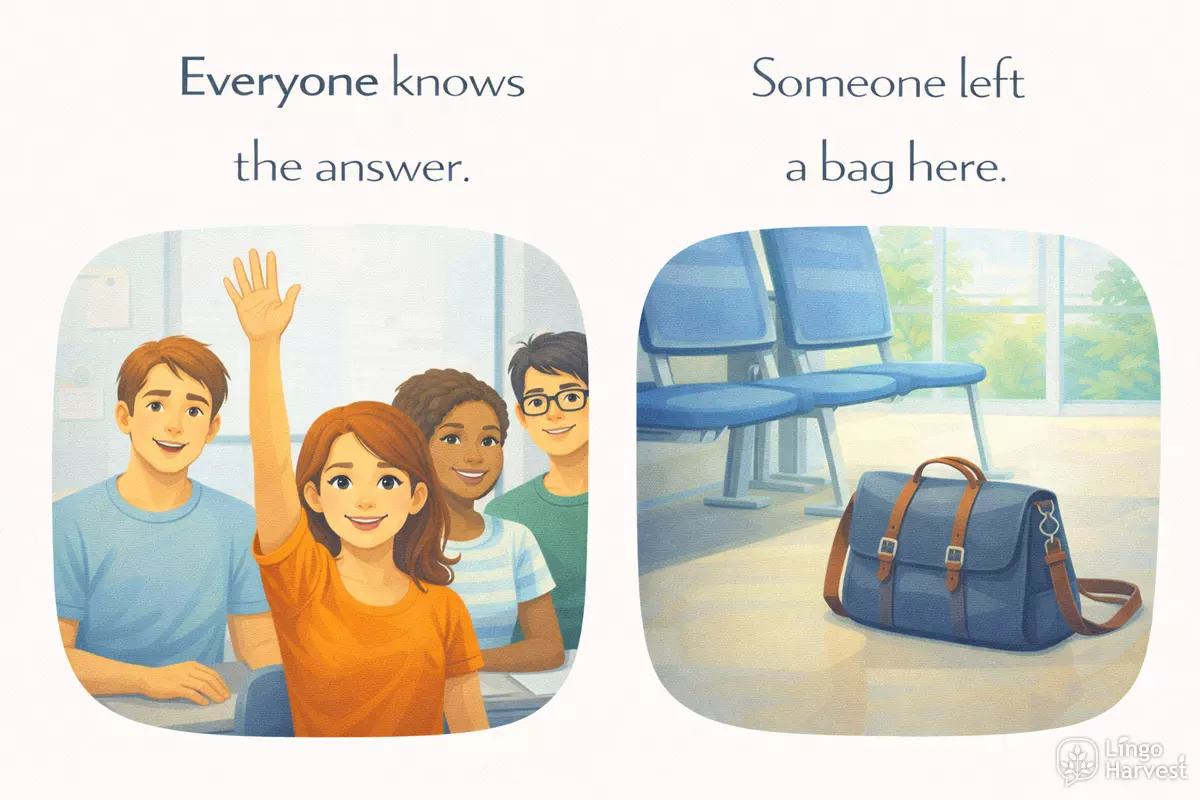
Several pronouns fall into this category. Some refer to people, others to things or places, and some can be used for both. Here are the most widely used indefinite pronouns:
- everyone → Everyone knows the answer.
- everybody → Everybody enjoyed the event.
- everything → Everything is ready now.
- someone → Someone left a bag here.
- somebody → Somebody is waiting outside.
- something → I need something to eat.
- anyone → Anyone can apply.
- anybody → Anybody would agree with that.
- anything → Do you want anything else?
- no one → No one answered the phone.
- nobody → Nobody understood the joke.
- nothing → Nothing seems wrong.
- each → Each has a different role.
- either → Either will work for me.
- neither → Neither was available.
- all → All were invited.
- some → Some are missing.
- any → Are there any left?
- none → None were accepted.
- several → Several have already left.
- few → Few understood the instructions.
- many → Many were surprised.
- both → Both agreed to the plan.
Agreement: singular or plural?
The verb form you use with an indefinite pronoun depends on whether the pronoun is considered singular or plural. Some pronouns are always singular, some always plural, and a few can be both depending on context. Here’s a quick guide:
| Type | Examples (with agreement) |
|---|---|
| Always singular |
|
| Always plural |
|
| Singular or plural (context-dependent) |
|
Common pitfalls and tips
- Words ending in -body, -one, and -thing (like anyone or everything) are always singular, even though they refer to more than one person or thing.
- Don’t be misled by words like each and every; they always take a singular verb.
- When the reference is to a group, context will guide whether the verb should be singular or plural (especially with all, some, none).
Getting comfortable with these general pronouns and their agreement patterns will help you avoid common mistakes, especially in writing and exams.
Quick error list and mini practice section
Common pronoun mistakes can cause confusion and make sentences unclear. Below, you'll find a fast-reference guide to typical errors, plus a short practice area to help you master correct usage. These points address frequent problems for learners at all levels.
Frequent Pronoun Mistakes ❌
- Subject vs. object confusion: Using "me" where "I" is needed, or vice versa.
Wrong: Me went to the store.
Correct: I went to the store. - Ambiguous reference: Not making it clear what or who "it," "they," or "this" refers to.
Unclear: Sam gave Alex his book. (Whose book?) - Inconsistent number: Mixing singular and plural forms.
Wrong: Each student must bring their pencils. (Formal: his or her) - Gender mismatch: Using "he" for a female or "she" for a male; using "it" for people.
- Reflexive misuse: Using "myself" instead of "me" or "I."
Wrong: Please contact myself if you need help. - Who vs. whom: Mixing up subject and object forms.
Who = subject, whom = object. - Its vs. it's: Confusing the possessive "its" with the contraction "it's" (it is).
- Double negatives: Using two negatives with pronouns.
Wrong: I don't know nobody. - Possessive pronoun errors: Using "your's" instead of "yours," or "their's" instead of "theirs."
- Omitting pronouns in English: Dropping the subject pronoun, which is required in standard English.
Personal Pronoun Paradigm
| Subject | Object | Possessive Adjective | Possessive Pronoun | Reflexive |
|---|---|---|---|---|
| I | me | my | mine | myself |
| you | you | your | yours | yourself |
| he | him | his | his | himself |
| she | her | her | hers | herself |
| it | it | its | its | itself |
| we | us | our | ours | ourselves |
| they | them | their | theirs | themselves |
Mini Practice: Spot the Error
- Her went to the market alone.
- The teacher gave we homework.
- Each of the boys has their own locker.
- Who did you see at the party?
- The cat licked it's paw.
- Me and John are going to the meeting.
- Everyone have finished their work.
- Between you and I, this is a bad idea.
- There is many reasons to stay.
- Neither of them are available today.
Show answers
- Should be She went to the market alone. (“Her” is an object form, not a subject.)
- Should be us. (“Gave us homework,” not “we.”)
- Formally, should be his or her. (“Each” is singular.)
- Formally, should be Whom. (“Whom did you see…”) In informal English, who is common.
- Should be its paw. (“It’s” means “it is.”)
- Should be John and I. Subject pronouns are used before the verb.
- Should be Everyone has. (“Everyone” is grammatically singular.)
- Should be Between you and me. Object pronouns are required after prepositions.
- Should be There are many reasons. Plural noun requires plural verb.
- Should be Neither of them is. “Neither” is singular.
Quick Pronoun Correction Task
Choose the correct option:
- Is this bag (your / yours)?
- He did it all by (himself / hisself).
- My friends and (me / I) went to the concert.
- Neither of them finished (his / their) project.
- Give the keys to (whoever / whomever) needs them.
- This seat is (my / mine), not yours.
- Everyone forgot (his or her / their) password.
- She introduced (herself / her) to the team.
- Between you and (I / me), this plan won’t work.
- The person (who / whom) you met yesterday is my cousin.
Show answers
- yours
- himself
- I
- his (formally correct), though their is widely accepted in informal English
- whoever
- mine
- his or her (formal), their (common in modern English)
- herself
- me
- whom (formal), though who is common in spoken English