Full Classification of English Pronouns Explained Clearly

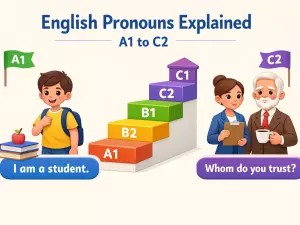
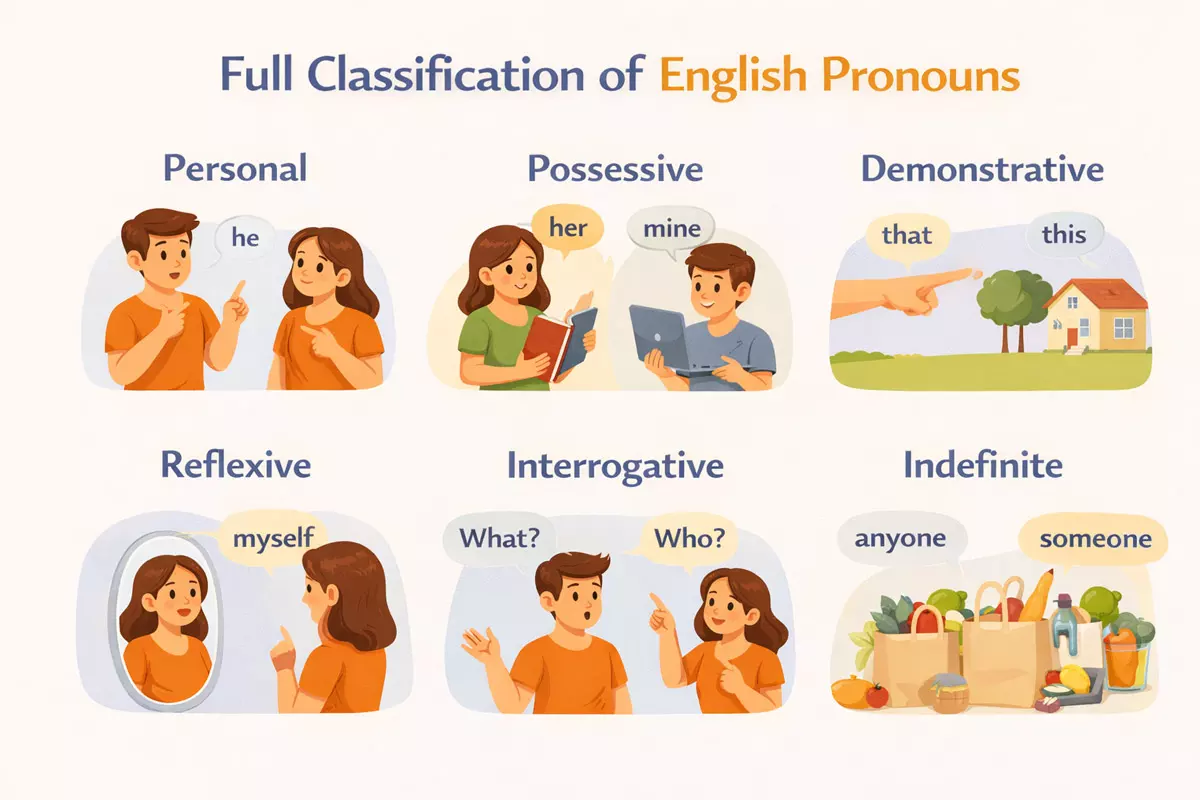 This article explains why a thorough pronoun classification is essential for accuracy, details all main types including personal, possessive, reflexive, demonstrative, relative, interrogative, indefinite, reciprocal, and dummy pronouns, and addresses common learner…
- Why a full pronoun classification matters for accuracy
- Core categories: personal, possessive, reflexive, demonstrative
- Relative and interrogative pronouns overview
- Indefinite and reciprocal pronouns explained
- Dummy and empty pronouns in structure
- How categories overlap in real usage
- Common classification mistakes by learners
- Visual summary of the full pronoun system
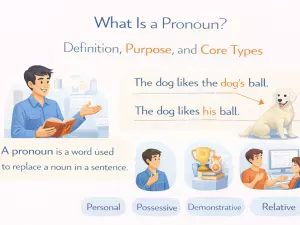
Pronouns such as he, those, or mine play a crucial role in making our conversations smoother and less repetitive by replacing nouns and clarifying who or what we are talking about. There are several types of pronouns in English, including personal pronouns like he or she, demonstrative pronouns like those, and possessive pronouns like mine. Each type has a specific function, whether it is indicating ownership, pointing out specific things, or referring to people already mentioned, all of which help us communicate more efficiently and clearly.
Why a full pronoun classification matters for accuracy
Clear and complete categorization of English pronouns is essential for precise communication and language learning. Without a thorough breakdown, it’s easy to overlook how pronouns shift in form and function depending on context. For example, understanding the distinction between subject and object pronouns helps avoid errors like “Me went to the store” instead of “I went to the store.”
Nuances in Meaning and Reference
Different types of pronouns serve unique roles. Personal, reflexive, possessive, demonstrative, and relative pronouns each fulfill a specific grammatical need. Lumping them together can blur these distinctions, leading to ambiguity or misunderstandings. For instance, “they,” “theirs,” and “themselves” all refer to people, but their functions in a sentence differ dramatically.
Common Types and Their Functions
- Subject pronouns: I, you, he, she, it, we, they
- Object pronouns: me, you, him, her, it, us, them
- Possessive pronouns: mine, yours, his, hers, its, ours, theirs
- Reflexive pronouns: myself, yourself, himself, herself, itself, ourselves, yourselves, themselves
- Demonstrative pronouns: this, that, these, those
- Relative pronouns: who, whom, whose, which, that
- Interrogative pronouns: who, whom, whose, which, what
- Indefinite pronouns: anyone, everyone, someone, nobody, each, few, many, several, all, some
- Reciprocal pronouns: each other, one another
- Intensive pronouns: myself, yourself, himself, herself, itself, ourselves, yourselves, themselves (when used for emphasis)
Comparison of Pronoun Forms
| Type | Examples |
|---|---|
| Subject | I, you, he, she, it, we, they |
| Object | me, you, him, her, it, us, them |
| Possessive | mine, yours, his, hers, ours, theirs |
| Reflexive | myself, yourself, himself, herself, itself, ourselves, yourselves, themselves |
Why Detail Prevents Mistakes
Detailed classification reduces confusion. For learners, recognizing the difference between “who” (subject) and “whom” (object) prevents classic mistakes. In writing and editing, accurate identification of pronoun types ensures agreement in number and case, which is especially important in complex sentences.
- Ensures correct pronoun-antecedent agreement
- Prevents ambiguous references
- Clarifies meaning in both speech and writing
- Improves grammatical accuracy
- Supports inclusive and precise language use
Ultimately, a full classification system is not just an academic exercise—it’s a practical tool for anyone who wants to communicate clearly and avoid common pitfalls in English grammar.
Core categories: personal, possessive, reflexive, demonstrative
English pronouns can be sorted into several main types, each with its own function and form. Understanding these groups helps make sentences clearer and avoids confusion about who or what is being discussed. Here’s a closer look at how these categories work and what makes each one unique.
Personal Pronouns
Personal pronouns stand in for specific people or things. They change form depending on their role in the sentence (subject or object) and whether they’re singular or plural. Common examples include:
- I, me (first person singular) → I am ready. / She called me yesterday.
- you (second person singular/plural) → You look tired today.
- he, him, she, her, it (third person singular) → He knows the answer. / I met her earlier.
- we, us (first person plural) → We are leaving now. / They invited us.
- they, them (third person plural) → They arrived late. / I spoke to them.
These pronouns help streamline communication by replacing names or nouns already understood from context.
Possessive Pronouns
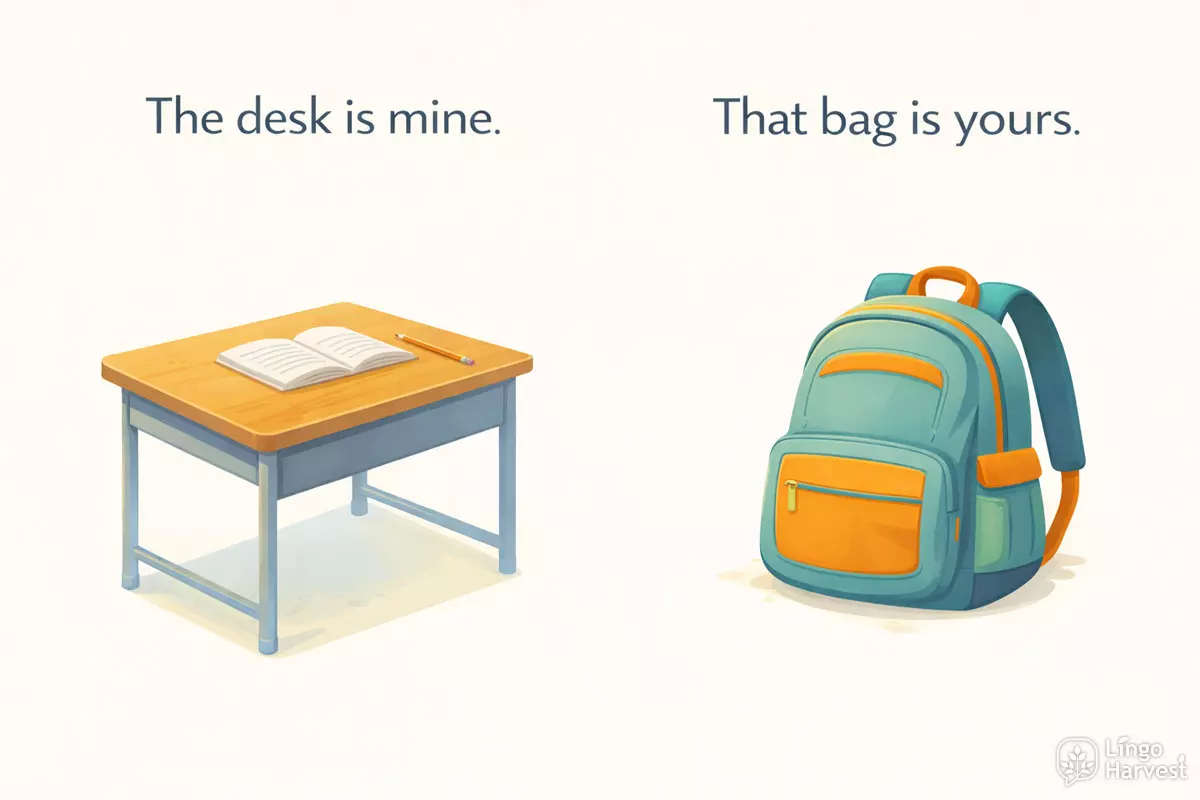
Possessive pronouns indicate ownership or belonging. They come in two forms: dependent (used before a noun) and independent (stand alone). Here are the main ones:
- my, mine → This is my desk. / The desk is mine.
- your, yours → Is this your bag? / That bag is yours.
- his, her, hers, its → His answer was correct. / The choice was hers. / The dog hurt its paw.
- our, ours → Our plan worked. / The victory was ours.
- their, theirs → Their house is new. / The responsibility is theirs.
For example, “This is my book” (dependent), or “The book is mine” (independent).
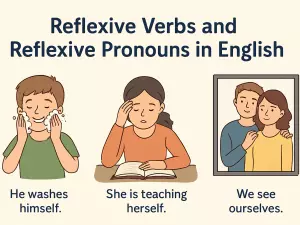
Reflexive Pronouns
Reflexive pronouns reflect the action of the verb back onto the subject. They’re easy to spot because they end in -self (singular) or -selves (plural):
- myself → I taught myself to code.
- yourself → You should take care of yourself.
- himself, herself, itself → He blamed himself. / She introduced herself. / The machine shut itself down.
- ourselves → We prepared ourselves for the test.
- yourselves → Make yourselves comfortable.
- themselves → They described themselves clearly.
These are used when the subject and object of the verb are the same, as in “She taught herself.”
Demonstrative Pronouns
Demonstrative pronouns point to specific things or people. They help clarify which item is meant, often by distinguishing between something near or far in space or time. The main demonstratives are:
- this (singular, near) → This looks interesting.
- that (singular, far) → That was a great experience.
- these (plural, near) → These are my notes.
- those (plural, far) → Those were difficult times.
Example: “These are delicious,” or “I prefer that.”
| Pronoun Type | Examples | Function |
|---|---|---|
| Personal | I, you, he, she, we, they | Replaces nouns referring to people or things |
| Possessive | my/mine, your/yours, their/theirs | Shows ownership or belonging |
| Reflexive | myself, yourself, themselves | Refers back to the subject of the clause |
| Demonstrative | this, that, these, those | Points to specific items or persons |
By recognizing these types and their uses, you can choose the right pronoun for clarity and precision in both writing and conversation. Each group has its own patterns and exceptions, so practice and careful reading can help reinforce these distinctions.
Relative and interrogative pronouns overview
Relative and interrogative pronouns are essential parts of English grammar, helping us connect ideas and ask questions clearly. Relative pronouns link clauses to nouns, providing more information, while interrogative pronouns introduce questions. Understanding how these words function can greatly improve both written and spoken communication.
What are relative pronouns?
Relative pronouns introduce relative clauses, which describe or identify nouns in a sentence. They often answer the questions "which one?", "what kind?", or "whose?" Common English relative pronouns include:
- who – refers to people (subject)
- whom – refers to people (object)
- whose – shows possession
- which – refers to animals or things
- that – can refer to people, animals, or things (more informal)
- where – refers to a place
- when – refers to a time
- why – refers to a reason
For example:
- The book that you lent me was fascinating.
- The person who called you is waiting outside.
- This is the house where I grew up.
What are interrogative pronouns?
Interrogative pronouns are used to ask questions about people or things. The most common ones in English are:
- who – asks about a person (subject)
- whom – asks about a person (object)
- whose – asks about possession
- what – asks about things or information
- which – asks about a specific choice from a known set
Example questions include:
- Who is at the door?
- Whose jacket is this?
- What happened here?
- Which color do you prefer?
Key differences and overlaps
Some pronouns, such as who, whom, whose, which, appear in both categories. Their function depends on sentence structure—whether they’re introducing a clause or forming a question.
| Pronoun | Relative Pronoun Example | Interrogative Pronoun Example |
|---|---|---|
| who | The teacher who helped me was kind. | Who is coming to dinner? |
| whom | The student whom you met is my friend. | Whom did you see? |
| whose | The artist whose paintings you admire lives nearby. | Whose bag is this? |
| which | The cake which she baked was delicious. | Which of these is yours? |
| that | The car that broke down is gone. | ❌ (not used as interrogative) |
When choosing between these pronouns, consider whether you are joining clauses or asking a question, and whether you’re referring to people, things, places, or reasons. Mastery of these forms allows for clearer, more nuanced sentences.
Indefinite and reciprocal pronouns explained
Indefinite pronouns refer to non-specific people or things, allowing speakers to talk in general terms without naming exact individuals. These pronouns answer questions like "Who?" or "How many?" when the answer is not definite. On the other hand, reciprocal pronouns are used to express a mutual relationship or action between two or more entities.
Indefinite pronouns: broad reference
Common indefinite pronouns include words such as someone, anybody, both, and everything. They can refer to people, objects, or quantities without specifying which ones. Indefinite pronouns are especially useful when the identity is unknown or unimportant.
- Someone left their bag here.
- Anything is possible.
- Few understood the instructions.
- Everybody enjoyed the concert.
- Nothing was left behind.
- Many have tried, but few succeeded.
- Several were absent today.
- Each received a prize.
- All are welcome to attend.
- Neither of the answers is correct.
- Others might disagree.
- Something smells delicious.
- None of the books are available.
- Anyone can join the club.
- Everything has been prepared.
Reciprocal pronouns: expressing mutual actions
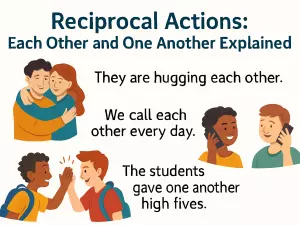
Reciprocal pronouns are a small group, mainly each other and one another. They are used when two or more people or things are acting in the same way towards each other, emphasizing a shared or mutual relationship.
- The children hugged each other before leaving.
- We should help one another in times of need.
| Type | Examples | Typical Use |
|---|---|---|
| Indefinite pronouns | someone, anything, few, everybody, none, several, all, each, both | Refer to non-specific people or things |
| Reciprocal pronouns | each other, one another | Show mutual action or relationship |
It's important to note that indefinite pronouns can be singular (everyone, each), plural (many, few), or sometimes both (all, none), which affects verb agreement. For reciprocal pronouns, the choice between each other and one another is stylistic in modern English; both are generally interchangeable.
Homework 1: Identify the pronoun type
- She taught herself to play the guitar.
- Those are the documents we discussed.
- Someone left their phone on the desk.
- The man who called you is waiting.
- This belongs to me.
- They helped each other during the project.
- Which of these options do you prefer?
- Everything is ready for the presentation.
- The students prepared themselves for the exam.
- That was exactly what I meant.
Show answers
- Reflexive pronoun
- Demonstrative pronoun
- Indefinite pronoun
- Relative pronoun
- Possessive pronoun (independent)
- Reciprocal pronoun
- Interrogative pronoun
- Indefinite pronoun
- Reflexive pronoun
- Demonstrative pronoun
Homework 2: Choose the correct pronoun
- That decision is _____ (my / mine).
- Everyone forgot _____ ticket.
- The manager spoke to the employee _____ arrived late.
- We should respect _____ opinions.
- _____ of the answers were correct. (None / Nothing)
- This laptop isn’t _____ (our / ours).
- The teammates supported _____ throughout the season.
- _____ bag is this?
- She blamed _____ for the mistake.
- _____ can apply for the position.
Show answers
- mine
- their
- who
- their
- None
- ours
- each other
- Whose
- herself
- Anyone
Dummy and empty pronouns in structure
Some English sentences require a subject, even when there isn't a real person or thing to refer to. In such cases, words like it and there fill grammatical slots but do not refer to anything concrete. These are often called “dummy” or “empty” pronouns. Their primary function is structural: they maintain standard English sentence patterns, ensuring clarity and smoothness.
Understanding dummy pronouns
A dummy pronoun stands in for a missing or unneeded subject. For example, in the statement “It is raining,” it does not refer to anything specific. The pronoun is present simply because English syntax typically requires a subject before the verb in declarative sentences.
- It is raining. (No real subject; “it” is only structural.)
- It seems that she left early. (“It” introduces a clause.)
- It’s important to stay hydrated. (“It” refers to the idea that follows.)
- It was said that the show was canceled.
- It’s time to leave.
- It appears that nobody is home.
- There is a book on the table. (“There” signals existence, not location.)
- There seems to be a problem.
- There are many reasons to visit.
- There was a loud noise outside.
- There comes a time when we must decide.
- Is there a solution?
Empty pronouns vs. real subjects
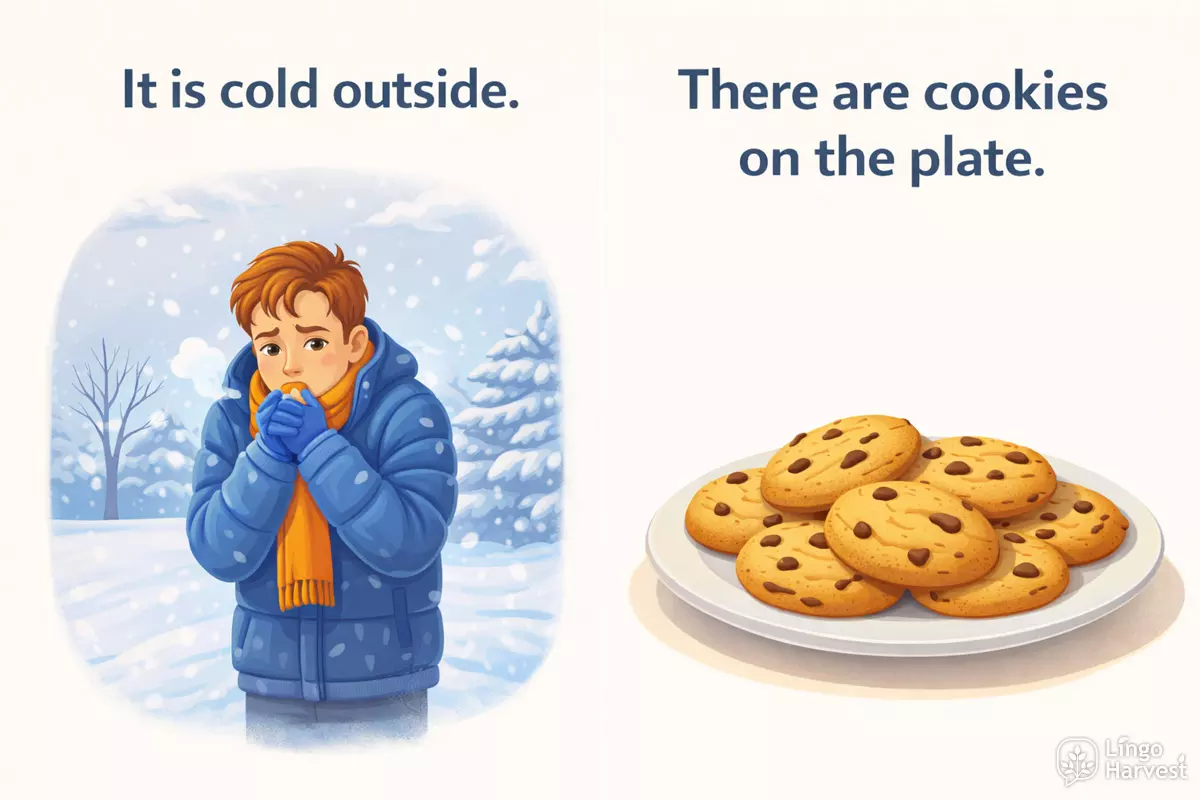
Unlike true pronouns (such as he, she, they), dummy and empty pronouns do not stand for any noun or noun phrase. Instead, they fulfill grammatical rules that require a subject position. This distinction is important for understanding how English sentence construction works.
| Pronoun Type | Example Sentence | Refers To |
|---|---|---|
| Dummy “it” | It is cold outside. | No real thing (just weather/state) |
| Dummy “there” | There are cookies on the plate. | No actual location; signals existence |
| Normal “he” | He is my friend. | A specific person |
| Normal “they” | They left early. | A known group |
Common uses in English structure
Dummy and empty pronouns most often appear in weather statements, existential sentences, and clauses where a subject is syntactically necessary but not semantically meaningful. Recognizing these structures helps learners avoid mistakes like omitting subjects or misidentifying what pronouns refer to.
- Weather: It’s snowing.
- Time: It’s late.
- Existence: There is hope.
- Distance: It’s a long way to the station.
- Impersonal expressions: It’s said that…
In summary, these pronouns are structural placeholders. They are essential for grammatical accuracy, even though they carry no concrete meaning themselves. Understanding how and why English uses these empty elements can clarify many confusing sentence patterns.
How categories overlap in real usage
English pronoun categories often blur together when people actually speak or write. While textbooks present neat divisions—like personal, reflexive, demonstrative, and indefinite pronouns—in everyday language, these boundaries are less rigid. A single pronoun can belong to more than one group depending on how it's used, and some words shift categories in different contexts.
Examples of Pronoun Category Blending
- "You" acts as both singular and plural, and as a subject or object.
- "They" serves as a personal pronoun, but now also as a singular gender-neutral form.
- "One" can function as an indefinite pronoun or a substitute for "I" (formal/generalized usage).
- "That" might be demonstrative ("That is mine") or a relative pronoun ("The book that I read").
- "Who" operates as both an interrogative and a relative pronoun.
- "It" sometimes refers to things (personal), but also works impersonally ("It is raining").
- "Each" is usually indefinite, but sometimes acts like a determiner-pronoun hybrid ("Each of them").
- "Somebody" and "anyone" are indefinite but can also refer to specific known people in certain contexts.
- "Myself" is reflexive, yet can also be used for emphasis ("I did it myself").
- "Which" appears as interrogative or relative, depending on its sentence role.
- "This" and "that" can be demonstrative pronouns or adjectives, depending on whether they stand alone or modify a noun.
- "What" can be interrogative, relative, or even exclamatory ("What a day!").
- "None" functions as both a pronoun ("None of them came") and a determiner ("None came").
- "All" can refer to people, things, or abstract ideas, and may be used as a pronoun or a quantifier.
Visualizing Overlaps: Common Multi-Category Pronouns
| Pronoun | Categories Used In | Example |
|---|---|---|
| That | Demonstrative, Relative | That is new. / The book that won. |
| Who | Interrogative, Relative | Who called? / The person who called. |
| They | Personal, Singular 'they' | They left early. / Someone left their bag; they should return. |
| Myself | Reflexive, Emphatic | I hurt myself. / I did it myself. |
| Which | Interrogative, Relative | Which do you want? / The option which is cheaper. |
| One | Indefinite, Generic Personal | One never knows. / One should try. |
| It | Personal, Impersonal | It is here. / It is raining. |
Why Overlaps Matter
Recognizing that pronoun groups are flexible helps with both understanding and producing natural English. Real language use rarely fits into strict categories, and speakers choose forms based on meaning, clarity, and context. This flexibility is a key reason why mastering pronouns requires more than just memorizing lists; it calls for noticing how words adapt to different roles in sentences.
Common classification mistakes by learners
Sorting out English pronouns can be tricky, especially for those new to the language or its grammar rules. Many learners mix up categories, confuse forms, or misapply functions. These errors often stem from overlapping forms, similar meanings, or misleading translations from other languages. Recognizing these typical pitfalls can help you avoid them and build a clearer understanding of pronoun types.
Confusing subjective and objective pronouns
One of the most frequent issues is swapping subject pronouns (like I, he, they) with object pronouns (me, him, them). This can lead to sentences like "Me went to the store" or "Give it to I," which sound unnatural in English. Remember, subjects perform the action, while objects receive it.
Mixing up possessive adjectives and possessive pronouns
Another common problem is not distinguishing between forms that show ownership: my vs. mine, your vs. yours, etc. These are not interchangeable. The table below illustrates the differences in function and example usage:
| Possessive Adjective | Possessive Pronoun | Example Sentence |
|---|---|---|
| my | mine | This is my book. / This book is mine. |
| your | yours | Is this your pen? / Is this pen yours? |
| her | hers | Her bag is blue. / The blue bag is hers. |
| their | theirs | Their house is big. / The big house is theirs. |
Overusing "it" for people or animals
Unlike some languages, English rarely uses it for people or named animals. Beginners might say "It is my friend" instead of "He is my friend." Use he/she/they for people, and for pets, use he/she if the gender is known.
Incorrectly identifying reflexive pronouns
Learners sometimes use reflexive pronouns (myself, herself, themselves) incorrectly, such as "She gave the book to myself." Reflexive forms should reflect back to the subject: "I did it myself." They are not used in place of standard object pronouns.
Mistaking demonstrative pronouns for adjectives
Words like this, that, these, those can be both pronouns ("This is mine") and adjectives ("This book is mine"). Confusion happens when learners attach nouns to demonstrative pronouns in places where only the pronoun is needed.
Not recognizing indefinite pronouns
Indefinite pronouns such as someone, anyone, nobody, everything often get misclassified or translated literally. Learners may attempt to use "anyone" as a specific person, which is incorrect. These forms refer to nonspecific people or things.
Commonly confused pronoun pairs
- Who vs. whom
- Who vs. which
- Each vs. every
- Somebody vs. anybody
- Anyone vs. no one
- Its vs. it's (the latter is a contraction, not a pronoun)
- Them (object) vs. their (possessive adjective)
- They (subject) vs. these/those (demonstrative pronouns)
- Myself vs. me
- Yours vs. your
Summary tips
- Always check if the pronoun is acting as a subject, object, or showing ownership.
- Be careful with reflexive forms—use them only when the subject and object are the same.
- Distinguish between pronouns and adjectives, especially with words like this/that.
- Remember that some pronouns refer to people, others to things, and some to both.
Being aware of these typical errors will help you classify pronouns more accurately and use them with confidence in both writing and conversation.
Visual summary of the full pronoun system
English pronouns are grouped by their function and form, covering a wide range of uses in everyday language. Understanding the categories at a glance helps clarify how each type fits into sentences and communicates meaning. Below, you'll find a concise overview of the main pronoun types, their roles, and typical examples.
Major categories and examples
- Personal pronouns: I, you, he, she, it, we, they
- Possessive pronouns: mine, yours, his, hers, its, ours, theirs
- Reflexive pronouns: myself, yourself, himself, herself, itself, ourselves, yourselves, themselves
- Demonstrative pronouns: this, that, these, those
- Relative pronouns: who, whom, whose, which, that
- Interrogative pronouns: who, whom, whose, which, what
- Indefinite pronouns: someone, anyone, everyone, no one, something, anything, everything, nothing, each, few, many, all, some, none
- Reciprocal pronouns: each other, one another
- Intensive pronouns: myself, yourself, himself, herself, itself, ourselves, yourselves, themselves (used for emphasis)
- Distributive pronouns: each, either, neither
Comparison of key forms
To highlight the distinctions among the most commonly used English pronouns, the following table compares their forms and typical uses in sentences. This makes it easier to spot patterns and avoid confusion.
| Type | Examples | Typical Use |
|---|---|---|
| Personal | he, her, we, them | Subject or object of verbs |
| Possessive | mine, yours, theirs | Shows ownership |
| Reflexive | herself, ourselves | Action reflects back to subject |
| Demonstrative | this, those | Points to specific things |
| Indefinite | anyone, few, all | Non-specific reference |
| Relative | which, who | Links clauses |
| Interrogative | what, whose | Asks questions |
| Reciprocal | each other | Mutual relationships |
Quick tips for distinguishing pronoun types
- Personal pronouns change form based on subject/object position: She (subject) vs. her (object).
- Possessive pronouns stand alone, not before nouns: “That book is mine.”
- Reflexive and intensive pronouns look identical; context (emphasis vs. reflection) tells them apart.
- Demonstrative pronouns point to things or people: “These are new.”
- Indefinite pronouns rarely refer to a specific noun: “Someone called.”
Recognizing these patterns in English pronoun use can make both writing and conversation clearer. With this reference, you can quickly check which form fits your sentence, whether you’re dealing with ownership, questions, or unclear references.
Homework: Dummy “it” and existential “there”
- _____ is raining again today.
- _____ seems that the meeting was canceled.
- _____ are three chairs left in the room.
- _____ is important to read the instructions carefully.
- _____ was a strange noise outside last night.
- _____ is a long way to the station from here.
- _____ appears that nobody has the key.
- Is _____ a reason to worry?
- _____ is said that this area is very safe.
- _____ are many ways to solve this problem.
Show answers
- It
- It
- There
- It
- There
- It
- It
- there
- It
- There