Pronouns Explained with Visual Sentence Mapping

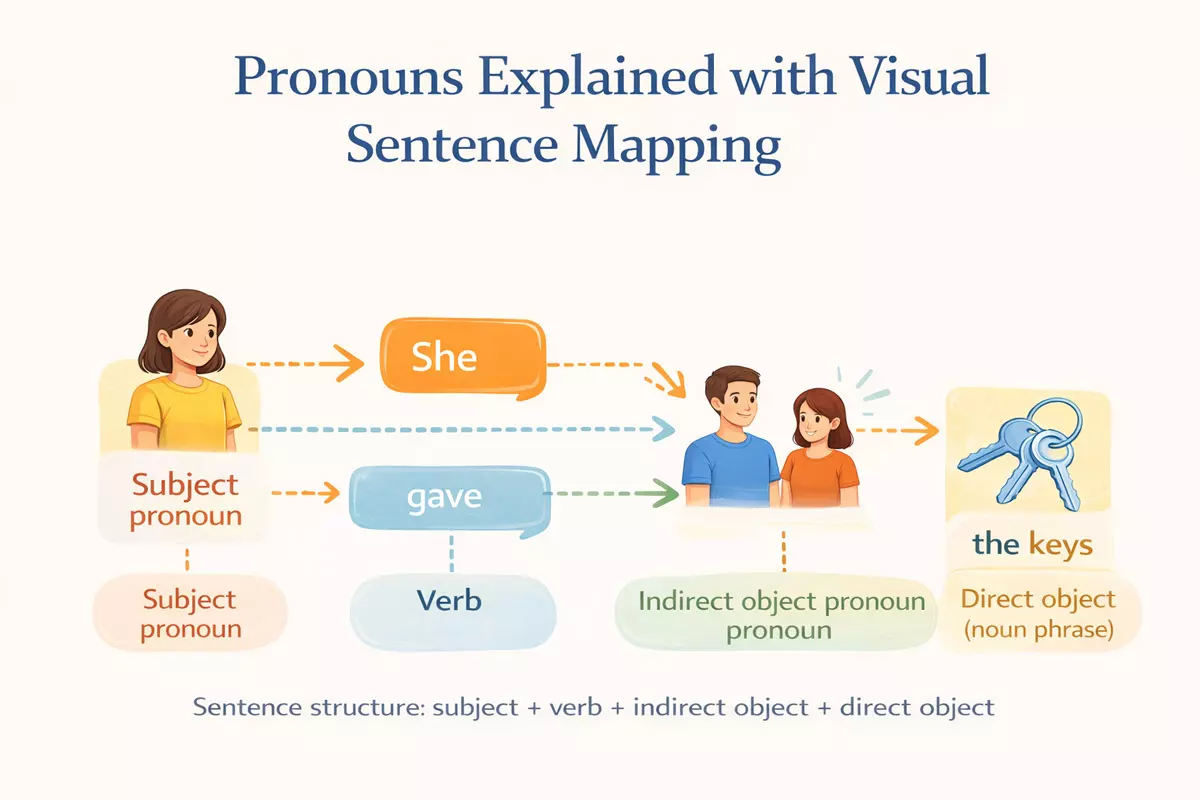 This article explains how visual mapping clarifies pronoun reference. It covers marking nouns, linking pronouns to antecedents, fixing unclear references, mapping subject and object roles, handling clauses, and practicing clear rewrites.
- Why visual mapping helps you understand pronoun reference
- Step 1: mark nouns and potential antecedents
- Step 2: draw links from pronouns to what they refer to
- Fixing unclear reference by renaming or restructuring
- Mapping subject vs object roles in a sentence
- Mapping clauses: who/which/that references
- Common confusion patterns and how mapping reveals them
- Practice: map and rewrite sentences for clarity
Have you ever thought about how words like he, she, or they work so smoothly in our sentences? These small words, known as pronouns, help us avoid repeating names and make our language flow more naturally. By standing in for people or things already mentioned, pronouns keep communication clear and concise. Exploring how pronouns connect ideas can offer a new perspective on how language functions, helping us appreciate the efficiency and simplicity they bring to our everyday conversations.
Why visual mapping helps you understand pronoun reference
Visual mapping makes it easier to see how pronouns relate to nouns in a sentence. Instead of reading a sentence and mentally tracking which word “he” or “they” refers to, a diagram or color-coded map provides instant clarity. This approach is especially useful for learners who struggle with abstract grammar explanations or who process information better visually.
How sentence mapping clarifies pronoun use
When you map out sentences, you can highlight or draw lines between pronouns and their antecedents. This reduces confusion in complex sentences, where multiple nouns might be possible referents. Visual aids help you spot errors or ambiguities that are hard to notice in plain text.
- “She gave Anna her book.” – Who does “her” refer to?
- “The students saw their teacher when they arrived.” – Does “they” mean the students or the teacher?
- “If the dog chases the cat, it will get tired.” – Is “it” the dog or the cat?
- “After Maria and Tom finished, she left.” – Who is “she”?
- “Sam told Alex that he would win.” – Who is the winner?
- “The children played while their mother watched them.” – Clear, but mapping still helps visualize roles.
- “When Lucy met Jane, she smiled.” – Who smiled?
- “The book on the table is mine; it is new.” – “It” clearly refers to “the book.”
- “John called his brother because he was worried.” – Who was worried?
- “The team celebrated after they won.” – “They” is the team, but mapping confirms this.
Benefits of visualizing reference
- Reduces ambiguity: Unclear pronoun reference is easier to spot and fix.
- Supports memory: Visual connections reinforce which nouns belong to which pronouns.
- Builds confidence: Learners can check their understanding quickly.
- Improves editing: Writers see where sentences might confuse readers.
Common pronoun reference issues visual mapping can reveal
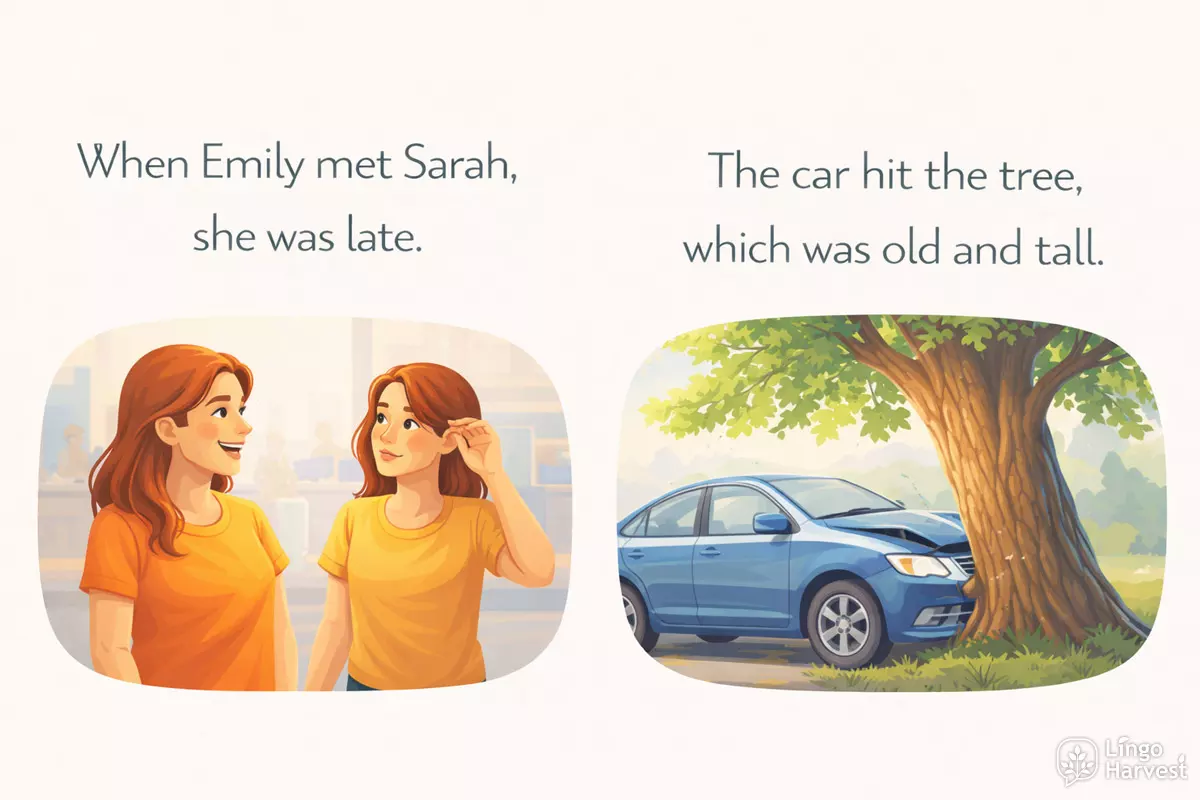
| Problem | Example Sentence | Possible Referents |
|---|---|---|
| Ambiguous antecedent | “When Emily met Sarah, she was late.” | Emily, Sarah |
| Remote antecedent | “The car hit the tree, which was old and tall.” | car, tree |
| Unclear plural reference | “The boys saw the girls, and they waved.” | boys, girls |
| Missing antecedent | “It was raining.” | (no clear noun) |
By turning sentences into visual maps, learners can directly see how pronouns function and avoid typical mistakes. This method supports both comprehension and production of clear, precise writing.
Step 1: mark nouns and potential antecedents
Identifying which words could be replaced by pronouns is the foundation of clear sentence mapping. Start by looking for all the nouns and noun phrases in your sentence, since these are the typical candidates for pronoun substitution. It's also helpful to consider which words or phrases might serve as antecedents—those are the items that a pronoun will refer back to later in the sentence or in a following sentence.
How to Recognize Nouns and Antecedents
Nouns are often people, places, things, or ideas. Pronouns like "he," "she," "it," or "they" usually refer back to these nouns. To make this step easier, try underlining or highlighting all the nouns and noun phrases as you read. Pay attention to the context: sometimes, more than one noun could serve as a pronoun’s reference, so clarity is essential.
- Person: teacher, Maria, students
- Place: library, park, school
- Thing: book, pencil, computer
- Idea: freedom, happiness, decision
- Compound nouns: ice cream, fire truck, swimming pool
- Groups: team, family, audience
- Animals: dog, cat, elephant
- Titles: President, Dr. Smith, Captain
- Abstract concepts: honesty, knowledge, friendship
- Pronoun-possible phrases: the old man, my best friend, that building
- Objects: chair, phone, bag
- Events: party, meeting, concert
- Quantities: group of children, pile of books
- Names: Sarah, London, Jupiter
- Organizations: company, club, orchestra
- Time-related nouns: morning, year, Monday
- Directions: north, left, outside
- Food: sandwich, pizza, apple
- Emotions: fear, joy, surprise
- Actions as nouns (gerunds): running, singing, swimming
Tips for Visual Mapping
Once you’ve marked all possible nouns and antecedents, you’re ready to start drawing lines or using colors to connect them with any pronouns that reference them. This step will make it much easier to track meaning and avoid confusion, especially in complex sentences. By systematically highlighting each possible referent, you lay the groundwork for understanding how pronouns function within the sentence structure.
Step 2: draw links from pronouns to what they refer to
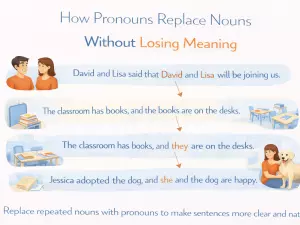
Understanding how pronouns connect to their referents is crucial for making sense of sentences. At this stage, you visually map each pronoun to its noun or noun phrase, clarifying meaning and resolving ambiguity. Drawing these connections—whether with arrows, color coding, or underlining—helps reveal which words are standing in for others.
Why map pronoun references?
Pronouns like he, she, it, they, and this replace nouns to avoid repetition, but their meaning depends on knowing what they're referring to. Mapping out these links:
- Makes complex sentences easier to follow
- Prevents confusion, especially with multiple possible referents
- Highlights unclear or ambiguous pronoun usage
How to illustrate pronoun links
You can use several methods to show connections between pronouns and their antecedents:
- Draw arrows from the pronoun to the noun it replaces
- Use matching colors or highlights for each pair
- Underline pronouns and their referents with the same style
- Annotate sentences with notes or labels
Examples of mapping pronouns
Consider these sentences and how one might visually connect pronouns to their sources:
- Anna lost her keys. She looked everywhere. → She → Anna
- The dogs barked until they were tired. → they → The dogs
- Jack and Jill climbed the hill. They found a well. → They → Jack and Jill
- My phone was missing. It was under the couch. → It → My phone
- The teacher gave us homework. She expected us to finish by Friday. → She → The teacher
- Lisa and her brother went outside. He played soccer while she read a book. → He → her brother; she → Lisa
- The cake was delicious. It was baked by grandma. → It → The cake
- Sarah told Mike that she would call later. → she → Sarah
- The committee reached its decision. → its → The committee
- The children played while their parents watched. → their → The children
Common pitfalls in linking pronouns
Ambiguity can arise when it’s unclear which noun a pronoun refers to. Always check that each pronoun is clearly connected to its intended referent. If you’re unsure, try replacing the pronoun with possible nouns to test the sentence’s clarity.
Visual mapping in practice
For longer or more complex sentences, mapping all pronoun links can quickly clarify relationships:
| Sentence | Pronoun Link |
|---|---|
| Mary gave Susan her book. | her → can mean Mary or Susan (ambiguous) |
| The car hit the tree because it was slippery. | it → can mean the car or the tree (ambiguous) |
| Tom lent his brother his bicycle. | First his → Tom; second his → Tom or his brother (ambiguous) |
| When Lisa met Jane, she smiled. | she → can mean Lisa or Jane (ambiguous) |
By systematically linking pronouns to their referents, you make sentence structure and meaning much clearer, especially when dealing with complex or ambiguous language. This visual mapping is an essential skill for both learners and anyone aiming to write or interpret text precisely.
Fixing unclear reference by renaming or restructuring
When a pronoun’s meaning is ambiguous, sentences can become confusing. This often happens when it’s not clear what or whom a pronoun refers to. To make your writing clearer, you can either replace the unclear pronoun with a more specific noun or change the sentence structure to clarify the reference. These strategies help readers follow your ideas without stumbling over vague or misleading pronouns.
Common Problems with Ambiguous Pronouns
- Multiple possible nouns: When two or more nouns could be the pronoun’s antecedent.
- Distant references: When the pronoun is far from its noun, making connections harder to spot.
- Unstated antecedent: When the noun isn’t mentioned at all.
Strategies for Clearer Sentences
To avoid confusion, try these techniques:
- Replace the pronoun with the specific noun (e.g., change "it" to "the cake").
- Restructure the sentence to place the noun closer to the pronoun.
- Split long sentences so each has only one main noun and pronoun.
- Repeat the noun if needed for clarity, even if it feels repetitive.
- Use names or descriptive phrases instead of just "he," "she," or "they" when context is unclear.
Examples of Ambiguous vs. Clear Sentences
Let’s look at some sample sentences and how they can be improved:
- Unclear: When Sarah gave Anna her book, she was grateful.
Clear: When Sarah gave Anna her book, Anna was grateful. - Unclear: The dog chased the cat, but it escaped.
Clear: The dog chased the cat, but the cat escaped. - Unclear: If you put the glass on the table, it might break.
Clear: If you put the glass on the table, the glass might break. - Unclear: Alex told Jordan that he would win.
Clear: Alex told Jordan, "You will win."
Quick Reference: Renaming and Restructuring Choices
| Ambiguous Example | Clear Revision |
|---|---|
| Maria gave Lily her phone. | Maria gave her phone to Lily. |
| Sam dropped the vase on the rug, and it broke. | The vase broke when Sam dropped it on the rug. |
| After Mark spoke to Paul, he left. | After Mark spoke to Paul, Mark left. |
| The teacher told the student that she was late. | The teacher told the student, "You are late." |
| Jess saw Morgan as she entered the room. | Jess saw Morgan as Morgan entered the room. |
By renaming unclear pronouns or restructuring sentences, you help readers understand exactly who or what you are talking about. This makes your communication smoother and less likely to cause misunderstandings.
Mapping subject vs object roles in a sentence
Understanding the distinction between subjects and objects is crucial for using pronouns correctly. In English, the subject is typically the person or thing performing the action, while the object receives the action. Visual mapping helps clarify these relationships, especially when pronouns replace nouns in different sentence positions.
How to Identify Subjects and Objects
The subject usually comes before the verb and answers "who" or "what" is doing something. The object often follows the verb and answers "whom" or "what" is affected by the action. For example:
- She (subject) reads the book (object).
- The dog (subject) chased him (object).
Common Subject and Object Pronouns
Pronouns change form depending on their role. Here’s a quick reference for the most common English pronouns:
| Subject Pronoun | Object Pronoun |
|---|---|
| I | me |
| you | you |
| he | him |
| she | her |
| it | it |
| we | us |
| they | them |
Sample Sentences for Visual Mapping
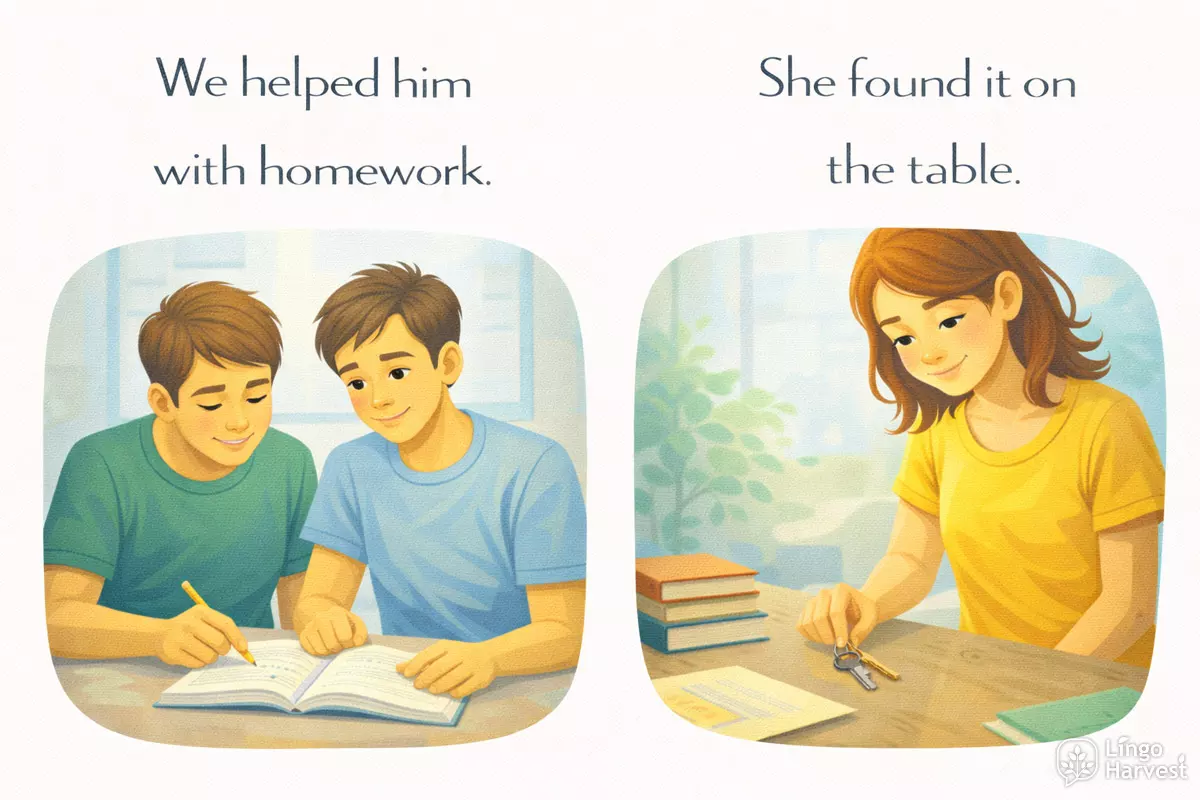
Let’s look at some examples that highlight the difference in pronoun use:
- He saw her at the park. (He = subject, her = object)
- They invited us to the celebration.
- I called them last night.
- We helped him with homework.
- She found it on the table.
- You met me after class.
- It surprised them.
- They thanked you.
- He told us a story.
- We saw her yesterday.
Quick Tips for Visual Sentence Mapping
- Draw arrows from the subject to the verb, then to the object to clarify roles.
- Remember, subject pronouns start sentences or clauses; object pronouns follow verbs or prepositions.
- When unsure, try replacing the noun with a pronoun and see if it fits naturally.
Recognizing these patterns makes it easier to choose the correct pronoun form and improves overall sentence clarity. Visual mapping, whether with diagrams or simple lists, is a powerful tool for mastering pronoun usage in English.
Mapping clauses: who/which/that references
When sentences become more complex, we often connect ideas using words like who, which, or that. These words introduce relative clauses, which give us extra information about a person, thing, or idea mentioned earlier in the sentence. Understanding how these references work helps us see how information is layered and keeps our writing or speech clear.
How relative pronouns connect ideas
Relative pronouns act as bridges. They link a main noun to a descriptive phrase, clarifying which person or thing we’re talking about. For example, in "The teacher who helped me", who refers back to "the teacher" and introduces a clause that tells us more.
- who — refers to people (e.g., "The girl who called you is here.")
- which — refers to things or animals (e.g., "The book which you lent me is fascinating.")
- that — can refer to people, things, or animals; often used in restrictive clauses (e.g., "The car that broke down was new.")
Visual sentence mapping: following the reference
To map these clauses visually, imagine drawing arrows from the relative pronoun back to its noun. This helps track what each pronoun is describing. For example:
- "The musician who played last night was amazing."
who → the musician - "I lost the keys that open the garage."
that → the keys
Examples: identifying references in context
Here are several sentences, each with a relative clause. Notice how the pronoun connects to its noun:
- The cake that she baked was delicious.
- Students who study regularly improve faster.
- The movie which won the award is French.
- The phone that rings is mine.
- People who travel often learn new languages.
- The dog which barked all night kept me awake.
- The bag that you found belongs to Alice.
- The artist who painted this lives nearby.
- The ideas that inspire you are important.
- The train which arrives at noon is usually late.
Quick guide: when to use who, which, or that
| Relative Pronoun | Refers to | Example |
|---|---|---|
| who | People | The teacher who smiled at me |
| which | Things/Animals | The book which was lost |
| that | People, Things, Animals (mostly in restrictive clauses) | The car that stopped suddenly |
By mapping these connections, you can break down complex sentences and understand exactly what each part is describing. This skill is especially useful when reading or writing detailed explanations.
Common confusion patterns and how mapping reveals them
Even experienced language learners stumble over pronouns due to their abstract nature and context dependence. Visual sentence mapping helps untangle these challenges by laying out sentence elements clearly, making relationships and references easier to spot. Below are some of the most frequent issues learners face, with examples of how mapping exposes and clarifies them.
Ambiguous pronoun reference
Sometimes, it's unclear what a pronoun refers to, especially when multiple nouns could be possible antecedents. Mapping sentences visually forces us to draw connections, highlighting ambiguity:
- “When Jane met Lisa, she was excited.” (Who was excited?)
- “The dog chased the cat, but it escaped.” (What does ‘it’ mean?)
Mismatched number or gender
Pronouns must agree in number and gender with their antecedents. Visual mapping makes mismatches stand out:
- “Everyone brought their books.” (Singular ‘everyone’ with plural ‘their’)
- “The boy lost her backpack.” (Gender mismatch)
Overuse of pronouns
Relying too heavily on pronouns can confuse the reader. Mapping reveals where clarity drops:
- “He told him he should finish it.” (Who is doing what?)
Shifting antecedents
When the noun a pronoun refers to changes mid-paragraph, it can be hard to track. Mapping helps maintain consistency:
- “Sally gave Anna her book because she finished it.” (Who finished the book?)
Reflexive and intensive pronoun mix-ups
Visual tools help distinguish between reflexive and intensive pronouns, which often look similar:
- “John himself fixed the car.” (Intensive)
- “John fixed the car himself.” (Reflexive)
Comparing subjective, objective, and possessive forms
Mapping can clarify which pronoun form fits each grammatical role. Below is a structured comparison:
| Subjective | Objective | Possessive Adjective | Possessive Pronoun |
|---|---|---|---|
| I | me | my | mine |
| he | him | his | his |
| she | her | her | hers |
| they | them | their | theirs |
| we | us | our | ours |
Commonly confused pronoun patterns (quick list)
- Who vs. whom
- Its vs. it’s
- They vs. he/she (gender-neutral references)
- That vs. which (relative pronouns)
- Each other vs. one another
- None vs. no one
- Anyone vs. any one
- Somebody vs. someone
- Either vs. neither
- This vs. these (singular vs. plural)
- Who’s vs. whose
- All vs. both
- Me vs. myself
- You vs. yourself
- Himself vs. themselves
By organizing sentence elements visually, learners can spot these pitfalls quickly, correct misunderstandings, and build a more intuitive grasp of how pronouns function in real communication.
Practice: map and rewrite sentences for clarity
Understanding how pronouns work in sentences takes more than just memorizing lists. Visual sentence mapping can help you see how pronouns connect to the nouns they replace, making your writing clearer. Use these practice tasks to strengthen your skills at identifying pronouns, mapping their references, and rewriting sentences for better clarity.
Identify pronouns and their antecedents
In each sentence below, identify the pronoun and the noun it refers to (the antecedent). Think about how using or changing a pronoun affects the sentence’s meaning.
- Maria gave her book to James because she had finished reading it.
- The dogs barked loudly, but they soon quieted down.
- When the teacher arrived, the students took their seats.
- Sam and Alex forgot their keys, so they couldn’t get inside.
- After the rain stopped, it became sunny.
- Olivia thanked Daniel because he helped her with the report.
- The phone rang, and it woke the baby.
- The visitors found the museum, but they couldn’t find its main entrance at first.
- Emma and her brother finished their lunch, and then they went outside.
- The company updated its website after it received feedback from customers.
Show answers
- her → Maria; she → Maria; it → book
- they → dogs
- their → students
- their → Sam and Alex; they → Sam and Alex
- it → the weather/the situation (implied)
- Daniel → Daniel; he → Daniel; her → Olivia
- it → phone
- they → visitors; its → museum
- their → Emma and her brother; they → Emma and her brother
- its → company; it → company
Rewrite sentences for clarity
Ambiguous pronouns can confuse readers. Try rewriting these sentences to make the references clear. You may need to replace a pronoun with a noun or rearrange the sentence.
- When Sarah met Lisa, she smiled.
- Jack told Mark that he won the prize.
- After putting the cake in the oven, it burned.
- Alex gave his brother his phone.
- Anna called Emily while she was driving.
Show answers
- When Sarah met Lisa, Sarah smiled.
or
When Sarah met Lisa, Lisa smiled. (Depends on context.) - Jack told Mark that Jack won the prize.
or
Jack told Mark that Mark won the prize. - After Alex put the cake in the oven, the cake burned.
or
After putting the cake in the oven, Alex burned it. - Alex gave his phone to his brother.
or
Alex gave his brother’s phone to him. - Anna called Emily while Anna was driving.
or
Anna called Emily while Emily was driving.
Visual mapping: connecting pronouns to nouns
Try mapping out the following sentences. Draw arrows on paper or imagine the connections between pronouns and their antecedents. This exercise helps clarify who or what each pronoun refers to.
- The children dropped their toys, but they picked them up later.
- Jessica lent her friend her notes, and she was grateful.
- Michael and Tom lost their tickets, so they missed the show.
- The cat chased the mouse, but it escaped.
- When the lamp fell, it broke.
- Sara emailed her manager, and he replied right away.
- The students finished their test, and they handed it in.
- Jason saw his neighbor, and he waved at him.
- The door was open, so it let in cold air.
- Emily gave her brother his jacket, and he thanked her.
Show answers
- their → children; they → children; them → toys
- her → Jessica; her notes → Jessica’s notes; she → friend (or Jessica, depending on meaning)
- their → Michael and Tom; they → Michael and Tom
- it → mouse (could also refer to cat if context is unclear)
- it → lamp
- her → Sara; her manager → manager; he → manager
- their → students; they → students; it → test
- his → Jason; his neighbor → neighbor; he → Jason (could also refer to neighbor if context is unclear); him → neighbor
- it → door
- her → Emily; her brother → brother; his → brother; he → brother; her → Emily
Common pronoun errors and how to fix them
Here are frequent mistakes with pronouns, along with clearer alternatives:
- Unclear reference: “He told him he was late.”
Better: “John told Mark that Mark was late.” - Vague ‘it’: “It says you should wait.”
Better: “The sign says you should wait.” - Ambiguous ‘they’: “They said the meeting is canceled.”
Better: “The organizers said the meeting is canceled.” - Pronoun without antecedent: “She was happy.”
Better: “Maria was happy.” - Shifting number: “If a student wants to succeed, they must study.”
Better: “If students want to succeed, they must study.”
By carefully mapping pronouns and rewriting sentences, you can greatly improve clarity and help readers follow your ideas more easily. Practice regularly to spot unclear references and fix them before they create confusion.