Tag Questions and Auxiliary Verbs Explained

 Learn what tag questions are used for and how to form them, including positive and negative patterns and choosing the right auxiliary. It also covers how intonation affects meaning, common irregular tags, typical learner mistakes, and homework practice tasks.
Tag questions at the end of a sentence depend on the auxiliary verb you use. In everyday conversation, they help check agreement, soften a request, or confirm a fact. To sound natural, match the tag to the main clause by keeping the same tense and using the correct subject pronoun, and remember that positive statements usually take negative tags, while negative statements take positive tags.
What tag questions are used for
Tag questions are short question endings added to a statement to manage the conversation. They help a speaker check information, invite a response, soften an opinion, or confirm shared understanding. The tag usually mirrors the auxiliary verb in the main clause and flips the polarity (positive statement → negative tag, or negative statement → positive tag).
Main purposes in real communication
- Checking whether something is true when you think it probably is: “You sent the email, didn’t you?”
- Confirming shared knowledge (you expect agreement): “We’ve met before, haven’t we?”
- Inviting someone to speak without asking a full question: “It’s been a long week, hasn’t it?”
- Softening a direct statement to sound less blunt: “That plan is risky, isn’t it?”
- Showing politeness in requests (especially with suggestions): “Close the window, will you?”
- Seeking reassurance when you feel uncertain: “I didn’t miss anything, did I?”
- Expressing surprise or mild criticism while still inviting a reply: “You forgot again, didn’t you?”
- Keeping a conversation flowing by prompting a short response: “You know what I mean, don’t you?”
- Testing agreement before continuing: “We’re focusing on cost first, aren’t we?”
- Encouraging cooperation in a friendly way: “Let’s start now, shall we?”
Common usage patterns to notice
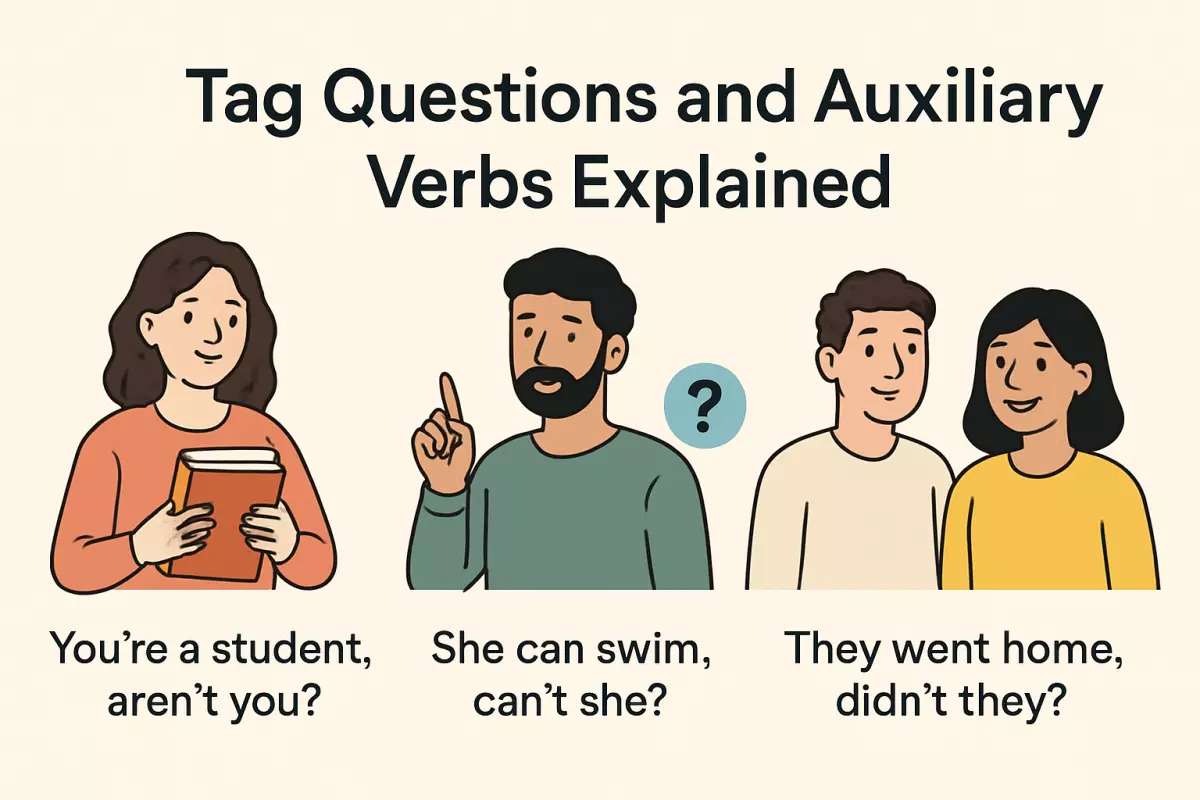
- Opposite polarity is the default pattern: “She’s coming, isn’t she?” / “She isn’t coming, is she?”
- The auxiliary comes from the main clause: “They have finished, haven’t they?”; “He can drive, can’t he?”
- No auxiliary in the statement → use do/does/did: “You like it, don’t you?”; “She went home, didn’t she?”
- Pronouns repeat the subject (not the noun): “Maria is here, isn’t she?” (not “isn’t Maria?”)
- Imperatives often use will you to make the request less sharp: “Pass the salt, will you?”
- Suggestions with let’s typically take shall we: “Let’s take a break, shall we?”
- With “I am …” the tag is usually aren’t I: “I’m late, aren’t I?”
- With “nothing/nobody/never”, the statement is negative in meaning, so the tag is usually positive: “Nobody called, did they?”
- Intonation changes the meaning: rising intonation often sounds like a real question (genuine uncertainty), while falling intonation often signals you expect agreement.
Example set (purpose → natural tag)
- Expectation of agreement → “It’s obvious, isn’t it?”
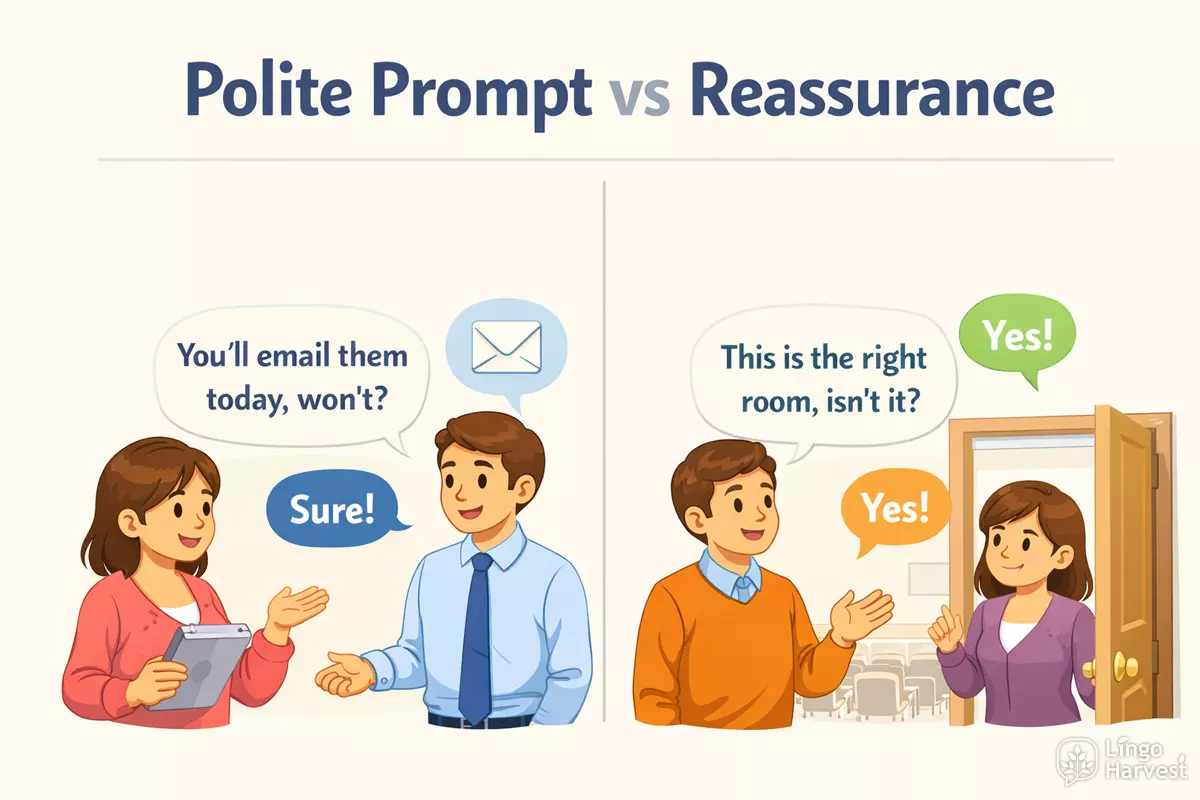
- Polite prompt → “You’ll email them today, won’t you?”
- Reassurance → “This is the right room, isn’t it?”
- Small talk → “Nice weather, isn’t it?”
- Gentle correction → “That’s not how it works, is it?”
- Checking a past detail → “We met in June, didn’t we?”
- Ability/permission → “You can stay, can’t you?”
- Prediction → “They’ll be late, won’t they?”
- Obligation → “You have to sign here, don’t you?”
- After a negative meaning word → “Nothing happened, did it?”
- With “used to” → “He used to live here, didn’t he?”
- With “there is/are” → “There’s a problem, isn’t there?”
Forming tag questions correctly
To build a natural tag question, match the auxiliary verb (or a form of be) from the main clause, then flip the polarity: a positive statement takes a negative tag, and a negative statement takes a positive tag. Finish with the correct subject pronoun so the tag “echoes” the subject of the statement.
Core pattern
- Positive statement → negative tag: She is ready, isn’t she?
- Negative statement → positive tag: She isn’t ready, is she?
- Keep the tag short: auxiliary + (not) + pronoun.
- Use the same tense as the statement: present, past, perfect, etc.
Choose the right auxiliary
- Be: They are late, aren’t they? / He was here, wasn’t he?
- Have (perfect): You’ve finished, haven’t you? / She hadn’t called, had she?
- Do (when there is no other auxiliary): He works here, doesn’t he? / They didn’t agree, did they?
- Modals (can, will, should, etc.): You can drive, can’t you? / We shouldn’t wait, should we?
- Future with will: It’ll be fine, won’t it?
Match the subject with the correct pronoun
- Repeat the subject as a pronoun: Maria is coming, isn’t she?
- Compound subjects usually become they: Tom and Lina left, didn’t they?
- Things and situations become it: The meeting is today, isn’t it?
- Uncountable or general nouns often take it: Traffic is bad, isn’t it?
Common special cases (with reliable patterns)
- I am → use aren’t I in standard tags: I’m next, aren’t I?
- Imperatives often use will you: Close the door, will you? (requests)
- Let’s → shall we: Let’s start, shall we?
- There is/are → keep there in the tag: There’s a problem, isn’t there?
- Negative words make the statement negative (so the tag turns positive): Nobody called, did they?
- Nothing/anything often takes it in the tag: Nothing happened, did it?
- Used to commonly tags with didn’t: You used to live here, didn’t you?
- Have meaning possession can vary by variety; a safe option is do: You have a car, don’t you?
Frequent errors to avoid
- ❌ Mixing auxiliaries: She is coming, doesn’t she? → ✅ She is coming, isn’t she?
- ❌ Forgetting polarity change: They didn’t leave, didn’t they? → ✅ They didn’t leave, did they?
- ❌ Wrong pronoun: The keys are here, isn’t it? → ✅ The keys are here, aren’t they?
- ❌ Adding extra words: You can help, can you not? (overly formal) → ✅ You can help, can’t you?
Positive and negative tag patterns
Tag questions usually follow a simple polarity rule: the short question at the end tends to flip the statement. A positive statement commonly takes a negative tag, and a negative statement commonly takes a positive tag. The auxiliary verb in the tag matches the tense, aspect, and modality of the main clause.
Core polarity rule (the default pattern)
- Positive statement → negative tag: You’re coming, aren’t you?
- Negative statement → positive tag: You aren’t coming, are you?
- Keep the same auxiliary (or the auxiliary implied by the main verb): She has finished, hasn’t she?
- Use the same subject as a pronoun in the tag: Maria called, didn’t she?
Auxiliary matching: what the tag “copies”
- Be: He is late, isn’t he? / They weren’t ready, were they?
- Have (perfect): You’ve seen it, haven’t you? / She hasn’t left, has she?
- Modals (can, will, should, etc.): We can wait, can’t we? / You shouldn’t do that, should you?
- Simple present/past with no auxiliary → use do/does/did: He works here, doesn’t he? / They left early, didn’t they?
- Progressive keeps be: She’s working, isn’t she? / They weren’t listening, were they?
- Perfect progressive keeps have: You’ve been waiting, haven’t you?
Common patterns and pitfalls (with quick contrasts)
- Don’t mix auxiliaries: ✅ He’s arrived, hasn’t he? ❌ He’s arrived, isn’t he?
- Don’t forget do support when there’s no auxiliary: ✅ She plays tennis, doesn’t she? ❌ She plays tennis, playsn’t she?
- Match tense in the tag: ✅ You met him yesterday, didn’t you? ❌ You met him yesterday, don’t you?
- Contracted negatives are typical in tags: isn’t it?, aren’t they?, won’t you?, can’t we?
- With I am, the standard tag is aren’t I: I’m next, aren’t I?
- With this/that/these/those, use it/they in the tag: That’s yours, isn’t it? / These are new, aren’t they?
Expanded example set (typical real-life sentences)
- You’re from Toronto, aren’t you?
- She isn’t in the office today, is she?
- They were joking, weren’t they?
- It wasn’t difficult, was it?
- We’ve met before, haven’t we?
- He hasn’t told you yet, has he?
- You can drive, can’t you?
- She can’t swim, can she?
- They’ll call later, won’t they?
- He won’t mind, will he?
- You should apologize, shouldn’t you?
- You shouldn’t be here, should you?
- She likes spicy food, doesn’t she?
- He didn’t lock the door, did he?
- We’re meeting at six, aren’t we?
- You weren’t expecting me, were you?
These patterns cover most everyday tag questions. Once you identify the auxiliary (or add do when there isn’t one), the tag form is largely mechanical: copy the auxiliary and subject, then reverse the polarity.
Choosing the right auxiliary
In tag questions, the helper verb in the tag is usually determined by the verb phrase in the main clause. The most reliable method is to identify the auxiliary already present (if any), match its tense and modality, and then reverse the polarity (positive → negative, or negative → positive).
Step-by-step selection
- Find the first auxiliary in the statement (be, have, do, or a modal). Use that same auxiliary in the tag.
- Match tense and form: present, past, perfect, progressive, modal, or passive.
- Flip the polarity: a positive statement typically takes a negative tag, and a negative statement typically takes a positive tag.
- Use the correct subject pronoun in the tag (it, they, he, she, you, we, I), referring back to the subject of the main clause.
- If there is no auxiliary in the statement, insert do/does/did in the tag based on tense and subject.
Common patterns (with examples)
- Be (main verb or auxiliary): “She is late, isn’t she?” / “They were waiting, weren’t they?”
- Progressive aspect (be + -ing): “You are working, aren’t you?”
- Passive voice (be + past participle): “The report was finished, wasn’t it?”
- Perfect aspect (have + past participle): “He has left, hasn’t he?” / “They had met, hadn’t they?”
- Perfect progressive (have + been + -ing): “She has been studying, hasn’t she?”
- Modal verbs: “You can swim, can’t you?” / “They should call, shouldn’t they?”
- Modal + perfect: “He might have forgotten, mightn’t he?” (also common: “might he?” in some varieties)
- No auxiliary in the statement (simple present): “She likes it, doesn’t she?”
- No auxiliary in the statement (simple past): “They arrived early, didn’t they?”
- Negative words already in the statement: “He never complains, does he?” (the statement is negative in meaning, so the tag is often positive)
- Imperatives: “Close the door, will you?” / “Don’t forget, will you?”
- Let’s + suggestion: “Let’s start, shall we?”
- I am: “I am next, aren’t I?” ✅ (not: ❌ “amn't I?” in most standard usage)
- There is/are: “There are seats left, aren’t there?”
- Subject is a noun phrase: “The students have finished, haven’t they?” (the tag uses a pronoun, not the full noun phrase)
- Compound subjects: “Maria and Jin were here, weren’t they?”
Quick checks for accuracy
- Keep the auxiliary identical to the one in the statement: “She has called, hasn’t she?” ✅ (not: ❌ “doesn’t she?”)
- Don’t add a second auxiliary when one already exists: “They are coming, aren’t they?” ✅
- Match number and person: “Your friends were invited, weren’t they?”
- Use do-support only when needed: “He plays chess, doesn’t he?” ✅ (but: “He is playing, isn’t he?”)
Intonation and meaning in tag questions
How your voice moves on the tag often matters as much as the words. In speech, rising and falling pitch signals whether you are genuinely asking, simply inviting agreement, sounding surprised, or challenging what was said. The same tag form can feel friendly, neutral, or confrontational depending on the intonation pattern.
Core intonation patterns and what they usually mean
- Rising intonation (↑): a real question; you are unsure and want confirmation. You’re meeting us at six, aren’t you↑?
- Falling intonation (↓): a check-in or prompt for agreement; you expect “yes.” It’s a long walk, isn’t it↓.
- Fall-rise (↓↑): partial uncertainty, politeness, or a “soft challenge.” You sent the email, didn’t you↓↑?
- Extra-high rise: surprise or disbelief. You quit already, did you↑?
- Low, flat delivery: can sound bored, impatient, or dismissive, even if the grammar is correct.
Usage patterns: choosing the tone to match your purpose
- To confirm new information, use a rise: She’s your sister, isn’t she↑?
- To keep conversation flowing, use a fall: Nice place, isn’t it↓.
- To show you think you are right, use a fall and keep the tag short: You’ve met him before, haven’t you↓.
- To sound less direct, use fall-rise: We should call first, shouldn’t we↓↑?
- To express mild criticism, a fall can sharpen the message: You could’ve told me, couldn’t you↓.
- To challenge a claim, a rise often signals disagreement: You “forgot,” did you↑?
- To show friendly interest, use a gentle rise (not too sharp): You’re from Leeds, aren’t you↑?
- To end a topic, a firm fall signals closure: That’s settled, then, isn’t it↓.
Examples: same tag, different meaning
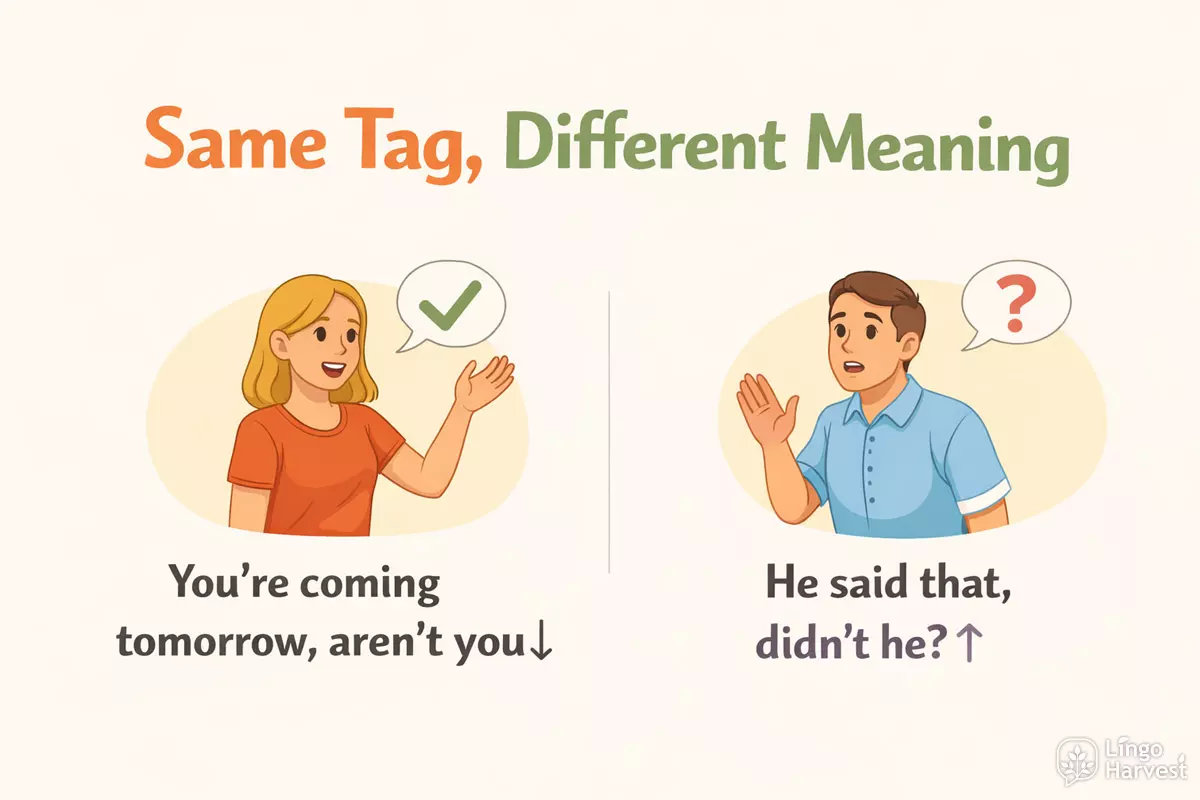
- You’re coming tomorrow, aren’t you↑? (I’m not sure; please confirm.)
- You’re coming tomorrow, aren’t you↓. (I assume you are; agree with me.)
- He said that, didn’t he↑? (I need verification.)
- He said that, didn’t he↓. (I’m confident; I’m inviting agreement.)
- We’ve paid already, haven’t we↑? (I’m uncertain; checking.)
- We’ve paid already, haven’t we↓. (I believe we have; confirming lightly.)
- She can drive, can’t she↑? (I’m asking because I don’t know.)
- She can drive, can’t she↓. (I think she can; you agree.)
- You didn’t call, did you↑? (I suspect you didn’t; checking.)
- You didn’t call, did you↓. (I know you didn’t; it may sound accusing.)
- They won’t mind, will they↑? (I’m worried; seeking reassurance.)
- They won’t mind, will they↓. (I’m confident; casual agreement.)
- We shouldn’t wait, should we↓↑? (I’m leaning one way but open to input.)
- You’ve finished, have you↑? (surprised; possibly skeptical.)
Common mismatches to avoid
- ❌ Using a sharp rise when you want to sound supportive: it can come across as doubting. ✅ Use a softer rise or a fall for encouragement.
- ❌ Using a firm fall with negative tags in sensitive contexts: it may sound like blame. ✅ Use fall-rise to keep it neutral: You didn’t get the message, did you↓↑?
- ❌ Overusing tags with strong falls: it can sound pushy. ✅ Mix in direct questions or statements when you truly need information.
Common irregular tag forms
Some tag questions don’t follow the neat “auxiliary + pronoun” pattern you expect from the main clause. The irregularity usually comes from one of three places: the verb phrase is special (like I am), the subject is non-standard (like let’s or an indefinite pronoun), or the meaning is negative even when the grammar looks positive.
High-frequency irregular patterns
- I am → aren’t I? (standard in many varieties): ✅ I’m late, aren’t I? ❌ I’m late, amn’t I?
- Imperatives often take will you? (or won’t you? for friendly urging): Close the door, will you? / Have a seat, won’t you?
- Negative imperatives commonly use will you?: Don’t forget, will you?
- Let’s + verb → shall we?: Let’s start, shall we?
- Let me + verb → will you? (requesting permission/cooperation): Let me explain, will you?
- There is/are keeps there in the tag: There’s a problem, isn’t there? / There aren’t any seats, are there?
- This/that often shifts to it in the tag: That was fun, wasn’t it?
- These/those often shifts to they: Those are yours, aren’t they?
- Indefinite pronouns (someone/anyone/no one) usually take they: Someone called, didn’t they? / No one noticed, did they?
- Everybody/everyone usually takes they: Everyone’s ready, aren’t they?
- Nothing/something usually takes it: Nothing happened, did it? / Something’s wrong, isn’t it?
- One as a subject can take one in formal style (or you informally): One should be careful, shouldn’t one?
- I think / I suppose / I guess + clause: the tag typically matches the embedded clause, not the reporting phrase: I think she’s coming, isn’t she?
- “You’d better …” often tags with hadn’t you?: You’d better leave now, hadn’t you?
- “Used to” varies by dialect and formality, but didn’t is common: You used to live here, didn’t you? (also heard: usedn’t you? in some varieties)
Meaning-based mismatches (grammar looks positive, meaning is negative)
- Words like “hardly,” “rarely,” “seldom,” “never” trigger a positive tag because the statement is negative in meaning: You hardly ever eat meat, do you?
- “Few” and “little” (meaning “not many/not much”) often behave like negatives: Few people know that, do they? / Little time is left, is there? (choice depends on structure; many speakers prefer a rephrase)
- “Nothing/no one” already contains negation, so the tag is positive: No one called, did they? / Nothing broke, did it?
Practical usage notes
- When the subject isn’t a clear person (this/that/something), the tag pronoun usually switches to it; for groups (these/those/everyone), it often switches to they.
- With commands, the tag is less about tense agreement and more about interaction: will you? checks cooperation; won’t you? often sounds more inviting.
- If you’re unsure, match the auxiliary from the main verb phrase and choose the pronoun that speakers naturally use for that subject (often it or singular they).
Typical learner mistakes
Most errors with question tags come from mismatching the auxiliary, getting the polarity wrong (positive vs. negative), or choosing the wrong pronoun. The fix is usually mechanical: identify the auxiliary in the main clause, mirror it in the tag, and flip the polarity.
1) Keeping the same polarity instead of switching
- ❌ You’re coming, are you? → ✅ You’re coming, aren’t you?
- ❌ She isn’t ready, isn’t she? → ✅ She isn’t ready, is she?
- ❌ They can help, can they? → ✅ They can help, can’t they?
2) Using the wrong auxiliary in the tag
The tag normally repeats the auxiliary from the statement. If there is no auxiliary, use do/does/did based on tense and subject.
- ❌ He likes it, isn’t he? → ✅ He likes it, doesn’t he?
- ❌ You went home, don’t you? → ✅ You went home, didn’t you?
- ❌ She has finished, didn’t she? → ✅ She has finished, hasn’t she?
- ❌ They are working, do they? → ✅ They are working, aren’t they?
3) Confusing be, do, and have
- Be as a main verb: ✅ You’re tired, aren’t you? (not don’t you)
- Have got: ✅ She’s got a car, hasn’t she? (common in UK English)
- Have (possession/experience): ✅ They have a meeting today, don’t they? (often treated like a main verb → needs do)
- Have (auxiliary in perfect): ✅ You’ve seen it, haven’t you?
4) Getting pronouns wrong in the tag
The tag uses a pronoun, not a repeated noun, and it must match the real subject.
- ❌ Maria is here, isn’t Maria? → ✅ Maria is here, isn’t she?
- ❌ My parents are coming, aren’t my parents? → ✅ My parents are coming, aren’t they?
- ❌ This book is interesting, isn’t he? → ✅ This book is interesting, isn’t it?
5) Tricky subjects: I, existential there, and imperatives
- With “I am”: ✅ I’m late, aren’t I? (not am I not in normal conversation)
- With “there is/are”: ✅ There’s a problem, isn’t there?
- Imperatives: ✅ Open the window, will you? / Don’t forget, will you?
- Let’s: ✅ Let’s start, shall we?
6) Not matching tense and modality
Time and modality in the statement control the tag. Past statements take did; modals repeat themselves.
- ❌ She called you, doesn’t she? → ✅ She called you, didn’t she?
- ❌ You should go, don’t you? → ✅ You should go, shouldn’t you?
- ❌ They might be late, aren’t they? → ✅ They might be late, mightn’t they? (or might they depending on meaning)
7) Overusing tags where a real question is needed
- If you truly don’t know: ✅ Are you coming? (clear information question)
- If you expect agreement: ✅ You’re coming, aren’t you? (seeking confirmation)
- If you’re checking politely: ✅ You don’t mind, do you? (softening the request)
Homework: tag question practice tasks
Use these tasks to build automatic control of auxiliary choice, polarity (positive → negative, negative → positive), and pronoun matching. Focus on the pattern: statement + comma + auxiliary + pronoun, and keep the tag short.
Task 1: Add the correct tag
Complete each sentence with a natural tag. Pay attention to tense, auxiliary verbs, and the subject pronoun.
- You’re coming tomorrow, ________?
- She can drive, ________?
- They haven’t finished yet, ________?
- He went home early, ________?
- We should call first, ________?
- I’m late, ________?
- It was raining, ________?
- You don’t eat meat, ________?
- There’s a problem, ________?
- Let’s start now, ________?
- Open the window, ________?
- Nothing happened, ________?
Show answers
- aren’t you
- can’t she
- have they
- didn’t he
- shouldn’t we
- aren’t I
- wasn’t it
- do you
- isn’t there
- shall we
- will you
- did it
Task 2: Choose the best auxiliary for the tag
Write the tag using the auxiliary shown in brackets, then decide whether it should be positive or negative.
- She has already left, ________? (have)
- You were listening, ________? (be)
- He plays tennis on weekends, ________? (do)
- They will be here soon, ________? (will)
- We didn’t lock the door, ________? (do)
- It might rain later, ________? (might)
- You had seen it before, ________? (had)
- There are two options, ________? (be)
- She doesn’t know, ________? (do)
- He is working today, ________? (be)
Show answers
- hasn’t she
- weren’t you
- doesn’t he
- won’t they
- did we
- mightn’t it
- hadn’t you
- aren’t there
- does she
- isn’t he
Task 3: Fix the incorrect tags
Each item contains a mistake (wrong auxiliary, wrong pronoun, or wrong polarity). Rewrite the tag only.
- You like it, isn’t you?
- She can’t swim, can’t she?
- They were late, didn’t they?
- He’s finished, isn’t he?
- We don’t need to go, don’t we?
- There isn’t any milk, isn’t there?
- I’m next, am I not?
- Nobody called, didn’t they?
Show answers
- don’t you
- can she
- weren’t they
- hasn’t he
- do we
- is there
- aren’t I
- did they
Task 4: Produce two versions (real question vs. checking)
For each prompt, write:
- Version A: a neutral information question (genuine uncertainty).
- Version B: a statement plus a tag used to confirm what you expect.
- (you / be / ready)
- (she / finish / the report)
- (they / not / arrive / yet)
- (he / can / help)
- (there / be / enough time)
- (we / should / leave)
Show answers
- A: Are you ready? B: You’re ready, aren’t you?
- A: Has she finished the report? B: She’s finished the report, hasn’t she?
- A: Haven’t they arrived yet? B: They haven’t arrived yet, have they?
- A: Can he help? B: He can help, can’t he?
- A: Is there enough time? B: There’s enough time, isn’t there?
- A: Should we leave? B: We should leave, shouldn’t we?
Task 5: Quick pattern drill (mix of common tricky cases)
Add a natural tag to each line. Keep an eye on special patterns like imperatives, let’s, there is/are, and negative words.
- Close the door, ________?
- Let’s take a break, ________?
- Everyone enjoyed it, ________?
- Nothing is wrong, ________?
- Somebody left a message, ________?
- I think he’s right, ________?
- You’d met her before, ________?
- He won’t mind, ________?
- We were supposed to call, ________?
- There were no seats left, ________?
Show answers
- will you
- shall we
- didn’t they
- is it
- didn’t they
- isn’t he
- hadn’t you
- will he
- weren’t we
- were there