Pronouns in Short Answers and Ellipsis

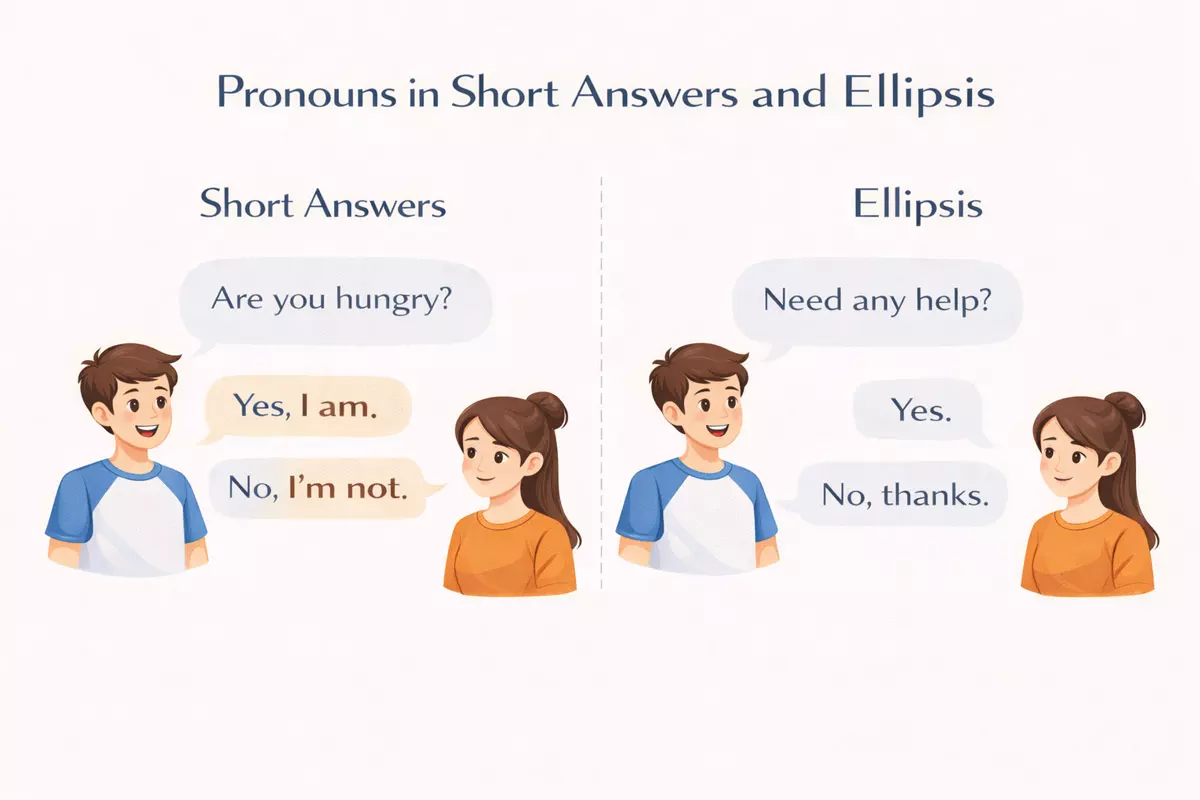 This article explains what ellipsis is, why it is used in English, and how it helps make short answers with pronouns and auxiliaries. It covers avoiding repetition, common mistakes, spoken versus written patterns, and includes practice.
Responding briefly in English often means using substitutes for nouns and leaving out unnecessary words to make your speech more concise. Mastering these strategies can help your conversations sound smoother and more natural, especially in casual or fast-paced interactions. By practicing the use of pronouns, contractions, and context-driven shortcuts, you can communicate your ideas clearly without repeating information or over-explaining, which is an important skill in both spoken and written English.
What ellipsis is and why English uses it
Ellipsis refers to the omission of words from a sentence when the meaning remains clear without them. In English, speakers often leave out repeated or predictable words to make speech and writing more efficient. Instead of restating everything, we simply use what is necessary for understanding. This process is common in responses, especially after questions, and in informal conversations where brevity is valued.
How ellipsis works in English
When using ellipsis, English relies on context to fill in the missing information. The words that are left out are "understood" from what has already been mentioned. This helps avoid repetition and keeps communication natural. For instance, after someone asks, "Are you coming to the party?" a full answer could be, "Yes, I am coming to the party." But in practice, most people would just say, "Yes, I am," or even just "Yes."
Common reasons for using ellipsis
- Efficiency: Avoids unnecessary repetition in conversation.
- Clarity: Focuses attention on new or important information.
- Natural flow: Mirrors the way people actually speak.
- Emphasis: Highlights the answer or key point by leaving out the rest.
- Politeness: Makes responses less abrupt or overly formal.
Typical places where ellipsis occurs
- Short answers to yes/no questions ("Did you eat?" "I did.")
- Tag questions ("You’re ready, aren’t you?")
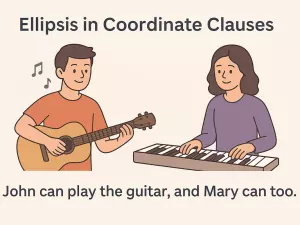
- Coordinated sentences ("She likes coffee, and he tea.")
- Instructions or headlines ("Apply within.")
- Lists and bullet points ("- Milk - Eggs - Bread")
Examples of ellipsis in short answers
- "Can you swim?" → "Yes, I can." (instead of "Yes, I can swim.")
- "Will they join us?" → "They will." (instead of "They will join us.")
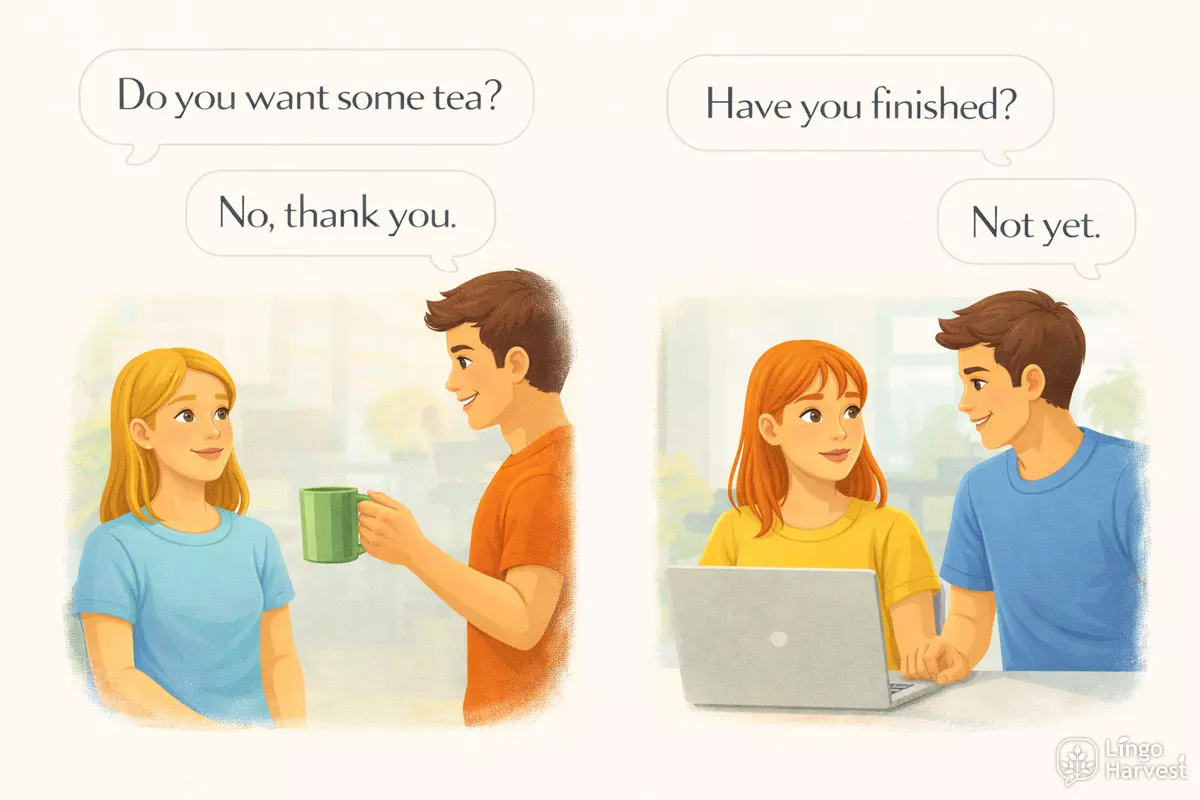
- "Do you want some tea?" → "No, thank you." (implied: I do not want tea.)
- "Have you finished?" → "Not yet." (implied: I have not finished yet.)
- "Is he coming?" → "He isn’t." (implied: He isn’t coming.)
- "Did you see it?" → "I did." (implied: I saw it.)
- "Are they ready?" → "They are." (implied: They are ready.)
- "Was it expensive?" → "It wasn’t." (implied: It wasn’t expensive.)
- "Can we start now?" → "We can." (implied: We can start now.)
- "Should I call her?" → "You should." (implied: You should call her.)
- "Is it raining?" → "It is." (implied: It is raining.)
- "Do you need help?" → "I don’t." (implied: I don’t need help.)
Why English prefers ellipsis
English often values concise, direct communication. Omitting repeated words saves time and makes exchanges smoother. This tendency is especially noticeable in spoken English, but it also appears in writing, especially in dialogue and informal contexts. Ellipsis helps speakers focus on what's new or relevant, making conversation feel more dynamic and less redundant.
Short answers with pronouns and auxiliaries
Responding to yes/no questions in English often involves a short reply that uses a pronoun and an auxiliary verb. This approach avoids repeating the whole question and keeps communication efficient. The pronoun in the answer matches the subject of the question, and the auxiliary verb reflects the tense and form used in the original sentence.
How pronouns and auxiliaries work in brief replies
When answering questions, the auxiliary (such as "do," "have," "is," "will," etc.) is paired with an appropriate pronoun. This forms a natural, concise response. For example, when someone asks, "Are you coming?", instead of restating, "Yes, I am coming," most speakers simply say, "Yes, I am."
- Are they ready? – Yes, they are. / No, they aren't.
- Did she call? – Yes, she did. / No, she didn't.
- Has it started? – Yes, it has. / No, it hasn't.
- Will you join us? – Yes, I will. / No, I won't.
- Do we have time? – Yes, we do. / No, we don't.
- Can he swim? – Yes, he can. / No, he can't.
- Should I wait? – Yes, you should. / No, you shouldn't.
- Was it difficult? – Yes, it was. / No, it wasn't.
- Is she here? – Yes, she is. / No, she isn't.
- Would they agree? – Yes, they would. / No, they wouldn't.
Negative and positive forms
Short answers can be affirmative or negative. For negative responses, the auxiliary verb is contracted with "not" (e.g., "isn't," "don't," "can't"). This helps keep the reply brief and natural.
Common patterns in short answers
The structure almost always follows this order:
- Pronoun (matching the subject of the question)
- Auxiliary verb (matching tense and form)
| Question | Short Answer |
|---|---|
| Are you tired? | Yes, I am. / No, I'm not. |
| Did they win? | Yes, they did. / No, they didn't. |
| Has she eaten? | Yes, she has. / No, she hasn't. |
| Will it rain? | Yes, it will. / No, it won't. |
| Can you help? | Yes, I can. / No, I can't. |
| Is he here? | Yes, he is. / No, he isn't. |
Important notes
- Never use the full verb in the short answer ("Yes, I coming" ❌); always use the auxiliary ("Yes, I am" ✅).
- The pronoun must agree in number and person with the subject of the question ("Are John and Mary coming? – Yes, they are.").
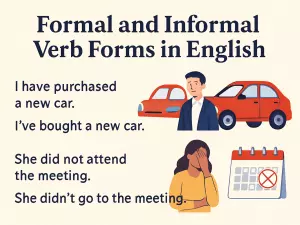
- Negative contractions are common in speech ("No, we aren't" instead of "No, we are not").
Mastering these concise responses makes conversations more natural and avoids repetition. They are a core feature of spoken English and are closely tied to ellipsis, where unnecessary words are left out for clarity and brevity.
Avoiding repetition using ellipsis
When responding to questions or continuing a conversation, repeating information can sound unnatural and redundant. In English, ellipsis allows us to omit words that are clearly understood from context, especially when using pronouns in short answers. This technique helps keep communication concise and fluid.
How ellipsis works in short answers
Ellipsis often removes repeated verbs, objects, or even whole clauses. Instead of restating the entire sentence, speakers use only the essential part—typically a pronoun and an auxiliary verb or modal. The omitted parts are easily inferred by the listener.
- Question: Are you coming to the meeting?
Answer: Yes, I am. (The verb "coming to the meeting" is omitted.) - Question: Has she finished her homework?
Answer: No, she hasn’t. (The phrase "finished her homework" is left out.) - Question: Do they like coffee?
Answer: They do. - Question: Will Alex join us?
Answer: He will. - Question: Did you see the movie?
Answer: I didn’t. - Question: Can we start now?
Answer: We can. - Question: Is it raining?
Answer: It isn’t. - Question: Have you eaten?
Answer: I have. - Question: Was the test difficult?
Answer: It was. - Question: Should we wait?
Answer: We shouldn’t.
Common patterns with ellipsis in short answers
The structure of these responses follows a predictable pattern:
- Affirmative: Subject + auxiliary/modal verb
- Negative: Subject + auxiliary/modal verb + not
This applies across different tenses and question types.
| Full Answer | Elliptical Short Answer |
|---|---|
| Yes, I am coming to the meeting. | Yes, I am. |
| No, she has not finished her homework. | No, she hasn’t. |
| Yes, they do like coffee. | They do. |
| No, I did not see the movie. | I didn’t. |
| Yes, we can start now. | We can. |
| No, it is not raining. | It isn’t. |
Benefits and clarity
Using ellipsis in responses makes exchanges quicker and avoids unnecessary repetition. The omitted information is usually clear from the previous question or context, so there is little risk of confusion. This approach is not only efficient but also natural in everyday English conversations.
Pronouns in confirmation and denial
Short answers in English often rely on pronouns to efficiently confirm or deny statements and questions. Instead of repeating the entire sentence, speakers typically use a pronoun and auxiliary verb, sometimes omitting parts of the original statement for brevity. This approach keeps responses natural and avoids unnecessary repetition.
Patterns in positive and negative replies
When confirming a statement, it’s common to use the subject pronoun that matches the original subject, followed by the appropriate auxiliary. In denials, the same structure is used, but with the negative form. Here’s how different pronouns appear in short answers:
| Statement | Short Answer (Confirmation) | Short Answer (Denial) |
|---|---|---|
| Are you coming? | Yes, I am. | No, I’m not. |
| Did she call? | Yes, she did. | No, she didn’t. |
| Will they help? | Yes, they will. | No, they won’t. |
| Has it started? | Yes, it has. | No, it hasn’t. |
| Were we late? | Yes, we were. | No, we weren’t. |
Key points for using pronouns in short answers
- Match the subject pronoun to the original subject (he/she/they/it/we/I/you).
- Use the correct auxiliary or modal verb (am, is, are, do, did, have, will, etc.).
- For negative replies, add not (often contracted: isn’t, haven’t, won’t, etc.).
- Omit repeated information—just the pronoun and auxiliary are usually enough.
- With yes/no questions, this structure is almost always used in natural conversation.
- Subject pronouns never change to object form in these answers (e.g., Yes, me am ❌ is incorrect).
- For formal or emphatic replies, the full form is possible: “Yes, I am coming.”
Examples of pronouns in confirmation and denial
- Yes, you are. / No, you aren’t.
- Yes, we have. / No, we haven’t.
- Yes, he does. / No, he doesn’t.
- Yes, I can. / No, I can’t.
- Yes, it was. / No, it wasn’t.
- Yes, they will. / No, they won’t.
- Yes, she did. / No, she didn’t.
- Yes, I do. / No, I don’t.
- Yes, they are. / No, they aren’t.
- Yes, we were. / No, we weren’t.
- Yes, it has. / No, it hasn’t.
- Yes, he can. / No, he can’t.
- Yes, you did. / No, you didn’t.
- Yes, she was. / No, she wasn’t.
- Yes, I will. / No, I won’t.
Notice how the pronoun always reflects the subject being discussed. This helps keep communication clear and direct, especially when using ellipsis to avoid repeating lengthy phrases. In practice, these patterns are essential for fluent, natural-sounding short answers in English.
Do/does/did in short replies
When responding to yes/no questions in English, we often use auxiliary verbs like do, does, and did to avoid repeating the full verb phrase. This approach not only makes conversations smoother but also highlights the use of pronouns and ellipsis. For instance, instead of saying "Yes, I like apples," you can simply say, "Yes, I do." This technique is especially common in spoken English, where brevity and clarity are valued.
How auxiliary verbs work with pronouns in answers
Short answers typically include a pronoun and the appropriate auxiliary verb. The choice between do, does, and did depends on the tense and subject of the question. Notice how the main verb is omitted (elliptical construction), and only the auxiliary and pronoun remain.
| Question | Short Reply |
|---|---|
| Do you like coffee? | Yes, I do. / No, I don't. |
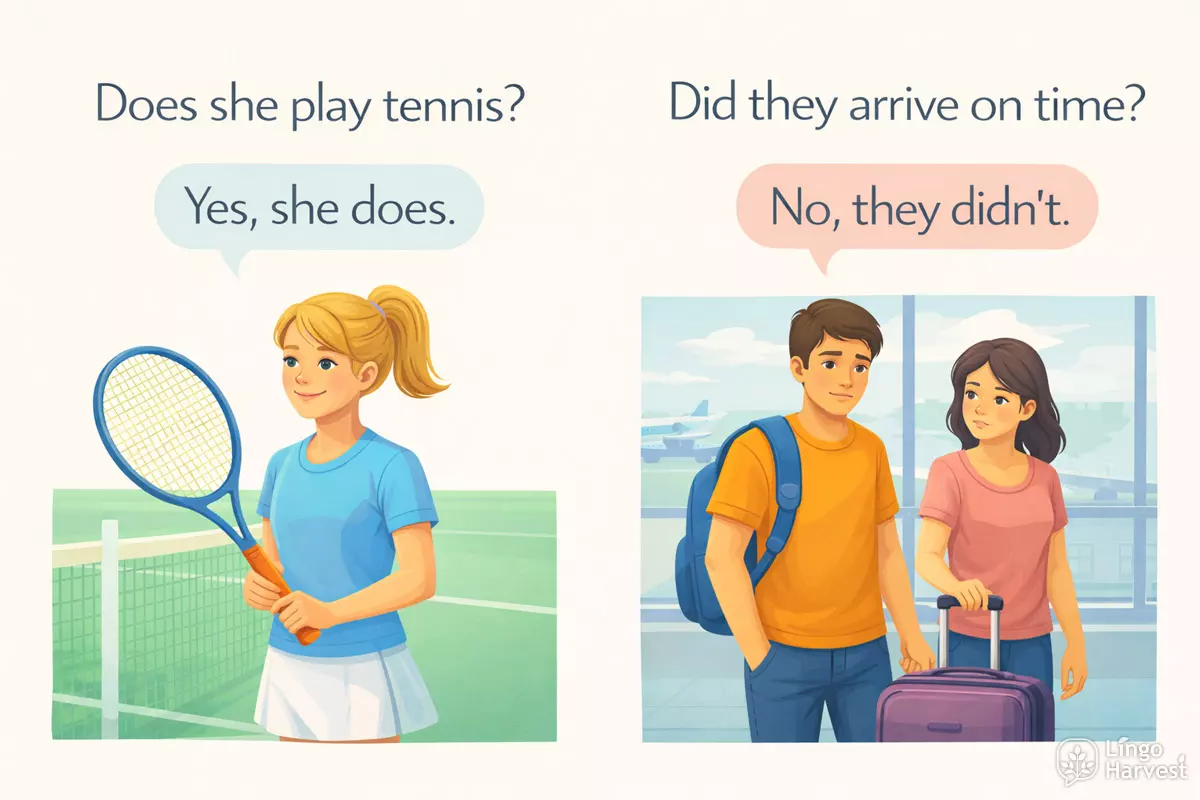
| Does she play tennis? | Yes, she does. / No, she doesn't. |
| Did they arrive on time? | Yes, they did. / No, they didn't. |
| Do we need tickets? | Yes, we do. / No, we don't. |
| Does it work? | Yes, it does. / No, it doesn't. |
| Did you see the movie? | Yes, I did. / No, I didn't. |
| Do they understand? | Yes, they do. / No, they don't. |
| Does he know the answer? | Yes, he does. / No, he doesn't. |
| Did she call you? | Yes, she did. / No, she didn't. |
| Do I have to go? | Yes, you do. / No, you don't. |
Key points for forming concise answers
- Match the auxiliary verb in your reply to the one used in the question (do, does, or did).
- Use the correct pronoun for the subject (I, you, he, she, it, we, they).
- For negative replies, add not (often contracted: don’t, doesn’t, didn’t).
- You can omit the auxiliary verb entirely in very informal speech, but this is not standard in writing.
Using these auxiliaries in short answers keeps your responses direct and avoids unnecessary repetition. This is especially useful in conversations where the context is clear, and you want to sound natural and fluent.
Common mistakes in short answers
Short answers in English often trip up learners because of subtle rules for pronoun use and ellipsis. These errors can lead to confusion or make your responses sound unnatural. Below are some of the most frequent issues people encounter when forming brief replies.
Misusing Pronouns
One typical error is picking the wrong pronoun in a response. Pronouns in short answers must match the subject of the original question, not necessarily the person speaking. For example, if the question is about “your brother,” the answer should use “he,” not “I.”
- Q: Is your sister coming?
❌ Yes, I am.
✅ Yes, she is. - Q: Do they play tennis?
❌ Yes, we do.
✅ Yes, they do.
Incorrect Verb Forms
Another common pitfall is using the wrong auxiliary verb or tense. The verb in your short response should echo the main verb or auxiliary from the question.
- Q: Did you see the movie?
❌ Yes, I do.
✅ Yes, I did. - Q: Are they ready?
❌ Yes, they do.
✅ Yes, they are.
Unnecessary Repetition or Omission
Short answers are designed to avoid repeating the entire statement, but omitting too much or too little can sound awkward. The pronoun and auxiliary are required; leaving one out is a mistake.
- ❌ Yes.
✅ Yes, he is. - ❌ No, doesn’t.
✅ No, she doesn’t.
Confusing Ellipsis Rules
Ellipsis lets us drop repeated information, but some learners overuse it or omit necessary parts. Remember, in short answers, only the verb and subject pronoun remain; dropping both leads to incomplete replies.
Summary Table: Correct vs. Incorrect Short Answers
| Question | Incorrect | Correct |
|---|---|---|
| Is Anna coming? | Yes, I am. | Yes, she is. |
| Do you like tea? | Yes, I am. | Yes, I do. |
| Did they leave early? | Yes, they do. | Yes, they did. |
| Are we late? | Yes, you are. | Yes, we are. |
| Can he help? | Yes, he do. | Yes, he can. |
More Frequent Mistakes to Watch For
- Switching from “you” in the question to “I” in the answer when talking about someone else.
- Leaving out the pronoun: “Yes, is.” instead of “Yes, he is.”
- Using “do” with “be” verbs: “Yes, I do.” for “Are you ready?”
- Forgetting to change the auxiliary verb: “Yes, I can.” for “Did you…?”
- Repeating the whole sentence instead of using a short answer.
- Mixing up singular and plural pronouns: “Yes, they is.”
- Using contractions incorrectly: “Yes, she’s.” for “Yes, she is.” in formal replies.
- Responding with just “Yes” or “No” without auxiliary and pronoun.
- Adding unnecessary information: “Yes, I do like it very much.” when a short answer is expected.
By paying close attention to pronoun agreement, verb forms, and ellipsis, you can avoid these common errors and sound more fluent in English conversations.
Spoken vs written ellipsis patterns
Ellipsis—the omission of words easily inferred from context—shows distinct tendencies in conversation compared to formal writing. In speech, people often drop pronouns, auxiliaries, or even entire verb phrases, trusting that listeners can fill in the gaps. Written language, on the other hand, usually favors more explicit structures, especially in formal contexts where clarity and completeness are prioritized.
Typical ellipsis in conversation
Everyday exchanges rely heavily on context and shared understanding, which allows for shorter, snappier responses. Speakers often leave out elements that would be required in writing. Here are some common features:
- Omission of subject pronouns: "Want some?" instead of "Do you want some?"
- Dropping auxiliary verbs: "Coming?" in place of "Are you coming?"
- Short answers with only pronouns: "He did." or just "He."
- Leaving out repeated information: "Don’t know." for "I don’t know."
- Using single-word replies: "Sure.", "Nope.", "Maybe."
- Reduced verb phrases: "Could have." instead of "I could have."
- Tag questions without full structure: "Coming, aren’t you?"
- Negative responses: "Not me." or "Not today."
- Minimal agreement: "Me too." or "Me neither."
- Pronoun-only answers: "She." in response to "Who called?"
- Elliptical imperatives: "Out!" for "Get out!"
- Short confirmations: "Will do." for "I will do it."
Written language: more explicit, less elliptical
Writers often avoid ambiguous omissions, especially outside of informal messaging. Even in short answers, written forms tend to preserve the subject or auxiliary, making responses clearer:
- "Yes, I do." instead of just "Do."
- "She will not attend." rather than "Not coming."
- "I haven’t seen it." instead of "Haven’t seen."
- "No, thank you." rather than a bare "No."
However, informal writing (like texts or chat) may resemble spoken habits, using similar ellipsis patterns.
Comparing spoken and written ellipsis
Some patterns appear in both speech and writing, but their frequency and acceptability can differ. The table below compares common response forms in each mode:
| Spoken Example | Typical Written Equivalent |
|---|---|
| "Coming?" | "Are you coming?" |
| "Me too." | "I do too." / "I also." |
| "Don’t know." | "I don’t know." |
| "He did." | "He did." |
| "Not me." | "It was not me." |
| "Will do." | "I will do it." |
| "Sure." | "Yes, certainly." |
| "She." | "She did." / "She called." |
| "Out!" | "Get out!" |
| "Not today." | "I will not today." |
Summary: When ellipsis is natural
In summary, conversational English allows for more radical omissions, especially when pronouns are involved in short answers. Written language, particularly in formal settings, tends to spell things out more fully. Still, informal writing often borrows from speech, blurring the boundaries. Context and shared understanding are key to interpreting these omissions correctly in any mode.
Practice: respond using short answers
Mastering short answers with correct pronouns and ellipsis is essential for natural English conversation. In this section, you’ll find targeted exercises to help you recognize and produce concise replies, focusing on subject and object pronouns as well as the use of ellipsis to avoid repetition.
Choose the right pronoun in short answers
Read each question and respond with the correct short answer, using the appropriate pronoun and ellipsis where possible.
- Are you coming to the party?
- Did Sarah finish her homework?
- Will they help us move?
- Has it rained today?
- Can John and Lisa swim?
- Is this your book?
- Do you know the answer?
- Was the movie interesting?
- Does your brother play guitar?
- Should we call them now?
Show answers
- Yes, I am. / No, I'm not.
- Yes, she did. / No, she didn't.
- Yes, they will. / No, they won't.
- Yes, it has. / No, it hasn't.
- Yes, they can. / No, they can't.
- Yes, it is. / No, it isn't.
- Yes, I do. / No, I don't.
- Yes, it was. / No, it wasn't.
- Yes, he does. / No, he doesn't.
- Yes, we should. / No, we shouldn't.
Identify correct ellipsis in short answers
Sometimes, repeating the verb or full phrase is unnecessary. Select the most natural short answer for each prompt.
- Are you tired? (Yes, I am. / Yes, I.)
- Did they call? (No, they didn’t. / No, they.)
- Will you go? (Yes, I will. / Yes, I go.)
- Is it raining? (No, it isn’t. / No, it.)
- Are you ready? (Yes, I am. / Yes, I ready.)
- Did she finish? (Yes, she did. / Yes, she finished.)
- Can you swim? (No, I can’t. / No, I not.)
- Do they agree? (Yes, they do. / Yes, they agree.)
- Has he arrived? (No, he hasn’t. / No, he not.)
- Was it expensive? (Yes, it was. / Yes, it expensive.)
- Should we wait? (No, we shouldn’t. / No, we don’t.)
- Were you there? (Yes, I was. / Yes, I were.)
Show answers
- Yes, I am.
- No, they didn’t.
- Yes, I will.
- No, it isn’t.
- Yes, I am.
- Yes, she did.
- No, I can’t.
- Yes, they do.
- No, he hasn’t.
- Yes, it was.
- No, we shouldn’t.
- Yes, I was.
Common pronouns in short answers: reference table
Here’s a quick reference table showing typical pronoun and verb combinations for short answers. Use these patterns to construct your own replies in conversation.
| Question Subject | Short Answer (Affirmative) | Short Answer (Negative) |
|---|---|---|
| I | Yes, I do. / Yes, I am. | No, I don’t. / No, I’m not. |
| You | Yes, you are. / Yes, you do. | No, you aren’t. / No, you don’t. |
| He/She | Yes, he does. / Yes, she is. | No, he doesn’t. / No, she isn’t. |
| They | Yes, they are. / Yes, they do. | No, they aren’t. / No, they don’t. |
| It | Yes, it is. / Yes, it has. | No, it isn’t. / No, it hasn’t. |
Build your own short answers
Try making short answers for these prompts, using correct pronouns and ellipsis:
- Are we late?
- Has she arrived?
- Do you need help?
- Is Mark at home?
- Can it fly?
- Did they finish the report?
- Will you join us later?
- Is the store open?
- Have you seen my keys?
- Was the meeting useful?
Show answers
- No, we aren’t.
- Yes, she has.
- Yes, I do.
- No, he isn’t.
- Yes, it can.
- Yes, they did.
- No, I won’t.
- Yes, it is.
- No, I haven’t.
- Yes, it was.
Practicing these forms boosts your fluency and helps you sound more natural in English conversations. Keep experimenting with different subjects and verbs for a wider range of responses.