This vs That: Psychological and Contextual Distance

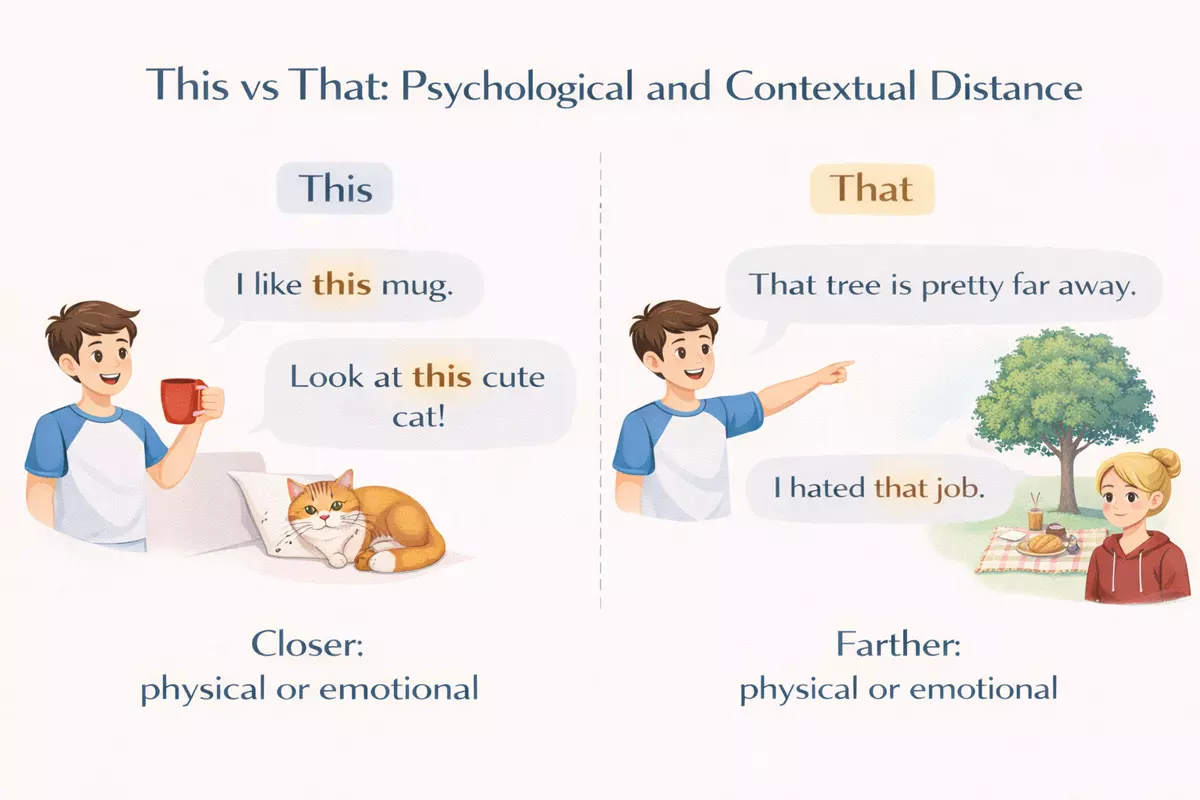 Here we the basic meanings of this and that, their use for physical and psychological distance, time, ideas, and situations, speaker attitude, and common learner mistakes.
- Basic meaning of this and that
- Physical distance vs psychological distance
- This and that for time, ideas, and situations
- Speaker attitude and emotional distance
- This vs that in conversations and storytelling
- Common learner confusion patterns
- Spoken vs written preferences
- Practice: choose this or that by context
Our perception of the world is shaped by both psychological and situational distance, influencing how close or distant events, people, or ideas seem to us. Psychological distance refers to how personally relevant or emotionally connected we feel to something, while situational distance relates to our actual physical or contextual separation from it. By examining the differences between these two types of distance, we can better understand why some experiences or concepts feel urgent and immediate, whereas others appear abstract or detached from our daily lives.
Basic meaning of this and that
Understanding how “this” and “that” function in English helps clarify not just grammar, but also the subtle ways we express distance and relevance. Both words are demonstratives, letting us point to things, people, or ideas in conversation or writing. The main difference comes down to proximity—whether something feels near or far, physically or psychologically.
Physical and Psychological Proximity
Generally, “this” signals something close to the speaker, while “that” refers to something farther away. However, the sense of closeness isn’t always about physical space. Sometimes, it’s about emotional connection or how recently the topic was introduced. For instance, a person might say, “I love this song,” about a tune currently playing, but “I liked that song,” for one that finished earlier.
Common Usage Patterns
English speakers use these terms in a variety of contexts, not just for objects in the room but for abstract concepts, ideas, or moments in time. Here’s a look at some typical scenarios:
- Referring to objects: “This chair is comfortable.” / “Can you hand me that book?”
- Describing time: “This morning was busy.” / “That day changed everything.”
- Introducing ideas: “This is what I mean…” / “That’s exactly my point.”
- Talking about people: “This is my friend, Alex.” / “That man over there is the manager.”
- Reacting to events: “This is amazing!” / “That was unexpected.”
- In storytelling: “So this happened…” / “After that, we left.”
- Expressing opinions: “This tastes great.” / “That doesn’t seem right.”
- Making choices: “I’ll take this one.” / “I don’t want that.”
- Giving instructions: “Do it like this.” / “Not like that.”
- Clarifying reference: “This, not that.”
Contrast at a Glance

| Demonstrative | Typical Use | Proximity (Physical/Psychological) | Example |
|---|---|---|---|
| This | Refers to something near the speaker or recently mentioned | Close | This coffee is hot. |
| That | Points to something farther away or less immediate | Distant | That mountain looks tall. |
| This | Indicates something emotionally relevant or important | Psychologically close | This is the moment we’ve been waiting for. |
| That | Used for something less connected or in the past | Psychologically distant | That was a difficult time. |
In Summary
The choice between “this” and “that” is not just about where something is, but how close it feels to the speaker, whether in space, time, or even emotion. Recognizing these patterns can make communication clearer and more precise, especially when it comes to sharing ideas or making distinctions in conversation.
Physical distance vs psychological distance
When we talk about how people perceive events or objects, it’s useful to distinguish between literal, spatial separation and the mental sense of closeness or remoteness. The first is easy to grasp: physical separation refers to the measurable space between people, places, or things—think meters, kilometers, or even continents. In contrast, psychological distance is a more abstract concept, capturing how far something feels from us in terms of time, familiarity, social connection, or hypothetical scenarios.
Defining the Two Concepts
- Physical separation: The actual, measurable space (e.g., being in different rooms, cities, or countries).
- Psychological separation: The perceived gap based on factors like time (past or future), emotional connection, likelihood, or relevance.
How They Interact
It’s possible to be physically close but feel mentally distant from someone, or the opposite—think of feeling emotionally connected to a friend who lives abroad. Both types of distance shape our attitudes, decisions, and even memory. For example, an event happening tomorrow in your hometown may feel urgent and relevant, while a similar event far away in time or space might seem less pressing.
Comparison Table
| Aspect | Physical Distance | Psychological Distance |
|---|---|---|
| Definition | Literal, spatial separation | Perceived remoteness in mind or feeling |
| Measurement | Units like meters or miles | Intangible; based on perception |
| Examples | Standing across the street, living in another city | Events in the distant future, unfamiliar cultures, hypothetical situations |
| Impact on Behavior | Navigation, accessibility, physical interaction | Empathy, decision-making, risk assessment |
| Can overlap? | Yes—close in space can also feel close in mind, but not always | Yes—can feel close to someone far away, or distant from someone nearby |
Common Forms of Psychological Separation
- Temporal (past or future events)
- Social (strangers vs. close friends)
- Hypothetical (real vs. imagined scenarios)
- Cultural (familiar vs. foreign customs)
- Emotional (shared feelings vs. detachment)
- Likelihood (certain vs. unlikely outcomes)
- Relevance (personal stake vs. indifference)
- Authority (peer vs. distant figure)
- Knowledge (well-understood vs. mysterious)
- Responsibility (directly involved vs. bystander)
Understanding the distinction and interplay between these two types of separation can help explain why some things feel urgent and real, while others seem remote or abstract. This distinction is crucial for communication, empathy, and effective decision-making in everyday life.
This and that for time, ideas, and situations
Demonstratives like “this” and “that” don’t just point to physical objects—they also help us frame time, concepts, and situations. The choice between these words often reflects how close or distant something feels, either psychologically or in context. For instance, “this moment” suggests immediacy, while “that moment” implies some separation in time or perspective.
Temporal Distance
When talking about events, people typically use “this” for things happening now or very recently, and “that” for things further in the past or future. The following examples show how subtle shifts in wording change the sense of time:
- This week (current, ongoing)
- That week (a specific, more distant week)
- This morning (today, still relevant)
- That morning (earlier, no longer immediate)
- This year (the present year)
- That year (a previous or particular year)
- This time (right now, current opportunity)
- That time (a remembered or referenced occasion)
Abstract Ideas and Discussions
In conversations, “this” often introduces an idea that feels relevant or close, while “that” can indicate a concept that’s been discussed earlier or is less central. For example:
- “This idea is worth exploring.” (immediate relevance)
- “That theory seems outdated.” (distance in thought or agreement)
- “Consider this proposal.” (direct attention)
- “Remember that suggestion from last week?” (past reference)
- “This point is key.” (current focus)
Situational and Psychological Distance
The language we use to describe situations reveals how we position ourselves relative to events or feelings. “This situation” signals involvement or immediacy, while “that situation” can create emotional or contextual distance. Here’s how these choices play out:
| Phrase | Typical Context | Implied Distance |
|---|---|---|
| This problem | Current, personal, or urgent issue | Near |
| That problem | Previously discussed, less immediate, or someone else’s issue | Far |
| This feeling | Present emotion, self-focused | Near |
| That feeling | Recalled emotion, possibly detached | Far |
| This case | Current situation being handled | Near |
| That case | Reference to another, less relevant scenario | Far |
| This approach | Suggested or preferred method | Near |
| That approach | Alternative, possibly rejected method | Far |
Patterns in Usage
People naturally shift between “this” and “that” to mark the boundaries of relevance, time, and emotional investment. Whether discussing plans (“this decision” vs. “that decision”), evaluating events (“this success” vs. “that failure”), or organizing thoughts, these choices subtly shape how we relate to what we’re describing. Recognizing these patterns can help us interpret not just the words, but the speaker’s stance and the context behind them.
Speaker attitude and emotional distance
Linguistic choices like "this" and "that" do more than just point out objects; they subtly reveal how close or distant a speaker feels—emotionally and psychologically—toward what they're talking about. These choices act as small windows into the speaker's mindset, showing not just where things are, but how the speaker relates to them.
How demonstratives reveal stance
When people choose between "this" and "that," they're often doing more than marking location. "This" can signal engagement, involvement, or even affection for the topic or object, while "that" may imply detachment, neutrality, or even disapproval. For example, saying "I love this idea" feels more immediate and warm than "I love that idea," which can sound slightly removed.
Common patterns and examples
- "This problem" (suggests current engagement or urgency)
- "That problem" (implies distance, possibly emotional separation)
- "This movie made me cry" (personal connection, recent experience)
- "That movie was boring" (distance, maybe judgment)
- "I can't believe this happened" (in the moment, emotional involvement)
- "I can't believe that happened" (retelling, less immediate)
- "This person" (favorably, sometimes intimate or approving)
- "That person" (neutral, dismissive, or even critical)
- "This mess" (speaker feels involved or affected)
- "That mess" (distance from the situation, observer)
- "This decision" (ownership, responsibility)
- "That decision" (distancing, possibly blaming others)
- "This choice" (personal stake or pride)
- "That choice" (critical or neutral detachment)
- "This moment" (cherished, present, or significant)
- "That moment" (past, less emotionally charged)
- "This kind of behavior" (current, relevant, impactful)
- "That kind of behavior" (general, less personally affecting)
Emotional proximity in conversation
Speakers often use "this" when they want to bring a topic emotionally closer to themselves or their listener. In contrast, "that" pushes things away, both spatially and emotionally. These subtle choices can shape the tone of a conversation, signaling openness, enthusiasm, irritation, or even judgment without a single explicit adjective.
| Phrase | Implied Emotional Distance |
|---|---|
| This opportunity | Engaged, positive, immediate |
| That opportunity | Detached, less personal, remote |
| This mistake | Personal, accepting responsibility |
| That mistake | Distancing, possibly blaming or minimizing |
| This story | Involved, invested, present |
| That story | Removed, less engaged |
In sum, demonstrative choices quietly color communication with layers of attitude and emotional nearness. By paying attention to "this" and "that," you can pick up on subtle cues about how speakers relate to their message and to their audience.
This vs that in conversations and storytelling
Choosing between “this” and “that” in dialogue or narration shapes how listeners or readers connect with the subject. “This” often draws attention to something immediate or emotionally close, while “that” signals distance—physical, psychological, or temporal. These subtle choices influence engagement, empathy, and even trust in both storytelling and everyday exchanges.
How demonstratives guide attention and connection
Speakers use “this” to bring ideas or objects closer, making them feel relevant and important. In contrast, “that” can create detachment or objectivity, sometimes making a story or statement feel less personal. For example, a storyteller might say, “This moment changed everything,” versus, “That moment changed everything.” The first feels immersive; the second, more reflective or removed.
Common patterns in dialogue and narrative
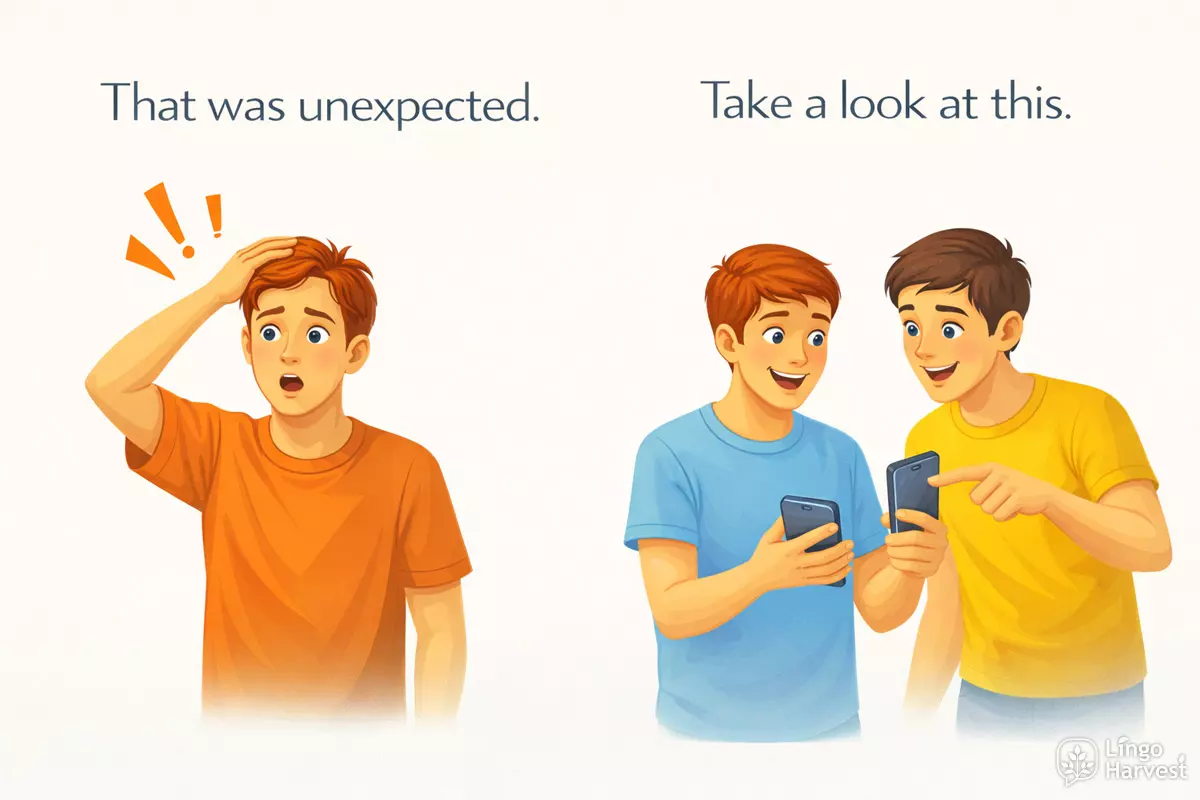
Everyday speech and stories rely on these words to set the scene, guide listeners, or highlight what matters. Here are some typical ways “this” and “that” show up:
- “Listen to this:” (introduces something close or exciting)
- “Remember that time…” (refers to a shared, perhaps distant, memory)
- “This is what I mean.” (clarifies a point just made)
- “That was unexpected.” (reflects on something that just happened)
- “Take a look at this.” (directs attention to something present)
- “That’s what I thought.” (connects to a previous idea or assumption)
- “This story gets better.” (builds anticipation)
- “That’s not the end.” (signals continuation or resolution)
- “This right here is the problem.” (pinpoints an issue)
- “That over there is the solution.” (removes the solution from the immediate context)
- “I’ll never forget this.” (emphasizes impact or emotion)
- “That reminds me…” (bridges to related memories or topics)
- “This is it!” (marks a moment of realization)
- “That’s all I have to say.” (concludes or distances)
Comparing psychological and contextual distance
When it comes to audience perception, “this” and “that” can evoke different psychological distances. The table below summarizes how each term typically functions in conversation and storytelling:
| Demonstrative | Effect on Listener/Reader |
|---|---|
| This | Creates closeness; signals immediacy or relevance; invites empathy |
| That | Establishes distance; suggests reflection or separation; can reduce emotional intensity |
| This (in storytelling) | Makes events feel current, vivid, or urgent |
| That (in storytelling) | Makes events seem past, resolved, or less personal |
Takeaways for effective communication
Writers and speakers can consciously choose between “this” and “that” to shape how their message lands. Using “this” pulls the audience in, while “that” can help create space for reflection or objectivity. Understanding these nuances lets communicators fine-tune their stories and conversations for greater impact.
Common learner confusion patterns
Understanding the nuances between “this” and “that” often leads to recurring misunderstandings, especially when psychological and contextual distance are involved. Many learners struggle not just with the literal meanings, but with the subtle cues that guide which term is appropriate in a given situation. This section highlights areas where confusion tends to cluster, and illustrates common missteps.
Typical areas of difficulty
- Assuming “this” and “that” are always interchangeable.
- Misinterpreting spatial reference: using “this” for something far away, or “that” for something nearby.
- Overlooking emotional or psychological closeness—such as using “that” for a topic the speaker feels strongly about.
- Ignoring discourse context, such as referring to something just introduced as “that” instead of “this.”
- Confusing physical distance with temporal distance, e.g., “this week” vs. “that week.”
- Forgetting that “this” can signal something upcoming, while “that” can refer to something past or hypothetical.
- Choosing the wrong demonstrative in written vs. spoken language.
- Misapplying rules across different languages due to false friends or differing systems.
- Not recognizing when “this” and “that” are used for emphasis or contrast.
- Mixing up which term to use when referencing shared knowledge or inside jokes.
- Transferring rules from informal to formal registers, leading to awkward phrasing.
- Overreliance on pointing or gestures, which may not translate in written communication.
- Difficulty with abstract concepts: “this idea” (immediate) vs. “that idea” (previously mentioned or less relevant).
- Assuming “this” is always preferred for positive topics and “that” for negative ones, rather than considering context.
- Not noticing shifts in focus, where the referent changes and the demonstrative should shift accordingly.
Side-by-side comparison: Psychological vs. Contextual Distance
| Psychological Distance | Contextual (Physical/Temporal) Distance |
|---|---|
| Refers to how emotionally or personally “close” something feels to the speaker. | Relates to how physically, spatially, or temporally near or far something is. |
| Example: “this problem” (I care about it) vs. “that problem” (less relevant to me) | Example: “this book” (right here) vs. “that book” (over there/on the shelf) |
| Can override physical distance in certain contexts (e.g., “this wonderful city” about a place far away) | Usually dominates in simple, concrete references (“this chair” when sitting on it) |
| Often subtle and harder for learners to identify | More visually or explicitly indicated in conversation |
These sources of confusion are not always obvious and may persist even as learners gain experience. Becoming aware of both psychological and contextual cues helps in making more accurate choices between “this” and “that,” especially in nuanced or abstract situations.
Spoken vs written preferences
People often make different choices depending on whether they're communicating out loud or in writing. The psychological and contextual distance between speaker and listener, or writer and reader, can influence which forms or words feel most natural. For example, when talking in person, language tends to be more informal, immediate, and direct. In contrast, written communication—especially in formal contexts—often favors precision, structure, and a certain degree of detachment.
Key distinctions in language use
Spoken language typically prioritizes clarity in the moment and relies on context, tone, and shared knowledge. Written forms, on the other hand, require more explicit detail, as the reader may not have access to nonverbal cues or immediate clarification. This difference shapes preference for certain words, sentence structures, and even pronoun choices.
| Spoken Language | Written Language |
|---|---|
| Often uses "this" for immediacy (e.g., “This is what I mean”) | Leans toward "that" for distance or objectivity (e.g., “That raises a concern”) |
| Relies on gestures or visual context (pointing, facial expressions) | Provides explicit context in words (background, definitions) |
| Sentences often incomplete or fragmented | Full sentences and clear structure expected |
| Immediate feedback allows for clarification | Anticipates questions, so explanations are more thorough |
| Emphasizes shared experience (“this one here”) | Emphasizes distance or abstraction (“that issue in the report”) |
Common patterns and preferences
- Spoken English often features present-tense verbs and demonstratives like “this” or “these.”
- Written language leans toward past tense or passive constructions for neutrality.
- Fillers (“um,” “you know”) are common in speech but rare in writing.
- Writers clarify references (“the aforementioned topic”) while speakers rely on immediate context.
- Direct address (“Let me show you this”) is typical in conversation, but less so in formal writing.
- Pronouns like “here” and “now” signal immediacy in speech.
- Writers may use “that” to refer to something previously mentioned, helping readers track ideas.
- Spoken exchanges may use vague or context-dependent phrases (“this thing”) that would be ambiguous in text.
- Written forms often include hedging (“it appears that…”) for politeness or caution.
- Speech allows for quick corrections, while writing requires careful revision before sharing.
- Speakers may reference objects in the environment, while writers describe them.
- Repetition is more acceptable in speech for emphasis, but avoided in writing for clarity.
- Speech can be more emotive; writing tends to be more restrained.
Understanding these distinctions helps explain why certain words or structures feel more fitting in conversation versus text. The psychological distance—how close or far we feel from our audience—shapes our choices, often unconsciously. Recognizing these patterns can improve both our speaking and writing, making communication more effective in any context.
Practice: choose this or that by context
Understanding when to use "this" or "that" often depends on both psychological and physical distance, as well as the context of the conversation. Try the following exercises to sharpen your sense of which demonstrative is appropriate in different scenarios.
Quick scenarios: pick the right word
- Your friend is holding a book and asks, “Do you want to read ____ book?”
- You point to a painting on the far wall and say, “I love ____ painting.”
- While on a video call, you show your pet to the camera and say, “Look at ____!”
- Recalling a story from last year, you say, “____ was a strange day.”
- Handing someone a cup, you ask, “Would you like ____?”
- Discussing a plan you’ve just mentioned, you say, “Let’s do ____.”
- Referring to a rumor everyone is talking about, you say, “Did you hear about ____?”
- Pointing at a distant mountain, you exclaim, “____ is beautiful!”
- Introducing a new idea in a meeting, you begin, “____ is what I propose.”
- Remembering a faraway childhood home, you sigh, “I miss ____ place.”
Show answers
- this
- that
- this
- that
- this
- this
- that
- that
- this
- that
Common patterns: when to use each
It helps to notice typical usage patterns. Here’s a list of contexts and cues that can guide your choice:
- “This”: Something physically near you (in your hand, on your desk)
- Referring to an idea or event just mentioned or about to happen
- Describing something emotionally close or personally relevant
- Introducing topics in writing or speech (“This article explains…”)
- Presenting an object to someone (“This is for you”)
- Focusing attention on something present (“This moment is important”)
- Talking about the current situation (“This is what we need to fix”)
- Highlighting something visible to both speakers and physically close
- Giving immediate instructions (“Take this pill now”)
- When something feels psychologically immediate or urgent
- “That”: Referring to something farther away (across the room, outside)
- Mentioning an idea or event discussed earlier or less relevant
- Describing something emotionally distant or less personal
- Recalling memories or past events (“That was a great day”)
- Talking about a previous point in conversation or writing
- Pointing out something others can see but isn’t close to you
- Distinguishing between two items, one near and one far (“This one or that one?”)
- Expressing a sense of detachment or neutrality
- Referring to something outside the immediate environment
- When something feels less immediate or less connected
Structured comparison: “this” vs “that” in context
| Situation | Preferred Choice | Reason |
|---|---|---|
| Handing someone an object in person | this | Object is physically near both speaker and listener |
| Pointing at an object across the room | that | Object is physically distant from the speaker |
| Talking about a plan you just mentioned | this | Plan is psychologically immediate and relevant |
| Referring to an event from last year | that | Event is temporally and psychologically distant |
| Introducing a new topic in conversation | this | Topic is being brought into focus right now |
| Describing a rumor everyone already knows | that | Information is familiar but not immediate |
Apply your understanding: mini-quiz
Choose “this” or “that” for each sentence:
- ____ was the best vacation of my life. (Referring to a trip years ago)
- Can you pass me ____ pen? (The pen is right next to you)
- Listen to ____! (You’ve just played a new song)
- I can’t believe ____ happened. (Reacting to unexpected news you just received)
- ____ was a difficult time for everyone. (Talking about the past)
- Look at ____ picture here. (Pointing to something close)
- Do you remember ____ day we met? (Referring to a past event)
- Try ____ cake. (The cake is in front of you)
- ____ was exactly what we needed back then. (Looking back)
- Check ____ out! (Showing something on your phone)
- I didn’t expect ____ result. (Reacting to what just happened)
- ____ idea might actually work. (An idea just mentioned)
Show answers
- That
- This
- This
- This
- That
- This
- That
- This
- That
- This
- This
- This