Indefinite Pronouns by Meaning and Usage

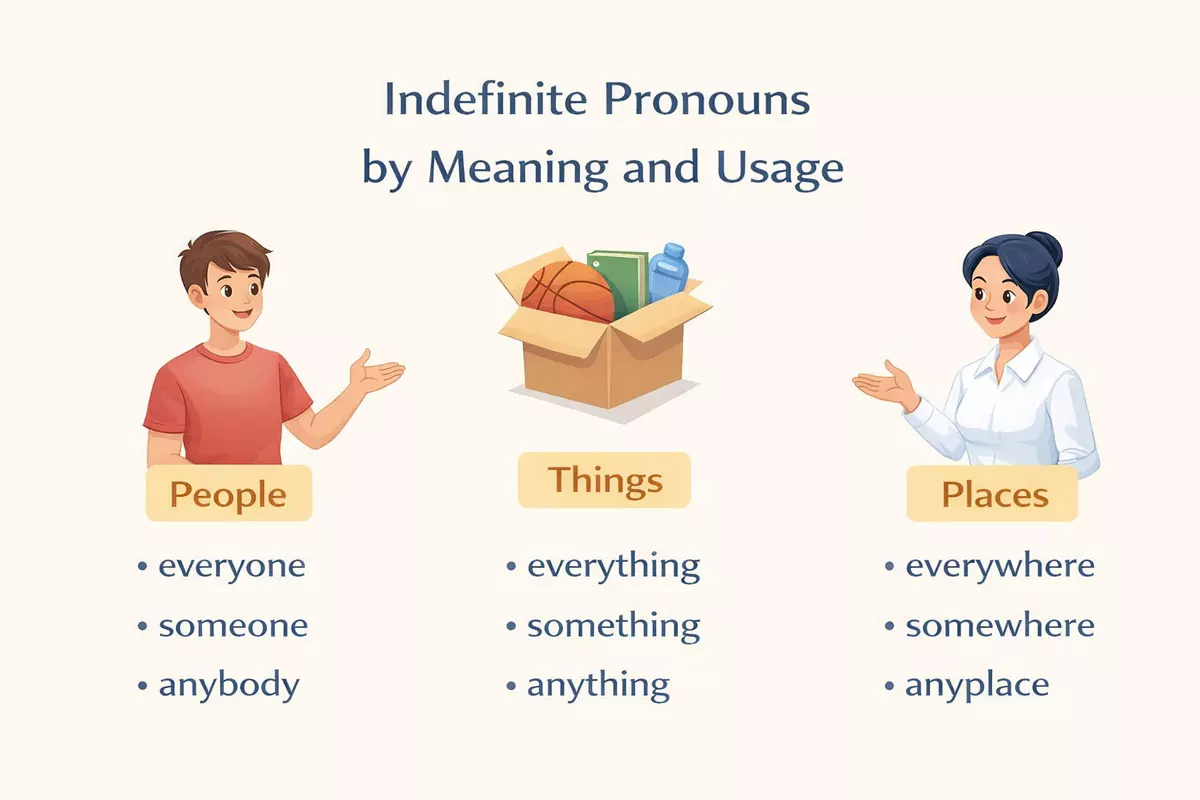 This article explains indefinite pronouns, grouping them by people, things, quantity, and negatives. It covers agreement patterns, highlights typical learner errors, and provides practice picking the correct group for different contexts.
- What indefinite pronouns are and why they matter
- People-focused pronouns: someone, anyone, everyone
- Thing-focused pronouns: something, anything, nothing
- Quantity-based pronouns: each, both, several, many
- Negative and limiting pronouns: no one, none, neither
- Agreement patterns with indefinite pronouns
- Common learner errors by group
- Practice: choose the correct group by context
Words such as someone, anything, or nobody are known as indefinite pronouns, and they play an important role in everyday conversation. By allowing us to refer to people or things without specifying exactly who or what we mean, these words make our speech more flexible and natural. Whether we want to keep things general, avoid repetition, or simply don’t know all the details, indefinite pronouns help us communicate ideas smoothly and efficiently in a variety of situations.
What indefinite pronouns are and why they matter
Indefinite pronouns are words that refer to non-specific people, things, or amounts. Instead of pointing to a particular individual or object, they stand in for an unknown or general group. This makes them useful for expressing ideas when the exact details are unknown, unimportant, or not yet specified. For example, in the sentence "Someone left their umbrella," the speaker doesn't identify the person, so "someone" fills that gap.
Why do we use them?
Using these pronouns helps speakers avoid awkward repetition and allows for more fluid, natural conversation. They are essential for generalizations, questions, and statements where the subject is indefinite. Without them, English would be less flexible and more cumbersome, especially when discussing things in a broad or inclusive sense.
Common forms and examples

There are several types of indefinite pronouns, each serving a slightly different function. Some refer to people, others to things, and some to amounts. Here are some of the most frequently used:
- anyone can join the discussion if they want.
- everybody enjoyed the presentation.
- something feels different today.
- nothing was mentioned about the delay.
- no one answered the phone.
- each participant received a certificate.
- few people understand how complex this issue is.
- many students chose to study abroad.
- all the documents were submitted on time.
- several options are still available.
- somebody left their umbrella in the hallway.
- anything can go wrong without preparation.
- nobody expected such a quick response.
- either option would work for me.
- none of the answers were correct.
- others preferred to stay silent.
How they affect meaning and clarity
Indefinite pronouns shape the scope of a statement. For instance, "everyone" includes all people in a group, while "someone" singles out an unspecified person. Choosing the right pronoun ensures your meaning is clear and your statements are accurate. They also help with politeness and indirectness, making language softer or more inclusive.
| Pronoun | What it refers to |
|---|---|
| anyone / anybody | an unspecified person |
| anything | an unspecified thing |
| everyone / everybody | all people in a group |
| something | a non-specific thing |
| none | not any (people or things) |
| few | a small number (people or things) |
| several | more than two but not many |
| each | every individual item or person |
Mastering these words helps you speak and write more precisely, whether you’re making general statements, asking open questions, or describing groups. They’re a fundamental part of English, shaping how we talk about the world when details are missing or unnecessary.
People-focused pronouns: someone, anyone, everyone
When we want to talk about people without naming them, English uses special indefinite pronouns. Words like someone, anyone, and everyone refer to people in a general or non-specific way. These pronouns help us discuss people in situations where their exact identity is unknown, unimportant, or applies to a group as a whole.
Common pronouns referring to people
Here are some of the most frequently used indefinite pronouns for people:
- someone – an unspecified person; we don’t know who
- anyone – any person at all; it doesn’t matter who
- everyone – all people in a group; no one excluded
- no one – not a single person
- somebody – same as “someone,” more informal
- anybody – same as “anyone,” more informal
- everybody – same as “everyone,” more informal
- nobody – same as “no one,” more informal
Meaning and usage patterns
These pronouns differ in how broad or specific they are. For example, someone suggests an unknown but particular person, while anyone opens up the possibility to all. Everyone is inclusive, referring to all members of a group. Negative forms like no one and nobody indicate absence of people.
| Pronoun | Typical Meaning | Example Sentence |
|---|---|---|
| someone / somebody | An unspecified person | Someone left their bag here. |
| anyone / anybody | Any person (doesn’t matter who) | Can anyone help me? |
| everyone / everybody | All people in a group | Everyone enjoyed the show. |
| no one / nobody | Not a single person | No one answered the phone. |
Typical contexts and grammar points
- someone/somebody often appear in affirmative statements and polite offers: “Would someone like tea?”
- anyone/anybody are common in questions and negatives: “Did anyone call?” or “I don’t know anybody here.”
- everyone/everybody are used to address whole groups: “Everybody must sign in.”
- no one/nobody are always negative: “Nobody knows the answer.”
These pronouns always take a singular verb: “Everyone is ready,” not “Everyone are ready.” However, in informal English, pronouns like they/their are often used to refer back to a person whose gender is unknown: “Someone left their umbrella.”
Quick reference: more people-focused pronouns
- Whoever finishes first can leave early.
- Whomever you choose will need to sign the agreement.
- Whosoever breaks these rules will be held responsible.
- Anybody else want to ask a question?
- Somebody else left their jacket in the meeting room.
- Everybody else has already submitted the form.
- No one else knew about the schedule change.
Understanding these pronouns makes it easier to express ideas about people in a flexible, natural way, whether you’re asking questions, making offers, or including or excluding groups.
Thing-focused pronouns: something, anything, nothing
When you want to refer to things in a general or indefinite way, English offers a set of useful pronouns: “something,” “anything,” and “nothing.” These words help you speak about objects, ideas, or facts without being specific. They are especially common in questions, negatives, and situations where the exact identity of “the thing” isn’t known or important.
How and When to Use Each Pronoun
- Something is generally used in positive statements and offers, or when you expect a positive answer. It refers to an unspecified thing that exists or is true. Example: “I heard something outside.”
- Anything is used in questions, negatives, and conditional statements. It refers to any possible thing, often with the sense of “it doesn’t matter what.” Example: “Did you see anything unusual?”
- Nothing is used in negative sentences to mean “not a single thing.” It emphasizes the absence of things. Example: “There is nothing in the box.”
Patterns and Example Sentences
- Is there anything I can help you with?
- He found something interesting in the attic.
- Nothing could be heard after midnight.
- Would you like something to drink?
- I don’t want anything right now.
- There’s nothing to worry about.
- If you need anything, just ask.
- She always brings something to the party.
- He said nothing during the meeting.
- Have you read anything by this author?
Quick Comparison Table
| Pronoun | Typical Context | Example |
|---|---|---|
| Something | Positive statements, offers | She wants something to eat. |
| Anything | Questions, negatives, conditionals | Do you need anything? |
| Nothing | Negative statements (absence) | There’s nothing inside. |
Tips and Common Mistakes
- Don’t use “nothing” and another negative in the same clause in standard English (avoid: “I didn’t see nothing” ❌).
- Use “anything” in questions even if you expect a positive answer: “Would you like anything else?”
- Remember that “something” is more assertive—it suggests that a thing exists. “Anything” is more open-ended.
These pronouns help keep your speech and writing clear when the focus is on unspecified or unknown things. With practice, choosing the right one becomes second nature.
Quantity-based pronouns: each, both, several, many
Indefinite pronouns that refer to quantity help us talk about amounts, numbers, or portions without specifying precise details. Words like each, both, several, and many are especially useful when the exact quantity is unknown or unimportant. These pronouns can refer to people, things, or groups, depending on the context.
Understanding the differences
While all these pronouns relate to number, they express different ideas:
- Each highlights individuality in a group ("Each student received a book").
- Both refers specifically to two items or people together ("Both answers are correct").
- Several means more than two but not a large number ("Several options are available").
- Many refers to a large, indefinite number ("Many have tried and failed").
Usage patterns and examples
The way these pronouns behave in sentences varies. Here are some typical patterns:
- Each can stand alone or with of + plural noun/pronoun:
→ "Each agreed."
→ "Each of the children was excited." - Both often appears before a plural noun or with of + plural pronoun/noun:
→ "Both windows are open."
→ "Both of them left early." - Several is always used with plural countable nouns:
→ "Several friends called me today." - Many can be used as a pronoun or with a noun:
→ "Many were disappointed."
→ "Many students passed."
Comparison of quantity-related pronouns
| Pronoun | Typical Meaning | Example Sentence |
|---|---|---|
| Each | Every individual in a group, considered separately | Each of us has a task. |
| Both | Exactly two, considered together | Both were invited. |
| Several | More than two but not many | Several attended the meeting. |
| Many | A large, indefinite number | Many left early. |
Common mistakes
- Using each with plural verbs: ❌ "Each are ready." ✅ "Each is ready."
- Applying both to more than two: only use for pairs.
- Mixing up several and many: several is a smaller number.
To sum up, these pronouns let us express different shades of quantity. Choosing the right one clarifies meaning and helps avoid ambiguity in communication.
Negative and limiting pronouns: no one, none, neither
Some indefinite pronouns specifically express the absence of people or things, or limit the options to zero or just one. These pronouns—such as no one, none, and neither—are used to indicate that something is not present, not possible, or that choices are restricted. Understanding how to use these words correctly can help make statements clearer and more precise in both spoken and written English.
Usage and meaning
- No one refers to not a single person; it is always singular. Example: No one was at home.
- None means not any, and can refer to people or things. It can be singular or plural, depending on the context. Example: None of the answers is correct. / None of the students are present.
- Neither refers to not one or the other of two people or things. It is used when there are exactly two options. Example: Neither choice is ideal.
Form and agreement
These limiting pronouns often cause confusion about subject-verb agreement. Here are some quick guidelines:
- No one always takes a singular verb: No one knows the answer.
- None can be singular or plural, but singular is more formal: None is available. (formal), None are available. (common in informal speech).
- Neither always takes a singular verb: Neither is correct.
Examples in context
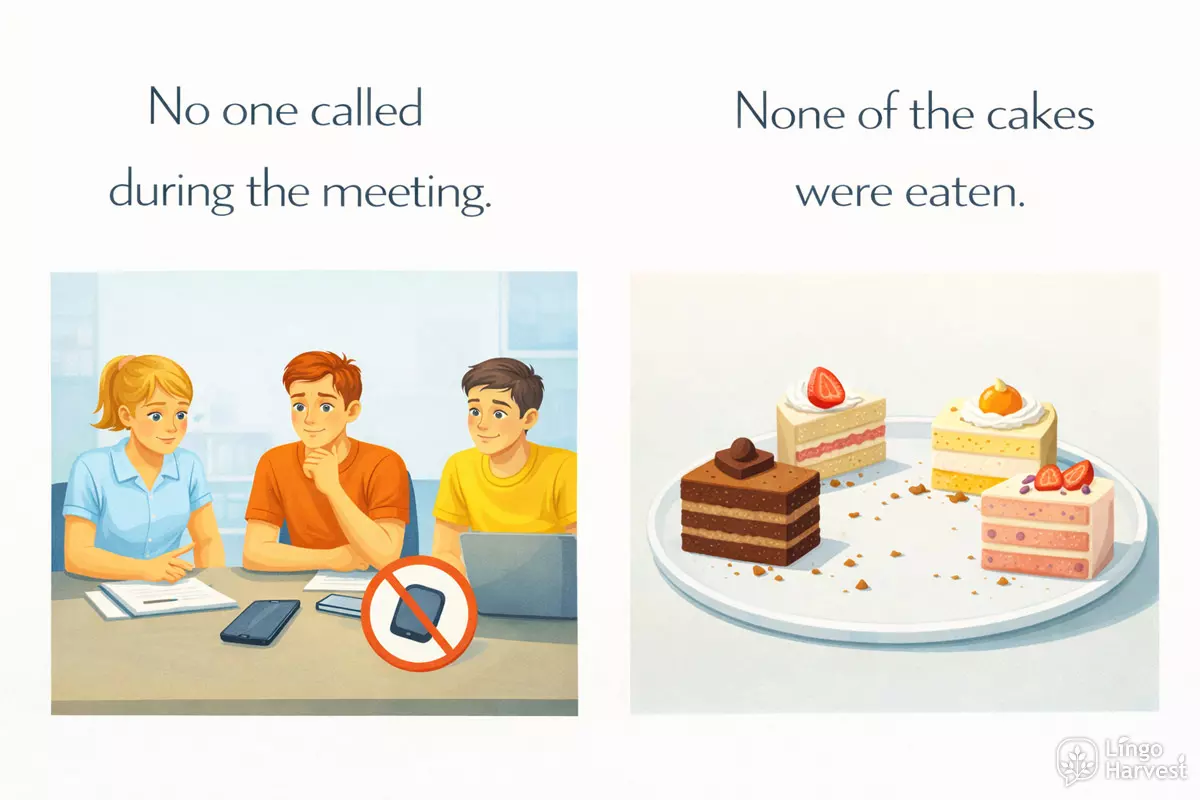
- No one called during the meeting.
- None of the cakes were eaten.
- Neither of the solutions works for us.
- No one understood the instructions.
- None of my friends like horror movies.
- Neither answer is satisfying.
- No one can help with this problem.
- None of these options appeal to me.
- Neither of them remembered the date.
- No one wants to leave early.
- None was found in the search.
- Neither suggestion was accepted.
- No one here speaks German.
- None of the lights are working.
- Neither candidate impressed the panel.
Comparison of function and typical use
| Pronoun | Key usage | Typical context |
|---|---|---|
| No one | Refers to zero people | Events, meetings, general statements |
| None | Refers to not any (things or people) | Groups, options, availability |
| Neither | Refers to not one or the other of two | Comparing two choices or alternatives |
In summary, these pronouns are essential for expressing negation and limitation in English. Choosing the right one depends on whether you are referring to people, things, or alternatives, and whether you are talking about none, not any, or not either of two.
Agreement patterns with indefinite pronouns
Patterns of agreement with indefinite pronouns can be tricky, as they do not always follow the same rules as definite nouns. In English, the verb and pronoun forms chosen often depend on whether the indefinite pronoun refers to a single person, a group, or an unspecified quantity. While some indefinite pronouns are always singular, others can be plural, and a few depend on context. Understanding these tendencies helps avoid common errors in both writing and speech.
Singular and plural agreement
Most indefinite pronouns, such as everyone, someone, and nobody, are treated as singular and take singular verbs and pronouns. However, words like few, many, and several are always plural. Some, including all, none, and some, can be either singular or plural depending on what they refer to.
| Indefinite Pronoun | Typical Agreement | Example Sentence |
|---|---|---|
| Everyone | Singular | Everyone is welcome. |
| Both | Plural | Both are correct. |
| None | Singular or Plural (context) | None is missing. / None are missing. |
| Some | Singular or Plural (context) | Some of the water is gone. / Some of the apples are gone. |
| Few | Plural | Few have arrived. |
| Anybody | Singular | Is anybody there? |
| Many | Plural | Many were chosen. |
| Nothing | Singular | Nothing matters now. |
Pronoun reference
Choosing the right pronoun to refer back to an indefinite form is another challenge. When the indefinite refers to people and is grammatically singular, writers may use he or she, they (as a singular pronoun), or recast the sentence for clarity. This is especially common with words like everyone or anyone.
- Everyone should bring their own lunch. (accepted informal singular ‘they’)
- Someone left his or her bag. (traditional formal style)
- No one remembered their umbrella.
- Each of the students did his or her best.
Special cases and variability
Some indefinite pronouns do not have a fixed verb agreement. Instead, their form depends on the noun or idea they refer to. The most common examples are all, some, most, and none.
When these words refer to an uncountable noun, they take a singular verb. When they refer to a plural countable noun, they take a plural verb.
- All of the information is correct. ✅ (uncountable)
- All of the equipment is ready. ✅ (uncountable)
- Some of the rice is cooked. ✅ (uncountable)
- Most of the advice is useful. ✅ (uncountable)
- All of the books are new. ✅ (plural countable)
- Some of the cookies are missing. ✅ (plural countable)
- Most of the students are present. ✅ (plural countable)
- None of the answers are correct. ✅ (plural countable)
By contrast, pronouns such as everyone, someone, anyone, nobody, and no one are always grammatically singular, even though they refer to people as a group.
- Everyone is ready. ✅
- Someone has left their bag here. ✅
- Nobody knows the answer. ✅
Common learner errors by group
Learners often struggle with indefinite pronouns because their meaning groups can seem similar, but usage rules vary. Errors tend to cluster depending on the group, such as using the wrong pronoun for positive, negative, or universal statements, or confusing singular and plural agreement. Below, we’ll look at the most typical mistakes for each group and how to avoid them.
Confusing "some-", "any-", and "no-" groups
A frequent issue is mixing up when to use pronouns like someone, anyone, or no one. This is especially common in questions and negative sentences. For example, learners may incorrectly use someone in questions where anyone is standard. Similarly, using no one in a sentence that is already negative leads to double negatives.
- ❌ I don't know no one here. → Incorrect double negative
- ✅ I don't know anyone here. → Correct
- ❌ Did someone call me? (when expecting anyone)
- ✅ Did anyone call me?
Singular vs. plural agreement
Another common pitfall is verb agreement with indefinite pronouns. Most are grammatically singular, even if they refer to multiple people or things, but learners sometimes use a plural verb by mistake.
- ❌ Everyone are here.
- ✅ Everyone is here.
- ❌ None of the students has finished. (when none can take a plural verb)
- ✅ None of the students have finished.
Using the wrong pronoun for objects vs. people
Mixing up pronouns that refer to people (someone, nobody) with those for things (something, nothing) is a recurring mistake, especially for speakers whose first language does not make this distinction.
- ❌ Is there something at the door? (when referring to a person)
- ✅ Is there someone at the door?
- ❌ Did you see anybody interesting? (correct, but learners may use anything instead of anybody)
Summary of typical errors by meaning group
| Meaning Group | Typical Learner Error |
|---|---|
| Positive (some-) | Using in negatives or questions: I don't want something |
| Negative (no-) | Double negatives: I didn't see nobody |
| Open/Universal (any-) | Using in positive statements: Anyone can help me (correct), but confusion in questions |
| Universal (every-) | Plural verbs: Everybody are ready |
| Object/Thing vs. Person | Mixing up something vs. someone |
Other pitfalls
Some learners overuse indefinite pronouns, making their speech vague. Others may omit them entirely, leading to incomplete sentences. Being aware of these patterns helps build more precise and natural communication.
Practice: choose the correct group by context
Understanding which indefinite pronoun group fits best depends on context and meaning. To build confidence, try these exercises focused on real usage. You’ll see sentences where you must select the group that makes sense, based on the idea of “all,” “some,” “none,” or “one/another.” The groups you’ll encounter are: universal (everyone, everything), existential (someone, something), negative (no one, nothing), and partitive/unspecified (anyone, anything).
Quick Selection Task
Read each sentence and choose which meaning group (universal, existential, negative, partitive) the bolded pronoun belongs to.
- Everyone arrived on time for the meeting.
- Is anyone still working on this project?
- No one could answer the final question.
- Did you find something interesting at the market?
- Nothing was left after the sale.
- Someone left their keys on the table.
- Everything seemed perfect during the event.
- She didn’t see anyone she recognized.
- Anything is possible if you try.
- Another volunteered to help.
Show answers
- Universal
- Partitive/unspecified
- Negative
- Existential
- Negative
- Existential
- Universal
- Partitive/unspecified
- Partitive/unspecified
- Partitive/unspecified
Meaning Group Comparison
Let’s compare how the four main indefinite pronoun groups function in similar contexts. This helps clarify their differences and appropriate uses.
| Group | Sample Pronouns | Example Sentence | Meaning |
|---|---|---|---|
| Universal | everyone, everything | Everyone enjoyed the concert. | All people/things |
| Existential | someone, something | Someone left their umbrella. | At least one (unknown) |
| Negative | no one, nothing | No one answered the phone. | Zero, none |
| Partitive/Unspecified | anyone, anything, another | Is anything missing? | Any (unspecified or unknown) |
Contextual Challenge: Which Group Fits?
For each prompt, decide which group of indefinite pronouns would be appropriate to complete the sentence. Choose from: Universal, Existential, Negative, Partitive/Unspecified.
- “__________ can join the club; there are no restrictions.”
- “I hope __________ brings snacks to the meeting.”
- “__________ was left after the fire.”
- “She didn’t see __________ she knew.”
- “__________ knows the correct answer.”
- “I didn’t hear __________ during the announcement.”
- “__________ left their phone on the table.”
- “__________ is allowed to enter this area.”
- “There isn’t __________ we can do now.”
- “__________ called while you were away.”
Show answers
- Universal (e.g., Anyone, Everyone)
- Existential (e.g., Someone)
- Negative (e.g., Nothing)
- Partitive / Unspecified (e.g., Anyone)
- Universal (e.g., Everyone)
- Negative (e.g., Anything)
- Existential (e.g., Someone)
- Universal (e.g., Anyone)
- Negative (e.g., Anything)
- Existential (e.g., Someone)
Tip: Look for Context Clues
Often, words like “all,” “some,” “none,” or “any” signal which indefinite pronoun group is needed. Practice spotting these clues in real sentences to improve your accuracy.