Who vs Whom: Rules That Actually Work

 Here we why who and whom are confusing, explains subject and object roles, and shows correct use in statements, questions, and after prepositions. It also discusses formal vs informal usage, common errors, and offers practice to decide which to use.
Understanding when to use subjective or objective pronouns in formal writing or conversation can be challenging, but it becomes easier with some key tips. Subjective pronouns such as I, he, she, we, and they serve as the subject of a sentence and perform the action, while objective pronouns like me, him, her, us, and them receive the action or follow prepositions. For example, use “She gave the book to him,” not “Her gave the book to he.” Practicing these distinctions will help you communicate more clearly and professionally.
Why who and whom are confusing
Many English speakers find it tricky to choose between “who” and “whom” because the distinction is based on grammar rules that aren’t always obvious in everyday speech. The confusion often stems from the fact that both words refer to people and can appear in similar parts of a sentence. However, their roles are different: one acts as the subject, while the other serves as the object. Since modern English often drops formal structures in conversation, the difference isn’t always clear, leading to uncertainty.
Subject vs. Object: The Source of the Mix-Up
At the heart of the issue is the subject-object distinction. “Who” is used as the subject of a clause—meaning it performs the action—while “whom” is the object, receiving the action. Yet, in casual speech, people frequently use “who” in both roles, making it harder to remember when “whom” is correct.
| Role in Sentence | Correct Pronoun | Example |
|---|---|---|
| Subject | who | Who called you? |
| Object | whom | To whom did you speak? |
| Object of preposition | whom | With whom are you going? |
| Subject in embedded clause | who | She is the one who won. |
Why the Rules Aren’t Obvious
- Spoken English often ignores the difference, so “whom” can sound overly formal or awkward.
- Word order can make it hard to spot the object or subject, especially in questions.
- People rarely diagram sentences in their heads, so the grammatical role isn’t always clear.
- Hypercorrection can make people use “whom” incorrectly, thinking it always sounds smarter.
- Relative clauses (like “the person who/whom I met”) add another layer of complexity, especially when the pronoun is far from the verb.
Common Situations That Cause Trouble

Below are some common patterns where “who” and “whom” get mixed up. These examples show how similar the sentences can appear, even though the correct word changes:
- Who/Whom do you trust?
- Who/Whom did you see at the meeting?
- The person who/whom called me was polite.
- For who/whom is this gift?
- She’s the one who/whom I told you about.
- Who/Whom should I ask?
- Who/Whom is coming to dinner?
- To who/whom should I address the letter?
- Who/Whom do they think will win?
- Who/Whom do you believe?
- The friend who/whom everyone admires
- Who/Whom are you waiting for?
In short, the overlap in usage and the shift in spoken English both contribute to uncertainty. Recognizing the subject-object split is the first step to mastering when to use each word.
Subject vs object role explained simply
Understanding the difference between a subject and an object in a sentence is crucial for deciding whether to use "who" or "whom." The subject is the person or thing performing the action, while the object is the person or thing receiving the action. This distinction helps clarify which pronoun fits correctly in a sentence.
How to spot the subject and object
To figure out if a word is acting as a subject or object, look at what role it plays in the sentence. Ask yourself: Who is doing something? That's the subject. Who is having something done to them? That's the object.
- Subject: The "doer" of the verb. Example: She eats the cake.
- Object: The receiver of the verb's action. Example: The dog chased him.
Quick subject vs object test
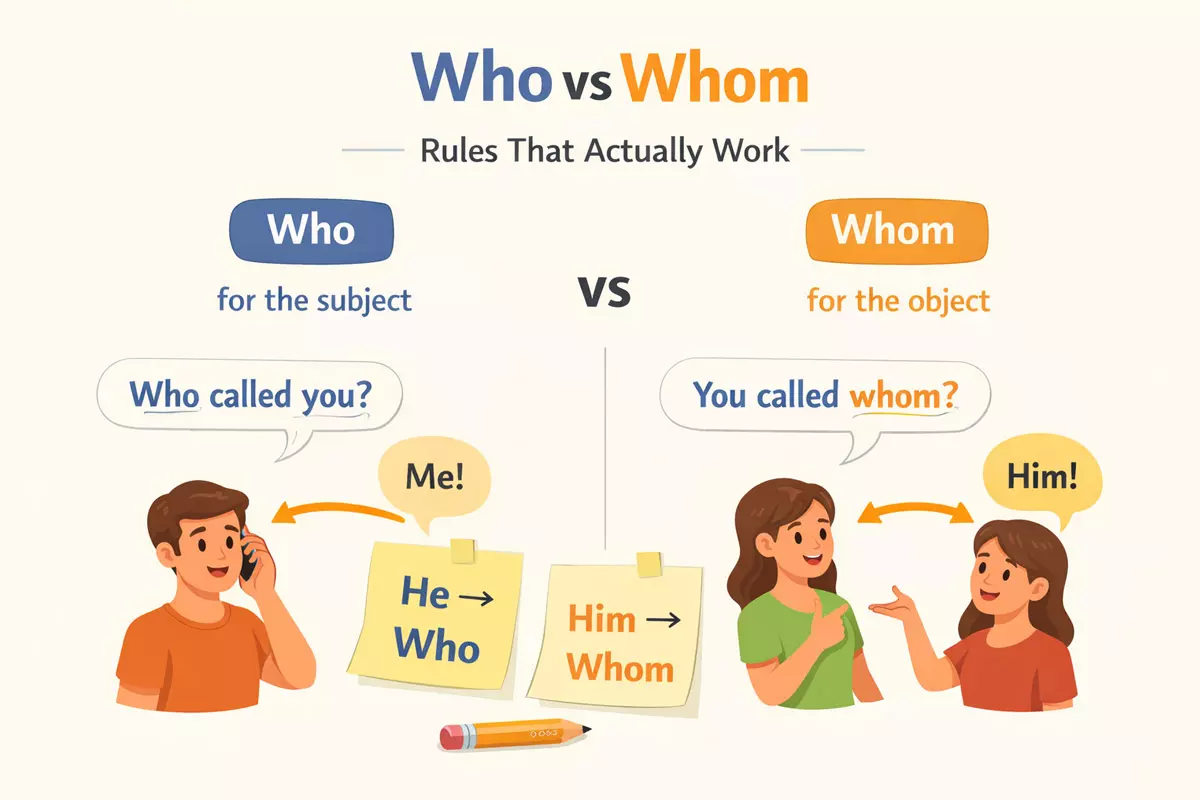
- Try replacing the word with "he/she" (subject) or "him/her" (object). If "he/she" fits, use "who." If "him/her" makes sense, use "whom."
- Example: "Who/whom did you see?" Test: "Did you see him?" (object) → Use "whom."
- Example: "Who/whom called you?" Test: "He called you." (subject) → Use "who."
| Role in sentence | Use | Example |
|---|---|---|
| Subject | who | Who made this cake? |
| Object | whom | To whom did you give the book? |
| Subject | who | Who is coming to dinner? |
| Object | whom | Whom should I invite? |
Common verbs and prepositions that trigger object form
- see (Whom did you see?)
- invite (Whom should we invite?)
- call (Whom did they call?)
- with (With whom are you speaking?)
- for (For whom is this present?)
- to (To whom should I address the letter?)
- ask (Whom did you ask?)
- meet (Whom did you meet?)
- help (Whom can I help?)
- about (About whom are you talking?)
Remember, recognizing whether a word is the actor or receiver in a sentence quickly unlocks the right choice between "who" and "whom." When in doubt, try the "he/him" swap—if "him" fits, "whom" is your answer.
Who/whom in statements and questions
Understanding when to use "who" versus "whom" can be a challenge, especially in both declarative sentences and interrogative forms. The core difference comes down to their grammatical roles: "who" functions as a subject, while "whom" serves as an object. Recognizing these roles in various types of sentences is the key to choosing correctly.
Identifying Subject and Object Roles
To decide which form to use, determine whether the word is acting as the subject (doing the action) or the object (receiving the action) within the clause. In everyday questions and statements, this distinction controls your choice.
- Who replaces subjects: "Who called you?" (Who is doing the calling)
- Whom replaces objects: "Whom did you call?" (Whom is receiving the call)
- "Who is coming to dinner?" (Who is the subject, performing the action)
- "To whom should I address the letter?" (Whom is the object of 'to')
- "Who made this cake?"
- "Whom are you inviting?"
- "Who wants ice cream?"
- "With whom did you speak?"
- "Who will win the prize?"
- "Whom do you trust?"
- "Who knows the answer?"
- "For whom is this package?"
- "Who left their umbrella?"
- "Whom should we thank?"
Quick Test: Use "he/she" or "him/her"
If you’re unsure, try substituting "he" or "him" (or "she"/"her") in the sentence. If "he/she" fits, use "who"; if "him/her" fits, use "whom." For example:
- "Who/Whom did you see?" → "Did you see him?" (So, "Whom did you see?")
- "Who/Whom is coming?" → "He is coming." (So, "Who is coming?")
Comparison Table: Usage in Sentences
| Sentence Type | Correct Form & Example |
|---|---|
| Subject in a question | Who is at the door? |
| Object in a question | Whom did you meet? |
| Object of a preposition | With whom are you traveling? |
| Subject in a statement | The person who called is waiting. |
| Object in a statement | The friend whom I saw was happy. |
Everyday Usage Tips
In casual speech, "who" often replaces "whom," but in formal writing or when clarity matters, using the correct form helps your sentences sound polished and precise. When in doubt, check the grammatical role or use the substitution trick above.
Whom after prepositions
Whenever a preposition comes directly before a pronoun, the formal choice is almost always "whom." This is because prepositions like to, for, with, and about require an object, and "whom" is the object form. Native speakers sometimes use "who" in casual speech, but in careful writing and speech, "whom" is expected after prepositions.
Why is "whom" used after prepositions?
Prepositions need an object, not a subject. Since "whom" serves as the object pronoun (while "who" is a subject pronoun), "whom" fits grammatically after prepositions. For example, in the phrase for whom the bell tolls, "whom" is the object of the preposition "for."
Common prepositions used with "whom"
Here are some typical prepositions that frequently appear with "whom" in both questions and relative clauses:
- about: Whom were you talking about?
- for: Whom is this gift for?
- with: Whom did you speak with after the meeting?
- to: To whom should I address the letter?
- by: Whom was the decision made by?
- from: From whom did you receive the message?
- after: Whom was she named after?
- before: Whom did he appear before?
- at: Whom was he shouting at?
- between: Between whom was the agreement signed?
- over: Whom were they arguing over?
- under: Under whom did she serve?
- without: Without whom could this project not succeed?
- among: Among whom was the prize divided?
- upon: Upon whom does the responsibility fall?
- against: Against whom were the charges filed?
- beside: Beside whom was he sitting?
- within: Within whom’s authority does this decision lie?
Sample patterns and sentences
You’ll often see "whom" following a preposition at the start of a question or relative clause. Here are some typical patterns and examples:
- To whom should I address the letter?
- With whom are you traveling?
- She’s the colleague about whom I was speaking.
- For whom did you buy this gift?
- That’s the person on whom you can rely.
- They have a friend with whom they share everything.
- By whom was the painting created?
- After whom is the award named?
- From whom did you hear the news?
- Without whom this project wouldn’t be possible.
Comparing usage: "who" vs. "whom" after prepositions
| Incorrect Form | Correct Form |
|---|---|
| To who did you give the keys? | To whom did you give the keys? |
| With who are you meeting? | With whom are you meeting? |
| About who are they talking? | About whom are they talking? |
| For who is this intended? | For whom is this intended? |
In summary, when a preposition directly precedes the pronoun, "whom" is the appropriate choice in formal English. If you’re unsure, try rephrasing the sentence in your head—if “him” or “her” fits, "whom" is correct.
Formal vs informal usage today
In modern English, the distinction between “who” and “whom” is much more noticeable in formal writing than in everyday conversation. You’ll often see “whom” in academic papers, legal documents, and business correspondence, where precise grammar is expected. On the other hand, in informal speech and casual writing—like emails, texting, and social media—“whom” is frequently replaced by “who,” or omitted entirely.
Where “whom” still appears
Although “whom” is less common in spoken English, it hasn’t disappeared. People tend to use it:
- In formal letters or applications
- When writing essays or research papers
- During speeches or presentations that require a polished tone
- In traditional invitations or ceremonial language
- When quoting or imitating older literature
- In legal or official documents
- Where clarity is essential, such as complex sentences with multiple clauses
- In certain fixed expressions (“To whom it may concern”)
- When writers want to sound particularly correct or authoritative
- In journalism, especially in publications with strict style guides
How usage differs in practice

Native speakers often use “who” instead of “whom” in informal settings, even when “whom” is technically correct. This shift is driven by the desire for conversational flow and simplicity. In fact, using “whom” in casual speech can sound overly formal or even pretentious, unless the context clearly calls for it.
| Context | Typical Usage | Example |
|---|---|---|
| Academic writing | “Whom” preferred | “The candidate whom we interviewed was impressive.” |
| Casual conversation | “Who” almost always used | “Who did you meet yesterday?” |
| Business emails | Mix of both; “whom” in formal greetings | “To whom it may concern:” |
| Texting/social media | “Who” dominates; “whom” rare | “Who are you talking about?” |
| Legal documents | Strict use of “whom” | “The party to whom notice is given…” |
| Fixed expressions | “Whom” remains standard | “To whom it may concern” |
Should you use “whom”?
In most professional or academic contexts, using “whom” correctly can help you sound polished and precise. However, in friendly, everyday settings, no one will notice—or care—if you stick with “who.” If you’re unsure, consider the level of formality and your audience. When in doubt, clarity and natural tone matter more than rigid rules.
When whom can be safely avoided
In modern English, using “whom” is often optional, especially in casual speech and informal writing. Many native speakers rarely use it in everyday conversation, and even in professional contexts, its absence is unlikely to confuse readers. While "whom" is technically correct as the object form of "who," clarity and natural flow often matter more than strict grammatical precision.
Situations where "who" works just fine
There are plenty of scenarios where substituting "who" for "whom" won’t raise eyebrows. Unless you’re writing for a highly formal publication or responding to an English grammar stickler, these are some common cases where you can relax:
- Questions: "Who did you see at the party?" instead of "Whom did you see at the party?"
- Relative clauses: "She’s the person who I was talking about" instead of "…whom I was talking about."
- Emails and texts: "Who should I call?" is almost always acceptable.
- Headlines and advertising: Conciseness and readability outweigh strict usage.
- Spoken English: Most people use "who" regardless of grammatical role.
- Social media posts: Brevity and tone matter more than perfect grammar.
- When the object is obvious from context: "Who are you meeting?"
- When “whom” feels awkward or stilted: If it interrupts the flow, skip it.
- Dialogue in fiction: Characters sound more natural with "who."
- Quick questions: "Who should I ask?" instead of "Whom should I ask?"
Why "whom" is fading in everyday usage
Language evolves, and many grammar rules that were once strictly enforced have become more relaxed. The distinction between "who" and "whom" is one such example. Even style guides often acknowledge that insisting on "whom" can make sentences sound unnatural or overly formal. Unless clarity demands it, using "who" as both subject and object is widely accepted.
When to avoid "whom" for clarity’s sake
Sometimes, sticking to "whom" can actually confuse your reader or disrupt the flow of your writing. If the sentence feels forced or you have to pause to check whether "whom" is correct, it’s usually better to use "who." This approach is especially helpful for non-native speakers and learners who want to prioritize clear communication over perfect grammar.
| Context | Preferred Usage |
|---|---|
| Casual conversation | Who |
| Informal emails/texts | Who |
| Social media | Who |
| Formal writing (academic/legal) | Whom (optional) |
| Literary dialogue | Who |
| Headlines/titles | Who |
In summary, if you’re unsure whether to use "whom," it’s almost always safe to use "who" in informal situations. Reserve "whom" for formal writing or when you want to sound particularly precise. Most readers won’t notice the difference—and if they do, it’s usually in settings where style guides still endorse the traditional rule.
Common learner errors
Learners often get tripped up by the distinction between "who" and "whom," especially since spoken English frequently bends the rules. The confusion usually arises because the two words sound similar and both refer to people. However, their grammatical roles are different, and using them interchangeably can lead to awkward or incorrect sentences.
Mixing up subject and object roles
A frequent mistake is using "who" when "whom" is needed, or vice versa. "Who" acts as the subject of a clause, while "whom" functions as the object. Many people default to "who" in all situations, even when it isn’t appropriate.
- Incorrect: Whom is coming to dinner tonight?
- Correct: Who is coming to dinner tonight?
- Incorrect: I don’t know who to invite.
- Correct: I don’t know whom to invite.
Forgetting the "he/him" test
A simple way to check which word to use is to replace "who" or "whom" with "he" or "him." If "he" fits, use "who"; if "him" fits, use "whom." Skipping this test can lead to mistakes, especially in complex sentences.
| Example Sentence | He/Him Test | Correct Choice |
|---|---|---|
| ______ did you see at the park? | You saw him. | Whom |
| ______ is making that noise? | He is making that noise. | Who |
| To ______ should I address the letter? | Address it to him. | Whom |
| ______ wants more cake? | He wants more cake. | Who |
Overcorrecting with "whom"
Some learners, trying to sound formal or correct, use "whom" everywhere—even as a subject. This leads to unnatural sentences and can make writing seem stilted.
- Using "whom" at the start of a question when "who" is correct.
- Inserting "whom" in casual speech where native speakers would never use it.
Misplacing in embedded clauses
Complex sentences with embedded clauses often cause confusion. Learners might lose track of the clause structure and choose the wrong form.
- “I met the artist who painted this.” (Correct: "who" as subject of “painted”)
- “She’s the person whom I told you about.” (Correct: "whom" as object of “told”)
- “Do you know who is coming?” ("who" as subject of “is coming”)
- “This is the student whom the teacher praised.” ("whom" as object of “praised”)
Summary of typical mistakes
- Using "who" as an object or "whom" as a subject
- Not applying the "he/him" substitution test
- Overusing "whom" to sound formal
- Getting lost in complex sentences and choosing the wrong word
Understanding these pitfalls—and practicing with real examples—can help you use "who" and "whom" with greater confidence.
Practice: decide who or whom by function
Understanding when to use "who" or "whom" comes down to their role in a sentence. "Who" acts as a subject, while "whom" is the object of a verb or preposition. Applying this rule can be tricky in everyday writing, so practicing with real examples is key.
Quick rule recap
- Who: Use when referring to the person doing the action (subject).
- Whom: Use when referring to the person receiving the action (object).
Examples: Spot the function
Consider these sentences. Decide which word fits by thinking about its grammatical function:
- ______ is coming to dinner tonight?
- To ______ should I address the letter?
- She didn’t know ______ had called her.
- He’s the one ______ everyone admires.
- ______ do you trust most?
- With ______ did you discuss the project?
- Can you tell me ______ finished the assignment?
- ______ are you inviting to the event?
- The manager, ______ we met yesterday, gave a great presentation.
- ______ of these candidates do you recommend?
Show answers
- Who is coming to dinner tonight?
- To whom should I address the letter?
- She didn’t know who had called her.
- He’s the one whom everyone admires.
- Whom do you trust most?
- With whom did you discuss the project?
- Can you tell me who finished the assignment?
- Whom are you inviting to the event?
- The manager, whom we met yesterday, gave a great presentation.
- Which of these candidates do you recommend? (Note: "Which" is correct here, not "who/whom.")
Common sentence patterns
Some sentence structures make it easier to decide which form to use. Here’s a table with typical patterns and their correct pronoun:
| Pattern | Correct word |
|---|---|
| Who/Whom + [verb] | Who ("Who called?") |
| [Preposition] + who/whom | Whom ("To whom did you speak?") |
| [Verb] + who/whom (object) | Whom ("Whom did you see?") |
| [Noun], who/whom + [clause] | Who ("The person who arrived") or Whom ("The person whom I met") |
Quick tip: Try “he/she” vs. “him/her”
A practical trick is to substitute "he/she" (subject) or "him/her" (object). If "he/she" fits, use "who." If "him/her" fits, use "whom." For example:
- “Who/Whom did you see?” → “Did you see him?” (object) → Whom
- “Who/Whom called you?” → “He called you.” (subject) → Who
Practice these patterns regularly to make the right choice automatic. If you’re ever in doubt, check the function in the sentence before deciding.