Omitted Relative Pronouns: When Zero Is Correct

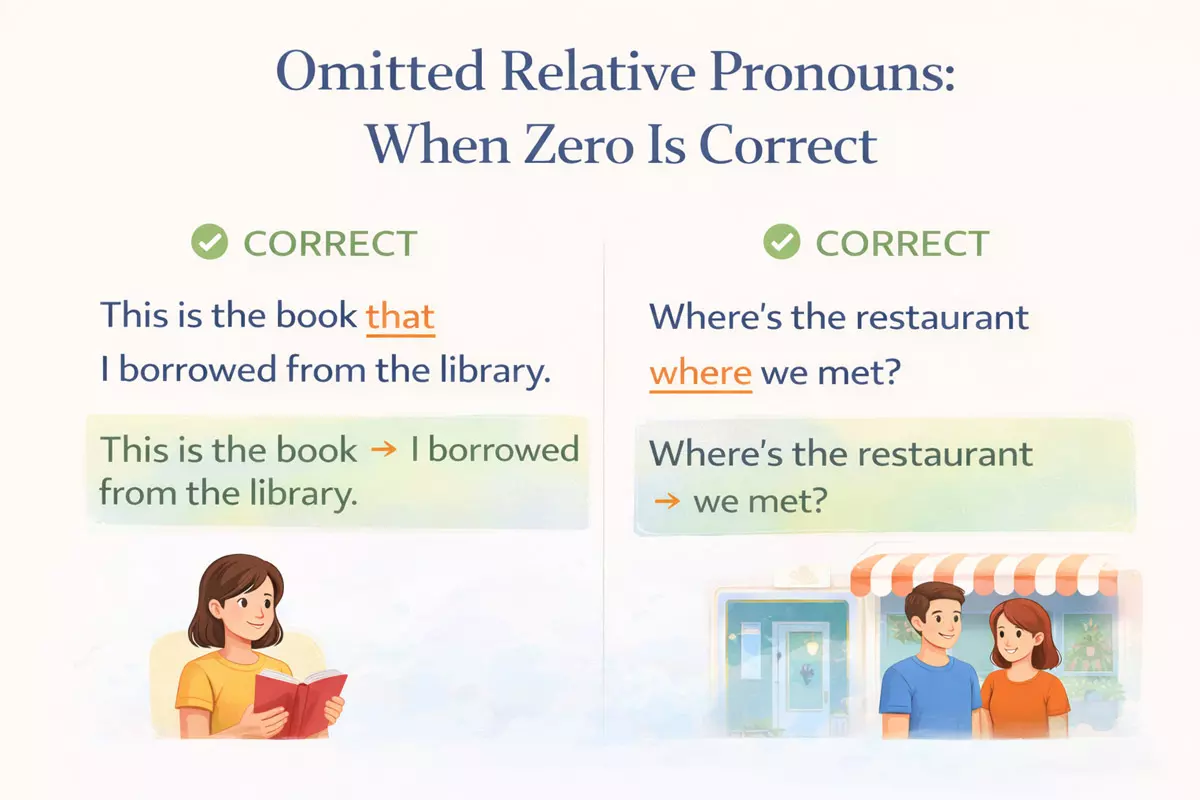 This article explains zero relative pronouns, when you can omit them, and the difference between subject and object positions in clauses. It covers restrictions, usage in speech and writing, frequent learner mistakes, and practice tips.
Mastering subtle grammar rules is essential for clear communication, particularly when it comes to omitting certain words deliberately. Understanding when to leave out a connecting word within a clause allows your writing to flow more smoothly and sound more natural to readers. This skill helps prevent awkward or redundant phrasing, making your sentences concise yet effective. By paying attention to these nuances, you can elevate your writing and ensure your message is conveyed with clarity and precision.
What zero relative pronouns are
English sometimes allows you to leave out certain words in a sentence, even though they’re technically “missing.” One common case is when a relative pronoun like that or which is omitted. This omission is known as the “zero relative pronoun.” Instead of saying, “This is the book that I recommended,” you can simply say, “This is the book I recommended.” The meaning stays the same, and the sentence often sounds more natural.
Where zero forms appear
You’ll most often find this kind of omission in defining (restrictive) relative clauses, especially when the missing word would be the object of the clause. In other words, you can drop the pronoun when it’s not the subject of the clause. Here are some contexts where it’s common:
- After nouns when the clause describes which person or thing you mean: “The movie [that] we watched was exciting.”
- With time and place expressions: “The year [that] we met was unforgettable.”
- In everyday speech, especially in short sentences: “The bag [that] you lost is here.”
- When the pronoun would be that, which, or who as the object: “She’s the artist [who] I admire.”
- In questions with relative clauses: “Do you remember the song [that] I played?”
- After words like all, everything, something: “Everything [that] you said was true.”
- When the relative clause follows an indefinite pronoun: “Someone [who] I trust will help.”
- In informal writing and speech, as a style choice.
- With verbs that naturally take a direct object: “The advice [that] she gave me was helpful.”
- In non-formal registers, omitting the object pronoun is common and accepted.
Zero vs. explicit relative pronouns
It’s important to know when you can omit the pronoun and when you can’t. Generally, you cannot drop the pronoun if it’s the subject of the clause. For example, you must say, “The man who called is here,” not “The man called is here.” The omission is only possible when the word would be the object of the relative clause.
| Full Relative Clause | With Zero Pronoun |
|---|---|
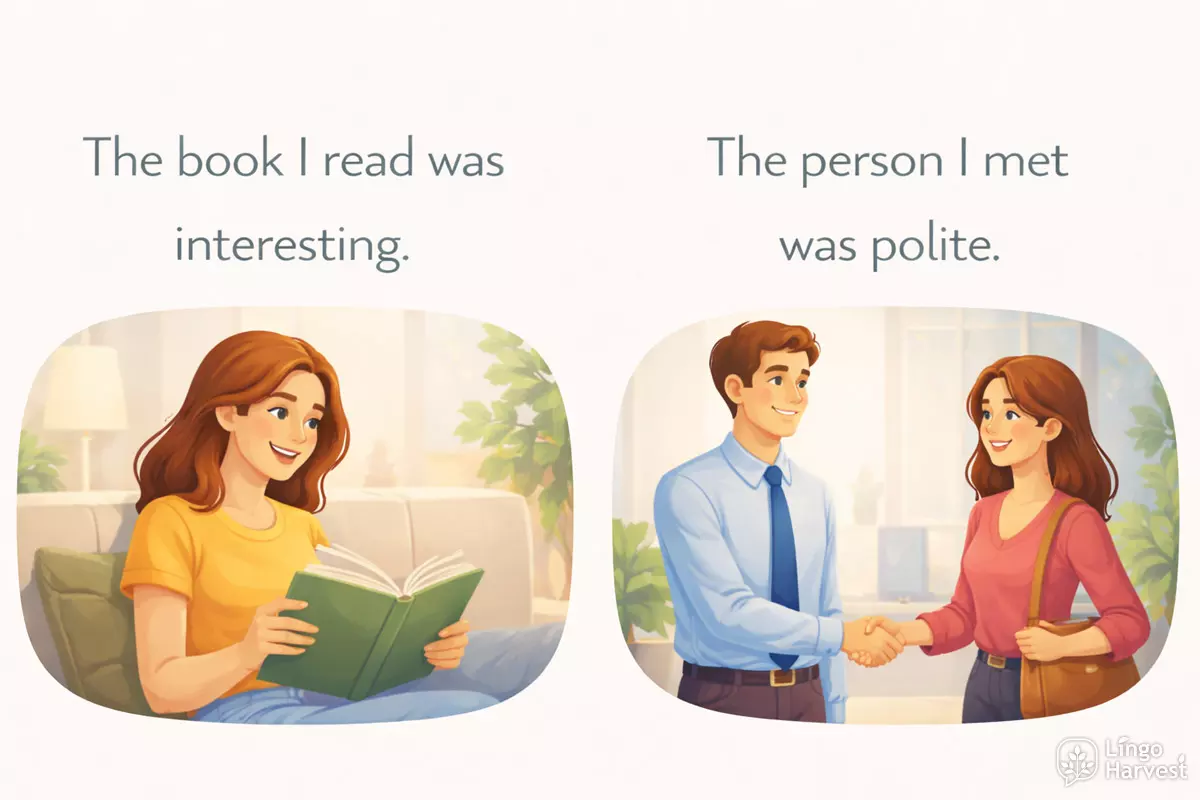
| The book that I read was interesting. | The book I read was interesting. |
| The person who I met was polite. | The person I met was polite. |
| The cake which you baked was delicious. | The cake you baked was delicious. |
| This is the film that we discussed. | This is the film we discussed. |
| The job that she wanted is available. | The job she wanted is available. |
Quick tips
- Use the zero form only when the pronoun would be the object.
- If the pronoun is the subject, it must stay.
- Omission is more common in speech and informal writing.
- “That,” “which,” and “who” are the usual candidates for omission.
Understanding when and how to leave out these words makes your English smoother and more concise, especially in everyday communication. It’s a subtle feature that can make your sentences sound more natural without losing clarity.
When relative pronouns can be omitted
In English, it’s often possible to leave out a relative pronoun—such as who, which, or that—without making the sentence ungrammatical. This omission is known as the “zero relative pronoun.” However, dropping the pronoun is only correct in specific grammatical contexts. Understanding when this is allowed can make your writing more natural and concise.
Situations where omission is allowed
You can usually omit the relative pronoun in restrictive relative clauses when it acts as the object of the clause, but not when it is the subject. Here are the main rules:
- Object of the clause: The pronoun can go missing if it would be the object of the verb in the relative clause.
Example: “The book (that) I read was fascinating.” - After prepositions (informal speech): In casual English, the pronoun is often dropped even when it’s the object of a preposition, especially if the preposition comes at the end.
Example: “This is the person (who) I was talking about.” - Never as subject: If the pronoun is the subject of the relative clause, it cannot be omitted.
Example: “The woman who called you is here.” (You can’t omit who here.)
Common patterns for omission
Here are some of the most frequent sentence structures where leaving out the relative pronoun is correct:
- She’s the artist (who) I met at the gallery.
- That’s the song (which) everyone loves.
- Here’s the house (that) they built in 1900.
- This is the jacket (which) I bought last week.
- The advice (that) you gave me was helpful.
- The team (which) we supported won the match.
- The cake (that) she baked was delicious.
- This is the problem (which) we need to solve.
- The email (that) you sent arrived late.
- The friend (who) you mentioned is here.
- The car (that) he drives is electric.
- The project (which) they started is finished.
- The question (that) you asked was difficult.
- The place (which) I visited was beautiful.
- The phone (that) you lost has been found.
- The dress (which) she wore was stunning.
- The exam (that) we took was hard.
- The solution (which) you suggested worked.
- The book (that) I borrowed is overdue.
Omission rules at a glance
| Clause Position | Can Omit Pronoun? | Example |
|---|---|---|
| Object of the verb | ✅ Yes | The film (that) I enjoyed was long. |
| Object of preposition (preposition at end) | ✅ Yes | The person (who) I spoke to was helpful. |
| Subject of the clause | ❌ No | The man who called left a message. |
| Non-restrictive clauses (with commas) | ❌ No | My car, which is red, is parked outside. |
To sum up, omitting a relative pronoun is often possible, but only when the pronoun is not the subject of its clause and the clause is restrictive (no commas). Avoid omissions in formal writing after prepositions placed before the gap, or in non-restrictive clauses. Recognizing these patterns helps you write more naturally and avoid common mistakes.
Subject vs object position inside clauses
Understanding where a relative pronoun is omitted—whether in subject or object position—makes a significant difference in English grammar. The key distinction is that omission is often possible when the relative pronoun would be the object of the relative clause, but not when it functions as the subject. This affects both clarity and correctness in sentence construction.
When omission is allowed: Object position
If the implied relative pronoun acts as the object within the relative clause, it can usually be dropped. This is most common in informal and conversational English, and it helps streamline sentences. The noun being described is still clearly linked to the rest of the clause, even without the pronoun.
- The book (that) I read was excellent. ✅
- The cake (which) she made was delicious. ✅
- The movie (that) we watched last night was funny. ✅
- The person (who) you met is my cousin. ✅
- The song (which) you like is playing. ✅
- The keys (that) I lost were found. ✅
- The painting (which) he bought is expensive. ✅
- The idea (that) you suggested works. ✅
- The teacher (whom) we saw was kind. ✅
- The advice (that) you gave helped me. ✅
When omission is not allowed: Subject position
If the relative pronoun would serve as the subject within the clause, it must be present. Omitting it creates confusion and ungrammatical sentences, because the clause would lack an explicit subject.
- The book that is on the table is mine. ❌ (Omission incorrect)
- The girl who called you is my sister. ❌
- The man who lives next door is a doctor. ❌
- The dog that barked all night kept me awake. ❌
- The car which broke down was towed. ❌
| Position of Relative Pronoun | Omission Possible? | Example (with/without pronoun) |
|---|---|---|
| Object | Yes ✅ | The book (that) I bought is new. The friend (who) you called is here. |
| Subject | No ❌ | The car that broke down is gone. The boy who helped me is kind. |
| Object of preposition (preposition at end) | Yes ✅ | The house (that) I live in is old. The person (who) I spoke to was helpful. |
| Object of preposition (preposition before pronoun) | No ❌ | The house in which I live is old. The person to whom I spoke was helpful. |
Summary of usage patterns
In summary, leaving out the relative pronoun is correct only when it does not function as the subject of the relative clause. When the pronoun is the object—or the object of a preposition placed at the end—omission is usually natural and grammatical. However, when the pronoun is the subject, or follows a preposition at the start, it must be included.
Restrictions: when omission is not possible
While omitting relative pronouns is common in English, there are several contexts where leaving them out results in ungrammatical or unclear sentences. Understanding these limits helps in choosing when to use "that," "who," "which," or "whom" explicitly.
When the Relative Pronoun Is the Subject
If the relative word serves as the subject of the relative clause, it cannot be omitted. Without it, the sentence structure breaks down and the meaning can become confusing. For example:
- The artist who painted this is famous. ✅
- The artist painted this is famous. ❌
Prepositions Before Relative Pronouns
When a preposition comes before the relative pronoun (preposition stranding is not used), omission is not allowed. The relative word must follow the preposition directly:
- The person to whom I spoke was helpful. ✅
- The person to I spoke was helpful. ❌
Non-defining (Non-restrictive) Clauses
In non-defining clauses (those giving extra, non-essential information), the relative pronoun cannot be dropped. These clauses are usually separated by commas:
- My brother, who lives in Canada, is visiting. ✅
- My brother, lives in Canada, is visiting. ❌
Examples: Omission vs. Retention
Here's a quick comparison of when you must keep the relative word and when you can leave it out:
| Context | Omission Allowed? |
|---|---|
| Object in defining clause The book (that) I read |
Yes |
| Subject in defining clause The girl who called |
No |
| After preposition The place at which we met |
No |
| Non-defining clause My father, who is a doctor, ... |
No |
| Possessive clauses The man whose car broke down |
No |
| Object in defining clause (no preposition) The dog (that) I adopted |
Yes |
Other Situations Where Omission Is Not Possible
- When "whose" is needed to indicate possession
- When omitting the pronoun causes ambiguity or confusion
- Formal, academic, or legal writing often prefers explicit pronouns
- When the relative clause modifies an entire sentence, not just a noun
- After "all," "much," "little," or "none" referring to things
As a general guideline, always check the grammatical role of the relative word in the clause. If it is the subject, follows a preposition, or introduces extra information, omission is not correct. When in doubt, keeping the pronoun ensures clarity and correctness.
Zero relatives in spoken English
In casual conversation, native speakers often skip relative pronouns such as "that" or "which" when they are not needed for clarity. This habit is especially common when the pronoun would serve as the object of the relative clause. Omitting these words can make sentences sound more natural and less formal, reflecting the rhythm and flow of everyday speech.
Where omission is natural
The dropped pronoun usually follows a noun and introduces extra information or defines the noun. For instance, in "That's the book I told you about," the word "that" is understood but not spoken. This omission is generally accepted when the relative pronoun would be the object, not the subject, of the clause.
Common patterns and examples

Spoken English favors dropping the relative pronoun in certain situations. Here are typical cases where this occurs:
- The movie (that) we watched last night was amazing.
- She's the artist (who/that) I met in Paris.
- The report (that) we discussed yesterday is finally complete.
- She’s the designer (who/that) I worked with last summer.
- There’s the package (which/that) you were waiting for.
- This is the podcast (that) I listen to on my commute.
- He’s the colleague (who/that) you were talking about earlier.
- That’s the message (that) I needed to hear.
- Here’s the document (that) you asked me to review.
- It’s a rule (that) everyone tends to forget.
- This is the apartment (that) we rented for the weekend.
- She found the receipt (which/that) she had misplaced.
- That’s the photo (that) everyone shared online.
When omission is not possible
Dropping the relative pronoun is not always correct. If the pronoun acts as the subject of the clause, it must remain. For example:
- The man who called is waiting. ❌ (Cannot omit "who")
- The dog that barked all night kept me awake. ❌ (Cannot omit "that")
In these cases, removing the pronoun would make the sentence ungrammatical.
Subject vs. object omission: a quick comparison
| Type | Example (with/without pronoun) |
|---|---|
| Object pronoun (can omit) | That's the car (that) I bought. |
| Subject pronoun (cannot omit) | The woman who called me is here. |
| Object of preposition (can often omit) | Here's the address (that) you asked for. |
| Possessive (cannot omit) | The boy whose bike was stolen is upset. |
Summary
Leaving out relative pronouns is a hallmark of fluid, everyday English, but it’s subject to certain rules. Generally, if the pronoun is not the subject or possessive in its clause, omitting it is natural and widely accepted in speech. Awareness of these patterns helps learners and non-native speakers sound more authentic and confident.
Written usage and clarity concerns
In formal writing, the choice to leave out a relative pronoun—sometimes called a "zero relative"—can impact how easily readers follow your sentence. While omitting "that," "which," or "who" is often acceptable in casual speech, written contexts demand more attention to clarity and formality. Skipping the pronoun is usually only correct when it serves as the object (not the subject) of the relative clause, and the omission does not create ambiguity or disrupt the sentence flow.
When omission works—and when it doesn't
Writers sometimes leave out the relative pronoun in restrictive clauses, especially after a noun. For example, "The book I read was fascinating" omits "that," which is acceptable because "I" is the subject of "read." However, omitting the pronoun can confuse readers if the sentence structure becomes unclear or if multiple clauses are involved. To ensure readability, always consider whether the omitted word would help the reader parse the sentence more easily.
| Full Relative Clause | Omitted Pronoun Version |
|---|---|
| The song that she likes is playing. | The song she likes is playing. |
| The man who you met is my uncle. | The man you met is my uncle. |
| This is the movie which I mentioned. | This is the movie I mentioned. |
| Here is the email that you requested. | Here is the email you requested. |
| The book which she wrote won an award. | The book she wrote won an award. |
Potential clarity pitfalls
- Ambiguity: If removing the pronoun makes it unclear which noun the clause describes, keep it in.
- Complex sentences: Multiple clauses or embedded phrases may require explicit relatives for smooth reading.
- Formality: In academic, legal, or official writing, retaining the pronoun is often preferred for precision.
- Subject vs. object: Only omit when the pronoun is an object; never drop it if it acts as the subject of the clause.
Common patterns where omission is possible
- After nouns with restrictive clauses: "The car I bought is blue."
- With verbs requiring an object: "The advice you gave helped me."
- In short, simple sentences: "The friend you called is here."
- When the omitted pronoun would be "that," "which," or "who" as object.
- After time expressions: "The year we moved was difficult."
- With place expressions: "The city we visited was crowded."
- In reported speech: "The story she told surprised everyone."
- With infinitive structures: "The person to contact is John."
- After quantifiers: "All the books I own are old."
- With prepositions at the end: "The topic I’m interested in."
To sum up, omitting a relative pronoun can make writing more concise, but only when it does not interfere with understanding. When in doubt, especially in more formal settings, including the pronoun is the safer choice.
Common learner mistakes
Learners often struggle to know when omitting the relative pronoun (such as "who," "which," or "that") is allowed, and when it creates an error. The confusion usually comes from applying rules inconsistently or misunderstanding the function of these pronouns in relative clauses.
Mixing up subject and object roles
A frequent issue is forgetting that a relative pronoun can only be dropped when it acts as the object, not the subject, of the relative clause. For example, in "The book (that) I read was interesting," "that" is the object and can be omitted. But in "The book that was interesting," "that" is the subject and cannot be left out.
- Leaving out the pronoun when it’s the subject: Incorrect: "The man lives next door is friendly."
- Omitting the pronoun when it’s needed for clarity: Incorrect: "This is the house built last year."
- Dropping the pronoun in formal writing where it’s better retained.
- Inserting the pronoun when omission is perfectly acceptable: Overusing: "The cake that I baked yesterday was delicious."
Confusion with restrictive and non-restrictive clauses
Another pitfall is misunderstanding when zero relative pronouns are allowed. The omission is possible only in restrictive (defining) clauses, not in non-restrictive (non-defining) ones. Learners sometimes try to omit the pronoun after a comma, which is never correct.
- Omitting after a comma: Incorrect: "My sister, I admire, is a doctor."
- Forgetting that non-defining clauses must always include a pronoun.
Problems with prepositions
When a relative pronoun is the object of a preposition, learners may omit the pronoun incorrectly or place the preposition awkwardly.
- Leaving out the pronoun after a preposition: Incorrect: "The company for I work is international."
- Separating the preposition from its object inappropriately: "The team I play for" (correct informal), but "The team for which I play" (formal).
Summary Table: When to Omit the Pronoun
| Situation | Can Pronoun Be Omitted? |
|---|---|
| Object of the relative clause (e.g. "The movie [that] I watched") |
✅ Yes |
| Subject of the relative clause (e.g. "The dog that barked") |
❌ No |
| After a preposition (e.g. "The friend to whom I spoke") |
❌ No |
| Non-defining clause (with comma) (e.g. "My brother, who lives abroad, ...") |
❌ No |
Typical learner errors
- Trying to omit the pronoun in all types of clauses without checking its grammatical role.
- Assuming omission is always informal or incorrect in academic writing (it is sometimes required, even in formal contexts).
- Confusing the rules for "who," "which," and "that" and applying omission inconsistently.
- Not recognizing when the omitted pronoun leads to ambiguity or awkwardness.
Understanding these patterns can help you decide when zero relative pronouns are correct and when they are not, leading to clearer and more accurate English.
Practice: remove or keep the relative pronoun
Understanding when to omit a relative pronoun is essential for clear, natural English. In some cases, the pronoun (like "that" or "which") is needed; in others, it can be dropped without changing the meaning. This practice section will help you decide when to keep or remove it.
Test Your Skill: Omit or Retain?
Below are sentences where you need to determine if the relative pronoun can be left out or must remain. Read each sentence, then decide your answer before revealing the solutions.
- This is the book that I told you about.
- The cake which she baked was delicious.
- The people who live next door are friendly.
- The report that he submitted was late.
- Here’s the email which you requested.
- The artist who painted this is famous.
- The song that you like is on the radio.
- They hired a designer who speaks French.
- The pen that I lost was blue.
- The students who passed the test were happy.
Show answers
- 1. Can be omitted: "This is the book I told you about."
- 2. Must be kept: "The cake which she baked was delicious." (optional in informal English, but best kept for clarity)
- 3. Must be kept: "The people who live next door are friendly." ("who" is the subject)
- 4. Can be omitted: "The report he submitted was late."
- 5. Can be omitted: "Here’s the email you requested."
- 6. Must be kept: "The artist who painted this is famous." ("who" as subject)
- 7. Can be omitted: "The song you like is on the radio."
- 8. Must be kept: "They hired a designer who speaks French." ("who" is subject)
- 9. Can be omitted: "The pen I lost was blue."
- 10. Must be kept: "The students who passed the test were happy." ("who" is subject)
Summary Table: When Can You Omit?
| Clause Type | Can the Relative Pronoun Be Omitted? |
|---|---|
| Object of the clause | Yes (e.g., "The movie (that) I watched") |
| Subject of the clause | No (e.g., "The person who called") |
| After prepositions (formal) | No (e.g., "The house in which I live") |
| After prepositions (informal, at end) | Yes, often omitted (e.g., "The house I live in") |
Quick Tips
- If the pronoun is the object of the clause, you can usually drop it.
- If the pronoun is the subject, keep it.
- Prepositions at the end often allow omission in informal contexts.
- In formal writing, omitting the pronoun after a preposition is less common.
Practicing these distinctions will help you write and speak more naturally, using relative clauses with confidence.