Relative Pronouns in Spoken vs Written English

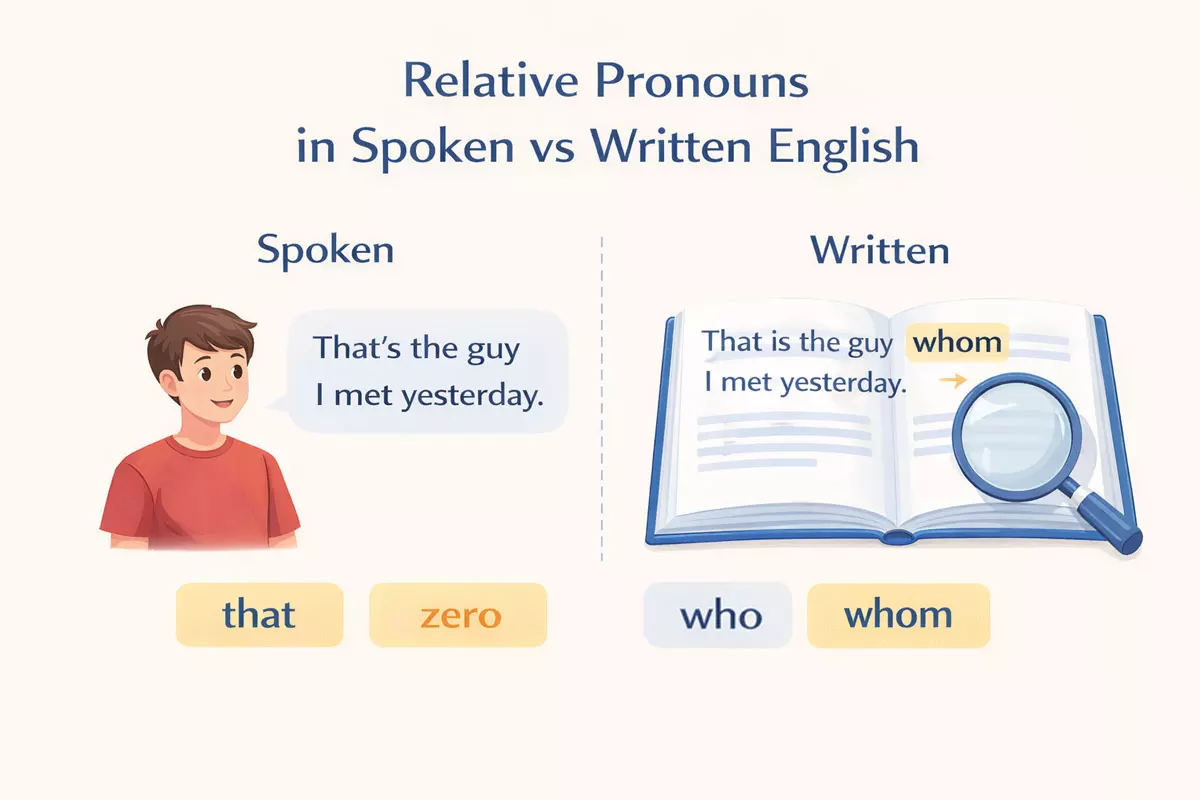 The article compares how spoken and written English use relative pronouns, including patterns in pronoun frequency, omission in speech, punctuation and clause length, register-driven choices, typical learner mistakes, and includes practice rewriting sentences.
- How spoken and written English treat relative pronouns differently
- Frequency of that, who, and which in conversation
- Omitting relative pronouns in spoken English
- More explicit structures in formal writing
- Comma usage and clause length differences
- Register-driven choices in real examples
- Typical learner mistakes across registers
- Practice: rewrite sentences for speech and writing
Comparing the ways people connect ideas in conversation and in formal writing reveals intriguing differences in word choice and structure. In casual speech, individuals often rely on simpler connectors like “and,” “but,” or “so,” which help keep the flow natural and spontaneous. In contrast, formal writing typically features more precise linking words such as “however,” “therefore,” or “in addition,” which clarify relationships between ideas and enhance clarity. These differences highlight how context influences the language we use to organize and express our thoughts.
How spoken and written English treat relative pronouns differently
Spoken and written forms of English often approach relative pronouns in surprisingly distinct ways. In conversation, speakers tend to prioritize speed and clarity, leading to frequent omission or simplification of relative pronouns. In contrast, formal writing usually maintains grammatical completeness and precision, making full use of these pronouns.
Common Patterns in Conversation
In everyday speech, people often drop relative pronouns, especially when their meaning is clear from context. This makes sentences flow more naturally and quickly. For example, instead of saying "The book that I read was fascinating," someone might simply say, "The book I read was fascinating." This omission is rarely considered incorrect in casual conversation, but it would be less acceptable in formal writing.
- Omitting "that" or "which" after a noun ("The movie I watched was great")
- Using "who" and "that" interchangeably for people ("She's the teacher that helped me")
- Starting sentences with relative clauses for emphasis ("What you said surprised me")
- Using "where" for places, even when a more formal structure is possible ("The café where we met")
- Replacing "whom" with "who" or omitting it entirely ("The friend I called")
- Ending sentences with prepositions ("The person I spoke to")
- Using "that" for things and sometimes people, even when "who" is traditionally preferred ("The girl that won")
- Combining clauses with "and" or "but" instead of using a relative pronoun ("He found the keys and he lost them again")
- Using "what" as a relative pronoun in informal speech ("That's what I need")
- Rarely using "whose" in conversation, preferring other structures ("The man with the broken car")
Written English: Grammatical Precision
In contrast, written language—especially academic or formal writing—tends to preserve relative pronouns. Writers use them to clarify relationships between clauses and maintain grammatical standards. Ambiguity is avoided, and structures are often more complex.
- Explicitly including "who," "which," "that," and "whose" even if optional ("The essay, which I finished yesterday, was challenging")
- Preferring "who" for people and "which" for things in restrictive and non-restrictive clauses
- Using "whom" in object positions, especially in formal contexts ("The author to whom the letter was addressed")
- Maintaining prepositions before relative pronouns ("The person to whom I spoke")
- Distinguishing between restrictive and non-restrictive clauses with punctuation and pronoun choice
- Using "whose" for possession ("The student whose book was missing")
- Rarely omitting relative pronouns, even when allowed in speech
- Ensuring that every clause is fully formed and unambiguous
Side-by-Side Comparison
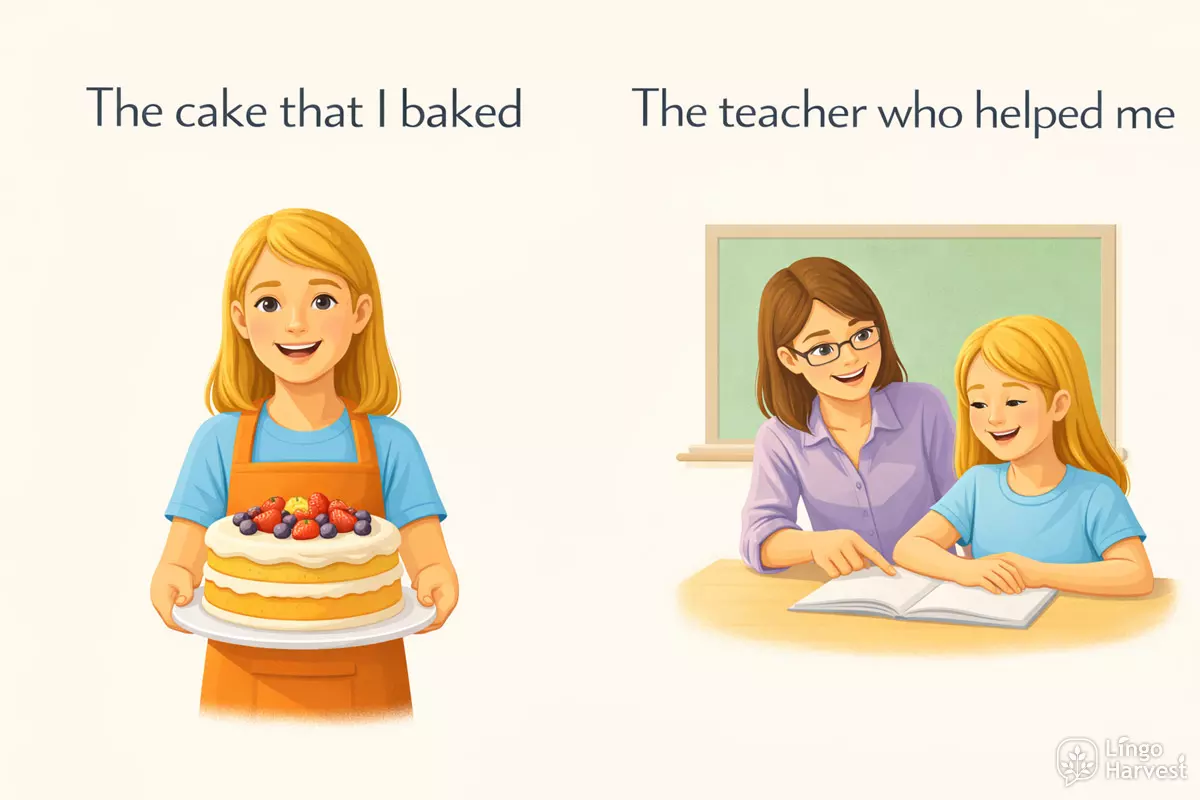
Below is a table highlighting typical differences between spoken and written usage:
| Spoken English | Written English |
|---|---|
| Omission of relative pronouns (“The cake I baked”) |
Retention of relative pronouns (“The cake that I baked”) |
| Use of "that" for people and things (“The teacher that helped me”) |
Preference for "who" for people, "which" for things (“The teacher who helped me”) |
| Rare use of "whom"; often replaced by "who" or omitted (“The friend I called”) |
Use of "whom" in object positions (“The friend whom I called”) |
| Prepositions at the end (“The person I spoke to”) |
Prepositions before the pronoun (“The person to whom I spoke”) |
Summary
To sum up, the way relative pronouns are handled in English depends a lot on whether the language is spoken or written. Speech tends to favor brevity and ease, while writing prioritizes clarity and correctness. Recognizing these tendencies helps learners and users of English adapt their language to fit both formal and informal contexts.
Frequency of that, who, and which in conversation
When people speak informally, the choice of relative pronouns shifts compared to written English. In everyday conversation, "that" is much more common than "who" or "which" when introducing relative clauses. This preference is especially noticeable in American and British spoken corpora, where speakers often use "that" to refer to both people and things, even when formal grammar would suggest another option.
Patterns in Spoken Usage
Listeners will often hear sentences like "the guy that called" or "the movie that I saw," rather than "the guy who called" or "the movie which I saw." The tendency to favor "that" comes from its versatility and the informal tone it sets. "Who" is still used, especially when talking about people, but less frequently than in formal writing. "Which" is the least common of the three in conversation, typically reserved for non-human subjects and more formal contexts.
Relative Pronouns in Conversational Contexts
To illustrate the usage of these pronouns, consider the following examples commonly heard in speech:
- The friend that helped me stayed until the problem was fully resolved.
- The teacher who explained it made the topic much easier to understand.
- The book that I finished left a strong impression on me.
- The car that broke down was taken to the nearest repair shop.
- The person who called didn’t leave a voicemail.
- The show that everyone loves was renewed for another season.
- The dog that barked woke the entire neighborhood.
- The team that won celebrated late into the night.
- The girl who sings performed confidently on stage.
- The movie that made me cry was based on a true story.
- The idea that changed everything came unexpectedly.
- The neighbor who moved away sold the house last month.
- The project that was late caused several delays.
- The story that you told me still stays in my mind.
- The artist who painted this is well known internationally.
- The thing that matters most is trust.
- The house that needs repairs has been empty for years.
- The child who smiled waved goodbye.
Notice how "that" dominates, even for people, in casual speech.
Comparing Relative Pronoun Use: Conversation vs. Writing
The table below highlights the approximate distribution of these pronouns based on common findings in spoken English research:
| Relative Pronoun | Typical Frequency in Conversation | Typical Frequency in Formal Writing |
|---|---|---|
| that | High | Moderate |
| who | Moderate | High |
| which | Low | High |
Speakers often drop relative pronouns entirely (e.g., "the book I read"), but when a pronoun is used, "that" is clearly favored in conversation. This reflects a broader tendency toward simplicity and efficiency in spoken language.
Omitting relative pronouns in spoken English
In everyday conversation, native English speakers often leave out words like "that," "who," or "which" when they connect clauses. This tendency makes speech more fluid and less formal compared to writing, where the inclusion of these connecting words is generally expected. Dropping these pronouns usually happens when the relative pronoun refers to the object of the clause, not the subject.
Common situations where omission occurs
Leaving out relative pronouns is especially frequent in informal exchanges. For example, instead of saying, "That’s the book that I bought," people might simply say, "That’s the book I bought." The meaning remains clear from the context, and omitting the pronoun makes the sentence shorter and more natural in conversation.
- She’s the person I told you about. (instead of "who I told you about")
- This is the movie we watched last night.
- Here’s the cake he made.
- The bag you left is on the table.
- That’s the song she likes.
- Do you remember the time we got lost?
- It’s the house they built.
- He’s the guy she met at the party.
- This is the answer I was looking for.
- The email you sent was helpful.
When omission is not possible
It’s important to note that skipping these connecting words only works when the pronoun would be the object of the clause. If the pronoun is the subject, it must be kept. For example, "She’s the woman who called me" cannot become "She’s the woman called me" ❌— the sentence would be ungrammatical.
| Type of Clause | Can Pronoun Be Omitted? |
|---|---|
| Object of the clause | ✅ Yes |
| Subject of the clause | ❌ No |
| With preposition at end | ✅ Often omitted |
| With preposition at front | ❌ Required |
Spoken versus written norms
While omitting relative pronouns is common in speech, formal writing typically keeps them for clarity and correctness. However, in casual emails, texts, or messages, speakers often write the way they talk, leaving out these words without confusion. The choice depends on the context, the audience, and the level of formality you want to maintain.
More explicit structures in formal writing
Academic, legal, and other formal texts tend to favor clarity and precision, so they use relative pronouns in a more overt and structured way than everyday conversation. Instead of dropping relative pronouns or shortening clauses, written English often maintains the full form, even when it feels redundant. This explicitness reduces ambiguity and ensures that complex ideas are conveyed unambiguously to the reader.
Common features of relative pronoun use in formal texts
- Relative pronouns like which, whose, whom, and that are rarely omitted.
- Writers frequently distinguish between restrictive and non-restrictive clauses, using commas for non-restrictive ones.
- More formal options such as whom are used instead of the informal who for object position.
- Prepositions are often placed before the relative pronoun, e.g., "the process to which he referred".
- Ambiguity is minimized by avoiding reduced or "contact" clauses (e.g., "the book I read").
- Relative clauses are used to add precise, qualifying information about nouns, especially in technical or academic writing.
- Writers may repeat the noun or use more explicit referents to avoid confusion.
- Formal texts avoid contractions and favor complete grammatical structures.
- Complex sentences with multiple embedded relative clauses are more common.
- Relative pronouns are often matched precisely to their antecedents in number and gender (when possible).
Contrasts: spoken vs. written English
To highlight how formal writing structures relative clauses more explicitly than speech, compare typical patterns in both modes:
| Spoken/Informal | Written/Formal |
|---|---|
| The book I told you about | The book about which I told you |
| That’s the person I met | That is the person whom I met |
| The company they work for | The company for which they work |
| The man who I spoke to | The man to whom I spoke |
| There’s a problem we need to solve | There is a problem that we need to solve |
Why explicitness matters
In scholarly or professional contexts, readers expect precision. By retaining relative pronouns and using full clauses, writers help readers follow complex arguments or dense information more easily. This approach also ensures that references are clear, reducing the risk of misinterpretation in critical communication.
Comma usage and clause length differences
One of the most noticeable contrasts between spoken and written English appears in the way relative clauses are punctuated and structured. In writing, punctuation—especially the comma—plays a key role in distinguishing between restrictive and non-restrictive relative clauses. Spoken language, on the other hand, relies more on intonation, pauses, and clause length to create clarity, often making the boundaries between clause types less explicit.
Commas and Relative Clauses: Written vs Spoken Practice
Writers use commas to indicate non-essential (non-restrictive) information, as in "My brother, who lives in Canada, is visiting." In speech, the same distinction is often made through pause and emphasis rather than punctuation. Shorter clauses in conversation may omit relative pronouns or rely on context, while written language tends toward more precise, formally marked boundaries.
| Written English | Spoken English |
|---|---|
| Commas clearly signal non-restrictive clauses. e.g., "The book, which is on the table, is mine." |
Pauses or intonation take the place of commas. e.g., "The book... which is on the table... is mine." |
| Relative clauses are often longer and more complex. | Clauses are usually shorter, sometimes incomplete or fragmented. |
| Omission of relative pronouns is less common; full forms are used. | Relative pronouns ("that," "who") are frequently dropped, especially in conversation. |
| Clear distinction between restrictive ("that") and non-restrictive ("which") clauses. | Speakers may use "that" and "which" interchangeably or omit them entirely. |
Common Patterns in Clause Length and Structure
- Written sentences often contain several clauses, increasing complexity.
- Spoken utterances tend to be shorter, with frequent restarts or corrections.
- Writers use punctuation to clarify meaning; speakers rely on vocal cues.
- Non-restrictive clauses in writing are set off by commas, while in speech, a pause signals extra information.
- Written English prefers explicit relative pronouns; spoken English favors brevity, sometimes omitting them.
- Spoken clauses may be incomplete, relying on shared context for understanding.
- Writers carefully distinguish clause types; speakers are often less precise.
- Spoken language often features unfinished sentences, especially in informal contexts.
- In writing, clause boundaries are visually obvious; in speech, they are auditory.
- Written language may use more embedded clauses for detail; spoken language breaks information into shorter units.
Understanding these differences helps explain why relative pronoun usage can look quite different on the page compared to everyday conversation. The conventions of punctuation and sentence structure in writing serve a similar function to the pauses and phrasing found in natural speech, but each mode has its own distinct patterns and tendencies.
Register-driven choices in real examples
The way English speakers and writers choose relative pronouns often depends on the context and level of formality. In casual speech, flexibility and economy typically take priority, while written English—especially in academic or professional settings—tends to follow stricter norms. Let’s look at how these choices play out in both registers, highlighting real-world usage and preferences.
Spoken English: Patterns and Preferences
In conversation, speakers often opt for relative pronouns that are easy to say or, sometimes, omit them altogether. The following tendencies are common:
- Frequent dropping of "that" or "who" when the meaning remains clear (e.g., "The guy I met yesterday was nice").
- Preference for "that" over "which" or "who" in defining clauses ("That’s the movie that I told you about").
- Use of "who" for people, but sometimes replaced by "that" ("She’s the friend that helped me").
- Rare use of "whom," which is often replaced by "who" or omitted entirely.
- In casual speech, prepositions rarely appear before the pronoun ("the person I spoke to" rather than "to whom I spoke").
- Greater tolerance for sentence fragments and unfinished relative clauses.
Written English: Formality and Precision
In print, especially in formal or academic genres, writers are more likely to observe distinctions between relative pronouns and avoid omissions. Here are some typical practices:
- Consistent use of "which" for non-defining clauses (e.g., "The book, which I borrowed, was fascinating").
- Preference for "who" and "whom" for people, with "whom" used after prepositions or in formal contexts ("To whom it may concern").
- Retention of the relative pronoun, even when omitting it would be possible in speech.
- Placement of prepositions before the pronoun in formal writing ("the person to whom I spoke").
- Careful distinction between "that" (restrictive) and "which" (non-restrictive).
Comparing Real Examples
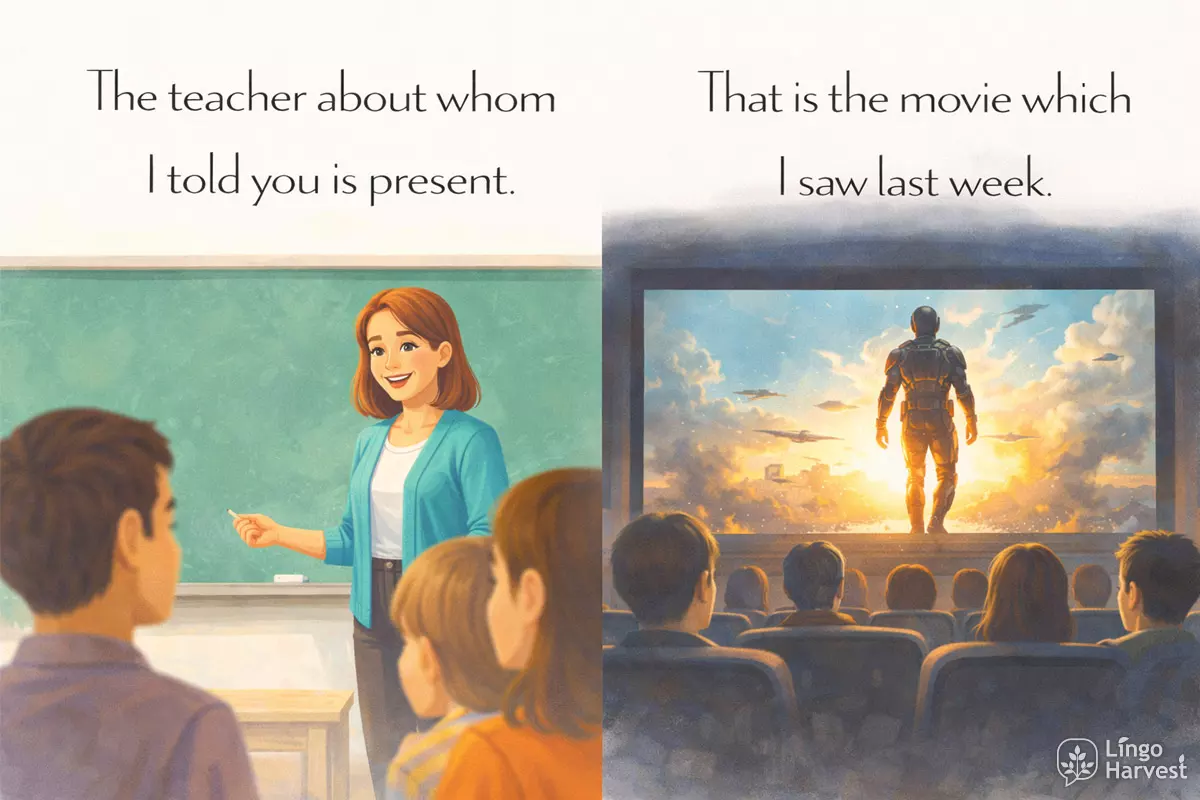
| Spoken Example | Written Example |
|---|---|
| The teacher I told you about is here. | The teacher about whom I told you is present. |
| That’s the movie I saw last week. | That is the movie which I saw last week. |
| She’s the person that helped me. | She is the person who helped me. |
| There’s a song I love. | There is a song which I love. |
Summary: Register Effects on Relative Pronouns
These examples illustrate how register shapes the selection and placement of relative pronouns in English. Conversation favors brevity and flexibility, while formal writing emphasizes clarity and adherence to grammatical conventions. Understanding these patterns helps speakers and writers adjust their language to suit the context, audience, and purpose.
Typical learner mistakes across registers
Learners often struggle with relative pronouns in both casual speech and more formal writing, but the types of errors can differ depending on the context. Spoken English tends to be less strict about pronoun use, while written English usually demands more precision. Understanding where mistakes commonly occur helps learners avoid them and communicate more clearly across different registers.
Frequent errors in spoken English
- Omitting the relative pronoun when it is required in writing (e.g., "The book I read was interesting" instead of "The book that I read was interesting").
- Using "which" instead of "that" in restrictive clauses (e.g., "The movie which I saw was good" when "that" is preferred).
- Overusing "who" for objects or animals (e.g., "The dog who barked" instead of "that" or "which").
- Mixing up "who" and "whom" (e.g., "The person whom called" instead of "who called").
- Adding unnecessary prepositions at the end (e.g., "The person who I spoke to with").
- Dropping necessary information, leading to ambiguous statements.
Common issues in written English
- Incorrectly using "that" for non-restrictive clauses, where "which" is standard (e.g., "My car, that is red, is new" instead of "which").
- Forgetting to include commas with non-defining clauses (e.g., "My sister who lives in London is visiting" instead of "My sister, who lives in London, is visiting").
- Confusing "whose" and "who's" (e.g., "The man who's car broke down" instead of "whose").
- Using "where" incorrectly for abstract nouns (e.g., "The situation where..." instead of "in which").
- Overusing relative pronouns, resulting in awkward or overly complex sentences.
- Misplacing the antecedent, making it unclear what or whom the pronoun refers to.
Comparing mistakes in speech and writing
| Spoken English | Written English |
|---|---|
| Omitting relative pronouns ("The guy I met") | Incorrect comma placement with relative clauses |
| Using "which" or "who" in place of "that" | Misusing "whose" vs. "who's" |
| Ending sentences with unnecessary prepositions | Using "that" in non-restrictive clauses |
| Mixing up "who"/"whom" | Overuse of relative pronouns in complex sentences |
Awareness of these tendencies helps learners adjust their language depending on whether they are speaking or writing. Regular exposure to authentic examples and targeted practice can reduce these errors and improve fluency in both registers.
Practice: rewrite sentences for speech and writing
Understanding how relative pronouns differ in speech and writing is essential for effective communication. In spoken English, sentences often become less formal and more direct, sometimes omitting pronouns or using simpler structures. In contrast, written English tends to maintain full relative clauses for clarity and precision. The following activities will help you recognize and practice these differences by rewriting sentences for both styles.
Task 1: Rewrite for Spoken English
Below are sentences typical of academic or formal writing. Try to rewrite each one as it would likely be said in everyday conversation.
- The report that was submitted yesterday contains several errors.
- She is the person whom I mentioned earlier.
- This is the restaurant in which we had dinner last week.
- The students who have finished their projects may leave early.
- There are several issues about which I am concerned.
- The files that were deleted by mistake have been restored.
- He is the colleague with whom I worked closely.
- This is the problem for which we need a solution.
- The meeting that was scheduled for Monday has been postponed.
- She described the experience that had changed her perspective.
Show answers
- The report submitted yesterday has several errors.
- She’s the person I mentioned earlier.
- This is the restaurant we had dinner at last week.
- The students who finished their projects can leave early.
- There are a few things I’m worried about.
- The files deleted by mistake have been restored.
- He’s the colleague I worked closely with.
- This is the problem we need a solution for.
- The meeting scheduled for Monday has been postponed.
- She described the experience that changed her perspective.
Task 2: Rewrite for Formal Writing
Now, take these conversational sentences and make them suitable for formal written contexts by using full relative clauses and appropriate pronouns.
- That’s the book I told you about.
- He’s the guy you met at the party.
- This is the place we stayed last summer.
- There’s something I want to discuss.
- She’s someone I trust.
- This is the project we talked about earlier.
- He’s the colleague I work with most closely.
- That’s the reason I called you.
- Here’s the email I mentioned before.
- She’s the person I was looking for.
Show answers
- That is the book about which I told you.
- He is the man whom you met at the party.
- This is the place where we stayed last summer.
- There is something that I would like to discuss.
- She is someone whom I trust.
- This is the project about which we talked earlier.
- He is the colleague with whom I work most closely.
- That is the reason why I called you.
- Here is the email that I mentioned before.
- She is the person whom I was looking for.
Common Patterns: Spoken vs Written Relative Clauses
Compare the typical forms used in each register. Notice how speech often omits or simplifies relative pronouns, while writing preserves them for clarity.
| Spoken English | Written English |
|---|---|
| The movie I saw was great. | The movie that I saw was great. |
| The friend you met is here. | The friend whom you met is here. |
| This is the place we visited. | This is the place which we visited. |
| That’s the reason I left. | That is the reason why I left. |
| The guy she’s talking to is my brother. | The man to whom she is talking is my brother. |
Quick Quiz: Identify the Register
Decide whether each sentence is more typical of speech or writing.
- The person who called you is waiting outside.
- The person you called is waiting outside.
- The car which was stolen has been found.
- The car that got stolen has been found.
- The report that was submitted yesterday needs revision.
- The report you submitted yesterday needs revision.
- The colleague whom I spoke to has already replied.
- The colleague I spoke to has already replied.
- The decision which was announced this morning surprised everyone.
- The decision they announced this morning surprised everyone.
Show answers
- Writing
- Speech
- Writing
- Speech
- Writing
- Speech
- Writing
- Speech
- Writing
- Speech
Practicing these transformations will help you use relative pronouns naturally and appropriately, whether you are writing formally or speaking informally.