Embedded Questions with Interrogative Pronouns

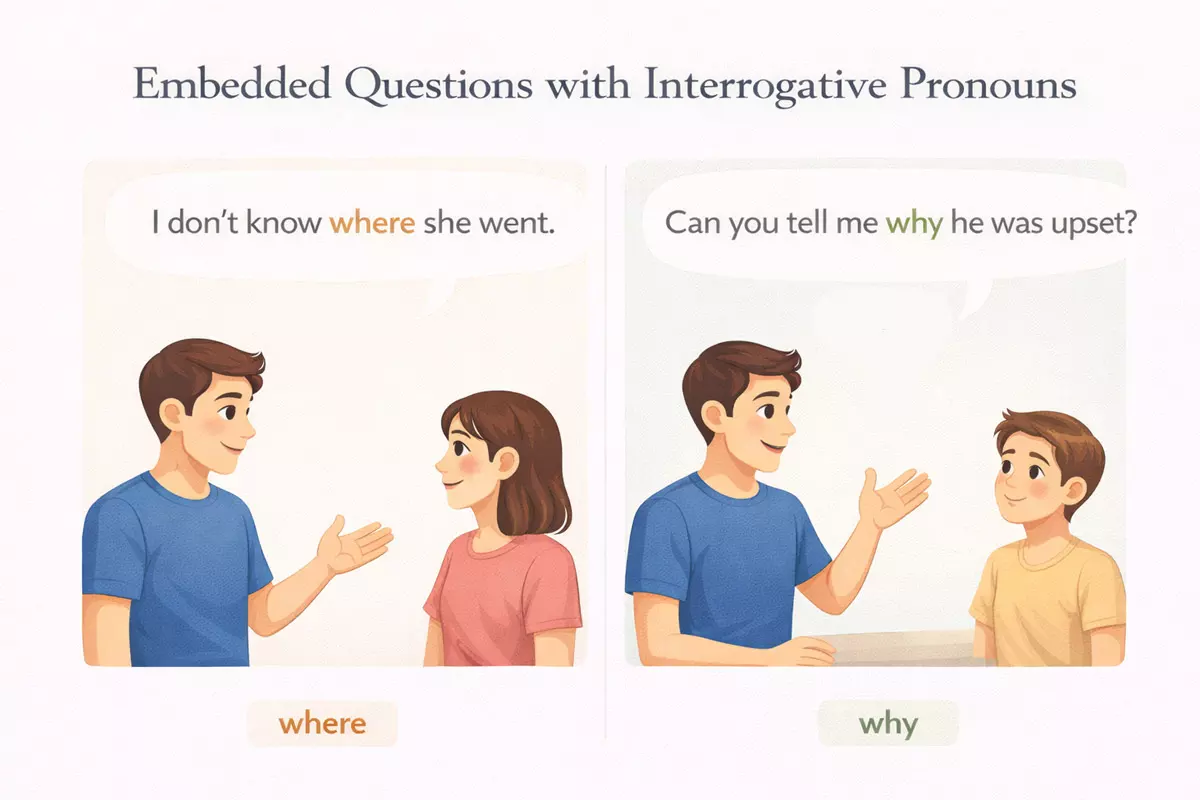 Here we what embedded questions are, how their word order differs from direct questions, and how to use interrogative pronouns and common introducing verbs.
- What embedded questions are
- Word order differences from direct questions
- Using interrogative pronouns in embedded clauses
- Common verbs introducing embedded questions
- Avoiding question-word inversion errors
- Formal vs informal embedded structures
- Typical learner mistakes
- Practice: convert direct questions into embedded ones
If you want to make your English sound more natural and fluent, it is important to know how to smoothly include questions within statements or other questions. This skill, known as forming indirect questions, often involves using interrogative pronouns such as who, what, or where. While it can be tricky at first, practicing these indirect forms helps you communicate more politely and clearly, especially in formal situations or when you want to sound less direct. Mastering indirect questions is a key step toward advanced English proficiency.
What embedded questions are
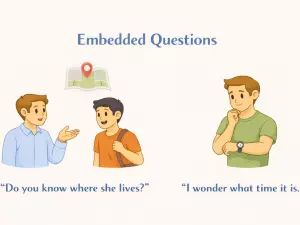
Embedded questions are indirect questions that appear inside a larger sentence, rather than standing alone as a direct inquiry. Instead of asking something directly, like “Where is she?”, you might say, “I wonder where she is.” This structure is common in both spoken and written English, especially when expressing curiosity, uncertainty, or politeness.
Unlike direct questions, which invert the subject and auxiliary verb (“Where did he go?”), embedded forms maintain standard statement word order (“I don’t know where he went”). They often begin after expressions such as know, wonder, ask, explain, or show. Interrogative pronouns like who, what, where, when, why, and how are typically used to introduce the embedded question part.
Key features of embedded questions
- No inversion of the subject and verb (they follow statement order).
- No question mark at the end, unless the whole sentence is a question.
- Often introduced by a phrase that signals indirectness (e.g., “Can you tell me…”).
- Use of interrogative pronouns to introduce the embedded clause.
Common introductory phrases
- I don’t know why she left so early.
- Can you tell me where you parked the car?
- I wonder if we should reschedule the meeting.
- Do you remember what he said about the deadline?
- Could you explain how this rule works in practice?
- Let me know when you’re ready to start.
- She asked whether anyone had seen her keys.
- It’s unclear who approved the final version.
- I’m not sure if this is the best option.
- They haven’t decided what time to leave.
- Please show me how to submit the form correctly.
- He forgot to attach the file to the email.
- I’d like to know how long the process usually takes.
- Tell me what you want to do next.
Direct vs. embedded structure
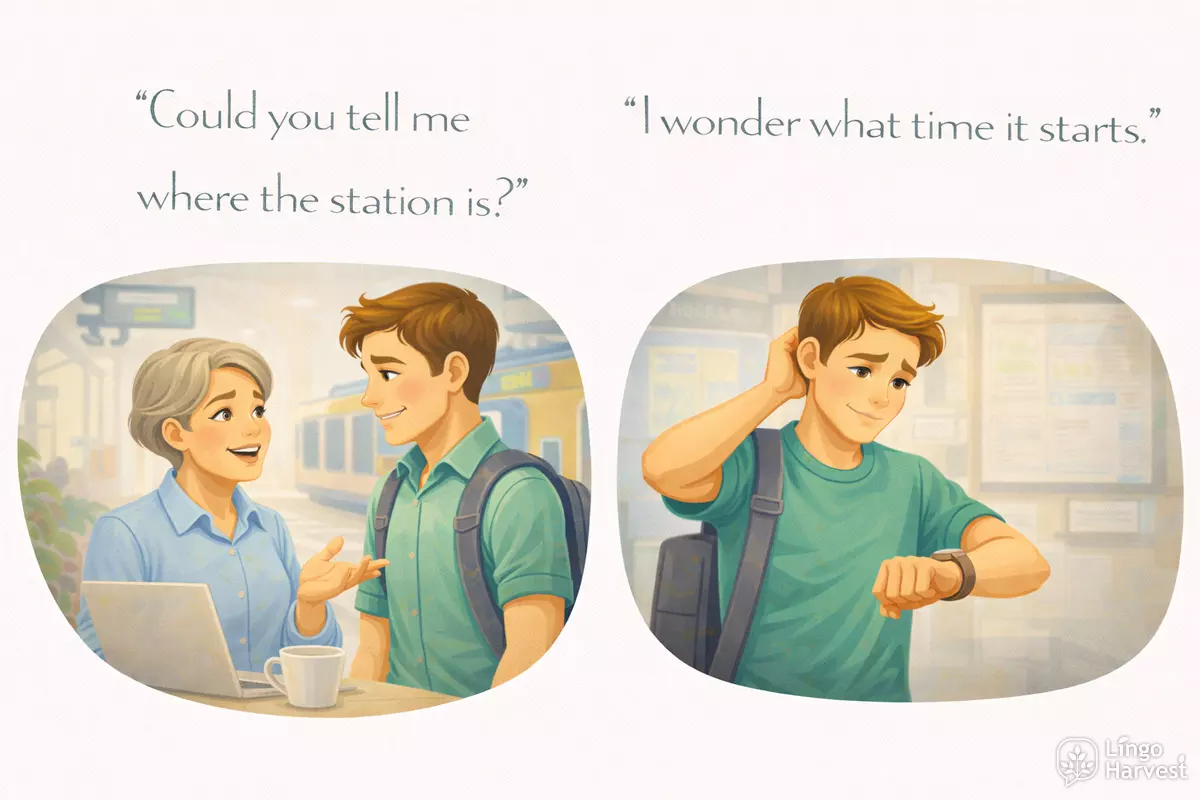
| Direct Question | Embedded Question |
|---|---|
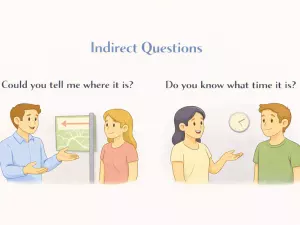
| Where is the station? | Could you tell me where the station is? |
| What time does it start? | I wonder what time it starts. |
| Why did she leave? | Do you know why she left? |
| How does this work? | Can you explain how this works? |
| Who called you? | Tell me who called you. |
In summary, embedded questions allow us to ask for information more politely or indirectly, and they require a specific grammatical structure. They are especially useful in formal situations, when we want to soften requests or express uncertainty.
Word order differences from direct questions
When forming embedded questions with interrogative pronouns (such as who, what, where, when, why, and how), the structure changes compared to direct question forms. Instead of the subject-auxiliary inversion found in direct questions, embedded questions follow the word order of declarative sentences. This means the subject comes before the verb, and auxiliary verbs do not precede the subject.
Direct vs. Embedded Question Structure
In a direct question, the verb often comes before the subject. For example, "Where is she going?" In an embedded question, the subject comes before the verb: "I wonder where she is going." Notice that the auxiliary is follows the subject in the embedded version.
| Direct Question | Embedded Question |
|---|---|
| What did he say? | I don't know what he said. |
| Where are they staying? | Can you tell me where they are staying? |
| Why did she leave? | Do you know why she left? |
| How does this work? | Please explain how this works. |
| Who is coming? | I wonder who is coming. |
| When will the train arrive? | Could you tell me when the train will arrive? |
| Which book did you choose? | I'd like to know which book you chose. |
| What time does it start? | Tell me what time it starts. |
| Who did she meet? | Can you say who she met? |
| Why are they late? | Explain why they are late. |
Key Patterns to Remember
- No subject-auxiliary inversion in the embedded form.
- The question word (interrogative pronoun) stays at the beginning of the embedded clause.
- If the embedded question follows a reporting verb (know, wonder, ask, explain), the rest of the clause behaves like a statement.
- Do/does/did are not used in the embedded clause (e.g., "Can you tell me where he lives?" not "where does he live?").
- Punctuation: Direct questions end with a question mark; embedded questions within a larger sentence usually end with a period unless the main clause is a question.
Common Mistakes ❌
- Using question word order in embedded clauses: Incorrect: "I wonder where is he."
- Adding do/does/did in embedded questions: Incorrect: "Can you tell me what did she say?"
- Forgetting to include the subject: Incorrect: "I don't know what said."
By consistently using statement word order after interrogative pronouns in embedded questions, you can avoid errors and create clear, natural sentences. This adjustment is a key difference from how you would form a direct question.
Using interrogative pronouns in embedded clauses
Understanding how to use interrogative pronouns within embedded clauses is key to expressing indirect questions and conveying uncertainty or curiosity in English. Instead of forming a direct question, these structures are typically used as part of a larger sentence—often after verbs like "know," "wonder," "ask," or "remember." Interrogative pronouns such as who, what, which, whose, where, when, why, and how introduce the embedded clause, but the word order changes compared to direct questions.
Word order in embedded questions
In embedded questions, the subject comes before the verb, unlike in direct questions where the auxiliary verb usually comes before the subject. For example, instead of "Where is she going?", you would say, "I wonder where she is going." The interrogative pronoun remains at the beginning of the embedded clause, but the sentence doesn’t use question word order.
Common patterns and examples
These structures are frequently used in everyday conversation and writing. Here are some typical verbs and phrases that introduce embedded questions:
- I don't know who called me.
- She asked what time the meeting starts.
- Can you tell me where the station is?
- They wondered why he left early.
- We need to decide which option is best.
- Do you remember when we met?
- He couldn't guess whose book it was.
- Please explain how this works.
- I’m not sure what she wants.
- Tell me who you saw at the party.
- She doesn’t know which route to take.
- I forgot where I parked my car.
- Let me know how you did it.
- He asked why the train was late.
- Do you know who that is?
Direct vs. embedded question structure
To clarify how embedded clauses differ from direct questions, see the comparison below:
| Direct Question | Embedded Question |
|---|---|
| Where did she go? | I wonder where she went. |
| Who is calling? | Can you tell me who is calling? |
| Why was he upset? | Do you know why he was upset? |
| What time does it start? | She asked what time it starts. |
| How did you do that? | Explain how you did that. |
Key points to remember
- Embedded questions do not use auxiliary verbs before the subject.
- No question mark is used unless the whole sentence is a question.
- The interrogative pronoun introduces the embedded clause, but the main sentence structure is that of a statement.
- These constructions are common after verbs like "know," "ask," "explain," "wonder," and "decide."
By mastering these patterns, you can form more nuanced and polite questions, and better comprehend English in formal and informal contexts.
Common verbs introducing embedded questions
When using interrogative pronouns (like what, where, who, how, and why) in statements rather than direct questions, certain verbs often come into play. These verbs signal that an indirect or reported question is being introduced. Understanding which verbs commonly introduce such embedded structures helps you recognize and form them naturally in both spoken and written English.
Typical verbs used before embedded questions
Here are several verbs frequently followed by an interrogative clause rather than a direct question. These verbs can be used to discuss knowledge, communication, opinion, or uncertainty about information:
- ask — She asked where the station was.
- know — Do you know what time it is?
- wonder — I wonder why he left early.
- remember — Can you remember where you put your keys?
- explain — Please explain how this works.
- show — Could you show me what you mean?
- tell — Tell me who called last night.
- find out — We need to find out what happened.
- discover — She discovered where they hid the treasure.
- decide — Have you decided which route to take?
- forget — I forgot when the meeting starts.
- understand — I don’t understand why this is important.
- see — Let’s see who arrives first.
- learn — He learned how the system operates.
- reveal — Can you reveal what the answer is?
- ask oneself — She asked herself how she could improve.
- inquire — They inquired where the nearest hotel was.
- predict — It’s hard to predict when it will rain.
- discuss — We discussed what to do next.
- suggest — He suggested where we might eat.
Patterns and usage notes
These verbs are usually followed by a clause beginning with an interrogative word. Unlike direct questions, word order after the interrogative stays the same as in a statement. For example: I wonder what he wants (NOT: I wonder what does he want). This is a key feature of embedded question structures.
| Verb | Example with Embedded Question |
|---|---|
| know | Do you know where she lives? |
| wonder | I wonder what time it is. |
| tell | Can you tell me how it works? |
| ask | He asked why you were late. |
| remember | Do you remember when we met? |
| explain | She explained what the problem was. |
These verbs are not limited to embedded questions with interrogative pronouns, but they are among the most common. Mastering their use will make your English sound more natural and precise when reporting questions or discussing unknown information.
Avoiding question-word inversion errors
Understanding how to form embedded questions with interrogative pronouns is essential for clear and accurate English sentences. One of the most common mistakes learners make is inverting the subject and auxiliary verb as if forming a direct question. However, when an interrogative clause is embedded within another sentence, the word order changes. Recognizing these patterns will help you avoid confusion and create more natural-sounding sentences.
Recognizing Incorrect and Correct Patterns
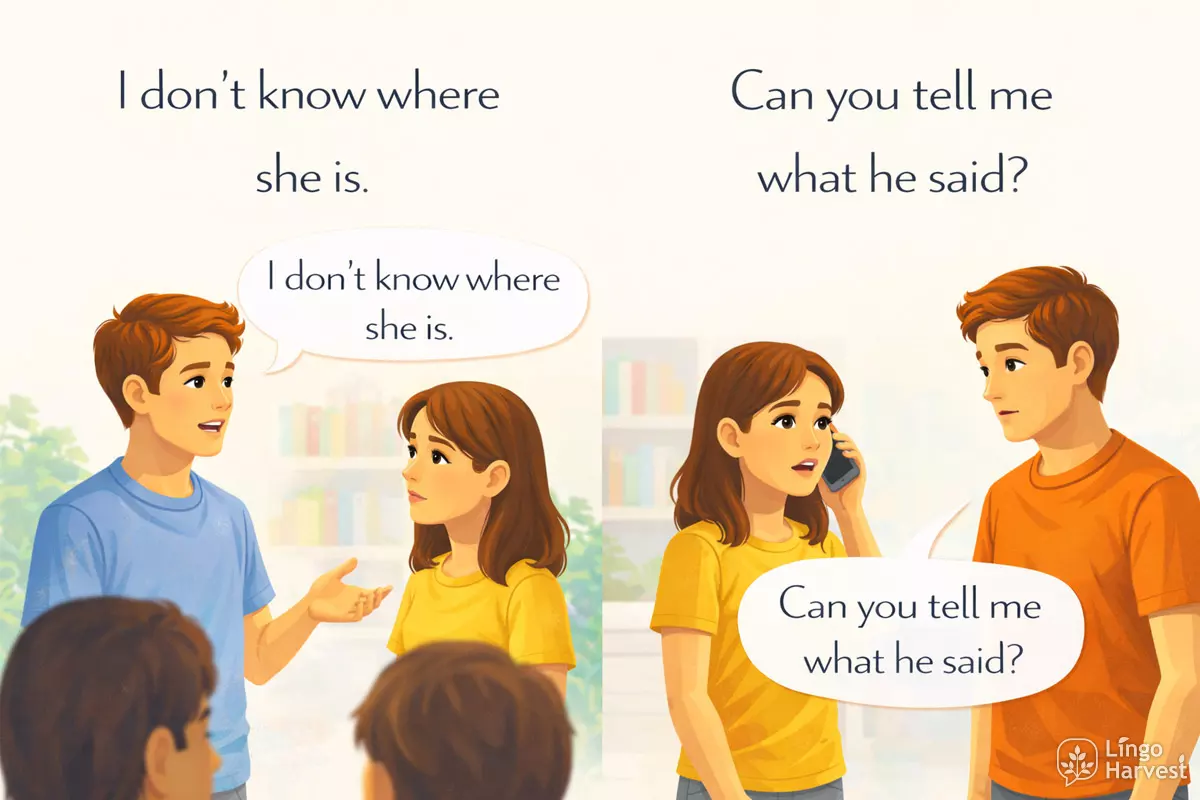
When embedding a question, do not use the auxiliary–subject inversion typical of direct questions. Instead, keep the subject before the verb, just as in a statement. This distinction is crucial for sentences introduced by verbs like "know," "wonder," or "explain," followed by question words such as "what," "where," "who," "when," "why," or "how."
| Direct Question | Embedded Question |
|---|---|
| Where is she? | I don't know where she is. |
| What did he say? | Can you tell me what he said? |
| Why are they leaving? | Do you know why they are leaving? |
| How does it work? | Please explain how it works. |
Common Triggers for Inversion Mistakes
Confusion often arises when learners treat indirect questions like direct ones. This can happen after verbs or phrases such as:
- Do you know where the nearest station is?
- I wonder why he didn’t reply.
- Could you tell me what time the meeting starts?
- He asked whether we had finished the task.
- I’m not sure if this is the correct file.
- Please explain how you solved this problem.
- Let me know when you’re available.
- I don’t remember where I put my keys.
- We need to find out who approved the budget.
- Tell me what you want to change.
- She forgot to lock the door.
- They didn’t say why the event was canceled.
- It’s unclear who is responsible.
- I’ll check if the tickets are still available.
- Can you show me how to do this step?
Tips for Avoiding Inversion Errors
- After a question word in an embedded clause, use statement word order: subject + verb.
- Do not insert "do/does/did" in embedded questions, even if the direct question uses it.
- Listen for the difference between direct and indirect questions in spoken English.
- Practice rewriting direct questions as embedded questions to reinforce the correct structure.
- Remember: question marks are only used for the main question, not for the embedded clause.
Mastering these forms will help you sound more fluent and avoid common sentence structure mistakes in both writing and conversation.
Formal vs informal embedded structures
When using interrogative pronouns in embedded questions, the level of formality influences both word choice and sentence structure. In more formal contexts, speakers tend to maintain full clauses and avoid contractions, while everyday conversation often features simpler, more compact forms. Recognizing these differences helps learners adapt their language for different situations, such as academic writing versus casual speech.
Key differences in structure and usage
- Formality: Formal embedded questions often use complete clauses and avoid colloquial expressions.
- Pronoun reference: Informal language may drop certain pronouns or auxiliary verbs for brevity.
- Word order: Both styles typically use subject-verb order (not inversion), but informal speech sometimes bends this rule.
- Verb forms: Formal writing sticks to standard verb forms; informal speech may use contracted or even omitted forms.
- Punctuation: Written formal questions use appropriate punctuation, while informal writing may be looser.
Examples: Embedded questions in different registers
Below is a comparison of how embedded questions with interrogative pronouns (who, what, where, when, why, how, which, whose) appear in formal and informal settings:
| Formal Example | Informal Example |
|---|---|
| I wonder who is coming to the meeting. | Any idea who’s coming? |
| Could you tell me what she said? | Do you know what she said? |
| We need to determine when the event will begin. | Can you tell me when it starts? |
| Please explain why this decision was made. | Any idea why they did that? |
| I am not sure where the documents are. | Not sure where the docs are. |
| Could you clarify how this process works? | Can you say how it works? |
| Let us consider which option is preferable. | Any idea which one’s better? |
| I would like to know whose turn it is. | Do you know whose turn? |
| Please inform me what the results are. | Tell me what happened. |
| Could you specify when the deadline is? | Any idea when it’s due? |
Tips for adapting embedded questions
- Use more complete clauses and fewer contractions in formal writing.
- In spoken English, brevity and contractions are more acceptable.
- Remember: embedded questions do not use auxiliary-subject inversion, even in informal speech.
- Adjust your register to suit your audience or context for clear, effective communication.
Typical learner mistakes
Learners often get tripped up by embedded questions with interrogative pronouns, especially when it comes to word order and auxiliary verbs. These errors can make sentences sound unnatural, confusing, or even change the meaning entirely. Understanding how to embed a question within another sentence, rather than using direct question syntax, is key to mastering this structure.
Confusing word order
A frequent error is using the same word order as in direct questions. When an interrogative pronoun like "what," "where," or "who" introduces an embedded clause, English requires a statement word order (subject + verb), not the inverted question form.
- Incorrect: Can you tell me where is the station?
- Correct: Can you tell me where the station is?
- Incorrect: I don’t know what does he want.
- Correct: I don’t know what he wants.
Unnecessary auxiliary verbs
Another stumbling block is inserting auxiliary verbs like "do" or "does" into embedded questions. These are used in direct questions but are omitted in the embedded form.
- Incorrect: I wonder where does she live.
- Correct: I wonder where she lives.
- Incorrect: Please tell me why did you leave.
- Correct: Please tell me why you left.
Misplacing the pronoun or verb
Sometimes, learners place the interrogative pronoun or verb in the wrong order, which can result in awkward or unclear sentences.
- Incorrect: Do you know is he coming?
- Correct: Do you know if he is coming?
- Incorrect: I forgot what said he.
- Correct: I forgot what he said.
Leaving out the subject
Omitting the subject after the interrogative pronoun is another error, especially for learners whose first language allows this.
- Incorrect: I don’t know where is.
- Correct: I don’t know where it is.
Summary of common errors
| ❌ Incorrect | ✅ Correct |
|---|---|
| Can you tell me where is my phone? | Can you tell me where my phone is? |
| I don’t know why did they leave. | I don’t know why they left. |
| Please explain how does it work. | Please explain how it works. |
| She asked who was he. | She asked who he was. |
| I can’t remember what did you say. | I can’t remember what you said. |
| Tell me when is the meeting. | Tell me when the meeting is. |
Other pitfalls
- Using a question mark at the end of an embedded question within a statement: He asked where she was? → He asked where she was.
- Forgetting to change verb tense when reporting: He asked what do you want → He asked what I wanted
- Using the wrong interrogative pronoun: I don’t know which is the time instead of what the time is
By noticing these common patterns, learners can avoid the most frequent slips and improve their confidence with embedded questions using interrogative pronouns.
Practice: convert direct questions into embedded ones
Understanding how to transform straightforward questions into embedded forms is crucial for sounding natural in English, especially in both spoken and written contexts. Embedded questions are typically more polite and less direct, as they are often used within larger statements or queries. This practice section will help you get comfortable with changing direct interrogative pronoun questions (who, what, where, when, why, how, which, whose) into their embedded equivalents.
How to form embedded questions with interrogative pronouns
Begin by identifying the main question word (such as "where" or "why"), then place it within a statement or another question. Remember: in embedded questions, the word order changes to that of a statement, and you do not use "do/does/did" as an auxiliary.
- Direct: Where is she? → Embedded: Can you tell me where she is?
- Direct: What did he say? → Embedded: I wonder what he said.
- Direct: Why are they late? → Embedded: Could you explain why they are late?
Practice: Change these direct questions into embedded forms
Try rewriting each direct question as part of a polite statement or question. Use the suggested introductory phrase, or create your own.
- Who called you?
- Where did she put the keys?
- How does this machine work?
- What time does the meeting start?
- Why are you upset?
- Which book did you choose?
- When will they arrive?
- Whose bag is this?
- How much does it cost?
- What happened yesterday?
Show answers
- Can you tell me who called you?
- Do you know where she put the keys?
- Could you explain how this machine works?
- I’d like to know what time the meeting starts.
- Can you tell me why you are upset?
- Could you tell me which book you chose?
- Do you know when they will arrive?
- Can you tell me whose bag this is?
- Could you tell me how much it costs?
- Do you know what happened yesterday?
Common introductory phrases for embedded questions
When forming embedded questions, these phrases are frequently used to introduce them:
- Can you tell me where the nearest café is?
- Do you know how long the flight usually takes?
- I wonder if they have already made a decision.
- Could you explain why this option is not available?
- I’d like to know what happens next.
- Would you mind telling me when the deadline is?
- Could you tell me who is in charge of this project?
- I’m not sure whether this information is accurate.
- Let me know if you need any help.
- Do you have any idea why the system stopped working?
Direct vs. Embedded: Structure Comparison
Below is a table comparing direct and embedded forms for various interrogative pronouns, so you can clearly see the changes in structure and word order.
| Direct Question | Embedded Question |
|---|---|
| Where is the station? | Could you tell me where the station is? |
| Why did she leave? | I wonder why she left. |
| How can I fix this? | Do you know how I can fix this? |
| Who owns this house? | Can you tell me who owns this house? |
| What caused the problem? | Could you explain what caused the problem? |
| When will it start? | Do you know when it will start? |
Working with embedded questions helps you communicate more fluidly and politely in English. Practice regularly, and soon this structure will become second nature.