Indirect Questions in English: Polite Forms and Examples

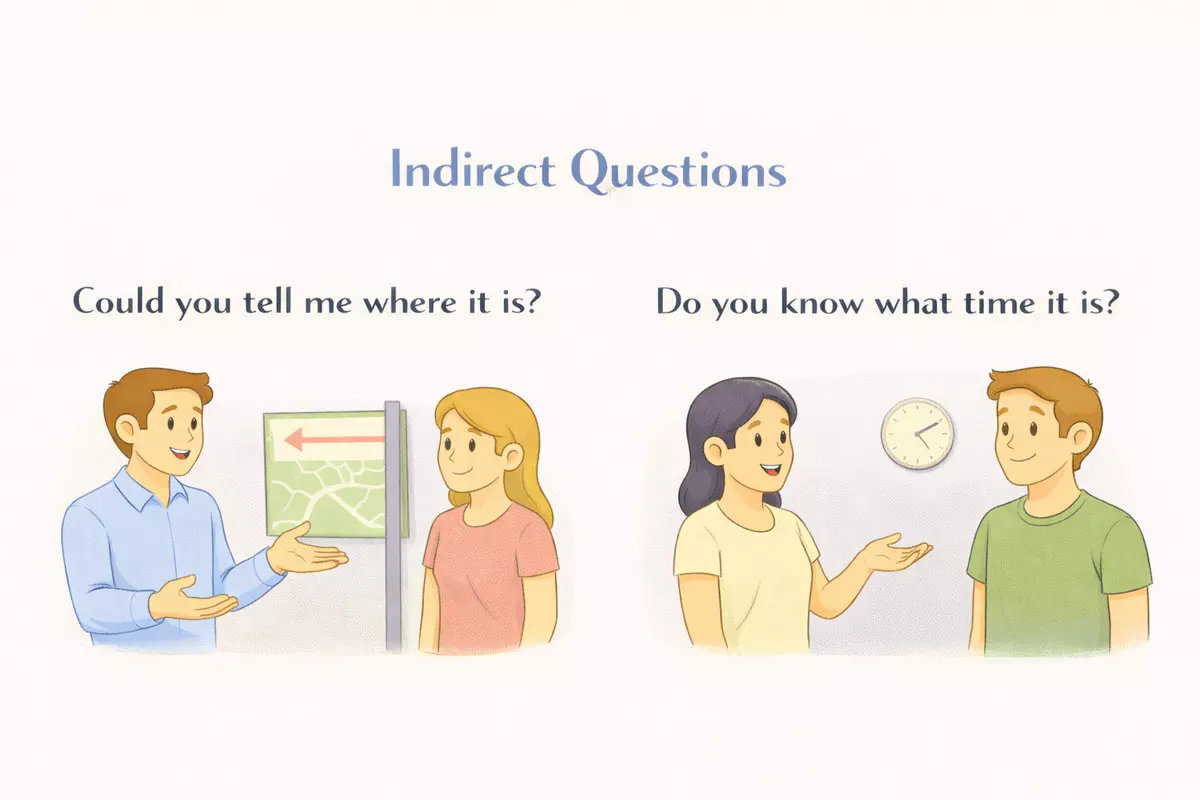 This article explains what indirect questions are, why they're used, their word order, and the difference between indirect yes/no and WH-questions. It covers common introductory phrases, typical learner mistakes, and offers practice exercises.
When engaging in conversations in English, adopting a polite and indirect approach can make your questions sound more courteous and approachable. Instead of asking direct questions, using softer phrases such as "Could you tell me," "Would you mind explaining," or "I was wondering if you could help" shows respect and consideration for the other person. These polite forms not only help you gather information more effectively but also create a positive atmosphere, making the interaction smoother and more comfortable for everyone involved.
What Indirect Questions Are
When we want to ask for information in a more formal or polite way, English speakers often use indirect questions. These are questions that are embedded inside statements or other questions, rather than being asked directly. Indirect forms are especially common in customer service, academic, or business settings, and they help to soften requests, making conversation sound less abrupt.
Unlike direct questions, which typically invert the subject and auxiliary verb (e.g., "Where is the station?"), indirect ones usually follow the standard sentence order. They often begin with introductory phrases such as "Could you tell me," "Do you know," or "I wonder," followed by the question content. This structure makes them less confrontational and more respectful.
Key Features of Indirect Questions
- They start with a polite introductory phrase.
- The word order stays the same as in a statement (no inversion).
- Question marks are only used if the entire sentence is a question.
- They often omit "do/does/did" in the embedded part.
- They use "if" or "whether" for yes/no questions.
Common Introductory Phrases
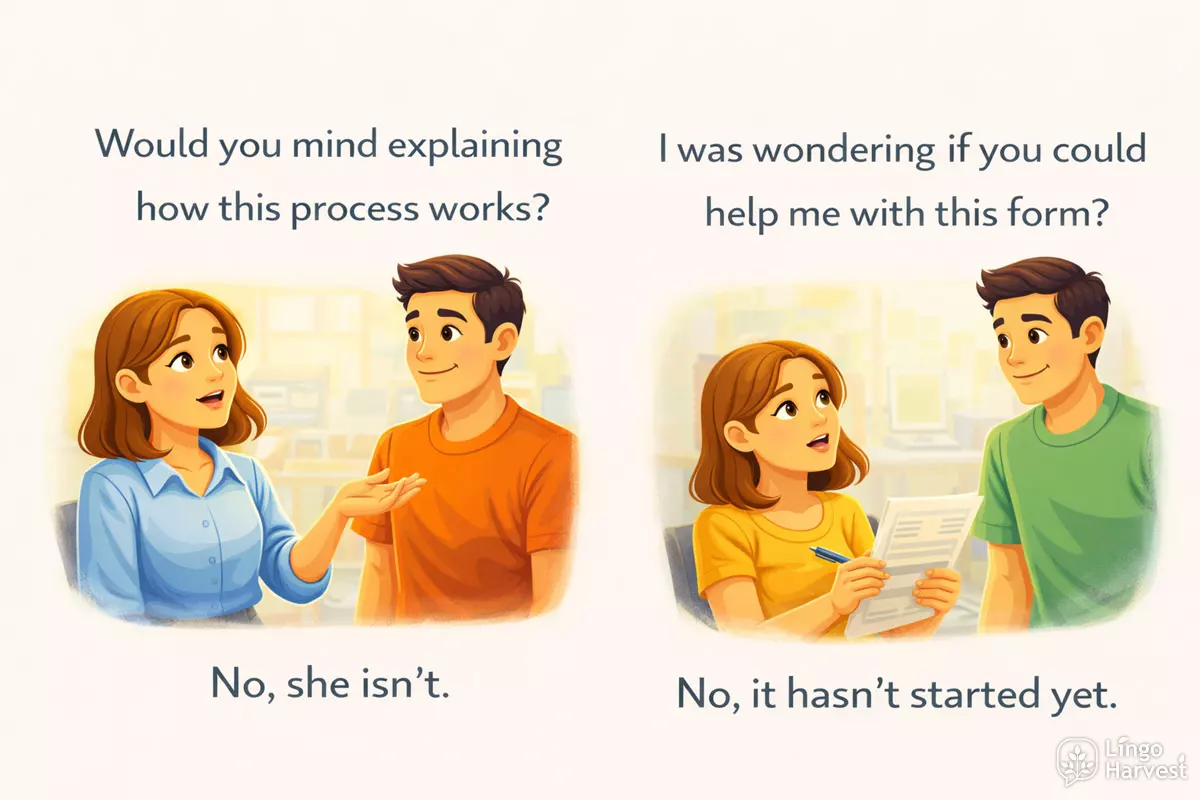
- Could you tell me where the nearest ATM is? → It’s on the corner next to the pharmacy.
- Do you know what time the meeting starts? → It starts at 3 pm.
- Would you mind explaining how this process works? → Sure — it has three simple steps.
- I was wondering if you could help me with this form? → Yes, I can help you.
- Can you let me know when the package arrives? → It should arrive tomorrow.
- May I ask why you chose this option? → Because it’s faster and cheaper.
- I'm not sure where I should submit the documents. → You should submit them online.
- I'd like to find out whether there are any discounts available. → Yes, there’s a student discount.
- Have you any idea why the website isn’t loading? → It might be a server issue.
- Is it possible to reschedule the appointment? → Yes, we can reschedule it.
- Would it be possible to get a refund? → Yes, a refund is possible within 30 days.
- Can you remember where you parked the car? → Yes, I parked it on Level 2.
- I'd like to know how long the delivery takes. → It usually takes 2–3 business days.
- Do you happen to know who is in charge of this project? → Yes, Maria is in charge.
- Would you happen to know where I can get a taxi? → There’s a taxi stand outside.
- Will you tell me what you decided in the end? → I decided to wait.
- I'm interested in finding out what courses you offer. → We offer evening and weekend courses.
Direct vs. Indirect Question Structure
| Direct Question | Indirect Question |
|---|---|
| Where is the nearest bank? | Could you tell me where the nearest bank is? |
| What time does the meeting start? | Do you know what time the meeting starts? |
| Did she call you? | I was wondering if she called you. |
| Why did they leave early? | Can you tell me why they left early? |
| Is the store open on Sundays? | Do you know if the store is open on Sundays? |
Using indirect forms helps speakers sound courteous and considerate, especially with strangers or in formal situations. By mastering this approach, you can communicate more effectively and avoid sounding too blunt or demanding.
Why Indirect Questions Are Used
Indirect questions play an important role in English communication, especially when speakers want to sound more courteous or less direct. Rather than asking something bluntly, people often choose a softer approach to avoid sounding demanding or intrusive. These constructions are particularly useful in professional settings, formal writing, and conversations with people you don't know well.
Politeness and Social Distance
One of the main reasons for choosing indirect forms is to show respect and maintain politeness. When interacting with strangers, superiors, or in customer service, a direct question can sometimes feel too forceful. Indirect phrasing helps soften the request or inquiry, making it easier for the listener to respond comfortably.
- Could you tell me where the nearest station is? → It’s two blocks down the street.
- Do you know if the meeting has started? → Yes, it started a few minutes ago.
- Would you mind explaining how this works? → Of course, I’ll walk you through it.
- I was wondering whether you have any free time tomorrow. → Yes, I’m free in the afternoon.
- Can you let me know when the report is ready? → I’ll let you know by email.
- May I ask what your name is? → My name is Alex.
- Do you happen to know when the train leaves? → It leaves at 7:30.
- I’d like to know how much this costs. → It costs $25.
- Would it be possible to get a receipt? → Yes, I can print one for you.
- Can you tell me if there is a restroom nearby? → Yes, there’s one next to the café.
Softening Demands or Requests
Using indirect questions can help avoid making statements or demands sound like orders. This is especially helpful when asking for favors or information from someone who isn't obligated to help you. The structure signals that you are being considerate of the other person's feelings and time.
- Would you be able to show me how to use this? → Yes, I can show you.
- Do you think you could help me move this box? → Sure, I can help.
- Is there any chance you could send the file today? → Yes, I’ll send it today.
- I was hoping you might review my application. → Of course, I’ll take a look.
Comparing Direct and Indirect Forms
Choosing between a direct and an indirect approach affects how your message is received. Here's a quick comparison of both forms:
| Direct Question | Indirect Question |
|---|---|
| Where is the library? | Could you tell me where the library is? |
| What time does the store open? | Do you know what time the store opens? |
| Are you free tomorrow? | I was wondering if you are free tomorrow. |
| Why is the meeting canceled? | Do you happen to know why the meeting was canceled? |
As seen above, indirect forms add extra words or phrases. This not only shows politeness but also helps create a sense of distance when needed. These structures are an essential tool for anyone looking to communicate smoothly and respectfully in English.
Word Order in Indirect Questions
When reporting a question indirectly, the sentence structure changes compared to direct questions. In indirect forms, the typical question word order (with auxiliary verbs before the subject) is replaced by the standard statement order: subject comes before the verb. This is a crucial difference that helps make the sentence sound natural and polite in English.
How the Structure Changes
In direct questions, the auxiliary verb (such as do, is, can) usually comes before the subject. However, in indirect questions, the auxiliary is either omitted or placed after the subject, just as in regular statements. The question mark is also dropped because you are not asking directly.
| Direct Question | Indirect Question |
|---|---|
| Where is the station? | Could you tell me where the station is? |
| What time does the meeting start? | Do you know what time the meeting starts? |
| Why did she leave? | Can you explain why she left? |
| Has he finished his homework? | I wonder if he has finished his homework. |
| Are they coming tonight? | Do you know if they are coming tonight? |
Common Patterns for Indirect Questions
- Use an introductory phrase: Could you tell me, Do you know, I wonder, Can you explain, Would you mind telling me, I'm not sure, I'd like to know.
- Follow with a question word (where, when, why, how, what, who) or if/whether for yes/no questions.
- Use statement word order after the introductory phrase: subject + verb.
- Do not use do/does/did in the indirect part.
- End with a period, not a question mark (unless the whole sentence is a question).
More Examples of Indirect Question Structure
- Can you tell me how long the movie lasts?
- I’d like to know if the shop is open.
- Do you remember where we parked the car?
- Could you explain why this happened?
- Would you mind telling me who called earlier?
- I'm not sure what she wants.
- Do you know whether he received the email?
- I wonder when the train leaves.
- Tell me how you solved the problem.
- Could you say if there are any updates?
Getting the sequence of words right in reported questions makes your English sound smooth and polite. Remember, the key is to use statement order after the introductory phrase, not the inverted order of direct questions.
Indirect Yes/No Questions
Questions that require a simple "yes" or "no" can be made more polite or formal by turning them into indirect forms. This is common in English when speaking to someone you don’t know well, or when you want to sound diplomatic. Instead of asking directly, speakers often introduce the question with phrases such as "Could you tell me," "Do you know," or "Would you mind telling me." The main advantage is that it softens the request and makes the conversation smoother.
How to Form Indirect Yes/No Questions
To create these polite queries, start with a lead-in phrase, followed by "if" or "whether," and then the subject + verb. Unlike direct questions, there is no subject-auxiliary inversion, and the sentence ends with a period, not a question mark.
- Direct: Is he coming to the meeting?
- Indirect: Could you tell me if he is coming to the meeting?
- Direct: Do they have any vegetarian options?
- Indirect: Do you know whether they have any vegetarian options?
Examples: Direct vs. Indirect Forms
Here are several examples showing how direct yes/no questions are made more polite or formal using indirect structures:
| Direct Question | Indirect Form |
|---|---|
| Are you free tomorrow? | Could you let me know if you are free tomorrow? |
| Did she finish the report? | Do you know whether she finished the report? |
| Is this seat taken? | Would you mind telling me if this seat is taken? |
| Have they left yet? | I was wondering if they have left yet. |
| Can we use the conference room? | Is it possible to find out whether we can use the conference room? |
| Will the meeting start on time? | Do you happen to know if the meeting will start on time? |
| Is there a restroom nearby? | Could you tell me if there is a restroom nearby? |
| Do you need any help? | May I ask whether you need any help? |
| Has the package arrived? | Would it be possible to find out if the package has arrived? |
| Are the tickets still available? | I'd like to know whether the tickets are still available. |
Key Points to Remember
- After the introductory phrase, use "if" or "whether" (both are usually correct).
- No inversion: the subject comes before the verb, just like in a statement.
- Finish with a period, not a question mark.
- These structures are especially helpful in emails, formal situations, and customer service.
Mastering these patterns can make your English sound more polished and considerate, especially when clarity and courtesy matter.
Indirect WH-Questions
When you want to ask for information politely or report someone’s question, you often use an indirect form. These constructions commonly start with an introductory phrase followed by a WH-word (who, what, where, when, why, how, etc.) and then a statement word order. This structure is useful in formal situations or when you want to sound less direct.
Instead of saying, “Where is the station?” you might ask, “Could you tell me where the station is?” Notice that in indirect forms, the subject comes before the verb, and the auxiliary “do/does/did” is not used, unlike in direct questions.
Common Patterns for Indirect WH-Questions
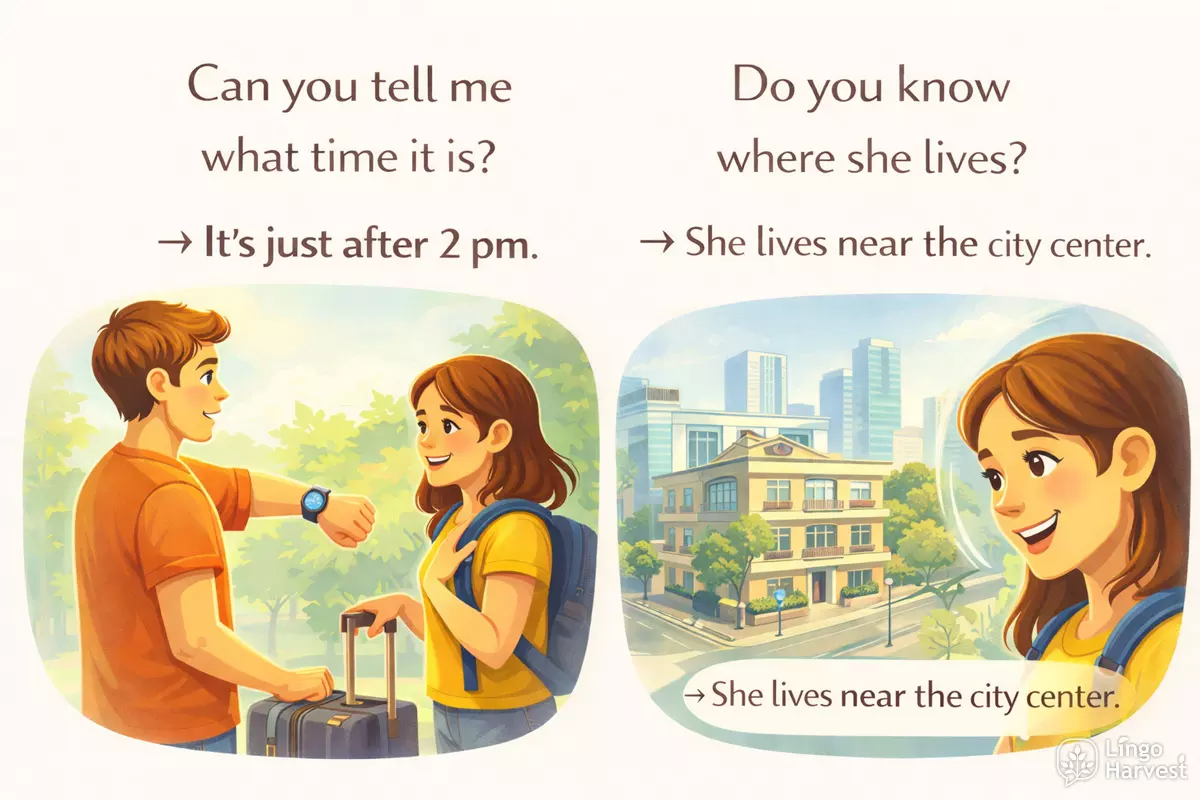
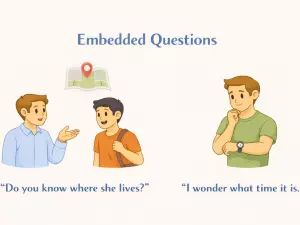
- Can you tell me what time it is? → It’s just after 2 pm.
- Do you know where she lives? → She lives near the city center.
- Could you explain why he left? → He left because of a family emergency.
- I wonder how they solved the problem. → They solved it by changing the approach.
- Would you mind telling me who called last night? → It was your colleague.
- I’m not sure when the meeting starts. → It starts at 10 am.
- Please let me know which train we should take. → You should take the express train.
- Could you show me how this works? → Sure, I’ll show you step by step.
- Do you remember what she said? → Yes, she said she would call back.
- Can you tell me why the store is closed? → It’s closed for renovations.
- I’d like to know where you bought this. → I bought it online.
- Do you have any idea when he will arrive? → He’ll arrive later this evening.
- Could you explain how it happened? → It happened because of a system error.
- Do you know who is responsible? → Yes, the manager is responsible.
- Can you tell me what this means? → It means the request was approved.
- I wonder why they are late. → They’re late because of traffic.
- Do you remember where we parked the car? → Yes, it’s on Level 3.
- Could you tell me when lunch is served? → Lunch is served from noon.
Key Differences: Direct vs. Indirect WH-Questions
| Direct Question | Indirect Form |
|---|---|
| Where is the bank? | Could you tell me where the bank is? |
| Why did he leave? | Do you know why he left? |
| What does this mean? | I’d like to know what this means. |
| How can I get there? | Can you explain how I can get there? |
Notice that in indirect forms, you do not use question word order or add a question mark unless the introductory phrase itself is a question. For example, “Can you tell me where the station is?” (with a question mark), but “I wonder where the station is.” (with a period).
Using these indirect structures helps you sound more polite and formal in English, especially when making requests or seeking information from people you don’t know well.
Common Introductory Phrases
When forming indirect questions in English, certain introductory expressions help make your request or inquiry sound softer and more polite. These openers set the tone and structure for the question that follows, signaling that you are not demanding information but asking with courtesy.
Typical Openers for Indirect Questions
English speakers use a variety of phrases to begin indirect questions, especially in formal or respectful contexts. These phrases are often followed by a clause introduced by "if," "whether," or a question word (such as "what," "where," "when," "how," etc.). Some of the most common introductory expressions include:
- I need to check whether this account is still active. → Yes, it’s active.
- I’d like some clarification on how this feature differs from the previous one. → It offers more control.
- I’m trying to understand why this setting changed automatically. → It updates after installation.
- I was hoping for some insight into how long approval usually takes. → It takes two business days.
- I’m looking for information about whether this plan renews automatically. → Yes, it renews monthly.
- I’d appreciate some guidance on which option suits beginners best. → The basic option is best.
- I’m checking if additional verification is required. → Yes, verification is required.
- I’m curious to know how often these settings can be changed. → You can change them anytime.
- I want to confirm whether this step can be skipped. → No, it’s mandatory.
- I’m requesting clarification on what happens after submission. → You’ll receive a confirmation email.
How These Phrases Work in Practice
Using these openers, the sentence structure changes from a direct question ("Where is the station?") to a more polite form ("Could you tell me where the station is?"). Notice that after the introductory phrase, the sentence order usually follows that of a statement—there is no subject-auxiliary inversion as in direct questions.
| Direct Question | Indirect Question |
|---|---|
| Where is the nearest bank? | Could you tell me where the nearest bank is? |
| What time does the meeting start? | Do you know what time the meeting starts? |
| Is she coming to the party? | I was wondering if she is coming to the party. |
| Why did he leave early? | Can you explain why he left early? |
| Can I use your phone? | Would you mind if I used your phone? |
Tips for Using Indirect Question Starters
When choosing an introductory phrase, consider the relationship with the listener and the level of formality needed. For example, "Could you tell me…" and "Would you mind telling me…" are ideal in professional or unfamiliar settings, while "Do you know…" is suitable for casual situations. Remember, these openers not only show respect but also help avoid sounding abrupt or demanding.
Typical Learner Mistakes
When learning to use polite, indirect questions in English, students often confuse the word order or use direct forms by mistake. The process of turning a direct question into an indirect one is not always intuitive, especially for speakers of languages with different question structures. Below, you’ll find some of the most frequent errors and misunderstandings, along with tips to avoid them.
Common Issues with Word Order
A frequent problem is keeping the subject-verb inversion from the direct question when it should be in statement order. For example, learners sometimes say, “Can you tell me where is the station?” instead of the correct “Can you tell me where the station is?”
- Using question word order after introductory phrases (e.g., “Do you know what is this?” ❌)
- Forgetting to change the verb to statement order (e.g., “I wonder what does she want.” ❌)
- Correct form: “Do you know what this is?” ✅
Omitting or Misusing Polite Phrases
Learners sometimes skip the introductory phrase, making the question sound too direct or even rude in formal situations. Alternatively, they may use a phrase that doesn’t fit the context.
- Leaving out “Could you tell me…” or “I’d like to know…”
- Mixing up formal and informal phrases (e.g., “Can you tell me what time is it, mate?”)
- Using “please” in the wrong spot (e.g., “Tell me please where the bank is.”)
Confusing If/Whether in Yes–No Questions
When the question doesn’t start with a wh-word (like “what” or “where”), English uses “if” or “whether” in indirect forms. Learners often omit these or use them incorrectly.
- Direct: “Is she coming?”
- Incorrect indirect: “Can you tell me is she coming?” ❌
- Correct: “Can you tell me if she is coming?” ✅
Comparison Table: Direct vs. Indirect Forms
| Direct Question | Indirect Question |
|---|---|
| Where is the station? | Could you tell me where the station is? |
| What time does the store open? | Do you know what time the store opens? |
| Is he at home? | Can you tell me if he is at home? |
| Why did she leave? | I wonder why she left. |
Other Frequent Pitfalls
- Using “do/does/did” in indirect questions: “Can you tell me where does he work?” instead of “where he works.”
- Forgetting to use a subject: “Do you know what time is?” instead of “what time it is.”
- Misplacing the introductory phrase: “Where the bank is, can you tell me?” (unnatural in English)
- Not matching verb tense: “I’d like to know when did he arrive.” should be “when he arrived.”
- Using “if” with wh-questions: “Can you tell me if where she went?” is incorrect.
- Omitting the question mark after indirect questions in writing: Even indirect questions are statements and take a period, not a question mark.
By paying attention to these patterns and reviewing the differences between direct and indirect forms, learners can avoid these common errors and communicate more politely and accurately in English.
Practice Exercises and Self-Check
Understanding how to form and recognize polite indirect questions is essential for clear and respectful communication in English. This section provides a variety of activities to help you practice spotting, rewriting, and creating indirect question forms. Use the tasks below to check your skills and deepen your understanding.
1. Identify the Indirect Question
Read each sentence and decide whether it is a direct or indirect question. Write "Direct" or "Indirect" after each one.
- Can you tell me where the nearest bank is?
- Where did she go?
- I wonder if he has finished his homework.
- What time does the meeting start?
- Do you know how old she is?
Show answers
1. Indirect2. Direct
3. Indirect
4. Direct
5. Indirect
2. Rewrite Direct Questions as Indirect
Transform these direct questions into polite, indirect forms. Use phrases like "Could you tell me...", "Do you know...", or "I was wondering...".
- Where is the restroom?
- What time does the train leave?
- Why did he quit his job?
- How much does this cost?
- When will the results be announced?
- Where did they park the car?
- How long does the meeting last?
- Who is responsible for this task?
- What does this button do?
- When did she arrive?
Show answers
- Could you tell me where the restroom is?
- Do you know what time the train leaves?
- I was wondering why he quit his job.
- Could you tell me how much this costs?
- Do you know when the results will be announced?
- Can you tell me where they parked the car?
- Do you know how long the meeting lasts?
- I’d like to know who is responsible for this task.
- Could you explain what this button does?
- Do you know when she arrived?
3. Spot the Error
Each sentence below contains a mistake in the indirect question form. Find and correct the error.
- Do you know what is the time?
- Can you tell me where does she live?
- I wonder what is he doing.
- Could you tell me when will the movie start?
- Do you know where is my phone?
- Can you explain why did they leave?
- I’m not sure what does this mean.
- Could you tell me how much is this ticket?
- Do you know when did he call?
- I wonder where are they going.
Show answers
- Do you know what the time is?
- Can you tell me where she lives?
- I wonder what he is doing.
- Could you tell me when the movie will start?
- Do you know where my phone is?
- Can you explain why they left?
- I’m not sure what this means.
- Could you tell me how much this ticket is?
- Do you know when he called?
- I wonder where they are going.
4. Create Your Own
Write three polite, indirect questions that you might use in a shop or at work. Try to use different introductory phrases from the list above.
Show answers
- Could you tell me if these shoes are available in size 10?
- Do you happen to know when the next meeting is scheduled?
- Would you mind telling me where I can find the printer?
Practicing these forms regularly will help you communicate more politely and naturally in English-speaking environments. For best results, review your answers and try to use indirect questions in real conversations whenever possible.