Pronoun Use in Informal Spoken English

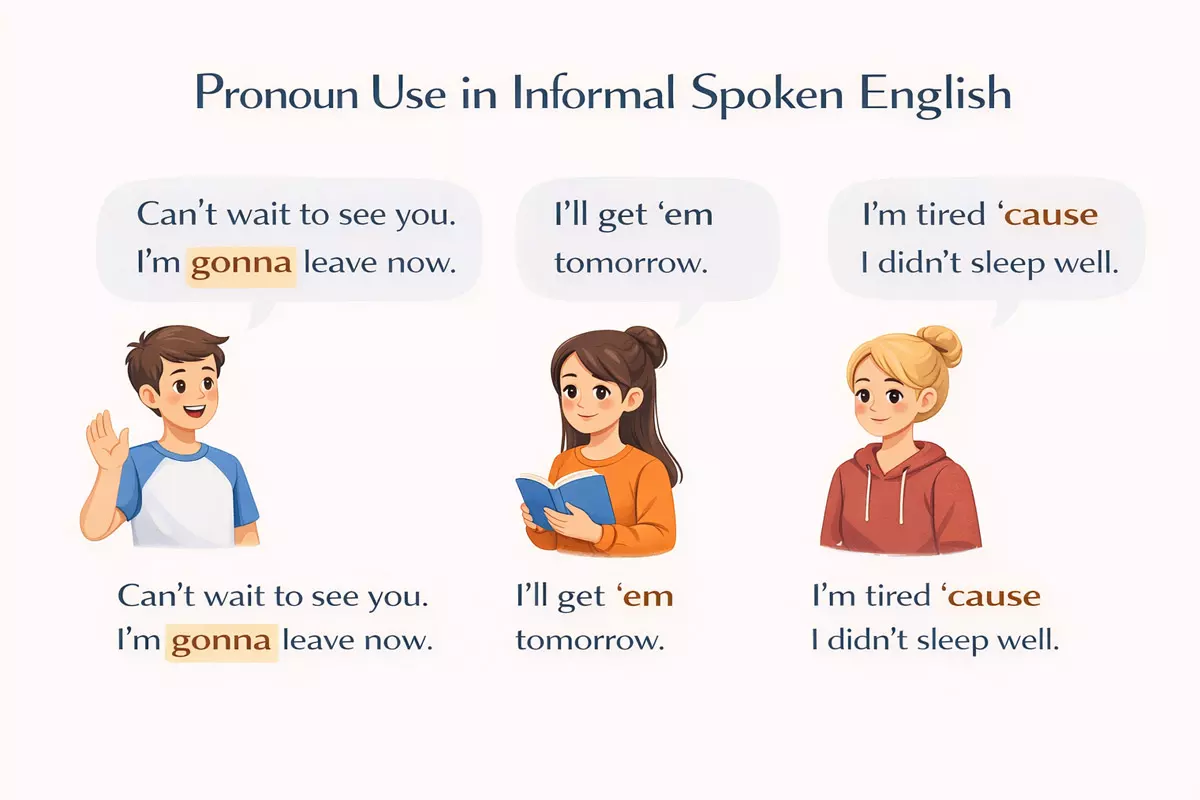 Here we how pronouns work in casual speech, focusing on reduced forms, vague references like they or it, and differences from formal writing. It also highlights common learner mistakes and gives practice rewriting sentences informally.
- Characteristics of pronouns in casual speech
- Reduced forms and dropped elements
- They, it, and you in vague reference
- Pronouns in everyday conversations and chats
- Differences from formal written usage
- Common informal patterns learners miss
- Typical learner overcorrections
- Practice: rewrite formal sentences informally
Everyday conversations involve subtle language choices that often go unnoticed, especially in the way we refer to people, objects, or ourselves. These small words and phrases, though seemingly insignificant, carry meaning that shapes our interactions and reflects our relationships with others. By paying attention to these details in casual speech, we can uncover interesting shifts in meaning and gain insight into how language influences social connection, highlighting the complexity and nuance present in even the most ordinary exchanges.
Characteristics of pronouns in casual speech
In everyday spoken English, pronouns often take on unique features that set them apart from their appearance in formal writing. Speakers tend to use shorter, simpler forms, sometimes blending or dropping sounds for ease and speed. Context usually makes the meaning clear, so people rely on shared understanding rather than strict grammar rules.
Common patterns in informal pronoun usage
- Reducing or contracting pronouns with verbs (e.g., “I’m” instead of “I am”)
- Dropping pronouns, especially the subject, when the meaning is obvious (“Got it” instead of “I got it”)
- Using generic pronouns like “you” or “they” to refer to people in general
- Switching to “we” or “you guys” for inclusive or group references
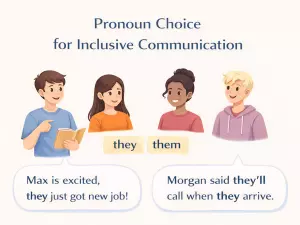
- Replacing “he or she” with “they” for gender neutrality
- Doubling pronouns for emphasis (“Me, I don’t care”)
- Using “it” for vague or unstated subjects (“It’s raining,” “It seems weird”)
- Employing “this” and “that” more flexibly to refer to ideas or things already mentioned
- Shifting between formal and informal forms depending on the relationship with listeners
- Shortening “them” to “’em” in rapid speech (“Give ’em a call”)
- Using “us” instead of “me” for certain requests (“Pass us the salt”)
- Repeating pronouns for clarification or emphasis (“You, you never listen!”)
- Using “one” rarely; preferring “you” or “they” for generalizations
- Blending subject and auxiliary verb (“She’s going” for “She is going”)
- Nonstandard forms in some dialects, like “y’all” or “youse” for plural “you”
- Substituting “that” for “he/she/they” in storytelling (“That was when that said…”)
Comparing formal and casual pronoun forms
| Standard Form | Casual Speech Example | Example Sentence |
|---|---|---|
| I am | I’m | I’m running a bit late today. |
| He is / She is | He’s / She’s | She’s already on her way. |
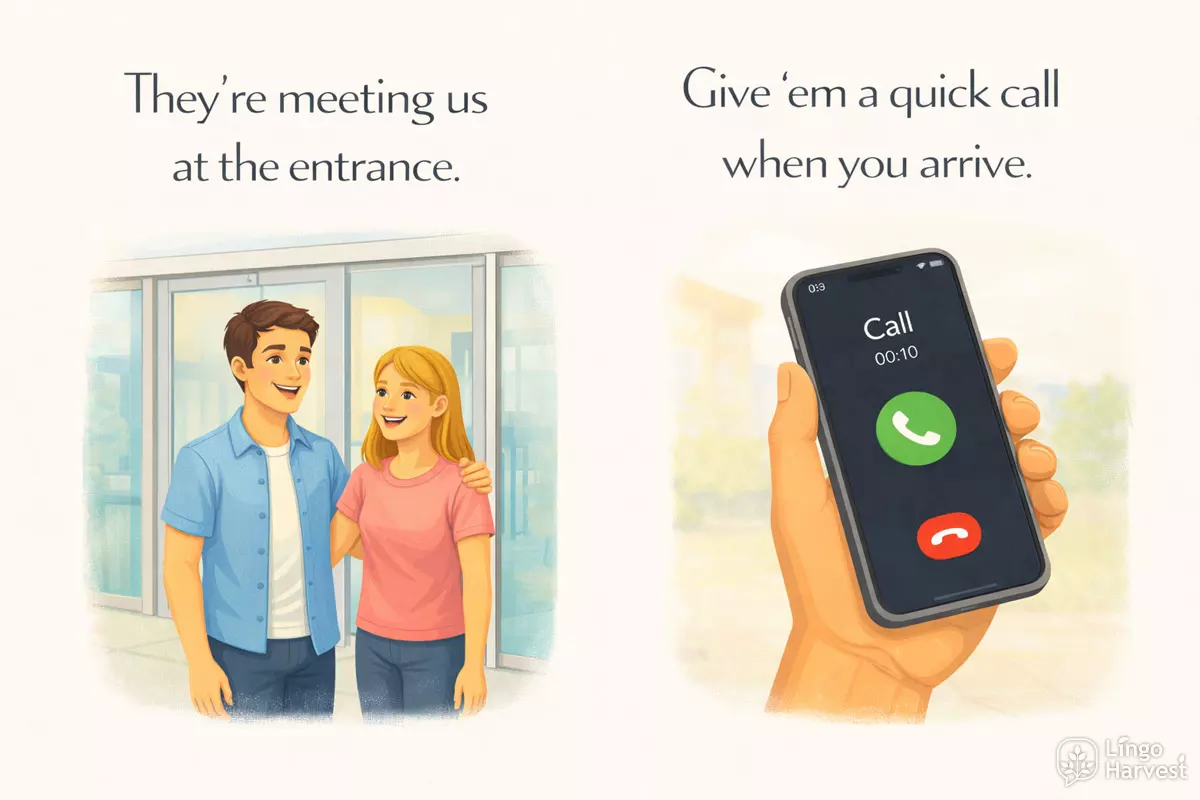
| They are | They’re | They’re meeting us at the entrance. |
| Give them | Give ’em | Give ’em a quick call when you arrive. |
| You all | Y’all / You guys | Y’all ready to order, or do you need a minute? |
| He or she | They | If someone calls, tell them I’ll call back. |
| It is | It’s | It’s not as complicated as it looks. |
| Pass me | Pass us | Pass us the charger when you’re done. |
| I do not know | Dunno | Dunno what happened, but the screen just froze. |
| Did you | D’you | D’you want to grab coffee after class? |
Spoken English’s pronoun choices are shaped by context, familiarity, and the need for quick, efficient communication. People adapt their language on the fly, using shortcuts and substitutions that may sound odd in writing but feel natural in conversation. These tendencies help create a sense of closeness and informality among speakers.
Reduced forms and dropped elements
In casual conversation, English speakers often shorten pronouns and leave out some words entirely. This tendency makes speech faster and more fluid, though it can be confusing for learners. These patterns are especially common in everyday talk, texting, and rapid exchanges among friends or family.
Common Pronoun Reductions
Informal English frequently blends or contracts pronouns with helping verbs and negatives. This results in forms that sound quite different from their full versions. Here are some examples:
- I am → I'm
- You are → You're
- He is → He's
- She will → She'll
- They have → They've
- We would → We'd
- It is not → It isn't or It’s not
- I would have → I'd've (spoken, rarely written)
- You had → You'd
- Who is → Who's
- That is → That's
- There is → There's
- What are → What're
- How did → How'd
Dropping Pronouns and Other Elements
Sometimes, people omit pronouns or even whole words when the meaning is obvious from context. This is especially true in responses, commands, and casual questions:
- Want some? (instead of Do you want some?)
- See you later. (short for I’ll see you later.)
- Gotta go. (from I have got to go.)
- Coming? (for Are you coming?)
- Need help? (instead of Do you need help?)
- Looks good. (short for It looks good.)
- Hope so. (from I hope so.)
- Been there. (meaning I have been there.)
- Don’t know. (for I don’t know.)
- Ready? (instead of Are you ready?)
- Sorry. (often for I’m sorry.)
- Sounds fun. (meaning That sounds fun.)
Comparison of Full vs. Reduced Forms
To see how everyday speech differs from formal usage, compare these forms:
| Full Form | Informal Spoken Form |
|---|---|
| I am going to leave now. | I'm gonna leave now. |
| Are you coming with us? | Coming with us? |
| She would have liked it. | She'd've liked it. |
| Do you want to eat? | Wanna eat? |
| He has not finished yet. | He hasn't finished yet. |
Understanding these habits makes it easier to follow native speakers and sound more natural in informal situations. While these short forms are typical in speech, they are generally avoided in formal writing.
They, it, and you in vague reference
In everyday spoken English, speakers often use pronouns like "they," "it," and "you" to refer to people or things in a general or nonspecific way. This vagueness helps keep conversations informal, smooth, and sometimes avoids directness. Each of these pronouns has its own subtle uses when the exact referent is unclear or not important for the listener.
How "they" is used vaguely
"They" frequently stands in for unknown or unspecified people. For example, when someone says, "They say it's going to rain," the speaker refers to people in general, not a specific group. This impersonal usage is common for rumors, rules, or general opinions.
- They don't make them like they used to.
- They told me the office is closed on Fridays.
- They say laughter is the best medicine.
- They always change the schedule at the last minute.
- They've increased the price again.
- They never answer the phone after 5 PM.
- They say the movie is really good.
- They won't let you park here.
- They've been working on this road for ages.
- They say coffee is bad for you.
Vague "it" in casual speech
"It" can refer to situations, weather, time, or abstract concepts without a clear noun. For instance, "It's raining" uses "it" as a dummy subject, standing in for the situation. This pronoun also appears in conversational phrases where the real subject is either obvious or unimportant.
- It's not easy to find good help.
- It's getting late.
- It's just one of those days.
- It's hard to say what happened.
- It's about time to go.
- It's no use arguing.
- It's up to you.
- It's been a while.
- It's worth a try.
- It's not the end of the world.
General "you" for nonspecific subjects
"You" is often used to mean "anyone" or "people in general." This impersonal usage makes statements feel more relatable or less direct. For example, "You never know what might happen" refers to anyone, not just the listener.
- You can't judge a book by its cover.
- You win some, you lose some.
- You never know until you try.
- You get used to it after a while.
- You just have to keep going.
- You shouldn't believe everything you hear.
- You can't always get what you want.
- You know how it is.
- You have to be careful with those.
- You don't realize what you have until it's gone.
Comparing vague pronoun reference
| Pronoun | Typical vague use |
|---|---|
| They | Unspecified people or authorities (e.g., "They say...") |
| It | General situations, weather, or abstract ideas (e.g., "It's raining") |
| You | People in general or anyone (e.g., "You never know") |
Why speakers prefer vague pronouns
Using these pronouns vaguely can soften statements, make advice feel less bossy, or keep the conversation moving without bogging it down in specifics. It also helps speakers talk about rules, habits, or shared experiences without naming individuals or groups directly. In informal spoken English, this approach is often more natural and less confrontational.
Pronouns in everyday conversations and chats
In spoken English, people rely on pronouns to keep conversations flowing naturally and efficiently. Instead of repeating names or subjects, speakers use words like “he,” “she,” “they,” or “it” to refer to people or things already understood from context. This helps make speech sound less repetitive and more relaxed, especially in informal settings such as chats with friends, family discussions, or quick text exchanges.
Common Uses of Pronouns in Informal Speech
Everyday talk is filled with instances where pronouns stand in for longer phrases or previously mentioned topics. Here are some typical ways pronouns appear in relaxed conversation:
- Referring to someone just mentioned (“Sarah said she’ll be late.”)
- Reacting in short, quick replies (“Got it!” or “I know!”)
- Asking for clarification (“Who did you see?” “Them.”)
- Talking about shared experiences (“We had the best time yesterday.”)
- Using “it” for weather, time, or situations (“It’s raining.” / “It’s late.”)
- Replacing names in group chats (“They said they’re on the way.”)
- Using “you” in general statements (“You never know.”)
- Choosing “they/them” for unknown or nonbinary people (“Someone left their bag.”)
- Shortening responses (“Do you want coffee?” “Yeah, I do.”)
- Expressing opinions (“I think it’s awesome.”)
- Referring to objects (“Where’s my phone? Have you seen it?”)
- Directing attention (“Look at this!”)
Informal Patterns and Shortcuts
Pronouns in casual English often appear in contractions or get dropped in very short replies. For example, “I am” becomes “I’m,” and “he is” turns into “he’s.” In text messages or chats, it’s common to see even further shortcuts, such as dropping the subject: “Coming now!” instead of “I am coming now!”
Comparison: Subject and Object Pronouns
Choosing the right pronoun form is important for clarity. Subject pronouns do the action, while object pronouns receive it. Here’s a quick look at the most common forms:
| Subject Pronoun | Object Pronoun |
|---|---|
| I | me |
| you | you |
| he | him |
| she | her |
| it | it |
| we | us |
| they | them |
Tips for Natural Pronoun Use in Conversations
- Use pronouns to avoid repeating names or nouns.
- Listen for context—make sure it’s clear who or what each pronoun refers to.
- In group chats, double-check that messages are clear to everyone.
- Don’t be afraid to clarify if a pronoun’s meaning is unclear (“Who do you mean by ‘they’?”).
- Practice using “they/them” as singular for unknown or nonbinary individuals.
Pronouns make informal spoken English smoother and more personal. As you listen or participate in real-life conversations and online chats, notice how often these words appear and how naturally they fit into everyday speech.
Differences from formal written usage
In everyday speech, pronouns often appear in ways that differ noticeably from standard written English. Spoken language tends to be more relaxed, with a focus on clarity and efficiency rather than strict grammatical rules. This leads to distinctive patterns, shortcuts, and sometimes even creative uses of pronouns that you might not see in formal writing.
Common variations in informal speech
People frequently use pronouns in ways that break from traditional grammar. For example, subject and object forms can get mixed, or extra pronouns might be added for emphasis. These shifts are a natural part of conversation and help speakers express tone, attitude, or familiarity.
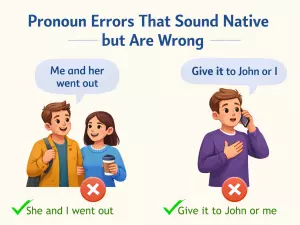
- Using "me" instead of "I" in compound subjects: "Me and Tom are going."
- Dropping pronouns altogether: "Told you so!" (instead of "I told you so!")
- Double subjects: "My brother, he loves pizza."
- Generic "you" for people in general: "You never know."
- Using "they" as a singular pronoun: "Someone left their bag."
- Overusing "they" for unknown or unspecified people: "They say it's going to rain."
- Adding "them" or "him" for emphasis: "I saw him, I did."
- Using "us" for "me": "Give us a hand."
- Using "her" for "she": "Her’s coming too."
- Contracted forms: "gonna," "wanna," "gotta," where the pronoun subject is often implied or omitted.
- Tag questions with pronouns: "You’re coming, aren’t you?"
- Nonstandard reflexives: "Hisself," "theirselves."
- Repetition for emphasis: "Me, I don’t care."
- Switching pronouns mid-sentence: "If you’re not careful, they’ll catch you."
- Use of "it" as a dummy subject: "It’s raining."
- Informal plural "you": "You guys," "y’all," "youse."
- Pronoun stacking: "We all of us need to help."
- Using "that" as a pronoun for people: "That’s the guy I told you about."
- Omitting relative pronouns: "The person I met yesterday."
Comparison: Formal vs. Informal Pronoun Usage
| Formal Written English | Informal Spoken English |
|---|---|
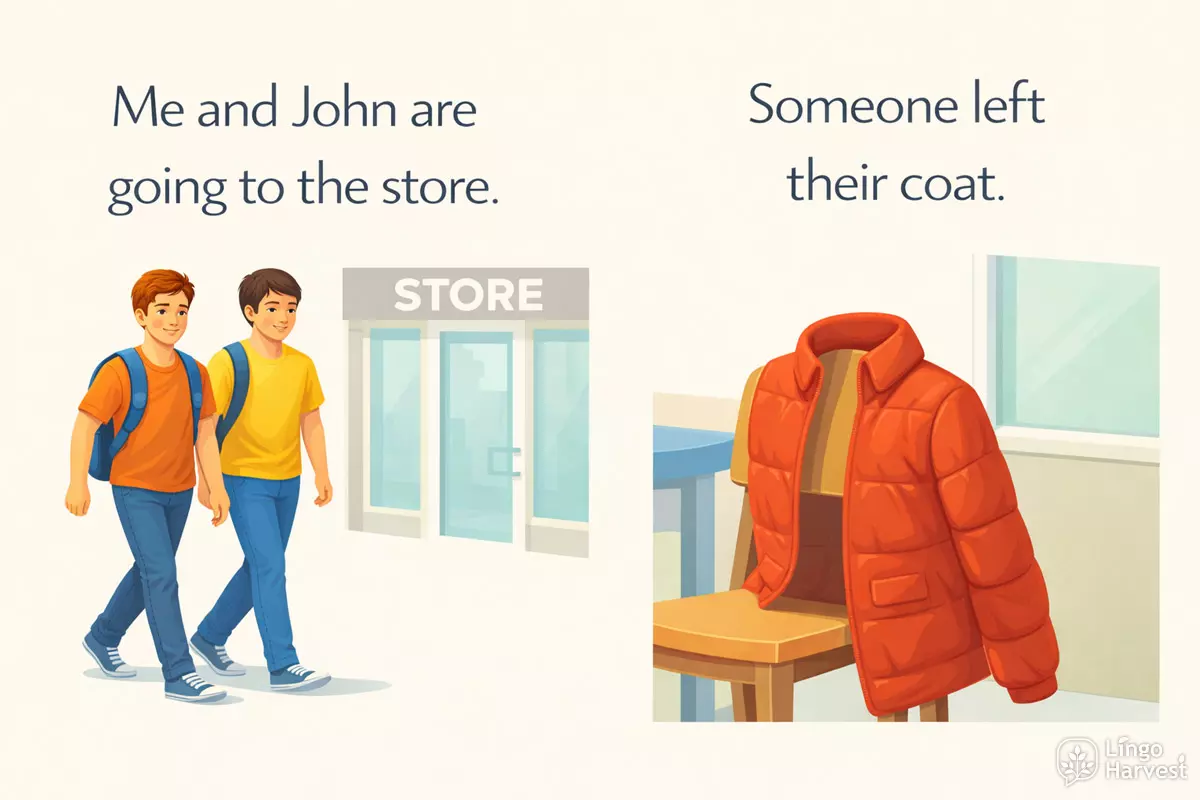
| "John and I are going to the store." | "Me and John are going to the store." |
| "Is anyone missing their coat?" | "Someone left their coat." |
| "She is taller than I am." | "She’s taller than me." |
| "If he were here, he would know." | "If he was here, he’d know." |
| "Will you help me?" | "Can you give us a hand?" |
These examples show how conversational English prioritizes ease and immediacy. While such forms may seem ungrammatical in writing, they are widely accepted and understood in speech. Recognizing these differences can help learners and listeners better navigate everyday conversations and understand how pronouns are really used outside the classroom or office.
Common informal patterns learners miss
Many English learners master textbook pronoun rules but often overlook how pronouns shift in everyday conversation. Informal speech tends to favor shortcuts, blending, and patterns that are rarely explained in formal lessons. Here, we’ll explore some of the most frequent ways native speakers use pronouns differently in casual settings, helping you sound more natural and understand real spoken English more easily.
Typical informal pronoun shortcuts
- Dropping subject pronouns: In fast speech, speakers sometimes drop “I” or “you” at the start of sentences. Example: “(You) Want some?” instead of “Do you want some?”
- Using “it” for vague subjects: “It” is often used when the real subject is obvious or unnecessary. Example: “It’s raining” (even if “rain” is the real subject).
- “They” for general people: “They” replaces “people” or “someone.” Example: “They say it’s good luck.”
- Object pronouns for subjects: Especially in responses, “Me too” replaces “I do too.”
- Double subjects: “My sister, she’s coming over.” (Both “my sister” and “she” refer to the same person.)
- Generic “you”: Used to mean “anyone” or “everyone.” Example: “You never know.”
- Using “us” for “me”: In friendly contexts: “Give us a minute.”
- Reduced forms: “Gimme” (give me), “lemme” (let me), “tell’em” (tell them).
- “One” avoided: “One” as a generic pronoun is rarely used in speech; “you” or “they” is preferred.
- Reflexives for emphasis: “I did it myself.”
- “Them” for objects: Informal use for non-people: “Where are them keys?” (nonstandard, but heard in some dialects)
- “Who” and “that” blurred: Using “that” for people: “She’s the one that called.”
- “We” for “you and I”: “We gotta go.”
- “He/she” for animals: Instead of “it,” speakers use “he” or “she” for pets.
- Omitting “it” as object: “Found (it)!” instead of “I found it!”
Comparison: Formal vs. Informal Pronoun Use
| Formal Version | Informal Spoken Version |
|---|---|
| Do you want to come with me? | Wanna come with me? |
| I cannot do it. | Can’t do it. |
| Let me see it. | Lemme see. |
| Give it to me, please. | Gimme that. |
| He is not here. | He’s not here. |
| They are not coming. | They’re not coming. |
Why these patterns matter
Being aware of these informal pronoun habits makes it easier to follow real conversations and respond naturally. Learners who stick only to formal rules may sound stiff or misunderstand native speakers. Noticing these subtle shifts can help you blend into English-speaking environments with confidence and clarity. Practice listening for these variations, and try them out in your own speech for a more authentic style.
Typical learner overcorrections
Many English learners, aiming for accuracy, sometimes go too far and use pronouns in ways that don’t match natural spoken English. This happens when learners apply textbook rules too strictly or avoid forms they think are “incorrect”—even when native speakers use them every day. Understanding these patterns can help learners sound more fluent and less formal in conversation.
Common patterns of overcorrection
Often, people who are learning English want to avoid mistakes so much that they end up using overly formal or unnatural pronoun forms. Here are some frequent examples:
- Replacing “me” with “I” after prepositions: “Between you and I” instead of the natural “Between you and me”.
- Insisting on “whom” in casual speech: “Whom did you see?” instead of the more common “Who did you see?”.
- Always choosing “he or she” instead of the singular “they”: “If someone calls, tell him or her I’m out” rather than “If someone calls, tell them I’m out”.
- Avoiding “them” for people: “I saw the students. I spoke to the students.” instead of using “I spoke to them.”
- Not using “it” for weather, time, or distance: “Is raining” instead of “It’s raining.”
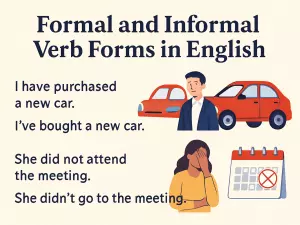
- Refusing contractions: “It is not” instead of the more conversational “It’s not” or “Isn’t”.
- Forcing gender-specific pronouns when the gender is unknown or irrelevant.
- Overusing reflexive forms: “Myself and John went to the store.”
- Avoiding object pronouns at the end of sentences: “Who are you talking to?” becomes “To whom are you talking?”
- Overusing “one” as a generic pronoun: “One should always do one’s best.” instead of the more casual “You should always do your best.”
- Over-formalizing: “It is I” instead of “It’s me.”
- Adding unnecessary pronouns: “My brother he lives in London.”
- Confusing subject and object pronouns in coordinated phrases: “Me and him went to the party.” (sometimes overcorrected to “He and I went…” in every situation, even when not needed).
- Pronoun dropping: Leaving out pronouns in fast speech, but overcorrecting by always including them in every sentence.
- Using “whom” in fixed questions where “who” is standard: “Whom’s there?”
Overcorrection vs. natural usage: A comparison
| Overcorrected Form | Natural Spoken English |
|---|---|
| It is I. | It’s me. |
| Between you and I | Between you and me |
| He or she should call. | They should call. |
| To whom are you speaking? | Who are you talking to? |
| If one wants to succeed, one must work hard. | If you want to succeed, you have to work hard. |
Why do these overcorrections happen?
Learners may overapply prescriptive grammar rules or misunderstand how native speakers actually use pronouns in real life. Exposure to authentic conversation and relaxed listening can help reduce these habits. Over time, recognizing when informal structures are not only acceptable but preferred will help learners sound more natural and confident.
Practice: rewrite formal sentences informally
Getting comfortable with how native speakers use pronouns in everyday English means learning to relax the rules a bit. In real conversations, people often shorten, contract, or even drop pronouns for a more natural flow. Try adjusting these formal sentences to sound like something you’d actually say with friends or colleagues.
Try it yourself: Change these formal lines to casual speech
Below, you’ll find a collection of sentences that might appear in essays, reports, or formal situations. Your goal: rewrite each one so it sounds like something you’d hear in relaxed, spoken English. Focus on pronoun changes, contractions, and dropping unnecessary words.
- It is important that you attend the meeting.
- She does not know whether she will be able to come.
- We have completed all of the assignments.
- He will not be able to join us tonight.
- I am not certain if I can help.
- They have not decided what they want yet.
- It is possible that I left my keys at your place.
- He is not sure whether he wants dessert.
- You are required to submit the form by Friday.
- We are interested in hearing your feedback.
Show answers
- You gotta come to the meeting.
- She’s not sure if she can make it.
- We finished all the assignments.
- He can’t come tonight.
- I’m not sure if I can help.
- They haven’t decided what they want yet.
- I might’ve left my keys at your place.
- He’s not sure if he wants dessert.
- You need to turn in the form by Friday.
- We’d love to hear what you think.
Spot the difference: Pronoun shifts in practice
Notice how informal English often uses contractions, omits repeated pronouns, and chooses simpler wording. The table below shows some common transformations from formal to informal usage, focusing on pronouns and related structures.
| Formal version | Informal version |
|---|---|
| It is not necessary for you to do that. | You don’t have to do that. |
| He would like to know if he can join us. | He wants to know if he can come. |
| We are unable to attend the event. | We can’t make it to the event. |
| They are planning to submit their work soon. | They’re gonna turn in their work soon. |
| I am not certain that I understand. | I’m not sure I get it. |
Tips for sounding natural in conversation
- Use contractions (I’m, you’re, we’ve, etc.).
- Drop repeated subjects when it’s clear who you mean.
- Replace “it is” or “there is” with “it’s” or “there’s.”
- Choose simpler pronouns (“you” instead of “one”).
- Avoid overusing “that” after verbs when it’s not needed.
- Swap “do not” and “cannot” for “don’t” and “can’t.”
- Use “gonna” or “wanna” in very casual speech (but not in formal writing).
- Shorten questions: “Are you coming?” instead of “Will you be attending?”
With practice, you’ll start to recognize when and how to use pronouns the way native speakers do in relaxed, everyday English.