Pronoun Reduction and Weak Forms in Speech

 Here we what weak forms are, why they matter, and how pronouns are reduced in fast speech. It discusses stress patterns, common reduced combinations, listening challenges, pronunciation versus spelling, examples, and practice activities.
- What weak forms are and why they matter
- Pronoun reduction in fast speech
- Stress patterns with strong vs weak pronouns
- Common reduced combinations in conversation
- Listening challenges for learners
- Pronunciation vs spelling differences
- Natural spoken examples
- Practice: identify reduced pronouns in dialogue
When we speak quickly, words referring to people or things often become less distinct and blend into the rhythm of conversation. This natural blending means that sounds may soften or even disappear, making speech flow more smoothly but sometimes harder to understand. By paying attention to how these elements shift in real conversations, we can discover interesting patterns in fluent speech and gain insights into how language changes in everyday use.
What weak forms are and why they matter
In everyday speech, many words are pronounced in a reduced or simplified way compared to their full, dictionary forms. These are called weak forms. Rather than stressing every word equally, speakers tend to shorten and blend certain function words—like pronouns, conjunctions, prepositions, and auxiliary verbs—so that the main meaning-carrying words stand out. This natural reduction is a key part of fluent, connected speech.
Why do speakers use reduced forms?
The primary reason is efficiency. Weak forms allow speakers to communicate more quickly and smoothly, helping listeners focus on the most important information. By lowering the prominence of less essential words, speech flows better and sounds more natural. Native speakers rarely pronounce every word in its full form, especially in rapid conversation.
- They help maintain rhythm and stress patterns in sentences.
- They prevent speech from sounding robotic or overly formal.
- They allow for easier linking between words.
- They signal which words carry new or important information.
Common examples of weak forms
Here are some frequently reduced words and their typical weak pronunciations in English:
- and → /ənd/ or /ən/ (“bread and butter”)
- to → /tə/ (“going to school”)
- of → /əv/ or /ə/ (“cup of tea”)
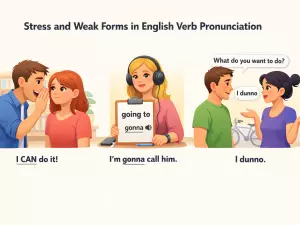
- can → /kən/ (“I can do it”)
- have → /həv/ (“I have seen”)
- he → /iː/ (“He said”)
- her → /hə/ (“Give her it”)
- them → /ðəm/ (“Tell them”)
- was → /wəz/ (“She was there”)
- that → /ðət/ (“That’s the one”)
- you → /jə/ (“Did you see?”)
- are → /ə/ (“You are here”)
- for → /fə/ (“For me”)
- from → /frəm/ (“From here”)
- at → /ət/ (“At home”)
- some → /səm/ (“Some people”)
- as → /əz/ (“As soon as”)
- has → /həz/ (“She has gone”)
- will → /wəl/ (“I will go”)
- him → /ɪm/ (“Give him time”)
Impact on listening and speaking
Learning to recognize and use these unstressed forms is essential for understanding native-level speech and for sounding more natural when speaking. Many language learners struggle with listening comprehension because they expect every word to be pronounced clearly and fully. Understanding weak forms helps bridge this gap and improves both listening and fluency.
| Full Form | Typical Weak Form | Example in Speech |
|---|---|---|
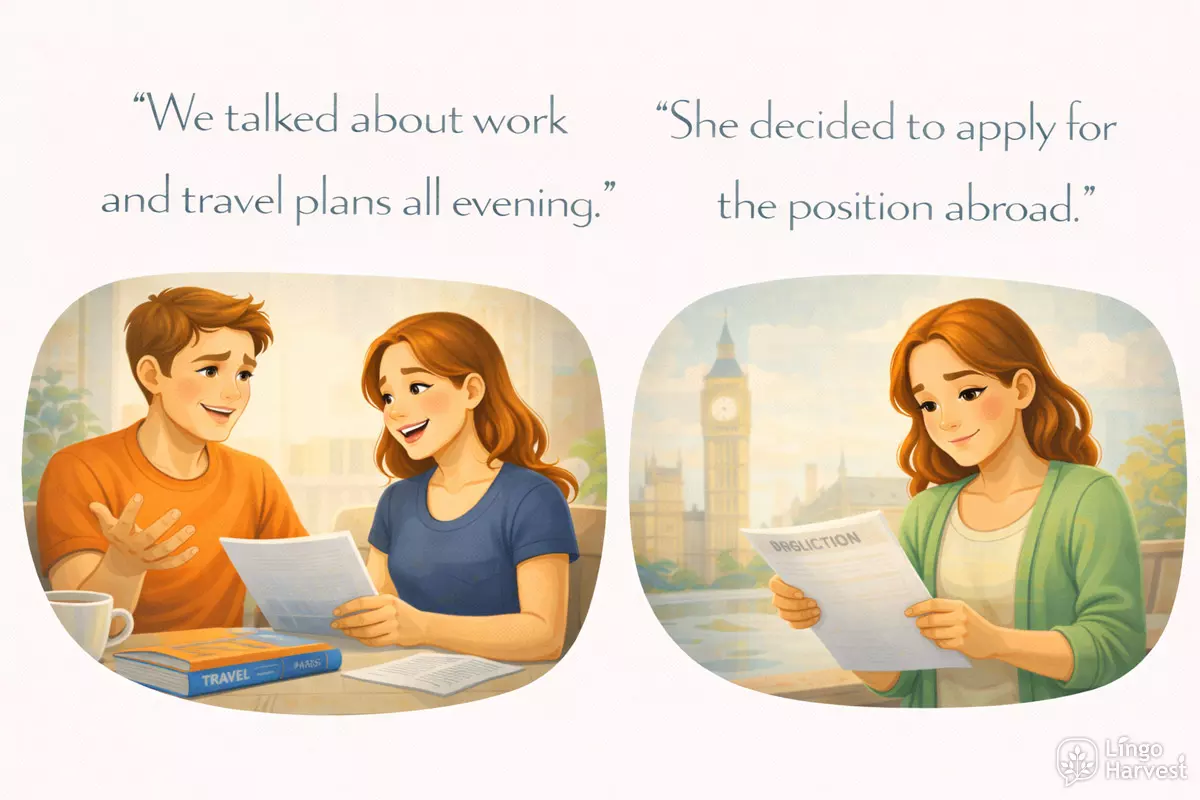
| and | /ənd/ or /ən/ | We talked about work and travel plans all evening. |
| to | /tə/ | She decided to apply for the position abroad. |
| of | /əv/ or /ə/ | That’s one of the reasons I stayed longer. |
| can | /kən/ | I can finish the report if you need it today. |
| have | /həv/ | They have already agreed to the new schedule. |
| her | /hə/ | Please give her the documents before the meeting. |
In summary, recognizing and practicing weak forms is a vital skill for anyone aiming for authentic English pronunciation and comprehension. These small changes make a big difference in real-world communication.
Pronoun reduction in fast speech
Rapid, casual speech often leads to significant changes in the way pronouns are pronounced. Instead of clear, full pronunciations, speakers tend to produce shorter, less distinct forms. This tendency is especially strong in connected, everyday conversation, where the need to maintain fluency and rhythm often outweighs the need for precision. As a result, many English pronouns develop weak forms or even merge with neighboring words, making them less noticeable to a casual listener.
Common patterns of reduced pronouns
Several pronouns are especially susceptible to reduction. The most frequent changes involve weakening vowels, dropping consonants, or blending with adjacent words. Here are some typical outcomes:
- “he” becomes /i/ or even merges with “’s” as in “he’s” [iz]
- “him” is reduced to /əm/ or /m/ in phrases like “give him” [gɪvəm]
- “her” often turns into /ə/ or /ɚ/ after verbs: “tell her” [tɛlər]
- “them” frequently becomes /əm/ as in “show them” [ʃoʊəm]
- “you” is commonly pronounced /jə/ in “would you” [wʊdʒə]
- “us” can become /əs/ or /s/, as in “give us” [gɪvəs]
- “it” may reduce to /ɪt/ or /ət/ and sometimes nearly disappears: “get it” [gɛɾɪt] or [gɛɾət]
- “we” can lose the initial consonant, especially in fast lists: “and we” [ən wi] or [ən i]
- “they” occasionally reduces to /ðe/ or merges with auxiliary verbs: “they’re” [ðɛr]
- “me” is sometimes pronounced /mi/ or /mɪ/ but less often reduced than “him” or “her”
Contexts that encourage reduction
Reduction is most likely when pronouns are unstressed, occur between function words, or follow auxiliary verbs. In questions, tag phrases, or when pronouns are part of fixed expressions, the weak forms are especially common. For example:
- “Did you see him?” → [dɪdʒə si əm]
- “Let us know” → [lɛt əs noʊ]
- “Tell her about it” → [tɛlər əbaʊɾ ɪt]
Comparison of full and reduced forms
| Pronoun | Full Form | Common Reduced Form | Example in Phrase |
|---|---|---|---|
| he | /hiː/ | /i/ | “What’s he doing?” [wɒts i duːɪŋ] |
| him | /hɪm/ | /əm/ | “Give him it” [gɪv əm ɪt] |
| her | /hɜːr/ | /ə/ | “Call her” [kɔːlər] |
| them | /ðɛm/ | /əm/ | “Show them” [ʃoʊ əm] |
| you | /juː/ | /jə/ | “Would you like?” [wʊdʒə laɪk] |
| us | /ʌs/ | /əs/ | “Let us go” [lɛt əs goʊ] |
| it | /ɪt/ | /ət/ | “Get it” [gɛɾ ət] |
Why does this happen?
Speakers naturally economize effort, especially in high-frequency words. Pronouns are among the shortest and most common words in English, so they often lose their full forms in order to keep speech fast and efficient. This process is part of a broader pattern of weak forms in English, affecting not just pronouns but other function words as well.
Stress patterns with strong vs weak pronouns
Understanding how pronouns are pronounced in everyday speech reveals important differences in their stress patterns. In natural conversation, most pronouns have both a “strong” (full) form and a “weak” (reduced) form, and the choice between them depends on their role in the sentence and the speaker’s intent. Stress placement affects not only the clarity of the message but often signals contrast, emphasis, or information structure.
When do we use strong or weak forms?
Typically, pronouns are pronounced in their weak (unstressed) forms unless they are being emphasized or contrasted, or appear at the end of a sentence. The strong form is used for clarity or to highlight the pronoun. For example, in the sentence "I saw her," the word "her" is usually weak unless you want to emphasize that it was her (not someone else) you saw.
Common patterns and pronunciation
Pronouns often reduce to a schwa or even disappear in rapid speech. Here are some common English pronouns with their strong and weak forms:
- he: /hiː/ (strong), /hɪ/ or /ɪ/ (weak)
- him: /hɪm/ (strong), /ɪm/ (weak)
- her: /hɜːr/ (strong), /hər/ or /ə/ (weak)
- them: /ðem/ (strong), /ðəm/ (weak)
- us: /ʌs/ (strong), /əs/ (weak)
- you: /juː/ (strong), /jə/ (weak, especially in connected speech)
- me: /miː/ (strong), /mi/ (weak; less reduction than others)
- it: /ɪt/ (strong), /ɪt/ or /ət/ (weak)
- we: /wiː/ (strong), /wi/ (weak; rarely reduced further)
- they: /ðeɪ/ (strong), /ðɪ/ (weak; less common)
- my: /maɪ/ (strong), /mɪ/ or /mə/ (weak, especially before a noun)
- your: /jɔːr/ (strong), /jər/ or /jə/ (weak)
- our: /aʊər/ (strong), /ɑːr/ or /ər/ (weak)
- their: /ðeər/ (strong), /ðər/ (weak)
- himself: /hɪmˈself/ (strong), /ɪmˈself/ (weak)
- herself: /hɜːˈself/ (strong), /həˈself/ (weak)
Typical contexts for strong and weak forms
- Strong forms appear:
- At the end of a sentence (“Who did you see?” “Her.”)
- When the pronoun is contrasted or emphasized (“I saw him, not you.”)
- If the pronoun is stressed for clarity (“Give it to ME!”)
- Weak forms are used:
- In the middle of sentences, when the pronoun is not emphasized
- In rapid, connected speech (“Did you see him?” /dɪd jə si ɪm?/)
- When the pronoun is predictable from context
Comparing strong and weak pronunciation
| Pronoun | Strong Form (Stressed) | Weak Form (Unstressed) | Example in Speech |
|---|---|---|---|
| her | /hɜːr/ | /hər/, /ə/ | Give it to her. (unstressed) |
| him | /hɪm/ | /ɪm/ | I saw him yesterday. (unstressed) |
| them | /ðem/ | /ðəm/ | Tell them the news. (unstressed) |
| us | /ʌs/ | /əs/ | Come with us. (unstressed) |
| you | /juː/ | /jə/ | Could you help me? (unstressed) |
| it | /ɪt/ | /ət/ | Pass it here. (unstressed) |
Why does this matter?
Mastering the use of reduced pronoun forms helps speech sound more natural and fluent. Listeners expect weak forms in casual conversation; overusing strong forms can make speech sound stilted or artificial. Conversely, using the full form at key moments adds emphasis and clarity, especially in contrastive or corrective contexts.
Common reduced combinations in conversation
In everyday speech, pronouns and auxiliary verbs are often shortened or blended together, making spoken language sound smoother and faster. These reductions are especially common in informal English, where words are frequently pronounced in their weak forms or elided altogether. Recognizing these patterns helps listeners follow rapid conversation and improves natural speech production.
Frequent Reductions and Blended Forms
Speakers often merge pronouns with helping verbs, or compress function words so they’re barely audible. Below are some of the most widespread combinations you’re likely to hear in casual dialogue:
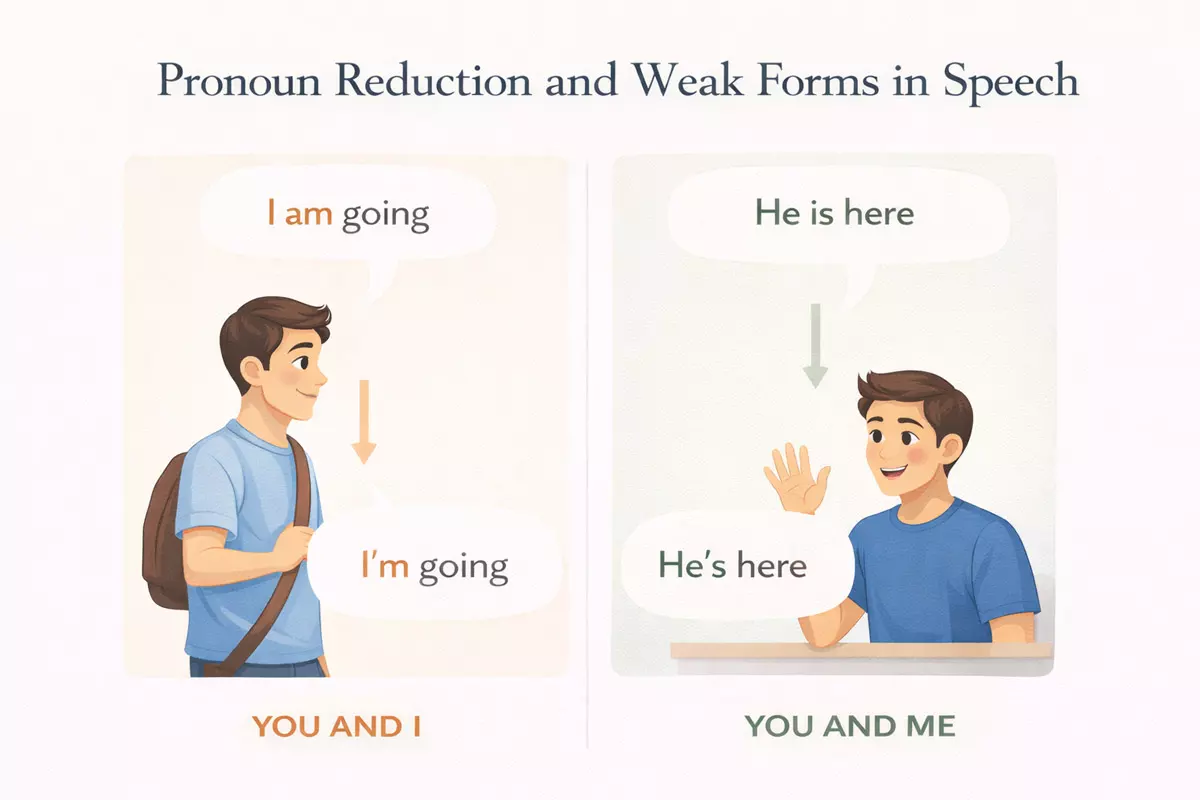
- I am → I'm [aɪm]
- You are → You're [jɔːr]
- He is → He's [hiz]
- She will → She'll [ʃɪl]
- We have → We've [wiːv]
- They would → They'd [ðeɪd]
- It is → It's [ɪts]
- I would → I'd [aɪd]
- You have → You've [juːv]
- He will → He'll [hɪl]
- She is → She's [ʃiz]
- We are → We're [wɪr]
- They had → They'd [ðeɪd]
- It would → It'd [ɪtɪd]
- I have → I've [aɪv]
- You will → You'll [juːl]
Weak Forms in Connected Speech
Sometimes, reductions go beyond simple contractions. Weak forms occur when words like can, have, or them are pronounced with a reduced vowel or blended into neighboring sounds. These forms are especially frequent in questions and quick statements.
- Can (as in "Can you?") often pronounced [kən] or [kn]
- Have in "Should have" sounds like [ʃʊdəv] ("should've")
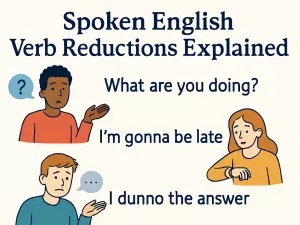
- To in "going to" becomes [gənə] ("gonna")
- Got to turns into [gɑɾə] ("gotta")
- Want to reduces to [wɑnə] ("wanna")
- Let me becomes [lɛmi] ("lemme")
- Give me becomes [gɪmi] ("gimme")
- Them in "give them" is often [ðəm] or just [əm]
Comparison of Full and Reduced Forms
To illustrate how these reductions appear side by side, here’s a quick reference for several common pronoun-verb combinations, showing both their full and reduced forms:
| Full Form | Reduced/Spoken Form |
|---|---|
| I am going to | I'm gonna |
| You have to | You've gotta |
| He would have | He would've |
| They are not | They aren't |
| She is going to | She's gonna |
| We have been | We've been |
| It will be | It'll be |
Mastering these reduced forms and weak pronunciations is a practical step toward understanding fast, natural English. Listening for these patterns can make conversation feel less overwhelming and help your own speech sound more fluent and authentic.
Listening challenges for learners
Understanding natural spoken English often proves difficult due to the way pronouns and other function words are reduced or weakened in rapid speech. Learners who are used to hearing words pronounced clearly in isolation may struggle to catch these subtle forms in conversation, especially when native speakers blend sounds together.
Common issues with reduced forms
Reduced pronouns and weak forms can sound very different from their full pronunciations. When these forms are used in sentences, they may be almost inaudible or merge with surrounding words, making it hard to identify what was said. This leads to missed information or misunderstandings, even when learners know the vocabulary.
- ‘He’ and ‘she’ often sound like /i/ and /ʃi/ or even just a soft vowel.
- ‘Them’ and ‘him’ may be pronounced /əm/ and /ɪm/.
- ‘Her’ can reduce to /ə/ or /ɚ/.
- ‘You’ often becomes /jə/ or /ju/.
- ‘We’ and ‘they’ sometimes blend into the previous word.
- Auxiliary verbs like ‘have’ and ‘has’ reduce to /v/ or /z/.
- ‘To’, ‘for’, ‘of’, ‘at’ often become /tə/, /fə/, /əv/, /ət/.
- ‘Can’ in questions is often pronounced /kən/ or just /kən/.
- ‘Would’ and ‘could’ reduce to /wəd/ and /kəd/.
- ‘Are’ and ‘were’ can become /ər/ and /wər/ or disappear entirely.
- Pronouns after verbs may be attached, as in “give ’em” for “give them”.
- Reduced forms may be skipped altogether in fast speech.
Why reduced forms are hard to catch
Learners may not expect pronouns and weak forms to be so short and unstressed. In fast-paced dialogue, these words lose their strong sounds and often blend with neighboring words, making them almost invisible to untrained ears. Exposure to slow, careful speech in classrooms rarely prepares students for these real-world listening demands.
| Full Form | Common Reduced Form | Example in Speech |
|---|---|---|
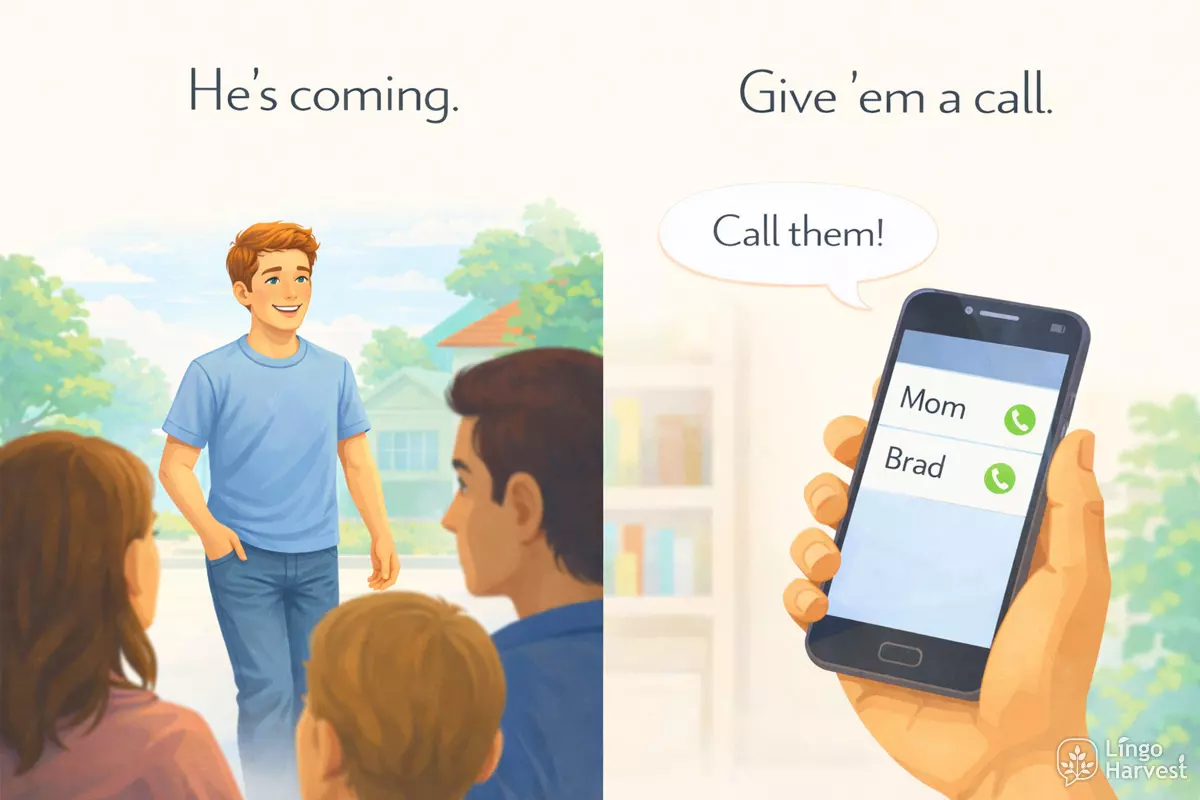
| He is | He's /iz/ | He's coming. → /iz ˈkʌmɪŋ/ |
| Give them | Give 'em /gɪv əm/ | Give 'em a call. → /gɪv əm ə kɔl/ |
| To | /tə/ | Want to go? → /wɑnə goʊ/ |
| Of | /əv/ or /ə/ | Lots of time. → /lɑts ə taɪm/ |
| Can | /kən/ | Can you help? → /kən jə hɛlp/ |
| Her | /ər/ or /ə/ | Tell her. → /tɛl ər/ |
| Have | /v/ | Could have gone. → /kʊdəv gɔn/ |
| Are | /ər/ | How are you? → /haʊ ər ju/ |
Tips for recognizing reduced forms
- Listen for context and meaning, not just individual words.
- Practice with authentic audio: movies, podcasts, or real conversations.
- Pay attention to word groups and how sounds blend together.
- Repeat short phrases and imitate native speakers’ rhythm and reductions.
- Ask for clarification if you miss something in a real conversation.
Becoming comfortable with these reduced and weak forms takes time and regular exposure. Over time, learners improve their ability to “fill in the gaps,” making everyday English much easier to follow.
Pronunciation vs spelling differences
When we talk about pronoun reduction and weak forms in speech, the way words sound in conversation often doesn’t match how they’re written. In casual English, pronouns like he, she, we, you, them, and us are pronounced much more quickly and with less emphasis than in careful or formal speech. This leads to forms that are nearly invisible in writing, but very common in everyday talk.
In writing, pronouns retain their full, standard forms. However, in spoken English—especially in unstressed positions—these words are frequently reduced. For example, “he” can sound like /ɪ/ or /i/, “them” might be pronounced /əm/, and “her” can become /ər/ or even just a schwa /ə/. These changes help speech flow more smoothly, but they can cause confusion for learners who expect a one-to-one match between spelling and sound.
Common reduced forms vs standard spelling
To illustrate the contrast, here’s a quick reference of how some pronouns are typically pronounced in their weak forms compared to their written forms:
| Standard Spelling | Common Reduced Pronunciation |
|---|---|
| he | /i/ or /ɪ/ |
| him | /ɪm/ |
| her | /ər/ or /ə/ |
| them | /əm/ |
| us | /əs/ |
| you | /jə/ or /ju/ |
| we | /wi/ or /wɪ/ |
| have | /əv/ |
| has | /əz/ |
| will | /l/ |
| are | /ə/ |
| am | /əm/ |
| is | /z/ or /s/ |
Why do these differences matter?
These mismatches between spelling and everyday speech can be challenging for listeners and learners. For example, in the phrase “What does he want?”, “does he” is usually pronounced /dəzi/ or even /dəzɪ/. Without recognizing these reductions, someone might miss the pronoun entirely. Understanding these patterns can help with listening comprehension and more natural-sounding speech.
- Reduced forms allow for faster, smoother communication.
- Spelling remains unchanged, so writing stays clear and standardized.
- Awareness of weak forms improves both listening skills and pronunciation.
- Not all pronouns reduce equally—context and emphasis play a role.
In summary, the relationship between how pronouns are written and how they’re spoken is often quite different, especially in rapid or informal contexts. Recognizing these weak forms is a key step in understanding spoken English and speaking it more fluently.
Natural spoken examples
Understanding how pronouns and their weak forms appear in real conversation helps clarify why these reductions are so common. In rapid, connected speech, speakers frequently shorten or blend pronouns, especially when the meaning is clear from context. These reductions are not just casual speech habits—they are a natural part of fluent communication in English.
Common reduced pronoun forms in context
The following list provides examples of how speakers often reduce or weaken pronouns in everyday speech. Notice how words are contracted, unstressed, or sometimes even omitted, making spoken English sound quite different from its written form.
- I'm going to the store. (instead of I am)
- You're late! (for You are)
- Did he call you? → Did 'e call you?
- She'll be here soon. (for She will)
- Where'd they go? (for Where did they go?)
- We'd better hurry. (for We had or We would)
- What's it about? → Whas' it about?
- I'm not sure. (for I am)
- Tell him to come in. → Tell 'im to come in.
- They're outside. (for They are)
- We've finished. (for We have)
- Give her a call. → Give 'er a call.
- I'll help you. → I'll help ya.
- See them over there? → See 'em over there?
- He's not coming. (for He is or He has)
- It'll rain soon. (for It will)
- Is she here? → Is she here? (with unstressed, almost whispered "she")
- You'd better go. (for You had or You would)
- We'll see. (for We will)
- How's it going? (for How is it going?)
Comparison of strong vs. weak forms
Below is a table contrasting the full (strong) forms of pronouns with their typical weak or reduced pronunciations in natural speech. This highlights just how much reduction can happen in everyday conversation.
| Strong Form | Reduced/Weak Form |
|---|---|
| him /hɪm/ | 'im /ɪm/ |
| her /hɜːr/ | 'er /ə/ |
| them /ðɛm/ | 'em /əm/ |
| you /juː/ | ya /jə/ |
| he /hiː/ | 'e /iː/ |
| it /ɪt/ | 't /ɪt/ (unstressed or linked to previous word) |
These patterns show that pronoun reduction is not random; it follows predictable paths driven by rhythm, stress, and context. Native speakers rely on these forms for efficient, natural communication.
Practice: identify reduced pronouns in dialogue
Understanding how pronouns are reduced in natural speech is key to following real conversations. In spoken English, pronouns like "him," "her," "them," and "us" often become less distinct, blending with surrounding words or losing their vowel sounds. This practice section helps you recognize these weak forms and apply your knowledge to real-life listening situations.
Common Examples of Reduced Pronouns in Conversation
When people speak quickly, pronouns can sound very different from their full forms. Here are some typical reductions you might hear:
- "him" → 'im (as in "give him" → "giv'im")
- "her" → 'er (as in "tell her" → "tell'er")
- "them" → 'em (as in "see them" → "see'em")
- "us" → 's (as in "let us" → "let's")
- "he" → 'e (as in "Did he" → "Did'e")
- "she" → 'she (can be reduced but often stays clear)
- "you" → ya (as in "Did you" → "Didya")
- "it" → 't (as in "get it" → "get't")
- "we" → w' (as in "Are we" → "Are w'going?")
- "they" → th' (as in "Are they" → "Are th'coming?")
Listening Practice: Spot the Reduced Pronouns
Below are short dialogues. Listen (in your mind or with a partner) and try to identify which pronouns are reduced and what their full forms are.
- “Can you give 'em a call?”
- “I told her, but she didn’t hear me.”
- “Let’s go, we’re late!”
- “Didja see the movie last night?”
- “I’ll get 'im for you.”
- “Tell 'er I’m here.”
- “You wanna join us?”
- “Where’d he go?”
- “I saw 'em at the store.”
- “Didn’t she call you?”
Show answers
- ‘em = them
- her (can be reduced to 'er, but here it’s likely clear)
- us (in “let’s”), we’re (“we are” is contracted, not reduced)
- Didja = Did you
- 'im = him
- 'er = her
- us (not reduced in spelling, but often weak in speech)
- he (can be reduced to 'e)
- 'em = them
- she (can be reduced, but often pronounced clearly), you (may be reduced to ya)
Tips for Recognizing Reduced Pronouns
- Listen for syllables disappearing or blending with other words.
- Notice how function words (like pronouns) are often less clear than content words.
- Pay attention to contractions—these can signal a reduced pronoun or auxiliary verb.
- Practice repeating common phrases with reduced forms to build your own fluency.
Reduced Pronoun Forms and Their Full Versions
| Reduced Form | Full Pronoun |
|---|---|
| 'em | them |
| 'im | him |
| 'er | her |
| 's | us |
| ya | you |
| 'e | he |
| 't | it |
| w' | we |
| th' | they |
Understanding these forms can help you listen more effectively and sound more natural in your own speech. Try to notice these patterns in real conversations or media, and practice using them in your own dialogues.