How Pronouns Function Inside Common Idiomatic Expressions

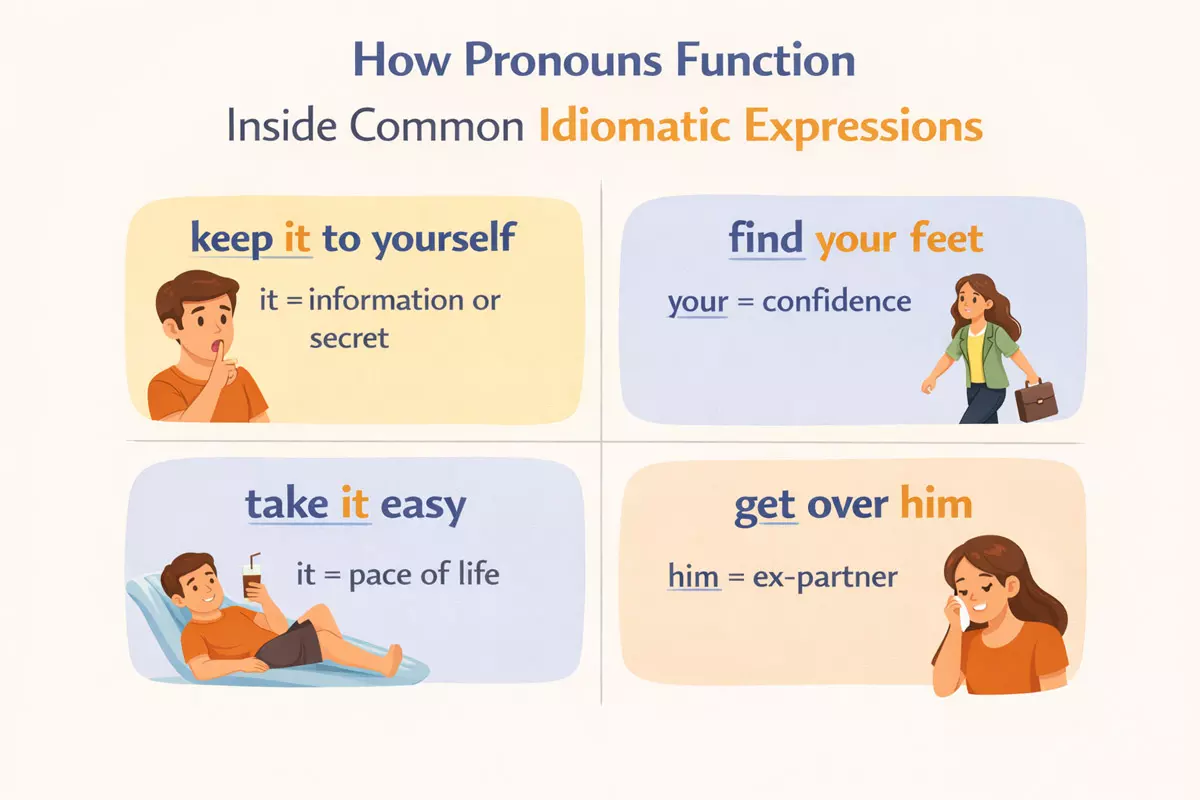 Here we why pronouns in idioms are often fixed, gives examples where pronouns can't be changed without losing meaning, compares spoken and written usage, and offers practice to help learners avoid literal interpretation mistakes.
- Why pronouns behave differently in idioms
- Fixed pronoun forms in idiomatic expressions
- Idioms where pronouns cannot be changed
- Meaning loss when pronouns are altered
- Common everyday idioms with pronouns
- Spoken vs written idiomatic usage
- Learner mistakes with literal interpretation
- Practice: match idioms with correct pronouns
Everyday language brims with colorful sayings, and personal references within these common phrases play a fascinating role in shaping meaning. By examining how words like "you," "we," or "they" influence familiar expressions, we discover the subtle ways that language adapts to context and relationships. These small shifts in wording can dramatically change the tone or intent of a saying, highlighting how lively and flexible our communication can be as we tailor phrases to fit specific situations or audiences.
Why pronouns behave differently in idioms
Pronouns inside idiomatic expressions often follow their own set of rules, which can seem odd compared to standard grammar patterns. This happens because idioms are fixed phrases whose meanings aren’t always literal, so their structure is preserved even when it clashes with typical pronoun usage. In many cases, the pronoun choice or placement is dictated by the historical development of the phrase, not by current grammar logic.
Idioms preserve traditional forms
Many idioms were coined centuries ago, reflecting older grammar. As English has evolved, these expressions have resisted change, keeping their original pronoun forms or word order. This "frozen" nature explains why a phrase like "make oneself at home" uses the reflexive pronoun, even though "make yourself at home" is more common in conversation today.
Pronoun substitution isn’t always possible
Unlike regular sentences, you can’t always swap pronouns freely within idioms. For example, "kick the bucket" doesn’t allow a pronoun replacement ("kick his bucket" ❌), because the phrase loses its idiomatic meaning. However, some expressions do allow for pronoun changes, but only in specific forms.

| Idiom | Pronoun Example | Grammatically Standard? | Still Idiomatic? |
|---|---|---|---|
| pull oneself together | She pulled herself together. | ✅ | ✅ |
| take it easy | He took it easy. | ✅ | ✅ |
| give someone the cold shoulder | They gave him the cold shoulder. | ✅ | ✅ |
| kick the bucket | He kicked his bucket. | ✅ | ❌ |
| let one’s hair down | She let her hair down. | ✅ | ✅ |
| stick your neck out | I stuck my neck out. | ✅ | ✅ |
| have a chip on one’s shoulder | He has a chip on his shoulder. | ✅ | ✅ |
| spill the beans | She spilled the beans. | ✅ | ✅ |
| lose one’s cool | They lost their cool. | ✅ | ✅ |
| hit the nail on the head | You hit the nail on the head. | ✅ | ✅ |
Fixed pronouns vs. variable pronouns
Some idioms always use a specific pronoun, regardless of the speaker or subject. For example, "it goes without saying" never changes "it" to another word. In contrast, idioms like "pull oneself together" allow the pronoun to change to match the subject: "I pulled myself together," "You pulled yourself together," and so on.
- Fixed pronouns: take it or leave it, let it be, bite the bullet
- Variable pronouns: keep your cool, wash your hands of, find oneself
Why idiomatic meaning depends on pronoun choice
Changing the pronoun in an idiom can destroy its figurative meaning. For example, "give someone the cold shoulder" is idiomatic, but "give someone a cold shoulder" sounds literal and loses the intended sense. This sensitivity to pronoun form and placement is unique to idiomatic language, making these expressions a challenge for learners and even native speakers.
Fixed pronoun forms in idiomatic expressions
Idiomatic phrases often lock pronouns into place, making it impossible or awkward to swap them for others—even if the meaning seems like it could change. This happens because the fixed wording is part of what makes these expressions familiar and easily understood by native speakers. Swapping out the original pronoun form can confuse listeners or make the phrase sound unnatural.
Common patterns with set pronouns
Many everyday phrases use specific pronouns, regardless of the speaker’s identity. Often, “it,” “you,” or “one” appears in these sayings, and altering them disrupts the idiomatic feel. Here are several commonly used expressions:
- It goes without saying → Everyone already understands this.
- You never know → Something unexpected might happen.
- Let it be → Don’t interfere or try to change it.
- So be it → I accept the situation.
- It takes one to know one → You recognize the trait because you have it too.
- Easy come, easy go → Things gained easily are lost easily.
- You can’t have your cake and eat it too → You can’t enjoy two incompatible advantages.
- Don’t take it personally → It’s not meant as an attack on you.
- It’s not you, it’s me → I’m the reason this isn’t working.
- Make yourself at home → Feel comfortable here.
- Suit yourself → Do what you want.
- Pull yourself together → Calm down and regain control.
- Don’t kid yourself → Don’t deceive yourself.
- Keep it up → Continue doing well.
- Take it or leave it → Accept it as it is or reject it.
- Speak for yourself → That’s your opinion, not mine.
- Be yourself → Act naturally.
- Help yourself → Take what you want.
- Give it a shot → Try it.
- Get over it → Move on and stop worrying about it.
Why the fixed forms matter
The set structure of these expressions helps listeners recognize meaning instantly. Changing the pronoun can cause confusion or make the phrase sound awkward. For instance, “You can’t have your cake and eat it too” is understandable to most English speakers, but “I can’t have my cake and eat it too” loses its idiomatic punch.
Examples of flexibility and inflexibility
Some idioms allow a little flexibility, but most do not. Here’s a quick comparison of expressions and whether their pronouns are fixed or variable:
| Expression | Pronoun can change? |
|---|---|
| Keep it up | ❌ (No – “Keep them up” sounds odd) |
| Suit yourself | ❌ (No – “Suit myself” is not idiomatic) |
| Put yourself in my shoes | ✅ (Yes – “Put myself in your shoes” can work for self-reflection) |
| Take it or leave it | ❌ (No – “Take them or leave them” changes the meaning) |
| Make oneself at home | ✅ (Yes – can be adapted, e.g., “Make yourselves at home” for a group) |
Learning which pronouns are “locked in” within idioms will help you sound more fluent and natural. When in doubt, use the established form—native speakers will expect it!
Idioms where pronouns cannot be changed
Some expressions in English rely on specific pronouns to keep their meaning and natural flow. Replacing the pronoun in these idioms with another—even one that seems grammatically correct—often results in awkward or nonsensical phrases. This is because the fixed wording is an essential part of what makes the idiom recognizable and meaningful.
Why certain pronouns are fixed in idioms
Set phrases and idiomatic expressions tend to solidify over time. The pronoun included is part of the established pattern, sometimes even if it doesn’t match the speaker’s gender or number. Swapping in a different pronoun can disrupt the idiom’s meaning or make it unidiomatic to native speakers’ ears.
Examples of non-substitutable pronouns in idioms
Here are some common idiomatic expressions where the pronoun must remain unchanged:
| Fixed Expression | Usage Note / What Not to Say | Example Sentence |
|---|---|---|
| Take it easy | Do not change it → not “take them easy” or “take this easy” | Take it easy and get some rest this weekend. |
| Let it slide | Fixed pronoun it → not “let them slide” | I was annoyed, but I decided to let it slide. |
| Have it out (with someone) | It refers to the conflict, not a person | She finally had it out with her manager. |
| Give it a shot | Do not replace it with a noun | If you’re unsure, just give it a shot. |
| Make it up to (someone) | It refers to a mistake or problem | I’ll make it up to you next time. |
| Stick to your guns | Your is part of the idiom’s force | Even under pressure, she stuck to her guns. |
| Hold your horses | Do not change the possessive | Hold your horses — we’re not ready yet. |
| Sweep it under the rug | It = the problem; do not replace | They tried to sweep it under the rug. |
| Bite your tongue | Fixed possessive form | I had to bite my tongue to stay polite. |
| Play it by ear | It cannot be replaced | We don’t have a plan — let’s play it by ear. |
| Have it in for (someone) | It refers to hostility or resentment | He’s had it in for her since the argument. |
| Keep your chin up | Encouraging idiom; possessive stays fixed | Keep your chin up — things will improve. |
| Pull yourself together | Reflexive pronoun required | Pull yourself together and focus. |
| Get your act together | Fixed possessive + noun | You need to get your act together. |
| Let yourself go | Reflexive meaning “lose control or discipline” | He let himself go after leaving the job. |
| Suit yourself | Set response; not a literal instruction | If that’s what you want, suit yourself. |
| Put your foot down | Means “assert authority” | The manager finally put her foot down. |
| Save your breath | Means “don’t waste effort speaking” | Save your breath — he won’t listen. |
How changing pronouns affects idioms
Altering the pronoun in these turns of phrase can confuse listeners or signal that the speaker is not fluent in English. For example, “play them by ear” or “make them up to you” are not accepted forms and would likely draw attention to the error.
Comparison: Fixed vs. Flexible Pronouns in Idioms
| Idiom | Pronoun Behavior | Correct Example | Incorrect Substitution |
|---|---|---|---|
| Take it easy | Fixed (“it”) | Take it easy! | Take them easy ❌ |
| Give it a shot | Fixed (“it”) | Give it a shot! | Give them a shot ❌ |
| Let yourself go | Changes (reflexive) | After the breakup, he let himself go. | After the breakup, he let yourself go ❌ |
| Pull yourself together | Changes (reflexive) | Pull yourself together. | Pull myself together. ❌ |
| Stick to your guns | Usually fixed in imperatives (“your”) | Stick to your guns. | Stick to their guns. ❌ |
Learning which pronouns are “locked in” within these expressions helps learners sound more natural and avoids confusion. When in doubt, it’s safest to use the idiom exactly as it is commonly heard.
Meaning loss when pronouns are altered
Idiomatic expressions often rely on specific pronouns to convey their intended nuance or cultural reference. Swapping out these pronouns can make the phrase sound awkward or even obscure its meaning entirely. This is because many idioms have evolved with certain pronouns that anchor the phrase to a particular perspective or relationship. When those pronouns are changed, the idiom may lose its punch, clarity, or even become nonsensical to native speakers.
Why pronoun changes disrupt idioms
Some idioms are tightly bound to the pronouns they contain, making them resistant to substitution. The original pronoun often signals who is involved or affected in the situation, and changing it can distort the core message. This inflexibility is especially noticeable in fixed expressions, where even a slight adjustment can result in confusion or a complete shift in intent.
Common idioms affected by pronoun shifts
- Speak your mind → Speak his/her mind (loses the direct personal emphasis)
- Pull yourself together → Pull themselves together (removes the imperative tone)
- Take it easy on yourself → Take it easy on him/her (changes the target, altering the advice)
- Suit yourself → Suit themselves (the idiomatic flavor weakens)
- Bite your tongue → Bite my tongue (the meaning shifts from advice to self-restraint)
- Mind your own business → Mind their own business (becomes less direct)
- Get your act together → Get our act together (shifts from individual to group, possibly losing the original impact)
- Keep your chin up → Keep his chin up (switches from encouragement to a third-person narrative)
- Put yourself in my shoes → Put herself in his shoes (distance and clarity are reduced)
- Don't get ahead of yourself → Don't get ahead of themselves (the warning loses immediacy)
- Have your cake and eat it too → Have their cake and eat it too (the idiom’s pointed criticism is softened)
- Save your breath → Save his breath (the directive becomes an observation)
- Hold your horses → Hold their horses (the urgency and directness fade)
- Count your blessings → Count her blessings (shifts from advice to commentary)
- Make up your mind → Make up their minds (the forcefulness is reduced)
- Let yourself go → Let themselves go (the self-directed nature is lost)
Patterns of semantic breakdown
In each of these examples, the core message either becomes less forceful, less clear, or even loses its idiomatic value. The pronoun is often what makes the phrase direct, personal, or emotionally charged. When altered, the phrase may still be grammatically correct, but it no longer functions as the familiar idiom intended.
Comparison of idiom effectiveness
| Original Idiom | Altered Pronoun Form | Effect on Meaning |
|---|---|---|
| Mind your own business | Mind their own business | Directness lost; becomes less of a command |
| Get your act together | Get our act together | Shifts focus from one person to a group |
| Put yourself in my shoes | Put herself in his shoes | Personal empathy is diluted |
| Hold your horses | Hold their horses | Urgency and directness diminish |
Ultimately, the choice of pronoun in idioms is rarely arbitrary. Swapping pronouns can dilute the emotional impact, blur the intended audience, or even cause the expression to lose its idiomatic quality. For learners and advanced speakers alike, preserving original pronouns is key to maintaining the full meaning and force of idiomatic language.
Common everyday idioms with pronouns
Idiomatic expressions frequently use pronouns to add color and directness to language. These phrases often rely on pronouns for clarity, emphasis, or to make the idiom more relatable. Understanding how pronouns function within these sayings can help both learners and fluent speakers grasp their meaning quickly and use them effectively in conversation.
Examples of idioms featuring pronouns

Here are some widely used idiomatic phrases where pronouns play a central role. These examples highlight how everyday speech incorporates pronouns in fixed expressions:
- Let it slide – to ignore something or not take action.
- Take it easy – to relax or not worry.
- Give it your all – to try your hardest.
- Hit the nail on the head – to describe something exactly right. (Here "the" acts as a definite article, but idioms like "do it by the book" use "it" as a pronoun.)
- Pull yourself together – to regain self-control.
- Put yourself in someone else’s shoes – to imagine being in another person’s situation.
- Keep it to yourself – to not share information.
- Suit yourself – do what you want (often used sarcastically).
- See for yourself – check or verify something personally.
- Have it both ways – try to get two incompatible benefits.
- Stick to your guns – maintain your position or opinion.
- Burn your bridges behind you – eliminate a way back or undo a decision.
- Play it by ear – improvise or decide as you go.
- Get your act together – organize yourself to be more effective.
- Make yourself at home – feel comfortable as if you were at home.
- Keep your chin up – remain positive in difficult circumstances.
- Blow your own trumpet – boast about your achievements.
- Leave it at that – accept the situation as it is and not pursue it further.
How pronouns shape idiomatic meaning
Pronouns in these idioms often serve several key functions. They can:
- Make the expression more personal or direct (e.g., "Give it your all").
- Allow the idiom to be adapted to different people or situations (e.g., "Pull yourself together," "Keep it to yourself").
- Shorten the phrase by replacing a noun, making it punchier and easier to remember.
Many idioms are flexible in the pronouns they use. For instance, "See for yourself" could become "See for himself/herself/themselves" depending on context.
Variations and adaptability
Some expressions can swap pronouns for others, changing the meaning slightly or fitting a new context. Here’s a quick comparative look at how different pronouns change the nuance in common idioms:
| Idiom Template | Possible Variations |
|---|---|
| Keep ___ to yourself | Keep it to yourself, Keep this to yourself, Keep that to yourself |
| See for ___ | See for yourself, See for himself, See for herself, See for themselves |
| Suit ___ | Suit yourself, Suit themselves |
| Pull ___ together | Pull yourself together, Pull themselves together |
Recognizing how pronouns work within idiomatic language not only improves comprehension, but also helps speakers sound more fluent and natural in conversation. By paying attention to the pronouns in these expressions, you can better understand both their literal structure and their intended meaning.
Spoken vs written idiomatic usage
The way pronouns are embedded in idiomatic expressions often shifts between conversational speech and formal or semi-formal writing. In everyday dialogue, speakers tend to use idioms with pronouns more freely, sometimes even bending grammatical norms for emphasis or rhythm. Written communication, especially in academic or professional contexts, usually favors more conventional forms, aiming for clarity and avoiding ambiguity.
Patterns in Conversation
In speech, idioms with pronouns are frequently shortened or altered for fluidity. These tweaks help speakers sound more natural, but can sometimes confuse non-native listeners. Here are some common spoken examples:
- “You’ve got it!” (affirming understanding or agreement)
- “I’ll hold you to it.” (expecting someone to keep a promise)
- “Don’t push your luck.” (warning not to risk too much)
- “Suit yourself.” (telling someone to do as they wish)
- “She’s got a chip on her shoulder.” (she is resentful)
- “He let himself go.” (he stopped caring about his appearance)
- “Take it or leave it.” (final offer)
- “You can say that again.” (strong agreement)
- “I told you so.” (reminding of a past warning)
- “Don’t get ahead of yourself.” (don’t act prematurely)
- “Give it a shot.” (try it)
- “Mind your own business.” (don’t interfere)
- “He’s full of himself.” (he’s arrogant)
- “She’s out of her mind.” (she’s acting irrationally)
- “I’ll see myself out.” (leaving without needing help)
Usage in Writing
Writers tend to preserve idiomatic structure but may avoid overly casual forms. In fiction or informal writing, conversational idioms with pronouns appear naturally, helping to build character voice or realism. In contrast, academic and business texts limit such expressions, especially those that could be misinterpreted or seem too colloquial.
| Idiom with Pronoun | Typical Context |
|---|---|
| “Don’t take it personally.” | Both spoken and written (advice or feedback) |
| “He made a name for himself.” | More common in writing (biographies, articles) |
| “You asked for it.” | Spoken, sometimes informal writing (warnings, jokes) |
| “She put herself in his shoes.” | Written, especially in narratives or analysis |
| “Let’s face it.” | Spoken, persuasive writing (introducing facts) |
Nuances and Shifts
It’s important to recognize that some idioms change meaning or tone depending on format. For instance, “get your act together” sounds more direct in speech, but in writing, it might seem blunt or even rude. Context, audience, and intent all shape how pronouns function within idiomatic language across different modes of communication.
Learner mistakes with literal interpretation
When learners first encounter idiomatic expressions that use pronouns, they often misinterpret them by analyzing each word literally. This can lead to confusion, awkward translations, or incorrect usage in conversation. Idioms frequently break the usual rules of grammar or meaning, especially in how pronouns refer to people or things. As a result, students may struggle to understand what or who the pronoun is actually referencing, or why it appears at all.
Common misunderstandings in idiomatic contexts
Many idioms use pronouns like "it," "them," or "you" in ways that don’t match their standard usage. Instead of pointing to a specific noun, these pronouns might refer to abstract situations, general people, or no one in particular. When learners apply literal logic, they can misread the intent and miscommunicate.
- Take it easy – Assuming "it" refers to a specific object, instead of meaning "relax."
- Hit the sack – Thinking "the sack" is a literal bag, not understanding it means "go to bed."
- Let it go – Searching for a physical "it," rather than interpreting as "stop worrying about something."
- Make up your mind – Believing "mind" is an object to physically assemble.
- Give it a shot – Looking for a target or object, missing that it means "try."
- Get over it – Taking "it" as a real obstacle, rather than an emotional issue.
- Pull yourself together – Imagining collecting body parts, not understanding it refers to calming down.
- Take your time – Thinking "time" is a possession to physically take.
- Break it down – Interpreting as physically breaking something, rather than explaining in detail.
- Stick to it – Reading "it" as a physical thing to attach to, instead of persisting with a task.
- Give me a hand – Believing someone is asking for an actual hand, not help.
- Let yourself go – Taking it as a command to leave, rather than to relax or stop controlling oneself.
- Keep it up – Assuming "it" needs to be held aloft, instead of maintaining an action or effort.
- Put your foot in it – Imagining stepping into something, not realizing it means making a social mistake.
- Play it by ear – Believing "ear" is literal, rather than improvising or adapting as events happen.
Why literal reading causes trouble
Interpreting idioms word-for-word prevents learners from grasping the intended meaning, which can lead to misunderstandings in both listening and speaking. Pronouns in idioms are often placeholders for concepts or actions, not tangible objects. If a student expects every "it" or "them" to have a clear, physical referent, conversational English becomes much harder to follow.
Comparing literal vs. idiomatic meaning
To highlight the difference, here's a table showing how a literal translation can go wrong versus what the idiom actually means:
| Expression | Literal vs. Idiomatic Meaning |
|---|---|
| Give it a go | Literal: Hand something to someone and leave; Idiomatic: Try something |
| Get over it | Literal: Climb over an object; Idiomatic: Move past a problem emotionally |
| Let it slide | Literal: Allow something to move physically; Idiomatic: Ignore a mistake or problem |
| Put your foot in it | Literal: Step into something; Idiomatic: Say something embarrassing or inappropriate |
| Take it or leave it | Literal: Physically take or abandon an object; Idiomatic: Accept or refuse an offer as it is |
Recognizing these pitfalls helps learners focus on the figurative sense and use idiomatic expressions more naturally. When in doubt, it’s best to check the meaning of the whole phrase rather than analyzing each pronoun in isolation.
Practice: match idioms with correct pronouns
Understanding how pronouns work inside idiomatic expressions is essential for sounding natural in English. Some idioms require a specific pronoun, while others can change depending on who is speaking or being referred to. Below you’ll find a series of tasks designed to help you recognize and use the right pronouns in common idioms.
Task 1: Choose the Correct Pronoun in Each Idiom
For each idiom below, select the pronoun that makes the expression grammatically and idiomatically correct.
- Keep ____ chin up.
- Pull ____ together.
- Bite ____ tongue.
- Break ____ heart.
- Give ____ a hand.
- Let ____ hair down.
- See ____ face to face.
- Get ____ act together.
- Stick ____ neck out.
- Burn ____ bridges.
Show answers
- your
- yourself
- your
- my/your/his/her/our/their (depends on context)
- me/him/her/them/us (depends on context)
- your
- you
- your
- your
- your
Task 2: Idioms That Change With Pronoun
Some idiomatic expressions shift meaning or reference depending on the pronoun. Match the idiom to the correct pronoun used in context.
| Idiom (with blank) | Appropriate Pronoun(s) |
|---|---|
| Take ____ word for it | my / his / her / your / our / their |
| Put ____ foot in ____ mouth | my / your / his / her / our / their (both blanks match) |
| Cross ____ fingers | my / your / his / her / our / their |
| Have ____ back | my / your / his / her / our / their |
| On ____ last legs | my / your / his / her / our / their |
| Lose ____ temper | my / your / his / her / our / their |
| Change ____ mind | my / your / his / her / our / their |
| Get ____ act together | my / your / his / her / our / their |
| Keep ____ fingers crossed | my / your / his / her / our / their |
| At ____ wit’s end | my / your / his / her / our / their |
Show answers
- Take my / his / her / your / our / their word for it → The pronoun changes based on the speaker or subject.
- Put my / your / his / her / our / their foot in my / your / his / her / our / their mouth → Both blanks must match the same subject.
- Cross my / your / his / her / our / their fingers → Adjusts depending on who hopes for success.
- Have my / your / his / her / our / their back → The pronoun refers to the person giving support.
- On my / your / his / her / our / their last legs → Refers to who or what is exhausted or near the end.
- Lose my / your / his / her / our / their temper → Changes according to who becomes angry.
- Change my / your / his / her / our / their mind → Matches the person who decides differently.
- Get my / your / his / her / our / their act together → The possessive agrees with the subject.
- Keep my / your / his / her / our / their fingers crossed → Used for hopes or wishes.
- At my / your / his / her / our / their wit’s end → Refers to who is extremely frustrated.
Task 3: Identify Fixed vs. Flexible Pronouns
Some idioms always use a specific pronoun, while others are flexible. Decide which idioms below require a fixed pronoun and which can change.
- Speak of the devil
- Have a change of heart
- Keep your cool
- Let your hair down
- See eye to eye
- Make up your mind
- Break the ice
- Once in a blue moon
- Get cold feet
- Lose your temper
Show answers
- Speak of the devil → No pronoun (fixed phrase)
- Have a change of heart → No pronoun (fixed phrase)
- Keep your cool → Uses “your” by default, but can change (my/his/her/our/their)
- Let your hair down → Uses “your” by default, but can change for other subjects
- See eye to eye → No pronoun (fixed phrase)
- Make up your mind → Uses “your” by default, but can change as needed
- Break the ice → No pronoun (fixed phrase)
- Once in a blue moon → No pronoun (fixed phrase)
- Get cold feet → No pronoun (fixed phrase)
- Lose your temper → Uses “your” by default, but can change (my/his/her/our/their)
Mastering the correct pronoun within idiomatic expressions will help your English sound more fluent and natural. Review the examples above to get comfortable with these patterns and make your own sentences for extra practice.