Editing Strategies: Fixing Pronoun Confusion

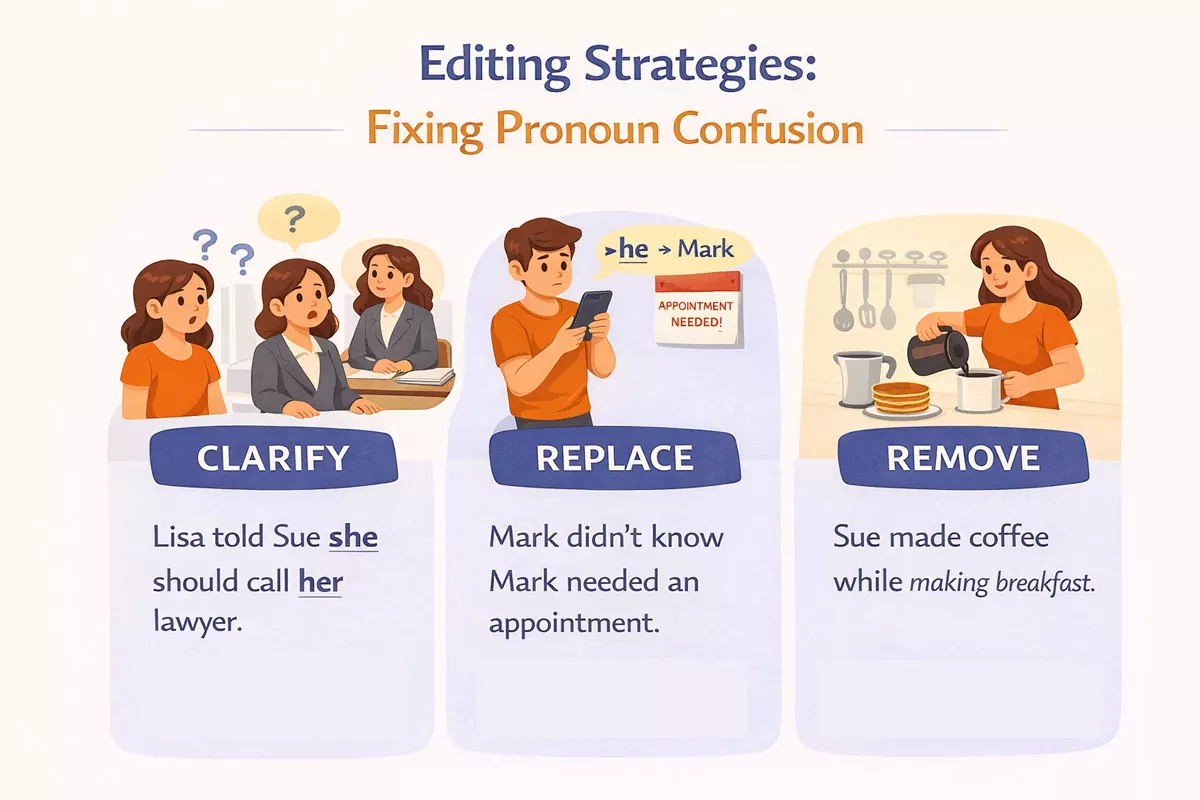 Here we why pronoun confusion happens in drafts, how to identify unclear antecedents, and methods for clarifying reference. It also discusses when to use nouns instead of pronouns, restructuring sentences, and offers editing examples and practice.
Misunderstandings can arise in writing when it is unclear who or what is being referred to, which can confuse readers and obscure your intended message. To address this, it is important to revise your sentences carefully, ensuring that references are specific and unambiguous. By focusing on clarity and making deliberate word choices, writers can create more precise and effective communication, allowing their ideas to be easily understood by their audience.
Why pronoun confusion happens in drafts
Writers often run into pronoun mix-ups during early drafts because ideas flow faster than careful sentence construction. When focusing on getting thoughts down, it’s easy to lose track of who or what each pronoun refers to, especially if there are multiple subjects or objects. This confusion can also result from editing sentence order, inserting new information, or changing the subject mid-paragraph without updating pronoun references.
Common reasons for unclear pronouns
- Multiple nouns: Sentences with two or more people or things make "he," "she," "they," or "it" ambiguous.
- Distance from antecedent: If a pronoun is far from its noun, readers may forget what it refers to.
- Switching subjects: Shifting focus within or between sentences without clarifying pronouns leads to confusion.
- Overuse of pronouns: Relying too much on "they," "this," or "it" can make writing vague.
- Unclear antecedent: Sometimes, it’s not obvious which noun a pronoun is meant to replace.
- Gender-neutral language: Choosing singular "they" or rephrasing to avoid gendered pronouns can unintentionally muddle meaning if not handled carefully.
- Editing in pieces: Revising sections separately can cause pronouns to mismatch with their new context.
- Assumed context: Writers may assume readers know what "he" or "it" means, but the context isn’t obvious to others.
- Rapid drafting: Fast writing sometimes skips over clarifying details that are needed for clear reference.
- Similar noun forms: Using several nouns with similar forms or meanings can make it tricky to assign the correct pronoun.
How pronoun confusion appears
Unclear references usually show up as sentences where the reader pauses to ask, “Who does ‘she’ mean here?” or “What is ‘it’ referring to?” In longer paragraphs, the problem increases as more nouns and pronouns appear together.
Examples of pronoun pitfalls
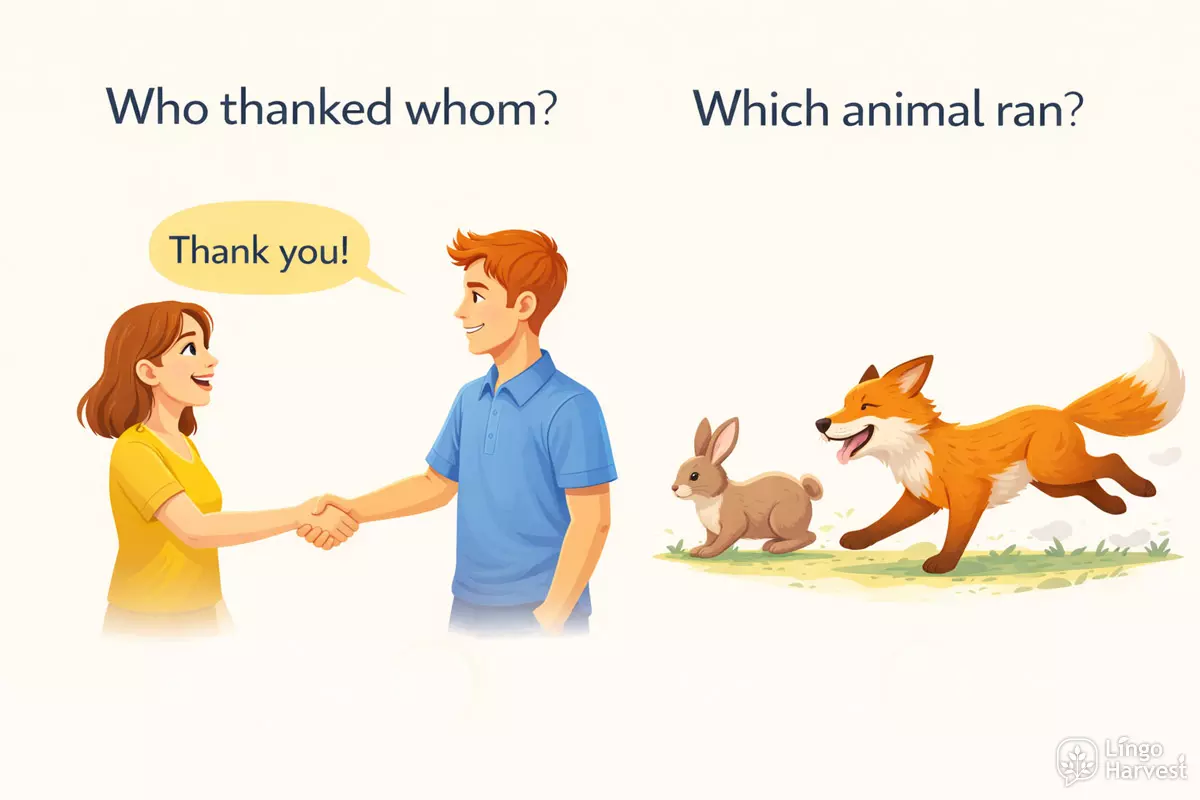
- After Sally gave Anna her book, she thanked her. (Who thanked whom?)
- The dog chased the cat until it ran up the tree. (Which animal ran?)
- They told Alex that they would be late. (Who will be late?)
- Sam and Jordan discussed his project. (Whose project?)
- The committee submitted its report after they finished. (Does “they” refer to the committee or someone else?)
Typical pronoun confusion triggers
| Trigger | Effect on Writing |
|---|---|
| Shifting subjects | Pronouns may not match the intended noun, leading to ambiguity. |
| Long sentences | The antecedent and pronoun are separated, making connections unclear. |
| Editing out nouns | Pronouns left behind lack a clear reference. |
| Similar names or roles | Readers confuse which person or thing the pronoun points to. |
| Generic pronouns | Words like "they" or "it" are too vague for precise meaning. |
Understanding these causes helps writers anticipate where confusion may arise and apply clearer, more precise language during revision.
Identifying unclear antecedents
Spotting pronoun confusion starts with recognizing when a pronoun’s reference is vague or ambiguous. If readers pause to wonder what “it,” “they,” or “this” refers to, there’s likely a problem. Editors need to be alert to sentences where more than one noun could be the pronoun’s match, or where the intended noun wasn’t stated at all.
Common signs of ambiguous pronouns
Writers often overlook unclear references because the connection seems obvious in their minds. However, in practice, several clues can signal trouble:
- Two or more possible nouns before the pronoun
- A pronoun placed far from its intended noun
- Pronouns introducing new information without a clear noun
- Sentences beginning with “it,” “this,” or “they” after a complex idea
- Use of “he” or “she” after mentioning multiple people
- Switching topics mid-paragraph, then using a pronoun
- Pronouns with unclear gender or number
- Abstract nouns as possible references (e.g., “This is important” after several ideas)
- Lists followed by “these” or “those” without specifying which items
- Passive constructions where the actor is missing
Examples of confusing vs. clear pronoun use
Sometimes, comparing problematic sentences to their improved versions helps clarify what to look for. Consider these pairs:
- Unclear: When Sam gave Tom his book, he thanked him.
❌ (Who thanked whom?) - Clear: When Sam gave Tom his book, Tom thanked Sam. ✅
- Unclear: They said the project would be late, but it wasn’t clear why.
❌ (“It” could mean the project or the statement.) - Clear: The reason for the project’s delay wasn’t clear. ✅
- Unclear: The team met with the manager after they finished the report.
❌ (Who finished the report?) - Clear: The team met with the manager after the team finished the report. ✅
Checklist for reviewing pronoun clarity
To make editing for pronoun confusion more systematic, use this quick checklist:
- Is the pronoun’s reference explicit and recent?
- Could any noun in the prior sentences match the pronoun?
- Would a reader unfamiliar with the topic guess the pronoun’s meaning correctly?
- Does the pronoun agree in number and gender with its intended noun?
- Are there sentences where replacing the pronoun with a noun would improve clarity?
Careful attention to these cues helps writers and editors spot and fix unclear pronoun references, ensuring smoother, more precise communication.
Techniques to clarify reference
When a pronoun’s meaning is vague, readers can lose track of who or what is being discussed. Making references clear is a cornerstone of effective editing. There are several practical ways to ensure that each pronoun unmistakably points to its intended noun, reducing confusion for your audience.
Replace ambiguous pronouns with specific nouns
If a sentence has more than one possible antecedent, swap the pronoun for a noun. This approach is especially useful when sentences mention multiple people or objects. For example: instead of writing, “When Sam gave Alex his book, he smiled,” clarify by saying, “When Sam gave Alex his book, Sam smiled.”
Add clarifying phrases
Inserting brief explanations or descriptive words can help specify which noun a pronoun refers to. This might mean adding a job title, relationship, or other identifying detail. For instance, “She spoke to the manager, who approved the request,” becomes clearer as, “She spoke to the manager, her supervisor, who approved the request.”
Reorder sentences for clarity
Sometimes, simply rearranging the structure of sentences makes pronoun references more obvious. Place the noun first and follow it with the related pronoun. This works well when several subjects are involved.
Use demonstrative pronouns with nouns
Pairing demonstrative pronouns (this, that, these, those) with a noun can clarify what is meant. For example, instead of, “This is confusing,” use, “This rule is confusing.” This strategy prevents misunderstandings, especially in complex discussions.
List of effective ways to resolve pronoun confusion
- Repeat the noun in place of the pronoun
- Add descriptive modifiers (e.g., “the teacher,” “her friend”)
- Break long sentences into shorter ones
- Place pronouns close to their nouns
- Introduce each noun before using a pronoun
- Limit the number of nouns per sentence when possible
- Replace “it,” “they,” or “this” with more precise terms
- Clarify with appositives (e.g., “my brother, Mike”)
- Use parallel structure in lists or comparisons
- Check for consistency across sentences and paragraphs
- Read aloud to spot unclear references
- Ask someone else to review for ambiguity
Common unclear vs. clear pronoun reference patterns
| Unclear Example | Clear Revision |
|---|---|
| After Jamie talked to Morgan, she left. | After Jamie talked to Morgan, Jamie left. |
| Alex told Jordan that he would win. | Alex told Jordan, “You will win.” |
| Put the vase on the table and dust it. | Put the vase on the table and dust the table. |
| The team discussed the plan with the manager, but they disagreed. | The team discussed the plan with the manager, but the manager disagreed. |
Taking time to review sentences for possible confusion is always worthwhile. By applying these strategies, you’ll help readers follow your ideas smoothly and accurately.
When to replace pronouns with nouns
Clarity is the main reason to swap a pronoun for a specific noun. If a reader might ask, “Who does this refer to?” it’s often best to restate the noun. Pronouns like he, she, they, or it can cause confusion when several possible antecedents exist, or when a sentence stands alone out of context. Editors should watch for ambiguous references and consider replacing unclear pronouns with the actual subject or object.
Common Situations for Replacing Pronouns
- Two or more people/things are mentioned, and a pronoun could refer to either.
- Several sentences separate the pronoun from its noun, creating distance.
- The pronoun starts a new paragraph or section, making its meaning unclear.
- The pronoun “it” is used without a clear subject (e.g., “It was raining” vs. “The weather was rainy”).
- Pronouns refer to abstract ideas or events, making their meaning vague.
- Gendered pronouns are used where gender is unknown or irrelevant.
- “This,” “that,” “these,” or “those” are used without specifying what they indicate.
- Pronouns are used in technical or academic writing, where precision is crucial.
- Dialogue or quoted speech where the antecedent isn’t obvious to the reader.
- Long lists or descriptions separate the pronoun from its reference.
Examples of Ambiguous vs. Clear References
| Unclear Sentence | Clear Revision |
|---|---|
| When Anna met Lisa, she was nervous. | When Anna met Lisa, Anna was nervous. |
| After placing the vase on the table, it broke. | After Anna placed the vase on the table, the vase broke. |
| They told the students that they would pass. | The teachers told the students that the students would pass. |
| John told Mike that he needed help. | John told Mike that Mike needed help. |
| Put it there. | Put the book on the shelf. |
General Guidelines
- Use a specific noun if the pronoun could refer to more than one thing.
- Repeat the noun after a long passage or paragraph break.
- Restate the noun if the pronoun introduces a new idea or action.
- Prefer nouns in formal or technical writing for accuracy.
- Balance repetition and clarity; sometimes, using a pronoun is fine if the reference is unmistakable.
Ultimately, the decision comes down to how easily a reader can follow your writing. If there’s any chance of misunderstanding, choosing a noun over a pronoun can make your message much clearer and more professional.
Sentence restructuring to reduce ambiguity
When sentences contain pronouns that could refer to more than one noun, readers can get confused about who or what is being discussed. One of the most effective ways to clarify meaning is to rewrite sentences so that the intended reference is unmistakable. This often means replacing ambiguous pronouns with specific nouns, changing sentence order, or splitting long sentences into shorter ones.
Common approaches to clarify pronoun references
- Replace vague pronouns: Swap out ambiguous pronouns with the actual name or noun they represent.
- Reorder sentence elements: Move the noun closer to the pronoun to make the reference clearer.
- Break up complex sentences: Divide lengthy sentences to ensure each pronoun clearly matches its noun.
- Add context: Use descriptive phrases that make the subject obvious before introducing a pronoun.
- Change passive to active voice: Active constructions often clarify who is acting and who is receiving the action.
- Limit pronoun use in dense passages: Especially when several people or things are being discussed, repeat the noun more often than usual.
- Vary sentence structure: Use questions, exclamations, or different clause types to break up repetitive patterns that cause confusion.
- Watch for nearby nouns: If two nouns are close together, avoid using “he,” “she,” or “it” immediately after; restate the intended noun.
- Use demonstratives carefully: Words like “this” or “that” should be paired with a noun (“this idea,” “that method”) to avoid confusion.
- Read aloud to catch ambiguity: Hearing the sentence can help spot unclear pronoun references.
Examples of restructuring for clarity

Let’s look at some before-and-after examples to illustrate how small changes can make a big difference in understanding.
| Original Ambiguous Sentence | Revised, Clear Sentence |
|---|---|
| When Sam met Alex, he was nervous. | When Sam met Alex, Sam was nervous. |
| The dog chased the cat, but it escaped. | The dog chased the cat, but the cat escaped. |
| After Jamie spoke to Taylor, she left the room. | After Jamie spoke to Taylor, Jamie left the room. |
| Maria gave Ana her book. | Maria gave her book to Ana. |
| The teacher told the student that she would win the prize. | The teacher told the student, “You will win the prize.” |
| Put the vase on the table and dust it. | Put the vase on the table and dust the table. |
Tips for editing sentences with unclear pronouns
- After identifying a confusing pronoun, ask, “To whom or what could this refer?”
- Replace pronouns with their nouns, at least on first reference, especially if multiple subjects are involved.
- Don’t be afraid to repeat a noun for clarity—repetition is preferable to confusion.
- Review sentences with multiple actions or actors; if there’s doubt, restructure.
- Have another person read the sentence to see if they interpret the pronoun as intended.
Effective editing often means prioritizing clarity over stylistic variety. By carefully restructuring sentences, writers can prevent misunderstandings and ensure readers always know exactly who is being discussed.
Checklist for pronoun clarity
Ensuring pronouns are clear in your writing can prevent misunderstandings and keep your message precise. Ambiguous references often confuse readers, so taking a moment to review your use of words like "he," "she," "it," or "they" can make a significant difference. Below are practical steps and reminders to help you spot and fix vague or confusing pronoun use.
Key questions to ask yourself
- Does every pronoun have a clear and specific noun (antecedent) it refers to?
- Could any pronoun in the sentence refer to more than one possible noun?
- Are multiple people or things of the same gender or type mentioned close together?
- Is the pronoun too far from its antecedent, making the reference unclear?
- Is it obvious to someone unfamiliar with the topic who or what the pronoun means?
Common pronoun pitfalls to watch for
- Using "it" to refer to abstract concepts or entire clauses, rather than specific nouns.
- Switching between singular and plural pronouns without clear reasoning.
- Introducing a pronoun before its noun has appeared in the text.
- Using "they" for a singular noun without clarifying the intended meaning.
- Referring to two or more people of the same gender in the same sentence with "he" or "she."
Quick pronoun clarity check: Examples
- Unclear: "When Anna spoke to Maria, she was upset." (Who was upset?)
- Clear: "When Anna spoke to Maria, Anna was upset."
- Unclear: "The box was placed on the table, but it was broken." (What was broken?)
- Clear: "The box was placed on the table, but the table was broken."
Editable pronoun reference patterns
| Pronoun Issue | How to Fix |
|---|---|
| Ambiguous "it" | Replace "it" with the specific noun (e.g., "the policy," "the result"). |
| Multiple possible antecedents | Repeat the noun or restructure the sentence for clarity. |
| Long distance between pronoun and noun | Move the pronoun closer to its antecedent or restate the noun. |
| Generic "they" | Specify the group or person if possible, especially in formal writing. |
Final review steps
- Read your sentences aloud to catch awkward or unclear pronoun references.
- Ask someone else to read a section and explain who or what each pronoun refers to.
- Use specific nouns more often if in doubt—clarity usually outweighs repetition.
A careful review using these strategies can help you identify confusing pronouns and revise for clearer, more effective writing.
Before-and-after editing examples
When writers use pronouns without clear reference, readers can quickly lose track of who or what is being discussed. To illustrate how targeted revisions can clarify meaning, let’s walk through sample sentences that suffered from unclear pronoun use, followed by their improved versions. These comparisons show the impact of small changes on overall clarity.
Common confusion patterns
Some of the most frequent causes of ambiguity include:
- Using “he,” “she,” or “they” when multiple people or groups are mentioned.
- Placing a pronoun too far from its noun, leaving readers guessing.
- Switching pronoun references within the same paragraph.
- Relying on “it” or “this” without a clear antecedent.
- Shifting from singular to plural pronouns mid-sentence.
- Assuming the reader knows who “they” or “we” refers to.
- Using “you” when “one” or a specific noun is more precise.
- Repeating pronouns unnecessarily, creating confusion.
- Mixing up gendered and neutral pronouns in the same context.
- Employing “their” for singular nouns without explanation.
- Overusing “this” or “these” at the start of sentences.
- Neglecting to restate the subject after a long descriptive phrase.
- Combining multiple pronouns in a single sentence without clear links.
- Using pronouns to refer to abstract ideas without specifying which one.
- Shifting point of view (e.g., from “we” to “they”) mid-paragraph.
Clarity in action: sample revisions
Let’s look at how sentences with vague pronoun references can be improved. In each case, the revised version explicitly connects the pronoun to its noun or rephrases for better understanding.
| Original Sentence | Revised Sentence |
|---|---|
| When Alex met Jordan, he was very nervous. | When Alex met Jordan, Alex was very nervous. |
| The committee sent their report, but it was unclear. | The committee sent their report, but the report was unclear. |
| Sarah told Emily that she needed more time. | Sarah told Emily that Emily needed more time. |
| After the dog chased the cat, it ran up the tree. | After the dog chased the cat, the cat ran up the tree. |
| They said you should finish the form. | The managers said all applicants should finish the form. |
| The book was on the table, but it was missing pages. | The book on the table was missing pages. |
| Maria and Lisa presented her project to the class. | Maria and Lisa presented Lisa’s project to the class. |
| When the students arrived, they were tired. | When the students arrived, the students were tired. |
| After reviewing the policy, it was confusing. | After reviewing the policy, the policy seemed confusing. |
| Sam handed the keys to Pat because he was in a hurry. | Sam handed the keys to Pat because Sam was in a hurry. |
Key takeaways
Clear writing demands careful attention to how pronouns are used. Whenever a sentence could refer to more than one person or thing, replace the pronoun with the specific noun, or restructure the sentence to make the reference unmistakable. This approach helps readers stay focused and improves overall comprehension.
Practice: edit a confusing paragraph
When pronouns are unclear, readers may struggle to follow who or what is being discussed. Let's work through a sample paragraph that contains ambiguous pronouns, then revise it to be clearer. This hands-on activity will help you recognize and fix pronoun confusion in your own writing.
Task: Identify and Fix Unclear Pronouns
Read the following paragraph. Pay attention to the pronouns and decide where the meaning gets muddled. Then, rewrite the paragraph with clear references.
Original paragraph:
When Jane gave Emily her book, she was surprised that she had already read it. She thanked her and said she enjoyed it, but she wondered if she had another copy.
- Highlight or list each pronoun with its possible referent(s).
- Rewrite the paragraph so that each pronoun clearly refers to one specific person.
Show answers
- Pronoun references:
- her book: Could mean Jane's or Emily's.
- she was surprised: Is it Jane or Emily?
- she had already read it: Who is "she" here?
- She thanked her: Who thanked whom?
- she enjoyed it: Who is "she"?
- she wondered if she had another copy: Who wondered? Who might have another copy?
- Revised paragraph:
When Jane gave Emily Jane's book, Jane was surprised that Emily had already read it. Emily thanked Jane and said she enjoyed the book, but Emily wondered if Jane had another copy.
Common Types of Pronoun Confusion
Writers often encounter confusion with pronouns in several situations. Here are some patterns to watch out for:
- Multiple people or objects are mentioned, but pronouns like "he," "she," or "it" are used without clear reference.
- Using "they" or "them" when the group isn't clearly identified.
- Switching subjects mid-sentence or paragraph, causing pronouns to point to different referents.
- Repetition of pronouns without clarifying nouns between them.
- Using "this" or "that" without specifying what is being referred to.
- Ambiguous use of "his," "her," or "their" when multiple people are involved.
- Unclear antecedents after a list of actions or descriptions.
- Introducing a new noun and then immediately using a pronoun.
- Pronouns at sentence beginnings after a long or complex previous sentence.
- Overuse of pronouns in one paragraph, making it hard to track references.
Quick Reference: Clarifying Pronouns
| Unclear Example | Clear Revision |
|---|---|
| She told her that she was late. | Maria told Anna that Anna was late. |
| They put it on the table, but it broke. | The children put the vase on the table, but the vase broke. |
| After the meeting with Sam and Alex, he left early. | After the meeting with Sam and Alex, Sam left early. |
| If the box is too heavy, move it to their room. | If the box is too heavy, move the box to the twins' room. |
| When the dog met the cat, it barked. | When the dog met the cat, the dog barked. |
| Jess and Riley went to her car. | Jess and Riley went to Jess's car. |
| He called Sam after he finished. | John called Sam after John finished. |
| After the teacher spoke to the student, she left. | After the teacher spoke to the student, the teacher left. |
| Sam gave Alex his keys. | Sam gave Alex Sam's keys. |
| Take it to them before they leave. | Take the package to the neighbors before the neighbors leave. |
By practicing with real examples and following these strategies, you can make your writing much clearer and easier for readers to follow.